

Global Solid Shampoo Market Size and Forecast – 2026 To 2033
The global solid shampoo market is estimated to be valued at USD 1,681.7 Mn in 2026 and is expected to reach USD 2,579.2 Mn by 2033, growing at a compound annual growth rate (CAGR) of 6.30% from 2026 to 2033. Growing consumer preference for plastic-free, waterless, and travel-friendly hair care products, along with manufacturers’ efforts to reduce packaging waste while maintaining cleansing performance, is supporting market expansion. The availability of concentrated formulations also provides brands with opportunities to differentiate their products through resource efficiency and convenience.
In May 2025, Canadian personal care manufacturer Rocky Mountain Soap Company introduced its Hair Bar range of solid shampoo and conditioner products. In its June 2025 sustainability update, the company reported that each bar could replace approximately 1.5 of its 360 mL liquid product bottles, pointing to the potential of solid hair care formats to reduce packaging waste and encourage environmentally responsible purchasing choices.
Key Takeaways of the Global Solid Shampoo Market
- Syndet-Based Shampoo Bars (Non-Soap Surfactant Bars) are projected to grow at a CAGR of 6.9% and account for 70.5% of the global solid shampoo market in 2026. Their compatibility with varying water conditions and balanced cleansing performance support broader consumer acceptance. In January 2025, HiBAR highlighted the hair compatibility and pH-balanced cleansing properties of its surfactant-based shampoo bars as advantages over alkaline soap formulations.
- Natural and botanical-based formulations are estimated to account for 52.7% of the global solid shampoo market revenue by 2026, with a compound annual growth rate (CAGR) of 7.2%. Plant-derived ingredients, ingredient traceability, and potential scalp care benefits support product differentiation among environmentally conscious consumers. Natulid launched the OLGO Re:Pine shampoo bar in May 2026, a botanical scalp care product containing upcycled Korean pine-cone extract and hinoki cypress oil.
- Normal and All Hair Types products are projected to represent 38.6% of global solid shampoo market sales in 2026, with an estimated CAGR of 5.9%. They are suitable for everyday cleaning so this makes it easier for households to buy them and for retailers to plan their range. The solid shampoo and conditioner collection that Bar & Bar introduced in May 2026 included the Grow + Protect formulation, which was specifically designed for normal hair.
- Europe is expected to remain the dominant region, accounting for 36.4% of the global solid shampoo market in 2026, with an estimated regional CAGR of 5.6%. Specialty beauty networks are in place that make the product easy to access and the packaging is preferred by those who are environmentally conscious. The EU’s Packaging and Packaging Waste Regulation, which came into force in August 2026, supported the business case for packaging-efficient personal care formats.
- North America is projected to register an estimated CAGR of 7.5% and account for 32.6% of global solid shampoo market revenue in 2026, positioning it as the fastest-growing region, expanding specialty retail distribution is improving product discovery beyond digital channels. In January 2025, Ethique increased its consumer exposure and access to mainstream retail channels by launching its range of solid shampoos in Ulta Beauty stores nationwide.
Segmental Insights
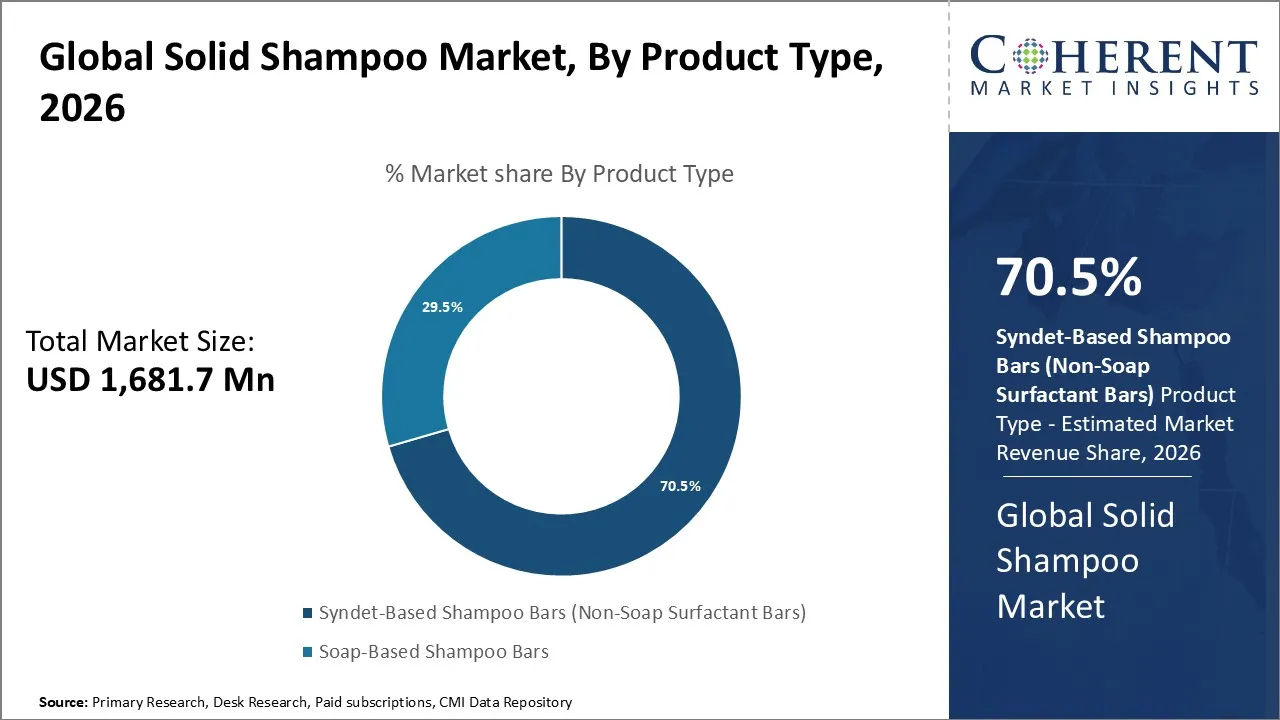
Why Do Syndet-Based Shampoo Bars Dominate the Global Solid Shampoo Market?
Syndet-Based Shampoo Bars are expected to account for 70.5% of the global solid shampoo market in 2026. This leadership is supported by cleansing systems that can be formulated independently of traditional soap-making chemistry. Surfactants such as sodium cocoyl isethionate allow developers to adjust lather, conditioning ingredients, and bar firmness to maintain consistent product performance. This is very useful for products that are contract-manufactured and branded for daily personal care, where consistent application and rinsing is required. A configurable surfactant base enables suppliers to develop multiple formulations without requiring entirely different production methods. In January 2025, Field Moon Handmade Soap detailed its shampoo bar formulation, which incorporates sodium cocoyl isethionate, sodium lauryl sulfoacetate, cocamidopropyl betaine, and conditioning ingredients. This illustrates the formulation choices available to producers developing non-soap solid cleansers.
- Current Industry Events of 2026
- Market Size Estimation
- Regional Breakdown
- Competitive Landscape
- Customer Intelligence
- Segmental Analysis
- Pricing Analysis
- Key Market Drivers, Challenges & Future Trends
- Customized Insights Section
Why Do Natural and Botanical-Based Formulations Represent the Largest Formulation Segment in the Global Solid Shampoo Market?
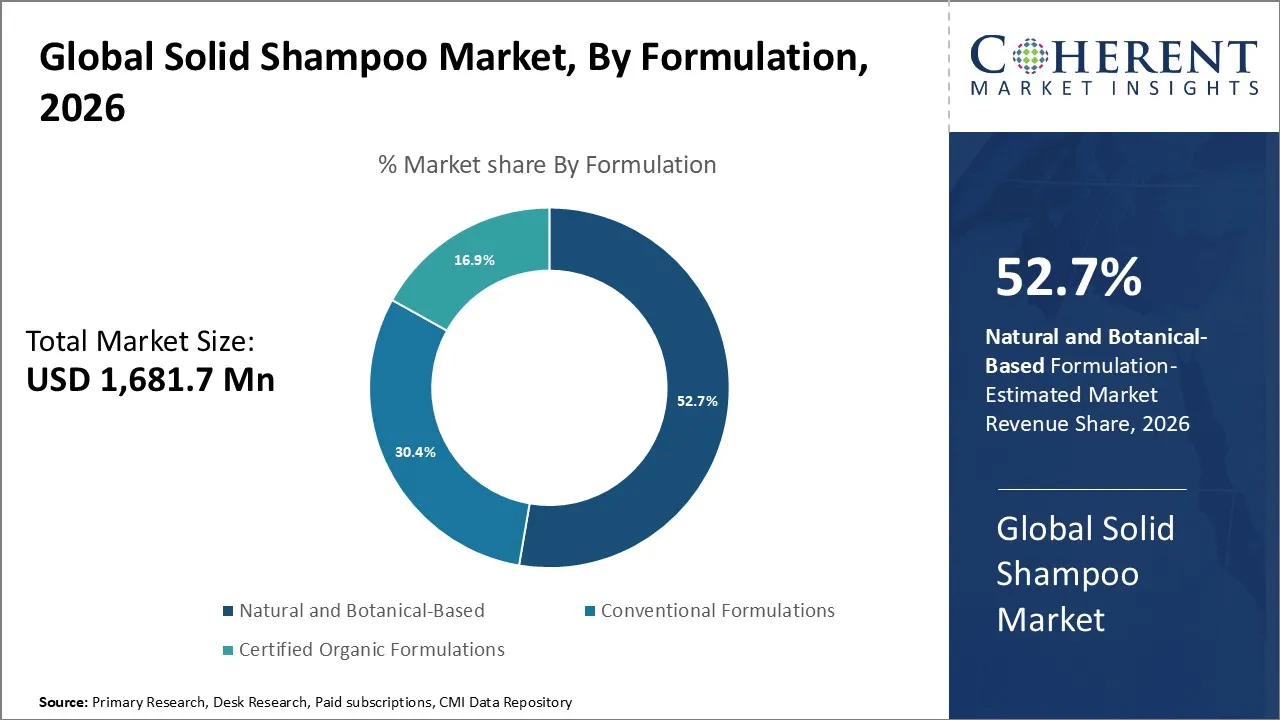
Natural and Botanical-Based formulations are expected to represent 52.7% of the global solid shampoo market in 2026, leading the formulation category through their ability to address specific scalp preferences with recognizable plant ingredients. Green tea, oat kernel, rosemary, and other botanical ingredients provide product developers with differentiated ingredient profiles and opportunities for tailored formulations. Consumers seeking familiar ingredient profiles may find such bars easier to evaluate, while specialized manufacturers can build differentiated product families around clearly defined scalp requirements. Commercial success will depend on consistent botanical sourcing, extract compatibility, and defensible product claims rather than ingredient names alone. In July 2025, Korean beauty company ERIGERON presented its Mochi Shampoo Bar collection, featuring green tea, oat kernel, heartleaf, rosemary, and mugwort, with eight formulas positioned for different scalp types. Its approach demonstrates how botanical selection can underpin portfolio segmentation.
Why Do Normal and All Hair Types Products Lead the Hair Type Segment of the Global Solid Shampoo Market?
Normal and All Hair Types shampoo bars are expected to secure 38.6% of the global solid shampoo market in 2026, leading the hair-type category as an accessible starting point for shoppers who are uncertain about specialized treatments. Brands can begin with a simple cleansing promise with a general purpose product, before moving to variants for oil control, dryness or scalp sensitivity. Manufacturers can develop a core assortment around a broadly positioned base formula and retailers can steer consumers to specialized options as needs become more defined. The framework allows for initial product testing and the subsequent discovery of new products, without requiring the assumption that each formulation is suitable for each user. In August 2026, Arizona-based All About the Suds detailed its handcrafted collection of eight shampoo bars. This product assortment demonstrates how manufacturers can address general cleansing requirements alongside specialized hair care needs.
Current Events and their Impact
Current Event | Description and Its Impact |
European Union Fragrance Allergen Labeling Requirements, July 2026 |
|
August 2026 – Expanded Cosmetic Ingredient Disclosure in Canada |
|
United States – FDA Cosmetics Registration Portal Update, February 2026 |
|
Global Solid Shampoo Market Dynamics
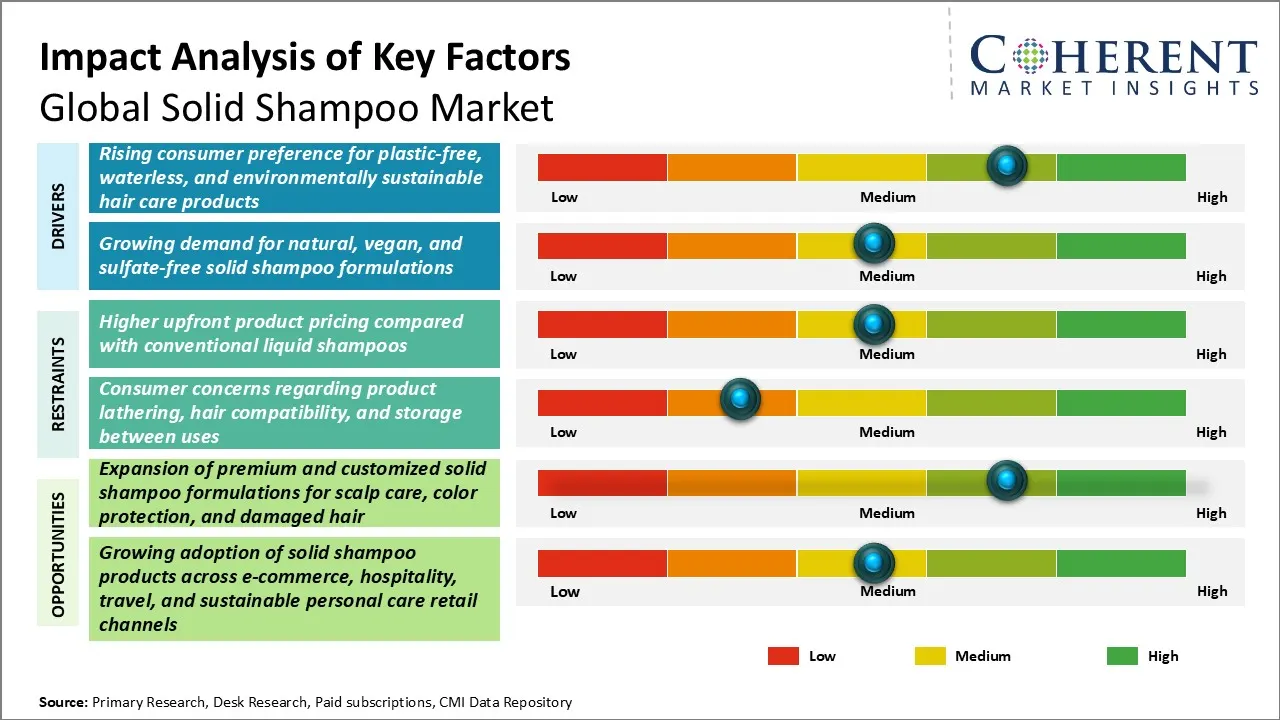
Key Market Drivers
- Rising consumer preference for plastic-free, waterless, and environmentally sustainable hair care products: Plastic-free solid shampoo formats are reshaping packaging economics and consumer purchasing choices. Concentrated shampoo bars offer convenient storage for frequent travelers while reducing reliance on rigid plastic bottles and lowering transportation weightThis can benefit manufacturers and specialty retailers by reducing packaging requirements and strengthening sustainability positioning. In July 2026, Lush reported cumulative global sales exceeding 57.6 million shampoo bars, which the company estimated had eliminated the need for 167.5 million plastic bottles. This demonstrates the commercial scale achievable through packaging-free hair care products.
- Growing demand for natural, vegan, and sulfate-free solid shampoo formulations: Consumers seeking gentler hair cleansing are encouraging manufacturers to develop plant-derived formulations with effective conditioning properties. Syndet-based shampoo bars can incorporate mild surfactants, botanical oils, and pH-controlled formulations, distinguishing them from traditional soap-based alternatives. This opens doors for formulators and suppliers of specialty ingredients. In June 2024, BRIXY introduced Hydrating and Strengthening Shampoo Bars featuring botanical ingredients and a proprietary ceramide-niacinamide complex. The vegan, sulfate-free formulations address specific hair concerns and support the transition toward performance-oriented solid hair care.
Emerging Market Trends
- Coordinated Solid Hair Care Routines Are Replacing Standalone Product Positioning: Solid shampoo portfolios are evolving from standalone products to coordinated cleansing, conditioning, and aftercare routines. Matching hair concerns with complementary formulations makes product selection easier and encourages consistent use.
Impact: The integration of product combinations can increase the average order value and encourage repeat purchases. Manufacturers will need to plan and coordinate their assortments more effectively for related product categories.
Market Relevance: This shift allows for portfolio-based merchandising and deeper engagement with consumers. During the forecast period, brands offering complete and convenient hair care routines could improve customer retention.
- Sensory Performance Is Becoming a Key Factor in Premium Shampoo Bar Development: Solid shampoo manufacturers are placing greater emphasis on the overall washing experience, rinsing characteristics, foam texture, and fragrance release. These attributes have an impact on consumers’ perception of the shampoo bars as being similar to traditional liquid formulas.
Impact: Improved sensory characteristics may enable premium pricing and reduce dissatisfaction after first purchases. Product developers need to balance the bar’s durability with the cleansing performance and fragrance stability.
Market Relevance: Sensory differentiation is expected to become increasingly important as product assortments expand. Manufacturers with consistent in-use performance may become more attractive to premium beauty consumers.
Regional Insights
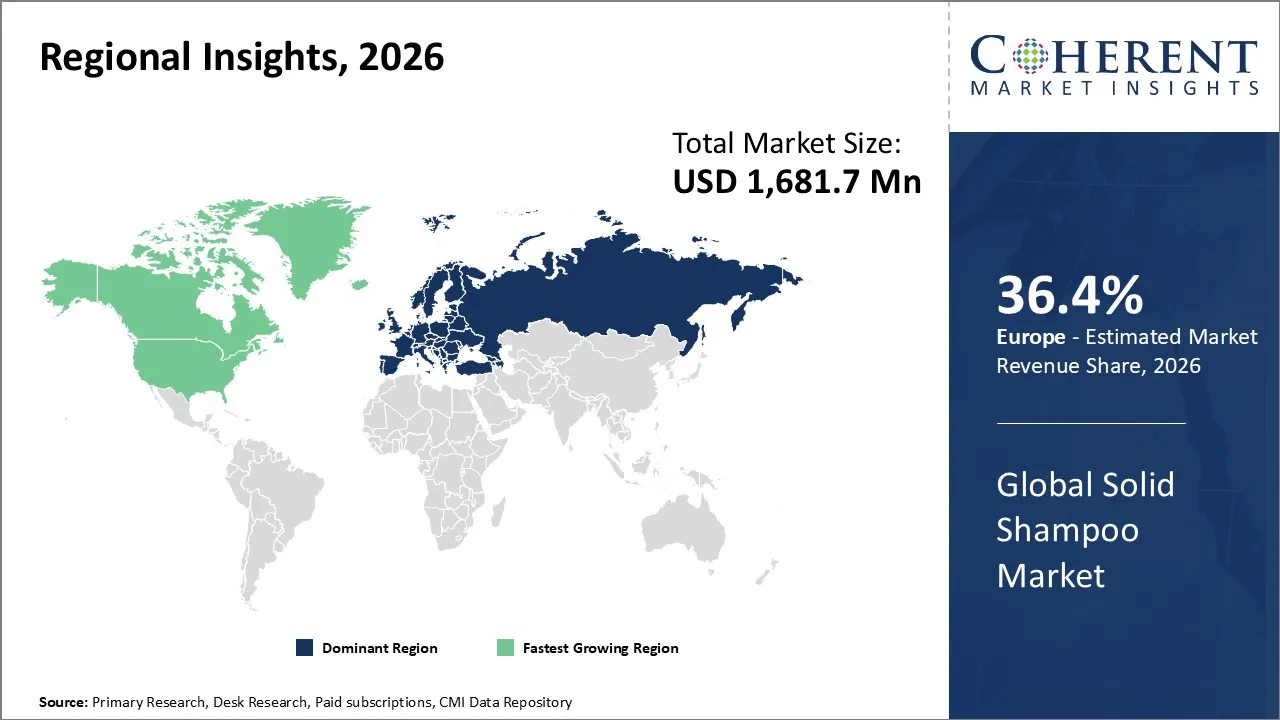
Why Does Europe Dominate the Global Solid Shampoo Market?
Europe is expected to represent 36.4% of the global solid shampoo market in 2026, supported by existing solid cosmetics production facilities, dedicated beauty retailers and consumers familiar with concentrated personal care formats. European manufacturers are increasingly differentiating shampoo bars through premium formulation standards, ingredient transparency, and demonstrated product performance. Independent testing helps manufacturers justify premium pricing and strengthen consumer confidence in solid shampoo alternatives. In May 2026, Beauty Disrupted published results of evaluations by Eurofins that showed that its 100-gram shampoo bar was comparable to using about 2.2–2.8 bottles of 250 mL premium liquid shampoo. This evidence supports performance-based marketing and gives European brands the opportunity to compete on the efficiency of the product and not just on packaging claims.
Why Is North America Emerging as the Fastest-Growing Region in the Global Solid Shampoo Market?
North America is expected to capture 32.6% of the global solid shampoo market in 2026, driven by innovative brand positioning and increasing consumer engagement. In the US and Canada, companies are developing an array of shampoo bars to appeal to eco-minded households, lifestyle communities and beauty enthusiasts. Besides traditional personal care advertising, collaborative marketing and limited edition collections are alternative customer acquisition channels. In August 2025, U.S.-based Dip partnered with band Guster to release limited-edition shampoo and conditioner bars, merging sustainable hair care with music audiences. Such partnerships allow manufacturers to introduce solid shampoo products to new consumer groups while strengthening brand awareness and encouraging product trials.
Global Solid Shampoo Market Outlook for Key Countries
Why Is Germany a Strategic Country in the Global Solid Shampoo Market?
Germany is an important market for solid shampoo manufacturers because of its established drugstore distribution networks and strong presence of private-label natural cosmetics. Retailers such as dm and Rossmann provide consumers with shampoo bars across affordable and specialized price categories. This kind of distribution structure allows manufacturers to compete on formulation, product availability and recognizable retail branding. German retailer dm has a good selection of shampoos in its own alverde NATURKOSMETIK brand and other personal care brands. In 2026 dm redesigned the brand presentation of alverde, focusing on the most important ingredients and product benefits. The current retail infrastructure supports repeat buying and provides manufacturers with a scalable route to market.
Why Is France Important in the Global Solid Shampoo Market?
France stands apart in the global solid shampoo market thanks to its local knowledge of cosmetics manufacturing, botanical ingredient sourcing, and experience in beauty product development. French manufacturers are increasingly differentiating solid shampoos by using certified formulations and offering specialized solutions for curly, color-treated and damaged hair. Local production capabilities also allow companies to keep traceability of ingredients and quality control. Near Marseille, French cosmetics maker Comme Avant makes solid shampoo bars using ingredients like broccoli seed oil, jujube powder and mild surfactants. Its COSMOS Organic-certified formulations are an example of how niche product development can help premium positioning. This positions France as an opportunity for manufacturers with local production, transparent formulations and targeted hair care performance.
Why Does India Support Growth in the Global Solid Shampoo Market?
India offers opportunity for global solid shampoo market, due to its developed familiarity with using herbal ingredients to clean the hair and the increasing availability of affordable specialty personal care products. Some of the ingredients are familiar formulation concepts for domestic manufacturers, such as Shikakai, reetha, amla and curry leaves, which can be matched with local purchasing preferences. Competitive pricing and smaller product formats can encourage consumers accustomed to conventional shampoos to try solid shampoo alternatives. Earth Rhythm, an Indian personal care company, sells shampoo bars that contain shikakai, reetha, amla and curry leaves as well as formulations that contain murumuru butter and ingredients targeted at dandruff. This product range demonstrates how to mix up familiar botanical ingredients with modern solid formulations. Digital beauty platforms and regional retail partnerships can further strengthen distribution for domestic manufacturers.
Why Is the U.S. a Key Market for the Global Solid Shampoo Market?
The U.S. offers substantial opportunities for solid shampoo manufacturers, supported by its established specialty personal care brands, mature digital beauty retail ecosystem, and consumer demand for products addressing specific hair care needs. Manufacturers increasingly position shampoo bars around moisturizing, curl definition, and scalp care rather than presenting them solely as alternatives to conventional shampoos. This segmentation allows brands to diversify their formulations and build targeted retail assortments. US personal care brand Babo Botanicals has introduced a Nourishing Mango & Hibiscus Shampoo Bar. Made with plant based ingredients, this shampoo bar is perfect for dry or color treated hair. Such products demonstrate that the advantages of specialized formulation can encourage consumers to switch away from liquid shampoos. Can increase repeat purchasing among retailers and manufacturers by providing clear guidance on product selection and consistent performance.
Why Is South Korea an Important Growth Market for the Global Solid Shampoo Market?
South Korea is emerging as an important market for specialized solid shampoo formulations, supported by its established cosmetics research ecosystem and consumer interest in targeted scalp care. At home, more and more companies are combining solid cleansing formats with conditioning ingredients and targeted formulations for oily, sensitive and dry scalps. This method is useful for product differentiation in premium products and for opening up export opportunities for specialized Korean beauty products. TOUN28, a South Korean company, has a seaweed-based shampoo bar for oily scalps with seaweed ingredients and a peptide complex. Its official product information also cites a review from February 2026 in connection with claims of relief from hair-loss symptoms. Through specialized formulations, Korean manufacturers can strengthen the commercialization of differentiated solid hair care products in domestic and international markets.
Consumer Preference and Product Evolution Landscape in the Global Solid Shampoo Market
Market Factor | Leading Segment (2026) | Current Market Landscape | Commercial Relevance |
Product Format Preference | Syndet-Based Shampoo Bars (70.5%) | Solid cleansing products that deliver the familiar lather, convenient handling and consistent washing performance are increasingly preferred by consumers over traditional soap-based bars. | Encourages manufacturers to prioritize reliable cleansing performance, consumer acceptance, and differentiated solid shampoo assortments. |
Ingredient and Formulation Preference | Natural and Botanical-Based (52.7%) | Consumers are more likely to select products with botanical oils, plant extracts, and recognizable ingredients, especially those looking for transparency in hair care products. | Creates opportunities for ingredient-led product differentiation, specialized formulations, and premium brand positioning. |
Hair Care Requirements | Normal and All Hair Types (38.6%) | Multi-purpose shampoo bars appeal to households seeking convenient cleansing solutions, whereas specialized formulations address issues like dryness, oiliness, color protection, and scalp sensitivity. | Permits access to more products. Helps producers create customized versions to serve more customer groups. |
Functional Product Expectations | Daily Cleansing (45.8%) | Consumers are increasingly evaluating shampoo bars on how well they clean, how easily they rinse, how they feel on the hair, and how well they fit into their usual washing routine. | Manufacturers that can deliver consistent performance can increase repeat purchases, improve customer satisfaction and reduce product switching behavior. |
Pricing and Value Positioning | Mid-Range (42.5%) | Buying the shampoo bars, the buyers consider the purchasing price, estimated washes, durability and quality (compared to liquid shampoo). | Perceptions of affordability can be improved by credible cost per wash benefits and competitive pricing. |
Retail and Purchase Preferences | Online Retail (55.8%) | Digital beauty platforms give access to niche shampoo bars, detailed ingredient lists, customer reviews and comparisons across formulations and brands. | Improves direct-to-consumer opportunities, helps discover niche products, and enables targeted marketing and easy replenishment. |
How Are Plastic-Free Hospitality Amenities Creating New Growth Opportunities in the Global Solid Shampoo Market?
The transition toward plastic-free guest amenities presents an underdeveloped commercial opportunity for solid shampoo manufacturers serving hotels, resorts, boutique accommodations, and wellness retreats. Hospitality operators require compact, hygienic, and easy-to-replenish toiletries that support operational efficiency without compromising guest satisfaction.
Solid shampoo suppliers can capture this opportunity through individually packaged amenity bars, coordinated hair care collections, and formulations tailored to different guest profiles. Recurring institutional revenue and less dependence on individual retail sales could result from custom branding and purchasing contracts.
Successful market participation will require investment in moisture-resistant storage solutions, controlled manufacturing specifications, product safety documentation, and reliable bulk distribution capabilities. Manufacturers also have to consider housekeeping requirements, guest acceptance, product wastage and the cost of replacing the normal amenities.
Established contract manufacturers and specialized personal care suppliers are likely to benefit from consistent product quality and institutional purchasing relationships. Smaller producers could compete on the basis of customization, local sourcing and flexible order quantities.
Market Players, Key Developments, and Competitive Intelligence
Key Developments
- In February 2026, Stream2Sea announced that its shampoo bar collection had received the USDA Certified Biobased Product label, with the company reporting 100% biobased content. Its formulations address sensitive scalps, swimming-related hair exposure, and color protection. This development strengthened third-party sustainability substantiation and supported differentiated positioning within specialized personal care retail.
- In April 2025, KinKind announced the planned introduction, in May, of its reformulated Make me SHINE! shampoo and conditioner bars, incorporating a seaweed complex and glycolic acid to improve hair gloss and manageability. The development strengthened the brand's positioning in specialized solid hair care for dull and color-treated hair.
- In July 2024, VOESH New York launched its Gua Sha Shampoo Bar, combining solid cleansing with an ergonomically shaped scalp-massage design. The formulation incorporates biotin, rosemary oil, and vegan probiotic ingredients. This development introduced functional design differentiation, allowing solid shampoo manufacturers to expand beyond conventional cleansing into enhanced scalp care experiences.
Competitive Landscape
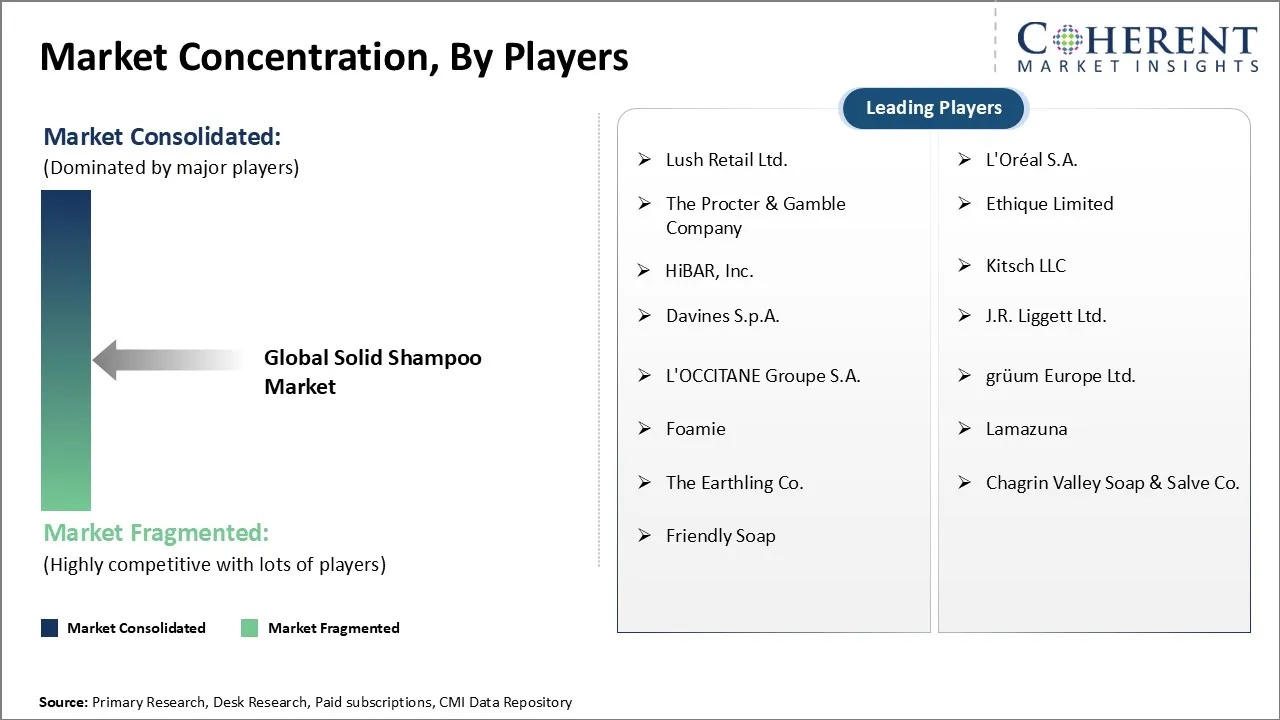
The global solid shampoo market is still fragmented, with a variety of players ranging from multinational personal care companies to specialist shampoo bar brands, artisanal manufacturers and private-label suppliers competing across a range of price categories. Competitive positioning is based on formulation reliability, product durability, pricing and consistency of manufacturing and distribution execution. Regional producers still have the edge in responding to localized product tastes, but specialist firms compete on formulation expertise, customer relationships and differentiated product specifications.
Key focus areas include
- Product performance: Manufacturers compete to provide consistent cleansing, manageable lather, effective rinsing and reduced residue for different hair textures.
- Price Competitiveness: Clear cost-per-wash comparisons can help brands justify retail prices and show the value of concentrated formulations.
- Manufacturing Efficiency: Standardized ingredient mixing, bar density and quality controls are critical to minimizing production losses and improving batch consistency.
- Quality Assurance: Product stability, ingredient traceability, safety assessments and substantiated performance claims enhance retailer confidence.
- Private-Label Manufacturing: Contract manufacturing capabilities allow retailers and emerging brands to introduce a customized assortment of shampoo bars without building dedicated manufacturing facilities.
- Distribution Reliability: Accurate demand forecasting, wholesale replenishment and inventory planning are key to maintain shelf availability and reduce stockouts.
- Professional Channel Access: Partnerships with salons and hair care professionals may increase product credibility and assist in targeted customer acquisition.
Market Report Scope
Global Solid Shampoo Market Report Coverage | |||
Report Coverage | Details | ||
Base Year | 2025 | Market Size in 2026: | USD 1681.7 Mn |
Historical Data For: | 2020 to 2024 | Forecast Period: | 2026 to 2033 |
Forecast Period 2026 To 2033 CAGR: | 6.30% | 2033 Value Projection: | USD 2579.2 Mn |
Geographies covered: |
| ||
Segments covered: |
| ||
Companies covered: | Lush Retail Ltd., L'Oréal S.A., The Procter & Gamble Company, Ethique Limited, HiBAR, Inc., Kitsch LLC, Davines S.p.A., J.R. Liggett Ltd., L'OCCITANE Groupe S.A., grüum Europe Ltd., Foamie, Lamazuna, The Earthling Co., Chagrin Valley Soap & Salve Co., Friendly Soap | ||
Growth Drivers: |
| ||
Restraints & Challenges: |
| ||
Analyst Opinion (Expert Opinion)
- The global solid shampoo market leadership is likely to shift toward brands capable of demonstrating measurable product performance and favorable purchasing economics. Retailers may increasingly evaluate shampoo bars using customer repurchase behavior, product complaints, and assortment profitability rather than sustainability positioning alone. Manufacturers that establish consistent testing standards and transparent performance comparisons could gain a competitive advantage.
- Greater participation from contract manufacturers could reshape the industry's competitive landscape by allowing established beauty brands and retailers to introduce proprietary solid shampoo products without investing in dedicated production facilities. This could intensify competitive pressure on independent brands that rely primarily on product-format differentiation. Manufacturing specialists with formulation expertise, intellectual property protection, and flexible production capabilities could capture greater value.
- Manufacturers should prioritize sensitive-scalp requirements, professional product recommendations, and differentiated institutional applications. Professional product recommendations and differentiated institutional applications and sensitive-scalp requirements should be prioritized. Companies should avoid excessive investment in poorly differentiated product variants while strengthening raw material sourcing, regulatory documentation, and relationships with qualified manufacturing partners.
Speak to the analyst
Want personalized insights?
Take the findings above to one of our principal consultants, or have the report rebuilt around the segments, geographies and competitors you actually track.
Market Segmentation
- Product Type Insights (Revenue, USD Mn, 2021 - 2033)
- Syndet-Based Shampoo Bars (Non-Soap Surfactant Bars)
- Soap-Based Shampoo Bars
- Formulation Insights (Revenue, USD Mn, 2021 - 2033)
- Natural and Botanical-Based
- Conventional Formulations
- Certified Organic Formulations
- Hair Type Insights (Revenue, USD Mn, 2021 - 2033)
- Normal and All Hair Types
- Dry and Damaged Hair
- Oily Hair
- Color-Treated Hair
- Sensitive Hair and Scalp
- Function Insights (Revenue, USD Mn, 2021 - 2033)
- Daily Cleansing
- Moisturizing and Nourishing
- Strengthening and Hair Repair
- Anti-Dandruff and Scalp Care
- Other Functions
- Price Range Insights (Revenue, USD Mn, 2021 - 2033)
- Economy
- Mid-Range
- Premium
- End Use Insights (Revenue, USD Mn, 2021 - 2033)
- Household and Individual Consumers
- Hotels and Hospitality
- Salons, Spas and Professional Hair Care
- Distribution Channel Insights (Revenue, USD Mn, 2021 - 2033)
- Online Retail
- Supermarkets and Hypermarkets
- Specialty Beauty and Personal Care Stores
- Pharmacies and Drugstores
- Salons and Professional Outlets
- Other Distribution Channels
- Regional Insights (Revenue, USD Mn, 2021 - 2033)
- North America
- U.S.
- Canada
- Latin America
- Brazil
- Argentina
- Mexico
- Rest of Latin America
- Europe
- Germany
- U.K.
- Spain
- France
- Italy
- Russia
- Rest of Europe
- Asia Pacific
- China
- India
- Japan
- Australia
- South Korea
- ASEAN
- Rest of Asia Pacific
- Middle East
- GCC Countries
- Israel
- Rest of Middle East
- Africa
- South Africa
- North Africa
- Central Africa
- North America
- Key Players Insights
- Lush Retail Ltd.
- L'Oreal S.A.
- The Procter & Gamble Company
- Ethique Limited
- HiBAR, Inc.
- Kitsch LLC
- Davines S.p.A.
- J.R. Liggett Ltd.
- L'OCCITANE Groupe S.A.
- grüum Europe Ltd.
- Foamie
- Lamazuna
- The Earthling Co.
- Chagrin Valley Soap & Salve Co.
- Friendly Soap
Sources
Primary Research Interviews
- Solid shampoo manufacturers, cosmetic formulators, and surfactant suppliers
- Personal care brands, contract manufacturers, beauty retailers, and distributors
Stakeholders
- Shampoo bar producers, botanical ingredient suppliers, and packaging manufacturers
- Cosmetic testing laboratories, certification agencies, and retail channel partners
End-use Sectors
- Household and individual consumers; hotels, resorts, and other hospitality establishments
- Salons, spas, professional hair care, and travel amenities
Regulatory and Industry Bodies
- European Commission (EC)
- U.S. Food and Drug Administration (FDA)
- European Chemicals Agency (ECHA)
- Central Drugs Standard Control Organization (CDSCO), India
Databases
- UN Comtrade and International Trade Centre (ITC) Trade Map
- Eurostat and U.S. Census Bureau
- EU CosIng Cosmetic Ingredient Database
- Cosmetics Direct (U.S. FDA)
Magazines and Journals
- International Journal of Cosmetic Science
- Journal of Cosmetic Dermatology
- Journal of Surfactants and Detergents
- Cosmetics (MDPI)
Associations
- Cosmetics Europe
- Personal Care Products Council (PCPC)
- Cosmetic, Toiletry and Perfumery Association (CTPA)
- Society of Cosmetic Chemists (SCC)
Public Domain Sources
- Company annual reports, sustainability disclosures, and product portfolios
- Shampoo bar ingredient lists, technical data sheets, and product certifications
- Cosmetic formulation studies, retail developments, and trade statistics
Key Standards and Regulations
- EU Cosmetics Regulation (EC) No. 1223/2009
- U.S. Modernization of Cosmetics Regulation Act (MoCRA)
- ISO 22716 – Cosmetics Good Manufacturing Practices (GMP)
- ISO 16128 – Natural and Organic Cosmetic Ingredient Guidelines
- COSMOS Standard – Natural and Organic Cosmetics Certification
Proprietary Elements
- CMI Data Analytics Tool
- Proprietary research repository, supported by primary interviews, shampoo bar consumption modeling, ingredient pricing analysis, distribution channel assessments, sustainability evaluations, and competitive intelligence.
Get access to 250+ pages report
Every segment, forecast, competitor profile and data table behind the analysis above — available for instant download.
- ESOMAR Member
- ISO 9001:2015 Certified
- D-U-N-S Registered
- GDPR & CCPA Compliant
Frequently Asked Questions
The CAGR of the global solid shampoo market is projected to be 6.30% from 2026 to 2033.
The global solid shampoo market is estimated to be valued at USD 1,681.7 Mn in 2026 and is expected to reach USD 2,579.2 Mn by 2033.
Yes, the report examines major manufacturers, product portfolios, competitive positioning, company strategies, and recent business developments to support strategic decision-making.
Formulation consistency, ingredient compatibility, bar hardness, moisture stability, and production efficiency are important considerations for commercial solid shampoo manufacturing.
The main quality parameters include pH balance, cleansing effectiveness, lather quality, rinsing properties, product shelf life, and stability during repeated use.
Companies can use the report to benchmark their competitive position, identify opportunities for product differentiation, assess their manufacturing strategies and make investment and business expansion decisions.
The global solid shampoo market is driven by increasing consumer preference for plastic-free, waterless and environmentally sustainable hair care products. There is also an increasing demand for natural, vegan and sulfate-free solid shampoo formulations.