

Global Specialty Gases Market Size and Forecast – 2026 To 2033
The Global Specialty Gases Market is estimated to be valued at USD 12.43 Bn in 2026 and is expected to reach USD 22.87 Bn by 2033, growing at a compound annual growth rate (CAGR) of 9.10% from 2026 to 2033. This growth trajectory reflects increasing requirements for high-performance gases across semiconductor fabrication, healthcare, analytical testing, aerospace, and advanced manufacturing applications.
The transition toward smaller semiconductor nodes, stricter laboratory accuracy requirements, and expansion of precision manufacturing processes are strengthening demand for ultra-high purity gases and customized gas mixtures. In November 2024, the European Semiconductor Industry Association (ESIA) highlighted continued semiconductor ecosystem investments across Europe, reinforcing the importance of reliable specialty material supply chains, including semiconductor-grade gases required for advanced chip production.
Key Takeaways of Global Specialty Gases Market
- Electronic Specialty Gases, with an estimated CAGR of 10.0% during 2026–2033, is expected to account for 38.6% of the global specialty gases market in 2026, supported by semiconductor fabrication requirements for ultra-clean process gases and precise contamination control. In October 2025, INOX Air Products announced plans for an Electronic Specialty Gas Hub in Gujarat to supply ultra-high purity gases for India’s semiconductor ecosystem.
- Ultra High Purity Grade, with an estimated CAGR of 9.3% during 2026–2033, is projected to capture 42.8% of the global specialty gases market in 2026, as advanced electronics manufacturing requires extremely controlled gas quality for deposition, etching, and fabrication processes. In April 2025, Linde expanded its ultra-high-purity atmospheric, process, and specialty gas supply agreement with Samsung’s semiconductor complex in South Korea.
- Semiconductor Manufacturing, with an estimated CAGR of 10.1% during 2026–2033, is anticipated to represent 34.8% of the global specialty gases market in 2026, due to increasing requirements for process gases across advanced nodes, memory production, and AI-focused chip fabrication. In March 2025, SEMI reported that global semiconductor fab equipment spending would increase, reflecting continued expansion of manufacturing capacity.
- North America, with an estimated CAGR of 8.8% during 2026–2033, is expected to contribute 32.8% of the global specialty gases market in 2026, supported by semiconductor reshoring initiatives, advanced manufacturing investments, and localized gas supply infrastructure. In July 2025, Air Liquide announced a more than USD 50 million investment in a new gas production facility in the Southeastern United States to support semiconductor manufacturing needs.
- Asia Pacific, with an estimated CAGR of 10.6% during 2026–2033, is expected to account for 30.7% of the global specialty gases market in 2026, supported by expanding semiconductor clusters, electronics manufacturing concentration, and regional supply chain development. In September 2025, Air Liquide announced two new industrial gas facilities in Singapore through long-term contracts to supply ultra-high-purity gases for semiconductor production.
Segmental Insights
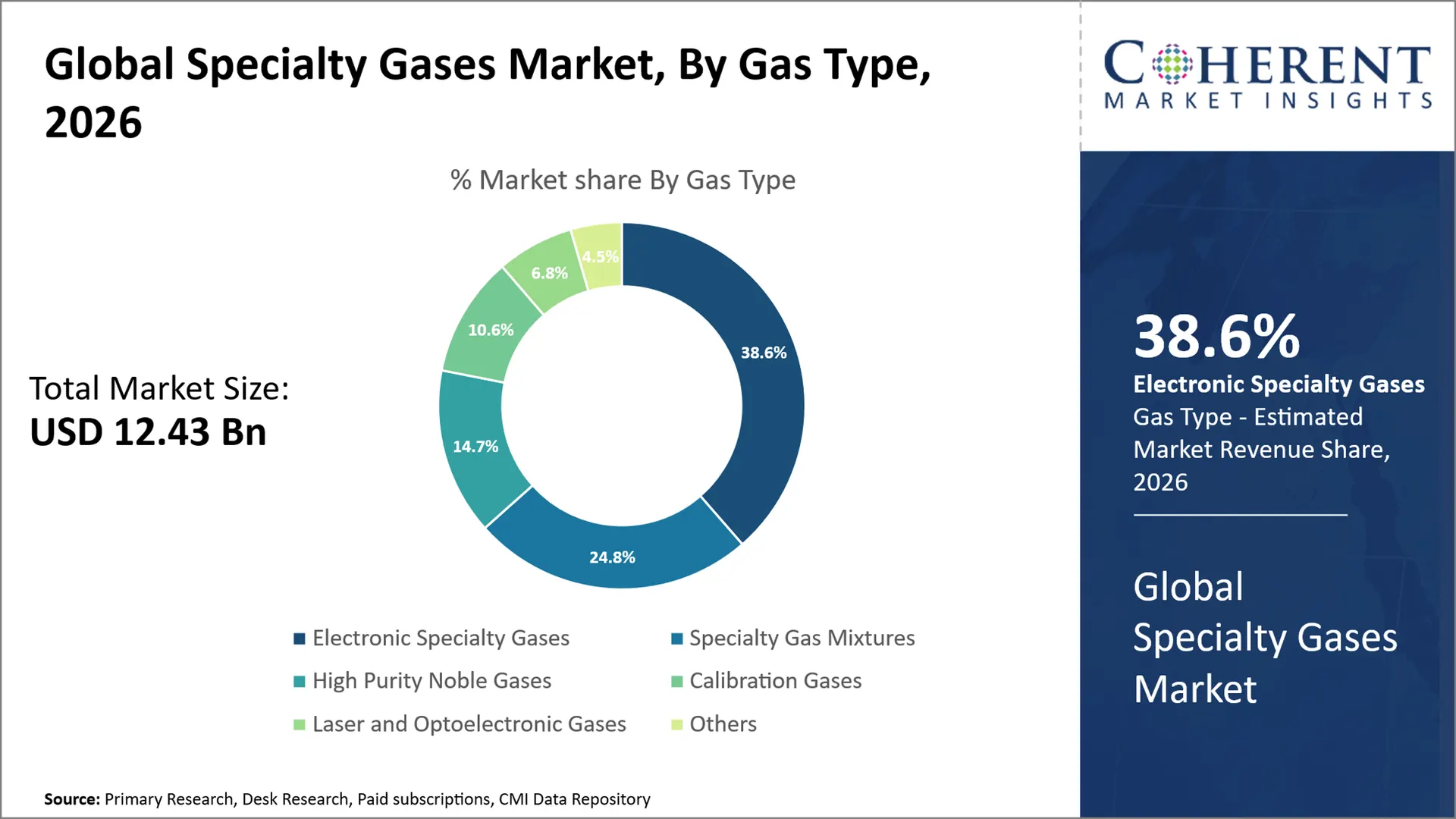
Why Do Electronic Specialty Gases Dominate the Global Specialty Gases Market?
Electronic Specialty Gases are expected to hold 38.6% share of the global specialty gases market in 2026, supported by their critical role in semiconductor fabrication, display manufacturing, photovoltaic production, and advanced electronics processing. These gases enable precise operations such as etching, deposition, chamber cleaning, and doping, where contamination control directly influences device performance and production yield. Suppliers with semiconductor-grade purification, blending, and delivery infrastructure are positioned to serve increasingly complex manufacturing requirements. The segment also benefits from long-term supply contracts between gas producers and electronics manufacturers, creating stable commercial opportunities across the value chain. In October 2025, Inox Air Products began construction of an electronic specialty gas hub in Dholera, Gujarat, designed to strengthen domestic availability of semiconductor-grade gases for India’s emerging electronics manufacturing ecosystem.
- Current Industry Events of 2026
- Market Size Estimation
- Regional Breakdown
- Competitive Landscape
- Customer Intelligence
- Segmental Analysis
- Pricing Analysis
- Key Market Drivers, Challenges & Future Trends
- Customized Insights Section
Why Does Ultra High Purity Grade Represent the Largest Purity Category in the Global Specialty Gases Market?
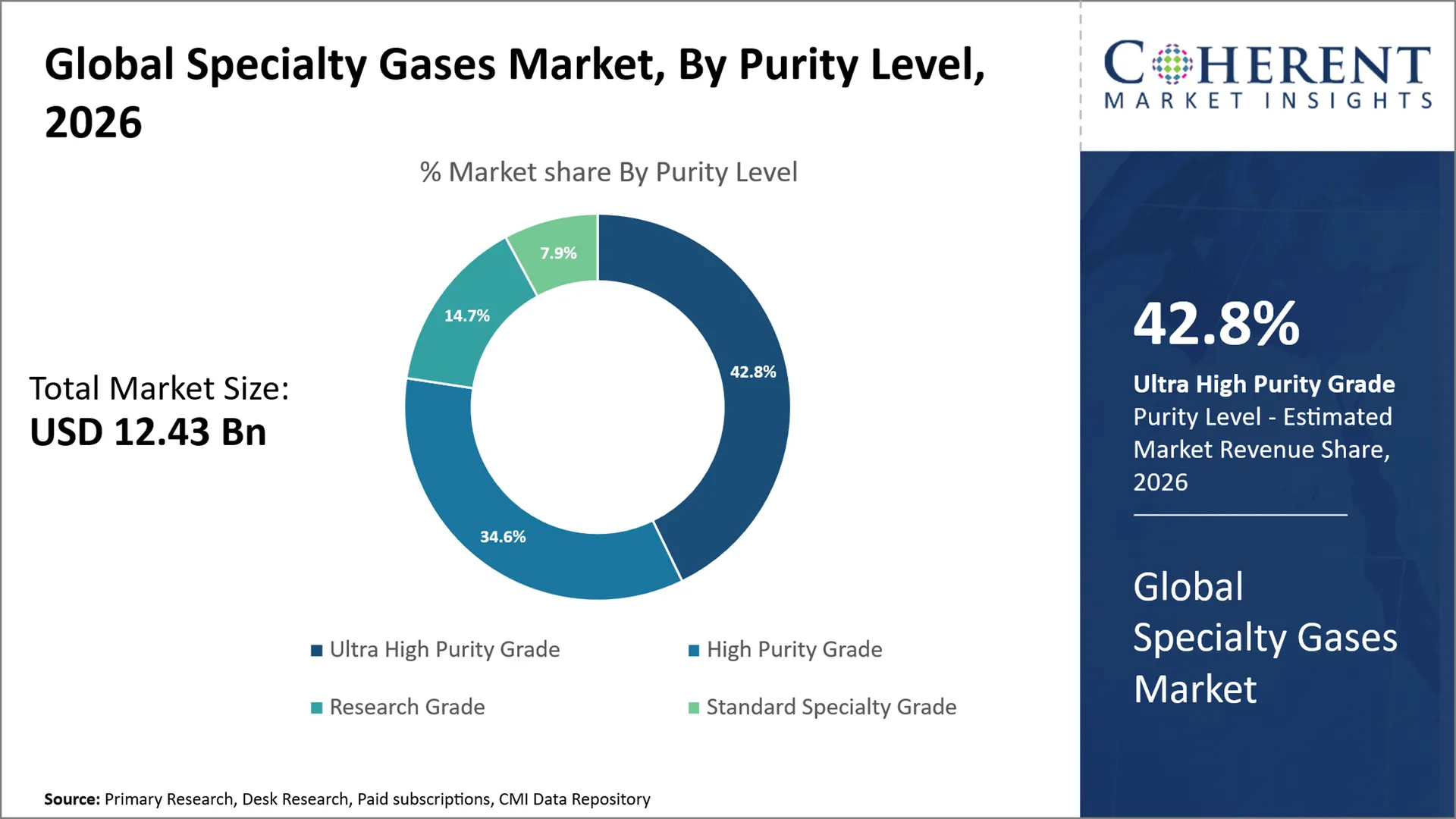
Ultra High Purity Grade specialty gases are projected to account for 42.8% share of the global specialty gases market in 2026, reflecting the stringent quality requirements of semiconductor manufacturing, advanced laboratories, and precision analytical applications. This grade leads because end users increasingly require gases with extremely controlled impurity levels to maintain process consistency, improve equipment reliability, and meet demanding production specifications. Manufacturers are investing in purification technologies, specialized cylinders, contamination monitoring systems, and dedicated supply chains to deliver consistent quality. The segment creates commercial value through premium pricing, technical service requirements, and long-term customer relationships. In September 2026, Waaree Clean Energy Solutions announced plans to establish a specialty gases facility in Gujarat focused on ultra-high purity gases including silane, ammonia, and precision gas blends for semiconductor and solar manufacturing applications.
Why Does Semiconductor Manufacturing Dominate the Application Category of the Global Specialty Gases Market?
Semiconductor Manufacturing is expected to represent 34.8% share of the global specialty gases market in 2026, supported by the essential role of specialty gases throughout integrated circuit production stages. Semiconductor fabs require precise gas compositions for processes including wafer cleaning, oxidation, deposition, lithography support, and plasma etching. Unlike conventional industrial applications, semiconductor production requires continuous supply reliability, strict quality certification, and advanced gas management systems, creating strong supplier engagement opportunities. Growth in artificial intelligence hardware, advanced computing chips, and memory technologies is increasing the complexity of fabrication processes and supporting demand for customized gas solutions. In June 2025, Samsung Electronics announced progress on expanding advanced semiconductor manufacturing capabilities at its Taylor facility in Texas, reinforcing future requirements for specialized process materials and semiconductor-grade gases.
Current Events and their Impact
Current Event | Description and Its Impact |
March 2024 – U.S. Environmental Protection Agency Finalizes Semiconductor-Related Climate Regulations |
|
October 2024 – European Union Updates Industrial Emissions Framework Implementation Measures |
|
January 2025 – China Strengthens Semiconductor Supply Chain Development Policies |
|
Global Specialty Gases Market Dynamics
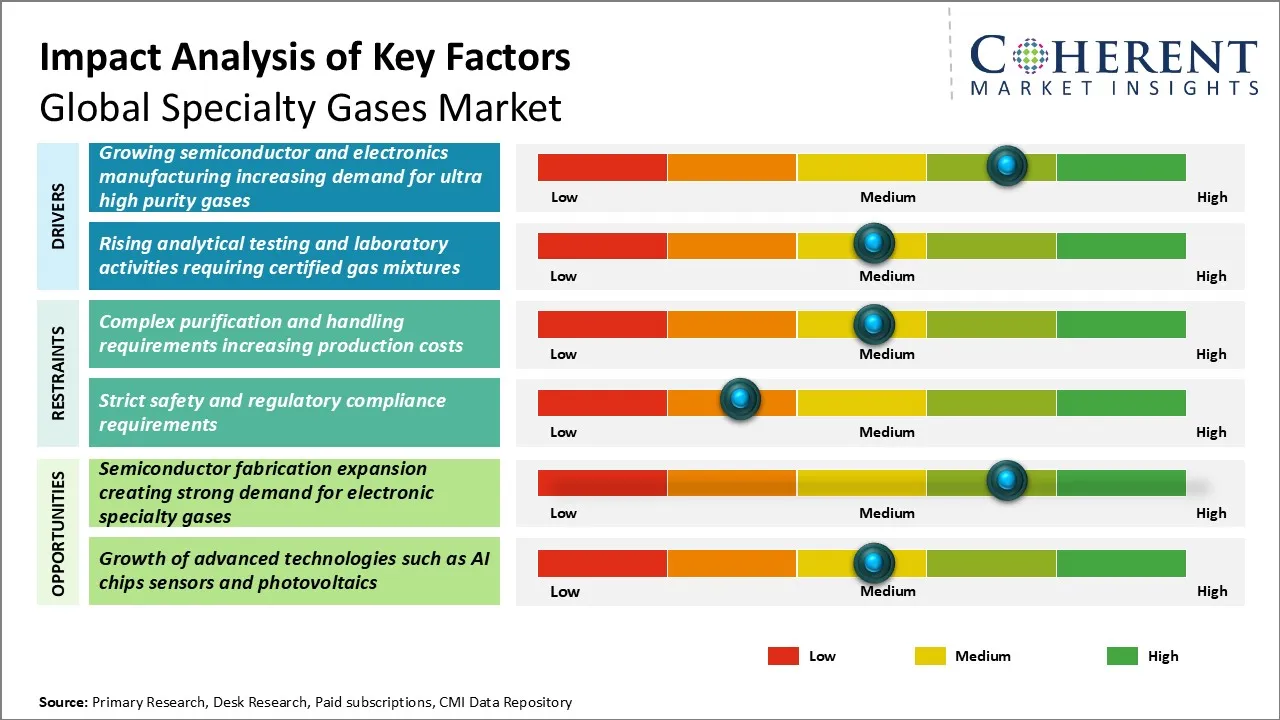
Key Market Drivers
- Growing Semiconductor and Electronics Manufacturing Increasing Demand for Ultra High Purity Gases: The expansion of advanced semiconductor fabrication is strengthening demand for ultra high purity specialty gases required in deposition, etching, chamber cleaning, and wafer processing operations. Semiconductor manufacturers increasingly depend on consistent gas specifications to maintain yield, reduce contamination risks, and support complex chip architectures. Specialty gas producers benefit through long-term supply contracts, localized production investments, and customized gas management services. In February 2025, Air Products announced a strategic investment to expand its industrial gas supply infrastructure supporting semiconductor manufacturing in Arizona, strengthening availability of critical gases for advanced chip production.
- Rising Analytical Testing and Laboratory Activities Requiring Certified Gas Mixtures: Analytical laboratories, environmental monitoring facilities, healthcare organizations, and industrial testing centers are increasing their dependence on certified gas mixtures for calibration accuracy, quality assurance, and regulatory compliance. These applications require precise gas compositions with traceable certification, creating opportunities for suppliers offering customized blends, documentation support, and technical services. Growth in emissions testing, pharmaceutical quality control, and research activities is increasing the commercial importance of calibration gas portfolios. In March 2025, Messer expanded its specialty gas capabilities in Europe through investments focused on analytical and calibration gas supply solutions for laboratories and industrial customers.
Emerging Market Trends
- Transition Toward Customized Specialty Gas Solutions and Integrated Supply Models: The specialty gases market is gradually moving from standardized gas supply toward application-specific solutions combining customized formulations, delivery systems, monitoring services, and technical support. Semiconductor manufacturers, research institutions, and industrial users increasingly prefer suppliers capable of managing complete gas ecosystems rather than only providing cylinders. This shift is creating differentiation opportunities for companies with advanced blending capabilities, quality-control infrastructure, and customer-specific engineering expertise. Over the forecast period, suppliers with integrated service models are expected to strengthen customer retention and improve value capture.
- Increasing Focus on Sustainable Production and Resource-Efficient Gas Management: Sustainability considerations are influencing specialty gas production, handling, and distribution strategies as industries seek improved resource efficiency and reduced environmental impact. Manufacturers are exploring optimized purification processes, recovery systems, improved logistics, and lower-waste cylinder management approaches. Electronics companies and industrial customers are increasingly evaluating suppliers based on operational reliability as well as environmental performance. This trend may create pressure on traditional suppliers to modernize production practices while benefiting companies capable of offering efficient, compliant, and environmentally responsible specialty gas solutions.
Regional Insights
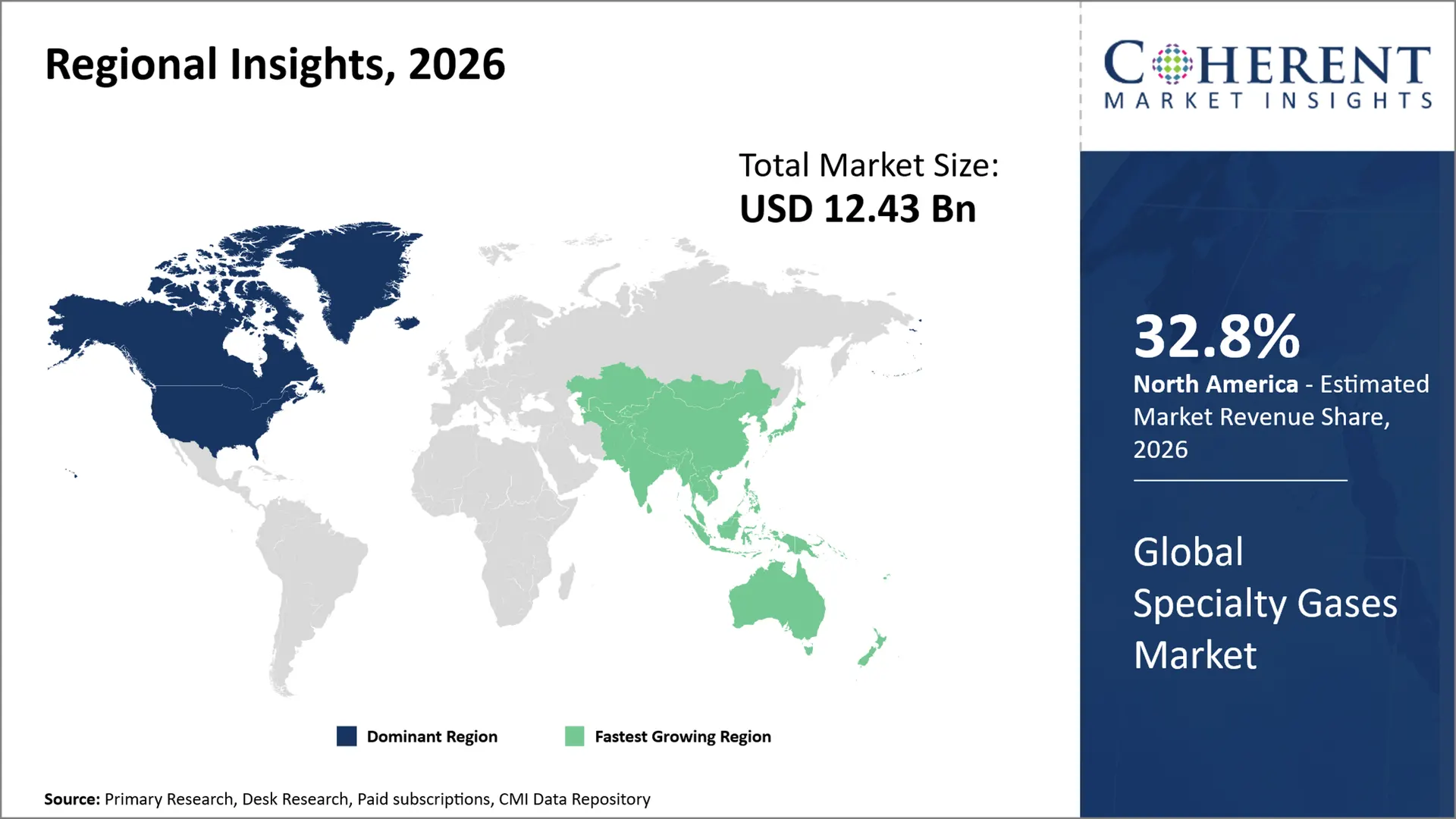
Why Does North America Dominate the Global Specialty Gases Market?
North America is projected to account for 32.8% share of the global specialty gases market in 2026, supported by its strong semiconductor manufacturing ecosystem, advanced research infrastructure, and high adoption of ultra-high purity gases across electronics, healthcare, aerospace, and analytical applications. The region benefits from established specialty gas suppliers, extensive laboratory networks, and growing investments in domestic semiconductor capacity. Demand is particularly concentrated around process gases required for wafer fabrication, thin-film deposition, etching, and advanced material research. Government initiatives supporting semiconductor supply chain localization are also strengthening regional consumption of electronic specialty gases. In January 2025, the U.S. Department of Commerce announced additional CHIPS Act funding initiatives to expand domestic semiconductor manufacturing capacity, indirectly supporting demand for specialty gas supply infrastructure.
Why Is Asia Pacific Emerging as the Fastest-Growing Region in the Global Specialty Gases Market?
Asia Pacific is expected to represent 30.7% share of the global specialty gases market in 2026 and is anticipated to record strong growth due to its concentrated semiconductor manufacturing base, expanding electronics production, and increasing investments in advanced fabrication facilities. Countries including China, Japan, South Korea, Taiwan, and India are strengthening domestic semiconductor ecosystems, creating sustained requirements for ultra-high purity gases, calibration gases, and specialty gas mixtures. The region also benefits from expanding healthcare infrastructure and rising analytical testing activities across industrial and academic laboratories. In June 2025, Taiwan Semiconductor Manufacturing Company (TSMC) announced continued investment in advanced semiconductor manufacturing capacity in Taiwan, reinforcing long-term demand for specialized process gases used in chip fabrication.
Global Specialty Gases Market Outlook for Key Countries
Why Is the U.S. a Key Market for the Global Specialty Gases Market?
The U.S. is a key market for the global specialty gases market due to its advanced semiconductor industry, extensive aerospace and defense manufacturing base, and strong presence of research laboratories requiring precision gases. The country has significant demand for electronic specialty gases, calibration gases, and high purity gases used in semiconductor fabrication, analytical instrumentation, medical applications, and environmental monitoring. The presence of leading specialty gas producers and technology companies supports reliable supply capabilities across critical industries. Expansion of domestic semiconductor manufacturing is creating additional opportunities for localized specialty gas production and distribution networks. In August 2025, Intel highlighted continued progress on its U.S. semiconductor manufacturing expansion projects, supporting increased demand for semiconductor-grade gases and related supply chain infrastructure.
Why Is India Important in the Global Specialty Gases Market?
India is becoming an important market for specialty gases due to increasing semiconductor ambitions, expanding electronics manufacturing, healthcare infrastructure development, and rising demand from laboratories and industrial users. The country currently relies on both domestic production and imports for several advanced specialty gases, particularly ultra-high purity gases used in semiconductor and research applications. Government initiatives focused on semiconductor manufacturing, electronics production, and industrial self-reliance are encouraging investments in local gas production capabilities. Growing pharmaceutical research, diagnostic laboratories, and environmental monitoring activities are also supporting demand for calibration and analytical gases. In September 2024, Tata Electronics announced plans to establish semiconductor manufacturing capabilities in India, creating future demand opportunities for semiconductor-grade specialty gas suppliers.
Why Does China Support Growth in the Global Specialty Gases Market?
China plays a significant role in the specialty gases market due to its extensive electronics manufacturing ecosystem, semiconductor industry expansion, and large-scale industrial production base. The country has developed strong demand for electronic specialty gases, noble gases, and fluorine-based gases used in semiconductor fabrication, display manufacturing, and advanced industrial applications. China’s domestic semiconductor supply chain development, combined with large electronics manufacturing clusters, continues to increase requirements for reliable specialty gas availability. Local production capabilities are also expanding as companies focus on improving supply security for critical materials. In March 2025, China’s National Integrated Circuit Industry Investment Fund continued supporting semiconductor industry development, strengthening downstream demand for manufacturing inputs including specialty gases.
Why Is Japan a Strategic Country in the Global Specialty Gases Market?
Japan holds strategic importance in the specialty gases market due to its advanced semiconductor materials industry, precision manufacturing capabilities, and strong research ecosystem. The country has long-established expertise in high-purity chemical and gas production, supporting applications across semiconductor fabrication, electronics, healthcare, and scientific research. Japanese manufacturers require stringent quality-controlled gases for advanced semiconductor processes, optical technologies, and analytical applications. The country’s focus on strengthening domestic semiconductor capabilities is expected to support continued specialty gas consumption. In February 2025, Japan’s Ministry of Economy Trade and Industry announced continued support measures for semiconductor supply chain development, strengthening the ecosystem requiring specialized manufacturing inputs such as high-purity gases.
Why Is Germany a Strategic Country in the Global Specialty Gases Market?
Germany is an important specialty gases market due to its advanced industrial manufacturing base, strong chemical industry, automotive technology sector, and extensive research infrastructure. The country generates demand for specialty gases across industrial manufacturing, healthcare, environmental monitoring, and scientific applications. Germany’s focus on precision engineering, quality standards, and industrial innovation supports the adoption of high purity gases and customized gas mixtures. The presence of major chemical and industrial gas companies further strengthens regional supply capabilities and technical expertise. Specialty gases are increasingly important for applications involving semiconductor materials, advanced manufacturing processes, and laboratory analysis. In May 2025, Germany’s Federal Ministry for Economic Affairs and Climate Action continued supporting semiconductor and advanced technology investments through industrial transformation initiatives, supporting future demand for specialized production inputs.
Why Is Brazil an Important Growth Market for the Global Specialty Gases Market?
Brazil represents an emerging opportunity in the specialty gases market due to expanding healthcare services, industrial manufacturing activities, environmental monitoring requirements, and growing laboratory infrastructure. Demand is supported by applications including medical gases, analytical testing, food processing quality control, and industrial process monitoring. While the country’s specialty gas market is smaller compared with North America, Europe, and Asia Pacific, increasing industrial modernization and scientific research activities are creating additional consumption opportunities. Brazil’s position as a major Latin American economy also supports regional distribution potential for specialty gas suppliers. In April 2025, Brazil’s Ministry of Science Technology and Innovation announced initiatives to strengthen scientific research infrastructure, supporting future demand for laboratory and analytical gases.
Specialty Gases Technology Adoption and Innovation Landscape
Technology | Application Area | Adoption Impact | Commercial Significance |
Ultra High Purity Gas Purification Systems | Semiconductor fabrication and research | Enables removal of trace contaminants from process gases | Supports premium-grade gas production and quality differentiation |
Advanced Gas Blending Technology | Calibration gases and analytical applications | Improves accuracy and repeatability of customized mixtures | Creates opportunities for specialized gas suppliers |
Digital Gas Monitoring Systems | Industrial and semiconductor facilities | Provides real-time tracking of consumption and quality parameters | Improves operational efficiency and supply reliability |
Gas Recovery and Recycling Technologies | Semiconductor and industrial applications | Helps reduce waste and improve resource utilization | Supports sustainability-focused procurement strategies |
Automated Cylinder Management Systems | Industrial gas distribution | Enhances inventory visibility and delivery planning | Strengthens supplier-customer relationships |
Specialty Gas On-Site Generation Systems | Large industrial users | Reduces dependency on external gas logistics | Enables localized and continuous supply models |
How Are Advanced Gas Management Solutions Creating New Growth Opportunities in the Global Specialty Gases Market?
Advanced gas management solutions represent an emerging opportunity as customers increasingly require reliability beyond traditional gas supply. Semiconductor fabs, research institutions, and industrial facilities are seeking integrated offerings that combine specialty gases, monitoring technologies, inventory management, and technical support. Companies capable of providing application-specific gas ecosystems can capture higher-value contracts compared with conventional cylinder supply models. The opportunity is particularly relevant for suppliers serving advanced manufacturing environments where uninterrupted gas availability directly affects operational performance. Market participants can strengthen their position by investing in digital monitoring platforms, customized blending capabilities, local distribution infrastructure, and technical service networks. This opportunity is likely to benefit established industrial gas companies and specialized suppliers with strong engineering capabilities, while smaller players may need partnerships or niche specialization to compete effectively.
Market Players, Key Development, and Competitive Intelligence
Key Developments
- May 2025 – Nippon Sanso Holdings expanded its specialty gas capabilities through investments in advanced gas supply solutions for semiconductor and electronics customers. This development strengthens the company’s ability to support high-value applications requiring precise gas specifications and reliable supply infrastructure.
- April 2025 – Taiyo Nippon Sanso announced initiatives to enhance semiconductor-related gas supply capabilities in Japan and other Asian markets. The development supports growing requirements for advanced manufacturing materials and strengthens regional supply chain resilience for electronics customers.
Competitive Landscape
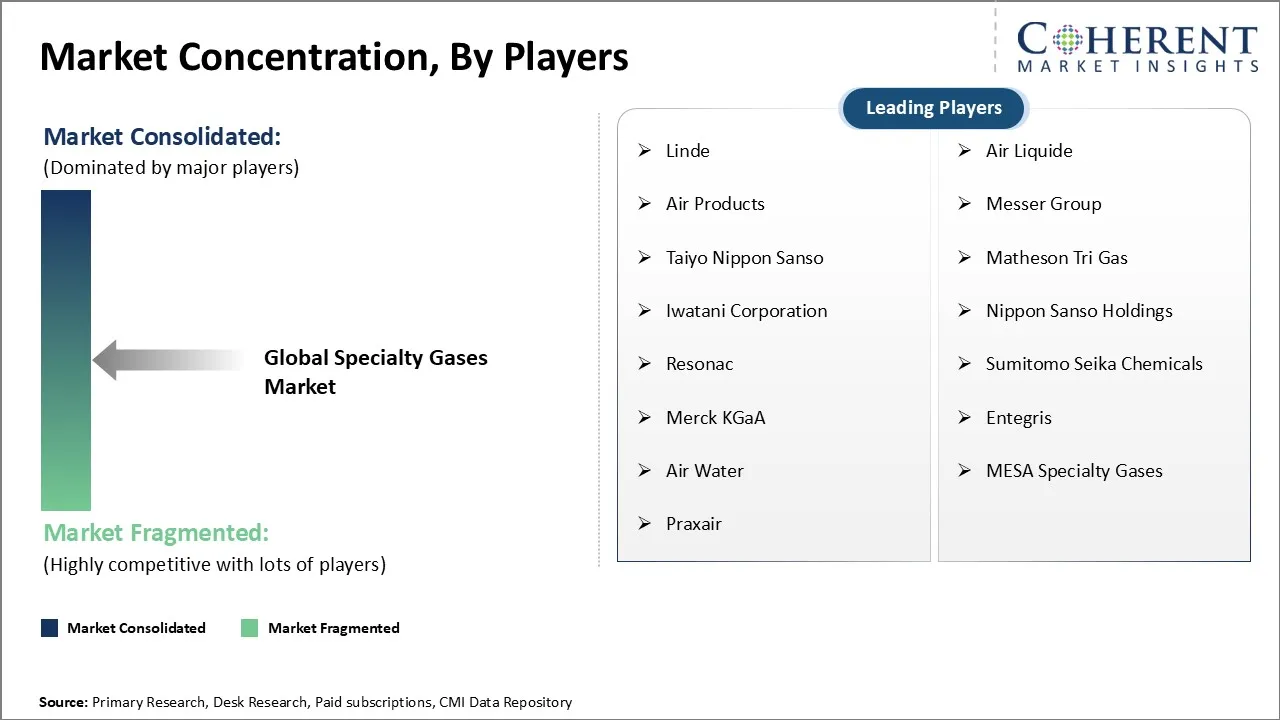
The global specialty gases market is moderately consolidated, with major industrial gas companies competing alongside regional specialists and application-focused suppliers. Competition is primarily based on purity standards, customized formulation capabilities, production reliability, technical support, regulatory compliance, and customer relationships. Companies with advanced purification infrastructure and localized supply networks hold advantages in high-value applications such as semiconductor manufacturing and analytical testing.
Key Focus Areas include
- Ultra high purity production capabilities and quality assurance systems
- Customized gas mixture formulation expertise
- Semiconductor-grade supply reliability and contamination control
- Manufacturing capacity and regional production presence
- Regulatory compliance and certification capabilities
- Technical support and application engineering services
- Digital monitoring and supply management solutions
- Strategic customer partnerships and long-term contracts
Market Report Scope
Global Specialty Gases Market Report Coverage | |||
Report Coverage | Details | ||
Base Year | 2025 | Market Size in 2026: | USD 12.43 Bn |
Historical Data For: | 2020 To 2024 | Forecast Period: | 2026 To 2033 |
Forecast Period 2026 To 2033 CAGR: | 9.10% | 2033 Value Projection: | USD 22.87 Bn |
Geographies covered: |
| ||
Segments covered: |
| ||
Companies covered: | Linde, Air Liquide, Air Products, Messer Group, Taiyo Nippon Sanso, Matheson Tri Gas, Iwatani Corporation, Nippon Sanso Holdings, Resonac, Sumitomo Seika Chemicals, Merck KGaA, Entegris, Air Water, MESA Specialty Gases, Praxair | ||
Growth Drivers: |
| ||
Restraints & Challenges: |
| ||
Analyst Opinion (Expert Opinion)
- The global specialty gases market is likely to shift from a commodity-oriented supply model toward a solution-based business structure where technical expertise, process integration, and customer-specific services become stronger sources of differentiation. Suppliers that combine gas production with application knowledge will be better positioned to protect margins and build deeper customer relationships.
- The most influential transformation will come from the integration of digital monitoring and intelligent supply management into specialty gas operations. Traditional suppliers may face pressure as customers increasingly expect visibility into consumption, quality tracking, and predictive supply planning rather than only physical gas delivery.
- Market participants should prioritize purification technology, customer-specific formulations, regional manufacturing presence, and resilient supply networks. Companies should carefully evaluate investments in capacity expansion while addressing risks related to environmental regulations, raw material availability, and changing customer specifications across advanced manufacturing sectors.
Speak to the analyst
Want personalized insights?
Take the findings above to one of our principal consultants, or have the report rebuilt around the segments, geographies and competitors you actually track.
Market Segmentation
- Gas Type Insights (Revenue, USD Bn, 2021 - 2033)
- Electronic Specialty Gases
- Specialty Gas Mixtures
- High Purity Noble Gases
- Calibration Gases
- Laser and Optoelectronic Gases
- Others
- Purity Level Insights (Revenue, USD Bn, 2021 - 2033)
- Ultra High Purity Grade
- High Purity Grade
- Research Grade
- Standard Specialty Grade
- Application Insights (Revenue, USD Bn, 2021 - 2033)
- Semiconductor Manufacturing
- Analytical and Laboratory Applications
- Healthcare and Medical Applications
- Industrial Manufacturing
- Aerospace and Defense
- Environmental Monitoring
- Gas Family Insights (Revenue, USD Bn, 2021 - 2033)
- Fluorine Based Gases
- Noble Gases
- Silicon Based Gases
- Nitrogen Based Gases
- Carbon Based Gases
- Others
- End Use Industry Insights (Revenue, USD Bn, 2021 - 2033)
- Electronics and Semiconductor
- Healthcare
- Research and Academic Institutions
- Industrial Manufacturing
- Aerospace and Defense
- Others
- Distribution Channel Insights (Revenue, USD Bn, 2021 - 2033)
- Direct Sales
- Indirect (Via Distributors)
- Regional Insights (Revenue, USD Bn, 2021 - 2033)
- North America
- U.S.
- Canada
- Latin America
- Brazil
- Argentina
- Mexico
- Rest of Latin America
- Europe
- Germany
- U.K.
- Spain
- France
- Italy
- Russia
- Rest of Europe
- Asia Pacific
- China
- India
- Japan
- Australia
- South Korea
- ASEAN
- Rest of Asia Pacific
- Middle East
- GCC Countries
- Israel
- Rest of Middle East
- Africa
- South Africa
- North Africa
- Central Africa
- North America
Sources
Primary Research Interviews
- Specialty gas manufacturers, electronic gas producers, calibration gas suppliers, industrial gas companies, and gas mixture formulators
- Semiconductor fabs, laboratories, healthcare facilities, environmental testing agencies, and industrial users
- Procurement managers, process engineers, laboratory managers, gas safety professionals, distributors, and technical specialists
Stakeholders
- Specialty gas and ultra-high purity gas manufacturers
- Gas purification, blending, cylinder, valve, regulator, and handling equipment suppliers
- Semiconductor, electronics, healthcare, aerospace, research, and industrial manufacturing companies
- Distributors, gas logistics providers, laboratories, and testing service providers
End-use Sectors
- Semiconductor and electronics manufacturing
- Analytical and laboratory applications
- Healthcare and medical applications
- Industrial manufacturing
- Aerospace and defense
- Environmental monitoring
Regulatory and Industry Bodies
- Compressed Gas Association CGA
- European Industrial Gases Association EIGA
- Semiconductor Equipment and Materials International SEMI
- U.S. Environmental Protection Agency EPA
- Occupational Safety and Health Administration OSHA
- International Organization for Standardization ISO
- National medical gas, transport, environmental, and workplace safety authorities
Databases
- Company annual reports and investor presentations
- Specialty gas product and purity-grade databases
- Semiconductor manufacturing and fab investment databases
- Industrial gas production and trade datasets
- Import-export databases for gas products and cylinders
- Laboratory, healthcare, and industrial application databases
- Gas pricing, specification, certification, and technical datasheet databases
Magazines and Journals
- Gasworld
- Industrial Gases
- Semiconductor Digest
- Solid State Technology
- Journal of Analytical Atomic Spectrometry
- Journal of Chromatography
- International Journal of Hydrogen Energy
Associations
- Compressed Gas Association CGA
- European Industrial Gases Association EIGA
- Asia Industrial Gases Association AIGA
- SEMI
- International Oxygen Manufacturers Association IOMA
- Regional industrial gas and semiconductor associations
Public Domain Sources
- Semiconductor fabrication and capacity statistics
- Industrial gas production and trade data
- Laboratory testing and environmental monitoring data
- Healthcare and medical gas usage information
- Gas purity, safety, transport, and storage updates
- Semiconductor investment and electronics manufacturing developments
- Environmental emission and gas-handling regulations
Key Standards and Regulations
- Specialty gas purity and composition standards
- Calibration gas certification and traceability requirements
- Compressed gas cylinder and transport regulations
- Hazardous gas storage, handling, and workplace safety standards
- Semiconductor process gas safety requirements
- Medical gas quality and regulatory requirements
- Environmental regulations for fluorinated and greenhouse gases
Proprietary Elements
- CMI Data Analytics Tool and
- Proprietary CMI repository containing 10+ years of specialty gases, industrial gases, semiconductor materials, laboratory applications, healthcare gases, trade flow, pricing, supplier, and end-use market intelligence.
Get access to 250+ pages report
Every segment, forecast, competitor profile and data table behind the analysis above — available for instant download.
- ESOMAR Member
- ISO 9001:2015 Certified
- D-U-N-S Registered
- GDPR & CCPA Compliant
Frequently Asked Questions
The CAGR of global specialty gases market is projected to be 9.10% from 2026 to 2033.
The global specialty gases market is estimated to be valued at USD 12.43 Bn in 2026 and is expected to reach USD 22.87 Bn by 2033.
Growing semiconductor and electronics manufacturing is increasing the need for ultra-high-purity gases, while expanding analytical testing and laboratory activities are strengthening demand for certified gas mixtures. Together, these factors are supporting the growth of the global specialty gases market.
Complex purification and handling requirements increasing production costs and strict safety and regulatory compliance requirements are the major factors hampering the growth of global specialty gases market.
In terms of gas type, electronic specialty gases are estimated to dominate the market revenue share in 2026.
Linde, Air Liquide, Air Products, Messer Group, Taiyo Nippon Sanso, Matheson Tri Gas, Iwatani Corporation, Nippon Sanso Holdings, Resonac, Sumitomo Seika Chemicals, Merck KGaA, Entegris, Air Water, MESA Specialty Gases, Praxair are the major players.
North America is expected to lead the global specialty gases market in 2026.