

Global Tensioner Market Size and Forecast – 2026 To 2033
The global tensioner market is expected to grow from USD 5.80 Bn in 2026 to USD 8.10 Bn by 2033, registering a compound annual growth rate (CAGR) of 5.1% from 2026 to 2033. The global tensioner market is driven by increasing adoption of automatic tensioning systems. In July 2026, Litens added 29 new aftermarket stock keeping units. Three new tensioners feature Easy Button latch and Technician Assist Pin technology.
Key Takeaways of the Global Tensioner Market
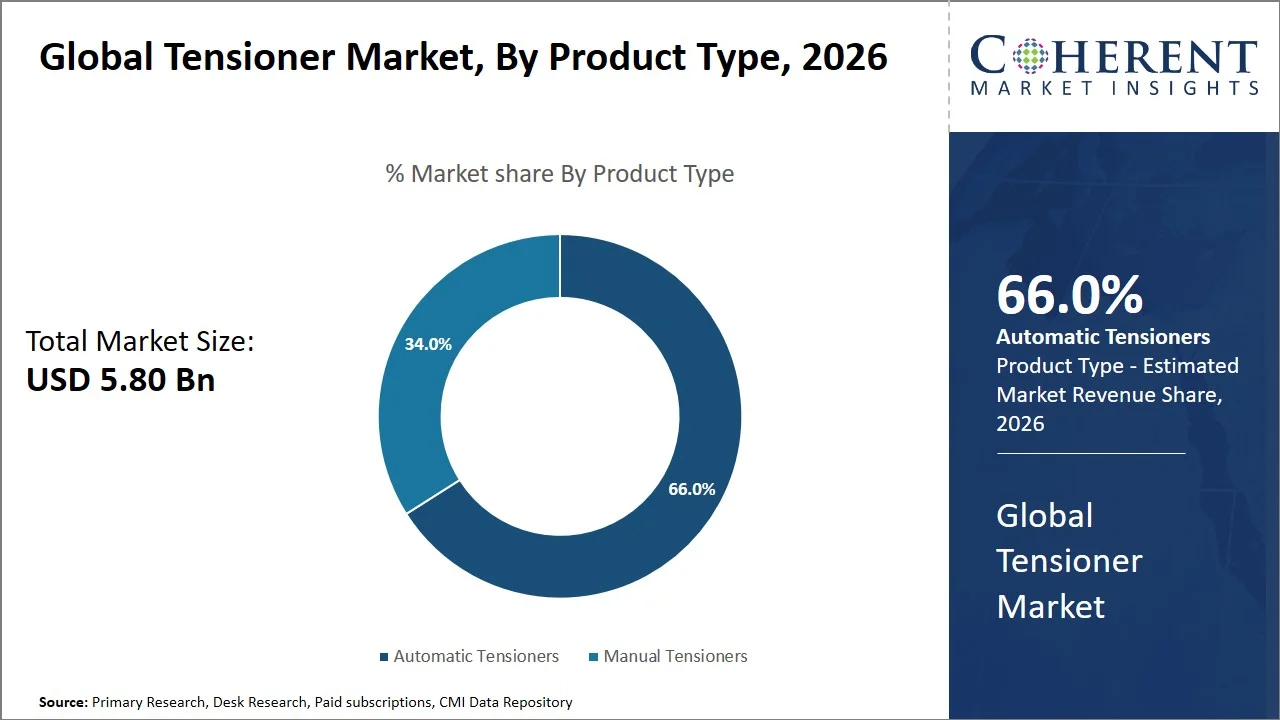
- The Automatic Tensioners segment is expected to account for 66.0% of the global tensioner market share in 2026. Growing requirements for reduced vibration and noise is driving the growth of the segment. In March 2025, Dayco published updated serpentine belt noise troubleshooting guidance. The guidance identifies low tension, misalignment, worn bearings, and tensioner movement as key noise sources.
- The Passenger Vehicles segment is estimated to capture 73.0% of the market share in 2026. Rising demand for longer component service intervals is majorly driving the growth of the segment. For instance, Continental's Multi V-Belt Kits combine belts, tensioning pulleys, idler pulleys, dampers, and fitting materials. The tensioner pulleys use high-rated bearings with increased lubrication volume.
- The Timing System segment is estimated to capture 57.0% of the market share in 2026. Increasing hybrid vehicle production is majorly driving the growth of the segment. On November 18, 2025, Toyota announced a USD 912 million investment to expand hybrid vehicle production capacity at five U.S. manufacturing plants.
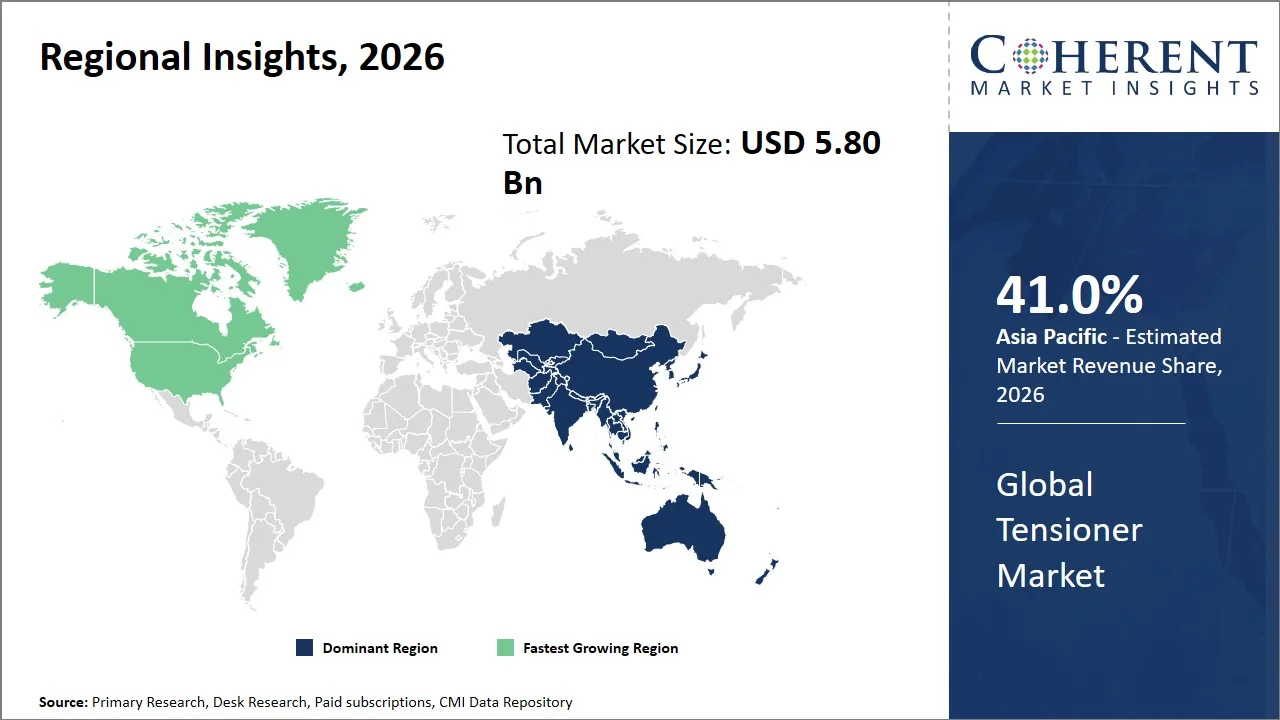
- Asia Pacific is expected to dominate the tensioner market in 2026 with a market share of 41.0%. Expansion of hybrid powertrain applications in Asia Pacific is driving the growth of the regional market. In October 2025, Kia announced that it would expand hybrid vehicle sales in Korea. The company specifically targeted hybrid recreational vehicles and additional vehicle segments.
- North America is expected to account for 23.0% share in 2026 and is projected to record the fastest growth over the forecast period. Expansion of aftermarket product portfolios in North America is driving the growth of the regional market. Continental's North American aftermarket portfolio includes application-specific Accu-Drive idler and tensioner pulleys. The range covers domestic and imported vehicles with plastic, steel, and two-piece pulley designs.
Segmental Insights
Why Does Automatic Tensioners Dominate the Global Tensioner Market?
The automatic tensioners segment is expected to account for 66.0% of the global tensioner market share in 2026. Automatic tensioners keep the belt at the proper tension throughout its life, even as it stretches and engine loads change. This decreases belt slippage, noise, vibration and premature component wear during vehicle operation. The automatic adjustment also decreases maintenance requirements as frequent manual correction of tension is not required. These benefits provide consistent accessory drive performance throughout a wide range of automobile operating circumstances. In May 2025, Dayco launched six new light duty tensioner part numbers. The products cover more than 11 million vehicles in operation across brands including Toyota, Honda, Lexus, Jeep, Ram, and Buick. Dayco states that the tensioners target quieter operation and longer service life.
- Current Industry Events of 2026
- Market Size Estimation
- Regional Breakdown
- Competitive Landscape
- Customer Intelligence
- Segmental Analysis
- Pricing Analysis
- Key Market Drivers, Challenges & Future Trends
- Customized Insights Section
Why is Passenger Vehicles the Most Crucial Vehicle Type?
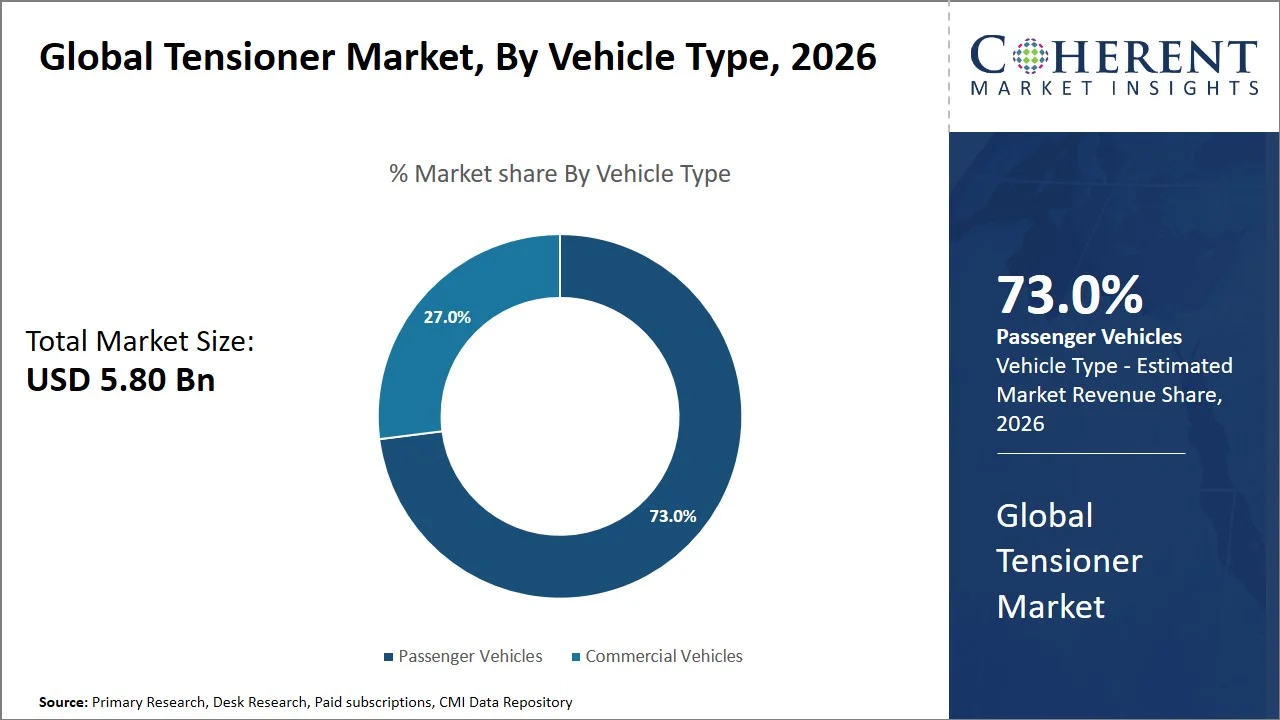
The passenger vehicles segment is expected to account for 73.0% of the global tensioner market share in 2026. Passenger vehicles have large accessory drive systems to power alternators, air-conditioning compressors, water pumps and other engine accessories. Huge world production base provides huge original equipment demand for suitable tensioning components. The International Organization of Motor Vehicle Manufacturers, says that global vehicle manufacturing stood at 96.4 million units in 2025. Gates also has tensioner applications for several of the passenger car makes and models. Passenger car applications thus represent a large and regular demand base for tensioner systems. On March 27, 2025, Hyundai Motor Group announced an additional USD 21 billion investment from 2025 to 2028 to drive U.S. manufacturing growth. Since entering the U.S., Hyundai Motor Group has invested USD 20.5 billion in the U.S.
Timing System Dominates the Global Tensioner Market
The timing system segment is expected to account for 57.0% of the global tensioner market share in 2026. Timing systems require precise tension control to maintain synchronization between engine components. Tensioners are used to keep timing belts correctly tensioned for reliable engine running, says Gates. If the tension is wrong, it might cause the belt to slip and vibrate and wear out prematurely and throw off the timing. The timing system failure and out of sync belts can cause very serious engine damage. This important need for reliability is driving continued demand for timing system tensioners in automotive applications. In April 2025, Continental launched the CT1228K3PRO and CT1228K4PRO timing belt kits. Kits contain tensioners, idler pulleys, gaskets, bolts and water pump belts. Designed for the PureTech engines, goods make a complete timing system replacement simple.
Current Events and their Impact
Current Events | Description and its Impact |
European Union - Euro 7 Regulation |
|
U.S. - Multi-Pollutant Emissions Standards |
|
Tensioner Market Dynamics
Market Drivers
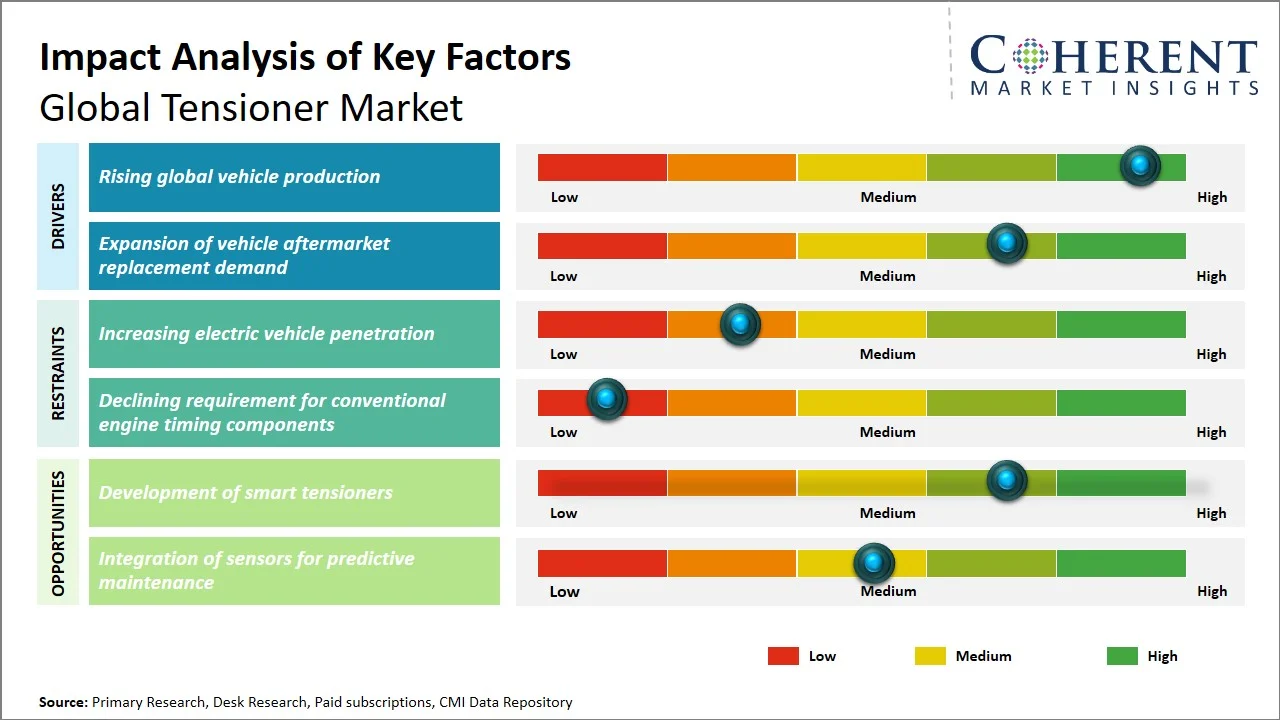
Rising global vehicle production
Global vehicle production grew from 92.7 million units in 2024 to 96.4 million units in 2025. Asia-Pacific production hit over 59.2 million automobiles during 2025. China produced 34.5 million automobiles India produced 6.5 million vehicles Higher vehicle manufacture directly drives demand for factory installed timing and accessory drive tensioners. The increasing production thus expands original equipment potential for tensioner makers in all major car producing countries. On May 11, 2026, Toyota Motor Corporation revealed its plans to develop a new Toyota Kirloskar Motor plant in the Bidkin industrial Area, Maharashtra, India. The new factory is scheduled to begin production in the first half of 2029 and is designed to enhance Toyota’s commercial foundation in the Indian market.
Expansion of vehicle aftermarket replacement demand
As the global vehicle parc grows, there is a recurring demand for the replacement of worn tensioners, belts, pulleys and other components. Periodically, older vehicles need the tensioner replaced to keep the belt tension proper and the accessories working reliably. Replacement demand is especially important for automobiles that are out of their original equipment warranty periods. Thus, independent workshops and aftermarket distributors are key sales channels for tensioner producers. This replacement cycle generates a recurring demand even if there are periodic fluctuations in the manufacture of new vehicles. For instance, Dayco continues offering timing belt kits containing matched belts, tensioners, idler pulleys, and installation instructions. These application-specific kits target replacement of worn original equipment components. The approach encourages replacement of related wear components during scheduled maintenance.
Emerging Trends
Hybrid-Specific Tensioner Systems
Mild hybrid vehicles are creating difficult operating conditions for belt drive components, and hence, hybrid-specific tensioner systems are increasing relevance. Special designs allow frequent engine starts and variable belt loads. That makes manufacturers want to design tensioners that are more durable and better at controlling vibrations.
Lightweight Tensioner Construction
As automakers strive to reduce vehicle mass and increase drivetrain efficiency, lightweight tensioner technology is becoming increasingly crucial. Manufacturers are using improved materials and refined designs to lower the weight of components. Such advancements can improve mechanical efficiency while preserving the needed strength and durability.
Integrated Tensioner Kits
Integrated tensioner kits are receiving a lift in the aftermarket automobile segment, as vendors group several timing and auxiliary drive components into one kit. These kits simplify replacement operations and lessen component compatibility problems. Workshops can also improve the consistency of installations by replacing related components concurrently.
Advanced Damping and Automatic Adjustment
Stable belt tension under changing operating conditions is necessary for modern automotive motors and so advanced damping and automatic adjustment technologies are gaining traction. Improved damping can help minimize vibration and noise, while maintaining belt stability. Uniform tension is also maintained throughout the life of the component with automatic adjustment.
Regional Insights
Why is Asia Pacific a Strong Market for Tensioner?
Asia Pacific is expected to account for a market share of 41.0% in 2026. In the Asia Pacific, the automotive manufacturing industry is centered in China, Japan, India, South Korea, Thailand, and Indonesia. China pushes broad sourcing of parts as homegrown automakers localize supply chains more Japan is a leader in the production of advanced hybrid vehicles, with companies like Toyota, Honda, and Nissan contributing to the field. India ramps up regional demand with more passenger vehicle and commercial vehicle manufacturing. Thailand and Indonesia supply powertrain component demand with significant Japanese carmaker output. Regional suppliers increasingly develop lightweight tensioners for hybrid powertrains and compact engines. These diverse manufacturing bases create multiple demand channels for original equipment and replacement tensioners.
Why Does North America Tensioner Market Exhibit High Growth?
North America is expected to register the fastest growth with a CAGR of 5.7% over the forecast period. North America is projected to account for 23.0% of the global tensioner market in 2026. North America benefits from integrated automotive supply chains connecting the U.S. and Canada. The U.S. has massive assembly capacity for General Motors, Ford, Stellantis, Toyota and others. In the United States, passenger cars, pickup trucks, sport utility vehicles and commercial vehicles are produced in significant numbers. The manufacturing operations of Toyota, Honda, General Motors and Stellantis in Canada are important to the companies. Durable tensioners are required for demanding automotive applications and larger powertrains, and regional production is a must. Cross-border sourcing of components promotes standardization of tensioner platforms across numerous assembly locations. Also, automotive manufacturers are improving regional supply chains for crucial components.
Global Tensioner Market Outlook for Key Countries
Why is China Emerging as a Major Hub in the Tensioner Market?
The country benefits from China's broad automotive manufacturing ecosystem and big domestic component supplier base. Battery electric vehicle production is reducing conventional engine component requirements across new vehicle platforms. However, plug-in hybrids and range-extender vehicles continue creating opportunities for mechanical engine components. Strong domestic car output was underpinned by BYD, Geely, Chery, SAIC Motor and Changan Auto. Chinese suppliers compete more and more on localization, cost effectiveness and rapid product development. Continued automobile manufacturing activity is being supported by government vehicle replacement schemes. The quality measures are also helping to add more focus to the durability, dependability and manufacturing uniformity of components.
Is U.S. the Next Growth Engine for the Tensioner Market?
The U.S. has a large production base of pickup trucks, sport utility vehicles, passenger automobiles and commercial vehicles. Ford, General Motors, Stellantis, Toyota, Honda and Hyundai Motor Group all have large manufacturing activities. Big car platforms create a need for sturdy accessory drive systems and hardy tensioning components. Since these powertrains still have internal combustion engines, there are more potential in the development of hybrid vehicles. The manufacture of heavy-duty vehicles also includes components suited for high load operating conditions. Domestic sourcing efforts might give corporations an incentive to develop North American component supply chains. Automakers are simultaneously adapting production strategies to changing emissions and trade policies.
South Korea Tensioner Market Analysis and Trends
South Korea benefits from concentrated automotive production led by Hyundai Motor Group and Kia. Hyundai Motor Company and Kia have large production facilities which supply both the home market and exports. The country has a mix of internal combustion, hybrid and electric car production inside well-established industrial ecosystems. Hybrid production continues to generate potential for tensioners in combination with conventional engine components. South Korean vendors are focusing on precision manufacturing, compact designs and excellent reliability for global automotive programs. Automotive parts exports link domestic suppliers to global assembly facilities. The country’s robust electronics industry also back possible integration of sensing capabilities into automobile components.
Japan Tensioner Market Analysis and Trends
Japan enjoys a high penetration of hybrid vehicles and advanced powertrain engineering skills. Toyota, Honda, Nissan, Subaru, Mazda and Suzuki all have big local manufacturing and supply networks. The hybrid systems of Toyota still require finely designed mechanical parts in internal combustion powertrains. Japanese vendors focus on durability, compact packaging, low vibration and perfect tension control. Ecosystems of advanced automotive components are supported by companies like Denso, Aisin and Mitsuboshi Belting. Japan’s mature aftermarket provides repeat opportunity for replacement of timing and auxiliary drive components. Expertise in engineering is also a driver of the development of tensioners that support increasingly compact and efficient powertrains.
India Tensioner Market Analysis and Trends
The increasing passenger vehicle production in India and a burgeoning automotive component manufacturing ecosystem is a positive for the country. Major production facilities of Maruti Suzuki, Hyundai Motor India, Tata Motors, Mahindra and Mahindra and Toyota Kirloskar operate. Increased predilection for sport utility vehicles bodes well for components used across bigger passenger car platforms. There is significant commercial vehicle manufacturing in India through Tata Motors, Ashok Leyland and Mahindra. Investments in hybrid vehicles also present further prospects for tensioners supporting internal combustion engine systems. India’s huge car population and increasing organized service networks are helping the aftermarket. Government industrial programs also promote domestic production of vehicle components and localization of the supply chain.
Global Tensioner Market - Global Vehicle Production by Country (2025)
Country | Total Vehicle Production |
China | 34,530,738 |
U.S. | 10,243,844 |
Japan | 8,410,232 |
India | 6,490,810 |
South Korea | 4,102,200 |
Germany | 4,148,836 |
Mexico | 4,092,448 |
Brazil | 2,644,054 |
Spain | 1,764,190 |
Thailand | 1,455,569 |
How is Development of Smart Tensioners Creating New Growth Opportunities in the Tensioner Market?
Development of smart tensioners can provide potential merging autonomous tension management with condition monitoring capabilities. Gates already employs electronic belt tension assessment equipment which calculates tension digitally and retains information for repeat maintenance. Smart tensioner designs may enhance this method by continuously monitoring tension changes, vibration and belt condition. Continental’s Accu-Drive tensioners are already designed for constant tension and vibration damping across accessory drive systems. The integration with vehicle diagnostics could allow for earlier diagnosis of belt degeneration and tensioner wear. This could move tensioner replacement from defined maintenance intervals to condition driven servicing, enabling premium component and aftermarket opportunities.
On October 1, 2025, China Sundy introduced a new intelligent tensioner with an integrated high-precision sensor module. The system measures tension, temperature, vibration, and rotational speed simultaneously. Its tension measurement combines strain-gauge and piezoelectric sensing technologies.
Market Players, Key Development, and Competitive Intelligence
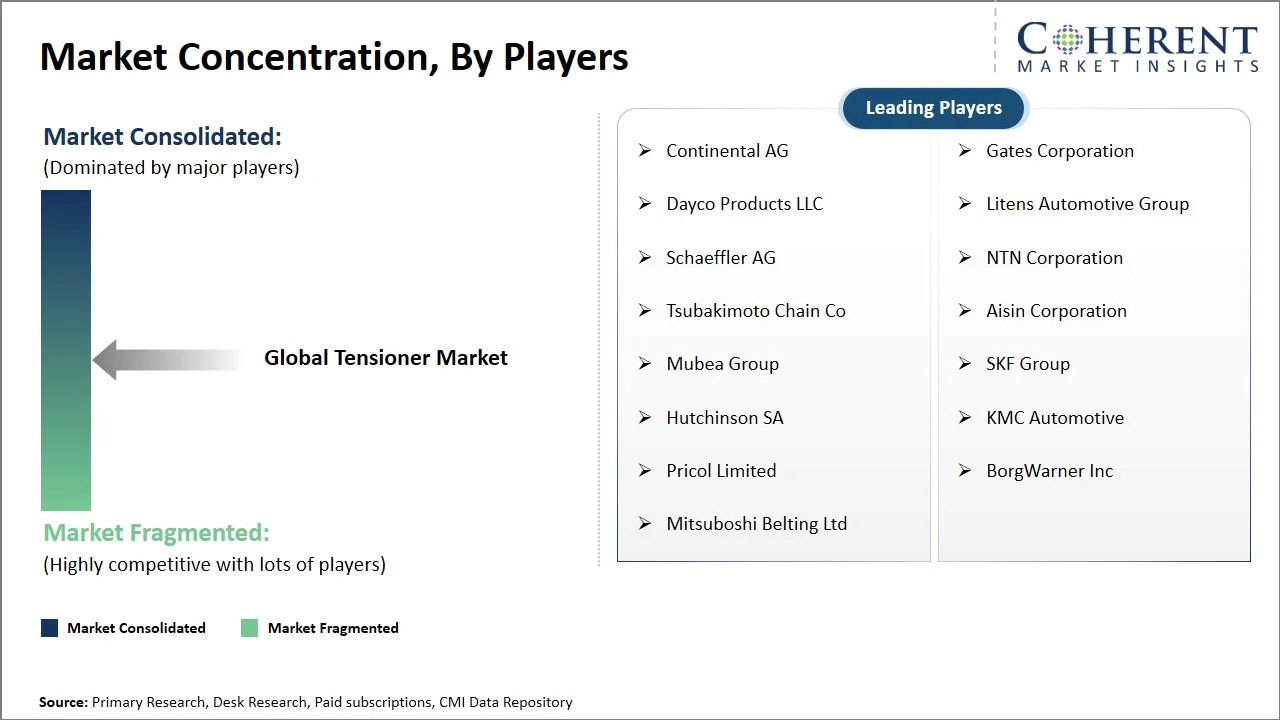
Key Developments
- On February 4, 2026, AISIN Corporation and AISIN AUTOMOTIVE HARYANA PRIVATE LIMITED (AHL), decided to expand AHL’s existing plant and build a new plant in Maharashtra with the aim of expanding business in India.
- On May 15, 2025, Dayco announced it is expanding its North America aftermarket portfolio with 30 new part numbers now available for order. The following new product introductions (NPIs) include 8 timing chain kits, 9 tensioners and 13 hoses, providing coverage opportunities for 28.8 million vehicles in operation.
Competitive Landscape
The competitive landscape is shaped by Gates, Litens, Schaeffler, and Continental through differentiated product and aftermarket strategies. Gates offers more than 500 tensioner products globally, including DriveAlign automatic and PowerGrip timing tensioners. Its strategy is based on OE-equivalent fit, vibration damping, durability and broad vehicle coverage. Litens is hard at work on hybrid applications, including specific tensioners for fast torque reversals and start-stop operation. It uses bi-stable mechanisms in the hybrid tensioners to switch between boost and regeneration conditions. Schaeffler is using its powertrain know-how and electrification competence after its integration of Vitesco. Tensioners for hybrid systems with decoupling are part of the 48-volt accessory drive line. Continental is focusing on portfolio specialization and operational efficiency following the business restructure in 2025.
Market Report Scope
Tensioner Market Report Coverage
| Report Coverage | Details | ||
|---|---|---|---|
| Base Year: | 2025 | Market Size in 2026: | USD 5.80 Bn |
| Historical Data for: | 2020 To 2024 | Forecast Period: | 2026 To 2033 |
| Forecast Period 2026 to 2033 CAGR: | 5.10% | 2033 Value Projection: | USD 8.10 Bn |
| Geographies covered: |
| ||
| Segments covered: |
| ||
| Companies covered: | Continental AG, Gates Corporation, Dayco Products LLC, Litens Automotive Group, Schaeffler AG, NTN Corporation, Tsubakimoto Chain Co, Aisin Corporation, Mubea Group, SKF Group, Hutchinson SA, KMC Automotive, Pricol Limited, BorgWarner Inc, Mitsuboshi Belting Ltd | ||
| Growth Drivers: |
| ||
| Restraints & Challenges: |
| ||
Analyst Opinion (Expert Opinion)
- The future of the tensioner industry will increasingly depend on hybrid-compatible mechanical systems rather than conventional engine applications alone. Hybrid powertrains create repeated start-stop events, torque reversals, and regenerative braking loads. Litens has specifically developed tensioners for these conditions, highlighting the technical shift occurring within accessory belt systems.
- The strongest opportunity should emerge in hybrid-specific tensioners, particularly for 48-volt and higher-load accessory drive systems. Japan, China, India, and South Korea deserve strong attention because their manufacturers maintain significant hybrid and electrified powertrain activity. Schaeffler already supplies decoupling tensioners for 48-volt accessory drive systems.
- Market players shall focus on hybrid-specific engineering, decreased vibration, quick torque response, and longer component life. Suppliers should develop aftermarket coverage with full kits and vehicle specific applications. Gates expanded its timing chain kit program during 2025, demonstrating the value of integrated replacement solutions. Companies combining OE development capabilities with aftermarket availability should gain stronger competitive positioning.
Speak to the analyst
Want personalized insights?
Take the findings above to one of our principal consultants, or have the report rebuilt around the segments, geographies and competitors you actually track.
Market Segmentation
- Product Type Insights (Revenue, USD Billion, 2021 - 2033)
- Automatic Tensioners
- Manual Tensioners
- Vehicle Type Insights (Revenue, USD Billion, 2021 - 2033)
- Passenger Vehicles
- Commercial Vehicles
- Application Insights (Revenue, USD Billion, 2021 - 2033)
- Timing System
- Accessory Drive System
- Regional Insights (Revenue, USD Billion, 2021 - 2033)
- North America
- U.S.
- Canada
- Latin America
- Brazil
- Argentina
- Mexico
- Rest of Latin America
- Europe
- Germany
- U.K.
- Spain
- France
- Italy
- Russia
- Rest of Europe
- Asia Pacific
- China
- India
- Japan
- Australia
- South Korea
- ASEAN
- Rest of Asia Pacific
- Middle East
- GCC Countries
- Israel
- Rest of Middle East
- Africa
- South Africa
- North Africa
- Central Africa
- North America
Sources
Primary Research Interviews
- Tensioner Manufacturers & OEM Representatives
- Automotive & Industrial Machinery Distributors
- Procurement & Supply Chain Managers
Magazines
- Machine Design Magazine
- Power Transmission Engineering Magazine
- Automotive Manufacturing Solutions (AMS)
- Industrial Equipment News (IEN)
Journals
- Journal of Mechanical Engineering
- International Journal of Industrial Engineering & Manufacturing
- Journal of Engineering Tribology
Associations
- Power Transmission Distributors Association (PTDA)
- Association for Manufacturing Technology (AMT)
- American Gear Manufacturers Association (AGMA)
Public Domain Sources
- U.S. Department of Energy (DOE) – Industrial Equipment Reports
- European Commission – Industrial Machinery & Equipment Publications
- World Trade Organization (WTO) – Trade Data on Mechanical Components
- U.S. International Trade Commission (USITC) Reports
Proprietary Elements
- CMI Data Analytics Tool
- Proprietary CMI Existing Repository of Information for the Last 10 Years
Get access to 250+ pages report
Every segment, forecast, competitor profile and data table behind the analysis above — available for instant download.
- ESOMAR Member
- ISO 9001:2015 Certified
- D-U-N-S Registered
- GDPR & CCPA Compliant
Missing comfort of reading report in your local language? Find your preferred language:
Frequently Asked Questions
The global tensioner market is expected to stand at USD 5.80 Bn in 2026 and is expected to reach USD 8.10 Bn by 2033.
The CAGR of the global tensioner market is projected to be 5.1% from 2026 to 2033.
Rising global vehicle production and Expansion of vehicle aftermarket replacement demand are the major factors driving the growth of the global tensioner market.
Increasing electric vehicle penetration and declining requirement for conventional engine timing components are the major factors hampering the growth of the global tensioner market.
In terms of product type, automatic tensioners segment is estimated to dominate the market revenue share in 2026.
A tensioner maintains appropriate belt or chain tension and helps prevent slippage, vibration, and premature wear
Hydraulic tensioners provide controlled tension and effective damping under changing engine operating conditions.