

Global Through Wall Radar Market Size and Forecast – 2026 To 2033
The global through wall radar market is expected to grow from USD 250 Mn in 2026 to USD 353 Mn by 2033, registering a compound annual growth rate (CAGR) of 4.3% from 2026 to 2033. The global through wall radar market is driven by growing law enforcement adoption. On January 3, 2025, STM delivered the upgraded version of the STM Through-the-Wall Radar system to the Turkish Armed Forces following its use at civilian rescue operations.
Key Takeaways of the Global Through Wall Radar Market
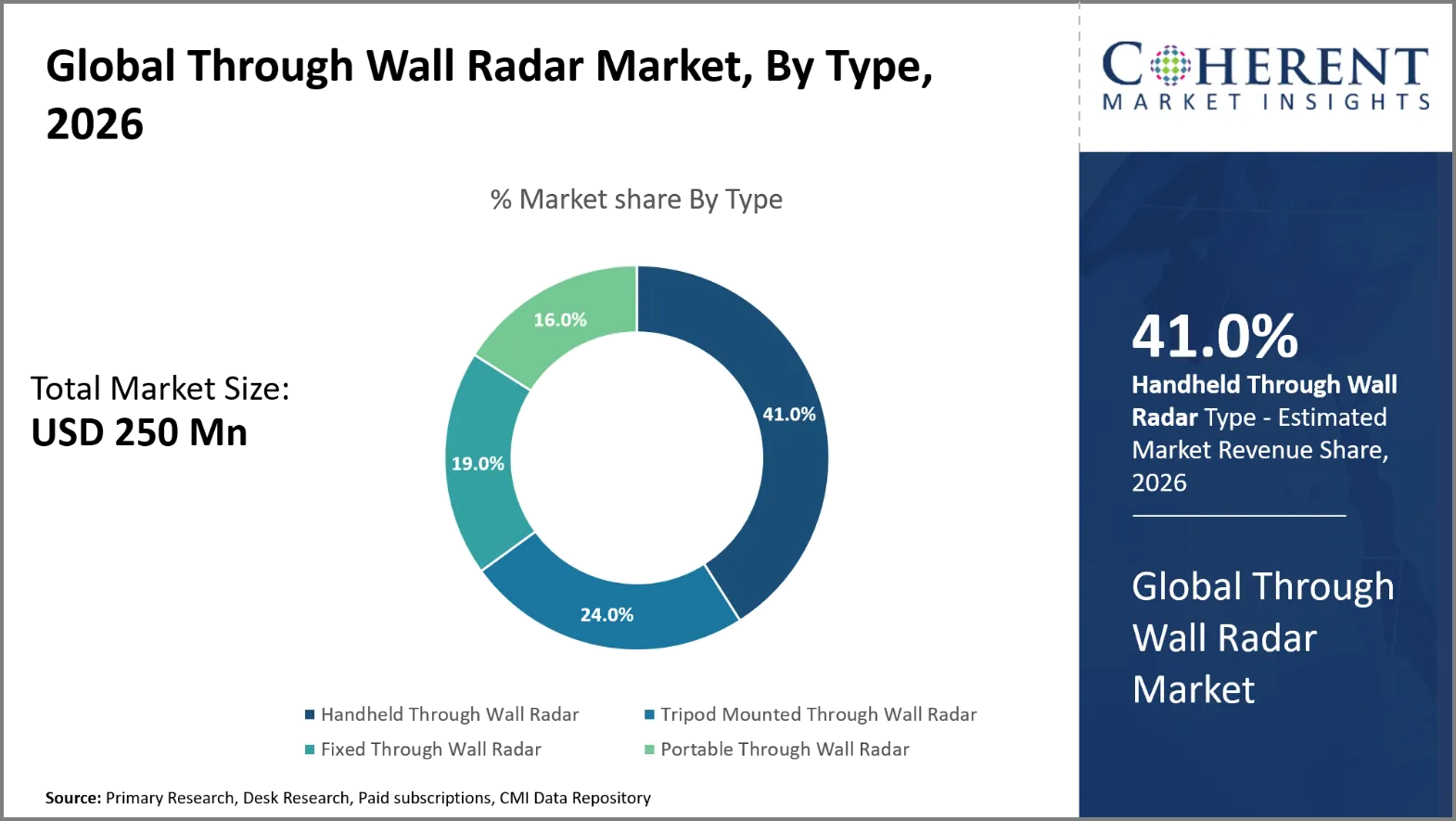
- The Handheld Through Wall Radar segment is expected to account for 41.0% of the global through wall radar market share in 2026. Expansion of search and rescue applications is driving the growth of the segment. In June 2026, Mistral Solutions presented its 2D and 3D through-wall radar systems. The systems detect static and moving people through concrete and other barriers.
- The Ultra-Wideband Radar segment is estimated to capture 39.0% of the market share in 2026. Advancements in ultra-wideband radar technology is majorly driving the growth of the segment. On March 10, 2025, Qorvo announced the QM35825 fully integrated low-power UWB System-on-Chip. The device combines radar-based sensing with on-chip artificial intelligence and machine learning.
- The Military and Defense segment is estimated to capture 37.0% of the market share in 2026. Increasing demand for portable surveillance equipment is driving the growth of the segment. On December 9, 2025, MatrixSpace launched its Portable 360 Radar. The transportable system provides panoramic awareness for rapid-response counter-drone operations.
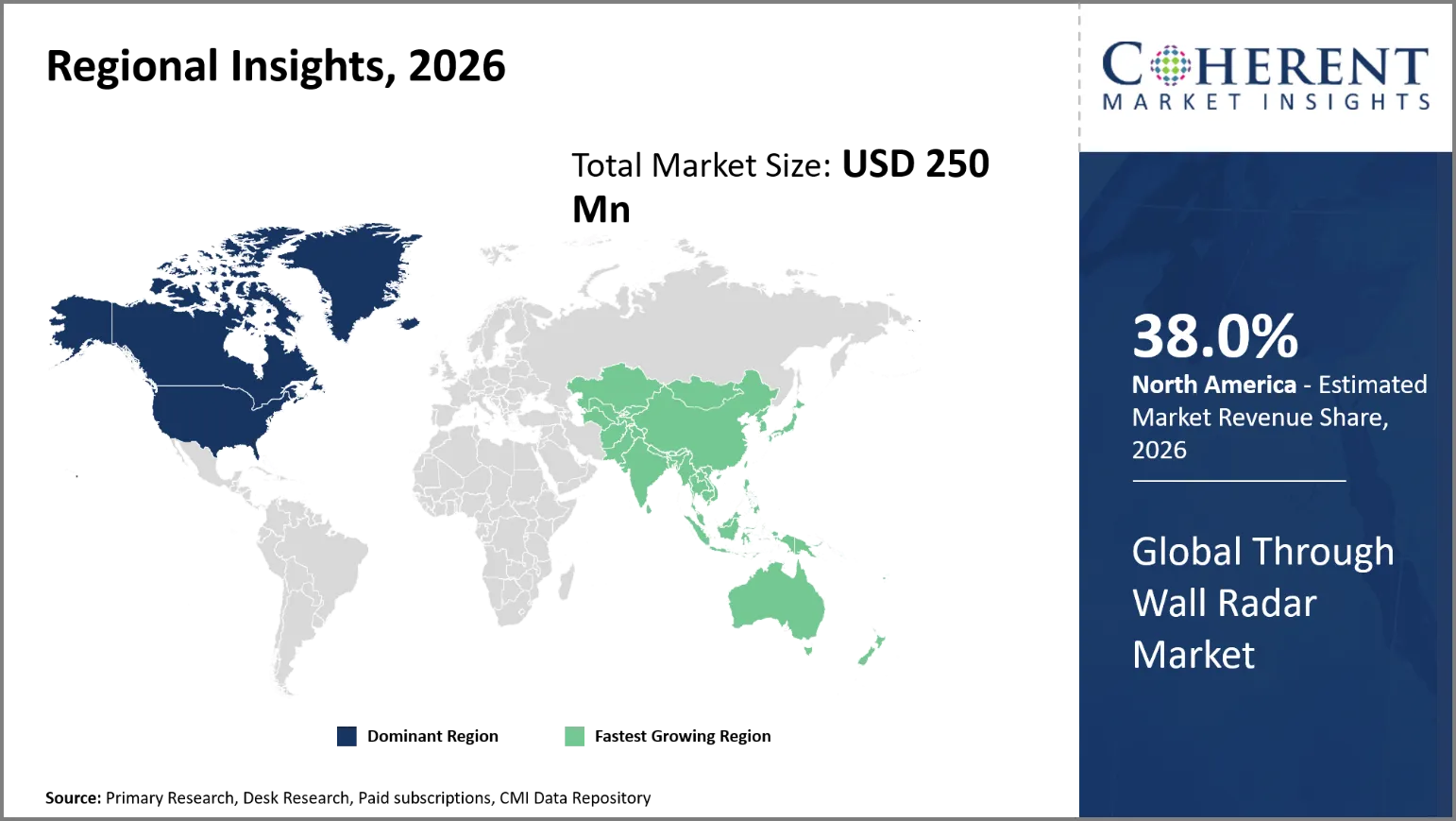
- North America is expected to dominate the through wall radar market in 2026 with a market share of 38.0%. Increasing development of three-dimensional imaging capabilities in North America is driving the growth of the regional market. For instance, Spotter Global strengthened its three-dimensional radar portfolio with the GAX500-3D in 2025. The Orem, Utah company uses its Compact Holographic 3D radar technology.
- Asia Pacific is expected to account for 25.0% share in 2026. Growing counter-terrorism and hostage rescue requirements in Asia Pacific is driving the growth of the regional market. On June 24, 2026, Mistral Solutions showcased its two-dimensional and three-dimensional through-wall radar systems at International Police Expo 2026.
Segmental Insights
Why Does Handheld Through Wall Radar Dominate the Global Through Wall Radar Market?
The handheld through wall radar segment is expected to account for 41.0% of the global through wall radar market share in 2026. Handheld solutions allow greater mobility for military and law enforcement personnel during essential operations. Because they are small, they can be deployed quickly in buildings, limited places and tough conditions. Operators can easily relocate the equipment and continue detection without interruption. This mobility increases operational flexibility in hostage rescue, tactical surveillance and search missions. Hence the growing demand for lightweight security equipment is driving the uptake of handheld devices. For example, Beijing Topsky’s YSR120 handheld through-wall radar was promoted over 2025. This system uses an ultra-portable system for human presence detection behind obstacles. Its small structure aids individuals working in limited or tough locations. The system targets emergency rescue, security, and tactical detection requirements.
- Current Industry Events of 2026
- Market Size Estimation
- Regional Breakdown
- Competitive Landscape
- Customer Intelligence
- Segmental Analysis
- Pricing Analysis
- Key Market Drivers, Challenges & Future Trends
- Customized Insights Section
Why is Ultra-Wideband Radar the Most Preferred Technology?
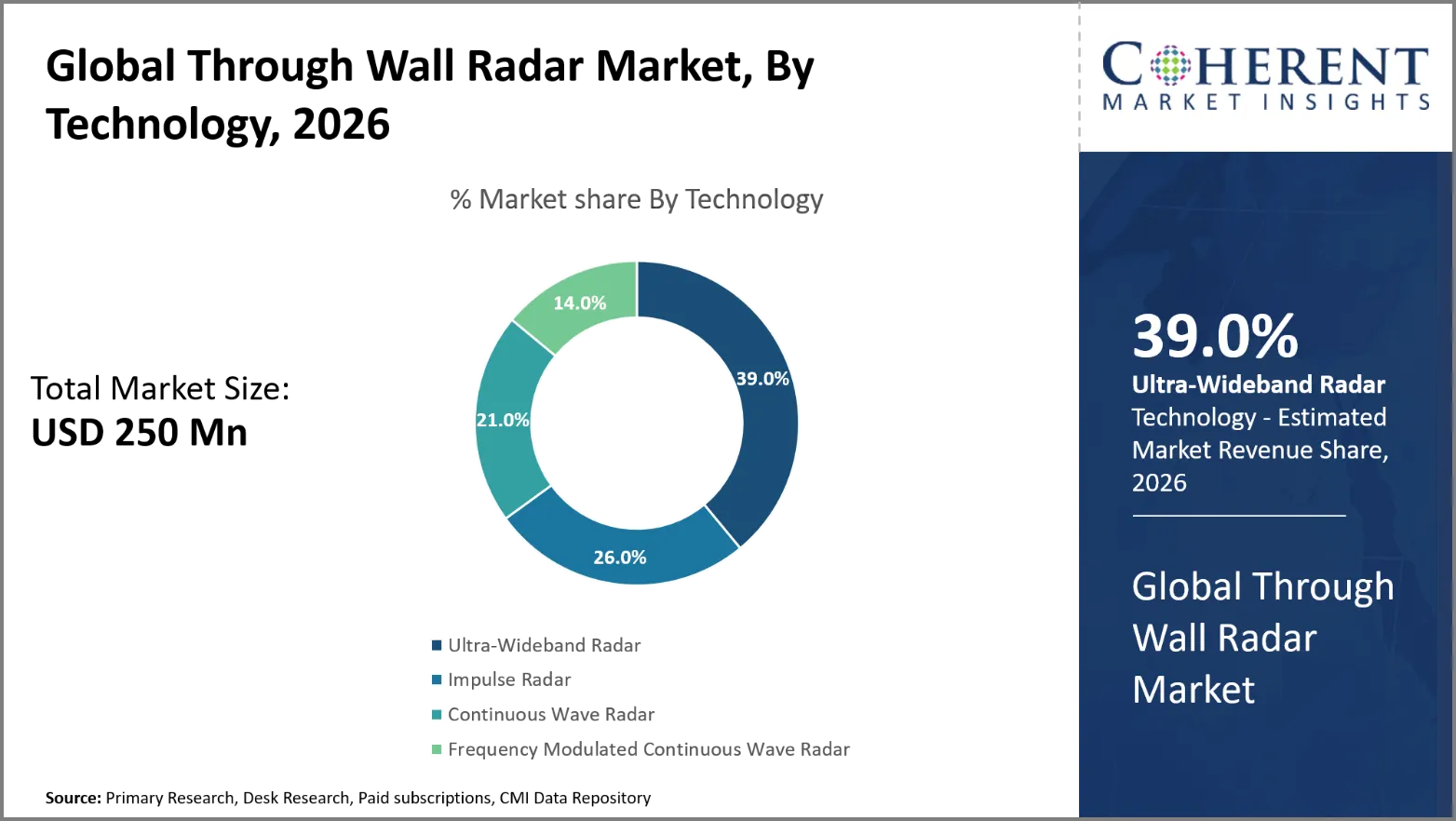
The ultra-wideband Radar segment is expected to account for 39.0% of the global through wall radar market share in 2026. Ultra-wideband radar delivers robust penetration through a variety of construction materials. Due to its wide frequency range, it detects humans and movement behind walls reliably. The technology can deliver useful range resolution while operating with low transmitted power. These features help accurate situational awareness during tactical operations and emergency response situations. Increasing demand for reliable non-invasive detection is also supporting ultra-wideband radar usage. In 2025, ARIA Sensing upgraded their Hydrogen UWB radar System-on-Chip. The platform offers one-dimensional, two-dimensional and three-dimensional radar detection. Its programmable architecture enables different sensing configurations within a compact semiconductor platform. This development supports smaller radar systems requiring detailed spatial information.
Military and Defense Dominates the Global Through Wall Radar Market
The military and defense segment is expected to account for 37.0% of the global through wall radar market share in 2026. Military agencies increasingly require through-wall detection for urban combat and tactical surveillance operations. The device allows users to identify residents without entering potentially risky structures. Reducing exposure to hostile threats during reconnaissance and rescue missions is a key capability. Defense forces also need accurate detection systems for hostage recovery and counterterrorism operations. Increasing investments in enhanced battlefield surveillance support significant demand from defense users. For example, in 2025 RETIA continued the development of the ReTWIS 5+ through-the-wall radar technology for defense and security applications. It can image in 2-D and 3-D behind non-metallic obstacles It can detect living entities and movement without requiring personnel to enter the monitored area. This capability supports military reconnaissance, counterterrorism, and hostage-rescue missions.
Current Events and their Impact
Current Events | Description and its Impact |
U.S. - Federal Communications Commission Ultra-Wideband Rules |
|
U.S. - Export Administration Regulations |
|
(Source: Federal Communications Commission, Bureau of Industry and Security)
Through Wall Radar Market Dynamics
Market Drivers
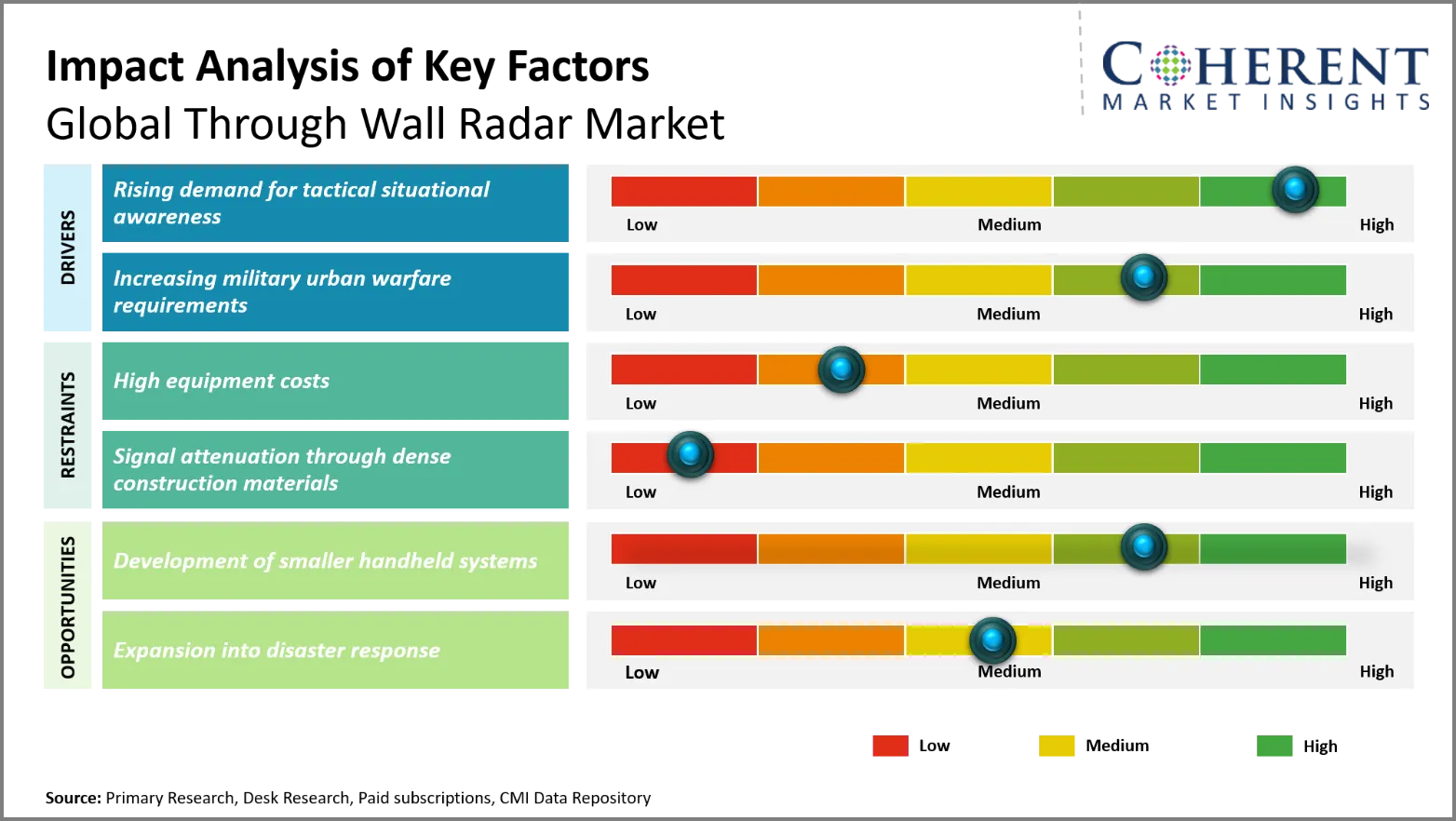
- Rising demand for tactical situational awareness: Military and security organizations require real-time awareness in covert areas and within buildings. Personnel can detect movement without immediately entering potentially unsafe locations utilizing through wall radar. The system can detect inhabitants, movement patterns and positions behind structural barriers. This capacity enables reconnaissance, hostage recovery, counterterrorism and high-risk law enforcement missions. Thus, the need for safer tactical intelligence is driving the widespread use of modern radar systems. On April 11, 2025, Camero-Tech announced two major contracts with special police forces in the Asia Pacific area for the delivery of its advanced XAVER 400 tactical through-wall imaging systems. These new contracts reflect the increasing global demand for Camero-Tech’s innovative solutions that improve tactical situational awareness and operational safety in complicated circumstances.
- Increasing military urban warfare requirements: Urban warfare is placing more demands on forces to operate in dense structures and complicated infrastructure. Walls can prevent direct observation, limiting the information available from traditional visual surveillance. Through wall radar allows staff to evaluate hidden areas before entering buildings. This skill can limit exposure to hidden hazards during tactical advances and rescue operations. The increase in urban operations has increased the need for small, fast deployable radar equipment in the military. Lockheed Martin contributed in the broader development of armed robotic capabilities throughout 2025. The U.S. Army has looked into robotic devices for reconnaissance and security duties in urban environments. These devices are designed to work with soldiers in dangerous areas. This breakthrough is a sign of industry’s expanding focus on technology that supports urban battlefield operations.
Emerging Trends
- Artificial Intelligence Integration: Manufacturers are coupling artificial intelligence with radar processing to enhance target recognition, movement classification and situational awareness. The features can reduce the operator workload and allow faster tactical judgments during complicated indoor surveillance and emergency response operations.
- Miniaturization and Portability: Radar developers are shrinking the size, weight and power requirements of systems for field deployment. Smaller equipment allows troops to take detection systems on reconnaissance, rescue missions and building searches, while keeping useful detection performance in difficult environments.
- Three-Dimensional Detection Capabilities: More advanced systems are gradually gaining three-dimensional detection skills to better location and movement analysis. Better spatial information can alert operators about layouts of rooms, where occupants are and how they move around spaces before entering potentially dangerous structures during tactical operations.
- Multi-Sensor System Integration: Wall radar systems are increasingly being integrated with other sensors such as cameras, temperature sensors, communication devices and command platforms. The fusion of several sensing technologies may improve operational awareness and deliver more detailed information to the personnel for security and emergency missions.
Regional Insights
Why is North America a Strong Market for Through Wall Radar?
North America is expected to account for a market share of 38.0% in 2026. In North America, adoption is closely tied to homeland security, emergency response, and specialized law enforcement needs. The U.S. Department of Homeland Security has looked into portable radar equipment that can be used to locate survivors and those who are hidden. The ND-SV004 portable radar and AKELA ASTIR system were selected as significant technologies in the assessment. ASTIR supports stand-off detection up to 30 meters and tracks stationary and moving individuals. The U.S. National Institute of Justice sponsored ASTIR development for law enforcement applications. These programs demonstrate government interest in portable concealed-person detection for collapsed structures and high-risk operations.
Why Does Asia Pacific Through Wall Radar Market Exhibit High Growth?
Asia Pacific is expected to register the fastest growth with a CAGR of 5% over the forecast period. It is projected to account for 25.0% of the global through wall radar market in 2026. The region is gaining technological momentum through disaster-response applications and indigenous radar development. China Coal Technology and Engineering Group developed the LST-30/120DM-CCTEG-1 ultra-wideband life detector. Field testing demonstrated detection of breathing and heartbeat signals within 30 meters. The tests included concrete rubble, brick walls, wooden boards and dirt. In simulations of earthquakes and building collapses, the technology obtained a centimeter-level resolution. Radar technologies were also used for terrain monitoring in China’s response to the February 2025 Sichuan landslide. These developments strengthen regional demand for radar-based survivor detection and complex disaster-response equipment.
Global Through Wall Radar Market Outlook for Key Countries
Why is U.S. Emerging as a Major Hub in the Through Wall Radar Market?
The U.S. through wall radar market benefits from federal research supporting concealed-person detection for emergency and law enforcement missions. The Department of Homeland Security evaluated several portable signs-of-life technologies under its technology assessment activities. AKELA ASTIR provides stand-off detection up to 30 meters and tracks stationary and moving people. The system originated through National Institute of Justice sponsorship. TiaLinx Eagle10-B detects breathing and movement beneath collapsed structures. These technologies address earthquake casualty detection and inaccessible search areas. Such federal evaluation activity provides a concrete pathway for specialized radar technologies entering responder and law enforcement applications.
Is China the Next Growth Engine for the Through Wall Radar Market?
China is advancing indigenous ultra-wideband radar development for disaster rescue and life detection. China Coal Technology and Engineering Group tested its LST-30/120DM-CCTEG-1 detector at the China Fire and Rescue Institute. During rubble simulations the equipment recognized many persons within 30 meters. Researchers examined its ability to penetrate concrete, brick, wood and soil. The device also detected breathing and heartbeat signals at centimeter resolution. Development teams have tested the technology in scenarios including collapsed buildings, earthquake rubble and buildings on a slope. The experiments provide a direct endorsement of China’s focus on developing rescue equipment domestically for earthquakes, geological disasters and structural collapses.
Germany Through Wall Radar Market Analysis and Trends
Germany has developed significant radar research capabilities around indoor tracking, obstacle penetration, and human detection. Fraunhofer Institute for Applied Solid State Physics developed a compact 360-degree radar for environments with visual obstructions. Fraunhofer Institute for Reliability and Micro-integration later developed the OMNICONNECT radar platform. The system combined four radar modules for 360-degree coverage and detected more than 30 people across 150 square meters. Artificial intelligence evaluated movement patterns and found something out of the ordinary. Another similar study by Fraunhofer presented human identification in fallen structures with an unmanned aerial vehicle based on radar. These advances extend the role of radar knowledge beyond traditional surveillance applications.
Israel Through Wall Radar Market Analysis and Trends
Israel has established a specialized ecosystem around tactical radar imaging for military, law enforcement, and rescue operations. Camero-Tech, founded in 2004, develops ultra-wideband radio imaging systems under its Xaver product family. Its Xaver 400 detects stationary and moving people behind walls while providing room-layout information. The Xaver LR40 provides detection at distances exceeding 50 meters from walls. The Xaver LR80 extends detection beyond 100 meters. Camero systems have been operationally deployed in more than 50 countries. In March 2025, Camero supported Israeli Home Front Command rescue operations following the Bangkok building collapse.
Japan Through Wall Radar Market Analysis and Trends
Japan's strongest distinct opportunity comes from its advanced disaster-preparedness ecosystem and radar engineering capabilities. The Japan Meteorological Agency operates 20 weather radar units nationwide for real-time disaster monitoring. Japanese radar research increasingly emphasizes compact systems and localized sensing capabilities. Furuno Electric developed an ultra-compact radar for localized heavy-rain and tornado monitoring. While these systems are not through-wall products, they demonstrate domestic expertise in miniaturized radar hardware. Japan's mountainous geography and frequent earthquakes also create strong requirements for technologies supporting difficult search environments. This environment provides opportunities for specialized radar systems supporting rescue and structural-collapse assessment.
Global Through Wall Radar Market - Three-Dimensional Imaging Adoption Across Tactical Applications (2025)
Tactical Application | Estimated 3D Imaging Adoption |
Military and Defense | 35% |
Law Enforcement and SWAT | 27% |
Search and Rescue | 20% |
Counterterrorism | 12% |
Intelligence and Surveillance | 6% |
Global Through Wall Radar Market - Special Forces Modernization Programs by Country (2025)
Country | Modernization Intensity |
U.S. | 22% |
India | 18% |
Israel | 16% |
Türkiye | 14% |
France | 10% |
South Korea | 8% |
Japan | 6% |
Australia | 6% |
How is Development of Smaller Handheld Systems Creating New Growth Opportunities in the Through Wall Radar Market?
Smaller handheld systems are expanding deployment in confined tactical environments where larger radar units are impractical. Camero-Tech’s Xaver 100 handheld device weighs about 600 grams and provides concealed-person detection capabilities. Its compact design enables individual operators to carry radar during building searches and hostage-rescue missions. Equipment weight is reduced, allowing quick mobility between rooms and on different floors during tactical operations. Portable architectures enable speedier deployment in structural collapses where responders cannot carry heavy equipment. These improvements are creating opportunities for specialized radar suppliers for police units, military teams and emergency responders. For instance, Hunan NovaSky Electronic Technology continued to market the CEM100 as a handheld ultra-wideband through-wall radar. The gadget weighs around 800 kilos and detects up to 30 meters. It is battery operated and will last for around four hours of use. These characteristics demonstrate how manufacturers are developing lighter equipment for mobile security and rescue teams.
Market Players, Key Development, and Competitive Landscape
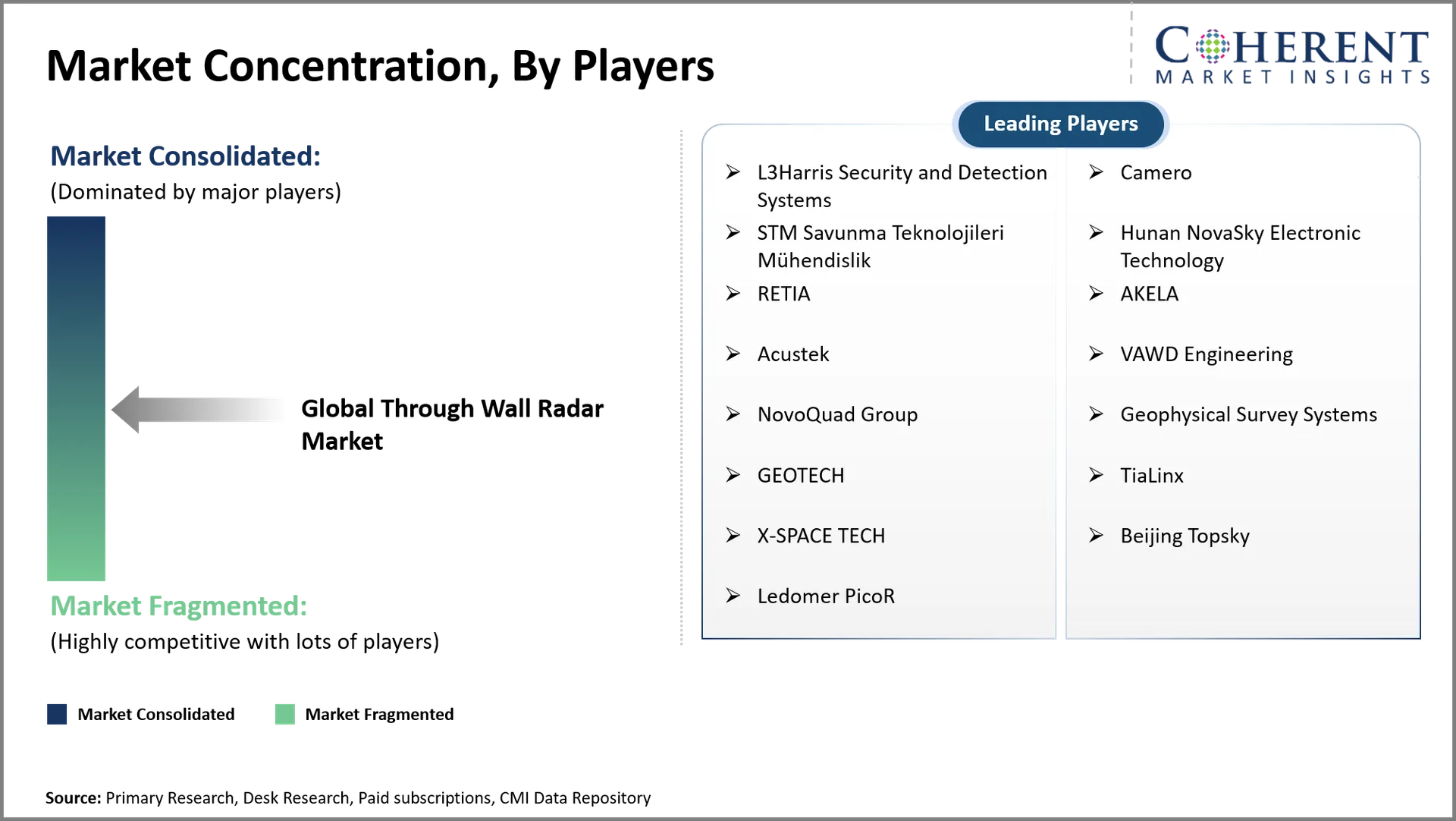
Key Developments
- On December 14, 2025, Camero developed an innovative presence of life detector, the Xaver 100. The Xaver 100 stems from the core radar- based imaging technology used in Xaver line of through wall imaging products. Developed with the specific needs of tactical operators in mind, the Xaver 100 provides instant critical situational awareness and target acquisition data.
- On June 7, 2024, NovoQuad Group introduced the ND-SV009 as a three-dimensional see-through-wall radar. The system provides three-dimensional imaging behind walls and structural barriers. It targets tactical surveillance, security, and rescue applications.
Competitive Landscape
Camero-Tech leads the specialized through wall radar space with its Xaver product family and strong tactical focus. Its Xaver 100 targets personnel-borne operations, while Xaver 400 provides two-dimensional and three-dimensional imaging. The company also offers Xaver LR40 and LR80 systems for stand-off detection beyond 50 meters and 100 meters. XaverNet adds wireless control of up to four Xaver systems simultaneously. This portfolio strategy addresses tactical entry, hostage recovery, reconnaissance, and search-and-rescue missions.
Market Report Scope
Report Coverage | Details | ||
Base Year | 2025 | Market Size in 2026: | USD 250 Mn |
Historical Data For: | 2020 To 2024 | Forecast Period: | 2026 To 2033 |
Forecast Period 2026 To 2033 CAGR: | 4.3% | 2033 Value Projection: | USD 353 Mn |
Geographies covered: |
| ||
Segments covered: |
| ||
Companies covered: | L3Harris Security and Detection Systems, Camero, STM Savunma Teknolojileri Mühendislik, Hunan NovaSky Electronic Technology, RETIA, AKELA, Acustek, VAWD Engineering, NovoQuad Group, Geophysical Survey Systems, GEOTECH, TiaLinx, X-SPACE TECH, Beijing Topsky, Ledomer PicoR | ||
Growth Drivers: |
| ||
Restraints & Challenges: |
| ||
Analyst Opinion (Expert Opinion)
- The industry should increasingly shift toward smaller systems with stronger onboard processing and network connectivity. Handheld products will remain important for room-entry teams requiring immediate occupancy information. Longer-range systems should gain relevance when operators need greater stand-off distances. Three-dimensional imaging will become more valuable for complex urban structures and intelligence operations.
- The strongest opportunities should emerge around handheld radar, three-dimensional imaging, and networked multi-system deployments. Military and law enforcement applications offer the clearest operational requirements for advanced capabilities. The U.S., Israel, China, and European defense markets should remain important technology-development centers. Search-and-rescue applications also offer opportunities where radar must locate survivors through rubble.
- Players looking for an edge should focus on lesser weight, longer battery life and faster target interpretation. Companies should build modular platforms for portable, robotic and unmanned deployment. Wireless networking can allow multiple radar units to provide simultaneous coverage from different positions. Camero-Tech already demonstrates this approach through XaverNet and its multi-system remote-control capability.
Speak to the analyst
Want personalized insights?
Take the findings above to one of our principal consultants, or have the report rebuilt around the segments, geographies and competitors you actually track.
Market Segmentation
- Type Insights (Revenue, USD Million, 2021 - 2033)
- Handheld Through Wall Radar
- Tripod Mounted Through Wall Radar
- Fixed Through Wall Radar
- Portable Through Wall Radar
- Technology Insights (Revenue, USD Million, 2021 - 2033)
- Ultra-Wideband Radar
- Impulse Radar
- Continuous Wave Radar
- Frequency Modulated Continuous Wave Radar
- Application Insights (Revenue, USD Million, 2021 - 2033)
- Military and Defense
- Law Enforcement
- Search and Rescue
- Surveillance and Security
- Construction and Civil Engineering
- End User Insights (Revenue, USD Million, 2021 - 2033)
- Military
- Police and Security Agencies
- Fire and Rescue Services
- Disaster Management Authorities
- Construction Companies
- Research Institutions
- Regional Insights (Revenue, USD Million, 2021 - 2033)
- North America
- U.S.
- Canada
- Latin America
- Brazil
- Argentina
- Mexico
- Rest of Latin America
- Europe
- Germany
- U.K.
- Spain
- France
- Italy
- Russia
- Rest of Europe
- Asia Pacific
- China
- India
- Japan
- Australia
- South Korea
- ASEAN
- Rest of Asia Pacific
- Middle East
- GCC Countries
- Israel
- Rest of Middle East
- Africa
- South Africa
- North Africa
- Central Africa
- North America
- Key Players Insights
- L3Harris Security and Detection Systems
- Camero
- STM Savunma Teknolojileri Mühendislik
- Hunan NovaSky Electronic Technology
- RETIA
- AKELA
- Acustek
- VAWD Engineering
- NovoQuad Group
- Geophysical Survey Systems
- GEOTECH
- TiaLinx
- X-SPACE TECH
- Beijing Topsky
- Ledomer PicoR
Sources
Primary Research Interviews
- Defense & Security Equipment Manufacturers
- Law Enforcement & Military Personnel
- Search & Rescue Operation Specialists
- Homeland Security Agencies
Magazines
- Defense Technology International
- Jane's Defense Weekly
- Military & Aerospace Electronics Magazine
- Defense News Magazine
Journals
- IEEE Transactions on Geoscience and Remote Sensing
- Journal of Electromagnetic Waves and Applications
- International Journal of Microwave and Wireless Technologies
Associations
- Association of Old Crows (AOC)
- National Defense Industrial Association (NDIA)
- Radar, Sonar and Navigation Society
- International Security Industry Organization (ISIO)
Public Domain Sources
- U.S. Department of Defense (DoD) Official Reports & Publications
- NATO Science & Technology Organization Reports
- U.S. Department of Homeland Security (DHS) Publications
- European Defence Agency (EDA) Public Reports
Proprietary Elements
- CMI Data Analytics Tool
- Proprietary CMI Existing Repository of Information for Last 10 Years
Get access to 250+ pages report
Every segment, forecast, competitor profile and data table behind the analysis above — available for instant download.
- ESOMAR Member
- ISO 9001:2015 Certified
- D-U-N-S Registered
- GDPR & CCPA Compliant
Missing comfort of reading report in your local language? Find your preferred language:
Frequently Asked Questions
The global Through Wall Radar market is expected to stand at USD 250 Mn in 2026 and is expected to reach USD 353 Mn by 2033.
The CAGR of the global Through Wall Radar market is projected to be 4.3% from 2026 to 2033.
Rising demand for tactical situational awareness and Increasing military urban warfare requirements are the major factors driving the growth of the global through wall radar market.
High equipment costs and signal attenuation through dense construction materials are the major factors hampering the growth of the global through wall radar market.
In terms of type, handheld through wall radar segment is estimated to dominate the market revenue share in 2026.
Through wall radar detects people, movement, and other objects behind walls using radio-frequency signals.
It helps military personnel identify occupants before entering potentially dangerous structures.