

Global Transparent Electronics Market Size and Forecast – 2026 To 2033
The global transparent electronics market is expected to grow from USD 3.00 Bn in 2026 to USD 12.00 Bn by 2033, registering a compound annual growth rate (CAGR) of 9.6% from 2026 to 2033. The global transparent electronics market is driven by increasing use of transparent electronics in automotive cockpits. On February 4, 2025, Samsung Display announced the signing of a Memorandum of Understanding with Qualcomm Technologies, Inc., with the goal of strengthening its position in the automotive OLED market. The collaboration includes the potential supply of OLED displays for Qualcomm Technologies’ Snapdragon Cockpit Experience Development Platform (CEDP) to provide next generation in-cabin experiences.
Key Takeaways of the Global Transparent Electronics Market
- The Transparent Displays segment is expected to account for 37.0% of the global transparent electronics market share in 2026. Expansion of smart windows and energy-generating glazing is driving the growth of the segment. On March 18, 2025, Miru Smart Technologies introduced one of the world’s largest electrochromic sunroof window devices for the automotive industry.
- The Thin Films segment is estimated to capture 43.0% of the market share in 2026. Growing demand for transparent wearable electronics is majorly driving the growth of the segment. XREAL unveiled a step change for its newest augmented reality (AR) glasses, XREAL One Series.
- The Consumer Electronics segment is estimated to capture 28.0% of the market share in 2026. Advancements in silver nanowires and conductive polymers is majorly driving the growth of the segment. On September 29, 2025, Vuzix Corporation announced that it has received a six-figure development order for customized waveguides from one of U.S.’ leading defense contractors.
- Asia Pacific is expected to dominate the transparent electronics market in 2026 with a market share of 44.0%. Rising investments in flexible and thin-film electronics in Asia Pacific is driving the growth of the regional market. In December 2025, Nikon launched S3S LAB at its Sagamihara Plant in Japan. The facility includes Nikon's roll-to-roll maskless lithography system and equipment for film deposition and multilayer wiring.
- North America is expected to account for 29.0% share in 2026 and is projected to record the fastest growth over the forecast period. Increasing deployment of transparent displays in retail environments in North America is driving the growth of the regional market. In December 2025, Duggal Visual Solutions announced transparent OLED retail displays. The New York-based company planned to showcase the technology at NRF 2026.
Segmental Insights
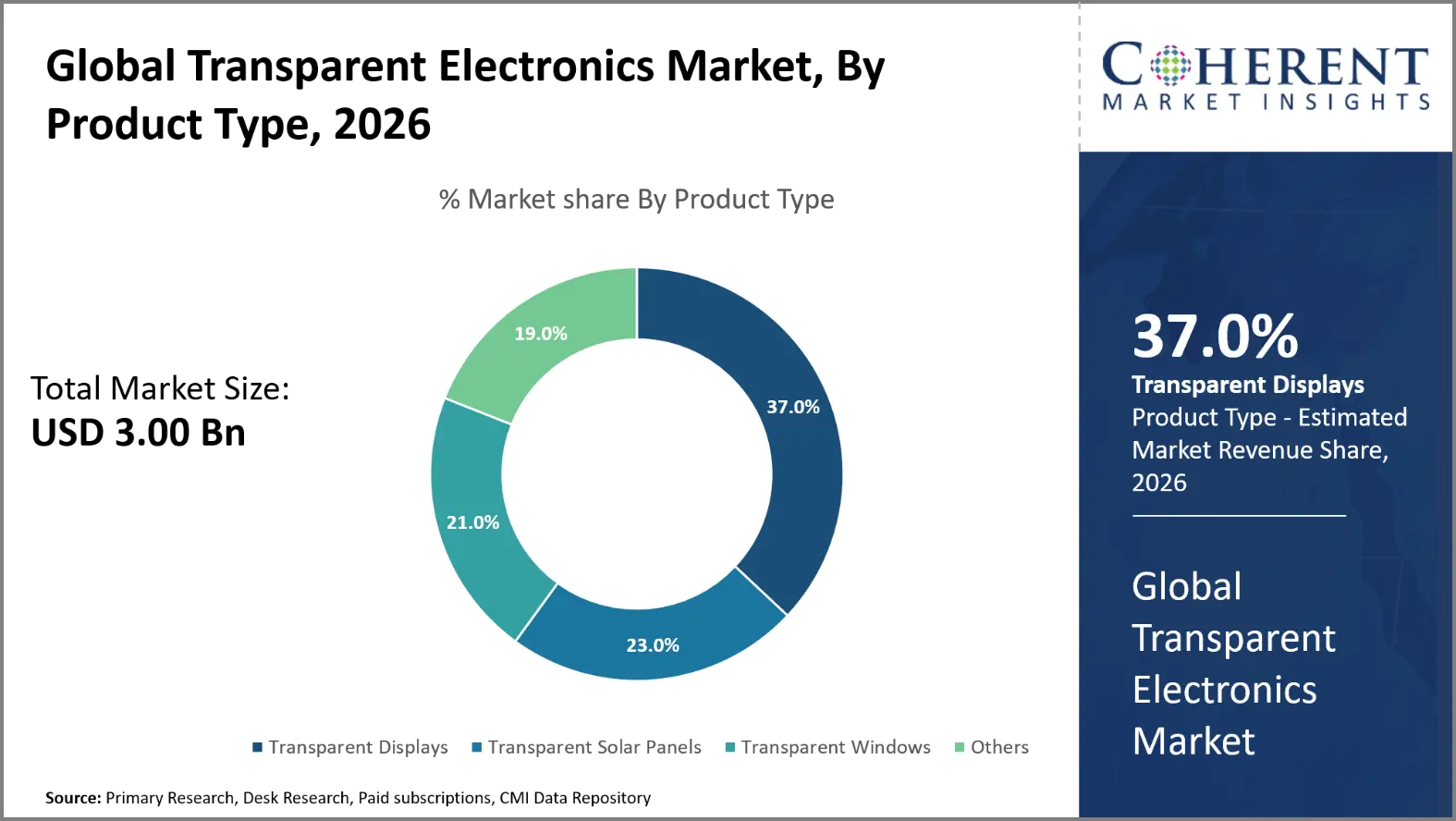
Why Does Transparent Displays Dominate the Global Transparent Electronics Market?
The transparent displays segment is expected to account for 37.0% of the global transparent electronics market share in 2026. The demand for immersive visual experiences is increasing in retail, automotive and consumer electronics sectors, driving the use of transparent displays. Increasingly, automakers are embedding transparent display technology into windshields, dashboards and passenger information systems. Retailers employ clear displays to view products and keep sight of inventory and store interiors. Innovations in transparent OLED and microLED technology are raising brightness, resolution, durability and energy efficiency. These advances are opening the door to larger commercialization in automotive, retail, advertising and smart buildings applications. LG Electronics, for example, constructed a 380-inch Transparent OLED display at NEWoMan TAKANAWA in Tokyo in 2025. The installation used sixteen 55-inch transparent OLED panels arranged in an 80/2 configuration. The deployment combines digital content with an open retail and event environment.
- Current Industry Events of 2026
- Market Size Estimation
- Regional Breakdown
- Competitive Landscape
- Customer Intelligence
- Segmental Analysis
- Pricing Analysis
- Key Market Drivers, Challenges & Future Trends
- Customized Insights Section
Why is Thin Films the Most Preferred Form Factor?
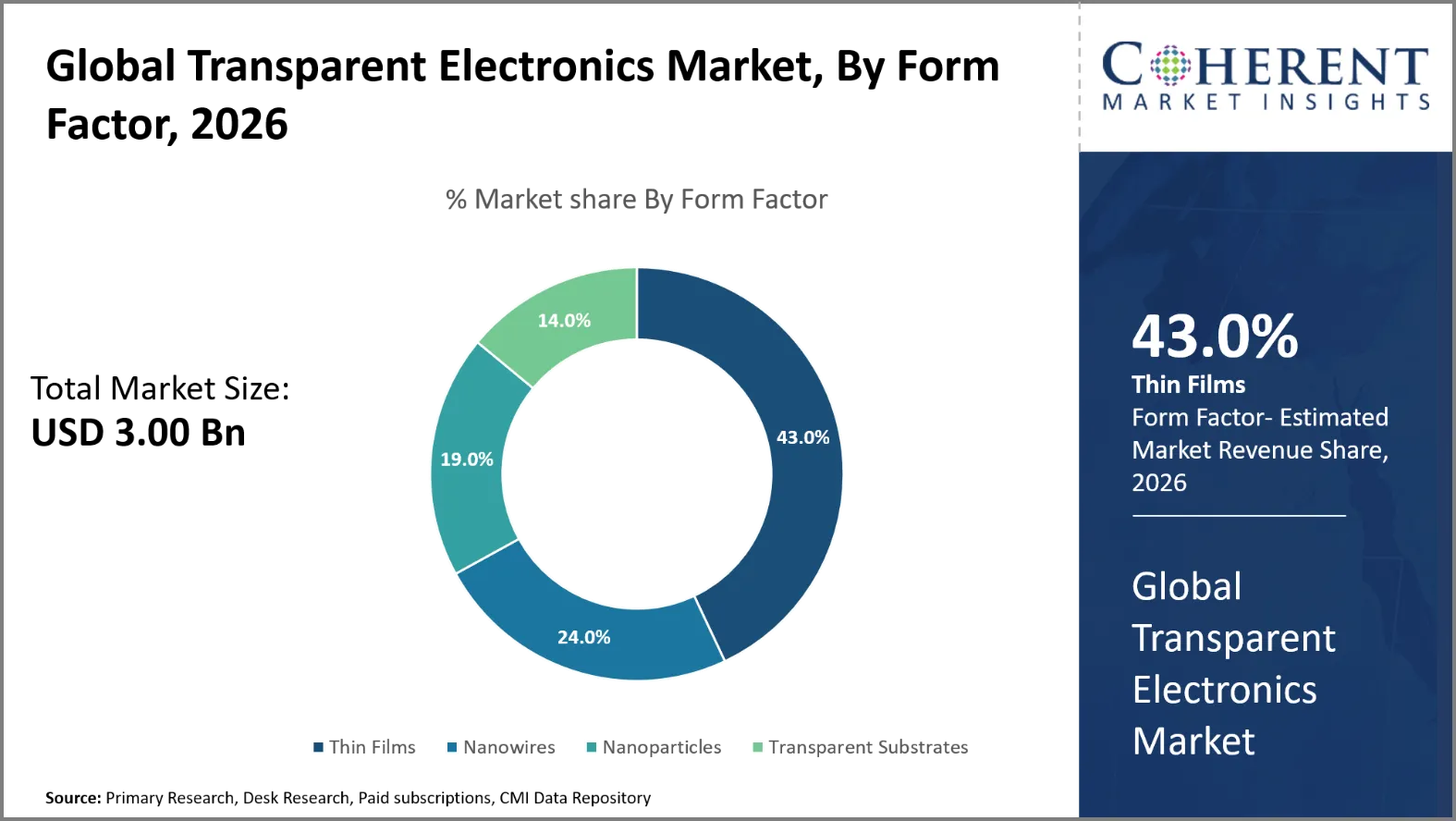
The thin films segment is expected to account for 43.0% of the global transparent electronics market share in 2026. Thin films have the advantage of light weight manufacturing and compact integration for a wide variety of transparent electrical devices. The thinness of the films enables flexible designs for displays, sensors, smart windows and solar applications. Manufacturers can apply functional electronic layers on glass, plastic and other compatible substrates. This flexibility opens the possibility of integration in curved surfaces and electrical systems where space is limited. The demand for lightweight and flexible electronics further drives the thin film usage in various applications. On July 23, 2026, Seiko Epson Corporation and Epson X Investment Corporation have just made an additional investment in Gosan Tech Co., Ltd. through a joint fund, EP-GB L.P. Gosan Tech is a South Korean company that has inkjet technology that may be applied in a range of industrial industries. The investment supports industrial inkjet systems for OLED fabrication and perovskite solar cells.
Consumer Electronics Dominates the Global Transparent Electronics Market
The consumer electronics segment is expected to account for 28.0% of the global transparent electronics market share in 2026. More and more consumer electronics makers are incorporating transparent screens into televisions, smartphones, wearables and augmented reality devices. They offer immersive interfaces without compromising on visibility and enable new product ideas. Another driver for manufacturers to develop transparent display technologies is the increasing consumer demand for larger interactive screens. Advances in transparent OLED technology increase image quality, brightness and device integration. Growing investments in sophisticated display technology are driving the broader use of these technologies across consumer electronic products. On September 23, 2025, Vuzix Corporation and TCL China Star Optoelectronics Technology announced long-term partnership to co-advance MicroLED displays and waveguide optics integration. The agreement is intended to provide the smart glasses industry with scalable, cost-effective and integration friendly optical solutions.
Current Events and their Impact
Current Events | Description and its Impact |
European Union - Ecodesign Requirements for Electronic Displays, Regulation (EU) 2019/2021 |
|
European Union - Ecodesign for Sustainable Products Regulation, Regulation (EU) 2024/1781 |
|
Transparent Electronics Market Dynamics
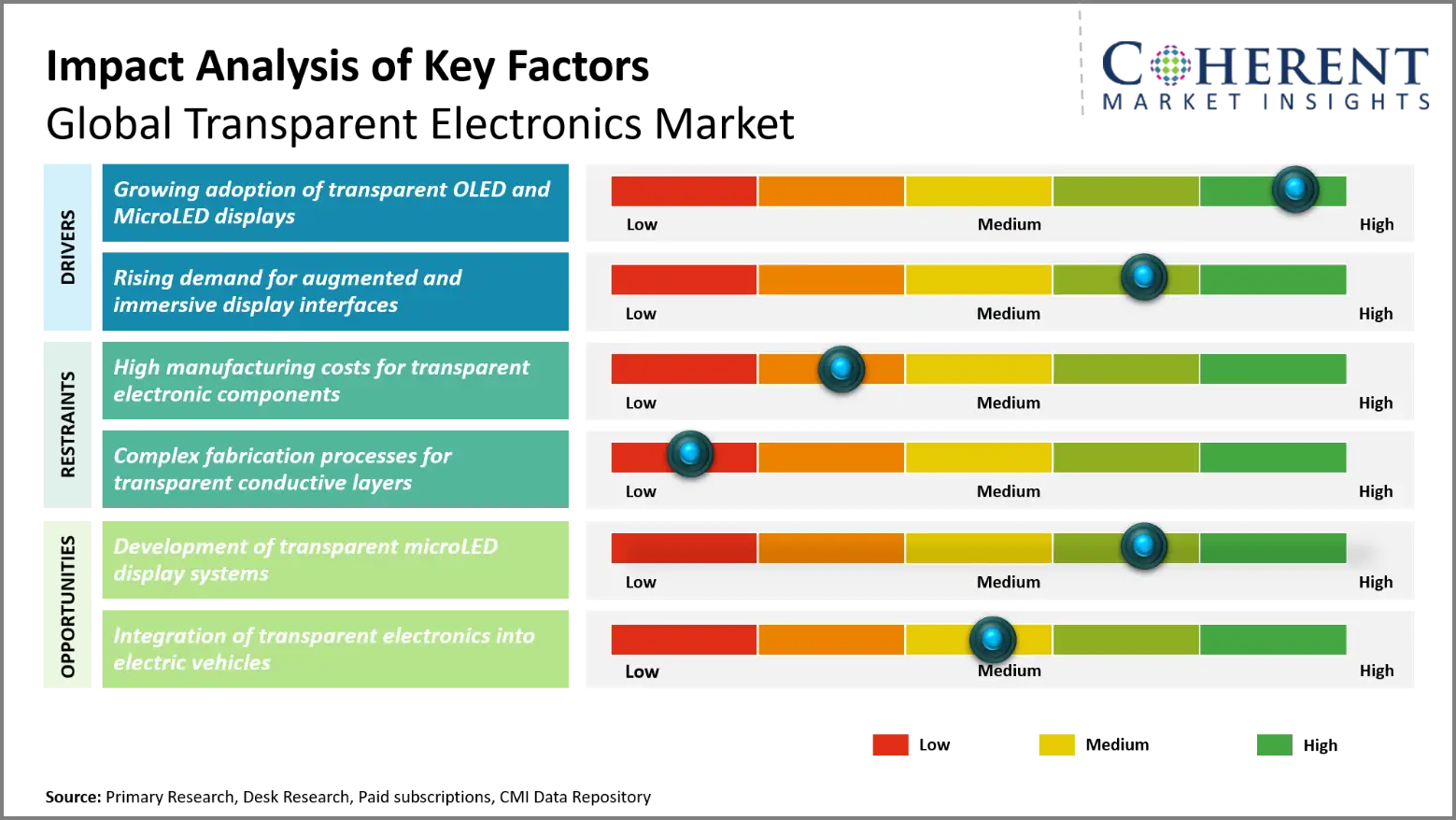
Market Drivers
- Growing adoption of transparent OLED and MicroLED displays: Transparent OLED and MicroLED displays are experiencing increased adoption in automotive, retail, consumer electronics, and architectural applications. They are made of transparent materials so that the digital information can be presented while keeping see-through visibility on the display surface. Automotive manufacturers are investigating these technologies for windshields, dashboards, and passenger information systems. Transparent displays allow retailers to promote products without blocking items. Wider commercial adoption is underpinned by improvement in brightness, contrast, durability and manufacturing methods. In May 2026, BOE Technology Group introduced a high-transparency OLED panel. The company developed the panel around transparency as a key display performance characteristic. BOE also announced research supporting a proposed transparent-display evaluation standard covering color, depth, clarity, and dynamic range.
- Rising demand for augmented and immersive display interfaces: There is an increasing demand for augmented and immersive display interfaces for consumer electronics, automotive systems, retail environments and industrial applications. This feature allows augmented reality interfaces, navigation systems, interactive product demonstrations and smart workplace applications. Automotive manufacturers are developing transparent interfaces that can present driving information within the driver's field of view. Continued development of spatial computing technologies is creating additional applications for transparent electronic displays. On June 17, 2026, Samsung Display showcased next-generation extended reality displays at AWE USA 2026. The company demonstrated a 1.3-inch RGB OLEDoS display reaching ultra-high brightness. Samsung also presented prototype smart glasses using a 0.62-inch RGB OLEDoS display.
Emerging Trends
- Transparent MicroLED Integration: Transparent MicroLED technology is developing toward brighter, thinner, and energy-efficient displays. The manufacturers are now developing higher resolution technologies for automotive, retail, wearable and architectural applications, allowing immersive interfaces that do not fully block backdrop visibility.
- Smart Window Integration: Transparent electronics are being combined with smart windows for buildings, vehicles and transportation infrastructure. Electrochromic and photovoltaic technologies provide dynamic light management, energy generation, and digital functionalities in transparent surfaces, enabling multifunctional architectural solutions.
- Automotive Transparent Interfaces: The automotive industry is creating transparent displays for windshields, side windows, dashboards and passenger information systems. These interfaces can display navigation, safety alerts and vehicle information while keeping the driver’s eyes on the road, enabling innovative cockpit designs and connected car experiences.
- Transparent Photovoltaic Electronics: Transparent photovoltaic technologies are becoming more popular for windows, façades, greenhouses and vehicle surfaces. These technologies integrate power generation and light transmission, leading to energy-producing transparent structures for everything from commercial buildings to transportation.
Regional Insights
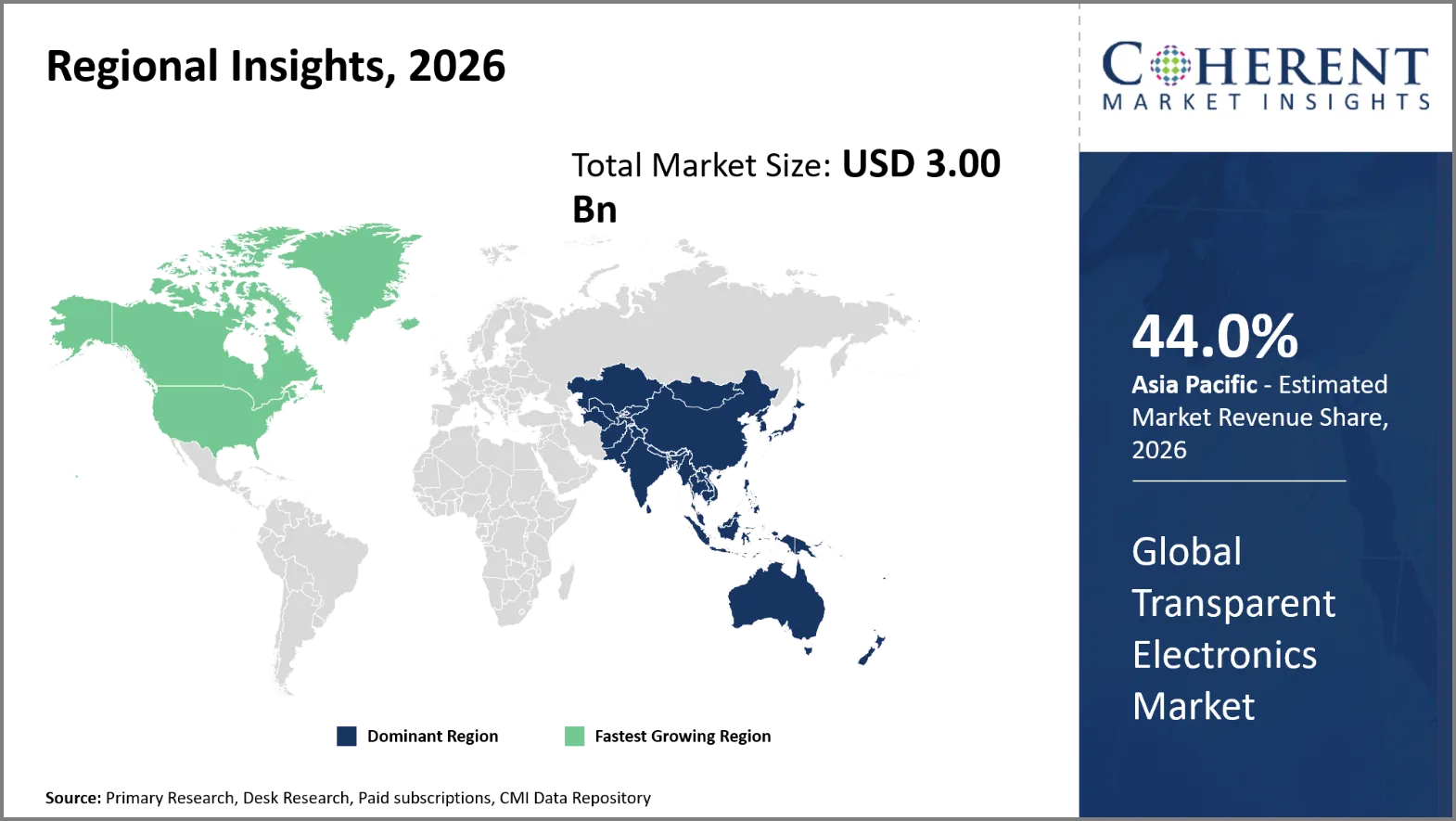
Why is Asia Pacific a Strong Market for Transparent Electronics?
Asia Pacific is expected to account for a market share of 44.0% in 2026. Asia Pacific is benefiting from the concentration of display manufacturing in China, South Korea and Japan. China is supporting transparent electronics by researching better conductive materials and making photovoltaic cells. South Korean manufacturers continue to innovate transparent OLED and MicroLED displays. Japanese firms have expertise in display materials, precision electronics and optical components. Samsung Electronics demonstrated Transparent MicroLED at Integrated Systems Europe 2025. LG Display also demonstrated transparent OLED automotive applications at K-Display 2025. These activities strengthen regional supply chains for transparent displays and related components.
Why Does North America Transparent Electronics Market Exhibit High Growth?
North America is expected to register the fastest growth with a CAGR of 10.2% over the forecast period. It is projected to account for 29.0% of the global transparent electronics market in 2026. The region’s growth is strongly connected with transparent interfaces for connected vehicles and advanced driver assistance systems. Corning develops automotive glass supporting transparent head-up displays and augmented reality applications. Its solutions target windshields, windows, sunroofs, and interior display surfaces. Corning also partners with Hyundai Mobis on augmented reality head-up display systems. Mercedes-Benz uses Corning automotive glass within its electric EQS MBUX Hyperscreen. These deployments demonstrate increasing integration between optical glass, vehicle electronics, sensing, and immersive interfaces.
Global Transparent Electronics Market Outlook for Key Countries
Why is China Emerging as a Major Hub in the Transparent Electronics Market?
China benefits from domestic research into transparent conductors, photovoltaic components, and advanced display materials. In 2025, the Institute of Physics, Chinese Academy of Sciences announced the discovery of an intrinsic transparent metal. The material addresses the conventional trade-off between conductivity and transparency for transparent electronic components. Transparent conductors support touchscreens, solar cells, light-emitting diodes, electrochromic devices, and transparent displays. China also maintains substantial display manufacturing capabilities supporting domestic development of advanced electronic interfaces. These research activities could improve material options for future transparent electronics and transparent photovoltaic applications.
Is U.S. the Next Growth Engine for the Transparent Electronics Market?
U.S. growth driven by automobile augmented reality, head-up displays, and new optical materials. Corning produces technical glass for transparent automotive interfaces and augmented reality systems. Its automotive offering is for windshields, windows, sunroofs, dashboards and sensor applications. Corning also cites digitally transparent windshield displays as an important automotive application. Its glass technologies are engineered for optical clarity, durability, low weight and display compatibility. These capabilities support integration of transparent electronics with connected vehicles and future autonomous driving environments.
Germany Transparent Electronics Market Analysis and Trends
Germany is strengthening transparent electronics through advanced microdisplay research and international semiconductor collaboration. Fraunhofer Institute for Photonic Microsystems achieved 45% transparency in a CMOS OLED microdisplay. The institute is also leading the DE-TW-MicroView project with Taiwanese research partners. The project targets transparent augmented reality displays exceeding 10,000 pixels per inch and 65% light transmission. It combines CMOS circuits, high-resolution MicroLEDs, and metalens arrays. These developments directly target industrial, medical, mobility, wearable, and augmented reality applications.
Japan Transparent Electronics Market Analysis and Trends
Japan boasts a long history of excellence in precise electronics, optical technology, and innovative display components. Japanese display development is progressively converging with vehicle interfaces, smart surfaces and small electronic devices. Transparent OLED technology can enable see-through interfaces that limit the environment around the traditional opaque display. Japanese makers are also part of the larger OLED and semiconductor supply chain that supports advanced display making. The country’s prowess in precision manufacturing provides capabilities for thin substrates, optical components, sensors and transparent conductive structures. These features enable transparent electronics for mobility, consumer products, industrial equipment and smart settings.
South Korea Transparent Electronics Market Analysis and Trends
South Korea benefits from advanced OLED manufacturing and continuous development of transparent automotive display technologies. LG Display demonstrated a 12.6-inch transparent OLED at K-Display 2025 for vehicle armrests. The company also developed transparent OLED technology offering 45% transparency. Its transparent OLED products are available in 30-inch, 55-inch, and 77-inch configurations. LG Display has additionally developed transparent OLED concepts for autonomous driving environments. These developments connect transparent electronics with automotive interiors, infotainment, spatial design, and next-generation mobility interfaces.
Global Transparent Electronics Market - Smart Window Installations Using Electrochromic, Photochromic, And Photovoltaic Technologies:
Technology | Installation | Location | Installation area |
Electrochromic | Rio Business Park | Bengaluru, India | 200,000 sq ft |
Electrochromic | Al-Muntada exhibition space | United Arab Emirates | 400 m² building |
Electrochromic | Large-area WO₃ smart window demonstration | Multiple global cities | 6,000 cm² |
Photochromic | WO₃ photochromic window film | Toronto, Canada | Full-scale window test |
Photovoltaic | NEXT Energy headquarters façade | Santa Barbara, U.S. | 100 sq ft |
Photovoltaic | Transparent OPV window units | Santa Barbara, U.S. | Six 40 × 60-inch windows |
How is Development of Transparent microLED Display Systems Creating New Growth Opportunities in the Transparent Electronics Market?
Advancements in transparent microLED systems are leading to the development of high-brightness displays in car windshields, retail windows, and augmented reality interfaces. Samsung Display showcased transparent MicroLED technology at Integrated Systems Europe 2025, demonstrating its use in see-through displays. MicroLED architecture can provide great brightness with transparency and can be used for displays subjected to high ambient light. Transparent surfaces in automotive applications are a promising approach to display navigation and safety information without completely obscuring the external view. In retail installations, digital content can be combined with the presence of actual items. These features broaden the scope of transparent electronics beyond traditional OLED applications and provide options for premium display integration.
On November 25, 2024, Smartkem and AUO announced a partnership to jointly develop the world’s first sophisticated rollable, transparent microLED display based on Smartkem’s technology. The project will use the organic thin film transistor technology of Smartkem and the MicroLED expertise of AUO. The companies are developing flexible displays using transparent, non-birefringent plastic substrates for automotive and consumer applications.
Market Players, Key Development, and Competitive Landscape
Key Developments
- On January 6, 2026, Smartkem, Inc. announced that it has entered into a 12-month paid proof-of-concept agreement with a global consumer electronics leader to develop next-generation smart wearables that incorporate a conformable MicroLED display utilizing Smartkem’s proprietary organic thin-film transistor (OTFT) technology.
- On May 16, 2025, AUO made a strong impression on the global stage at SID Display Week 2025, securing two international honors. Its 64-inch transparent Micro LED display earned the Best Micro LED-Based Technology award.
Competitive Landscape
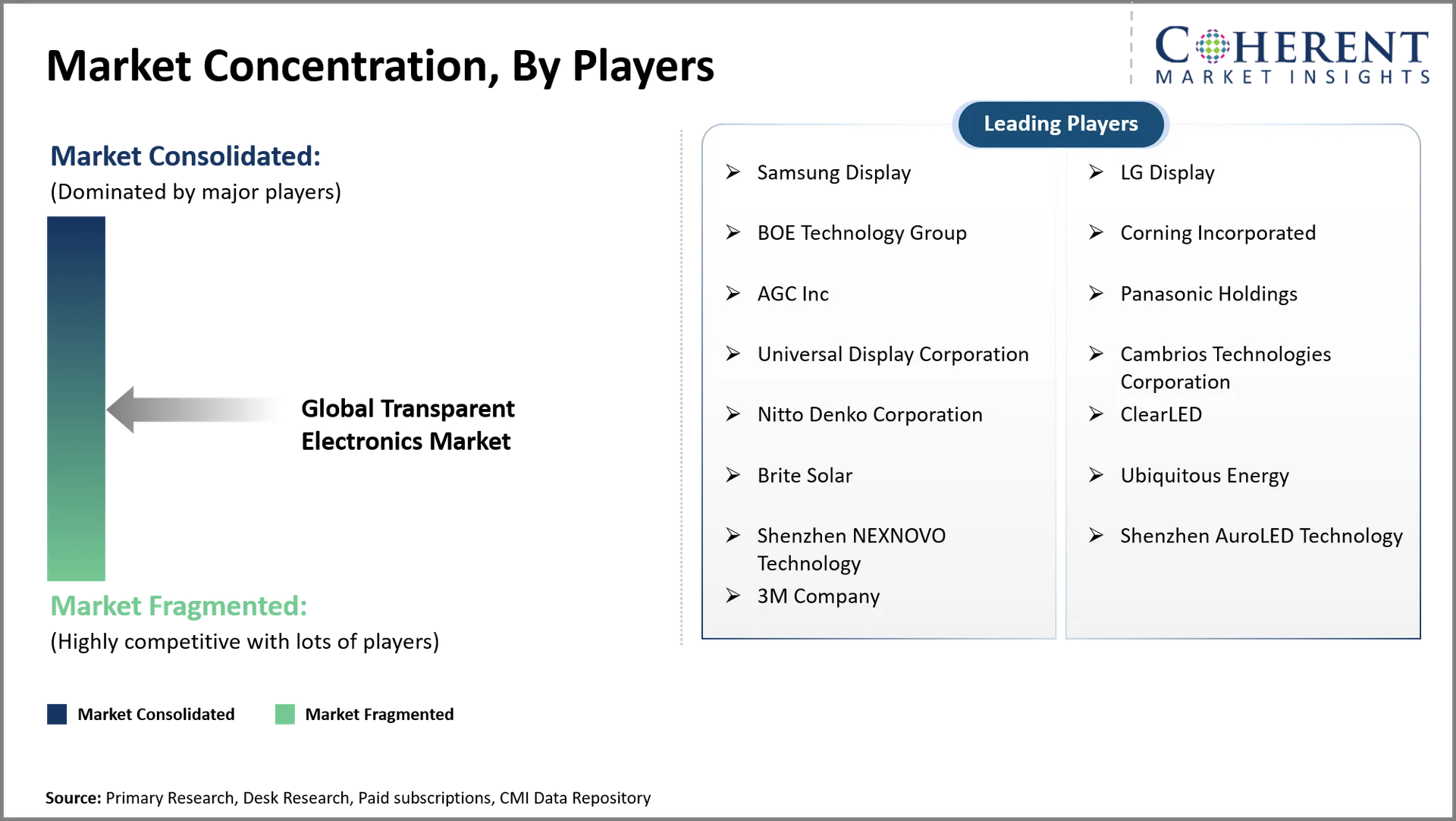
Leading players are competing through transparent OLED, MicroLED, automotive displays, and premium commercial installations. Samsung Display invests on auto OLED, flexible designs and superior MicroLED development The 2025 mobility expo brought the DRIVE automotive OLED brand and other future cockpit designs. LG Display promotes transparent OLED, tandem OLED, plastic substrates, automotive integration. It provides a digital cockpit platform with a 12.3-inch transparent OLED cluster for autonomous driving scenarios. LG Electronics pushes forward with commercial applications with massive transparent OLED installations. Its 380-inch transparent OLED exhibit at Tokyo’s NEWoMan TAKANAWA demonstrates retail and architectural potential. Corning focuses on the enabling glass layer for transparent automotive electronics. Its technologies target head-up displays, augmented reality interfaces, sensors, windshields, windows, and sunroofs.
Transparent Electronics Market Report Coverage | |||
Report Coverage | Details | ||
Base Year | 2025 | Market Size in 2026: | USD 3.00 Bn |
Historical Data For: | 2020 To 2024 | Forecast Period: | 2026 To 2033 |
Forecast Period 2026 To 2033 CAGR: | 9.6% | 2033 Value Projection: | USD 12.00 Bn |
Geographies covered: |
| ||
Segments covered: |
| ||
Companies covered: | Samsung Display, LG Display, BOE Technology Group, Corning Incorporated, AGC Inc, Panasonic Holdings, Universal Display Corporation, Cambrios Technologies Corporation, Nitto Denko Corporation, ClearLED, Brite Solar, Ubiquitous Energy, Shenzhen NEXNOVO Technology, Shenzhen AuroLED Technology, 3M Company | ||
Growth Drivers: |
| ||
Restraints & Challenges: |
| ||
Analyst Opinion (Expert Opinion)
- The industry's next phase should shift from standalone transparent screens toward integrated transparent electronic surfaces. Automotive applications offer particularly strong potential because displays can combine information delivery with windshield and cabin functionality. Transparent OLED should remain important for automotive clusters, passenger displays, and retail signage. Transparent MicroLED can gain importance where higher brightness and longer operating life are required. Examples of this technology convergence include Samsung Display’s MicroLED research and automotive OLED expansion.
- Automotive, upscale retail and architectural applications should be the biggest prospects. Transparent screens can be embedded directly into dashboards, windshields and passenger interfaces in automotive systems. LG Display’s transparent OLED cluster is an example of how these systems may complement the autonomous driving environment. Japan also has attractive application prospects, as transparent OLED and MicroLED are entering large commercial venues. LG’s 2025 Tokyo installation shows how it may be used in practice across huge retail sites.
- Players looking for an edge should focus on application-specific engineering, not just transparent panels. Automotive suppliers should integrate display, optical glass, sensor, thermal management and software know-how. The display producers should increase brightness, transparency, durability and visibility at changing ambient circumstances. Companies should also create modular panels which allow for huge installations and integration over curved surfaces. LG's modular transparent OLED signage demonstrates how scalable panel architectures can support unconventional commercial spaces.
Speak to the analyst
Want personalized insights?
Take the findings above to one of our principal consultants, or have the report rebuilt around the segments, geographies and competitors you actually track.
Market Segmentation
- Product Type Insights (Revenue, USD Billion, 2021 - 2033)
- Transparent Displays
- Transparent Solar Panels
- Transparent Windows
- Others
- Form Factor Insights (Revenue, USD Billion, 2021 - 2033)
- Thin Films
- Nanowires
- Nanoparticles
- Transparent Substrates
- Application Insights (Revenue, USD Billion, 2021 - 2033)
- Consumer Electronics
- Automotive
- Construction
- Healthcare
- Military and Defense
- Security Systems
- Smart Windows
- Industrial Electronics
- Regional Insights (Revenue, USD Billion, 2021 - 2033)
- North America
- U.S.
- Canada
- Latin America
- Brazil
- Argentina
- Mexico
- Rest of Latin America
- Europe
- Germany
- U.K.
- Spain
- France
- Italy
- Russia
- Rest of Europe
- Asia Pacific
- China
- India
- Japan
- Australia
- South Korea
- ASEAN
- Rest of Asia Pacific
- Middle East
- GCC Countries
- Israel
- Rest of Middle East
- Africa
- South Africa
- North Africa
- Central Africa
- North America
- Key Players Insights
- Samsung Display
- LG Display
- BOE Technology Group
- Corning Incorporated
- AGC Inc
- Panasonic Holdings
- Universal Display Corporation
- Cambrios Technologies Corporation
- Nitto Denko Corporation
- ClearLED
- Brite Solar
- Ubiquitous Energy
- Shenzhen NEXNOVO Technology
- Shenzhen AuroLED Technology
- 3M Company
Sources
Primary Research Interviews
- Transparent Electronics Manufacturers & OEMs
- Display Technology Developers & Innovators
- Consumer Electronics Retailers & Distributors
- Semiconductor & Materials Suppliers
Magazines
- Electronics Weekly
- IEEE Spectrum Magazine
- Display Daily
- Photonics Media Magazine
Journals
- Journal of Display Technology (IEEE)
- Advanced Electronic Materials (Wiley)
- Thin Solid Films (Elsevier)
Associations
- Society for Information Display (SID)
- Consumer Technology Association (CTA)
- International Electronics Manufacturing Initiative (iNEMI)
- Semiconductor Industry Association (SIA)
Public Domain Sources
- U.S. Department of Energy (DOE) – Energy Efficiency Reports
- European Commission – Digital & Electronics Industry Reports
- World Intellectual Property Organization (WIPO) – Patent Databases
- National Institute of Standards and Technology (NIST)
Proprietary Elements
- CMI Data Analytics Tool
- Proprietary CMI Existing Repository of Information for the last 10 years
Get access to 250+ pages report
Every segment, forecast, competitor profile and data table behind the analysis above — available for instant download.
- ESOMAR Member
- ISO 9001:2015 Certified
- D-U-N-S Registered
- GDPR & CCPA Compliant
Missing comfort of reading report in your local language? Find your preferred language:
Frequently Asked Questions
The global transparent electronics market is expected to stand at USD 3.00 Bn in 2026 and is expected to reach USD 12.00 Bn by 2033.
The CAGR of the global transparent electronics market is projected to be 9.6% from 2026 to 2033.
Growing adoption of transparent OLED and MicroLED displays and Rising demand for augmented and immersive display interfaces are the major factors driving the growth of the global transparent electronics market.
High manufacturing costs for transparent electronic components and Complex fabrication processes for transparent conductive layers are the major factors hampering the growth of the global transparent electronics market.
In terms of product type, transparent displays segment is estimated to dominate the market revenue share in 2026.
Transparent electronics are electronic components designed to transmit visible light while performing functions such as displaying, sensing, switching, or generating electricity.
Transparent MicroLED can provide higher brightness and durability for automotive, retail, and architectural applications.