

U.S. Hearing Aids Market Size and Forecast – 2026 To 2033
The U.S. hearing aids market is expected to grow from USD 3,897.0 Mn in 2026 to USD 5,663.1 Mn by 2033, registering a compound annual growth rate (CAGR) of 5.5% from 2026 to 2033. The U.S. hearing aids market is poised for significant expansion, fueled by the rising prevalence of hearing loss among the aging population.
According to the National Institute on Deafness and Other Communication Disorders (NIDCD), based on the 2012 National Health Interview Survey (NHIS) data, approximately 37.5 million U.S. adults (15% of those aged 18 and older) report some degree of hearing difficulty. Based on 2015–2020 National Health and Nutrition Examination Survey (NHANES) data, one in three adults aged 65–74 and nearly half of those aged 75 and older experience hearing loss, creating sustained demand for hearing aids and hearing care services.
Key Takeaways of the U.S. Hearing Aids Market
- Hearing aid devices are projected to hold 68.3 % of the U.S. hearing aids market share in 2026, making it the dominant product type segment, owing to continuous advancements in digital hearing technologies and expanding access to hearing care. The segment continues to benefit from regulatory oversight that ensures the safety and performance of hearing devices. For instance, the U.S. Food and Drug Administration (FDA) maintains a dedicated Hearing Aids and Personal Sound Amplification Products (PSAPs) regulatory framework, requiring hearing aids marketed in the U.S. to comply with applicable medical device requirements, including labeling, quality system, and post-market safety regulations.
- Sensorineural hearing loss is projected to hold 52.3 % of the U.S. hearing aids market share in 2026, making it the dominant type of hearing loss segment, owing to its irreversible nature and the need for long-term hearing rehabilitation. The segment is supported by national clinical recommendations promoting timely hearing intervention. For instance, the U.S. Preventive Services Task Force (USPSTF) evaluates evidence on hearing loss screening in adults and highlights the importance of identifying hearing impairment to facilitate appropriate intervention including hearing aid use where clinically indicated.
- The adults segment is projected to hold 66.3 % of the U.S. hearing aids market share in 2026, making it the dominant patient type segment, driven by increasing access to hearing healthcare and reimbursement support for eligible populations. The segment continues to benefit from public healthcare coverage policies. For instance, the U.S. Department of Veterans Affairs (VA) provides hearing aids and related audiology services to eligible veterans through its nationwide healthcare system, making it one of the largest providers of hearing healthcare in the U.S. and supporting sustained demand for adult hearing aid devices.
- Expansion of AI-Enabled Self-Fitting Hearing Aids: The growing adoption of AI-powered self-fitting hearing aids is emerging as a key driver in the U.S. These devices automatically optimize sound settings based on the user's listening environment, reducing dependence on repeated in-clinic adjustments. The technology enhances user convenience, personalization, and overall hearing performance, encouraging higher adoption among first-time users.
- Integration of Hearing Aids into Consumer Digital Health Ecosystems: The increasing integration of hearing aids with smartphones, smartwatches, and digital health platforms presents a significant growth opportunity. Advanced hearing aids now support remote programming, health tracking, voice assistants, and seamless audio streaming, transforming them into connected wearable health devices. This convergence is expected to attract younger adults and technology-oriented consumers while expanding the market beyond traditional hearing care.
Segmental Insights
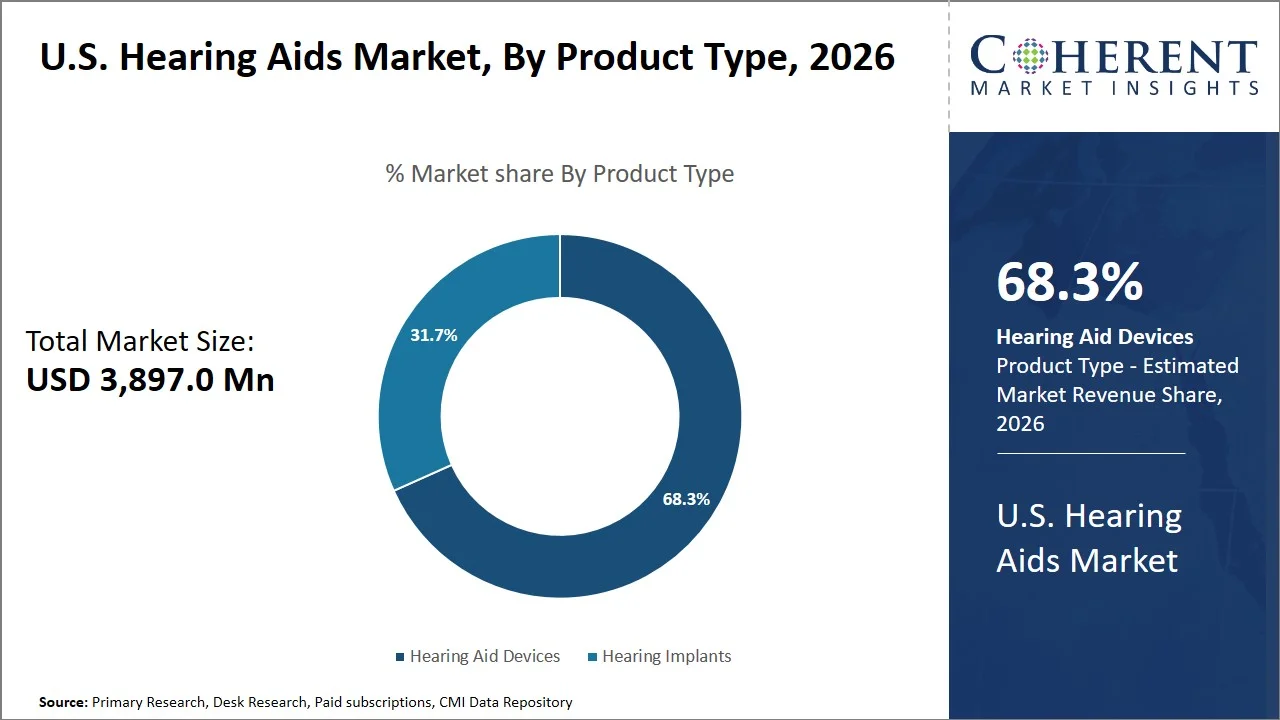
Why Do Hearing Aid Devices Dominate the U.S. Hearing Aids Market?
Hearing aid devices are projected to hold a market share of 68.3% in 2026, due to their versatility, applicability in different stages of hearing loss, non-invasive methodology for implementation, and technological innovation. Technological advancements such as digital sound processing, wireless connectivity, rechargeable hearing aids, compact designs have contributed to increased user comfort and have helped in achieving higher penetration rates besides the rising prevalence of OTC and prescription hearing aids. For instance, in October 2024, U.S.-based hearing aid manufacturer, Starkey Laboratories, Inc. introduced its Edge AI hearing aid platform with the G2 Neuro Processor, advanced AI-powered speech enhancement, noise control, and health tracking technology, reflecting the industry’s attention to smart hearing solutions.
- Current Industry Events of 2026
- Market Size Estimation
- Regional Breakdown
- Competitive Landscape
- Customer Intelligence
- Segmental Analysis
- Pricing Analysis
- Key Market Drivers, Challenges & Future Trends
- Customized Insights Section
Why Does Sensorineural Hearing Loss Represent the Largest Type of Hearing Loss Segment in the U.S. Hearing Aids Market?
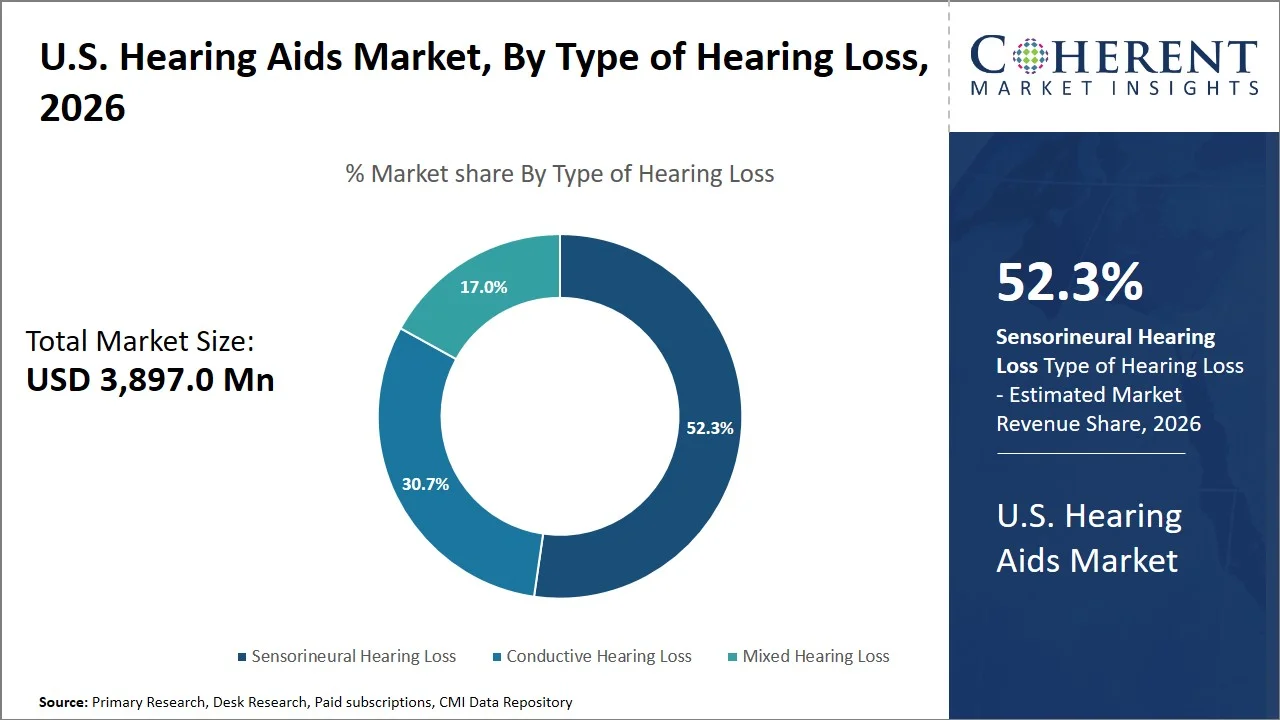
Sensorineural hearing loss is projected to hold 52.3% of the market share in 2026, due to its prevalent nature, irreversibility and increased dependency on hearing aids as an ideal alternative treatment option. Higher incidence of hearing impairment due to increasing cases associated with aging, extended noise exposure as well as the ever-growing burden of various long-term ailments provides sustained requirement for innovative rehabilitation solutions of hearing devices. For instance, the National Institute on Deafness and Other Communication Disorders (NIDCD) funds the Auditory Development and Restoration Program that examines fundamental biological processes in hearing and fosters research toward therapeutic intervention and regenerative approaches for a wide range of inner-ear disorders, including sensorineural hearing loss.
Adults Segment Dominates the U.S. Hearing Aids Market
The adults segment is expected to hold 66.3% of the U.S. hearing aids market share in 2026, owing to the increased prevalence of age induced hearing loss and increased exposures towards high workplace and occupational noise. Increasing perception of healthy hearing and demand for connected, discreet and smart devices enabled by AI in hearing are fueling greater pace in adult’s purchase decisions to maintain communication and quality of life. For instance, the American Academy of Audiology (AAA) designated October as National Audiology Awareness Month to encourage routine hearing evaluations, raise public awareness of hearing health, and promote timely intervention, supporting greater adoption of hearing care services among adults.
Current Events and their Impact
Current Events | Description and its Impact |
U.S. Food and Drug Administration (FDA) Authorizes the First Over-the-Counter Hearing Aid Software (September 2024) |
|
Centers for Medicare & Medicaid Services (CMS) Finalizes CY 2025 Medicare Physician Fee Schedule for Audiology Services (November 2024; Effective January 2025) |
|
U.S. Hearing Aids Market Dynamics
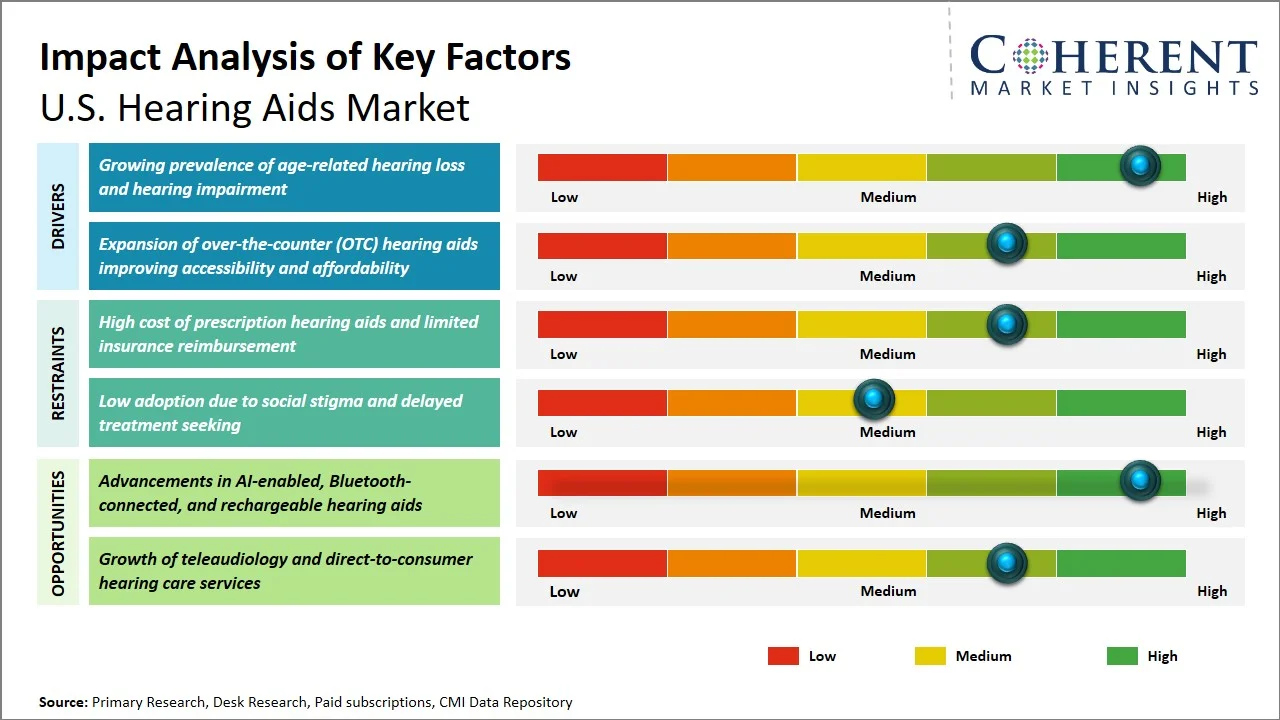
Market Drivers
- Growing prevalence of age-related hearing loss and hearing impairment: The growing elderly population in the U.S. is a major driver of the hearing aids market, as age-related hearing impairment becomes increasingly common with advancing age. Rising life expectancy and greater awareness of hearing health are encouraging earlier diagnosis and treatment, supporting sustained demand for hearing aid devices. For instance, the U.S. Census Bureau projects that by 2030, all Baby Boomers will be aged 65 years or older, and one in every five U.S. residents will be of retirement age, significantly expanding the population requiring hearing healthcare and assistive hearing technologies.
- Expansion of over-the-counter (OTC) hearing aids improving accessibility and affordability: The expansion of over-the-counter (OTC) hearing aids is significantly improving access to hearing care by enabling adults with perceived mild to moderate hearing loss to purchase hearing aids without a prescription or audiologist visit. This has reduced cost barriers, increased consumer convenience, and broadened product availability through retail and online channels, supporting higher adoption rates. For instance, according to the U.S. Food and Drug Administration (FDA), the OTC hearing aid regulation became effective in October 2022, establishing a new category of hearing aids that can be sold directly to consumers, thereby expanding access to affordable hearing care across the United States.
Emerging Trends
- Rising Adoption of OTC Hearing Aids Through Retail and Pharmacy Channels: The expansion of retail pharmacies, consumer electronics stores, and online marketplaces as distribution channels is reshaping the U.S. hearing aids market. Increasing availability of U.S. FDA-regulated OTC hearing aids through these channels is improving consumer convenience, broadening market reach, and encouraging earlier intervention for individuals with mild to moderate hearing loss.
- Increasing Personalization Through Real-Time Hearing Environment Analytics: Manufacturers are increasingly incorporating real-time environmental sensing into hearing aids, allowing devices to automatically adapt to changing acoustic environments such as conversations, traffic, or crowded spaces. This trend is enhancing speech clarity, reducing listening fatigue, and improving long-term user satisfaction, driving demand for premium hearing aid solutions.
U.S. Hearing Aids Market: Technological Evolution and Market Impact
Technology Trend | Description | Impact on Market |
AI-Powered Sound Processing | Automatic optimization of speech and environmental noise | Improves speech intelligibility and premium device adoption |
Rechargeable Lithium-Ion Batteries | Longer battery life and elimination of disposable batteries | Enhances user convenience and replacement demand |
Bluetooth LE Audio & Auracast | Direct audio streaming from public venues and consumer devices | Improves accessibility and connected hearing experiences |
Remote Programming & Teleaudiology | Virtual fitting and follow-up through mobile applications | Expands access to hearing care, particularly in rural areas |
How are advancements in AI-enabled, Bluetooth-connected, and rechargeable hearing aids creating new growth opportunities in the U.S. hearing aids market?
Increasing proliferation of digital hearing devices opens significant opportunity for growth of the U.S. hearing aids market via enhanced treatment outcomes and increased applications of hearing care. As technology continues, particularly to the innovation of the AI driven sound therapy solutions as well as other advanced personal devices such as tailored hearing support and connectable technologies, they continue to lead positive developments which can more easily access hearing healthcare. For instance, in June 2025 the U.S. FDA approved SoundHealth’s SONU Band for Pediatrics, making the personalized and AI-powered sound therapy for children emphasizing ongoing U.S. Regulators’ approval and receptiveness to emerging and innovative digital hearing technology solutions.
Market Players, Key Development, and Competitive Landscape
Key Developments
- In November 2025, Widex expanded its Allure hearing aid portfolio in the U.S. by introducing new device form factors, accessories, and enhancements to its fitting platform. The launch strengthens personalization, clinician workflow efficiency, and user experience, reinforcing the industry's focus on advanced digital hearing solutions and expanding product offerings in the U.S. market.
- In July 2025, Nano Hearing Aids announced the return of its hearing aid manufacturing operations to the United States, reinforcing its commitment to domestic production and supply chain resilience. The initiative is expected to improve product availability, shorten delivery timelines, and support local manufacturing capabilities, reflecting the growing emphasis on U.S.-based production within the hearing aids industry.
- In March 2025, hearX and Eargo completed their merger to form LXE Hearing, creating a company focused on expanding access to prescription and over-the-counter hearing solutions in the U.S. The combined organization leverages hearX's digital hearing technology and Eargo's direct-to-consumer expertise to strengthen innovation and market reach across the hearing care sector.
Competitive Landscape
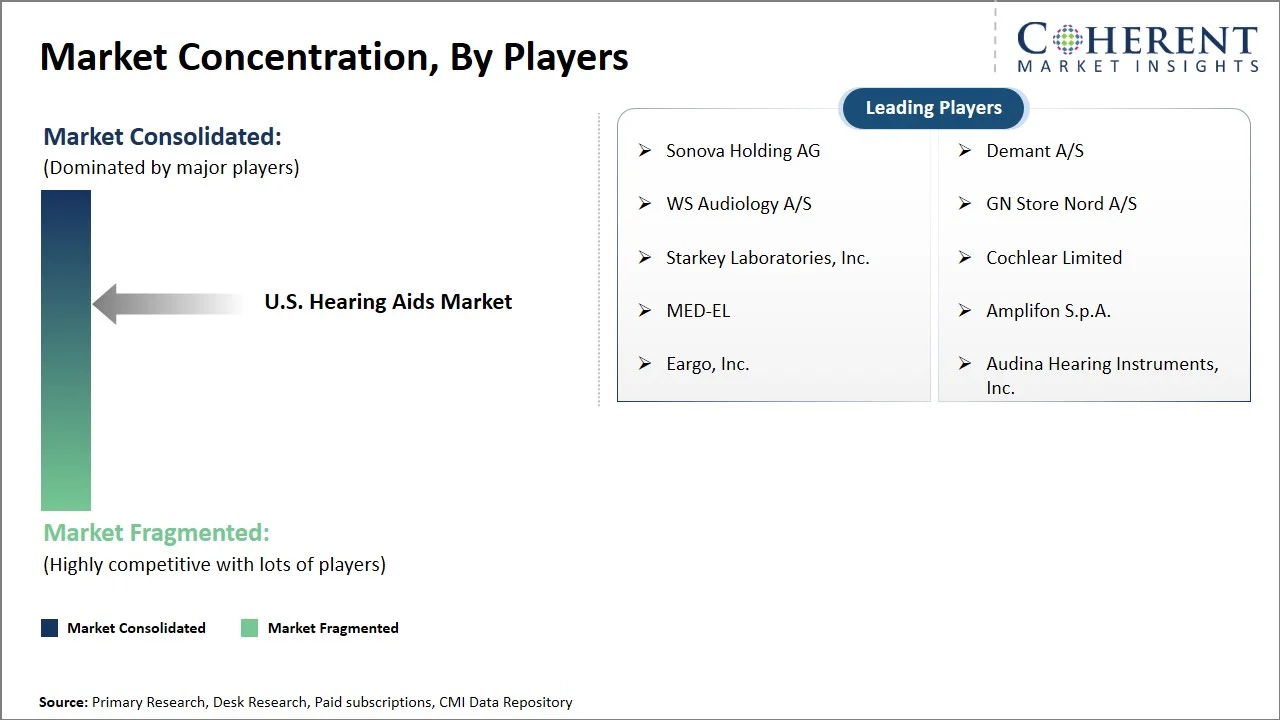
The U.S. hearing aids market is moderately consolidated, with leading manufacturers competing through continuous innovation in AI-enabled hearing technologies, wireless connectivity, and personalized hearing solutions. Companies are focused on expanding their over-the-counter (OTC) and prescription hearing aid portfolios, strengthening partnerships with audiology clinics, retail providers, and hearing care networks, while investing in digital hearing platforms to enhance patient experience and accessibility. Key focus areas include:
- Expansion of AI-enabled, rechargeable, and Bluetooth-connected hearing aid portfolios
- Strengthening over-the-counter (OTC) and prescription hearing aid offerings across retail and online channels
- Enhancing teleaudiology, remote fitting, and smartphone-integrated hearing care solutions
- Pursuing regulatory approvals and strategic partnerships to expand distribution and improve market penetration
Market Report Scope
U.S. Hearing Aids Market Report Coverage
| Report Coverage | Details | ||
|---|---|---|---|
| Base Year: | 2025 | Market Size in 2026: | USD 3,897.0 Mn |
| Historical Data for: | 2020 To 2024 | Forecast Period: | 2026 To 2033 |
| Forecast Period 2026 to 2033 CAGR: | 5.5% | 2033 Value Projection: | USD 5,663.1 Mn |
| Segments covered: |
| ||
| Companies covered: | Sonova Holding AG, Demant A/S, WS Audiology A/S, GN Store Nord A/S, Starkey Laboratories, Inc., Cochlear Limited, MED-EL, Amplifon S.p.A., Eargo, Inc., and Audina Hearing Instruments, Inc. | ||
| Growth Drivers: |
| ||
| Restraints & Challenges: |
| ||
Analyst Opinion (Expert Opinion)
- The future of the U.S. hearing aids market is expected to witness sustained growth over the forecast period, driven by the increasing prevalence of hearing loss, an aging population, and continued innovation in AI-enabled, connected, and over-the-counter (OTC) hearing solutions. The industry is expected to transition beyond traditional amplification devices toward intelligent, software-driven hearing platforms that offer personalized, accessible, and digitally integrated hearing care.
- The maximum growth opportunity lies within OTC hearing aid devices for adults with mild to moderate hearing loss in the United States, supported by favorable FDA regulations, expanding retail and e-commerce distribution, and growing consumer preference for affordable, self-managed hearing care. AI-powered and smartphone-connected hearing aids are also expected to gain strong traction as users seek greater convenience and personalized listening experiences.
- In order to create an advantage for themselves, the competitors should focus on expanding their AI-enabled and OTC product portfolios, invest in teleaudiology and remote fitting capabilities, and strengthen partnerships with audiology clinics, pharmacy chains, and online retailers. Additionally, leveraging digital health technologies, software updates, and data-driven personalization will be critical for enhancing user engagement, improving clinical outcomes, and differentiating products in an increasingly competitive market.
Speak to the analyst
Want personalized insights?
Take the findings above to one of our principal consultants, or have the report rebuilt around the segments, geographies and competitors you actually track.
Market Segmentation
- Product Type Insights (Revenue, USD Mn, 2021 - 2033)
- Hearing Aid Devices
- Hearing Implants
- Type of Hearing Loss Insights (Revenue, USD Mn, 2021 - 2033)
- Sensorineural Hearing Loss
- Conductive Hearing Loss
- Mixed Hearing Loss
- Patient Type Insights (Revenue, USD Mn, 2021 - 2033)
- Adults
- Pediatrics
- Sales Channel Insights (Revenue, USD Mn, 2021 - 2033)
- Audiology Clinics
- Otolaryngology (ENT) Clinics
- Retail Stores
- E-commerce
- Others
- Key Players Insights
- Sonova Holding AG
- Demant A/S
- WS Audiology A/S
- GN Store Nord A/S
- Starkey Laboratories, Inc.
- Cochlear Limited
- MED-EL
- Amplifon S.p.A.
- Eargo, Inc.
- Audina Hearing Instruments, Inc.
Sources
Primary Research Interviews
- Hearing Aid Manufacturers (Product Management, R&D, and Commercial Business Units)
- Audiologists and Hearing Instrument Specialists
- Otolaryngologists (ENT Specialists) and Hearing Healthcare Professionals
- Retail Hearing Care Providers (e.g., HearingLife, Miracle-Ear, Beltone)
- Hospital and Academic Audiology Centers
- Digital Hearing Health and Teleaudiology Solution Providers
- Pharmacy and Consumer Electronics Retail Representatives (OTC Hearing Aids)
Stakeholders
- Hearing Aid Manufacturers (e.g., Sonova Holding AG, Demant A/S, WS Audiology A/S, GN Store Nord A/S, Starkey Laboratories, Cochlear Limited)
- Audiology Clinics and Hearing Care Centers
- Hospital and Health System Audiology Departments
- Otolaryngology (ENT) Clinics
- Retail Hearing Aid Chains and Independent Hearing Care Practices
- End-use Sectors
- Hospitals
- Audiology Clinics
- Otolaryngology (ENT) Clinics
- Retail Hearing Aid Stores
- Home Healthcare Settings
- Regulatory & Health Bodies
- U.S. Food and Drug Administration (FDA)
- National Institute on Deafness and Other Communication Disorders (NIDCD)
- Centers for Medicare & Medicaid Services (CMS)
- American Academy of Audiology (AAA)
- American Speech-Language-Hearing Association (ASHA)
Databases
- U.S. Food and Drug Administration (FDA) – Hearing aid regulations, over-the-counter (OTC) hearing aid guidance, medical device approvals, and safety communications.
- National Institute on Deafness and Other Communication Disorders (NIDCD) – Hearing loss prevalence, epidemiological statistics, hearing health research, and public education resources.
- Centers for Medicare & Medicaid Services (CMS) – Medicare reimbursement policies, audiology service coverage, and physician fee schedules.
- National Institutes of Health (NIH) – Clinical research, hearing science, auditory disorders, and emerging hearing technologies.
- American Academy of Audiology (AAA) – Clinical practice guidelines, audiology standards, hearing care best practices, and industry policy updates.
- American Speech-Language-Hearing Association (ASHA) – Professional guidelines, hearing assessment protocols, audiology practice resources, and workforce insights.
Magazines
- The Hearing Journal
- Audiology Today Magazine
- Hearing Health Magazine
- ASHA Leader Magazine
Journals
- Journal of the American Academy of Audiology
- International Journal of Audiology
- American Journal of Audiology
Associations
- American Academy of Audiology (AAA)
- Hearing Industries Association (HIA)
- American Speech-Language-Hearing Association (ASHA)
- Hearing Loss Association of America (HLAA)
Public Domain Sources
- U.S. Food and Drug Administration (FDA)
- National Institute on Deafness and Other Communication Disorders (NIDCD)
- Centers for Disease Control and Prevention (CDC)
- U.S. Census Bureau
Proprietary Elements
- CMI Data Analytics Tool, Proprietary CMI Existing Repository of information for last 10 years.
Get access to 250+ pages report
Every segment, forecast, competitor profile and data table behind the analysis above — available for instant download.
- ESOMAR Member
- ISO 9001:2015 Certified
- D-U-N-S Registered
- GDPR & CCPA Compliant
Missing comfort of reading report in your local language? Find your preferred language:
Transform your Strategy with Exclusive Trending Reports
Frequently Asked Questions
The U.S. hearing aids market is estimated to be valued at USD 3,897.0 Mn in 2026 and is expected to reach USD 5,663.1 Mn by 2033.
Hearing aid devices dominate due to their widespread adoption for managing mild to profound hearing loss, continuous technological advancements, and the growing availability of both prescription and over-the-counter (OTC) solutions.
Hearing aids are electronic medical devices that amplify and process sound to improve hearing and communication for individuals with hearing impairment.
The CAGR of the U.S. hearing aids market is projected to be 5.5% from 2026 to 2033.
Digital hearing aids use advanced signal processing algorithms to amplify speech, reduce background noise, and automatically adapt to different listening environments for enhanced hearing performance.
Prescription hearing aids are professionally fitted for all degrees of hearing loss, while OTC hearing aids are intended for adults with perceived mild to moderate hearing loss and can be purchased without a prescription.
Growing prevalence of age-related hearing loss and hearing impairment, and expansion of over-the-counter (OTC) hearing aids improving accessibility and affordability are the major factors driving the growth of the U.S. hearing aids market.