

U.S. Ischemic Neurological Interventional Medical Devices Market Size and Forecast – 2026 To 2033
The U.S. ischemic neurological interventional medical devices market is expected to grow from USD 11,740.3 Mn in 2026 to USD 16,574.4 Mn by 2033, registering a compound annual growth rate (CAGR) of 5% from 2026 to 2033. The U.S. ischemic neurological interventional medical devices market is poised for significant expansion, fueled by the soaring burden of burden of ischemic stroke across the country.
According to the U.S. Centers for Disease Control and Prevention (CDC), more than 795,000 people experience a stroke annually in the U.S., and approximately 87% of these are ischemic strokes, creating sustained demand for advanced neurointerventional devices and mechanical thrombectomy procedures.
Key Takeaways of the U.S. Ischemic Neurological Interventional Medical Devices Market
- Neurothrombectomy devices are projected to hold 80.8 % of the U.S. ischemic neurological interventional medical devices market share in 2026, making it the dominant device type segment, due to increasing adoption of endovascular stroke treatment. For instance, in 2024, the U.S. Food and Drug Administration (FDA) prioritized the review of innovative medical devices for life-threatening conditions, including stroke interventions, under its Breakthrough Devices Program, accelerating patient access to novel neurovascular technologies
- Mechanical thrombectomy is projected to hold 54.6 % of the U.S. ischemic neurological interventional medical devices market share in 2026, making it the dominant procedure type segment, owing to strong evidence-based treatment recommendations. For instance, the American Heart Association/American Stroke Association (AHA/ASA) recommends mechanical thrombectomy as a Class I intervention for eligible patients with acute ischemic stroke caused by large vessel occlusion, reinforcing its routine adoption in clinical practice.
- Hospitals are projected to hold 45.7 % of the U.S. ischemic neurological interventional medical devices market share in 2026, making it the dominant end user segment, due to the availability of specialized stroke care infrastructure. For instance, in FY 2025, the Centers for Medicare & Medicaid Services (CMS) finalized updates to the Hospital Inpatient Prospective Payment System (IPPS), maintaining reimbursement for advanced stroke interventions, including mechanical thrombectomy, thereby supporting hospitals in expanding neurointerventional services.
- Expansion of Mobile Stroke Units (MSUs) Driving Earlier Neurointervention: The growing deployment of Mobile Stroke Units (MSUs) across the U.S. is creating new opportunities for ischemic neurointerventional devices by enabling pre-hospital stroke diagnosis through onboard CT imaging and tele-neurology. Earlier identification of large vessel occlusion (LVO) patients facilitates faster referral to thrombectomy-capable centers, increasing the number of eligible patients for endovascular intervention. This trend is expected to support demand for advanced thrombectomy and neurovascular access devices.
- AI-Enabled Stroke Management Enhancing Thrombectomy Adoption: The rapid evolution of AI-enabled stroke management is creating significant growth opportunities for the U.S. ischemic neurological interventional medical devices market. Advanced stroke management platforms enable faster large vessel occlusion (LVO) detection, automated imaging analysis, and real-time patient triage, reducing door-to-treatment times. These capabilities improve patient selection for mechanical thrombectomy and are expected to increase the utilization of neurointerventional devices across comprehensive stroke centers.
Segmental Insights
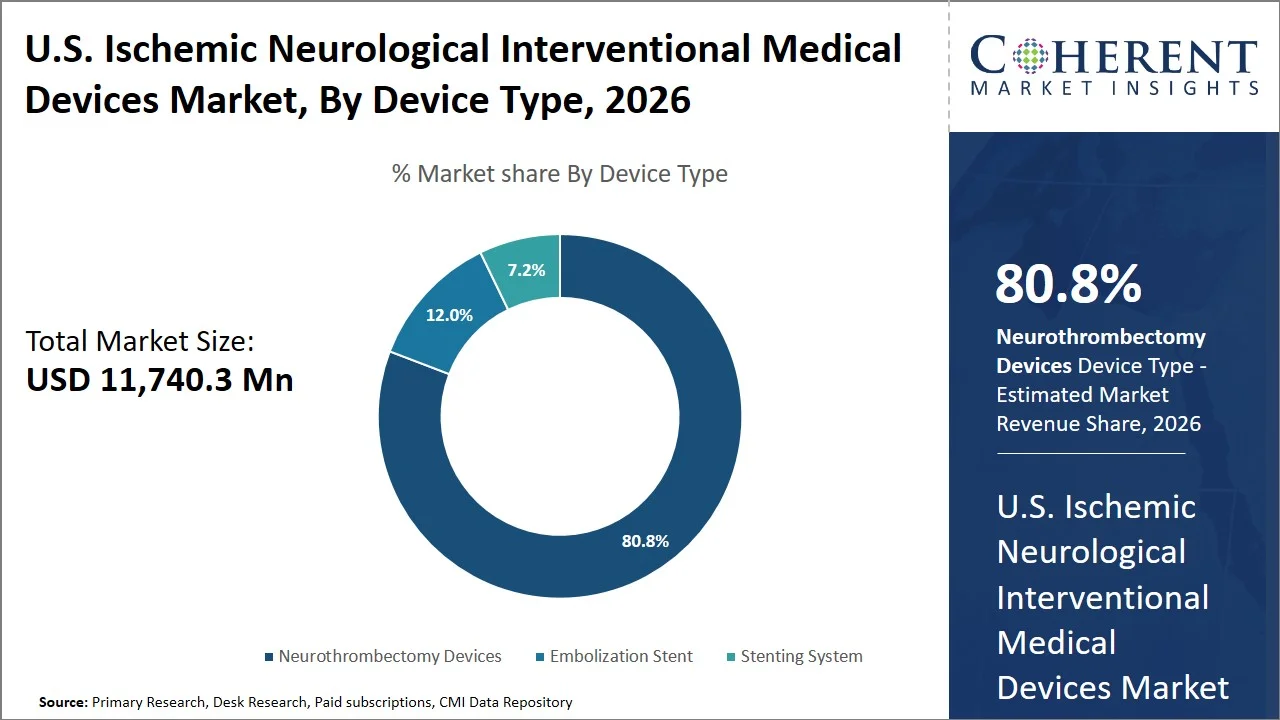
Why Do Neurothrombectomy Devices Dominate the U.S. Ischemic Neurological Interventional Medical Devices Market?
Neurothrombectomy devices are projected to hold a market share of 80.8% in 2026, due to its higher rate of clinical success in restoring cerebral blood in stroke due to massive blockage. Ongoing innovations in techniques for removal of clots, accompanied by the rise in the acceptance rate of endovascular stroke therapy is strengthening segment growth. For instance, in May 2025, Brain Attack Coalition provided revised guidelines regarding comprehensive stroke center capabilities, reinforcing the importance of on-demand 24-hour endovascular thrombectomy, specialized neurointerventional expertise, and state-of-the-art neurovascular resources that facilitate optimal management of acute ischemic stroke patients.
- Current Industry Events of 2026
- Market Size Estimation
- Regional Breakdown
- Competitive Landscape
- Customer Intelligence
- Segmental Analysis
- Pricing Analysis
- Key Market Drivers, Challenges & Future Trends
- Customized Insights Section
Why Does Mechanical Thrombectomy Represent the Largest Procedure Type Segment in the U.S. Ischemic Neurological Interventional Medical Devices Market?
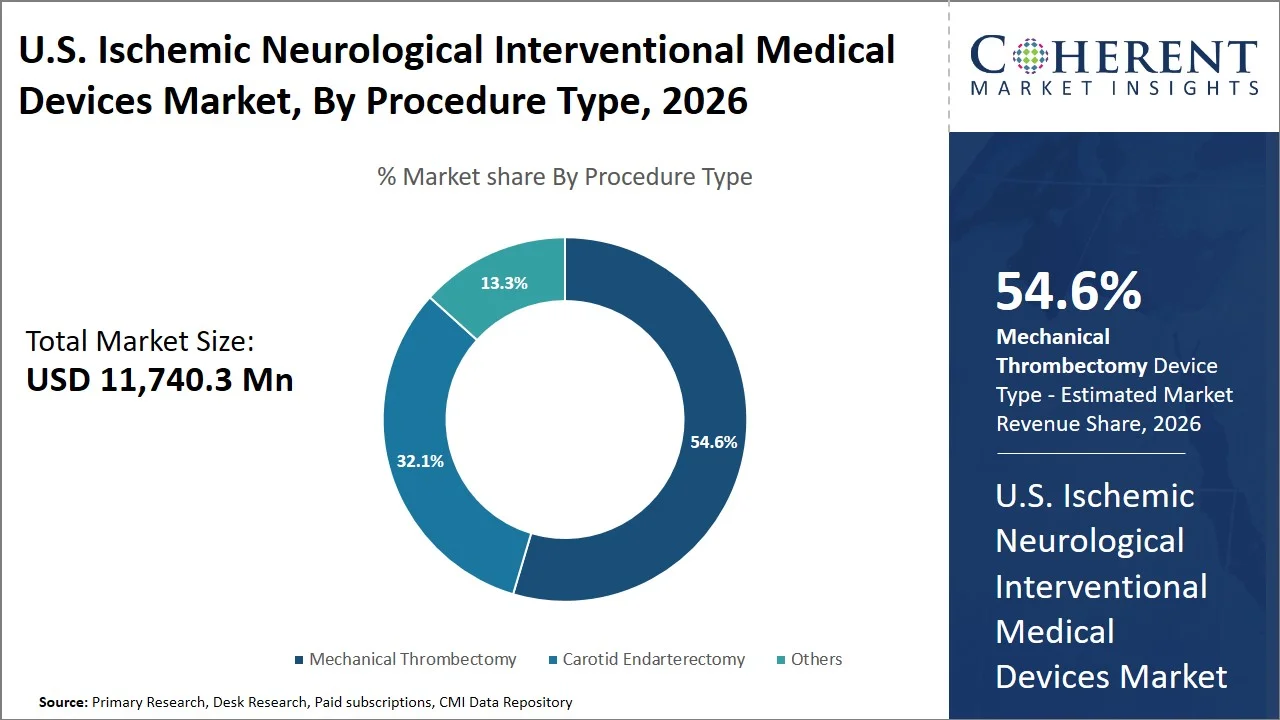
Mechanical thrombectomy is projected to hold 54.6% of the market share in 2026 driven by the proven clinical benefit of mechanical thrombectomy over intravenous thrombolysis in patients with acute large vessel occlusions (LVOS). Superior efficacy data, rapidly progressing thrombectomy device technology, and expanding access within certified stroke centers, has established it as the standard of care for eligible patients. For instance, the Joint Commission's 2026 stroke certification standards, strengthened requirements for thrombectomy-capable stroke centers (TCSC) and comprehensive stroke centers (CSC), thereby supporting the adoption of mechanical thrombectomy across the country and increasing public access to cutting-edge endovascular stroke therapy.
Hospitals Segment Dominates the U.S. Ischemic Neurological Interventional Medical Devices Market
The hospitals segment is expected to hold 45.7% of the U.S. ischemic neurological interventional medical devices market share in 2026, driven by the availability of advanced neurovascular infrastructure and around the clock emergency stroke treatment services to manage acute stroke intervention like mechanical thrombectomy. These facilities ensure speedy diagnosis and early management due to availability of multidisciplinary teams and advanced technological support, such as, catheterization lab and imaging system. For instance, in July 2025, U.S. News & World Report incorporated the American Heart Association's stroke care performance measure into its national hospital rankings, recognizing hospitals for timely, evidence-based stroke treatment and reinforcing the importance of comprehensive stroke care capabilities.
Current Events and their Impact
Current Events | Description and its Impact |
Centers for Medicare & Medicaid Services (CMS) Finalizes FY 2026 Hospital IPPS Rule Supporting Advanced Stroke Care (August 2025) |
|
American Heart Association Releases 2025 Scientific Sessions Highlighting Endovascular Stroke Care (November 2025) |
|
U.S. Ischemic Neurological Interventional Medical Devices Market Dynamics
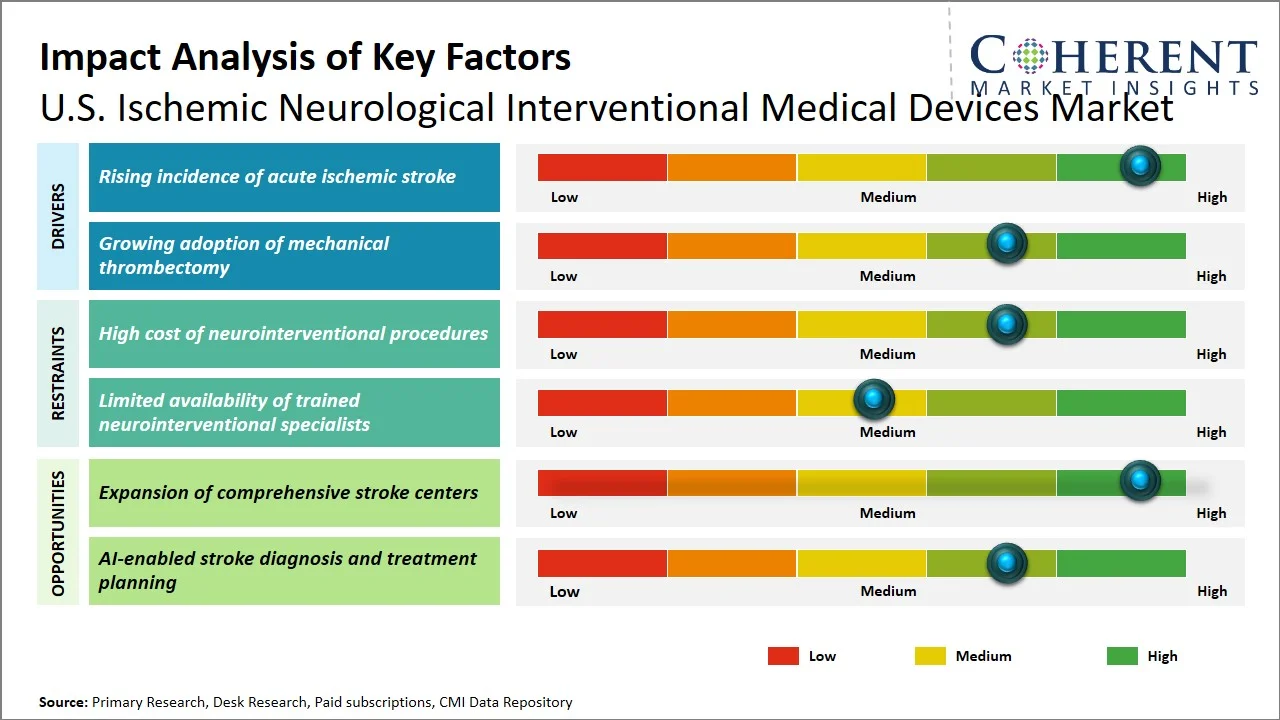
Market Drivers
- Rising incidence of acute ischemic stroke: The rising burden of acute ischemic stroke is driving demand for advanced neurointerventional devices capable of rapid vessel recanalization and improved clinical outcomes. Greater emphasis on coordinated stroke care and timely endovascular intervention is further accelerating device adoption across the U.S. For instance, the U.S. Centers for Medicare & Medicaid Services (CMS) Paul Coverdell National Acute Stroke Program provides funding to participating states to improve stroke care quality through standardized data collection, performance measurement, and implementation of evidence-based treatment protocols across emergency medical services and hospitals.
- Growing adoption of mechanical thrombectomy: The increasing adoption of mechanical thrombectomy as the standard of care for eligible patients with acute ischemic stroke is significantly driving demand for neurointerventional medical devices in the U.S. Expanding clinical evidence demonstrating improved functional outcomes and wider availability of thrombectomy-capable stroke centers are accelerating procedural volumes and the use of advanced thrombectomy systems. For instance, the Society of Neurointerventional Surgery (SNIS) recommends rapid access to mechanical thrombectomy for eligible patients with large vessel occlusion and supports the expansion of thrombectomy-capable stroke systems to improve timely treatment and patient outcomes.
Emerging Trends
- Shift Toward Radial-Access Neurointerventional Procedures: The adoption of transradial access (TRA) is increasing in ischemic neurointerventional procedures as an alternative to traditional femoral access. The approach offers lower vascular complication rates, improved patient comfort, and faster post-procedure recovery, driving demand for neurovascular catheters and access devices specifically designed for radial interventions.
- Increasing Adoption of Large-Bore Aspiration-First Techniques: Healthcare providers are increasingly adopting large-bore aspiration-first thrombectomy techniques as an initial treatment strategy for acute ischemic stroke due to their procedural simplicity and potential for faster reperfusion. This trend is encouraging manufacturers to develop high-trackability aspiration catheters with enhanced flexibility and larger inner diameters to improve clot retrieval performance.
Key Regulations and Reimbursement Frameworks Influencing the U.S. Ischemic Neurological Interventional Medical Devices Market
Governing Authority | Framework Type | Key Focus | Impact on Market |
U.S. Food and Drug Administration | Medical Device Regulation | Reviews and authorizes neurovascular interventional medical devices for clinical use through regulatory pathways. | Facilitates market entry of innovative ischemic stroke intervention technologies while ensuring device safety and effectiveness. |
Centers for Medicare & Medicaid Services | Reimbursement Policy | Establishes reimbursement policies for mechanical thrombectomy and other inpatient neurointerventional procedures. | Encourages hospitals to invest in advanced stroke intervention technologies and expand procedural capacity. |
American Heart Association/ American Stroke Association | Clinical Practice Guidelines | Develops evidence-based recommendations for the diagnosis and endovascular treatment of acute ischemic stroke. | Standardizes mechanical thrombectomy as a preferred treatment approach, driving device adoption across healthcare facilities. |
Centers for Disease Control and Prevention | Stroke System Improvement | Supports statewide stroke care quality improvement through the Paul Coverdell National Acute Stroke Program. | Enhances coordinated stroke care pathways, enabling timely referrals to thrombectomy-capable hospitals and increasing procedural volumes. |
The Joint Commission | Hospital Accreditation | Certifies Comprehensive Stroke Centers and establishes performance standards for advanced stroke care. | Promotes the expansion of specialized stroke centers, increasing demand for neurointerventional medical devices. |
How is the expansion of comprehensive stroke centers creating new growth opportunities in the U.S. ischemic neurological interventional medical devices market?
The expansion of comprehensive stroke centers in the U.S. is creating lucrative growth opportunities in ischemic neurological interventional medical devices market by improving access to advanced endovascular stroke care. The increasing neurointerventional capabilities of increasing number of hospitals are expected to increase demand for mechanical thrombectomy systems, aspiration catheters and other neurovascular devices. For instance, in April 2026, St. Vincent’s Medical Center was recognized as a certified stroke center for its ability to manage complex strokes requiring the most advanced endovascular therapy and advanced interventional procedures, often called mechanical thrombectomy
Market Players, Key Development, and Competitive Landscape
Key Developments
- In January 2026, Boston Scientific Corporation announced a definitive agreement to acquire Penumbra, Inc. in a transaction valued at approximately USD 14.5 billion. The acquisition expands Boston Scientific's neurovascular and mechanical thrombectomy portfolio, strengthening its presence in ischemic stroke intervention and other vascular disease treatment markets.
- In May 2024, Rapid Medical announced the successful completion of acute ischemic stroke procedures using the world's first robotic thrombectomy device. The milestone demonstrates the feasibility of robotic-assisted mechanical thrombectomy and marks an important step toward advancing precision, procedural efficiency, and innovation in neurovascular stroke intervention.
- In February 2024, CERENOVUS, part of Johnson & Johnson MedTech, launched the CEREGLIDE 71 Intermediate Catheter with TruCourse in the U.S. for the revascularization of patients with acute ischemic stroke. The next-generation catheter is designed to improve navigation through complex neurovascular anatomy while supporting direct aspiration and compatible stent retrievers during mechanical thrombectomy procedures.
Competitive Landscape
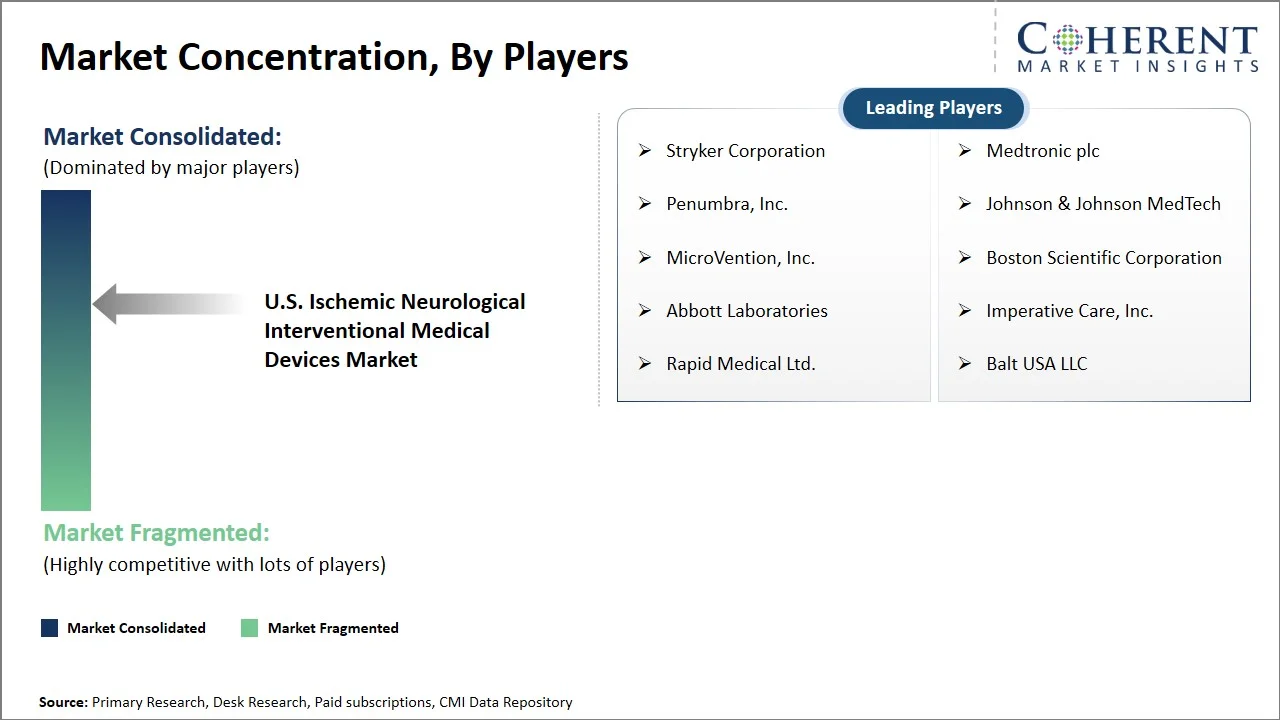
The U.S. ischemic neurological interventional medical devices market is moderately consolidated, with leading manufacturers competing through continuous innovation in mechanical thrombectomy systems, aspiration catheters, stent retrievers, and neurovascular access devices. Companies are prioritizing product portfolio expansion, regulatory approvals, and clinical evidence generation to strengthen their market position while expanding collaborations with comprehensive stroke centers and integrated healthcare networks. Key focus areas include:
- Development of next-generation mechanical thrombectomy and aspiration technologies
- Expansion of neurovascular product portfolios through strategic acquisitions and partnerships
- Increasing investment in AI-enabled stroke imaging and procedural planning solutions
- Strengthening clinical evidence and physician training programs to accelerate adoption of endovascular stroke therapies
Market Report Scope
U.S. Ischemic Neurological Interventional Medical Devices Market Report Coverage
| Report Coverage | Details | ||
|---|---|---|---|
| Base Year: | 2025 | Market Size in 2026: | USD 11,740.3 Mn |
| Historical Data for: | 2020 To 2024 | Forecast Period: | 2026 To 2033 |
| Forecast Period 2026 to 2033 CAGR: | 5% | 2033 Value Projection: | USD 16,574.4 Mn |
| Segments covered: |
| ||
| Companies covered: | Stryker Corporation, Medtronic plc, Penumbra, Inc., Johnson & Johnson MedTech, MicroVention, Inc., Boston Scientific Corporation, Abbott Laboratories, Imperative Care, Inc., Rapid Medical Ltd., and Balt USA LLC | ||
| Growth Drivers: |
| ||
| Restraints & Challenges: |
| ||
Analyst Opinion (Expert Opinion)
- The future of the U.S. ischemic neurological interventional medical devices market will be shaped by the continued shift toward minimally invasive, endovascular stroke treatment supported by advancements in thrombectomy technologies, AI-assisted imaging, and expanding comprehensive stroke care infrastructure. Increasing emphasis on reducing treatment times and improving functional outcomes will further strengthen market demand.
- The maximum growth opportunity lies within mechanical thrombectomy devices used for the treatment of acute ischemic stroke, particularly across Comprehensive Stroke Centers and Thrombectomy-Capable Stroke Centers in the United States. The expansion of certified stroke centers and improved emergency stroke referral pathways are expected to drive higher procedural volumes.
- In order to create an advantage for themselves, the competitors should focus on developing next-generation thrombectomy and neurovascular access devices with enhanced navigability and first-pass recanalization performance. Companies should also strengthen collaborations with stroke centers, generate robust clinical evidence through multicenter studies, and invest in physician training programs to accelerate adoption and differentiate their product portfolios.
Speak to the analyst
Want personalized insights?
Take the findings above to one of our principal consultants, or have the report rebuilt around the segments, geographies and competitors you actually track.
Market Segmentation
- Device Type Insights (Revenue, USD Mn, 2021 - 2033)
- Neurothrombectomy Devices
- Embolization Stent
- Stenting System
- Procedure Type Insights (Revenue, USD Mn, 2021 - 2033)
- Mechanical Thrombectomy
- Carotid Endarterectomy
- Others
- End User Insights (Revenue, USD Mn, 2021 - 2033)
- Hospitals
- Specialty Centers
- Ambulatory Surgical Centers
- Others
- Key Players Insights
- Stryker Corporation
- Medtronic plc
- Penumbra, Inc.
- Johnson & Johnson MedTech
- MicroVention, Inc.
- Boston Scientific Corporation
- Abbott Laboratories
- Imperative Care, Inc.
- Rapid Medical Ltd.
- Balt USA LLC
Sources
Primary Research Interviews
- Neurointerventional Neurosurgeons, Interventional Neurologists, and Neurointerventional Radiologists
- Comprehensive Stroke Center Directors and Catheterization Laboratory Managers
- Mechanical Thrombectomy Device Manufacturers and Neurovascular Business Unit Executives
- Hospital Procurement Heads and Neurovascular Device Purchasing Managers
- Clinical Affairs, Regulatory Affairs, and Medical Affairs Executives of Neurovascular Device Companies
Stakeholders
- Medical Device Manufacturers (Mechanical Thrombectomy, Aspiration Catheters, Stent Retrievers, Neurovascular Access Systems)
- Comprehensive Stroke Centers and Thrombectomy-Capable Stroke Centers
- Hospitals and Academic Medical Centers
- Ambulatory Surgical Centers Performing Neurovascular Procedures
- Group Purchasing Organizations (GPOs) and Hospital Procurement Networks
- Emergency Medical Services (EMS) and Regional Stroke Networks
- End-use Sectors
- Hospitals
- Comprehensive Stroke Centers
- Thrombectomy-Capable Stroke Centers
- Academic and University Medical Centers
- Ambulatory Surgical Centers
- Specialty Neurovascular Clinics
- Regulatory & Health Bodies
- United States Food and Drug Administration
- Centers for Medicare & Medicaid Services
- Centers for Disease Control and Prevention
- National Institutes of Health
- National Institute of Neurological Disorders and Stroke
- The Joint Commission
Databases
- United States Food and Drug Administration – Medical Device Databases (510(k), PMA & De Novo)
- Centers for Medicare & Medicaid Services – Medicare Coverage and Hospital Payment Data
- Centers for Disease Control and Prevention – Stroke Data & Statistics
- National Institutes of Health – ClinicalTrials.gov
- National Center for Health Statistics
- Agency for Healthcare Research and Quality – Healthcare Cost and Utilization Project (HCUP)
Magazines
- NeuroNews International
- Endovascular Today
- Medical Device Network
- MedTech Dive
- Medical Design & Outsourcing
Journals
- Journal of NeuroInterventional Surgery
- Journal of Stroke and Cerebrovascular Diseases
- Journal of NeuroInterventional Surgery (JNIS)
- Interventional Neuroradiology
Associations
- Society of NeuroInterventional Surgery
- American Heart Association
- American Stroke Association
- Society of Vascular and Interventional Neurology
- American Association of Neurological Surgeons
- Congress of Neurological Surgeons
Public Domain Sources
- U.S. Food and Drug Administration
- Centers for Medicare & Medicaid Services
- Centers for Disease Control and Prevention
- National Institutes of Health
- National Institute of Neurological Disorders and Stroke
- ClinicalTrials.gov
- Agency for Healthcare Research and Quality
- The Joint Commission
Proprietary Elements
- CMI Data Analytics Tool, Proprietary CMI Existing Repository of information for last 10 years.
Get access to 250+ pages report
Every segment, forecast, competitor profile and data table behind the analysis above — available for instant download.
- ESOMAR Member
- ISO 9001:2015 Certified
- D-U-N-S Registered
- GDPR & CCPA Compliant
Missing comfort of reading report in your local language? Find your preferred language:
Transform your Strategy with Exclusive Trending Reports
Frequently Asked Questions
The U.S. ischemic neurological interventional medical devices market is estimated to be valued at USD 11,740.3 Mn in 2026 and is expected to reach USD 16,574.4 Mn by 2033.
Neurothrombectomy devices dominate due to their widespread use in mechanical thrombectomy procedures for acute ischemic stroke and strong clinical preference for rapid vessel recanalization.
Ischemic neurological interventional medical devices are minimally invasive devices used to restore blood flow in patients with acute ischemic stroke and other cerebrovascular occlusions.
The market is expected to witness steady growth, driven by expanding mechanical thrombectomy adoption, technological advancements in neurovascular devices, and the increasing number of comprehensive stroke centers across the U.S.
Mechanical thrombectomy is generally recommended for eligible patients within 24 hours of symptom onset, depending on clinical and advanced imaging assessment.
Mechanical thrombectomy is an endovascular procedure that uses specialized devices to physically remove a blood clot from a blocked cerebral artery and restore blood flow.
The CAGR of U.S. ischemic neurological interventional medical devices market is projected to be 5% from 2026 to 2033.