

Air Abrasion Unit Market Size and Share Analysis- Growth Trends and Forecasts (2026-2033)
The Air Abrasion Unit Market size is anticipated to grow at a CAGR of 5.5%, from USD 563.25 Mn in 2026 to approximately USD 819.92 Mn by 2033. The primary drivers are largely defined by the increasing adoption of minimally invasive dentistry, growing preference for drill-free cavity preparation, rising demand for patient-friendly dental procedures, and expanding use of air abrasion systems for caries removal, surface preparation, stain removal, and restorative dental applications. According to the CDC states that approximately half of children aged 6 to 9 years old have had cavities in either their primary or permanent teeth and that approximately 10% of adolescents aged 12 to 19 years old have at least one untreated cavity.
Key Takeaways
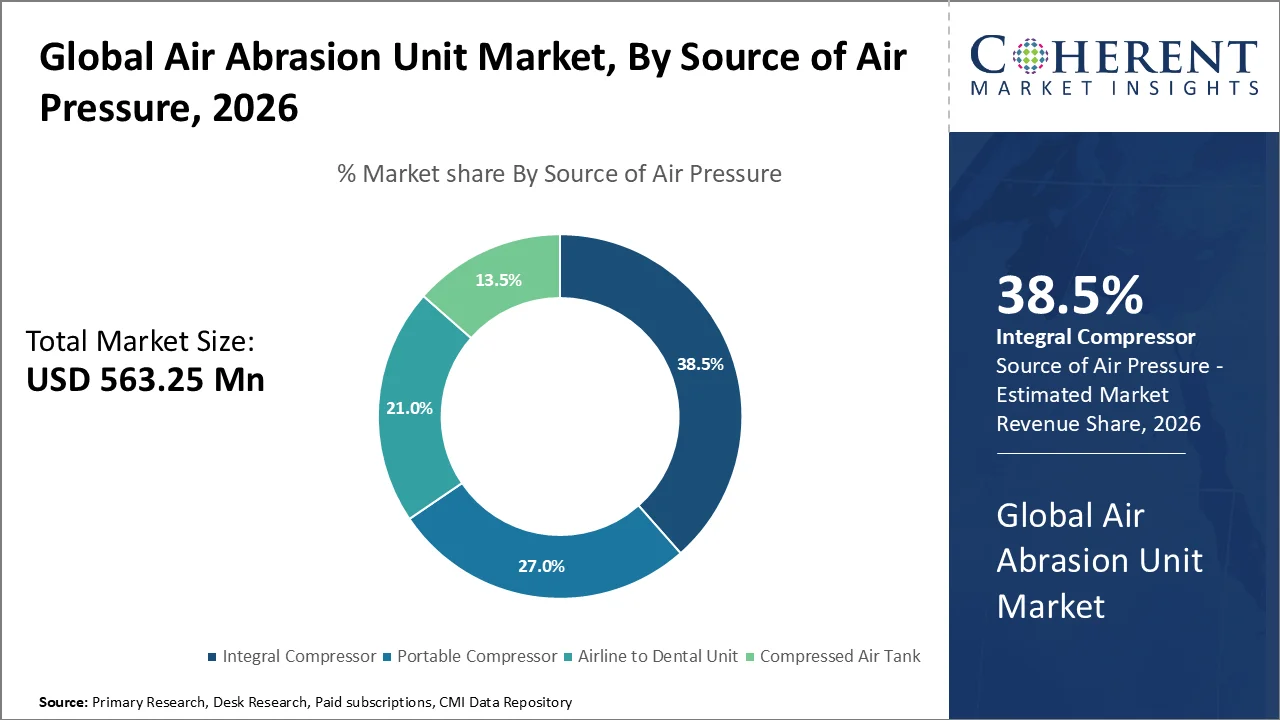
- The integral compressor segment is likely to dominate the market with 38.5% in 2026. The segment’s growth is owing to self-contained air-pressure generation, consistent operating pressure, reduced dependence on centralized dental-unit air lines, and easier movement of integrated systems between treatment rooms. The U.S. alone has 135,665 dental practice establishments, providing a substantial installed base for compact and integrated dental equipment.
- The detection and removal of caries segment is set to lead with 34.5% in 2026. The segment’s growth is owing to the increasing emphasis on conservative caries removal, preservation of healthy tooth structure, reduced vibration compared with rotary drilling, and suitability for minimally invasive restorative procedures. According to the CDC’s 2024 Oral Health Surveillance Report, 20.5% of U.S. adults aged 20–64 years had untreated tooth decay in permanent teeth, highlighting a substantial addressable patient population for caries-management procedures.
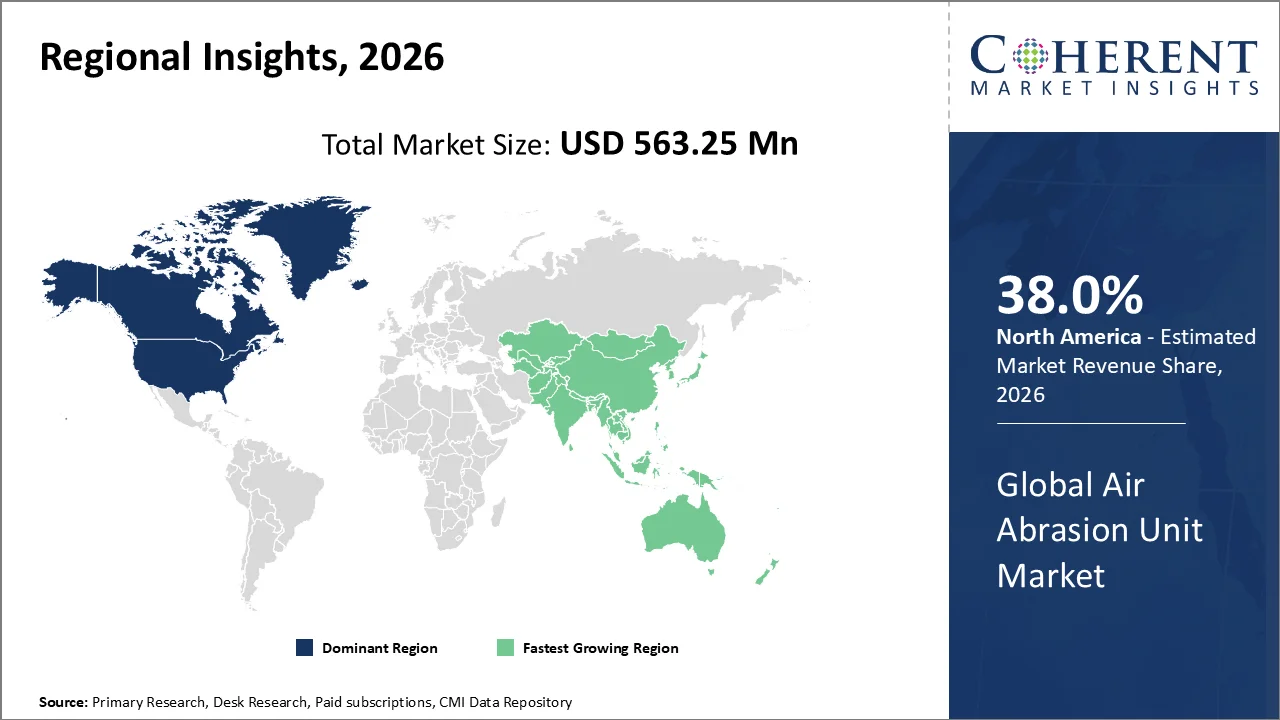
- North America is expected to dominate the market with 38.0% in 2026. The region’s leadership is supported by high dental-care expenditure, an established dental-practice infrastructure, early adoption of advanced restorative technologies, and strong patient utilization of dental services. According to the American Dental Association Health Policy Institute, U.S. national dental expenditure reached USD 189 billion in 2024 and increased 4% in inflation-adjusted terms compared with 2023.
Market Drivers
Rising Dental Caries Burden is Accelerating Demand for Minimally Invasive Dental Treatment
The Air Abrasion Unit Market is driven by increasing burden of dental caries globally and the rising trend of minimally invasive dentistry. Air abrasion is a technique that allows clinicians to selectively remove carious tooth structure with a controlled stream of abrasive particles. This may result in less removal of healthy enamel and dentin compared with conventional rotary preparation.
In March 2026, the World Health Organization issued a new global guideline that explicitly recommended less-invasive approaches to the prevention and management of dental caries. WHO estimates that dental caries affects approximately 2.7 billion people worldwide highlighting the importance of treatment approaches that conserve tooth structure while improving patient safety and quality of care.
Growing Clinical Evidence for Air Abrasion is Expanding its Role in Restorative Dentistry
Clinical evidence for air-particle abrasion is increasing, supporting its use beyond traditional cavity preparation for surface conditioning, indirect restorations, adhesive dentistry and restorative procedures. Air abrasion can change the dental surface and increase the micromechanical retention, making the technology more and more relevant with the expansion of resin-based and adhesive restorative procedures.
A 2025 systematic review and meta-analysis of seven studies published in the Journal of Dentistry found that cleaning dentin with 50-µm aluminum oxide air abrasion resulted in a significant increase in the resin-cement bond strength (standardized mean difference: 0.94; 95% confidence interval: 0.43–1.46, favoring air abrasion). The results support its use before cementation of selected indirect restorations and extend the clinical utility of air abrasion units beyond caries removal.
Current Events and Their Impact on the Air Abrasion Unit Market
Current Event | Description and its Impact |
FDA Quality Management System Regulation Becomes Effective for Medical Device Manufacturers (February 2026) |
|
EU Dental Amalgam Phase-Out Reaches Final Transition Deadline (June 2026) |
|
- Current Industry Events of 2026
- Market Size Estimation
- Regional Breakdown
- Competitive Landscape
- Customer Intelligence
- Segmental Analysis
- Pricing Analysis
- Key Market Drivers, Challenges & Future Trends
- Customized Insights Section
Segmental Insights
Why is Integral Compressor Acquiring the Largest Share?
On the basis of source of air pressure, the integral compressor segment is projected to account for the largest Air Abrasion Unit Market share of 38.5% in 2026. The segment’s growth is owing to its self-contained air supply, consistent operating pressure, reduced dependence on centralized dental air lines, compact installation requirements, and suitability for independent and single-location dental practices.
The American Dental Association Health Policy Institute’s 2025 U.S. Dentist Workforce report shows that 34% of U.S. dentists practiced in a single-location solo practice in 2024, while another 39% worked in a single-location practice with more than one dentist.
In January 2025, Durr Dental introduced its new Tornado dental compressor, which delivers oil-free, dry and hygienic compressed air with increased operational reliability, durability and performance.
Why is Detection and Removal of Caries Acquiring the Largest Share?
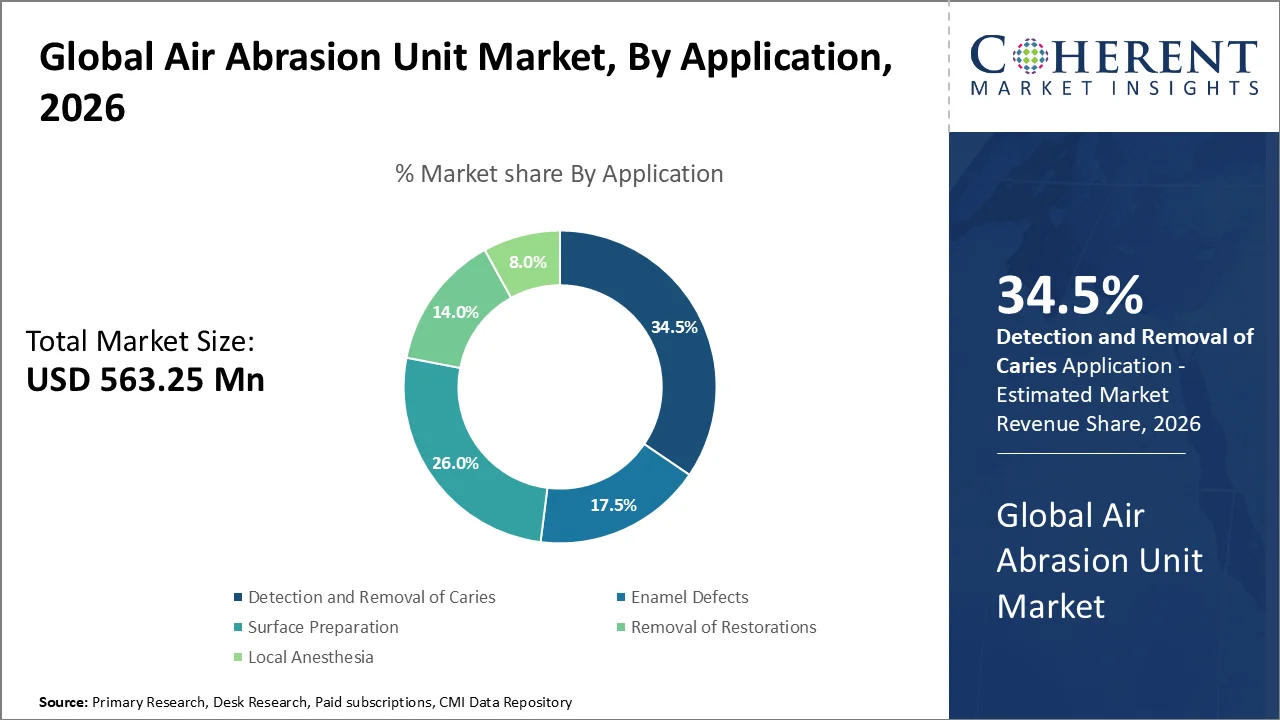
On the basis of application, the detection and removal of caries segment is projected to lead the Air Abrasion Unit Market with 34.5% in 2026. The segment’s growth is owing to the persistent burden of untreated dental decay, increasing preference for selective caries excavation, preservation of healthy tooth structure, and growing adoption of minimally invasive alternatives to conventional rotary cavity preparation.
The U.K. Office for Health Improvement and Disparities published the 2025 National Dental Epidemiology Program survey, which found that 22.4% of five-year-old children in England had experienced dentinal decay. The average number of decayed teeth per child was 3.5, and 81.4% of decayed teeth were untreated.
In January 2025, VideaHealth announced Caries 3.0, an upgraded AI-powered dental caries detection model that helps find early and incipient lesions. The company said the reduction in false positive detections per image was 65%, allowing dentists to more consistently find actionable lesions and intervene sooner.
Air Abrasion Unit Market Trends
- The increasing usage of air abrasion in the workflows of adhesive and restorative dentistry is extending its use beyond the traditional cavity preparation. In current studies, more attention is paid to particle size, pressure, irrigation and adhesive combinations for improving surface conditioning and bonding performance. A 2026 Journal of Esthetic and Restorative Dentistry study found dentin bond-strength values were highest with aluminum-oxide airborne-particle abrasion combined with simultaneous irrigation, with significant differences versus the control (p < 0.001).
- The growing use of air abrasion for composite bonding and dentin surface preparation is prompting a rise in procedure-specific treatment protocols. In 2026, a study on 38 permanent molars showed a mean shear bond strength of 25.8 MPa for air-abraded dentin with an etch-and-rinse adhesive, compared to 17.36 MPa for a self-etch adhesive.
- Development of alternative abrasive media, such as bioactive glass, is emerging as a key technology trend. In a 2026 General Dentistry study, the microshear bond strength of 40 caries-affected human molars treated with bioactive-glass air abrasion was examined. The study found a mean microshear bond strength of 23.66 MPa when used with an etch-and-rinse adhesive, compared with 22.06 MPa without bioactive-glass abrasion.
Regional Insights
North America Dominates Owing to Advanced Dental Care Infrastructure and High Adoption of Chairside Technologies
North America is expected to hold the highest share in the Air Abrasion Unit Market in 2026 at 38.0%. The region’s dominance is attributed to its well-developed dental care infrastructure, broad availability of restorative dentistry services, high penetration of advanced chairside equipment, and increasing preference for minimally invasive dental procedures.
In July 2026, the American Dental Association Health Policy Institute reported that 43.3% of surveyed U.S. dentists were already using artificial intelligence for at least one practice activity, while another 26.4% planned to adopt it. Approximately 22.8% were already using AI specifically for imaging and diagnostics.
Asia Pacific Air Abrasion Unit Market Trends
Asia Pacific is expected to emerge as the fastest-growing region in the Air Abrasion Unit Market over the forecast period. Regional growth is owing to expanding public dental infrastructure, improving access to oral healthcare, rising awareness of minimally invasive dentistry, and increasing investment in dental equipment across countries such as India, China, Japan, South Korea, and Australia.
India is significantly expanding its public oral healthcare infrastructure through the National Oral Health Programme. According to the Directorate General of Health Services reported that a total of 9,587 dental care units received full or partial government support. These include 5,113 Primary Health Centers, 2,849 Community Health Centers, 1,083 Sub-District Hospitals and 593 District Hospitals.
In March 2025, Japan-based NSK Nakanishi also introduced the Varios Combi Pro2, a new powder-jet and ultrasonic dental system, at IDS 2025. The platform integrates supragingival and subgingival powder therapy and incorporates a precision jet nozzle, water heating, and wireless foot control.
High Dental Procedure Throughput and Continued Equipment Investment are Accelerating the Air Abrasion Unit Market in the United States
The U.S. Air Abrasion Unit Market is witnessing steady growth owing to the strong restorative dentistry base, increasing preference for conservative tooth preparation, and continued investment by dental practices in advanced chairside equipment. Air abrasion systems are increasingly relevant across cavity preparation, caries removal, restorative-surface conditioning, and adhesive dentistry workflows.
According to the American Dental Association Health Policy Institute’s Q2 2026 State of the U.S. Dental Economy report, 15.8% of surveyed dentists had already made major equipment purchases during 2026 by the end of Q2, while 24.4% had indicated plans for major equipment purchases entering the year.
China Air Abrasion Unit Market Trends
China is expected to witness strong growth in the Air Abrasion Unit Market over the forecast period. Growth is owing to continued expansion of dental hospital infrastructure, increasing investment in modern dental treatment capacity, wider adoption of minimally invasive restorative procedures, and regulatory efforts to standardize oral healthcare services.
In June 2025, Sino-Dental 2025 in Beijing attracted nearly 900 dental companies from more than 40 countries and regions, with technologies showcased across approximately 50,000 square meters of exhibition space.
Who are the Major Companies in Air Abrasion Unit Industry
Some of the major key players in Air Abrasion Unit Market are Danville, Velopex, DENTSPLY International, Groman, and Straumann.
Key News
- In March 2025, Dentsply Sirona announced major enhancements to Primescan 2, including caries-detection functionality. This is particularly relevant to the detection-and-removal-of-caries application, as improved lesion identification can support earlier and more targeted minimally invasive treatment.
- In September 2025, Dentsply Sirona announced the U.S. launch of new DS Core Diagnose capabilities, expanding AI-supported dental X-ray interpretation. The development strengthens digital diagnosis and earlier identification of dental pathology before restorative treatment.
Market Report Scope
Air Abrasion Unit Market Report Coverage
| Report Coverage | Details | ||
|---|---|---|---|
| Base Year: | 2025 | Market Size in 2026: | USD 563.25 Mn |
| Historical Data for: | 2020 To 2024 | Forecast Period: | 2026 To 2033 |
| Forecast Period 2026 to 2033 CAGR: | 5.5% | 2033 Value Projection: | USD 819.92 Mn |
| Geographies covered: |
| ||
| Segments covered: |
| ||
| Companies covered: | Danville, Velopex, DENTSPLY International, Groman, and Straumann | ||
| Growth Drivers: |
| ||
| Restraints & Challenges: |
| ||
Analyst Opinion
- The Air Abrasion Unit Market is increasingly benefiting from the shift toward patient-friendly and minimally invasive dental treatment, particularly among patients who experience anxiety related to conventional drilling, vibration, and injections. A 2026 systematic review and meta-analysis covering 19 studies and 9,267 adults estimated the global prevalence of high dental anxiety at 18%.
- Air abrasion is also evolving beyond conventional caries removal into CAD/CAM restorative and prosthetic surface-preparation workflows. A study published in the Dental Materials Journal in March 2026 found that chairside air abrasion with water injection using 50-µm alumina demonstrated bond-strength performance comparable to conventional laboratory sandblasting for all CAD/CAM materials tested.
- Future market growth is likely to depend on indication-specific clinical positioning rather than air abrasion replacing rotary instruments across all procedures. A January 2026 study in Odontology found that 29-µm alumina air abrasion achieved enamel bond strength comparable with acid etching, but air abrasion did not improve bond strength on untreated dentin or immediate-dentin-sealing surfaces.
Speak to the analyst
Want personalized insights?
Take the findings above to one of our principal consultants, or have the report rebuilt around the segments, geographies and competitors you actually track.
Market Segmentation
- By Source of Air Pressure (Revenue, USD Mn, 2021-2033)
- Integral Compressor
- Portable Compressor
- Compressed Air Tank
- Airline to Dental Unit
- By Application (Revenue, USD Mn, 2021-2033)
- Enamel Defects
- Detection and Removal of Caries
- Surface Preparation
- Removal of Restorations
- Local Anesthesia
- By Region (Revenue, USD Mn, 2021-2033)
- North America
- U.S.
- Canada
- Latin America
- Brazil
- Mexico
- Argentina
- Rest of Latin America
- Europe
- Germany
- U.K.
- France
- Italy
- Spain
- Russia
- Rest of Europe
- Asia Pacific
- China
- India
- Japan
- Australia
- South Korea
- ASEAN
- Rest of Asia Pacific
- Middle East
- GCC
- Israel
- Rest of Middle East
- Africa
- South Africa
- Central Africa
- North Africa
- North America
Sources
Primary Research Interviews
- Dental surgeons and restorative dentists
- Prosthodontists and pediatric dentists
- Dental clinic owners and practice managers
- Dental equipment manufacturers and product managers
- Dental distributors and channel partners
- Dental hygienists and chairside clinical professionals
- Key opinion leaders (KOLs) in minimally invasive and restorative dentistry
Databases
- World Health Organization (WHO) – Global Oral Health Status Database
- Centers for Disease Control and Prevention (CDC) – Oral Health Data
- U.S. Food and Drug Administration (FDA) – Medical Device Database
- U.S. Census Bureau – County Business Patterns
- Organisation for Economic Co-operation and Development (OECD) Health Statistics
- World Bank – Health and Demographic Indicators
- PubMed / National Library of Medicine
Magazines
- Dental Products Report
- Dentistry Today
- Dental Tribune
- Inside Dentistry
- Compendium of Continuing Education in Dentistry
- Dental Economics
Journals
- Journal of Dentistry
- Dental Materials
- The Journal of the American Dental Association (JADA)
- Operative Dentistry
- Journal of Esthetic and Restorative Dentistry
- International Journal of Paediatric Dentistry
- Clinical Oral Investigations
Newspapers
- The New York Times
- The Wall Street Journal
- Financial Times
- The Guardian
- The Economic Times
- Business Standard
Associations
- American Dental Association (ADA)
- American Academy of Pediatric Dentistry (AAPD)
- FDI World Dental Federation
- International Association for Dental, Oral, and Craniofacial Research (IADR)
- Academy of General Dentistry (AGD)
- American College of Prosthodontists (ACP)
- European Federation of Conservative Dentistry (EFCD)
Public Domain Sources
- Company annual reports, product catalogs, and press releases
- FDA medical device classifications and 510(k) records
- WHO and CDC oral health publications
- Government dental health and oral disease surveillance reports
- Peer-reviewed clinical studies on air abrasion and restorative dentistry
- Dental equipment regulatory approvals and product registrations
- Patent databases such as WIPO, USPTO, and Google Patents
- University and dental-school clinical research publications
Proprietary Elements
- CMI Data Analytics Tool
- Proprietary CMI Existing Repository of Information for the Last 10 Years
Get access to 250+ pages report
Every segment, forecast, competitor profile and data table behind the analysis above — available for instant download.
- ESOMAR Member
- ISO 9001:2015 Certified
- D-U-N-S Registered
- GDPR & CCPA Compliant
Missing comfort of reading report in your local language? Find your preferred language:
Transform your Strategy with Exclusive Trending Reports
Frequently Asked Questions
The Air Abrasion Unit Market is expected to reach approximately USD 819.92 Mn by 2033, increasing from USD 563.25 Mn in 2026.
Major players operating in the global Air Abrasion Unit Market include Danville, Velopex, DENTSPLY International, Groman, and Straumann.
The high equipment and maintenance cost and limited suitability of air abrasion systems for deep cavity preparation are among the key factors hampering market growth.
The rising prevalence of dental caries and restorative treatment needs, along with the growing adoption of minimally invasive dentistry, are major factors driving demand for air abrasion units.
The Air Abrasion Unit Market is anticipated to grow at a CAGR of 5.5% between 2026 and 2033.
Among regions, North America is expected to dominate the Air Abrasion Unit Market with a 38.0% share in 2026, supported by advanced dental-care infrastructure and strong adoption of chairside dental technologies.
Asia Pacific is expected to emerge as the fastest-growing region during the forecast period, supported by expanding dental infrastructure, improving access to oral healthcare, rising awareness of minimally invasive dentistry, and increasing investment in dental equipment.