

North America Visual Impairment Products and Services Market Analysis - 2026 To 2033
The North America Visual Impairment Products and Services Market size is anticipated to grow at a CAGR of 5.9% with USD 1,840 Mn in 2026 and is expected to reach USD 2,750 Mn in 2033. The primary drivers are defined by the growing visually impaired population, aging demographics, rising diabetes and glaucoma burden, and wider adoption of assistive technologies across North America. Some of the other factors include expansion of low-vision rehabilitation services, school-based accessibility programs, workplace inclusion policies, digital accessibility compliance, hospital-based vision screening, orientation and mobility training, and demand for products such as screen readers, braille displays, magnifiers, mobility aids, and web accessibility software. According to CDC, around 7 Mn people in the U.S. have vision impairment, including 1 Mn with blindness, supporting sustained demand for visual impairment products and services across the region.
Key Takeaways
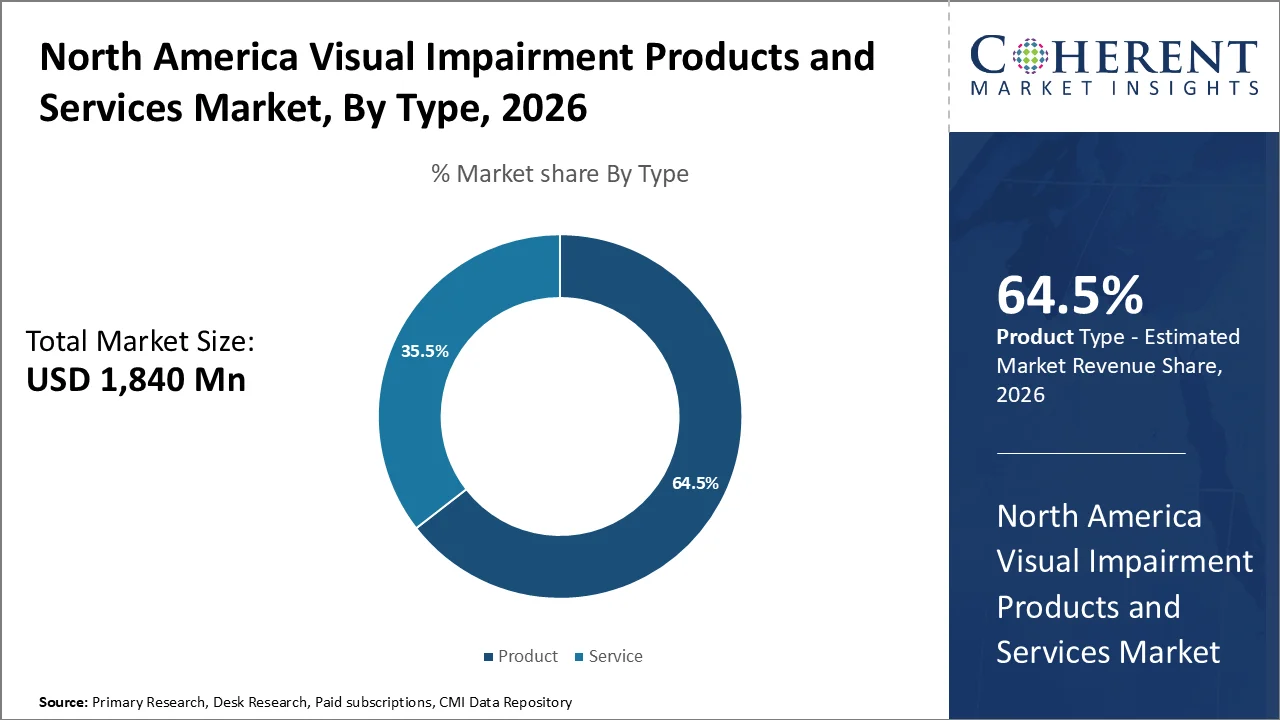
- The product segment is likely to dominate the market with 64.5% in 2026. The segment’s growth is owing to the growing use of magnifiers, screen readers, braille displays, wearable assistive devices, and mobility products. The National Eye Institute indicates that visual impairment and blindness in the U.S. are expected to double by 2050, supporting long-term demand for assistive products.
- The personal use segment is set to lead the market with 52.3% in 2026. The segment is growing as individuals with sight loss increasingly require daily-use assistive devices for reading, navigation, communication, education, work, and home independence. CDC data indicates that more than 1.6 Mn Americans living with vision loss or blindness are younger than 40, widening demand beyond elderly care.
- U.S. is expected to acquire the prominent share of 78.3% in 2026. The country’s growth is owing to the high disease burden, established assistive technology suppliers, strong rehabilitation networks, and regulatory pressure for digital accessibility. The CDC estimated the U.S. economic burden of vision loss and blindness at USD 134.2 billion, including USD 98.7 billion in direct costs.
Segmental Insights
Why is Product Segment Acquiring the Largest Share?
On the basis of type, the product segment is projected to account for the largest North America Visual Impairment Products and Services Market share of 64.5% in 2026. The segment’s growth is owing to the rising demand for low vision devices, braille displays, electronic magnifiers, screen readers, wearable assistive devices, and mobility products.
The CDC reported that over 350,000 people with vision loss or blindness live in group quarters, such as nursing homes or prisons, which further supports institutional procurement for accessibility devices and rehabilitation tools.
The product segment is also supported by innovation from companies such as Apple, APH, HumanWare, Vispero, OrCam, and eSight. APH’s Monarch is a notable example. It is a multiline braille device that renders tactile graphics with braille on a 10-line by 32-cell refreshable display and is listed at USD 15,500 as Federal Quota eligible.
- Current Industry Events of 2026
- Market Size Estimation
- Regional Breakdown
- Competitive Landscape
- Customer Intelligence
- Segmental Analysis
- Pricing Analysis
- Key Market Drivers, Challenges & Future Trends
- Customized Insights Section
Why is Personal Use Segment Acquiring the Largest Share?
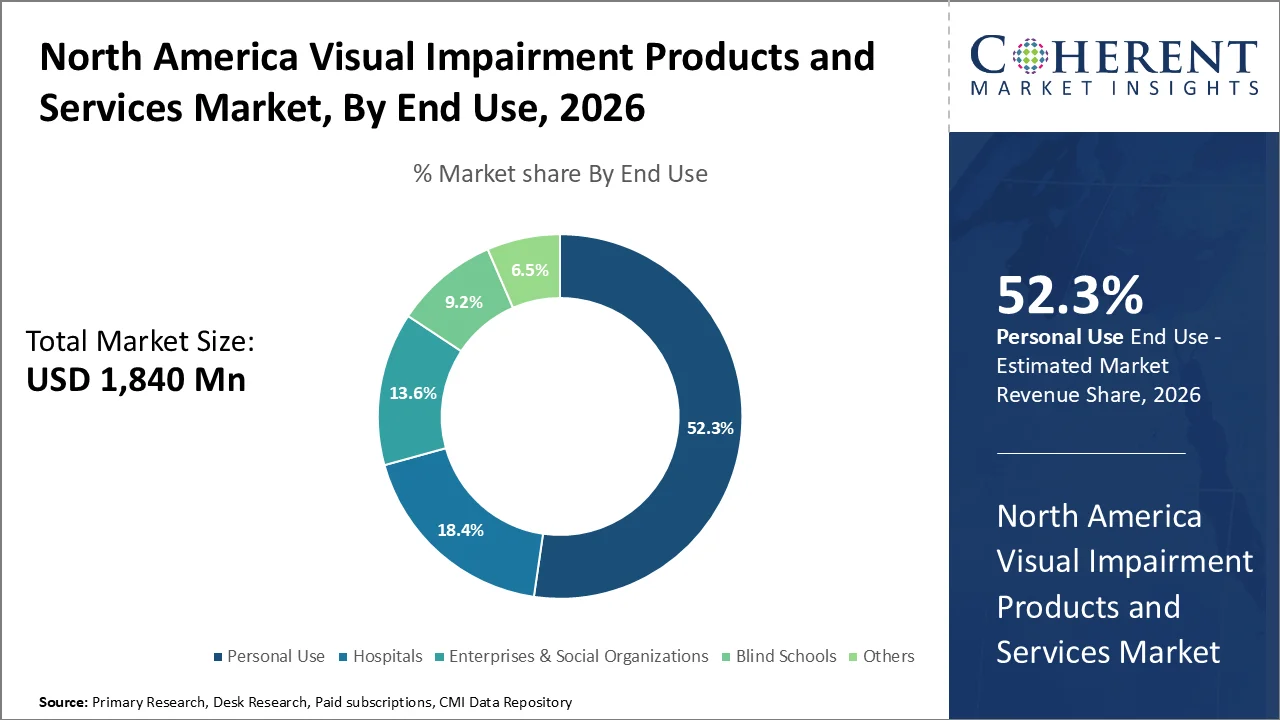
On the basis of end use, the personal use segment is projected to account for the largest North America Visual Impairment Products and Services Market share of 52.3% in 2026. The segment’s growth is owing to the rising demand for daily-use assistive products such as screen readers, magnifiers, braille note-takers, smart canes, AI visual assistants, and mobile accessibility tools.
The National Health and Aging Trends Study found that 27.8% of U.S. adults aged 71 years and above had vision impairment, thereby supporting the higher adoption among elderly personal users.
In July 2025, Envision partnered with San Francisco’s Museum of Craft and Design to pilot Ally, an accessible AI assistant for blind and low-vision visitors. The smartphone-based tool offers artwork descriptions, QR access, as well as interactive voice-guided questions to improve accessibility.
Market Drivers
Rising Innovations in AI-Based Accessibility are Transforming the Visual Impairment Products and Services Market in the U.S.
The U.S. is seeing fast growth in AI-based accessibility tools. These tools are being used in smartphones, mixed-reality devices, screen readers, smart magnifiers, and visual assistance platforms. They assist the blind and low-vision users in reading documents, identifying objects, moving through spaces, as well as accessing online content. AI-powered visual description tools are useful owing to their ability in reducing the need for human help. They also provide real-time support at home, at work, in schools, and in public places.
In May 2026, Apple announced accessibility updates powered by Apple Intelligence including enhanced capabilities for VoiceOver, Magnifier, Voice Control, and Accessibility Reader. The firm stated that detailed descriptions and natural language navigation would strengthen the accessibility across Apple devices. This development is expected to support the adoption of AI-driven visual assistance tools across personal users, schools, enterprises, as well as rehabilitation providers in North America.
Multimodal AI Visual Assistance: A Major Breakthrough in North America Visual Impairment Products and Services Market
Multimodal AI visual assistance is becoming a major breakthrough in the market. It combines computer vision, language models, voice interaction, and mobile cameras to describe surroundings and support decision-making for blind and low-vision users. Unlike traditional magnifiers or static screen readers, AI-based systems can interpret images, identify products, read text, describe scenes, and answer follow-up questions. This makes the technology useful for shopping, travel, education, workplace tasks, and home activities.
In March 2026, Be My Eyes Foundation launched as a nonprofit initiative to expand free access to AI, volunteers, and emerging technologies for blind and low-vision individuals. Be My Eyes stated that its broader mission targets the world’s 340 million blind and low-vision individuals, reinforcing the increasing role of AI-enabled support in accessibility services. Such innovations are expected to accelerate the North America Visual Impairment Products and Services Market growth during the forecast period.
Current Events and Their Impact on the North America Visual Impairment Products and Services Market
Current Event | Description and its Impact |
2026 ADA Title II Digital Accessibility Compliance Extension in the U.S.
|
|
Accessible Canada Act Reporting and Accessibility Planning Push |
|
North America Visual Impairment Products and Services Market Trends
- Rising demand for assistive technologies such as screen readers, magnifiers, braille displays, closed captioning, and low-vision devices is strengthening product adoption across schools, workplaces, and personal use.
- Digital accessibility regulations are boosting software and service demand, especially for web accessibility audits, alternate text, closed captioning, accessible documents, and compliance consulting.
- Aging population and chronic eye disease burden are increasing demand for low-vision rehabilitation, mobility training, assessment services, and adaptive devices. CDC data states that 4.2 million Americans aged 40 years and older had uncorrectable vision impairment, and this number is expected to more than double by 2050, supporting long-term market expansion.
- AI-enabled and smart accessibility tools are transforming user independence, with companies integrating object recognition, live magnification, reading assistance, and braille support into mainstream devices.
- Canada’s expanding disability and accessibility framework is supporting demand for visual impairment products and services across education, employment, public services, and digital platforms. Statistics Canada reported that 7.4% of Canadians had seeing disabilities under the 2022 Canadian Survey on Disability, while 15.0% reported difficulty seeing under the 2022 CCHS, highlighting a sizable addressable user base.
Regional Insights
U.S. Dominates Owing to the Aging Population, Strong Assistive Technology Adoption, and Accessibility Innovation
The U.S. is expected to dominate the market with 78.3% share in 2026. The country’s growth is owing to the large visually impaired population, strong adoption of digital assistive technologies, established suppliers, active nonprofit networks, and expanding accessibility compliance requirements.
The U.S. population aged 65 years and above reached 61.2 million in 2024, increasing by 3.1% from 2023. This strengthens the long-term demand for low-vision devices, mobility aids, and home-based vision support services.
The U.S. also leads in technology innovation. In May 2025, Apple introduced Braille Access, turning iPhone, iPad, Mac, and Apple Vision Pro into a braille note-taker, while also expanding Vision Pro accessibility features. These developments strengthen the U.S. market by embedding accessibility into mainstream consumer technology rather than limiting it to specialized devices.
Canada Visual Impairment Products and Services Market Trends
Canada is expected to be the fastest-growing country in North America. The growth is supported by the rising sight-loss awareness, public policy attention, rehabilitation service availability, and assistive technology programs.
Statistics Canada’s 2022 Canadian Survey on Disability indicated that 11.4% of Canadians aged 65 years and above, had a seeing disability. This is supporting demand for accessibility services and assistive products.
Canada’s market is further supported by national-level policy action. In June 2026, Health Canada published the National Strategy for Eye Care, which focuses on preventing vision loss, improving access to care, and supporting people who are blind or partially sighted. This is expected to improve coordination across government, providers, and nonprofit organizations.
Who are the Major Companies in Asia Pacific Impairment Products and Services Industry
Some of the major key players in North America Visual Impairment Products and Services Market are Adaptivation, Inc., AbleNet, Inc., Amedia Corporation, ACCESS INGENUITY, American Thermoform, GF Health Products Inc., Dolphin Computer Access Limited, Cambium Learning, ViewPlus Technologies, VISPERO, LS&S LLC, Drive DeVilbiss Healthcare, and Technologies HumanWare Inc.
Key News
- In June 2026, Meta showcased how Ray-Ban Meta and Oakley Meta AI glasses help people with disabilities, especially blind and low-vision users, live more independently. The glasses provide hands-free support for real-time object identification, communication, translation, navigation, and developer-enabled accessibility applications.
- In October 2025, Vispero launched Fusion Suite 2026, the latest version of its JAWS, ZoomText, and Fusion accessibility software for blind and low-vision users. The update adds AI-powered navigation tools, improved Braille support, user registration, enterprise compatibility, and enhanced productivity features.
Market Report Scope
North America Visual Impairment Products and Services Market Report Coverage
| Report Coverage | Details | ||
|---|---|---|---|
| Base Year: | 2025 | Market Size in 2026: | USD 1,840 Mn |
| Historical Data for: | 2020 To 2024 | Forecast Period: | 2026 To 2033 |
| Forecast Period 2026 to 2033 CAGR: | 5.9% | 2033 Value Projection: | USD 2,750 Mn |
| Geographies covered: |
| ||
| Segments covered: |
| ||
| Companies covered: | Adaptivation, Inc., AbleNet, Inc., Amedia Corporation, ACCESS INGENUITY, American Thermoform, GF Health Products Inc., Dolphin Computer Access Limited, Cambium Learning, ViewPlus Technologies, VISPERO, LS&S LLC, Drive DeVilbiss Healthcare, and Technologies HumanWare Inc. | ||
| Growth Drivers: |
| ||
| Restraints & Challenges: |
| ||
Analyst Opinion
- The North America Visual Impairment Products and Services Market is driven by rising age-linked vision impairment and the need for independent-living support. According to a recent CDC study, 13.6% of national survey respondents aged 65 years or older reported vision impairment. This shows strong demand for low-vision devices, screen readers, smart magnifiers, mobility aids, and rehabilitation services.
- Aging-driven vision loss will continue to support recurring demand for assistive products and services. The National Eye Institute projects that the number of people with visual impairment or blindness in the U.S. will double to more than 8 million by 2050. This indicates the long-term growth opportunities for magnifiers, braille tools, mobility devices, screen readers, as well as home-based support services.
- AI-enabled visual assistance is gaining strong traction in the market. Apple, Be My Eyes, and other technology providers are bringing accessibility into mainstream devices and cloud-connected services. Be My Eyes reported more than 900,000 users and 9.3 million volunteers globally in 2025, showing rising demand for scalable and low-cost visual assistance models.
Speak to the analyst
Want personalized insights?
Take the findings above to one of our principal consultants, or have the report rebuilt around the segments, geographies and competitors you actually track.
Market Segmentation
- By Type (Revenue, USD Mn, 2021-2033)
- Product
- Educational Devices & Software
- Closed Caption
- Braille transcription
- Alternate text
- Web accessibility software
- Others
- Mobility Devices
- Low Vision Devices
- Others
- Educational Devices & Software
- Service
- Assessment
- Screenings
- Direct Service
- Orientation and Mobility
- Others
- Product
- By End User (Revenue, USD Mn, 2021-2033)
- Blind Schools
- Enterprises & Social Organizations
- Personal Use
- Hospitals
- Others
- By Region (Revenue, USD Mn, 2021-2033)
- U.S.
- Canada
Sources
Primary Research Interviews
- Ophthalmologists
- Optometrists and low-vision specialists
- Vision rehabilitation therapists
- Orientation and mobility specialists
- Assistive technology trainers
- Blind school administrators
- Rehabilitation center managers
- Hospital and eye care clinic administrators
- Distributors of low-vision and assistive devices
- Accessibility software providers
- Key opinion leaders (KOLs) in visual impairment care and rehabilitation
Databases
- World Health Organization (WHO)
- Centers for Disease Control and Prevention (CDC)
- National Institutes of Health (NIH)
- National Eye Institute (NEI)
- U.S. Census Bureau
- Statistics Canada
- Centers for Medicare & Medicaid Services (CMS)
- Canadian Institute for Health Information (CIHI)
Magazines
- Ophthalmology Times
- Review of Ophthalmology
- Review of Optometry
- AccessWorld Magazine
- VisionAware
Journals
- Ophthalmology
- American Journal of Ophthalmology
- JAMA Ophthalmology
- Optometry and Vision Science
- Journal of Visual Impairment & Blindness
- British Journal of Ophthalmology
Newspapers
- The New York Times
- The Wall Street Journal
- The Washington Post
- The Globe and Mail
- Toronto Star
Associations
- American Academy of Ophthalmology
- American Optometric Association
- American Foundation for the Blind
- National Federation of the Blind
- VisionServe Alliance
- Association for Education and Rehabilitation of the Blind and Visually Impaired
- Canadian National Institute for the Blind
- Canadian Council of the Blind
Public Domain Sources
- Company Annual Reports and Investor Presentations
- Government Health Ministry Publications
- Public Health Agency Publications
- Clinical Trial Registries Such as ClinicalTrials.gov
- Disability and Accessibility Policy Documents
- Public Procurement and Assistive Technology Program Documents
Proprietary Elements
- CMI Data Analytics Tool
- Proprietary CMI Existing Repository of Information for Last 10 Years
Get access to 250+ pages report
Every segment, forecast, competitor profile and data table behind the analysis above — available for instant download.
- ESOMAR Member
- ISO 9001:2015 Certified
- D-U-N-S Registered
- GDPR & CCPA Compliant
Missing comfort of reading report in your local language? Find your preferred language:
Transform your Strategy with Exclusive Trending Reports
Frequently Asked Questions
The North America Visual Impairment Products and Services Market is expected to reach USD 2,750 Mn in 2033.
Major players operating in the global North America Visual Impairment Products and Services Market include Adaptivation, Inc., AbleNet, Inc., Amedia Corporation, ACCESS INGENUITY, American Thermoform, GF Health Products Inc., Dolphin Computer Access Limited, Cambium Learning, ViewPlus Technologies, VISPERO, LS&S LLC, Drive DeVilbiss Healthcare, and Technologies HumanWare Inc.
The high out-of-pocket costs, complex integration with existing systems, and strict regulatory compliance requirements are the key factors hampering growth of the market.
The aging population, an increasing prevalence of chronic eye conditions like diabetic retinopathy and glaucoma, and robust technological advancements in assistive AI and smart devices is boosting the demand for Impairment Products and Services.
The North America Visual Impairment Products and Services Market is anticipated to grow at a CAGR of 5.9% between 2026 and 2033.
U.S. is expected to account for a largest market share in the global North America Visual Impairment Products and Services Market over the forecast period.
The market includes products and services that help blind and low-vision individuals improve independence, mobility, learning, communication, digital access, and daily living. It covers low vision devices, braille products, mobility aids, screen readers, accessibility software, assessment, rehabilitation, and orientation and mobility services.