

Gas Separation Membrane Market Size and Share Analysis - 2026 To 2033
The Gas Separation Membrane Market size is anticipated to grow at a CAGR of 6.5% with USD 1,780 Mn in 2026 and is expected to reach USD 2,770 Mn in 2033. The primary drivers are defined by the rising demand for natural gas processing, biogas upgrading, hydrogen recovery, carbon dioxide removal, and on-site nitrogen generation. According to the International Energy Agency, global natural gas demand increased by around 40 bcm in 2025, despite weaker industrial activity and high LNG prices. This is strengthening demand for compact, energy-efficient, and modular membrane systems across oil & gas, chemicals, power generation, biogas, and industrial gas applications.
Key Takeaways
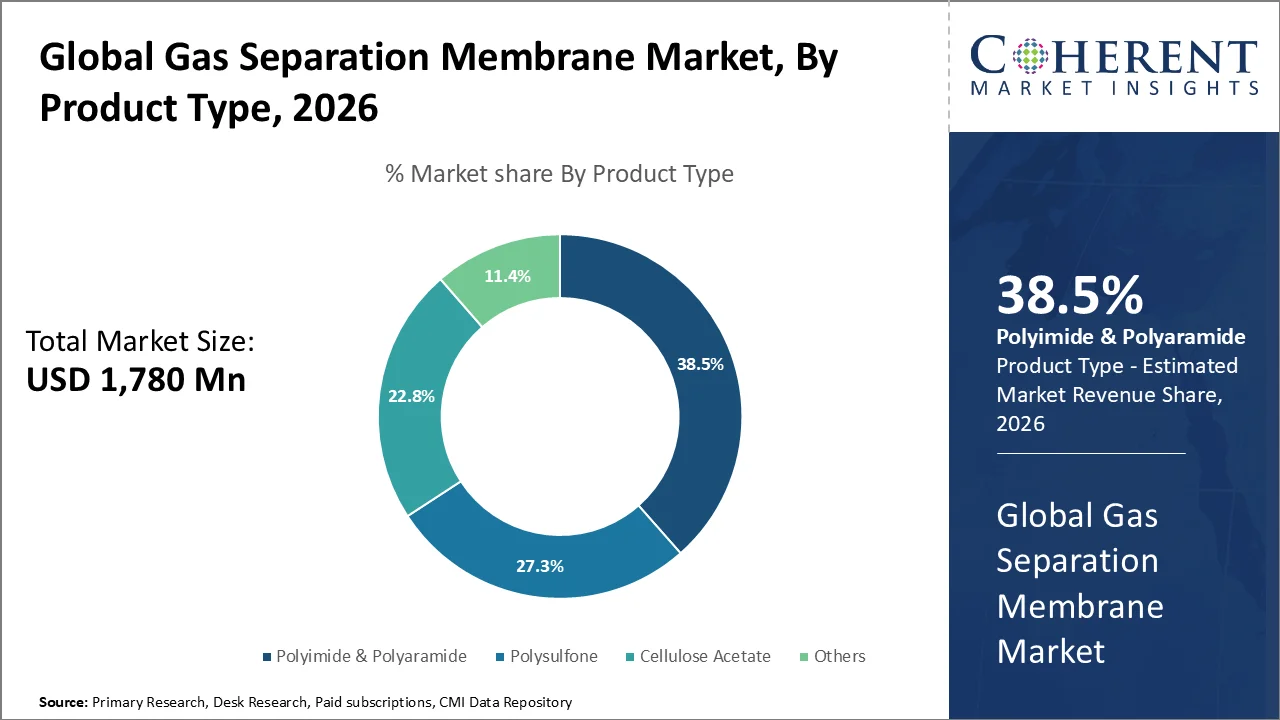
- The polyimide & polyaramide segment is likely to dominate the market with 38.5% in 2026. The segment’s growth is owing to the high selectivity, chemical resistance, thermal stability, and strong suitability for CO₂/CH₄ separation. In October 2025, UBE stated that its polyimide-based CO₂ separation membranes can enable biomethane purification up to 99.5% and biomethane recovery up to 99.8%, thereby supporting the adoption in biogas upgrading.
- The hollow fiber segment is set to lead with 60.2% in 2026. The segment’s growth is owing to the high surface area, compact footprint, and energy-efficient operation, thus making it suitable for large-scale industrial gas separation systems.
- The nitrogen generation & oxygen enrichment segment is set to lead with 32.5% in 2026. The segment’s growth is owing to the growing use of on-site nitrogen generation in chemicals, food packaging, electronics, oil & gas, and marine applications.
- The chemical & petrochemical industry segment is set to lead with 34.6% in 2026. The segment’s growth is owing to the strong use of membranes in hydrogen recovery, syngas adjustment, CO₂ removal, and feed-gas purification.
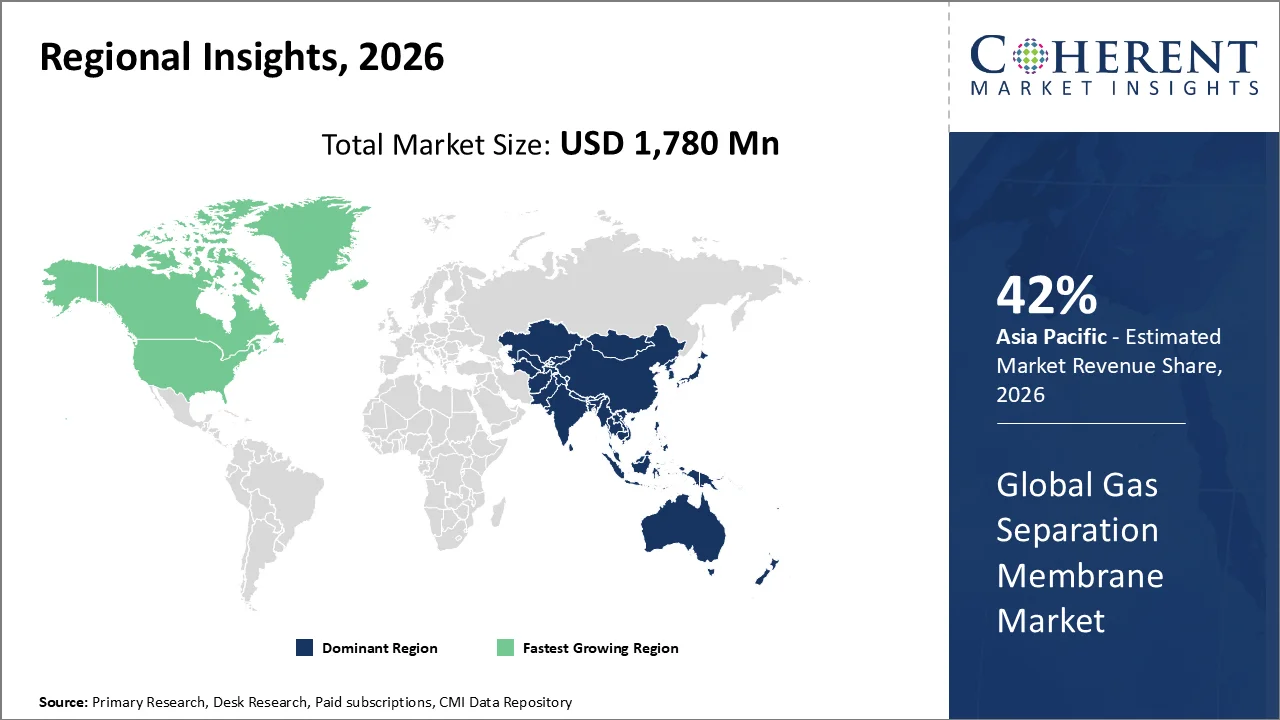
- Asia Pacific is expected to acquire the prominent share of 42% in 2026. The region’s growth is owing to the industrial gas demand, biogas upgrading projects, refinery expansion, and clean energy investments across China, India, Japan, South Korea, and ASEAN. Japan's primary natural gas supply is projected to reach 53–61 Mn mt in FY2040–41 under the 73% GHG reduction scenario.
Segmental Insights
Why is Polyimide & Polyaramide Segment Acquiring the Largest Share?
On the basis of product type, the polyimide & polyaramide segment is projected to account for the largest Gas Separation Membrane Market share of 38.5% in 2026. The segment’s growth is owing to the superior physicochemical properties, excellent thermal stability, chemical resistance, and mechanical strength of these membrane separation materials.
The research from the National Institutes of Health (NIH) demonstrates that rigid polyimide fillers provide an exceptional CO2 plasticization pressure of 300 psi in high-pressure operations.
In January 2025, Arkema and OOYOO partnered to develop gas separation membranes for CO₂ capture using high-performance polymers like Pebax, polyimide, PEKK, and PVDF. The collaboration combines Arkema’s advanced polymer materials with OOYOO’s membrane design expertise to improve selectivity, reduce costs, as well as support decarbonization.
- Current Industry Events of 2026
- Market Size Estimation
- Regional Breakdown
- Competitive Landscape
- Customer Intelligence
- Segmental Analysis
- Pricing Analysis
- Key Market Drivers, Challenges & Future Trends
- Customized Insights Section
Chemical & Petrochemical Industry hold the Largest Market Share
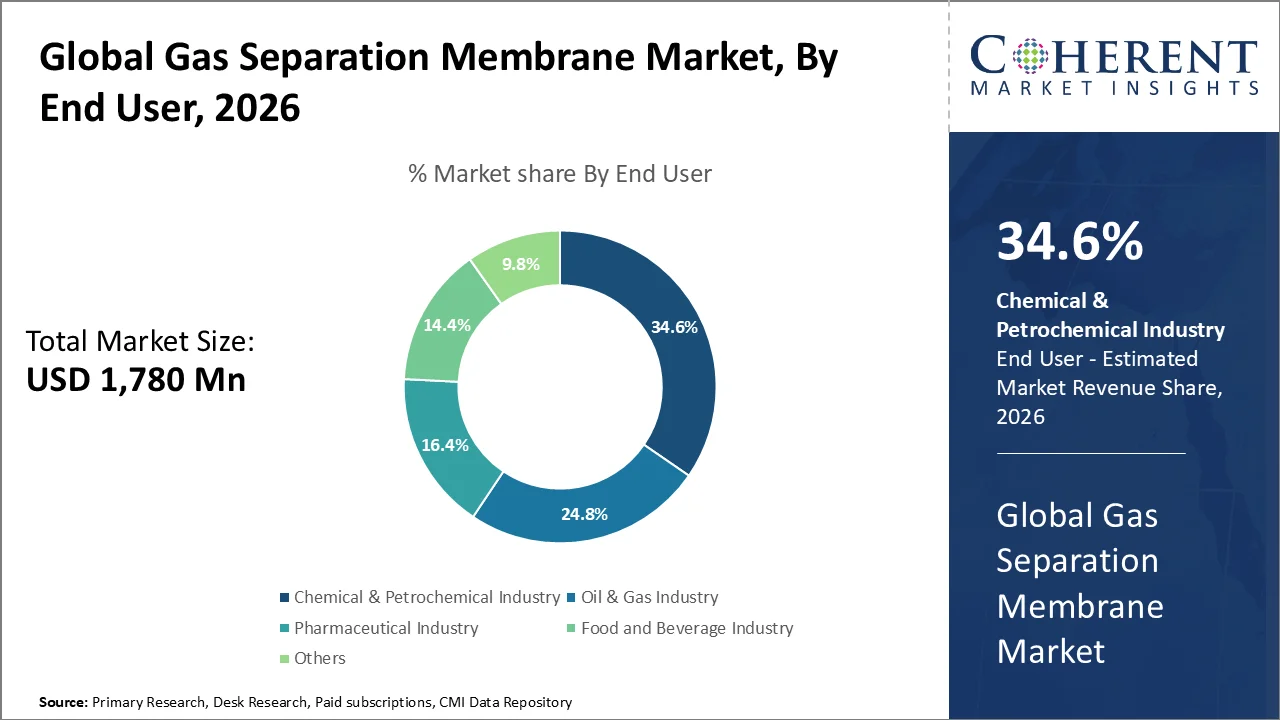
On the basis of end user, the chemical & petrochemical industry segment lead with a major 34.6% share in 2026. The growth is owing to the increasing use of gas separation membranes for hydrogen recovery, nitrogen generation, CO₂ removal, natural gas dehydration, and solvent vapor separation across refineries, ammonia, methanol, polymer, and specialty chemical facilities.
The U.S. EIA reported that industrial natural gas consumption averaged 23.6 Bcf/d in 2025 and forecast a further 1.2% rise in 2026. It also identifies chemicals as the largest industrial natural gas-consuming subsector. In Europe, the EEA reported chemical industry GHG emissions of 155,495 kilotonnes CO₂-eq, equal to 5% of EU net GHG emissions, thereby reinforcing the demand for cleaner separation processes.
Market Drivers
Rising Innovations in Membrane-Based Gas Processing are Transforming the Gas Separation Membrane Market in the U.S.
The U.S. is witnessing strong innovation in membrane-based gas processing owing to the rising natural gas production, LNG exports, industrial gas demand, marine nitrogen systems, and carbon capture interest. Membranes are being adopted as compact and modular solutions for nitrogen generation, CO₂ removal, hydrogen recovery, and bio-LNG purification.
According to the U.S. Energy Information Administration, U.S. LNG exports reached 17.9 Bcf/d in April 2026, the highest April rate since tracking began in 1997. This supports the demand for gas treatment technologies that improve purity, reliability, and operational efficiency across LNG, energy, and industrial gas infrastructure.
In June 2026, Air Products Membrane Solutions announced the expansion of its Missouri manufacturing and logistics center. The products manufactured at the facility include PRISM GreenSep membrane separator for bio-LNG production and PRISM N2Sep membrane separator.
Advanced Hollow Fiber Membranes: A Major Breakthrough in Gas Separation Membrane Market
Advanced hollow fiber membranes are emerging as a major breakthrough in the gas separation membrane market because they combine high surface area, compact equipment design, continuous operation, and modular scalability. The hollow fiber modules can be integrated into compact skids and deployed closer to the point of gas use or gas generation. These systems are used for nitrogen production, oxygen enrichment, hydrogen recovery, CO₂ removal, natural gas sweetening, vapor dehydration, and biomethane upgrading.
UBE states that its CO₂ separation membrane modules use polyimide hollow fiber membranes that allow CO₂ to permeate preferentially over methane. This allows for the efficient biomethane production from biogas derived from livestock waste, landfill waste, and sewage sludge. UBE also states that its CO₂ separator modules have been applied to several hundred biomethane plants worldwide, while its N₂ modules can generate dry nitrogen with 90% to 99.9% purity.
In April 2026, Evonik announced that it became the membrane technology partner for a public-private biogas upgrader in Asia through a large-scale agreement with MTC Orec Sdn Bhd in Malaysia. The firm will supply SEPURAN Green membranes and patented technology to MTCO, which plans to expand biogas plant development in Asia.
Current Events and Their Impact on the Gas Separation Membrane Market
Current Event | Description and its Impact |
EU Methane Regulation and Import Compliance Rules |
|
Carbon Capture and Industrial Carbon Management Policy Push |
|
Gas Separation Membrane Market Trends
- Rising use of membrane-based CO₂ separation supports carbon capture, natural gas purification, and biomethane upgrading applications in energy-intensive industries.
- Growing CCUS project activity strengthens the demand, as the global operational CO₂ capture and storage capacity exceeded 50 Mt in Q1 2025 and the project pipeline could reach around 430 Mt/year by 2030.
- Biomethane expansion boosts membrane adoption for CO₂/CH₄ separation. The EU targets 35 bcm/year biomethane production by 2030. Europe’s biomethane plants increased from 1,678 to 1,975 between 2025 and 2026 data collection periods.
- On-site nitrogen generation is gaining traction as membrane systems offer compact, continuous, and low-maintenance nitrogen supply for oil & gas, chemicals, food packaging, and marine applications. Air Liquide offers membrane systems with nitrogen purity ranging from 95% to 99.9%.
- Membrane-based carbon capture is gaining attention because it can reduce chemical use, water consumption, and space requirements. In February 2025, Pall Corporation and MTR Carbon Capture partnered to integrate Pall’s filtration and coalescer technology with MTR’s Polaris membrane system for carbon capture. This supports the adoption in cement, refining, steel, and waste-to-energy facilities.
Regional Insights
Asia Pacific Dominates Owing to the Strong Industrial Gas Demand and Biogas Upgrading Momentum
The Asia Pacific region accounts for 42% of the market share in 2026. The region’s growth is owing to expanding chemical production, natural gas processing, LNG infrastructure, renewable gas projects, and industrial manufacturing. China, India, Japan, South Korea, and ASEAN countries are using membrane technologies for nitrogen generation, hydrogen recovery, CO₂ separation, and biogas upgrading.
In Jan 2023, UBE Corporation announced expansion of its gas separation membrane manufacturing facilities in Japan to meet rising demand, especially for CO₂ separation membranes. The expansion will increase production capacity by about 1.8 times and support applications such as biomethane, hydrogen separation, nitrogen separation, and dehumidification.
North America Gas Separation Membrane Market Trends
North America expected to witness strong growth in Gas Separation Membrane Market over the forecast period. The region’s growth is owing to high natural gas production, LNG infrastructure, carbon capture investments, refinery modernization, hydrogen recovery, and modular gas treatment demand. The U.S. remains the region’s largest market, while Canada benefits from natural gas processing, CCS deployment, and oil sands-related industrial gas treatment.
EIA reported that the U.S. dry natural gas production reached 110.9 Bcf/day in April 2026 supported by the strong output from shale basins along with the LNG-linked infrastructure demand. The region also has strong carbon capture activity. The Global CCS Institute reported continued growth in commercial CCS projects globally, with operational projects rising sharply in 2025.
Growing Natural Gas Infrastructure are Accelerating the Gas Separation Membrane Market in China
China is expected to remain one of the most important country markets in Asia Pacific. The growth is owing to its large industrial base, growing natural gas infrastructure, hydrogen economy ambitions, and long-term biomethane potential. According to the IEA, China’s natural gas demand grew by around 2% in 2025, despite weaker industrial activity and rapid renewable electricity expansion.
China’s long-term biomethane potential is also supporting the future membrane demand. The IEA’s outlook indicates that China could produce over 30 Mtoe of biomethane by 2040 under stated policies, with biomethane injected into its expanding natural gas grid. This supports the adoption of CO₂ removal and methane purification membranes for renewable gas production.
United States India Gas Separation Membrane Market Trends
The U.S. is a major market for gas separation membranes owing to the high natural gas production, LNG exports, industrial gas demand, and strong presence of membrane technology suppliers. According to the U.S. Energy Information Administration, LNG exports reached 17.9 Bcf/d to 35 countries. This creates demand for gas treatment, nitrogen generation, CO₂ removal, as well as fuel gas conditioning technologies.
In August 2025, Transfilm Technology Corporation launched IonClear, a Silicon Valley-based membrane company serving U.S., Canadian, and Mexican markets. IonClear’s RO and NF membranes support water filtration, purification, resource recovery, localized service, supply resilience, and sustainable reuse across industrial applications.
Who are the Major Companies in Gas Separation Membrane Industry
Some of the major key players in Gas Separation Membrane Market are Fujifilm Manufacturing Europe B.V., Air Products and Chemicals, Inc., Honeywell UOP, Air Liquide Advanced Separations, Schlumberger Ltd., DIC Corporation, Ube Industries Ltd., Parker Hannifin Corporation, Membrane Technology and Research Inc., and Generon.
Key News
- In June 2026, Evonik launched a pilot plant in Marl, Germany, to produce its high-performance DURAION membrane for AEM water electrolysis. The membrane supports cost-efficient green hydrogen production, reduces investment costs, avoids added PFAS, and offers capacity for up to 2.5 GW of electrolysis annually.
- In April 2026, Membrane Technology & Research secured USD 27 million investment from Climate Investment and Hartree Partners. The aim is to expand membrane-based gas separation and carbon capture solutions. The funding supports the global deployment in industrial separations, hydrogen, natural gas, BTX recovery, as well as acid gas enrichment applications.
- In May 2025, Borna Membrane Solutions planned to invest USD 40 million in Egypt to manufacture flare gas recovery, carbon separation, and reinjection systems. The facility supports emission reduction, carbon credit trading, lower energy imports, and CBAM compliance for exporters.
Market Report Scope
Gas Separation Membrane Market Report Coverage
| Report Coverage | Details | ||
|---|---|---|---|
| Base Year: | 2025 | Market Size in 2026: | USD 1,780 Mn |
| Historical Data for: | 2020 To 2024 | Forecast Period: | 2026 To 2033 |
| Forecast Period 2026 to 2033 CAGR: | 6.5% | 2033 Value Projection: | USD 2,770 Mn |
| Geographies covered: |
| ||
| Segments covered: |
| ||
| Companies covered: | Fujifilm Manufacturing Europe B.V., Air Products and Chemicals, Inc., Honeywell UOP, Air Liquide Advanced Separations, Schlumberger Ltd., DIC Corporation, Ube Industries Ltd., Parker Hannifin Corporation, Membrane Technology and Research Inc., and Generon. | ||
| Growth Drivers: |
| ||
| Restraints & Challenges: |
| ||
Analyst Opinion
- Gas separation membrane demand is driven by real industrial need. Refineries, chemical plants, natural gas processors, and biogas facilities need continuous gas purification, CO₂ removal, nitrogen generation, and hydrogen recovery. This means the market is growing because industries need lower-energy, compact, and cleaner separation systems.
- Carbon capture is becoming a major demand driver. The global operational CO₂ capture and storage capacity was just more than 50 million tonnes in Q1 2025. The project pipeline could reach around 430 million tonnes per year by 2030.
- Biomethane upgrading and nitrogen generation are gaining strong traction. Europe reached nearly 1,974 biomethane-producing facilities by June 2026, thereby creating the demand for membrane-based CO₂/CH₄ separation. At the same time, membrane nitrogen systems are widely used for on-site nitrogen supply, with PRISM systems typically offering 95–97% nitrogen purity and capability up to 99.9%. This supports the adoption in food packaging, chemicals, marine, oil & gas, and industrial inerting applications.
Speak to the analyst
Want personalized insights?
Take the findings above to one of our principal consultants, or have the report rebuilt around the segments, geographies and competitors you actually track.
Market Segmentation
- By Product Type (Revenue, USD Mn, 2021-2033)
- Polyimide & polyaramide
- Polysulfone
- Cellulose acetate
- Others
- By Module (Revenue, USD Mn, 2021-2033)
- Hollow Fiber
- Spiral Wound
- Plate and Frame
- Others
- By Application (Revenue, USD Mn, 2021-2033)
- Nitrogen generation & oxygen enrichment
- Hydrogen recovery
- Carbon dioxide removal
- Vapor/gas separation
- Vapor/vapor separation
- Air dehydration
- Others
- By End User (Revenue, USD Mn, 2021-2033)
- Chemical & Petrochemical Industry
- Oil & Gas Industry
- Pharmaceutical Industry
- Food and Beverage Industry
- Others
- By Region (Revenue, USD Mn, 2021-2033)
- North America
- U.S.
- Canada
- Latin America
- Brazil
- Mexico
- Argentina
- Rest of Latin America
- Europe
- Germany
- U.K.
- France
- Italy
- Spain
- Russia
- Rest of Europe
- Asia Pacific
- China
- India
- Japan
- Australia
- South Korea
- ASEAN
- Rest of Asia Pacific
- Middle East
- GCC
- Israel
- Rest of Middle East
- Africa
- South Africa
- Central Africa
- North Africa
- North America
Sources
Primary Research Interviews
- Chemical engineers
- Gas processing plant operators
- Industrial gas manufacturers
- Membrane technology suppliers
- Oil & gas industry experts
- Hydrogen production specialists
- Carbon capture project developers
- Petrochemical plant managers
- Key opinion leaders (KOLs) in membrane separation technology
Databases
- International Energy Agency (IEA)
- U.S. Energy Information Administration (EIA)
- U.S. Environmental Protection Agency (EPA)
- European Environment Agency (EEA)
- United Nations Industrial Development Organization (UNIDO)
- Organisation for Economic Co-operation and Development (OECD)
Magazines
- Gasworld
- Hydrocarbon Processing
- Chemical Engineering
- Oil & Gas Journal
- Processing Magazine
Journals
- Journal of Membrane Science
- Separation and Purification Technology
- Industrial & Engineering Chemistry Research
- Chemical Engineering Journal
- Membranes
Newspapers
- The New York Times
- The Guardian
- The Wall Street Journal
- Financial Times
- Reuters
Associations
- International Gas Union
- American Institute of Chemical Engineers
- European Membrane Society
- North American Membrane Society
- Compressed Gas Association
- International Association for Hydrogen Safety
Public Domain Sources
- Company Annual Reports And Investor Presentations
- Government Energy And Environmental Agency Publications
- Patent Databases And Technology Registries
- Industrial Gas Production Statistics
- Carbon Capture And Hydrogen Project Databases
Proprietary Elements
- CMI Data Analytics Tool
- Proprietary CMI Existing Repository of Information for the Last 10 Years
Get access to 250+ pages report
Every segment, forecast, competitor profile and data table behind the analysis above — available for instant download.
- ESOMAR Member
- ISO 9001:2015 Certified
- D-U-N-S Registered
- GDPR & CCPA Compliant
Missing comfort of reading report in your local language? Find your preferred language:
Transform your Strategy with Exclusive Trending Reports
Frequently Asked Questions
The Gas Separation Membrane Market is expected to reach USD 2,770 Mn in 2033.
Major players operating in the global Gas Separation Membrane Market include Fujifilm Manufacturing Europe B.V., Air Products and Chemicals, Inc., Honeywell UOP, Air Liquide Advanced Separations, Schlumberger Ltd., DIC Corporation, Ube Industries Ltd., Parker Hannifin Corporation, Membrane Technology and Research Inc., and Generon.
The high initial implementation costs, complex integration with legacy building systems, and a lack of skilled personnel to manage advanced AI and IoT-enabled tools are the key factors hampering growth of the market.
The rapid adoption of hybrid work models, cost optimization pressures, and the integration of AI-driven analytics is boosting the demand for Gas Separation Membrane.
The Gas Separation Membrane Market is anticipated to grow at a CAGR of 6.5% between 2026 and 2033.
Among regions, North America is expected to account for a largest market share in the global Gas Separation Membrane Market over the forecast period.
The Gas Separation Membrane Market includes software platforms and related services used to plan, allocate, visualize, and optimize physical spaces such as offices, campuses, warehouses, hospitals, retail stores, and public facilities. These solutions support floor planning, seating allocation, occupancy tracking, room booking, move management, and facility optimization.