

U.S. OTC Adhesive Bandage Market Size and Forecast – 2026 To 2033
The U.S. OTC adhesive bandage market is expected to grow from USD 695.0 Mn in 2026 to USD 923.9 Mn by 2033, registering a compound annual growth rate (CAGR) of 4.1% from 2026 to 2033. The U.S. OTC adhesive bandage market is poised for significant expansion, fueled by the high incidence of cuts and pierce injuries requiring immediate wound protection.
According to the U.S. Centers for Disease Control and Prevention National Hospital Ambulatory Medical Care Survey, approximately 2.05 million emergency department visits in the U.S. in 2022 were associated with cut or pierce injuries, accounting for 4.7% of all injury-related visits. This recurring burden of minor and moderate injuries supports demand for readily available OTC adhesive bandages for wound coverage and protection.
Key Takeaways of the U.S. OTC Adhesive Bandage Market
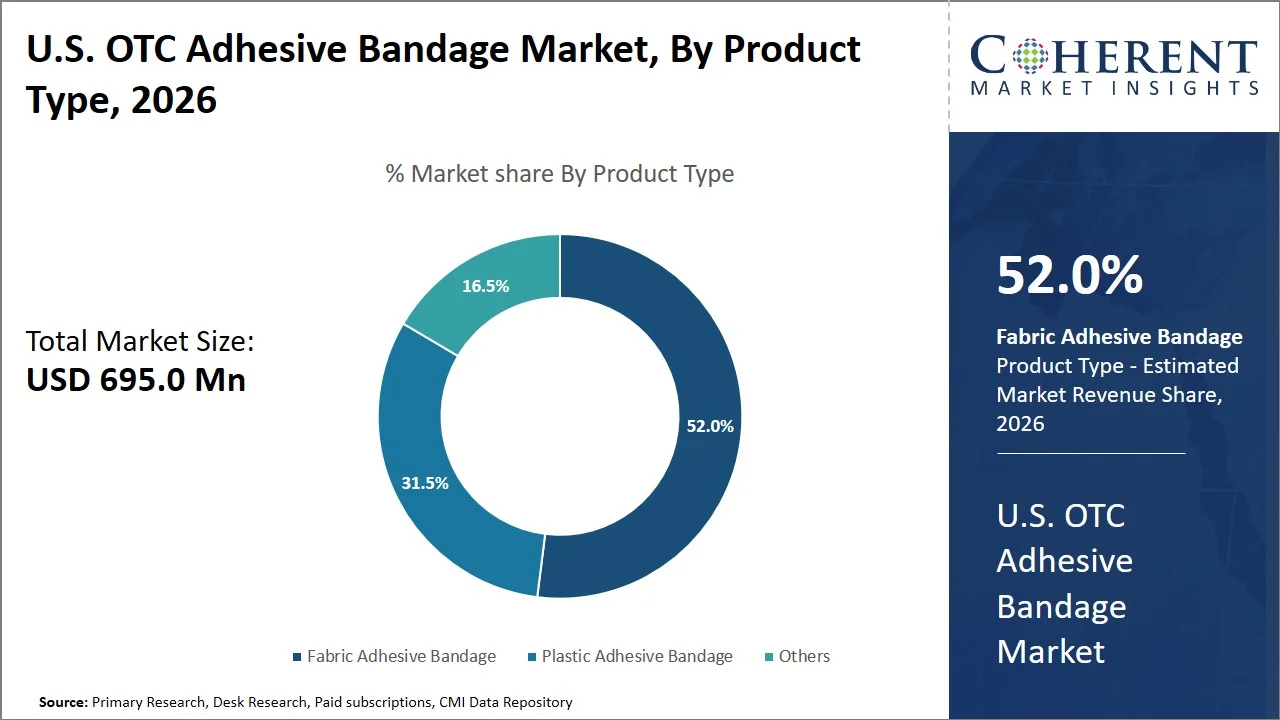
- Fabric adhesive bandage is projected to hold 52.0 % of the U.S. OTC adhesive bandage market share in 2026, making it the dominant product type segment, supported by its flexibility and suitability for everyday minor wound protection. For instance, the U.S. Food and Drug Administration (FDA) classifies medical adhesive tape and adhesive bandages under Product Code KGX and 21 CFR 880.5240 as Class I, 510(k)-exempt devices, reflecting their established use as low-risk wound-care products.
- Retail pharmacies are projected to hold 48.6 % of the U.S. OTC adhesive bandage market share in 2026, making it the dominant distribution channel segment, supported by the direct-to-consumer nature of OTC medical devices. For instance, the U.S. Food and Drug Administration (FDA) identifies bandages as OTC medical devices that can be sold directly to consumers without a prescription, while its guidance notes that OTC and home-use medical devices are commonly available through pharmacies and other consumer channels.
Segmental Insights
Why Do Fabric Adhesive Bandage Dominate the U.S. OTC Adhesive Bandage Market?
Fabric adhesive bandage is projected to hold a market share of 52.0% in 2026, because of its flexibility, strength and customer convenience for wound dressing. Being made from fabric, it fits well on the body and withstands the repeated use at fingertips, joints and movement areas. For instance, BAND-AID Flexible Fabric bandages combine MEMORY WEAVE fabric that stretches with movement for superior comfort and stretchability and a unique QUILT-AID comfort pad that “cushions little injuries,” specifically addressing the segments of “flexible” and “comfortable. The product is available in numerous pack sizes through major U.S. retailers, highlighting its broad consumer-market positioning. (Source: Kenvue Brands LLC )
- Current Industry Events of 2026
- Market Size Estimation
- Regional Breakdown
- Competitive Landscape
- Customer Intelligence
- Segmental Analysis
- Pricing Analysis
- Key Market Drivers, Challenges & Future Trends
- Customized Insights Section
Why Does Retail Pharmacies Represent the Distribution Channel Segment in the U.S. OTC Adhesive Bandage Market?
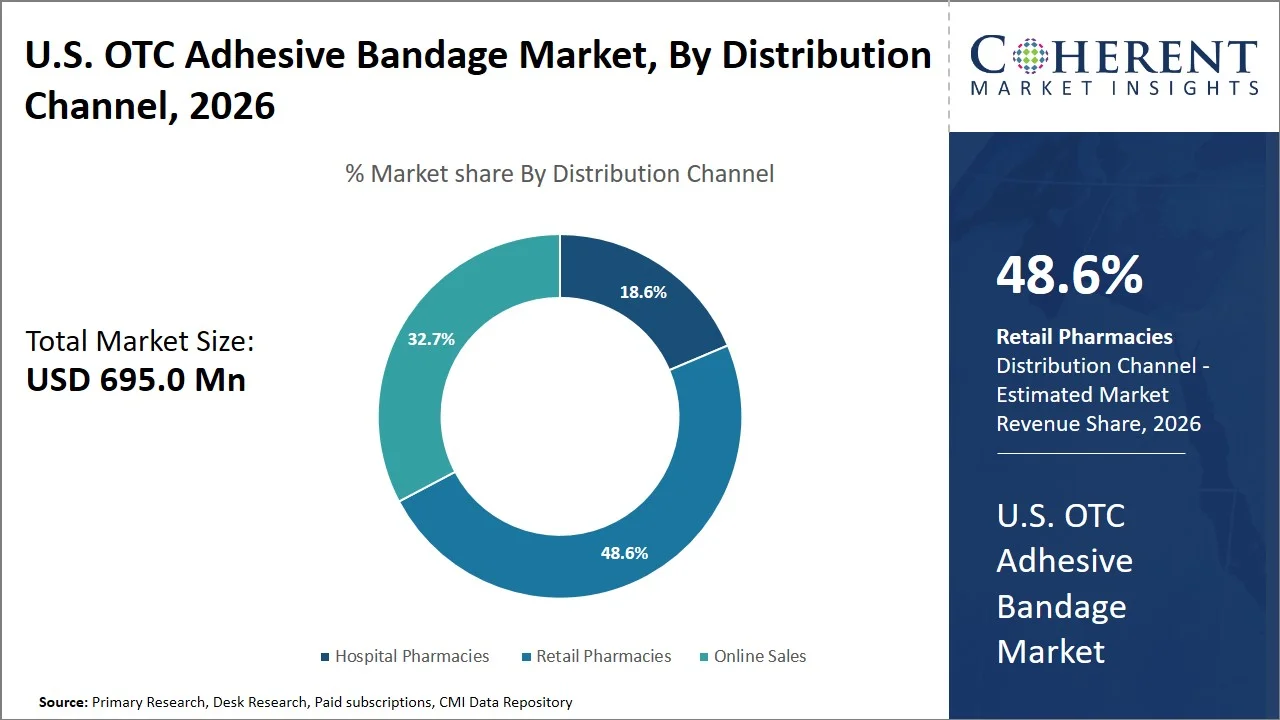
Retail pharmacies are projected to hold 48.6% of the market share in 2026, due to its numerous physical locations that ensure product availability and consumer familiarity to purchase health-related products. Pharmacies carry numerous branded and in-house label OTC first aid products that give consumers the choice between expensive to low price products based on the type of injuries they have. For instance, CVS Pharmacy has an extensive and convenient, specialized section dedicated to first-aid kits and a large selection of band-aids from several brands, highlighting the use of the channel to enable quick availability to OTC wound-care supplies.
Current Events and their Impact
Current Events | Description and its Impact |
U.S. FDA Received Adverse Event Report for Welly Health Adhesive Bandages (September 2025) |
|
U.S. FDA Updated U.S. Adhesive Bandage Device Listings (June 2026) |
|
U.S. OTC Adhesive Bandage Market Dynamics
Market Drivers
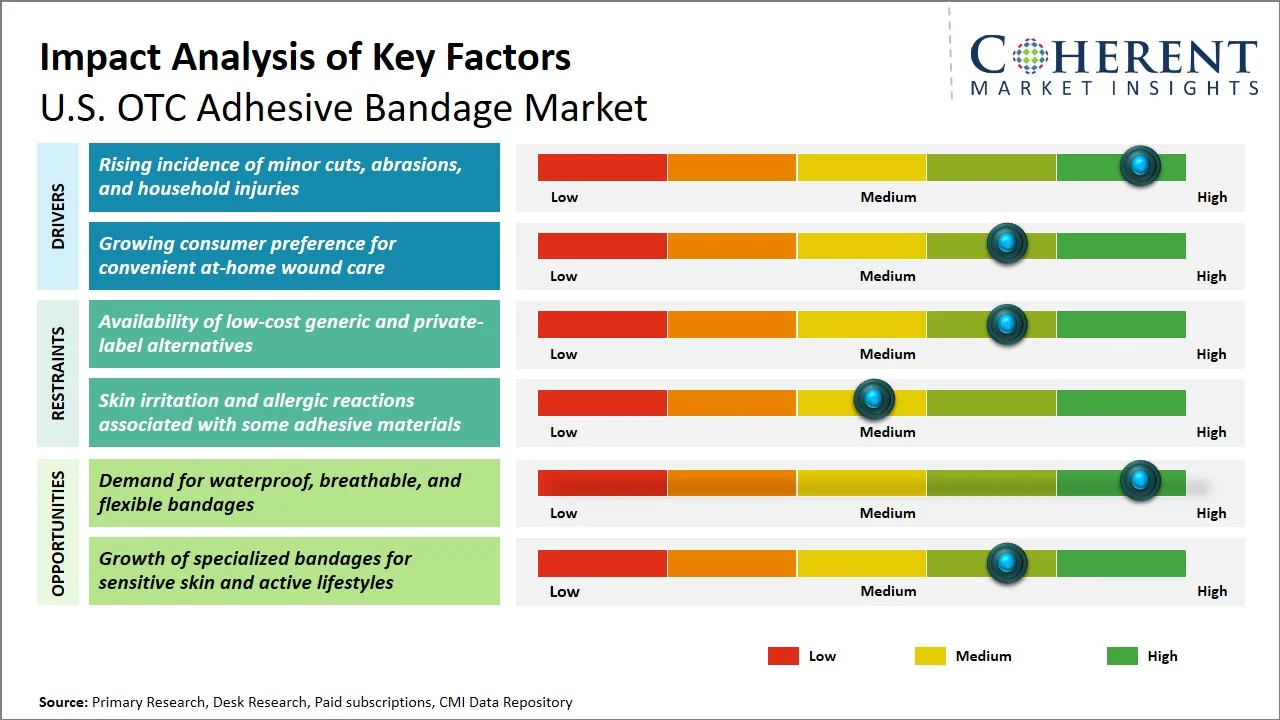
- Rising incidence of minor cuts, abrasions, and household injuries: The U.S. OTC adhesive bandage market is supported by the recurring incidence of minor cuts, abrasions and household injuries, which creates consistent demand for convenient first-aid products. Everyday activities such as cooking, home maintenance, sports and recreation frequently result in injuries requiring immediate wound coverage. For instance, the U.S. Consumer Product Safety Commission (CPSC) reported approximately 1.11 million emergency-department-treated injuries associated with beds, mattresses and pillows in 2024, highlighting the substantial burden of injuries occurring in everyday household settings.
- Growing consumer preference for convenient at-home wound care: The U.S. OTC adhesive bandage market is benefiting from increasing consumer preference for self-managed wound care at home, particularly for minor cuts, scrapes and superficial wounds that do not require clinical intervention. The U.S.FDA recognizes bandages as OTC medical devices that can be purchased and used directly by consumers, supporting the shift toward convenient, accessible first-aid solutions. For instance, the U.S. FDA notes that OTC medical devices are designed to allow consumers to self-select, self-treat and self-manage their conditions without healthcare-provider assistance.
- Growing Demand for Specialized and Antimicrobial Bandages: The U.S. OTC adhesive bandage market is gaining opportunities from specialized products that provide benefits beyond basic wound coverage, including antibacterial protection and bleeding control. For instance, U.S. FDA-cleared HemCon Bandage PRO OTC is indicated for the management of minor cuts, lacerations and abrasions while also providing an antibacterial barrier, demonstrating the development of function-specific OTC bandage solutions.
Emerging Trends
- Growing adoption of antimicrobial bandages: The market is witnessing greater interest in bandages incorporating antimicrobial agents to provide an additional protective barrier for minor wounds. U.S. FDA-cleared products demonstrate continued development of antibacterial bandages for minor cuts and scrapes.
- Increasing emphasis on latex-free and skin-compatible adhesives: Manufacturers are increasingly prioritizing latex-free and gentler adhesive formulations to address skin sensitivity and improve comfort during prolonged wear. The trend is also supported by evidence of contact reactions associated with medical adhesives, encouraging greater attention to hypoallergenic materials and skin-friendly formulations.
- Shift toward multi-functional wound-protection designs: Adhesive bandages are evolving beyond basic wound coverage toward designs that combine secure adhesion, moisture management and enhanced barrier protection. U.S. FDA classifications and product developments increasingly reflect innovations integrating different backing, absorbent-pad and adhesive technologies.
U.S. FDA Classification of OTC Adhesive Bandage-Related Devices
FDA Product Code | Device Type | Regulation | Device Class | OTC Relevance |
KGX | Medical adhesive tape and adhesive bandage | 21 CFR 880.5240 | Class I | Core OTC adhesive bandage category |
PYO | Adhesive tape and bandage with adjustable closing mechanism | 21 CFR 880.5240 | Class I | OTC wound closure and minor-wound protection |
FPX | Adhesive skin-closure strip | 21 CFR 880.5240 | Class I | Adjacent minor-wound closure application |
MZR | Topical approximation system | 21 CFR 880.5240 | Class I | Adjacent wound-closure application |
How is the demand for waterproof, breathable, and flexible bandages creating new growth opportunities in the U.S. OTC adhesive bandage market?
Waterproof, breathable, and flexible OTC adhesive bandages offer a profitable avenue for the U.S. OTC adhesive bandage market, as consumers recognize the value bandages that work effectively and do not hinder daily activities. Comfort, a lack of restriction and a sense of security provided by moisture resistance, are aspects that are gaining importance for the consumer. For instance, 3M's Nexcare Ultra Stretch Bandages' flexible, breathable backing molds to the body's movements, while 3M's waterproof bandages keep water and moisture out. These shows manufacturers' concerns of providing the most comfortable, flexible and protective OTC bandages in the next generations.
Market Players, Key Development, and Competitive Landscape
Key Developments
- In July 2026, Antix LLC announced the launch of Brandage adhesive bandages, which transfer a temporary tattoo onto a child’s skin when removed, aiming to make bandage removal less stressful. The product is being introduced to U.S. retailers at ASD Market Week in August 2026, highlighting the growing differentiation of OTC adhesive bandages through child-friendly designs and consumer-focused features.
- In April 2024, Vomaris introduced PowerHeal, an FDA-cleared bioelectric bandage for over-the-counter use, featuring moisture-activated microcell battery technology designed to support wound healing and provide antibacterial protection. The launch demonstrates the shift toward technologically advanced OTC adhesive bandages that offer functions beyond basic wound coverage.
Competitive Landscape
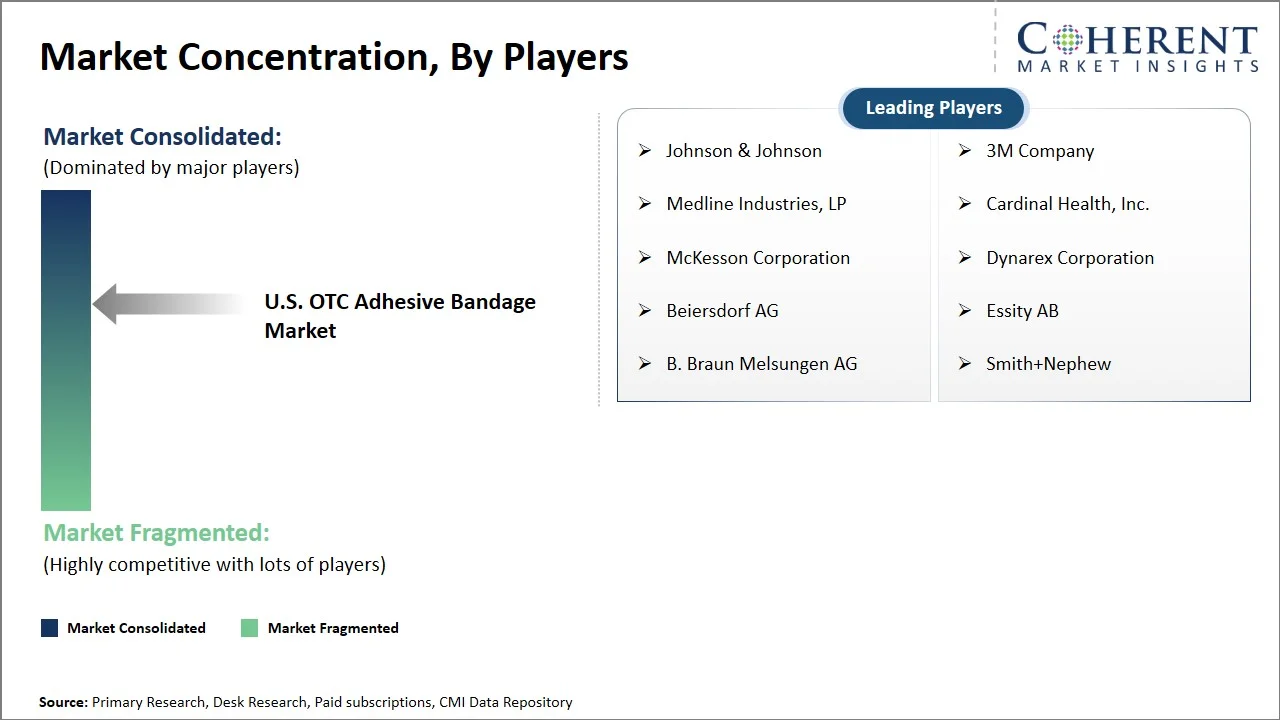
The U.S. OTC adhesive bandage market is competitive, with manufacturers focusing on improving adhesion, flexibility, skin comfort and wound protection across everyday first-aid applications. Companies are expanding product portfolios with fabric, waterproof and flexible formats while maintaining compliance with U.S. Food and Drug Administration (FDA) requirements for adhesive bandages classified as Class I medical devices under 21 CFR 880.5240. Key focus areas include:
- Development of flexible, breathable and skin-friendly adhesive bandages for improved comfort and wearability
- Expansion of water-resistant and durable bandages designed for active consumers and prolonged wound protection
- Innovation in specialized bandages, including products for sensitive skin, children and high-friction areas
- Strengthening retail pharmacy and direct-to-consumer distribution to improve accessibility for routine first-aid needs
- Maintaining FDA compliance in product classification, device listing, labeling and manufacturing controls for OTC adhesive bandages
Market Report Scope
U.S. OTC Adhesive Bandage Market Report Coverage
| Report Coverage | Details | ||
|---|---|---|---|
| Base Year: | 2025 | Market Size in 2026: | USD 695.0 Mn |
| Historical Data for: | 2020 To 2024 | Forecast Period: | 2026 To 2033 |
| Forecast Period 2026 to 2033 CAGR: | 4.1% | 2033 Value Projection: | USD 923.9 Mn |
| Segments covered: |
| ||
| Companies covered: | Johnson & Johnson, 3M Company, Medline Industries, LP, Cardinal Health, Inc., McKesson Corporation, Dynarex Corporation, Beiersdorf AG, Essity AB, B. Braun Melsungen AG, Smith+Nephew | ||
| Growth Drivers: |
| ||
| Restraints & Challenges: |
| ||
Analyst Opinion (Expert Opinion)
- In the coming years, U.S. OTC adhesive bandage market is expected to remain a stable, high-volume wound-care market, with future growth increasingly shifting from basic commodity bandages toward value-added products offering improved adhesion, skin compatibility, waterproof protection and specialized wound-care benefits. Product differentiation rather than volume expansion is likely to become the primary competitive lever as the market matures.
- The maximum growth opportunity lies within fabric and advanced adhesive bandages for everyday wound management/first-aid in the U.S. Manufacturers can capture incremental value by combining the established consumer preference for fabric formats with features such as hypoallergenic adhesives, breathable materials, waterproof construction and antimicrobial or hydrocolloid wound-contact layers, particularly for active consumers, children and individuals with sensitive skin.
- In order to create an advantage for themselves, the competitors should focus on premiumization and product differentiation rather than competing primarily on price. Developing skin-friendly and longer-wearing products, expanding targeted product lines, strengthening retail-pharmacy visibility and using e-commerce for convenient replenishment can help companies increase brand loyalty and defend shelf space.
Speak to the analyst
Want personalized insights?
Take the findings above to one of our principal consultants, or have the report rebuilt around the segments, geographies and competitors you actually track.
Market Segmentation
- Product Type Insights (Revenue, USD Mn, 2021 - 2033)
- Fabric Adhesive Bandage
- Plastic Adhesive Bandage
- Others
- Distribution Channel Insights (Revenue, USD Mn, 2021 - 2033)
- Hospital Pharmacies
- Retail Pharmacies
- Online Sales
- Key Players Insights
- Johnson & Johnson
- 3M Company
- Medline Industries, LP
- Cardinal Health, Inc.
- McKesson Corporation
- Dynarex Corporation
- Beiersdorf AG
- Essity AB
- Braun Melsungen AG
- Smith+Nephew
Sources
Primary Research Interviews
- OTC Adhesive Bandage Manufacturers – product development, material selection, pricing and portfolio strategies for fabric, plastic and specialized adhesive bandages
- Retail Pharmacy Buyers – purchasing patterns, consumer demand and shelf-space allocation for OTC wound-care products
- Wound Care Specialists – utilization of adhesive bandages for minor cuts, abrasions and superficial wounds
- Pharmacists – consumer preferences, OTC product selection and recommendations for minor wound management
- Healthcare Procurement Managers – institutional purchasing trends for adhesive bandages and first-aid supplies
- E-commerce and Retail Distributors – online demand, product assortment and distribution trends for OTC adhesive bandages
- First-Aid and Occupational Health Managers – workplace demand and usage patterns for adhesive bandages
- Consumer Healthcare Product Distributors – demand trends across retail pharmacies, supermarkets, mass retailers and online channels
Stakeholders
- OTC Adhesive Bandage Product Manufacturers (e.g., Johnson & Johnson, 3M, Medline Industries, Cardinal Health, Dynarex, Beiersdorf, Essity, B. Braun, Smith+Nephew)
- End-use Sectors
- Households and individual consumers
- Workplaces and occupational health facilities
- Schools and childcare facilities
- Sports and recreational facilities
- Retail pharmacies and drugstores
- Outpatient clinics and first-aid centers
- Regulatory & Health Bodies
- U.S. Food and Drug Administration (FDA)
- Centers for Disease Control and Prevention (CDC)
- National Center for Health Statistics (NCHS)
- National Institute for Occupational Safety and Health (NIOSH)
Databases
- U.S. FDA Device Registration & Listing Database – adhesive bandage manufacturers, device listings and product classifications
- U.S. FDA Product Classification Database – classification and regulatory information for adhesive tape and bandages
- CDC WISQARS – injury statistics relevant to cuts, puncture wounds and other unintentional injuries
- CDC/NCHS National Hospital Ambulatory Medical Care Survey (NHAMCS) – emergency department utilization and injury-related healthcare data
- U.S. Census Bureau Retail Trade Data – retail sales and distribution trends relevant to pharmacies and health-care stores
Magazines
- Medical Design & Outsourcing – medical device materials, manufacturing and product innovation
- MedTech Dive – medical device industry developments and regulatory updates
- Medical Device Network – medical device technologies, product launches and industry developments
- Drug Store News – retail pharmacy, consumer healthcare and OTC product trends
- Chain Drug Review – pharmacy retailing and consumer health product distribution
Newspapers
- The Wall Street Journal (Health & Business Sections) – healthcare products, consumer health and medical device industry developments
- The New York Times (Health Section) – consumer healthcare and healthcare product trends
- The Washington Post (Health & Science Section) – healthcare policy, consumer health and medical technology
- USA Today (Health Section) – consumer health, first-aid and healthcare access trends
Associations
- Consumer Healthcare Products Association (CHPA) – OTC healthcare products, consumer behavior and self-care trends
- Advanced Medical Technology Association (AdvaMed) – medical device industry and regulatory developments
- National Association of Chain Drug Stores (NACDS) – retail pharmacy distribution and consumer healthcare products
- Wound Healing Society (WHS) – wound healing research and clinical practices
- Association for the Advancement of Wound Care (AAWC) – wound-care practices, education and product developments
- American Pharmacists Association (APhA) – pharmacy practice and consumer access to OTC healthcare products
Public Domain Sources
- U.S. Food and Drug Administration (FDA) – adhesive bandage classification, device registration, labeling, recalls and regulatory requirements
- Centers for Disease Control and Prevention (CDC) – injury incidence, cuts, puncture injuries and related health statistics
- National Center for Health Statistics (NCHS) – emergency department visits and injury-related healthcare utilization
- National Institute for Occupational Safety and Health (NIOSH) – workplace injury and occupational safety statistics
- U.S. Census Bureau – retail trade, consumer spending and demographic data relevant to OTC healthcare distribution
- National Institutes of Health (NIH) / National Library of Medicine (PubMed) – peer-reviewed evidence on wound healing, dressings and adhesive technologies
- Agency for Healthcare Research and Quality (AHRQ) – healthcare utilization, quality and wound-care-related research
Proprietary Elements
- CMI Data Analytics Tool, Proprietary CMI Existing Repository of information for last 10 years.
Get access to 250+ pages report
Every segment, forecast, competitor profile and data table behind the analysis above — available for instant download.
- ESOMAR Member
- ISO 9001:2015 Certified
- D-U-N-S Registered
- GDPR & CCPA Compliant
Missing comfort of reading report in your local language? Find your preferred language:
Transform your Strategy with Exclusive Trending Reports
Frequently Asked Questions
The market is expected to maintain steady growth through 2033, supported by recurring first-aid demand, product innovation and expanding consumer access.
Private-label bandages provide lower-cost alternatives, increasing price competition and encouraging branded manufacturers to differentiate through product performance.
The market is highly competitive, with established manufacturers competing through product innovation, brand strength, retail presence and portfolio expansion.
Manufacturers are focusing on advanced adhesives, flexible materials, waterproof designs and specialized formats to improve comfort and wound protection.
Consumers increasingly prefer comfortable, skin-friendly, waterproof and durable bandages that provide reliable protection during daily activities.
Online sales are improving consumer convenience, product accessibility and availability of specialized adhesive bandage formats.
Yes, OTC adhesive bandages are regulated as medical devices intended to cover and protect minor wounds.