

Global Vanilla Bean Market Size and Forecast – 2026 To 2033
The Global Vanilla Bean Market is estimated to be valued at USD 1,408.2 Mn in 2026 and is expected to reach USD 2,089.6 Mn by 2033, growing at a compound annual growth rate (CAGR) of 5.80% from 2026 to 2033. Market expansion is supported by broader use of natural vanilla across food and beverages, premium snacks, cosmetics, and specialty formulations, alongside consumer preference for recognizable and naturally derived ingredients.
Food manufacturers are also incorporating vanilla into clean-label and premium-positioned products to improve flavor differentiation. In July 2025, All In Food expanded its Madagascar Vanilla, Honey + Almond snack bars nationally through Sprouts Farmers Market, demonstrating continued commercialization of vanilla-led products made with organic ingredients.
Key Takeaways of the Global Animals Wearing Clothes Market
- Madagascar Bourbon Vanilla is estimated to expand at a 5.6% CAGR during 2026–2033 and is expected to hold 74.5% of the global vanilla bean market in 2026. Its leadership reflects Madagascar’s established curing expertise, recognizable Bourbon sensory profile, and buyer preference for traceable natural vanilla. In June 2026, IFF detailed its Sustainable Vanilla Program across Madagascar’s SAVA region, emphasizing regenerative farming, traceability, and resilient sourcing.
- Gourmet Grade is projected to grow at a 6.2% CAGR through 2033 and is expected to represent 48.6% of the global vanilla bean market in 2026. Premium beans retain commercial importance where aroma intensity, moisture, appearance, and whole-pod presentation influence chef and artisan purchasing. In August 2024, Vanillest’s Madagascar Vanilla Milk Jam, made with whole Grade A Madagascar vanilla beans, received a two-star Great Taste award.
- Food and Beverages is estimated to record a 5.9% CAGR from 2026 to 2033 and is expected to account for 58.7% of the global vanilla bean market in 2026. Vanilla beans remain commercially important across bakery, dairy, desserts, beverages, and premium foodservice because they provide natural aroma and visible seed cues. In January 2025, Starbucks returned its Vanilla Bean Custard Danish to participating stores for a limited seasonal period.
- Europe is estimated to advance at a 5.5% CAGR during 2026–2033 and is expected to capture 34.7% of the global vanilla bean market in 2026. The region combines sophisticated bakery, confectionery, dairy, and culinary demand with established natural-ingredient processors and premium retail positioning. In December 2025, France-based Eurovanille showcased its latest vanilla innovations and gourmet applications at Food Ingredients Europe in Paris.
- North America is forecast to post a 6.5% CAGR through 2033 and is expected to account for 32.6% of the global vanilla bean market in 2026, making it the fastest-growing region. Product developers are using vanilla across indulgent beverages, frozen desserts, bakery, and hybrid flavor concepts, widening commercial pull for natural vanilla inputs. In June 2026, PepsiCo launched MUG Root Beer Floats Vanilla Howler nationwide across U.S. retail.
Segmental Insights
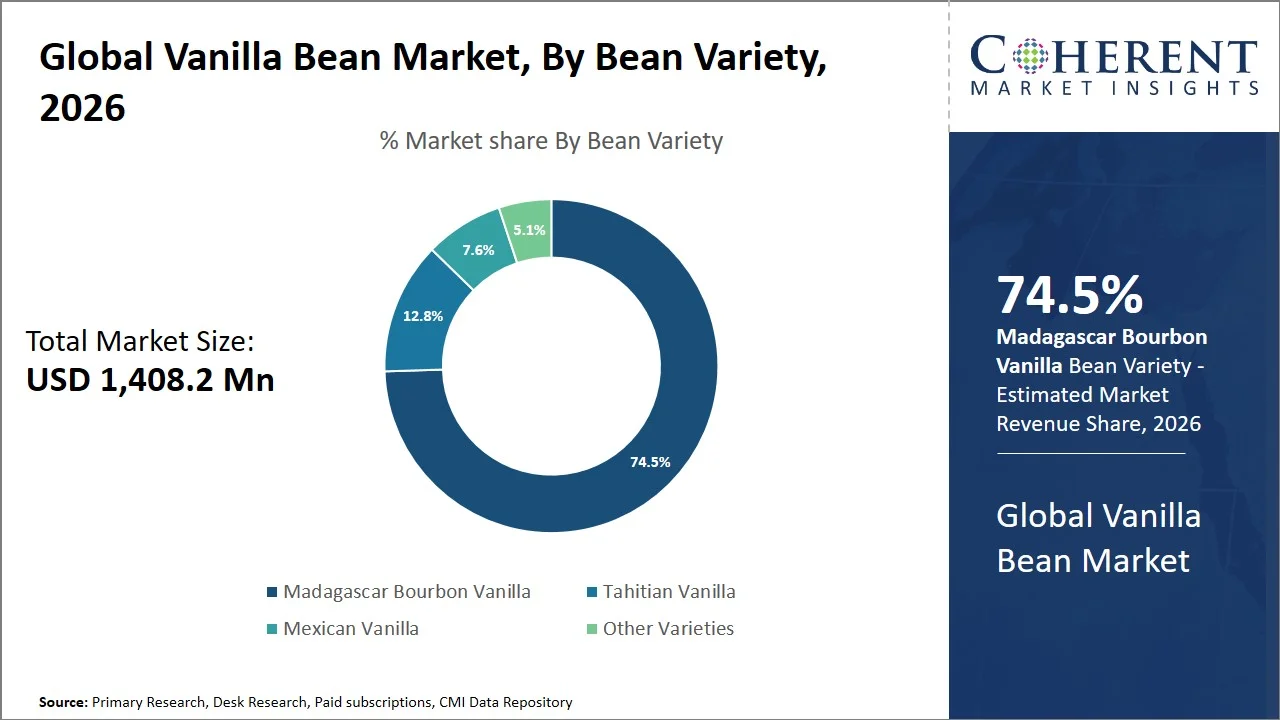
Why Does Madagascar Bourbon Vanilla Dominate the Global Vanilla Bean Market?
Madagascar Bourbon Vanilla, with an expected 74.5% share in the global vanilla bean market, leads the bean-variety category because the SAVA production system combines suitable agro-climatic conditions with a deep base of growers, curing expertise, exporters, and established buyer specifications. Its commercial advantage is not only flavor recognition; it also comes from the scale of post-harvest know-how required to convert green pods into exportable beans with consistent moisture and aroma. This gives processors and international flavor buyers a broader sourcing pool than competing origins. In May 2024, Fairtrade published an updated Madagascar vanilla Living Income Reference Price based on 480 farmer interviews across 16 SAVA villages, highlighting the structured production economics behind the country’s supply base. The update helps buyers and certified supply-chain participants benchmark sustainable farm-gate economics while protecting long-term crop availability.
- Current Industry Events of 2026
- Market Size Estimation
- Regional Breakdown
- Competitive Landscape
- Customer Intelligence
- Segmental Analysis
- Pricing Analysis
- Key Market Drivers, Challenges & Future Trends
- Customized Insights Section
Why Does Gourmet Grade Represent the Largest Grade in the Global Vanilla Bean Market?
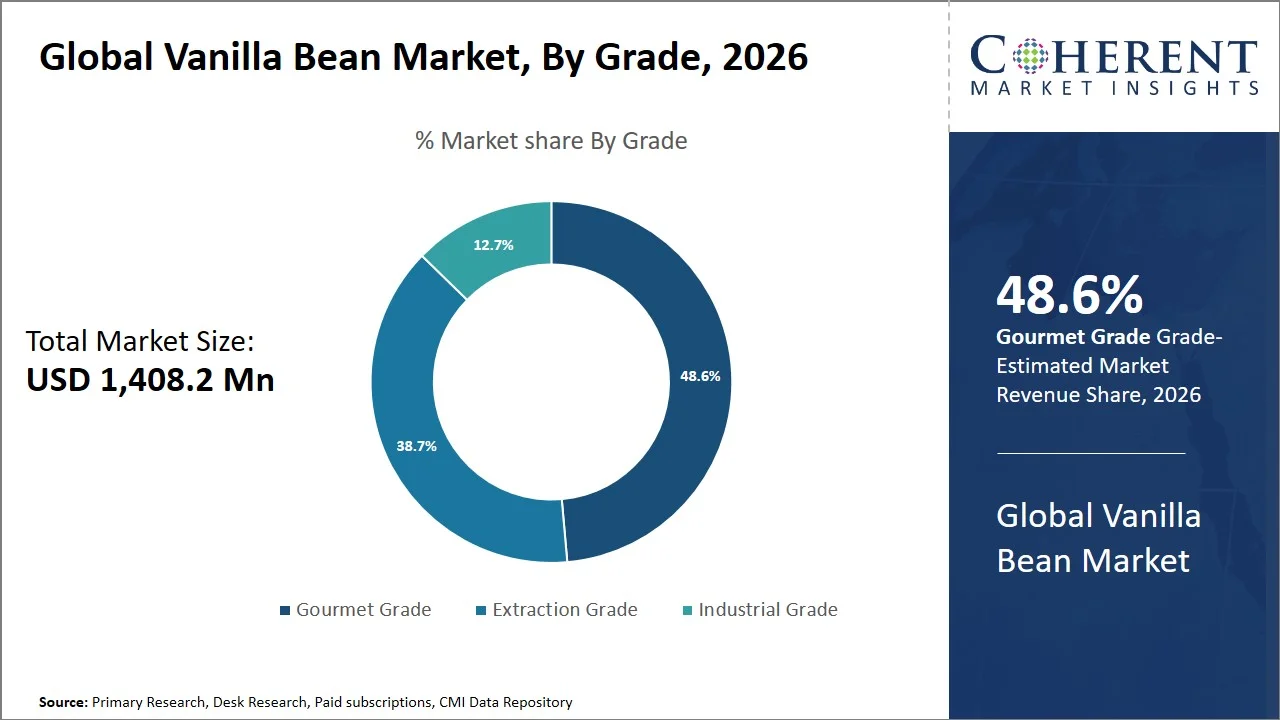
Gourmet Grade, expected to account for 48.6% of the global vanilla bean market in 2026, represents the largest grade because premium buyers value plump, pliable pods that can be split, scraped, infused, and visibly incorporated into finished foods. Unlike extraction-grade beans, gourmet pods create both aroma and a recognizable seed-speck appearance, making them particularly useful for pastry, custards, ice cream, sauces, and chef-led applications where ingredient presentation supports premium pricing. Suppliers therefore compete on moisture control, pod length, flexibility, appearance, and lot consistency rather than price alone. In November 2024, Rodelle expanded its gourmet vanilla distribution nationwide through Walmart, placing its Vanilla Bean Paste in more than 3,600 stores. The move broadened access to premium vanilla formats and showed how gourmet-quality positioning can move beyond specialty channels into mainstream baking retail.
Why Do Food and Beverages Dominate the Application Segment of the Global Vanilla Bean Market?
Food and Beverages, with an expected 58.7% share in the global vanilla bean market, remains the leading application because vanilla functions across more formulation environments than other end uses, including dairy, frozen desserts, bakery, confectionery, beverages, and culinary preparations. Food manufacturers can use whole beans, seeds, powders, pastes, or extracts depending on processing conditions and desired sensory intensity, giving the ingredient unusually broad commercial flexibility. Its value is also reinforced by the ability to support both standalone vanilla products and blended flavor systems. In September 2025, Tillamook’s research and development team detailed the distinct positioning of its Vanilla Bean ice cream, which uses vanilla bean seeds and a lighter, more delicate profile suited to ice cream sandwiches, cakes, and pairings. This illustrates how food developers use bean-derived characteristics to differentiate applications rather than treating vanilla as a single standardized flavor.
Current Events and their Impact
Current Event | Description and Its Impact |
November 2025 – Madagascar revised the 2025–2026 vanilla export campaign procedures |
|
November 2025 – U.S. reciprocal tariff scope was modified for vanilla and other agricultural products |
|
Global Vanilla Bean Market Dynamics
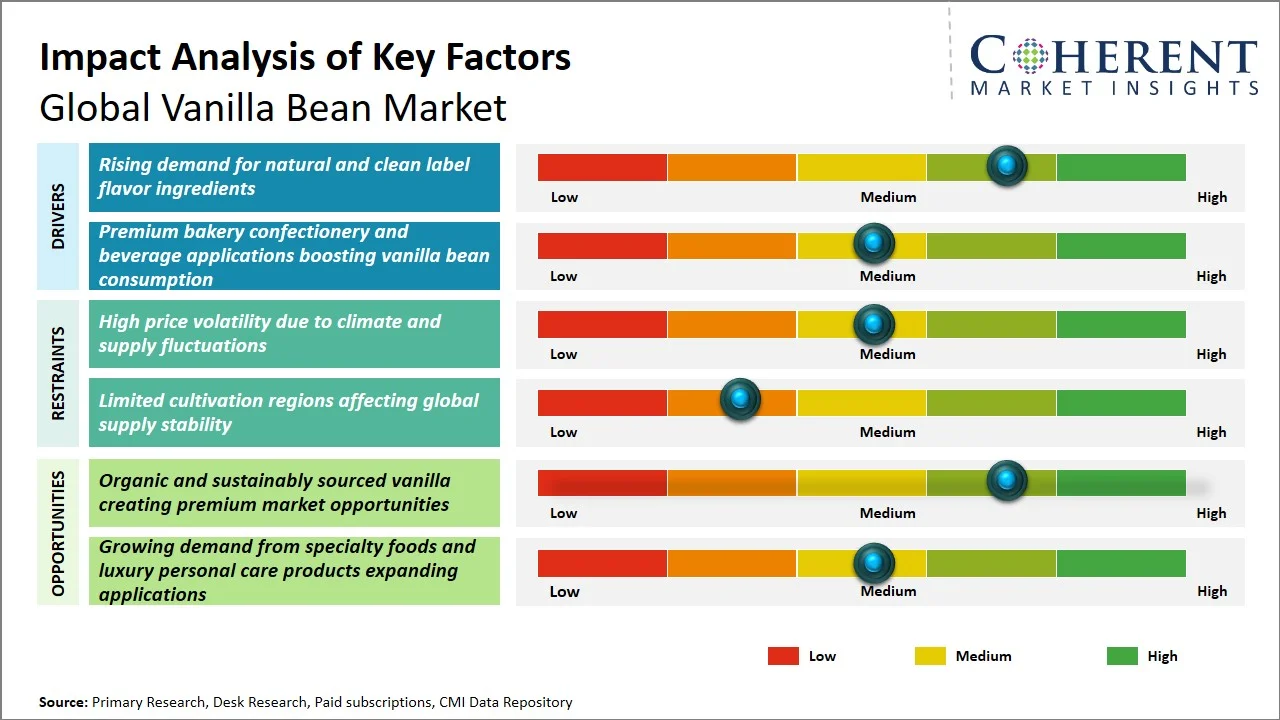
Key Market Drivers
Rising demand for natural and clean label flavor ingredients
Rising demand for natural and clean-label flavor ingredients is moving vanilla from a generic flavor note toward a declared, recognizable input in premium formulations. Food and beverage developers benefit because real bean powder can support ingredient transparency, while vanilla processors and growers gain access to higher-value formulations that might otherwise rely on artificial flavor systems. In April 2025, Laird Superfood launched its Vanilla Instant Latte with real vanilla bean powder, explicitly positioning it against artificial vanilla flavor commonly used in coffee products. This illustrates how clean-label formulation choices can translate directly into bean-derived ingredient demand.
Premium bakery, confectionery and beverage applications boosting vanilla bean consumption
Premium bakery, confectionery and dessert developers use vanilla bean to create richer sensory profiles, visible authenticity cues, and higher-value menu positioning. This increases pull-through for beans, pastes, and extracts among bakery chains, dessert manufacturers, ingredient distributors, and specialty processors. In August 2024, Magnolia Bakery India introduced eggless cheesecakes across its stores, including a Vanilla Bean Cheesecake made with fresh vanilla. The launch shows how premium bakery operators can widen vanilla consumption by adapting established indulgent formats to local dietary preferences while retaining a bean-led flavor identity.
Emerging Market Trends
Visible Vanilla Seeds Are Becoming Part of Product Design
Visible vanilla seeds are increasingly functioning as a design element rather than merely a flavor carrier. In ice cream, yogurt, custards, bakery fillings, and premium desserts, bean specks help communicate ingredient authenticity before consumption and can strengthen perceived product quality. This shifts purchasing toward pastes, ground material, and controlled-particle formats that combine flavor delivery with visual consistency. Processors able to manage seed dispersion, color, and texture should gain relevance, while suppliers focused only on clear extracts may have fewer opportunities in appearance-led applications.
Vanilla Is Expanding into Flavor Modulation for Functional Foods
Vanilla is increasingly being used as a flavor-modulation tool in functional and nutrition-focused foods, not only as the named headline flavor. Its rounded aromatic profile can soften bitterness, mask protein or botanical notes, and improve perceived sweetness in reduced-sugar formulations. This broadens the commercial role of vanilla across protein foods, plant-based products, nutrition beverages, and fortified snacks. Ingredient processors with application-development capabilities should benefit, while raw-bean suppliers may need closer partnerships with formulators to participate in these less visible but technically demanding uses.
Regional Insights
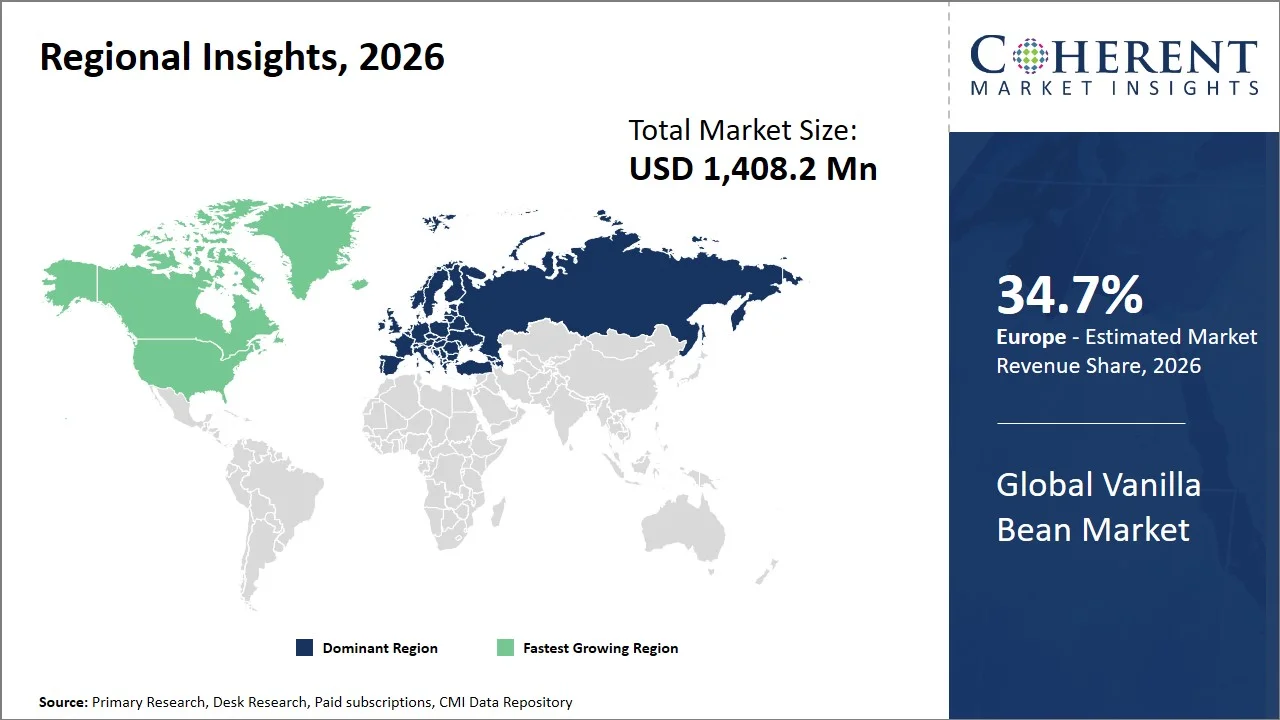
Why Does Europe Dominate the Global Vanilla Bean Market?
Europe is expected to account for 34.7% of the global vanilla bean market in 2026, supported by its dense concentration of premium bakery, confectionery, dairy, dessert, and flavor-processing industries. European buyers place strong emphasis on natural ingredient declarations, traceable sourcing, sensory consistency, and certified supply chains, which favors genuine vanilla beans and high-quality extracts over purely synthetic flavor systems in premium formulations. France, Germany, the Netherlands, and other trading hubs also connect producing countries with processors, food manufacturers, and specialty distributors across the region. Europe’s mature gourmet food culture further supports demand for whole beans and Bourbon-origin material. In October 2025, the European Union submitted formal comments on “requirements for vanilla” during the Codex Committee on Spices and Culinary Herbs, reinforcing the region’s focus on standardized quality and transparent trade specifications.
Why Is North America Emerging as the Fastest-Growing Region in the Global Vanilla Bean Market?
North America is expected to hold 32.6% of the global vanilla bean market in 2026 and emerge as the fastest-growing region, reflecting broad use of vanilla across ice cream, bakery, beverages, nutritional products, foodservice, and home baking. The U.S. and Canada support a large addressable base for premium and natural flavor ingredients, while product developers increasingly use vanilla to soften bitter notes, build indulgent profiles, and complement coffee, dairy, protein, and dessert formulations. Strong retail penetration and rapid flavor-renovation cycles also accelerate commercial adoption. In April 2025, Lactalis Canada, in collaboration with Nestlé Canada, launched iÖGO into frozen yogurt with eight SKUs, including a vanilla tub. The launch illustrates how established dairy brands are extending vanilla into new formats and consumption occasions across the region.
Global Vanilla Bean Market Outlook for Key Countries
Why Is Madagascar a Key Market for the Global Vanilla Bean Market?
Madagascar remains strategically central to the global vanilla bean market because it combines large-scale cultivation, specialized curing knowledge, and global recognition for Bourbon vanilla. The country’s northeastern production belt supports a labor-intensive value chain involving hand pollination, harvesting, curing, grading, aggregation, and export preparation, giving international buyers access to distinctive aroma profiles and commercially established quality specifications. Its role is especially important for gourmet beans and natural vanilla extract supply used by European and North American customers. Logistics and rural connectivity are therefore directly linked to export reliability. In May 2026, the World Bank highlighted the Manambery Bridge in northeastern Madagascar as critical infrastructure supporting a vanilla value chain that provides jobs for about 70,000 farmers. This underscores why transport access, farm connectivity, and dependable movement from producing communities to export channels remain commercially important.
Why Is Indonesia Important in the Global Vanilla Bean Market?
Indonesia is an important country in the global vanilla bean market because its tropical agro-climatic conditions, extensive spice-farming base, and geographically diverse production areas create scope for both vanilla cultivation and export-oriented supply. Indonesian beans provide buyers with an alternative origin to Madagascar and can support diversification strategies for flavor houses, specialty traders, and food manufacturers seeking to reduce concentration risk. The country also benefits from established spice-export infrastructure and experience serving Asian markets, where natural flavor ingredients have applications across food, beverages, cosmetics, and specialty products. In July 2025, Indonesia’s Ministry of Trade oversaw an export shipment from Bali to Hong Kong covering spices including vanilla, cinnamon, and nutmeg, alongside honey. The development demonstrates active government support for widening overseas market access for Indonesian spice producers and small exporters.
Why Does Mexico Support Growth in the Global Vanilla Bean Market?
Mexico holds a distinctive position in the global vanilla bean market as the historical origin of Vanilla planifolia and as the home of the protected Vainilla de Papantla designation. Commercial relevance is concentrated in Veracruz and neighboring producing areas, where traditional cultivation knowledge, recognizable provenance, and premium sensory positioning support opportunities in gourmet, artisanal, and specialty food applications. Mexico’s domestic food and beverage industry also provides a natural base for local consumption, while origin-linked quality can support higher-value export positioning. In July 2026, Mexico’s Secretariat of Economy reported that an international Codex standard for vanilla had been approved with Mexico serving in a technical co-chairing role. The development strengthens Mexico’s influence over internationally recognized quality parameters and can improve confidence around specification, authenticity, and trade of Mexican vanilla in premium channels.
Why Is the U.S. a Strategic Country in the Global Vanilla Bean Market?
The U.S. is a key demand market within the global vanilla bean market because vanilla is deeply embedded across commercial baking, ice cream, confectionery, coffee beverages, nutritional products, foodservice, and household baking. Domestic manufacturers depend substantially on imported natural vanilla beans and derivatives, making supplier reliability, origin diversification, traceability, and price stability important procurement considerations. The country’s large branded-food ecosystem also creates frequent opportunities for vanilla to appear in limited-edition flavors, premium formulations, and cross-category innovations. In January 2026, McCormick introduced a limited-edition Bridgerton collection of finishing sugars, including Lavender Vanilla, through Walmart, Amazon, and retailers nationwide. The launch shows how vanilla continues to serve as a flexible flavor platform that can be paired with botanical and indulgent profiles to create differentiated consumer products.
Why Is France an Important Growth Market for the Global Vanilla Bean Market?
France is a strategic country in the global vanilla bean market because it functions as both a major consumption center and a value-adding hub for imported vanilla. French expertise in pastry, chocolate, dairy, ice cream, fine dining, and fragrance creates steady demand for premium beans, extracts, and customized natural flavor solutions. The country also hosts specialist ingredient companies that source beans from producing regions, conduct extraction and formulation, and supply finished vanilla solutions to food manufacturers and professional users across Europe. This strengthens France’s role beyond end consumption and makes it an important processing and redistribution market. In November 2025, French flavor specialist PROVA presented Organic Fairtrade and Care&Act Vanilla extracts and flavors at Natexpo, emphasizing sustainable sourcing and application flexibility. The development reflects continued French investment in premium, certified, and responsibly sourced vanilla solutions.
Technology Adoption Landscape: Vanilla Production, Quality and Processing
Technology | Application in the Vanilla Value Chain | Adoption Position | Commercial Impact |
Tissue-Culture Propagation | Produces more uniform and potentially disease-screened planting material for plantation expansion and crop renewal. | Emerging to moderate | Can shorten multiplication cycles and improve consistency of planting stock, supporting suppliers seeking more controlled agronomic performance. |
Sensor-Controlled Curing Systems | Tracks temperature, humidity, sweating, drying, and conditioning conditions during post-harvest processing. | Emerging | Reduces batch variability and improves repeatability of aroma development, allowing processors to target tighter customer specifications. |
Machine Vision and Optical Sorting | Grades cured pods using length, surface condition, color, defects, and physical uniformity. | Early commercial adoption | Improves sorting productivity and enables more consistent separation of gourmet, extraction, and lower-grade material. |
Near-Infrared Spectroscopy | Enables rapid, non-destructive screening of moisture and selected quality attributes before shipment or processing. | Emerging | Reduces reliance on slow manual testing and strengthens procurement decisions where buyers require consistent incoming lots. |
GC-MS, HPLC and Advanced Chemical Profiling | Measures aroma compounds and supports characterization, adulteration screening, and formulation consistency. | Moderate among sophisticated processors | Allows suppliers to sell against defined sensory and chemical specifications rather than relying only on visual bean grading. |
Digital Lot-Level Traceability Systems | Links farms, curing batches, exporters, processors, certificates, and customer shipments through digital records. | Expanding | Improves recall readiness, auditability, compliance documentation, and buyer confidence in complex multi-stage sourcing networks. |
How Is Origin-Level Processing Creating New Growth Opportunities in the Global Vanilla Bean Market?
Origin-level processing creates an underdeveloped opportunity to capture more value before vanilla leaves producing countries. Instead of exporting only cured beans, origin processors can convert suitable grades into paste, powder, concentrated extracts, or standardized semi-finished ingredients for food, beverage, cosmetic, and flavor customers. This model can monetize beans that do not meet premium whole-pod specifications while giving buyers more consistent, application-ready inputs. Commercial capture requires food-grade extraction or milling equipment, solvent and hygiene controls, laboratory quality assurance, export certification, skilled process teams, and dependable utilities. Local partnerships with cooperatives and exporters can secure feedstock and reduce procurement fragmentation. The opportunity is especially attractive in emerging producing origins where value addition remains limited relative to cultivation. Vertically integrated exporters and specialist processors are likely to benefit most because they can connect farm-level sourcing with processing economics, quality documentation, and international B2B sales rather than competing solely on raw-bean price at scale.
Market Players, Key Development, and Competitive Intelligence
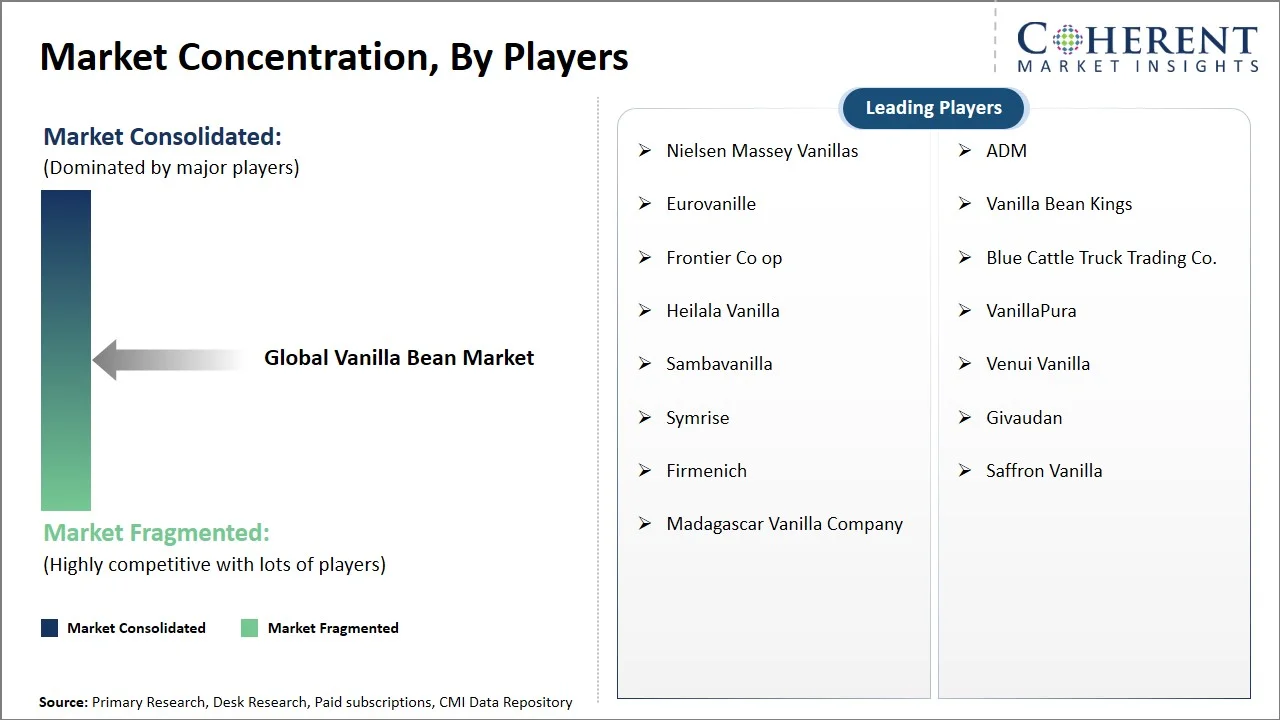
Key Developments
- In August 2025, Vanilla Vida announced a full-scale integrated vanilla growing and curing facility in Uganda. The project is strategically important because it extends commercial production beyond the company’s original development base and creates a new origin platform combining cultivation, curing, operating routines, training, and export-oriented supply preparation.
- In June 2025, Givaudan introduced Rainforest Alliance certification for selected vanilla extracts marketed in Europe. The development expands certification-backed options for food and flavor customers and allows qualifying products to carry recognized sustainability claims, strengthening Givaudan’s differentiation where procurement teams require independently verified agricultural sourcing credentials.
- In March 2025, MANE showcased its Vanilla Bourbon Infusion at Flavour Talk 2025, describing it as a premium natural extract produced from ethically sourced Madagascar vanilla pods. The development strengthens MANE’s value-added vanilla portfolio and gives formulators another natural extract option for applications requiring a refined Bourbon-style sensory profile.
Competitive Landscape
The global vanilla bean market remains fragmented, because cultivation is distributed across smallholder networks while curing, export aggregation, extraction, and distribution involve numerous regional specialists and global ingredient companies. Competition centers on sensory consistency, grade control, delivered price, compliance, and dependable fulfillment. Specialist firms can defend premium niches through curing expertise and customer-specific specifications, while larger processors compete through multi-origin procurement, quality systems, and broad B2B distribution.
Key focus areas include:
- Curing precision and batch consistency are important differentiators where buyers require repeatable moisture, aroma, appearance, and extraction performance.
- Bean variety, grade, format, and specification flexibility allow suppliers to address gourmet, extraction, industrial, foodservice, and ingredient-manufacturing requirements separately.
- Analytical quality assurance is becoming more important for verifying residues, authenticity, moisture, microbial condition, and chemical profile before commercial shipment.
- Inventory management and fulfillment reliability influence purchasing decisions because vanilla procurement involves long crop, curing, shipping, and working-capital cycles.
- Organic, fair-trade, regenerative, and sustainability certifications provide access to customers with formal responsible-procurement criteria.
- Extraction and application-development capabilities allow processors to move beyond raw-bean trading into customized B2B flavor solutions.
- Distributor and direct-account coverage remain important for accessing industrial food manufacturers, artisan users, foodservice buyers, and specialty retailers across multiple markets.
Market Report Scope
Vanilla Bean Market Report Coverage
| Report Coverage | Details | ||
|---|---|---|---|
| Base Year: | 2025 | Market Size in 2026: | USD 1,408.2 Mn |
| Historical Data for: | 2020 To 2024 | Forecast Period: | 2026 To 2033 |
| Forecast Period 2026 to 2033 CAGR: | 5.80% | 2033 Value Projection: | USD 2,089.6 Mn |
| Geographies covered: |
| ||
| Segments covered: |
| ||
| Companies covered: | Nielsen Massey Vanillas, ADM, Eurovanille, Vanilla Bean Kings, Frontier Co op, Blue Cattle Truck Trading Co., Heilala Vanilla, VanillaPura, Sambavanilla, Venui Vanilla, Symrise, Givaudan, Firmenich, Saffron Vanilla, Madagascar Vanilla Company | ||
| Growth Drivers: |
| ||
| Restraints & Challenges: |
| ||
Analyst Opinion (Expert Opinion)
- Market leadership is likely to bifurcate between origin specialists that can command value for distinctive beans and ingredient solution providers that translate vanilla into customer-ready formats. Midstream traders without differentiated quality control, processing capability, or application knowledge may face margin pressure. The strongest positions should emerge where suppliers deliberately choose a value pool instead of trying to compete simultaneously in commodity trading, gourmet beans, and formulation-led ingredients.
- Precision-fermented and biosynthetic vanilla molecules could become the market’s most important structural disruption in price-sensitive applications. If flavor developers can reproduce more of natural vanilla’s complexity at predictable cost, extraction-grade beans may lose volume in mass-market formulations. Whole beans and origin-specific natural extracts should remain more defensible where authenticity is visible or central to the product story, creating a sharper separation between functional flavor supply and agricultural vanilla.
- Participants should prioritize curing consistency, residue and authenticity testing, working-capital discipline, and closer technical engagement with end users. Margin risk is greatest when firms accumulate undifferentiated inventory or rely on a narrow set of buyers during volatile crop cycles. Investment should favor flexible processing, quality documentation, and customer-specific formats; companies should avoid scaling raw-bean exposure faster than they can secure repeat demand and defensible commercial contracts.
Speak to the analyst
Want personalized insights?
Take the findings above to one of our principal consultants, or have the report rebuilt around the segments, geographies and competitors you actually track.
Market Segmentation
- Bean Variety Insights (Revenue, USD Mn, 2021 - 2033)
- Madagascar Bourbon Vanilla
- Tahitian Vanilla
- Mexican Vanilla
- Other Varieties
- Grade Insights (Revenue, USD Mn, 2021 - 2033)
- Gourmet Grade
- Extraction Grade
- Industrial Grade
- Application Insights (Revenue, USD Mn, 2021 - 2033)
- Food and Beverages
- Cosmetics and Personal Care
- Pharmaceuticals and Nutraceuticals
- Household and Other Applications
- Form Insights (Revenue, USD Mn, 2021 - 2033)
- Whole Vanilla Beans
- Ground Vanilla Beans
- Vanilla Bean Powder
- Distribution Channel Insights (Revenue, USD Mn, 2021 - 2033)
- Direct Sales
- Indirect Sales
- Regional Insights (Revenue, USD Mn, 2021 - 2033)
- North America
- U.S.
- Canada
- Latin America
- Brazil
- Argentina
- Mexico
- Rest of Latin America
- Europe
- Germany
- U.K.
- Spain
- France
- Italy
- Russia
- Rest of Europe
- Asia Pacific
- China
- India
- Japan
- Australia
- South Korea
- ASEAN
- Rest of Asia Pacific
- Middle East
- GCC Countries
- Israel
- Rest of Middle East
- Africa
- South Africa
- North Africa
- Central Africa
- North America
Sources
Primary Research Interviews
- Vanilla bean producers, farmers, exporters, processors, extract manufacturers, flavor ingredient suppliers, food and beverage manufacturers, bakery and confectionery companies, and distributors
- Flavor formulators, procurement managers, sourcing specialists, chefs, food technologists, and industry executives
- Retailers, premium food brands, organic product manufacturers, and end-use product developers
Stakeholders
- Vanilla growers, plantation owners, curing processors, vanilla extract producers, flavor houses, ingredient suppliers, and private-label manufacturers
- Food and beverage companies, bakery and confectionery brands, dairy manufacturers, nutraceutical companies, and specialty food producers
- Importers, exporters, wholesalers, distributors, supermarkets, e-commerce platforms, and specialty ingredient retailers
End-use Sectors
- Bakery, confectionery, and dessert applications
- Dairy products including ice cream, yogurt, and flavored beverages
- Food and beverage flavoring applications
- Premium, organic, and clean-label food products
- Cosmetics, personal care, and fragrance applications
Regulatory and Industry Bodies
- Food safety and regulatory authorities governing vanilla ingredients and food additives
- Agricultural ministries and vanilla-producing country authorities
- Organic certification bodies and sustainability organizations
- Import-export authorities regulating vanilla trade and quality standards
- Food ingredient and flavor industry regulatory organizations
Databases
- Company annual reports, investor presentations, corporate filings, and product portfolio databases
- Vanilla production, agricultural output, and commodity trade databases
- Import-export statistics, customs datasets, and global trade platforms
- Food ingredient supplier databases and flavor industry directories
- Retail pricing databases, e-commerce platforms, and consumer purchasing datasets
Magazines and Journals
- Food ingredient and flavor industry publications
- Food technology and processing journals
- Agricultural and commodity trade publications
- Bakery, confectionery, and beverage industry magazines
- Sustainability, organic food, and consumer trend publications
Associations
- International Vanilla Growers Association
- Flavor and Extract Manufacturers Association (FEMA)
- International Food Information Council (IFIC)
- Food ingredient and spice trade associations
- Organic food and sustainable agriculture associations
- Agricultural commodity and exporter associations
Public Domain Sources
- Vanilla cultivation trends, production developments, and supply-chain conditions
- Consumer preference shifts toward natural, clean-label, and premium flavor ingredients
- Sustainable vanilla farming initiatives and ethical sourcing programs
- Food and beverage product innovation using vanilla-based ingredients
- Global trade trends, pricing movements, and sourcing diversification strategies
Key Standards and Regulations
- Food safety standards for vanilla beans, extracts, and flavor ingredients
- Import-export regulations for vanilla and agricultural commodities
- Organic certification requirements for natural vanilla products
- Sustainability and ethical sourcing standards for vanilla cultivation
- Quality grading, purity, and authentication standards for vanilla ingredients
Proprietary Elements
- CMI Data Analytics Tool
- Proprietary CMI repository containing 10+ years of food ingredients, flavor & fragrance, agriculture, commodity trade, consumer goods, and market intelligence data.
Get access to 250+ pages report
Every segment, forecast, competitor profile and data table behind the analysis above — available for instant download.
- ESOMAR Member
- ISO 9001:2015 Certified
- D-U-N-S Registered
- GDPR & CCPA Compliant
Missing comfort of reading report in your local language? Find your preferred language:
Frequently Asked Questions
The CAGR of global vanilla bean market is projected to be 5.80% from 2026 to 2033.
The global vanilla bean market is estimated to be valued at USD 1,408.2 Mn in 2026 and is expected to reach USD 2,089.6 Mn by 2033.
Vanilla bean suppliers face challenges related to inconsistent crop cycles, labor-intensive cultivation and curing processes, quality variation across origins, supply chain complexity, and changing procurement requirements from international buyers.
Climate change affects vanilla cultivation through changing rainfall patterns, temperature fluctuations, extreme weather events, and risks to flowering and harvesting cycles, creating challenges for production stability and long-term supply planning.
Major vanilla-producing and trading countries include Madagascar, Indonesia, Mexico, Uganda, Papua New Guinea, and other tropical regions with suitable climatic conditions for vanilla cultivation.
Sustainability is becoming increasingly important through initiatives focused on responsible farming practices, farmer livelihood improvement, traceable sourcing, ethical procurement, and certification programs supporting transparent vanilla supply chains.
Increasing consumer preference for natural and clean-label flavor ingredients, along with rising demand for premium bakery, confectionery, dairy, and beverage products, is driving the growth of the global vanilla bean market.