

Global Vibration Control Systems Market Size and Forecast – 2026 To 2033
The global vibration control systems market is expected to grow from USD 6.25 Bn in 2026 to USD 9.90 Bn by 2033, registering a compound annual growth rate (CAGR) of 6.8% from 2026 to 2033. The global vibration control systems market is driven by growing automotive production and electric vehicle adoption. On June 24, 2026, Tenneco announced the completion of its fully automated Monroe Full Active suspension actuators production line at its Suzhou facility in China. The investment marks Tenneco’s further commitment to the Chinese market and its continued drive to enhance competitiveness in the new energy vehicle and intelligent driving sectors.
Key Takeaways of the Global Vibration Control Systems Market
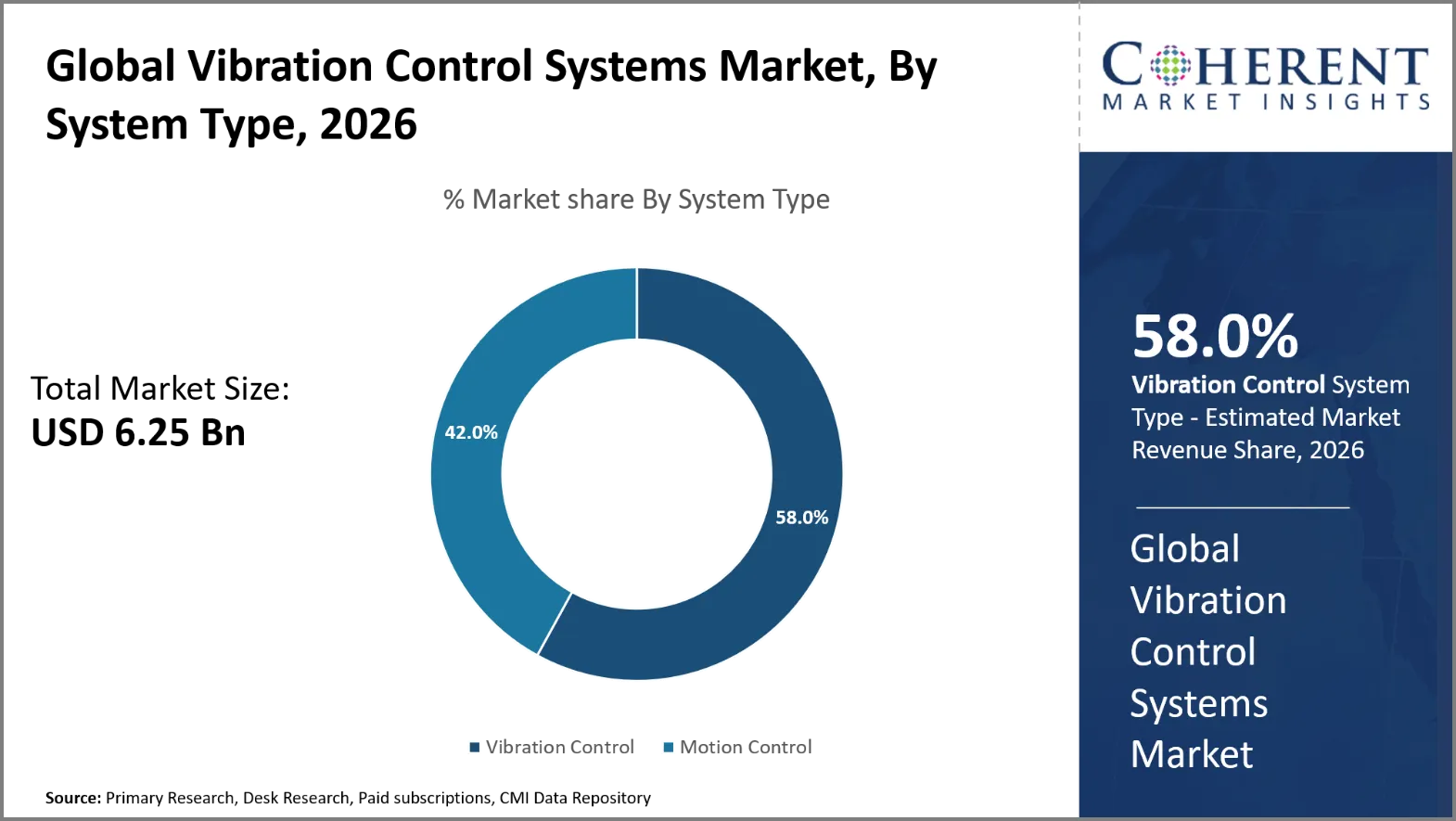
- The Vibration Control segment is expected to account for 58.0% of the global vibration control systems market share in 2026. Increasing aerospace and defense equipment requirements is driving the growth of the segment. On May 21, 2026, Parker Hannifin Corporation announced that it has entered into a definitive agreement to acquire the Commercial and Defense Aerospace business of CIRCOR International, Inc.
- The Manufacturing segment is estimated to capture 26.0% of the market share in 2026. Greater focus on noise, vibration and harshness reduction is majorly driving the growth of the segment. On January 6, 2026, ZF unveiled its Active Noise Reduction software at Consumer Electronics Show 2026. The system uses smart chassis sensors and semi-active dampers to counter tire-cavity noise.
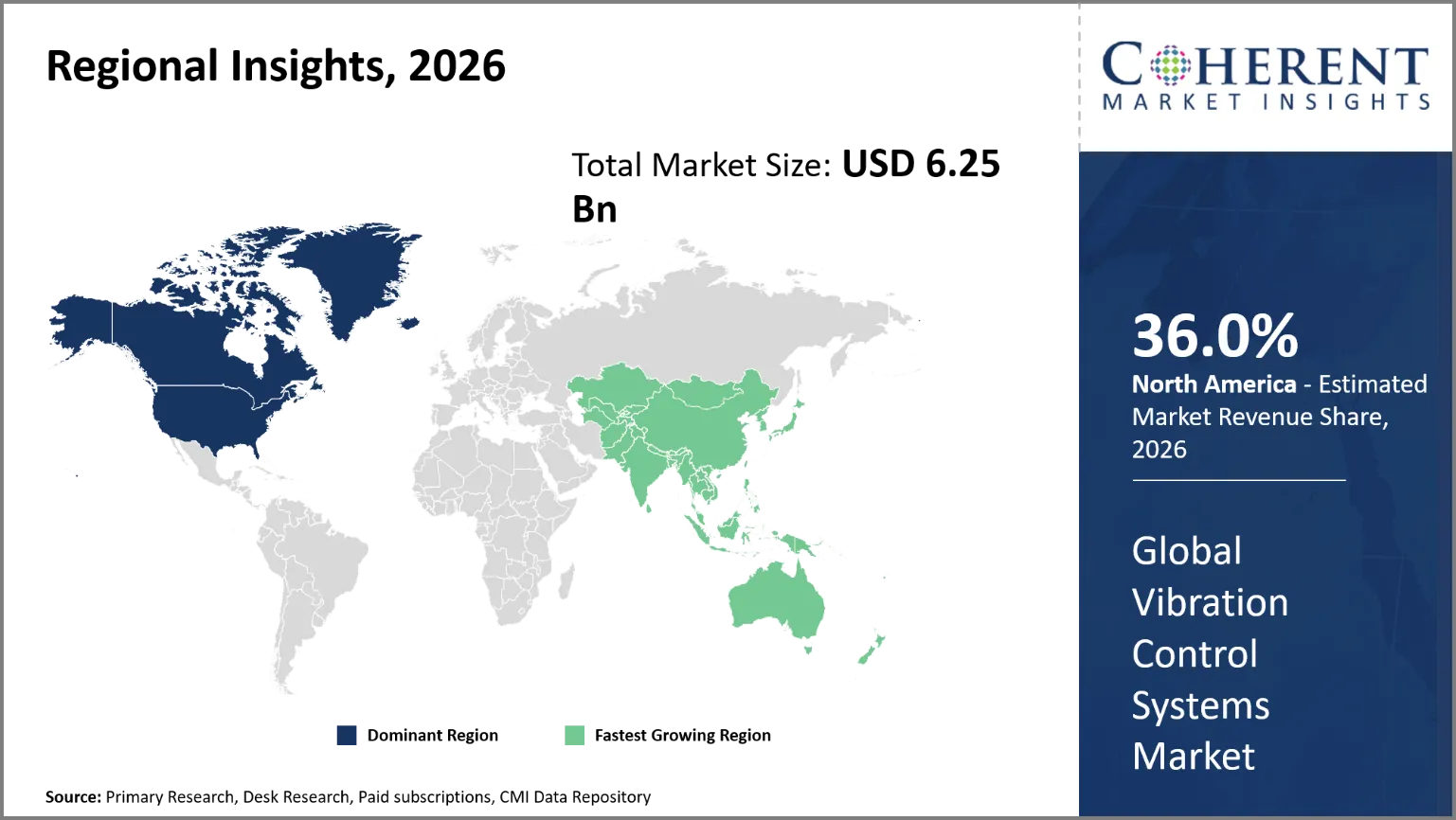
- North America is expected to dominate the vibration control systems market in 2026 with a market share of 36.0%. Rising adoption of predictive maintenance and vibration monitoring in North America is driving the growth of the regional market. On July 21, 2025, Fluke Reliability announced the full integration of its eMaint Computerized Maintenance Management System (CMMS) with Watchman Services, the company’s AI vibration condition monitoring solution.
- Asia Pacific is expected to account for 28.0% share in 2026. Growing use of advanced active vibration control technologies in Asia Pacific is driving the growth of the regional market. On September 10, 2026, DAEIL SYSTEMS installed its active DVIA-ML1000 vibration isolation platform at ASE Korea. The system supports a TESCAN FIB-SEM used for advanced semiconductor analysis.
Segmental Insights
Why Does Vibration Control Dominate the Global Vibration Control Systems Market?
The vibration control segment is expected to account for 58.0% of the global vibration control systems market share in 2026. Vibration control is of utmost importance, since it prevents unnecessary mechanical movement and protects equipment from dynamic stresses. It increases the reliability of machines, operational stability, durability of components and working conditions. Industrial equipment has spinning and reciprocating parts that result in constant vibration during operation. Vibration isolation is employed to safeguard delicate gear against both internally produced and externally conveyed disturbances. Active control methods are employed to handle low-frequency vibrations that require precise movement control. These benefits encourage its use in a wide range of industries including manufacturing, transportation, aircraft, electronics, health care and energy.
On April 12, 2026, EvoQuip, a TEREX brand, launched TRAC, a vibration analysis system developed to provide clearer insight into the performance, condition and long‑term integrity of screening equipment. The technology is now available across EvoQuip screening equipment.
- Current Industry Events of 2026
- Market Size Estimation
- Regional Breakdown
- Competitive Landscape
- Customer Intelligence
- Segmental Analysis
- Pricing Analysis
- Key Market Drivers, Challenges & Future Trends
- Customized Insights Section
Why is Manufacturing the Most Widespread Application?
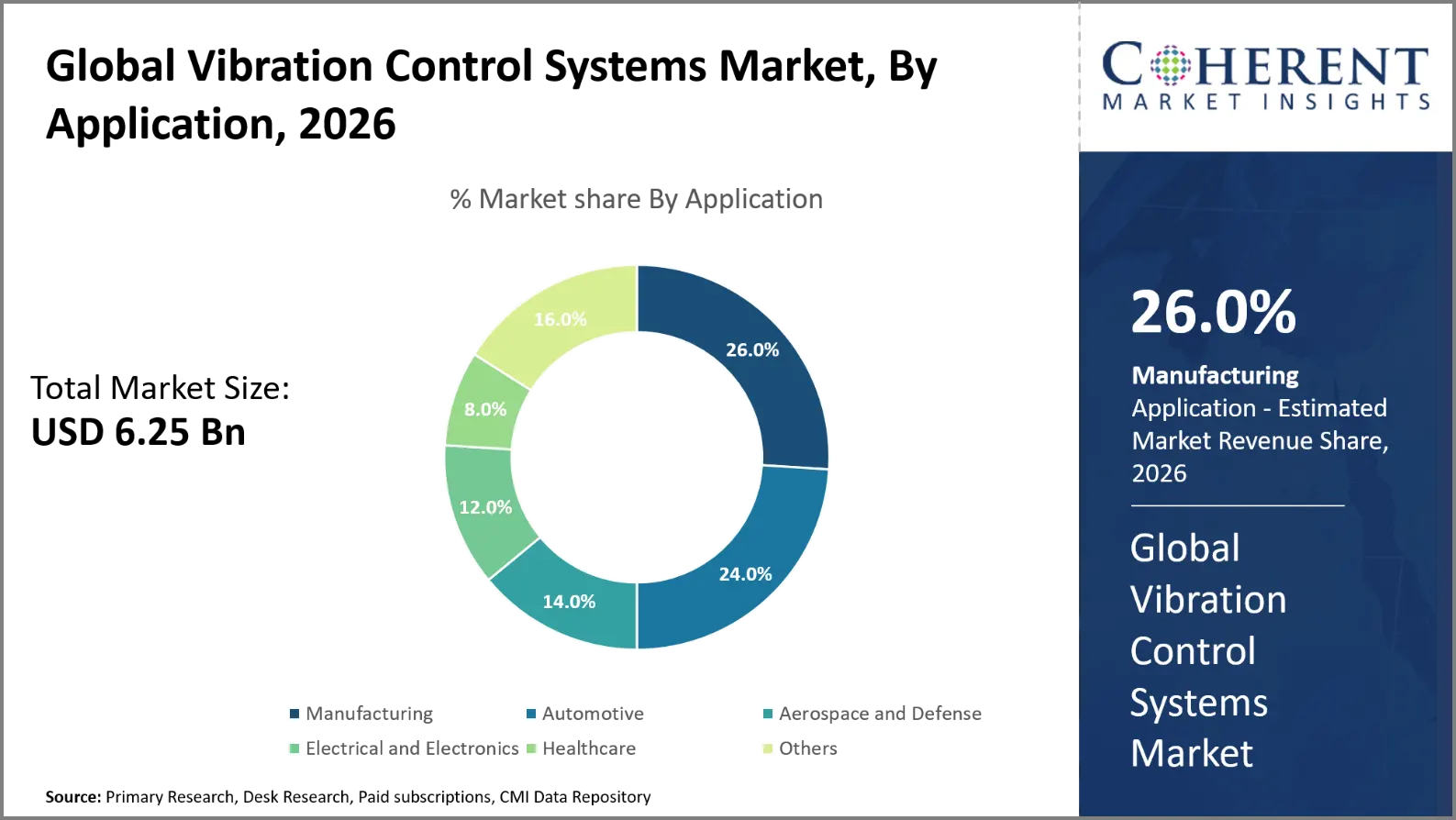
The manufacturing segment is expected to account for 26.0% of the global vibration control systems market share in 2026. The most common application is manufacturing, since production facilities have many machineries creating vibration. Effective vibration management is required for presses, motors, gears, bearings, compressors and rotating machinery. Excessive vibration can lead to component damage and raise the equipment maintenance need. Vibration control also enhances production accuracy by reducing undesired movement of the machine during precision tasks. Particularly stable settings are needed for sensitive production equipment used in semiconductor and electronics manufacturing. The requirements mean that there is a constant demand for vibration isolators, mounts, pads, sensors and active control systems. For example, Technical Manufacturing Corporation promoted STACIS 4 and Everstill K-400 for semiconductor manufacturing at SEMICON West 2025. STACIS 4 employs sensors, control algorithms and piezoelectric actuators to eliminate floor vibrations in real time. Everstill K-400 targets low-frequency vibration between one and ten hertz.
Current Events and their Impact
Current Events | Description and its Impact |
European Union Machinery Regulation, Regulation (EU) 2023/1230 |
|
European Union Outdoor Noise Directive, Directive 2000/14/EC |
|
Vibration Control Systems Market Dynamics
Market Drivers
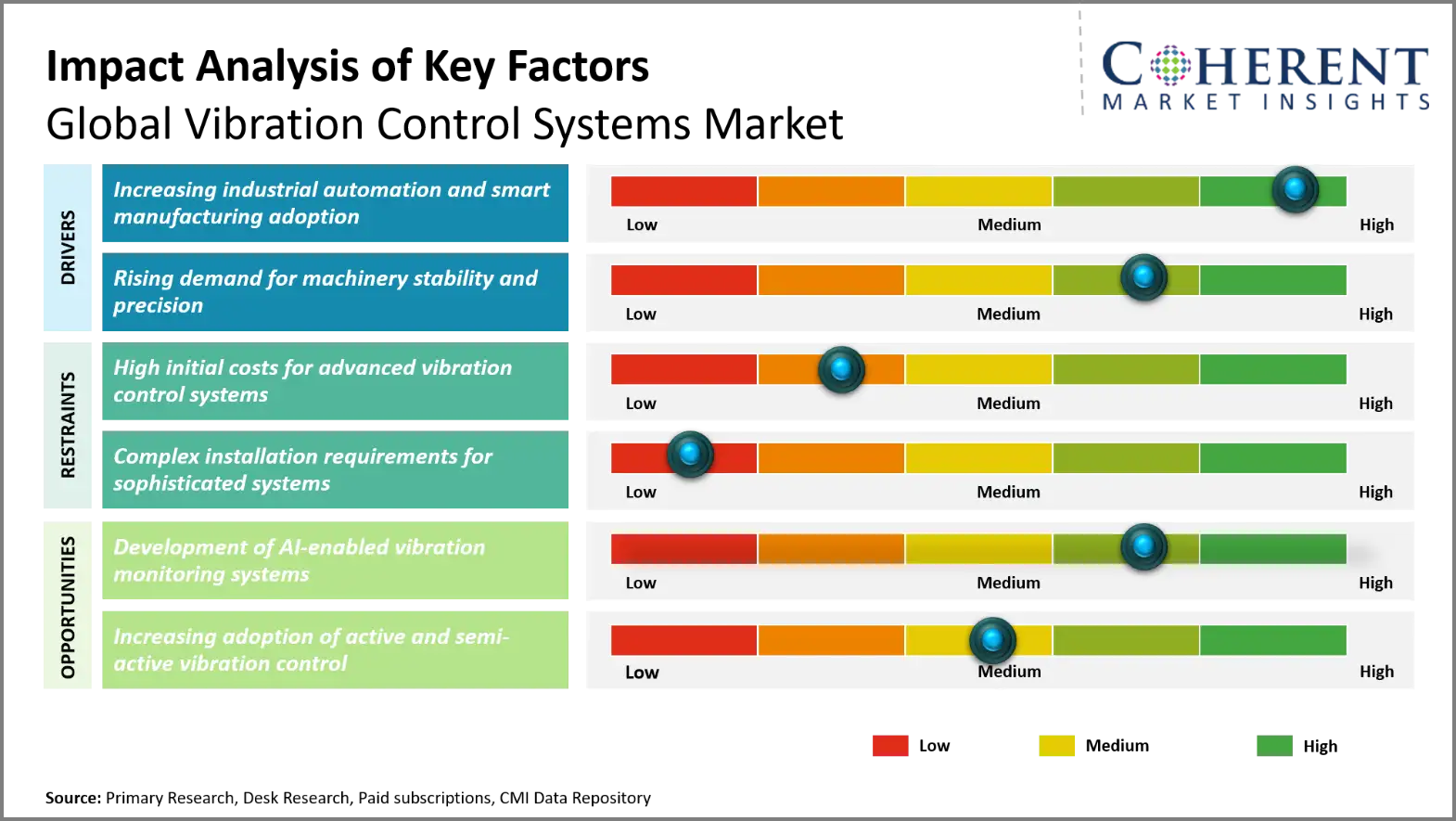
- Increasing industrial automation and smart manufacturing adoption: The growing adoption of industrial automation and smart manufacturing is boosting the need for vibration control systems in production facilities. Automated machinery now runs 24/7 with great precision and speed, and is more sensitive to undesirable mechanical vibrations. Vibration control systems help keep equipment in place and promote consistent production performance. Industrial automation also means more use of robots, automated assembly systems, precision machinery and networked manufacturing equipment. Vibration isolation is necessary for the protection of components and the maintenance of operational precision of these systems. Hence, manufacturers are including vibration control technologies in automated production environments.
- On March 9, 2026, ABB announced plans to invest an additional USD 75 million in India in 2026 to significantly expand its manufacturing presence and research & development capabilities. This investment together with its spend of USD 35 million in 2025 is proof of ABB’s commitment to scale up its local-for-local approach in India.
- Rising demand for machinery stability and precision: Increasing demand for machinery stability and precision is supporting the adoption of vibration control systems across industrial applications. Modern manufacturing requires accurate placement, stable operating conditions, and reliably constant operation of equipment. Mechanical vibrations can have a negative impact on the dimensional accuracy, surface quality, component alignment and machine productivity. Vibration control systems are used to reduce unwanted motion and enhance the stability of critical machinery. Vibration control is very important in precision applications such as semiconductor fabrication, electronics manufacturing and sophisticated machining. This requirement maintains the current demand for isolation mounts, dampening systems, vibration isolators, and active vibration control technologies.
- On September 21, 2026, DAEIL SYSTEMS implemented the DVIA-ULF700 platform in a semiconductor clean booth. The active tuning and vibration measurements under working settings were performed by DAEIL SYSTEMS. The installation reached VC-F through VC-G vibration levels except at frequencies affected by the pump.
Emerging Trends
- AI Enabled Vibration Monitoring: Artificial intelligence is rapidly evolving in its integration with vibration monitoring systems to detect abnormal patterns, predict equipment failures and improve maintenance plans. This enables manufacturers to transition from reactive maintenance to predictive and condition-based maintenance methods.
- Active and Adaptive Vibration Control: The increasing popularity of active and adaptive systems is because of their automatic response to changing vibration conditions, which enhances the isolation performance under varying operating speeds, loads and frequencies in precision machinery, transportation, aerospace and industrial equipment.
- Lightweight and Advanced Materials: Manufacturers are developing lightweight polymers, composites, elastomers and advanced materials for vibration control components that reduce the weight of equipment, while providing damping performance, durability, thermal resistance and mechanical stability in demanding industrial applications.
- Integration with Smart Factory Systems: Vibration control solutions are increasingly integrated with industrial Internet of Things platforms, sensors and machine monitoring software to enable centralized equipment health assessment, real time condition monitoring, automatic alerts and data driven maintenance decisions.
Regional Insights
Why is North America a Strong Market for Vibration Control Systems?
North America is expected to account for a market share of 36.0% in 2026. For North America, the benefits are in aircraft manufacturing, semiconductor fabrication and sophisticated automotive production needing severe vibration control. In September 2025, Canada’s aircraft product manufacturing was USD 2.9 billion. Transportation equipment sales grew 3.2% in the third quarter of 2025. The U.S. Department of Commerce announced USD 1.4 billion in advanced packaging awards during January 2025. These investments support demand for precision isolation around lithography, packaging, testing, and cleanroom equipment.
Why Does Asia Pacific Vibration Control Systems Market Exhibit High Growth?
Asia Pacific is expected to register the fastest growth with a CAGR of 7.5% over the forecast period. It is projected to account for 28.0% of the global vibration control systems market in 2026. Asia Pacific benefits from concentrated semiconductor, electronics, robotics, and advanced manufacturing supply chains. The Association of Southeast Asian Nations is responsible for about 23% to 24% of semiconductor exports globally. Semiconductor activities account for over 60% of electronics exports in the Philippines. Malaysia, Singapore, Vietnam, Thailand and the Philippines have large electronics manufacturing ecosystems. Semiconductor equipment must be accurately isolated from vibration, because even tiny disturbances can impact the accuracy of wafer processing and the performance of wafer inspection. These manufacturing clusters support specialized vibration-control adoption.
Global Vibration Control Systems Market Outlook for Key Countries
Why is U.S. Emerging as a Major Hub in the Vibration Control Systems Market?
The U.S. is expanding vibration-sensitive semiconductor and advanced manufacturing infrastructure across several states. The U.S. Department of Commerce finalized USD 1.4 billion in advanced packaging awards during January 2025. GlobalFoundries received USD 75 million for advanced packaging expansion in New York. Infinera received up to USD 93 million for photonic semiconductor manufacturing and advanced packaging. Corning received up to USD 32 million for specialized lithography glass. These projects increase requirements for high-precision equipment isolation and vibration monitoring.
Is China the Next Growth Engine for the Vibration Control Systems Market?
China is speeding up industrial automation, electric car manufacture, robots and vibration-sensitive semiconductor production. Output of industrial robots grew 28% in 2025 compared to 2024. New energy vehicle production reached 16.52 million units during 2025. Integrated circuit production reached 484.28 billion units during 2025. Production of 3D printers in China grew by 52.5% in 2025. The growing production lines need solid machine foundations, damping components, precision mountings and automatic vibration monitoring.
Germany Vibration Control Systems Market Analysis and Trends
Germany's vibration-control demand is strongly connected with automotive engineering, machinery manufacturing, and precision equipment. Automotive production increased 12.3% month-on-month during September 2025. Production of electronic and optical equipment increased 5.1% during September 2025. Production of aircraft, ships, trains and military vehicles grew by 10.5% in December 2025. These manufacturing tasks need regulated movement of machines during high-speed operation. Therefore, manufacturers are progressively applying mounts, dampers, isolators and structural vibration solutions to manufacturing equipment.
Japan Vibration Control Systems Market Analysis and Trends
Precision manufacturing, robotics, semiconductor equipment and advanced automotive production underpin the vibration control systems. Japanese businesses rely on robotic assembly and high-precision machining equipment that need regulated mechanical motion. Semiconductor equipment manufacture involves vibration isolation of wafer handling, inspection and measuring procedures. Japan’s earthquake-prone industrial environment also imposes requirements for seismic isolation and structural vibration management. Automotive production adds demand for engine mounts, drivetrain isolation and component level damping systems. Specialized applications drive the adoption of advanced passive, active and adaptive vibration-control technologies.
India Vibration Control Systems Market Analysis and Trends
India’s railroad manufacturing, industrial automation, automotive production and infrastructure modernization are all driving greater demand for vibration control. Indian Railroads produced 1,681 locomotives in the FY 2024-25. This was an increase of 19% from the previous financial year. The growth of railroad systems brings with it the need for vibration isolation in locomotives, coaches, track infrastructure, and station equipment. India is also trying to boost domestic electronics and semiconductor manufacturing capabilities. These developments increase opportunities for vibration-control components in precision machinery, transportation equipment, and industrial facilities.
Global Vibration Control Systems Market - Adoption of Sensor-Integrated Vibration Isolators Across Industrial Machinery (2025)
Industrial Machinery | Sensor-Integrated Vibration Isolator Adoption |
Machine Tools | 24% |
Semiconductor Equipment | 22% |
Pumps and Compressors | 19% |
Motors and Drives | 17% |
Presses and Forming Equipment | 10% |
Turbines and Generators | 8% |
How is Development of AI-Enabled Vibration Monitoring Systems Creating New Growth Opportunities in the Vibration Control Systems Market?
Development of AI-enabled vibration monitoring systems is creating opportunities by converting vibration data into automated equipment-health decisions and maintenance actions. AI models can distinguish normal operating signatures from abnormal patterns across motors, pumps, compressors, bearings and rotating machinery. This ability enables the detection of imbalance, misalignment, bearing deterioration and looseness earlier than relying on scheduled inspections alone. Integration with industrial Internet of Things platforms also enables vibration measurements to be combined with temperature, acoustic, load and speed data. So, manufacturers can design intelligent vibration-control systems that adjust damping or isolation settings automatically as machine conditions change. These capabilities enhance demand for sensor-integrated mounts, adaptive isolators, edge analytics, and software-connected vibration-control platforms.
On March 11, 2025, Augury introduced its Machine Health Ultra Low solution, delivering the industry’s first AI-driven monitoring and diagnostics for slow-rotating machinery (1-150 RPM). This breakthrough solution leverages ultrasonic sensing and advanced AI diagnostics to detect machine faults early, at a high degree of accuracy, in manufacturing equipment previously considered too complex to monitor continuously.
Market Players, Key Development, and Competitive Intelligence
Key Developments
- On June 26, 2025, Baker Hughes announced the launch of the GuardVibe torsional vibration dampener, a new approach to limiting the impact of high-frequency torsional drill string vibrations. Through its unique, field-proven approach, GuardVibe can extend the service life of bottom hole assemblies (BHA), reduce capital costs and limit unplanned downtime for operators.
- On May 20, 2025, The Pate Company announced the introduction of Pate Sound & Vibration Reduction Technology (PSVRT), which will feature a complete line of sound reduction and vibration isolation products designed to meet the needs of building owners, engineers and architects in a wide range of commercial and industrial building applications.
Competitive Landscape
Leading players differentiate themselves by application-specific materials, technical services and expert vibration-control portfolios. Trelleborg is a specialist in polymer engineering, antivibration mounts, dampening devices and custom solutions in automotive, aircraft, manufacturing, rail, marine and energy. Trelleborg also investigates damping solutions for electric vehicles, such as materials that control inverter and motor noise. Getzner Werkstoffe develops polyurethane materials (Sylomer, Sylodyn, Sylodamp) for trains, buildings and industrial machinery. Getzner is also integrating sensor-based monitoring into railroad isolation solutions for condition forecasting. This combination of engineered materials, customized designs, and application-specific monitoring is shaping competition across major end-use sectors.
Market Report Scope
Global Vibration Control Systems Market Report Coverage | |||
Report Coverage | Details | ||
Base Year | 2025 | Market Size in 2026: | USD 6.25 Bn |
Historical Data For: | 2020 To 2024 | Forecast Period: | 2026 To 2033 |
Forecast Period 2026 To 2033 CAGR: | 6.80% | 2033 Value Projection: | USD 9.90 Bn |
Geographies covered: |
| ||
Segments covered: |
| ||
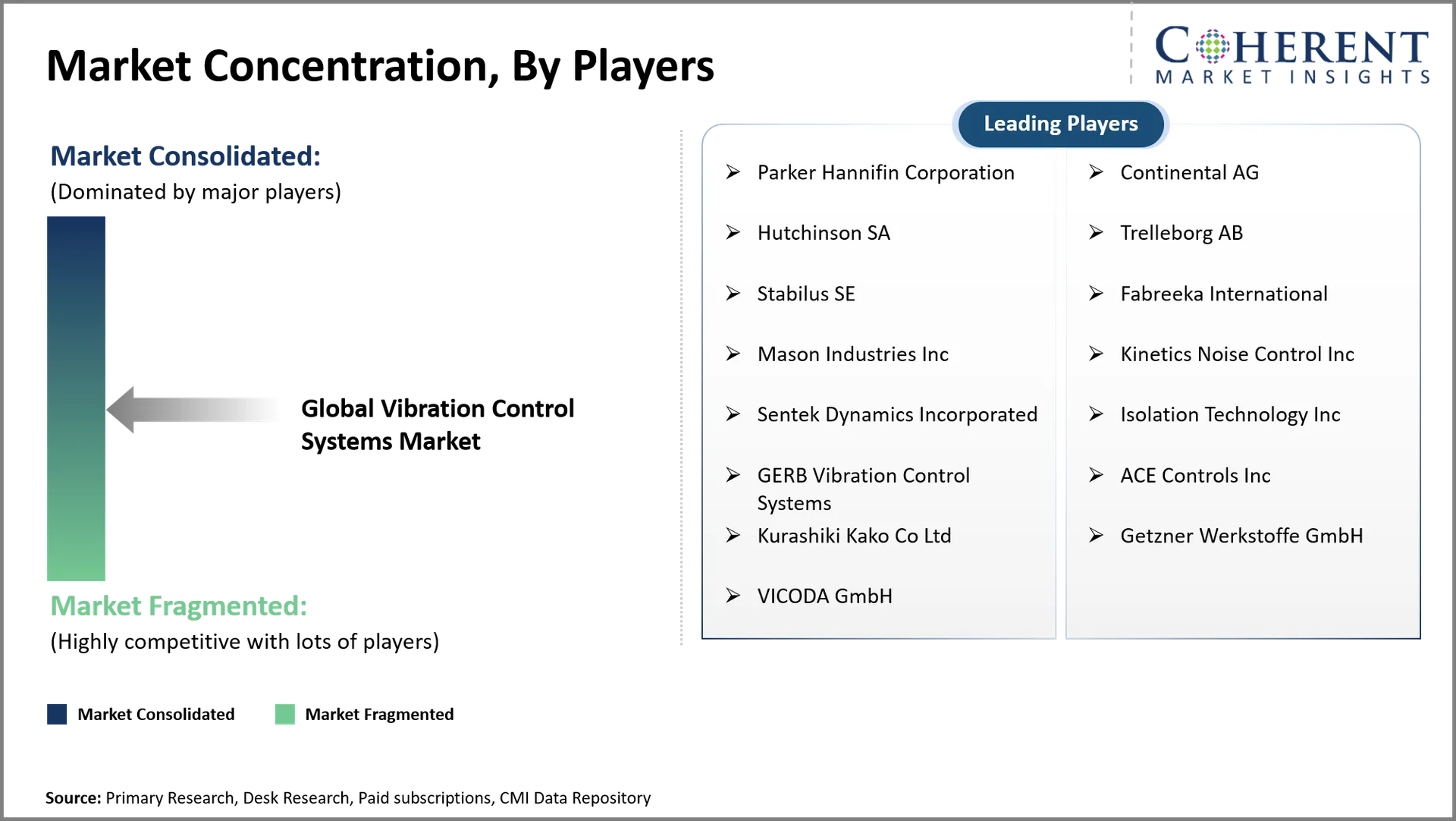
Companies covered: | Parker Hannifin Corporation, Continental AG, Hutchinson SA, Trelleborg AB, Stabilus SE, Fabreeka International, Mason Industries Inc, Kinetics Noise Control Inc, Sentek Dynamics Incorporated, Isolation Technology Inc, GERB Vibration Control Systems, ACE Controls Inc, Kurashiki Kako Co Ltd, Getzner Werkstoffe GmbH, VICODA GmbH | ||
Growth Drivers: |
| ||
Restraints & Challenges: |
| ||
Analyst Opinion (Expert Opinion)
- The vibration control systems market is expected to move from standalone passive isolation toward connected and adaptive vibration-control architectures. Sensor-integrated isolators can provide operating-condition data while software identifies changing vibration behavior. Getzner already describes sensor integration for real-time railway monitoring and condition forecasting. This direction creates opportunities for suppliers combining mechanical isolation with sensing, diagnostics, and predictive maintenance capabilities.
- The most promising opportunities will be in active and adaptive vibration control, especially for semiconductor equipment, robotics, precision machining, electric vehicles, and advanced rail systems. Semiconductor equipment demands the most stable operating environments and electric vehicles generate differing acoustic and vibration profiles around the motors and inverters. Trelleborg specifically identifies inverter and electric-motor noise as an electric vehicle opportunity. China, Japan, the U.S., and Germany offer particularly important opportunities because of their advanced manufacturing and precision-engineering ecosystems.
- Players looking for an edge should blend material innovation, application engineering, and embedded sensing. The efficiency and sustainability requirements can be met with lightweight elastomers, recyclable polyurethane materials and adaptive damping designs. Relomer by Getzner is made from recycled polyurethane granules for railroad and construction purposes. Suppliers should also build local engineering capabilities in the proximity of large automobile, semiconductor, railroad and industrial clusters. Trelleborg’s industrial footprint on three continents demonstrates the importance of local production and customer service.
Speak to the analyst
Want personalized insights?
Take the findings above to one of our principal consultants, or have the report rebuilt around the segments, geographies and competitors you actually track.
Market Segmentation
- System Type Insights (Revenue, USD Billion, 2021 - 2033)
- Vibration Control
- Isolating Pads
- Isolators
- Others
- Motion Control
- Springs
- Washers and Bushes
- Mounts
- Vibration Control
- Application Insights (Revenue, USD Billion, 2021 - 2033)
- Manufacturing
- Automotive
- Aerospace and Defense
- Electrical and Electronics
- Healthcare
- Others
- Regional Insights (Revenue, USD Billion, 2021 - 2033)
- North America
- U.S.
- Canada
- Latin America
- Brazil
- Argentina
- Mexico
- Rest of Latin America
- Europe
- Germany
- U.K.
- Spain
- France
- Italy
- Russia
- Rest of Europe
- Asia Pacific
- China
- India
- Japan
- Australia
- South Korea
- ASEAN
- Rest of Asia Pacific
- Middle East
- GCC Countries
- Israel
- Rest of Middle East
- Africa
- South Africa
- North Africa
- Central Africa
- North America
Sources
Primary Research Interviews
- Vibration Control Systems Manufacturers
- Industrial Machinery & Equipment Suppliers
- Aerospace & Defense Technology Specialists
- Automotive Engineering Consultants
Magazines
- Machine Design Magazine
- Aerospace Manufacturing and Design Magazine
- Automotive Engineering International (SAE Media)
- Vibration & Acoustics Technology Magazine
Journals
- Journal of Sound and Vibration (Elsevier)
- Journal of Vibration and Control (SAGE Publications)
- Mechanical Systems and Signal Processing (Elsevier)
Associations
- Society of Automotive Engineers (SAE International)
- Acoustical Society of America (ASA)
- Institute of Noise Control Engineering (INCE)
- Vibration Institute (VI)
Public Domain Sources
- U.S. Department of Energy (DOE) – Industrial Equipment Reports
- European Commission – Industrial Machinery & Safety Regulations
- International Organization for Standardization (ISO) – Vibration Standards (ISO 10816 Series)
- National Institute of Standards and Technology (NIST)
Proprietary Elements
- CMI Data Analytics Tool
- Proprietary CMI Existing Repository of Information for the Last 10 Years
Get access to 250+ pages report
Every segment, forecast, competitor profile and data table behind the analysis above — available for instant download.
- ESOMAR Member
- ISO 9001:2015 Certified
- D-U-N-S Registered
- GDPR & CCPA Compliant
Frequently Asked Questions
The global vibration control systems market is expected to stand at USD 6.25 Bn in 2026 and is expected to reach USD 9.90 Bn by 2033.
The CAGR of the global vibration control systems market is projected to be 6.8% from 2026 to 2033.
Increasing industrial automation and smart manufacturing adoption and rising demand for machinery stability and precision are the major factors driving the growth of the global vibration control systems market.
High initial costs for advanced vibration control systems and complex installation requirements for sophisticated systems are the major factors hampering the growth of the global vibration control systems market.
In terms of system type, vibration control segment is estimated to dominate the market revenue share in 2026.
Vibration control systems reduce unwanted mechanical movement, oscillation, shock, and structural transmission in equipment and infrastructure.
Artificial intelligence enables automated vibration analysis, abnormality detection, predictive maintenance, and adaptive control decisions.