

Global Voyage Management Software Market Size and Forecast – 2026 T0 2033
The global voyage management software market is expected to grow from USD 1.77 Bn in 2026 to USD 2.97 Bn by 2033, at a compound annual growth rate (CAGR) of 7.7% over 2026–2033. Voyage management software is the group of applications that plan a ship's voyage, guide it while at sea and review it afterwards. A typical platform combines route and weather planning, speed and fuel advice, estimated time of arrival (ETA) tracking, voyage cost and emissions calculation, and links to charter, port and compliance systems. The need is easy to measure. UNCTAD reported that the world fleet's carrying capacity reached 2.5 billion dead weight tons on January 1, 2026. The software forms a growing part of the wider Fleet Management Solution Market and draws on data from the Maritime Analytics Market.
Three forces support this growth. First, carbon rules now price every voyage. The European Commission's schedule has shipping companies surrender EU Emissions Trading System allowances for 70% of their 2025 emissions in 2026 and for 100% of reported emissions from 2027 onward, and methane and nitrous oxide entered the scope in 2026. Second, global rules are still being settled. The International Maritime Organization (IMO) announced that its Marine Environment Protection Committee will resume its Second Extraordinary Session on December 4, 2026, subject to confirmation by its 85th session, to take up the Net-Zero Framework. Third, the fleet keeps growing, with UNCTAD reporting an increase of 85 million dead weight tons in the year to January 1, 2026, which adds to the routing, speed and arrival decisions that operators must make each day.
Key Takeaways of the Global Voyage Management Software Market:
- On-Premise deployment is expected to account for 66.0% of the deployment segment in 2026. Voyage tools must keep working on board when satellite links are slow or drop out, so installed software on the vessel and on company servers remains the default for core planning and monitoring. On August 25, 2026, NAVTOR announced NavFleet 2.7 with passage plan management, which lets shore teams set passage planning settings centrally in NavFleet and push them to vessels.
- Voyage Planning is expected to account for 48.0% of the function/module segment in 2026. Every voyage starts with a route, a speed profile and a fuel plan, so planning tools are used on every sailing across fleets. On July 15, 2026, Weathernews and HD Hyundai Marine Solution announced a framework agreement to commercialize OSR-OW, an AI-powered route optimization solution, and reported fuel savings of at least 3% in trials.
- Large organisations are expected to account for 60.5% of the organisation size segment in 2026. Large operators run many vessels, charters and compliance regimes at once, so they need one controlled voyage workflow rather than separate tools. On August 4, 2026, ZeroNorth announced Propel, an agentic AI platform for maritime operations, with Cargill, Ultrabulk and CMB.TECH as launch partners getting early access.
- Container lines are expected to account for 27.0% of the vessel type segment in 2026. Liner services run to fixed schedules and terminal berth windows, which makes speed and arrival-time decisions a daily task. On October 30, 2026, StormGeo announced that it had closed the acquisition of Portchain, whose network connects shipping lines with more than 200 terminals representing over 40% of global container terminal capacity.
- North America is expected to dominate the voyage management software market in 2026, with a share of 35.0%. The region is home to leading voyage software vendors such as Veson Nautical and ABS Wavesight. On June 30, 2026, Veson Nautical announced the Veson Platform, which brings IMOS, CoCaptain, Mail and the new Vessel Insights and Bunker Insights under a single interface.
- Asia Pacific is expected to account for a 26.0% share in 2026 and to be the fastest-growing region over 2026–2033. Asian owners hold more than half of the world's carrying capacity and are digitalising voyage work. On January 13, 2026, OrbitMI announced its expansion in Japan with a new Tokyo office and the appointment of Kazuo Yamashita as Business Development Partner for Japan.
Segmental Insights
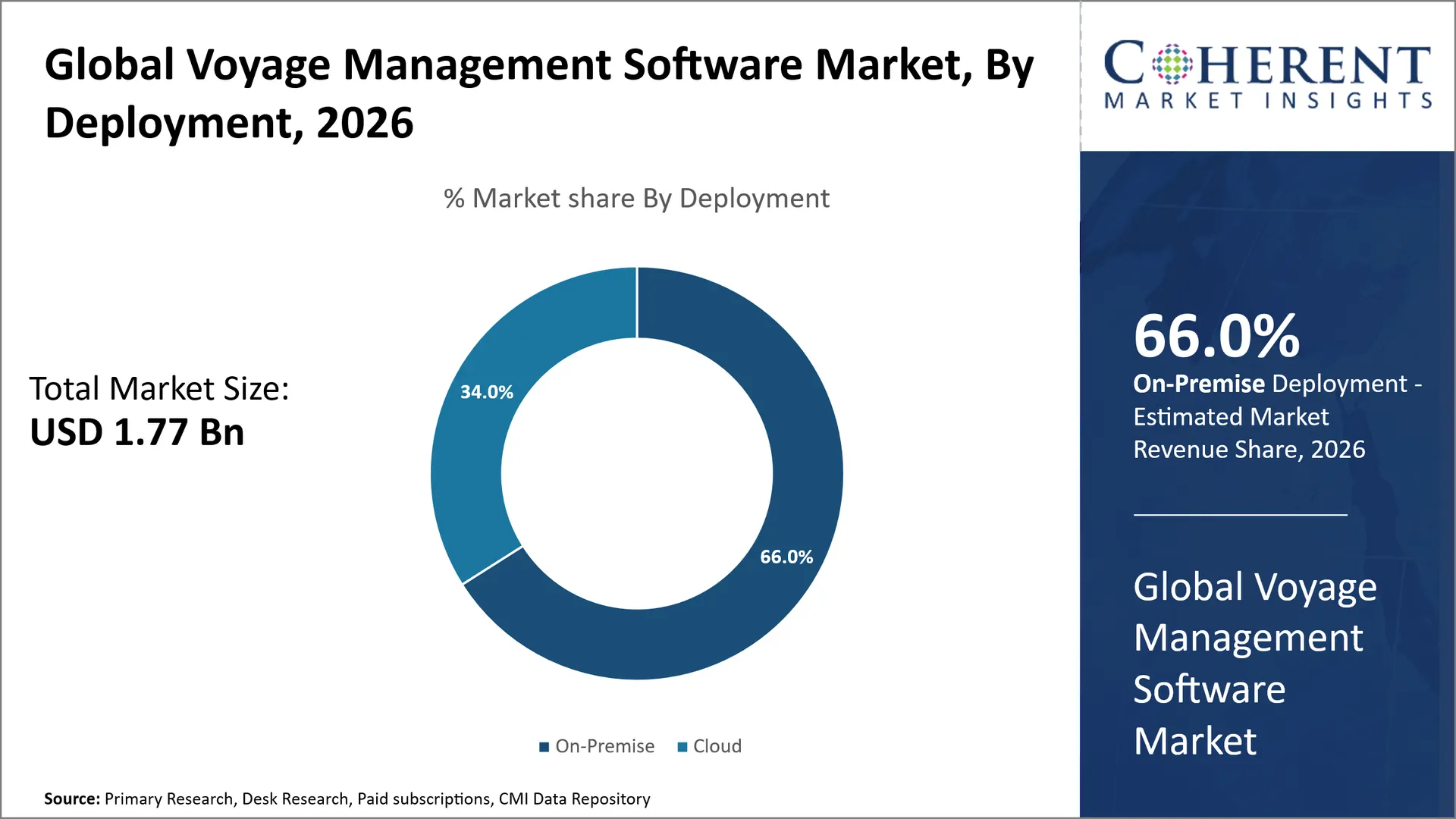
Why Does On-Premise Deployment Lead the Deployment Segment?
In terms of deployment, on-premise systems are expected to account for 66.0% of the global voyage management software market share in 2026. A ship is a remote site with a satellite link that is costly, slow and sometimes unavailable. Voyage planning, ECDIS-linked route checks and performance calculations therefore run on servers and workstations on board and in the owner's own data centre, where they keep working without a live connection. Installed software also stays under the owner's control for data and cyber policy, which matters when a system connects to navigation and engine data.
An on-premise voyage stack usually has four parts, each of which is bought, upgraded and integrated separately
- Onboard planning workstation: holds the route, the passage plan and the weather files so the master can plan and re-plan without a shore link.
- Sensor and data interface: collects speed, position, fuel flow and engine data from the ship's own systems and noon reports.
- Shore server and database: stores voyage records, charter terms and fleet data inside the company's own network.
- Ship-to-shore synchronization: sends plans and settings to the vessel and returns reports when a connection is available.
- Current Industry Events of 2026
- Market Size Estimation
- Regional Breakdown
- Competitive Landscape
- Customer Intelligence
- Segmental Analysis
- Pricing Analysis
- Key Market Drivers, Challenges & Future Trends
- Customized Insights Section
Why Does Voyage Planning Lead the Function/Module Segment?
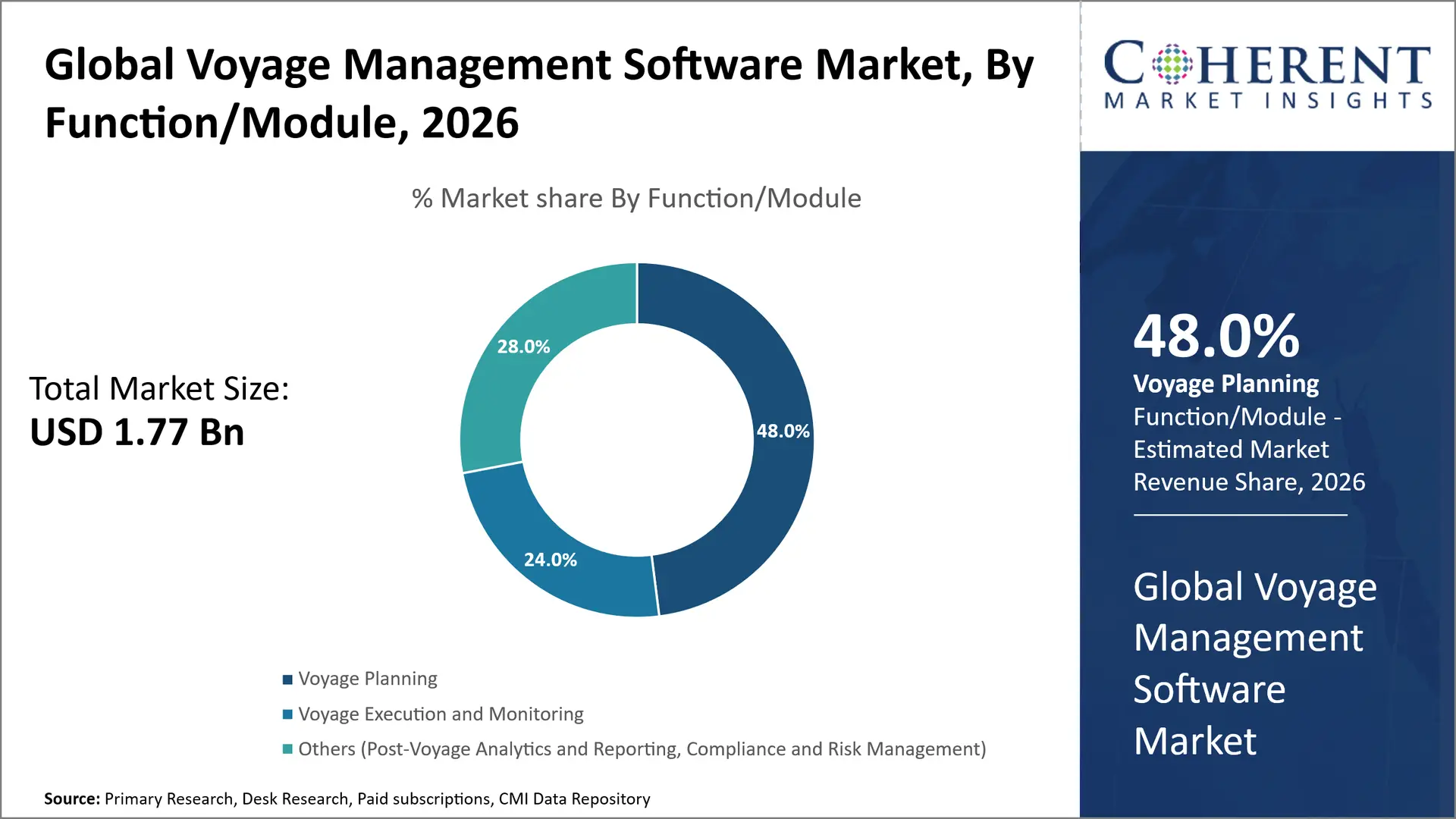
In terms of function/module, voyage planning is expected to account for 48.0% of the global voyage management software market share in 2026. Planning is the step where most of the money is decided. A route, a speed profile, a bunkering stop and a port arrival time fix fuel burn, emissions, charter-party compliance and delay risk before the ship leaves. Planning software ingests weather and ocean data, applies the vessel's performance model, and compares route and speed options against cost and carbon targets. The same module serves commercial teams that estimate voyage results before a fixture and masters who check the passage plan.
A complete planning module usually covers five tasks:
- Weather and ocean routing: builds routes around waves, wind and currents using forecast data.
- Speed and fuel optimisation: sets a speed profile that meets the arrival target with the lowest fuel use.
- Passage planning: prepares the safe route against charts, depth and navigational warnings.
- Voyage estimation: calculates voyage cost, time and emissions before fixing a cargo.
- Re-planning: updates the route and speed when weather, port or charter conditions change.
Why Do Large Organizations Lead the Organisation Size Segment?
In terms of organisation size, large organisations are expected to account for 60.5% of the global voyage management software market share in 2026. A large operator may manage hundreds of vessels, many charters and several emissions regimes at the same time. It needs one system of record that links voyage plans to charter terms, fuel purchases, port costs and compliance reports, and it has the staff and budget to integrate such a system with its own finance and technical platforms. Large groups also run voyage desks around the clock, which raises the use of every planning and monitoring module.
Why Do Container Lines Lead the Vessel Type Segment?
In terms of vessel type, container lines are expected to account for 27.0% of the global voyage management software market share in 2026. Container ships sail on published schedules and call at terminals with booked berth windows, so a late or early arrival has a direct cost for the carrier and for terminal operators. Speed and route are adjusted continuously to hit the berth window with the least fuel. Container operators also face the broadest exposure to port-call data, since a single loop may touch many terminals in a few weeks.
Current Events and their Impact
Current Events | Description and its Impact |
IMO Net-Zero Framework: resumed session set for December 4, 2026 |
|
European Commission proposal to revise EU ETS, MRV and FuelEU Maritime: July 17, 2026 |
|
Voyage Management Software Market Dynamics
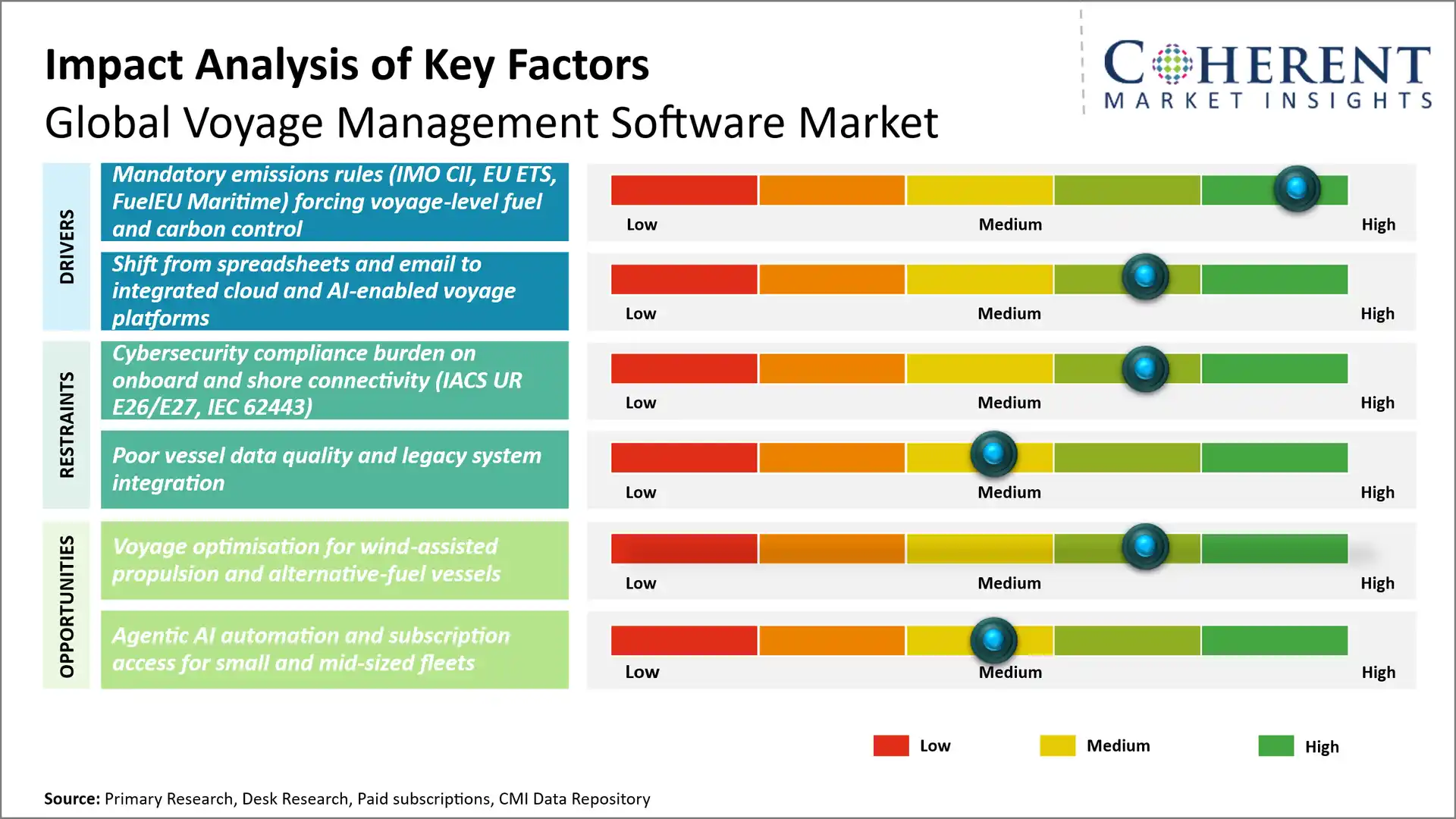
Market Drivers
- Mandatory emissions rules (IMO CII, EU ETS, FuelEU Maritime) forcing voyage-level fuel and carbon control: The IMO's Carbon Intensity Indicator rates each ship every year, the EU ETS charges for emissions on voyages touching European ports, and FuelEU Maritime sets limits on the greenhouse gas intensity of the energy a ship uses. Each rule turns a routing or speed choice into a measurable cost, so operators need software that calculates the carbon and fuel effect of a voyage before and during the sailing. On October 20, 2025, ABS Wavesight announced that Navilands Group had selected ABS Wavesight Advantage for digitalized FuelEU and EU ETS compliance.
- Shift from spreadsheets and email to integrated cloud and AI-enabled voyage platforms: Voyage teams have long moved data between spreadsheets, e-mails and separate systems for charter, weather and port data. Integrated platforms hold these inputs in one place and add AI to flag risks and propose actions, which cuts re-keying and delay. On April 8, 2025, Dataloy Systems announced a partnership with Lloyd's List Intelligence that brings risk and compliance data directly into its Voyage Management System through Dataloy Widgets.
Emerging Trends
- Voyage decisions are being tied to carbon and idle-time economics: Operators now compare routes and speeds on money and carbon together. On September 25, 2025, ABS announced that its Chairman and CEO outlined a vision of software as the main tool for intelligent maritime operations, noting that cutting one metric ton of CO₂ equivalent per voyage can save more than USD 40,000 in carbon penalties and that avoiding one idle day can unlock about USD 40,000 in potential earnings.
- Impact: Voyage tools that show cost and carbon in one view become part of daily commercial decisions rather than a reporting add-on.
- Relevance to the market: Voyage tools that show cost and carbon in one view become part of daily commercial decisions rather than a reporting add-on. This widens the use of planning and monitoring modules beyond compliance teams to chartering and operations desks.
- Open data exchange between ships, ports and authorities is moving to application programming interfaces: Standard interfaces let voyage software send and receive port and clearance data without manual entry. On April 21, 2026, the Maritime and Port Authority of Singapore launched OCEANS-X, a data and API exchange platform that currently hosts over 100 APIs and datasets and allows industry players and startups to build analytics and AI-enabled tools on it.
- Impact: Ports and authorities that share data through open interfaces let voyage software pick up arrival and port-call information automatically, so crews type in less and ETA advice becomes more accurate.
- Relevance to the market: Vendors no longer need to build a separate link for every port. Platforms with open interfaces can add new data sources quickly, which gives them an edge when owners compare voyage software.
Regional Insights
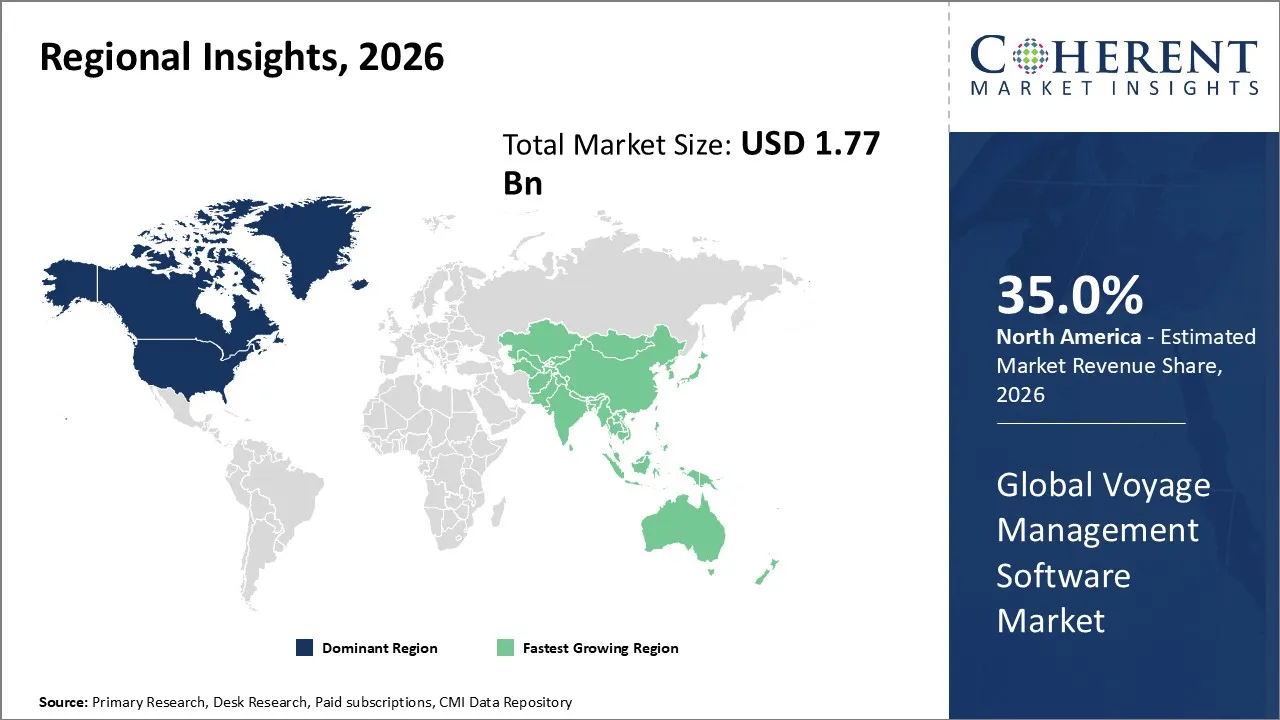
Why Does North America Lead the Global Voyage Management Software Market?
North America is expected to account for a market share of 35.0% in 2026. The region's leadership rests on its base of software vendors and commercial shipping buyers. Veson Nautical, whose IMOS platform runs chartering and voyage workflows, is based in Boston, and ABS Wavesight, the software company affiliated with the classification society ABS, is based in Houston. On February 13, 2026, the White House released America's Maritime Action Plan, which sets a federal framework for shipbuilding, port infrastructure and workforce development and supports spending on maritime technology.
Why Is Asia Pacific the Fastest-Growing Region in the Voyage Management Software Market?
Asia Pacific is expected to account for a 26.0% share in 2026 and to register the fastest growth over the forecast period. Asian companies own 56% of the world’s carrying capacity in dead weight tons, according to UNCTADstat. On January 1, 2026, China held 377 million dead weight tons and Japan held 243 million. So most of the world’s ships are run from Asian head offices, and that is where the demand for voyage software grows. Governments in the region are also backing digital shipping, which adds to that demand..
Global Voyage Management Software Market Outlook for Key Countries:
Is the U.S. the Largest Market for Voyage Management Software?
The U.S. voyage management software market is projected to reach USD 0.55 Bn in 2026, the largest of the five countries covered here. The country combines major charterers, cruise lines and offshore operators with a deep supplier base. On May 18, 2026, the U.S. Coast Guard announced the launch of its Digital Transformation Initiative through ALCOAST 136/26, a blueprint to modernize the Service in line with the President's Maritime Action Plan, which signals a wider move to digital data in the U.S. marine system.
Is China the Largest Asia Pacific Market for Voyage Management Software?
The China voyage management software market is projected to reach USD 0.15 Bn in 2026, making it the largest in Asia Pacific. China is one of the three largest shipowning economies by beneficial ownership according to UNCTADstat, and the Ministry of Transport reported that the country handled about one-third of global seaborne trade in 2025. In March 2026, the Ministry of Transport, the Ministry of Industry and Information Technology, the State-owned Assets Supervision and Administration Commission and the State Administration for Market Regulation jointly issued the Smart Shipping 2030 Action Plan, which sets out requirements and tasks for smart shipping during the 15th Five-Year Plan period (2026-2030).
Is Norway the Leading European Market for Voyage Management Software?
The Norway voyage management software market is projected to reach USD 0.14 Bn in 2026, the largest in Europe among the countries covered here. Norway hosts a dense cluster of voyage software suppliers, including Kongsberg Maritime, StormGeo in Bergen, Dataloy Systems in Bergen and NAVTOR in Egersund. From September 15, 2026, Norwegian Customs applies new digital reporting requirements, known as Digitoll, to all maritime traffic, which pushes shipping companies and agents toward system-to-system data exchange.
Is Singapore the Main Engine of Growth in Asia Pacific?
The Singapore voyage management software market is projected to reach USD 0.09 Bn in 2026. Singapore is a major hub port, bunkering centre and base for ship managers, so it holds a large number of voyage decisions per vessel. On April 21, 2026, the Maritime and Port Authority of Singapore opened Singapore Maritime Week 2026, which brought together more than 20,000 participants from nearly 80 countries and regions, with digitalisation and decarbonisation among its main themes.
Is Greece the Anchor of European Ship Ownership Demand for Voyage Management Software?
The Greece voyage management software market is projected to reach USD 0.07 Bn in 2026. Greece is one of the three largest shipowning economies by beneficial ownership according to UNCTADstat. The Greek Shipping Co-operation Committee reported that Greek shipowners controlled 4,388 ships over 1,000 gross tons, with a carrying capacity of 360,564,729 dead weight tons, as of March 3, 2026, a record for the Greek-owned fleet. A fleet of this size means a large number of voyages planned and estimated from Greek offices each year.
Global Voyage Management Software Market – Published Specifications by Capability
Capability | What It Does | Published Figure or Capability | Source |
AI route optimization | Chooses routes and speeds to cut fuel use on commercial voyages | OSR-OW works with vessels already using either company's services with no additional equipment; trials confirmed fuel savings of at least 3%; planned rollout across a combined customer base of about 8,000 vessels | Weathernews and HD Hyundai Marine Solution |
Port-call and berth alignment | Links vessel arrival to terminal berth plans in real time | Network connects shipping lines with more than 200 terminals, over 40% of global container terminal capacity; Voyage Intelligence optimizes for arrival time, fuel consumption or a balance of both | StormGeo (Alfa Laval) |
Ship-to-shore passage planning | Pushes shore-set planning rules to vessels | Passage plan settings pushed to vessels running Passage Plan version 5 and later; multiple settings profiles for different vessel types | NAVTOR |
Integrated voyage cycle | Covers planning, execution and post-voyage reporting in one solution | Pre-planning, weather-informed route planning, dynamic trim optimisation, hull performance analytics and automated emissions reporting in KM Performance | Kongsberg Maritime |
Cloud performance monitoring and voyage optimization | Monitors ship performance and optimizes speed profiles for upcoming weather | Cloud-based with no hardware installation or initial investment; integrates with any vessel data source; monitors CII, EU ETS and FuelEU compliance | NAPA |
Embedded commercial data | Brings third-party data into the voyage system through widgets | Risk and compliance data embedded in the voyage management system through Dataloy Widgets; weather data integrated for pre-fixture planning | Dataloy Systems |
Shore-side voyage planning module | Plans and re-plans voyages with commercial considerations | Web module for voyage planning and re-planning connected to Navi-Port, with post-voyage analysis of fuel use by speed, route, port waiting time and weather | Wärtsilä |
How Are Wind-Assisted Propulsion and Agentic AI Creating New Growth Opportunities in the Voyage Management Software Market?
Two openings stand out. The first is voyage optimisation for wind-assisted propulsion and alternative-fuel vessels. A ship that mixes sails, biofuel or LNG has to decide on every leg how much work the wind should do and which fuel to burn, and ordinary routing tools were not built for that choice. Software vendors that model wind assistance and fuel mix can sell a higher-value module on top of a base planning licence. In June 2025, Kongsberg Maritime launched K-Sail, a service that ties wind-assist sails into propulsion, power management and AI-based route and speed optimisation, with the first reference tanker for Terntank.
The second is agentic AI automation and subscription access for small and mid-sized fleets. Smaller operators rarely have a large voyage desk, so AI agents that read e-mails, update voyage records and prepare plans, sold as a monthly subscription, open a buyer group that licence-heavy systems did not reach. On November 18, 2026, Veson Nautical announced CoCaptain Agentic Workflows, eleven prebuilt and configurable workflows for chartering, operations and claims teams that help evaluate opportunities and process voyage updates. On August 27, 2024, ABS Wavesight announced NS – Web, a cloud-based module that keeps the features of its on-premise Nautical Systems software and can scale from a small fleet to a global operation.
Market Players, Key Development, and Competitive Landscape
Key Developments
- On November 10, 2026, Weathernews announced the availability of Offline mode for SeaNavigator for Master, its AI-powered navigation support service for ship masters, after onboard trials from February to April 2026 found that unreliable connectivity was preventing masters from using live weather data at sea. Route simulation and the AI Agent still require a live connection.
- On November 6, 2026, Alfa Laval announced a definitive agreement to acquire NAVTOR AS for USD 700 Mn in an all-cash transaction, with closing expected in the first quarter of 2027 after regulatory approvals. NAVTOR will join the Ocean Division and its platform will be consolidated with the StormGeo and Portchain platforms.
- On February 26, 2026, StormGeo announced a new Premium Fleet Performance Center Service that adds quarterly expert-led reviews of data quality and vessel performance, with tailored recommendations, to its daily alerts and is available globally as an add-on to s-Insight.
- On February 13, 2026, Kongsberg Maritime unveiled a harmonised Digital Solutions portfolio and launched KM Performance, the first solution area from it, which combines K-IMS, Vessel Insight, K-Fleet and Coach under its Digital Ocean digital office on a common data foundation.
- On October 21, 2025, NAPA and Interoutes announced the launch of the Expert Route Monitoring service, which combines NAPA Voyage Optimization with expert human guidance for captains and operators across the voyage.
- On September 3, 2025, ABS Wavesight announced the launch of ABS Wavesight Advantage, a platform designed to simplify compliance, unify operations and improve maritime efficiency
Competitive Landscape
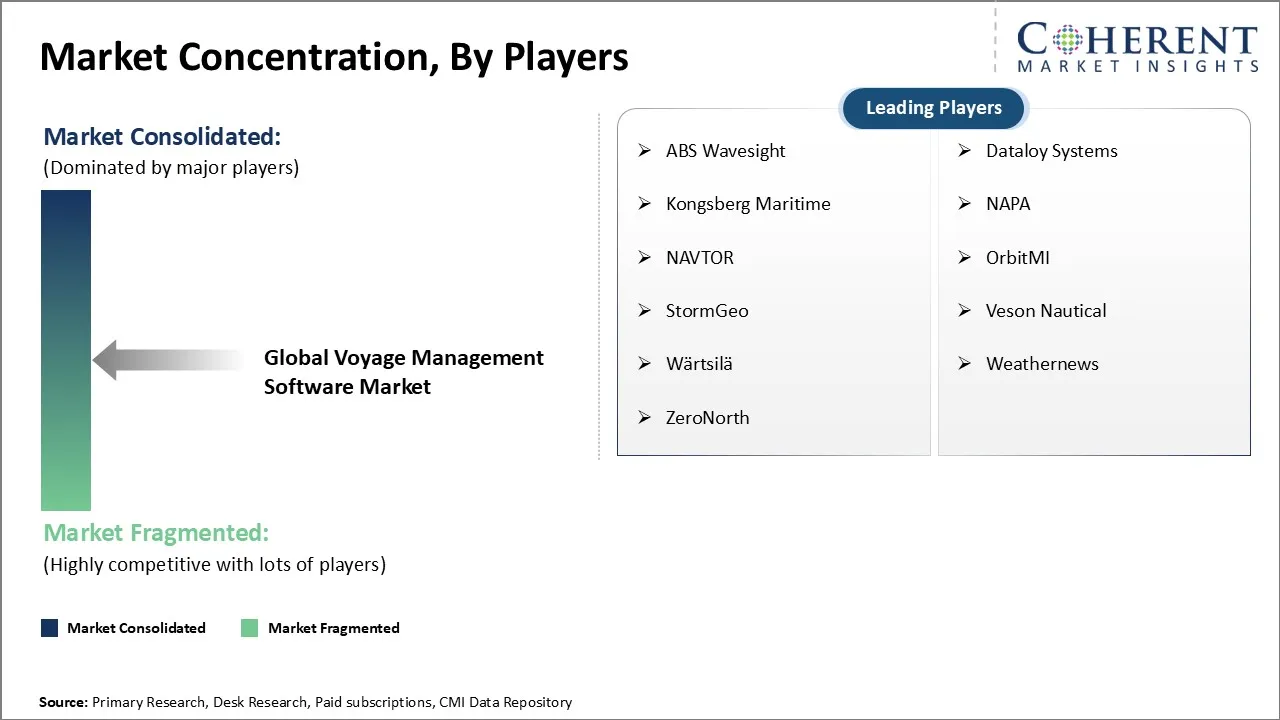
The market is shared between four groups that increasingly work together. Commercial and chartering platform providers such as Veson Nautical and Dataloy Systems hold the voyage estimate, charter terms and cost records. Weather, route and performance specialists such as NAPA, OrbitMI, StormGeo, Weathernews and ZeroNorth supply the routing, speed and fuel advice. Marine technology groups such as Kongsberg Maritime and Wärtsilä link voyage software to navigation, automation and engine data on board, while NAVTOR adds e-navigation and chart services. ABS Wavesight, affiliated with the classification society ABS, offers fleet and compliance software to owners and managers. Competition centers on route accuracy, depth of integration with charter, port and compliance systems, ease of use for crews, and coverage of emissions rules. Alfa Laval's agreement to acquire NAVTOR, which would join StormGeo and Portchain in one group, shows how vendors are widening their platforms through acquisitions.
Top Companies and Notable Products in the Voyage Management Software Market
Company | Notable Product | Key Features |
ABS Wavesight | Nautical Systems (NS) and ABS Wavesight Advantage | Fleet management and voyage tools with a digital logbook, extended by a platform for compliance and unified operations; NS – Web adds a cloud-based module |
Dataloy Systems | Dataloy Voyage Management System (VMS) | Web-based chartering and operations system that places users and the voyage at the centre, with embedded risk, weather and port data through integrations |
Kongsberg Maritime | KM Performance | Covers pre-planning, voyage execution and post-voyage reporting, with weather-informed route planning, dynamic trim optimisation, hull performance analytics and automated emissions reporting |
NAPA | NAPA Fleet Intelligence and NAPA Voyage Optimization | Cloud-based monitoring and weather routing built on a ship-specific performance model, with emission compliance monitoring for CII, EU ETS and FuelEU |
NAVTOR | NavFleet and NavStation | E-navigation and vessel-performance platform with charts, ECDIS services and passage plan management between ship and shore |
OrbitMI | OrbitMI platform | Maritime software-as-a-service and voyage optimization platform that connects several operational systems into one workflow to improve reporting accuracy and data quality |
StormGeo | s-Suite, s-Insight and Voyage Intelligence | Voyage optimization, vessel-performance insight and expert route guidance, with options to optimize for arrival time, fuel consumption or a balance of both |
Veson Nautical | Veson Platform with IMOS | Unified AI-powered platform that brings IMOS, CoCaptain, Mail, Vessel Insights and Bunker Insights under a single interface |
Wärtsilä | Navi-Planner and Fleet Optimisation Solution (FOS) | ECDIS-connected voyage planning and a fleet solution for route planning, voyage optimisation and nautical compliance, on board and on shore |
Weathernews | SeaNavigator and OSR | AI-powered navigation support for masters with route simulation and offline weather data, plus weather routing and route optimization services |
ZeroNorth | Voyage Optimisation and Propel | Voyage optimisation platform with an agentic AI layer that handles repetitive voyage, vessel and fuel tasks within boundaries set by operators |
Market Report Scope
Voyage Management Software Market | |||
Report Coverage | Details | ||
Base Year | 2025 | Market Size in 2026: | USD 1.77 Bn |
Historical Data For: | 2020 To 2024 | Forecast Period: | 2026 To 2033 |
Forecast Period 2026 To 2033 CAGR: | 7.7% | 2033 Value Projection: | USD 2.97 Bn |
Geographies covered: |
| ||
Segments covered: |
| ||
Companies covered: | ABS Wavesight, Dataloy Systems, Kongsberg Maritime, NAPA, NAVTOR, OrbitMI, StormGeo, Veson Nautical, Wärtsilä, Weathernews, ZeroNorth | ||
Growth Drivers: |
| ||
Restraints & Challenges: |
| ||
Analyst Opinion (Expert Opinion)
- On-premise systems lead, but connected platforms decide the wins. On-Premise deployment holds 66.0% of the deployment segment in 2026, voyage planning holds 48.0% of the function/module segment, large organisations hold 60.5% of the organisation size segment and container lines hold 27.0% of the vessel type segment. Buyers in these segments choose tools that run reliably on board and still sync cleanly with charter, bunker, port and compliance systems, so the contest is mostly won in multi-year sourcing decisions. Vendors that combine accurate routing, emissions reporting and open integration in one validated package are best placed for those awards.
- Growth is strongest where emissions rules and owner demand are rising, and two risks remain. North America holds 35.0% of the market in 2026, while Asia Pacific grows fastest as Asian owners digitalise voyage work. The first risk is the cybersecurity compliance burden on onboard and shore connectivity (IACS UR E26/E27, IEC 62443), which adds cost and approval steps for every connected system. The second is poor vessel data quality and legacy system integration, which weakens the advice that voyage tools can give. Vendors with certified security practices and proven data-cleaning and integration toolkits are the least exposed to both.
Speak to the analyst
Want personalized insights?
Take the findings above to one of our principal consultants, or have the report rebuilt around the segments, geographies and competitors you actually track.
Market Segmentation
- Deployment Insights (Revenue, USD Billion, 2021 - 2033)
- On-Premise
- Cloud
- Function/module Insights (Revenue, USD Billion, 2021 - 2033)
- Voyage Planning
- Voyage Execution and Monitoring
- Others (Post-Voyage Analytics and Reporting, Compliance and Risk Management)
- Organisation Size Insights (Revenue, USD Billion, 20201 - 2033)
- Large
- Small and Medium Sized
- Vessel Type (Revenue, USD Billion, 2021 - 2033)
- Container Lines
- Bulk Carriers
- Tankers
- LNG/LPG Carriers
- Cruise and Ro-Pax
- Offshore Support Vessels
- Regional Insights (Revenue, USD Billion, 2021 - 2033)
- North America
- U.S.
- Canada
- Latin America
- Brazil
- Argentina
- Mexico
- Rest of Latin America
- Europe
- Germany
- U.K.
- Spain
- France
- Italy
- Russia
- Rest of Europe
- Asia Pacific
- China
- India
- Japan
- Australia
- South Korea
- ASEAN
- Rest of Asia Pacific
- Middle East
- GCC Countries
- Israel
- Rest of Middle East
- Africa
- South Africa
- North Africa
- Central Africa
- North America
- Key Players Insights
- ABS Wavesight
- Dataloy Systems
- Kongsberg Maritime
- NAPA
- NAVTOR
- OrbitMI
- StormGeo
- Veson Nautical
- Wärtsilä
- Weathernews
- ZeroNorth
Sources
- Primary Research Interviews
- Ship Operators and Technical Managers
- Chartering, Operations and Voyage Desk Managers
- Voyage Software, Weather Routing and Performance Vendors
- Marine Technology and E-Navigation Providers
- Port, Terminal and Classification Society Digital Teams
- Magazines
- Seatrade Maritime News
- Ship & Bunker
- Hellenic Shipping News
- MarineLink
- The Maritime Executive
- gCaptain
- Riviera Maritime Media
- Journals
- Maritime Policy & Management
- Transportation Research Part E: Logistics and Transportation Review
- Ocean Engineering
- Journal of Marine Science and Engineering
- Associations
- BIMCO
- International Chamber of Shipping (ICS)
- INTERTANKO
- INTERCARGO
- Union of Greek Shipowners
- Norwegian Shipowners' Association
- Public Domain Sources
- United Nations Trade and Development (UNCTAD): UNCTADstat maritime data, world fleet and ownership, data updated June 18, 2026
- International Maritime Organization: Press briefing on the 84th session of the Marine Environment Protection Committee, May 1, 2026
- European Commission: Reducing emissions from the shipping sector, EU ETS maritime schedule and the July 17, 2026 revision proposals (COM(2026) 616 and COM(2026) 620)
- ABS: Regulatory News No. 14/2026, EU MRV, ETS and FuelEU Review, August 2026
- Maritime and Port Authority of Singapore: Media releases of April 21, 2026 (OCEANS-X and Singapore Maritime Week 2026)
- China Ministry of Transport and partner ministries: Smart Shipping 2030 Action Plan, March 2026
- White House: America's Maritime Action Plan, February 13, 2026
- U.S. Coast Guard: ALCOAST 136/26, Launch of the Coast Guard Digital Transformation Initiative, May 18, 2026
- Norwegian Customs: Digitoll digital reporting requirements for maritime traffic, effective September 15, 2026
- Greek Shipping Co-operation Committee: Greek-owned fleet data as of March 3, 2026
- Company press releases and newsrooms (Alfa Laval, StormGeo, NAVTOR, Weathernews, ZeroNorth, Kongsberg Maritime, NAPA, Veson Nautical, ABS Wavesight, Dataloy Systems, OrbitMI, Wärtsilä)
- Proprietary Elements
- CMI Data Analytics Tool
- Proprietary CMI Existing Repository of information for last 10 years
Get access to 250+ pages report
Every segment, forecast, competitor profile and data table behind the analysis above — available for instant download.
- ESOMAR Member
- ISO 9001:2015 Certified
- D-U-N-S Registered
- GDPR & CCPA Compliant
Frequently Asked Questions
The global voyage management software market is valued at USD 1.77 Bn in 2026 and is expected to reach USD 2.97 Bn by 2033.
The CAGR of the global voyage management software market is projected to be 7.7% from 2026 to 2033.
Mandatory emissions rules (IMO CII, EU ETS, FuelEU Maritime) forcing voyage-level fuel and carbon control, and the shift from spreadsheets and email to integrated cloud and AI-enabled voyage platforms, are the major factors driving market growth.
The cybersecurity compliance burden on onboard and shore connectivity (IACS UR E26/E27, IEC 62443), and poor vessel data quality and legacy system integration, are the major factors hampering market growth.
In terms of deployment, on-premise is expected to dominate the market, with a revenue share of 66.0% in 2026.
It is software that plans a ship's voyage, guides it at sea and reviews it afterwards. Shipowners, operators, charterers and ship managers use it to choose routes and speeds, estimate voyage cost and emissions, track arrival times and report performance.
A typical deployment combines onboard workstations and servers, links to the ship's navigation and engine systems, and sensors for speed, position and fuel flow. Satellite communication terminals carry data between the ship and shore, and a shore server or cloud service stores voyage records and fleet data.