

Global Wardrobe Market Size and Forecast – 2026 To 2033
The Global Wardrobe Market is estimated to be valued at USD 74.02 Bn in 2026 and is expected to reach USD 117.24 Bn by 2033, growing at a compound annual growth rate (CAGR) of 6.79% from 2026 to 2033. This growth indicates a growing consumer preference for multi-functional space saving storage solutions appropriate for urban housing and changing household needs. The market is also getting a boost from home renovation activities and rising spends on premium and customized bedroom furniture.
In September 2025, Livspace launched an expanded Regalia luxury wardrobe collection, featuring 15 shutter designs, over 70 finishes, and 20 new accessories. The collection shows how manufacturers are combining personalized looks with high-end storage fittings and flexible setups to win higher-value residential furniture orders.
Key Takeaways of the Global Wardrobe Market
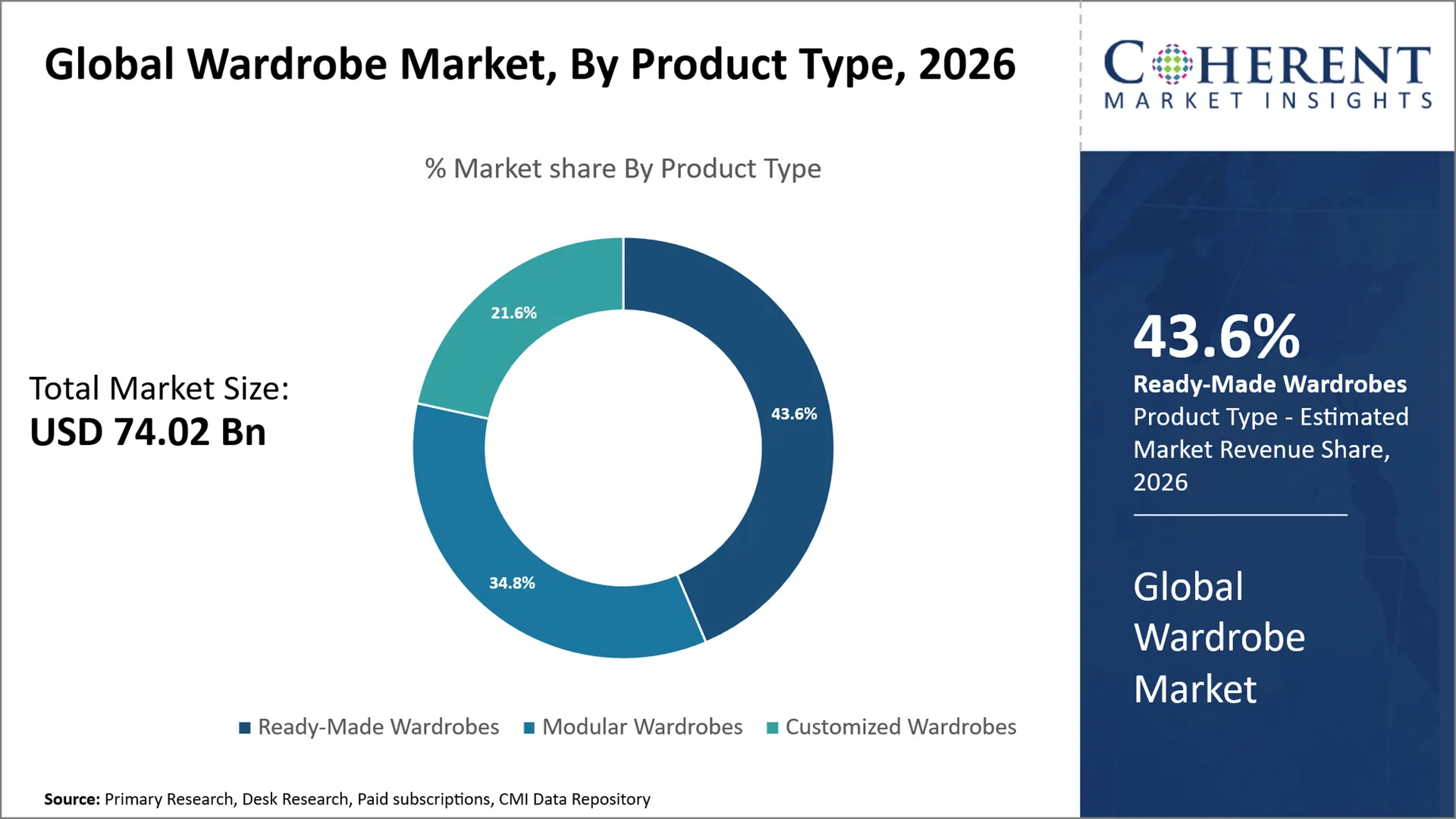
- Ready-Made Wardrobes are anticipated to record a CAGR of 5.9% through 2033, accounting for 43.6% share of the global wardrobe market. Commercially, they are attractive because of their standardized sizes, predictable pricing and shorter purchasing cycles. Asian Paints has launched its Cabiné range of wardrobes available in compact one-door, two-door and three-door options in August 2025.
- Built-In Wardrobes are expected to grow at an estimated CAGR of 7.4% through 2033 and are projected to hold a market share of 57.3% in the global wardrobe market. Wall-to-wall fitting uses awkward spaces and ceiling height to increase design and installation revenue. In August 2025, Sharps introduced a Soft Linen finish to its range of fitted furniture, offering more coordinated choices for interior design.
- Hinged Door Wardrobes are likely to register estimated CAGR of 6.2% through 2033 while accounting for projected market share of 53.1% in global wardrobe market. The free access to the cabinet allows a convenient organization of garments, and the standardized hinge mechanisms facilitate the manufacturing and maintenance. Blum introduced M BLUMOTION hinges for flat-pack furniture with integrated soft-close in May 2025.
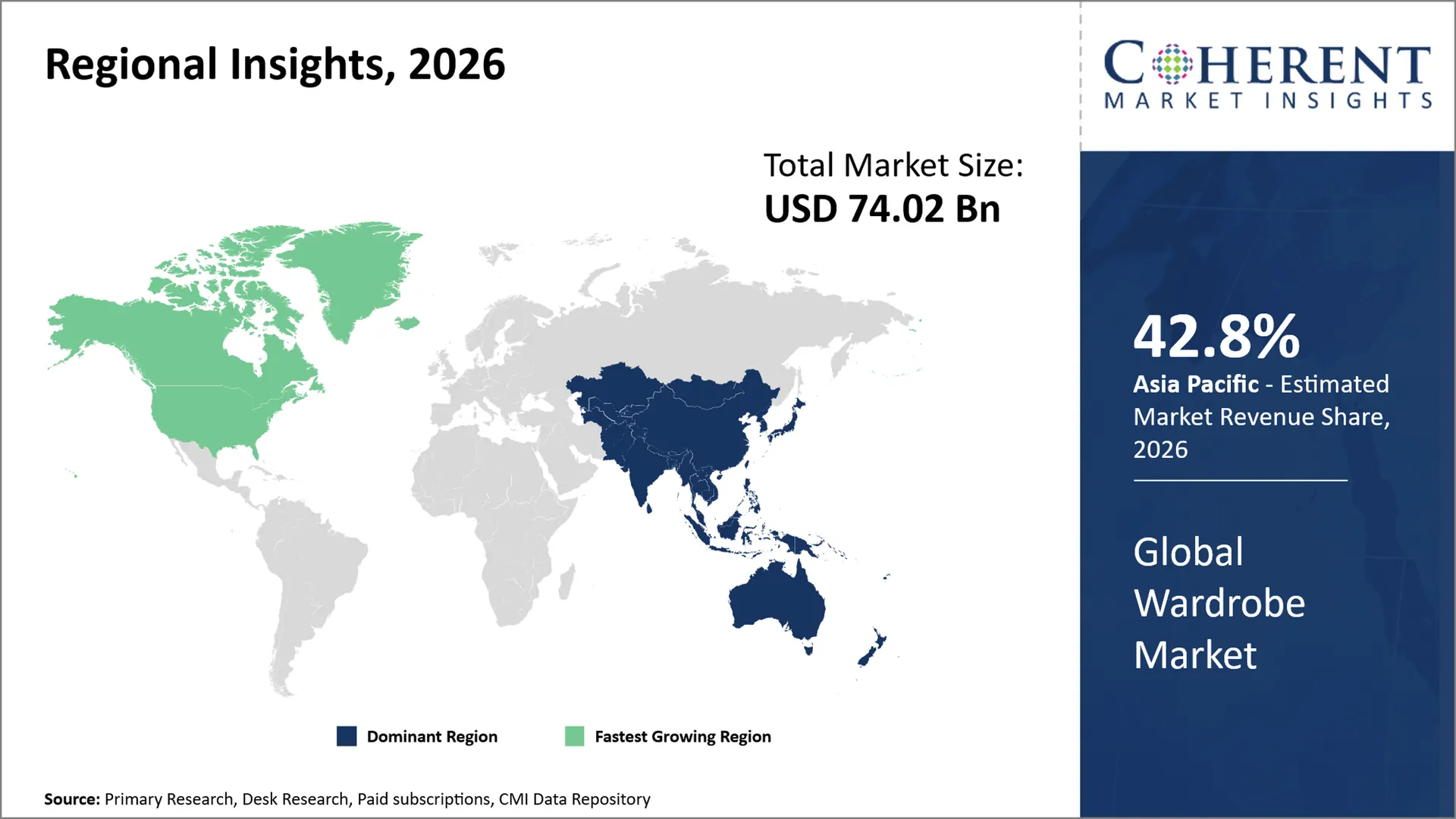
- Asia Pacific wardrobe market is projected to grow at a CAGR of 6.5% through 2033 and account for 42.8% share of the global wardrobe market revenue in 2026. Compact urban housing drives storage solutions that blend efficient layouts with controlled spending. In February 2026, Index Living Mall, Thailand, introduced PI WARDROBE, a semi-built-in system, offering affordable prices with the flexibility to configure designs.
- North America is projected to achieve the fastest estimated CAGR of 8.3% through 2033, against its anticipated global wardrobe market share of 25.2% in 2026. Residential remodeling creates opportunities for customized closet design, professional installation, and local manufacturing. In July 2025, PLC Closets announced its new Florida showroom and manufacturing facility, strengthening engagement with builders and designers.
Segmental Insights
Why Do Ready-Made Wardrobes Dominate the Global Wardrobe Market?
Ready-Made Wardrobes are expected to account for 43.6% of the global wardrobe market by product type in 2026. The leadership they offer is a demonstration of the capability of furniture retailers to provide repeatable cabinet designs through existing dealer networks, especially for new-home furnishing and multi-unit residential projects. Buyers have the option of synchronized bedroom products at the time of handover of the property, thus doing away with the need of getting carpentry works done separately. Predictable model specifications make it easier for manufacturers to replenish their inventories and can be used to supply replacement units through existing distribution channels. In August 2025, Interio by Godrej launched Ready-to-Furnish Flat Solutions with real estate developers in Indian cities, which included standard bedroom furniture and steel and wooden wardrobes. The set-up demonstrates how sales associated with the developer can bring manufactured wardrobes into the buying process before the residents move in, increasing customer reach and creating opportunities for furniture bundle orders.
- Current Industry Events of 2026
- Market Size Estimation
- Regional Breakdown
- Competitive Landscape
- Customer Intelligence
- Segmental Analysis
- Pricing Analysis
- Key Market Drivers, Challenges & Future Trends
- Customized Insights Section
Why Do Built-In Wardrobes Represent the Largest Installation Segment in the Global Wardrobe Market?
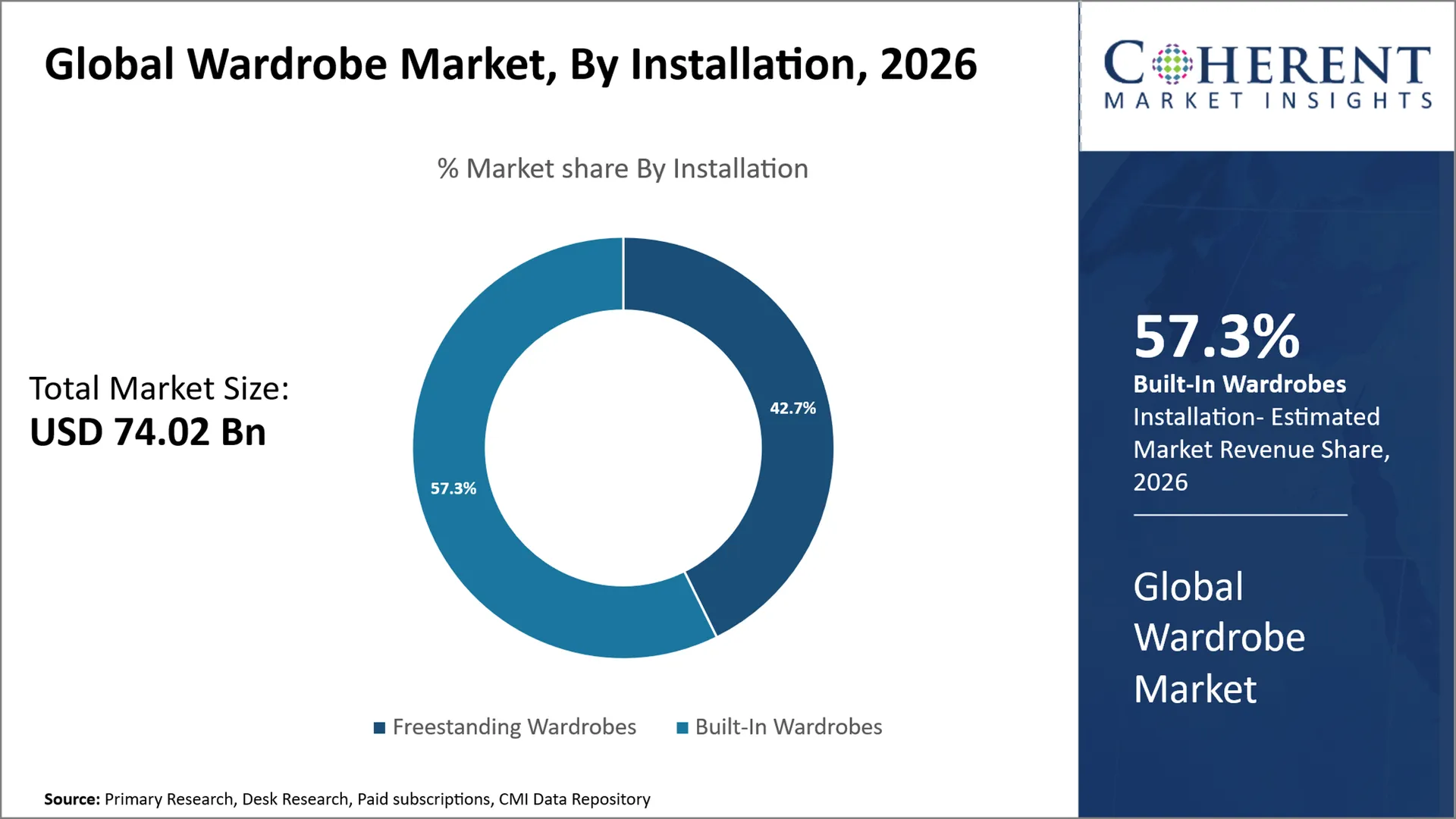
Built-In Wardrobes are projected to command 57.3% of the global wardrobe market by installation type in 2026. Their commercial strength lies in the ability to treat clothing storage as part of a planned bedroom or dressing-room environment, rather than as an interchangeable furniture purchase. Homeowners commissioning integrated interiors can specify coordinated doors, concealed lighting, and adjoining dressing areas through a single design brief. This favors specialist fabricators, architectural designers, and installers able to manage detailed specifications and consistent finishing quality. In September 2025, Poltrona Frau featured its DressCove Night System during Milan Fashion Week, displaying the wardrobe and walk-in closet system alongside an Akris fashion collection. The presentation illustrates the growing role of integrated wardrobe solutions in premium interior projects, where spatial coordination and material selection can support higher-value design contracts.
Why Do Hinged Door Wardrobes Lead the Door Type Category of the Global Wardrobe Market?
Hinged Door Wardrobes are estimated to hold 53.1% of the global wardrobe market by door type in 2026. Their position is akin to the wide availability of interchangeable fittings that enable manufacturers to accommodate differing door weights, finishes and cabinet configurations without having to re-engineer an entire opening mechanism. Furniture manufacturers can offer adjustable alignment and soft close options across entry-level and premium ranges, whilst installers can benefit from familiarity with servicing procedures. These are important features in family bedrooms and replacement-furniture purchases, where long-term usability is a major consideration. Hettich named modular wardrobes as one of its areas of application in October 2025, referring to its Sensys wide-angle hinge with a 165-degree opening angle and temperature-stable damping. The development shows how component-level engineering keeps hinged wardrobes relevant as demands for durable and quieter furniture hardware change.
Current Events and Their Impact
Current Event | Description and Its Impact |
Bureau of Indian Standards revises storage unit standards (January 2026) |
|
European Commission Prioritizes Furniture Under Ecodesign Planning (April 2025) |
|
European Union Revises Deforestation Regulation Implementation Timeline (December 2025) |
|
Global Wardrobe Market Dynamics
Key Market Drivers
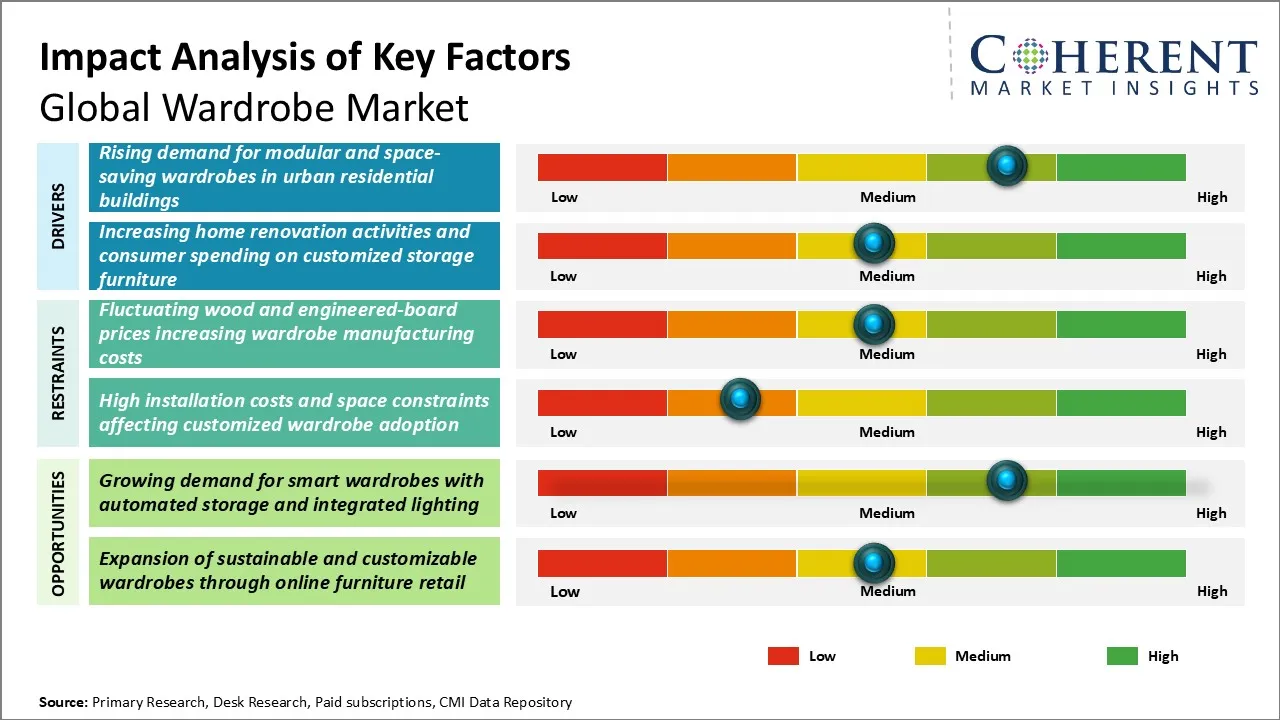
- Rising demand for modular and space-saving wardrobes in urban residential buildings: The trend toward smaller bedroom footprints and changing household storage needs, consumers are increasingly opting for modular wardrobes that offer flexible internal configurations. Homeowners can get the most out of their storage space with adjustable shelves, hanging compartments and interchangeable accessories, without having to make major structural changes. Producers like the standardization, while furniture dealers get the opportunity to sell more fittings and organizers. In September 2024, IKEA launched a revised version of its PAX wardrobe, featuring a foldable frame that makes vertical assembly easier in tight spaces. This is a very real challenge to installing wardrobes in smaller homes.
- Increasing home renovation activities and consumer spending on customized storage furniture: The bedroom renovation projects are increasingly incorporating fitted wardrobes that match existing interiors while enhancing the organization of garments. Consumers doing up their homes can justify increasing expenditure on custom dimensions, integrated drawers and co-ordinated cabinetry finishes. This supports revenue opportunities for custom furniture manufacturers, interior designers and professional installation providers. In April 2025 Wren Kitchens finished a residential bedroom project that included floor-to-ceiling fitted wardrobes with bespoke hanging rails, shelves and drawers. The installation shows how bedroom renovation spending leads to demand for custom storage furniture.
Emerging Market Trends
- Premium Wardrobe Interiors Shift Toward Specialized Garment Organization: Wardrobe buying trends are moving from simple hanging space toward organized sections for specific clothing and accessories. The cabinet’s exterior stays the same, but manufacturers can provide different interior setups that include pull-out trouser rails, jewelry trays, shoe organizers and special sections for handbags. This opens up new sources of income for both accessory manufacturers and specialist furniture installers. Interior functionality is anticipated to be a major premium purchase criterion in the forecast period, leading manufacturers to develop coordinated accessory collections and more defined product upgrade packages.
- Wardrobe Designs Evolve Toward Integrated Bedroom Furniture Concepts: Wardrobes are increasingly being planned as part of a coordinated bedroom interior rather than as self-contained storage units. Designers can make a cohesive layout of bedrooms with attached dressing counters, hidden vanity areas, matching bedside cabinets and seamless furniture fronts. This shift could increase average project values and encourage collaboration between furniture makers and interior designers. Suppliers of coordinated furniture collections and consistent surface finishes might perform better than suppliers of stand-alone cabinets without matching bedroom furnishings over the forecast period.
Market Restraints
- High Raw Material Costs and Installation Complexity: The profit margins of wardrobe manufacturers may be affected by changes in the price of engineered wood panels, decorative laminates, metal fittings and transportation. Custom wardrobes bring additional cost pressures. Wrong measurements of rooms, uneven walls and installation mistakes can mean replacement panels or return visits to the site. These types of challenges are most applicable to smaller manufacturers with less purchasing power and installation networks. These risks can be controlled by standardized production specifications, accurate measurement procedures and reliable supplier agreements.
- Limited Consumer Willingness to Pay for Automated Wardrobes: Automated wardrobes require additional expenditure on electric lifting mechanisms, sensors, controllers, and specialized maintenance. For consumers buying traditional bedroom furniture these features may be hard to justify when manual storage systems provide sufficient functionality. There is also the added problem of the need for electrical servicing and the uncertainty of the availability of replacement parts. Hence, the manufacturers targeting the automated wardrobe market should showcase the practical benefits, reliability, and affordable maintenance, instead of concentrating merely on the technological differentiation.
Regional Insights
Why Does Asia Pacific Dominate the Global Wardrobe Market?
Asia Pacific is expected to dominate the global wardrobe market, accounting for 42.8% of revenue in 2026. The region leverages its established retail distribution in key residential markets, competitive panel-processing capability and extensive furniture manufacturing networks. Locally made wardrobes, imported fittings and regionally adapted cabinet designs allow manufacturers to cater for a range of consumer budgets. Moreover, there is also a strong furniture retail infrastructure even outside metropolitan areas to make products accessible. Nitori will open its global flagship store at Bugis Junction, Singapore, in August 2025, extending its home-furnishing presence in Southeast Asia. The expansion reflects the potential for organized furniture retailers to scale up their regional footprint and improve the availability of standardized storage products to consumers. Continued investment in local furniture production and retail networks is expected to further strengthen the region’s market leadership.
Why Is North America Emerging as the Fastest-Growing Region in the Global Wardrobe Market?
North America is projected to be the fastest-growing region in the global wardrobe market, representing 25.2% of global revenue in 2026. Market opportunities are particularly attractive for manufacturers offering professionally installed storage systems, factory-finished components, and reliable project fulfillment. Greater emphasis on production localization can improve delivery responsiveness and support customized orders without excessive inventory commitments. In October 2025, Modular Closets announced plans to establish manufacturing operations in Forsyth County, North Carolina, involving a USD 30 million investment and the creation of 100 jobs during its first year. The development highlights manufacturer interest in expanding domestic production capacity for configurable closet systems. Regional suppliers combining scalable manufacturing with established installation networks are expected to strengthen their competitive positions.
Global Wardrobe Market Outlook for Key Countries
Why Is Germany a Strategic Country in the Global Wardrobe Market?
Germany’s strong position in the global wardrobe market is based on the cabinet manufacturing industry, the existing furniture engineering expertise and the good integration between manufacturers and specialist retailers. German manufacturers concentrate mainly on precision-machined cabinet components, durable surface finishes and configurable furniture systems suitable for premium residential interiors. These capabilities allow for product differentiation and give manufacturers the ability to deliver consistent quality in their bedroom furnishings to customers. In December 2025, the German furniture manufacturer nobilia presented the concept of a Dream wardrobe. It includes configurable cabinet units, interchangeable internal fittings and coordinated bedroom furniture. The development is an example of how traditional furniture manufacturers can move into wardrobe systems using their existing production and dealer networks. This approach can improve production efficiency and increase sales for coordinated furniture collections and categories.
Why Is the U.S. a Key Market for the Global Wardrobe Market?
The U.S. represents an important global wardrobe market because consumers increasingly evaluate bedroom storage through professionally designed closet systems, walk-in configurations, and property-specific installations. This is why the United States is a major global market for wardrobes. And custom closet companies offer homeowners coordinated dressing areas, adjustable shelving and special storage for garments. There are also opportunities for businesses that integrate consultation, fabrication, and installation, given the strong home-remodeling service sector in the country. In May 2025, Closet America, a division of Renuity, expanded its custom closet and home-storage services into Raleigh, North Carolina. This is evidence of how far specialized providers are extending their geographic service coverage to include residential storage projects. Firms that can offer dependable installation, easy access to design consultations, and solid after-sales support can strengthen customer relationships and repeat remodeling business.
Why Does China Support Growth in the Global Wardrobe Market?
China’s large furniture manufacturing ecosystem, well-established engineered wood processing industry and domestic custom cabinetry sector are major influencers in the global wardrobe market. The concentrated manufacturing clusters enable producers to source decorative panels, aluminum profiles, sliding mechanisms and cabinet accessories from established supplier networks. Home-furnishing replacement programs also provide targeted opportunities for domestic wardrobe purchases. In May 2025, the Jinan Municipal Commerce Bureau issued a home-furnishing renewal subsidy policy, which explicitly listed integrated wardrobes and kitchen cabinets as eligible furniture products. Such local measures could make purchases more affordable and encourage homeowners to replace their aging storage furniture. Supported renovation purchases represent an opportunity for manufacturers with efficient distribution capabilities, participating retail partners and qualifying products.
Why Is Japan an Important Market for the Global Wardrobe Market?
Japan continues to be an important market for wardrobe designs because residential layouts often require careful coordination between storage furniture, circulation space, and multipurpose rooms. Consumers place a high value on compact cabinet footprints, flexible internal organization, and designs that complement existing interior finishes. As a countermeasure, domestic manufacturers are adopting specialized storage engineering and simplified installation mechanisms. EIDAI launched its FF Wall storage system in October 2025, which features integrated shelving supports and continuous flush doors for easy installation. The product is designed to assist with storage organization in places where it is impractical to create large dedicated closets. The development demonstrates the commercial opportunity for flexible storage furniture that not only integrates architecturally with practical installation requirements, but also with home renovation and interior improvement projects.
Why Is India an Important Growth Market for the Global Wardrobe Market?
India offers considerable opportunities for global wardrobe market through its expanding organized furniture retail sector, growing participation of interior design professionals, and increasing preference for factory-manufactured cabinetry. Indian households need wardrobe configurations that can accommodate traditional wear, seasonal clothing, footwear and extra household storage. It is also a commercial consideration. Manufacturers have to consider humidity exposure, maintenance requirements and varying consumer budgets when selecting materials. Häfele announced the launch of its flagship Design Center in Gurugram in May 2026. Spread across 10,000 square feet, the center offers end-to-end interior solutions. This investment emphasizes the significance of professional design involvement and physical product displays in India’s interiors industry. Suppliers who can provide reliable installation services, accessible design expertise and appropriate materials are well positioned to meet the growing demand for residential purchases that emphasize specifications.
Wardrobe Product Evolution and Consumer Preference Landscape
Market Dimension | Wardrobe-Specific Market Characteristics | Commercial Significance | Key Market Considerations |
Product Design and Configuration Preferences | In the selection of a wardrobe, the main considerations are the size of the bedroom, the amount of storage required, the proportions of the cabinet and its compatibility with existing furniture. | Manufacturers can also cater to a variety of customer budgets, with compact, multifunctional and premium wardrobe collections. | The choice of products depends on the available floor space, the shape of the bedroom, the storage capacity and the design consistency. |
Material and Surface Finish Preferences | As an option, you have wood, engineered wood, metal, glass, and decorative laminates . Each has different esthetic, durability and maintenance characteristics. | Manufacturers can target the economy, mid-range and luxury furniture segments thanks to diversified material portfolios. | Cost of materials, moisture resistance, surface durability, cleaning requirements and consistency of finish are all factors in purchasing decisions. |
Interior Storage and Organization Preferences | In terms of wardrobes, consumers are becoming more interested in adjustable shelving, separate hanging sections, drawers, shoe compartments and accessory storage. | The functional interior layouts offer possibilities for premium product placement and additional accessory sales. | Product usability depends on household clothing needs, cabinet internal storage accessibility, compartment flexibility, and usable cabinet depth. |
Residential Interior Design Choices | Wardrobe designs include integrated dressing areas, minimalist cabinet fronts, decorative glass panels and co-ordinated bedroom finishes. | Furniture manufacturers can raise their average order values by collaborating with interior designers and creating integrated collections for the bedroom. | Consumers have very different preferences for colors, finishes, door styles, and overall bedroom esthetics across residential property categories. |
Distribution and Installation Preferences | Wardrobes for consumers are available at furniture showrooms, specialty dealers, interior design firms and online furniture retailers. Installation requirements vary. | Businesses can also increase market accessibility and customer satisfaction by professional assembly and reliable delivery. | The purchase decision depends on the cost of delivery, installation difficulties, availability of local service, risk of damage to the product, and the time required to fulfilll the order. |
Product durability and after sales preferences | Buyers assess wardrobe stability, door alignment, shelf strength, finish quality, hardware reliability, and replacement-part availability. | Companies that offer reliable warranties and maintenance support may improve the credibility of the brand and reduce customer dissatisfaction. | Warranty coverage, repair costs, spare-part compatibility, expected product lifespan, and maintenance requirements all impact the long-term value of a purchase. |
How Are Standardized Wardrobe Packages for Rental Housing Creating New Growth Opportunities in the Global Wardrobe Market?
Custom-built rental apartments, student housing and professionally managed co-living spaces represent an untapped opportunity for wardrobe makers to supply repeat furniture packages. Unlike individual homeowners, property operators are looking for durability, maintenance efficiency, cost prediction for replacement and consistency of installation across multiple units.
These specifications can be met by manufacturers by providing interchangeable door panels, durable interior components, finishes appropriate for frequent change of occupancy, and standard wardrobe dimensions. Contracts provide a more repeatable opportunity for coordinated purchasing, installation and replacement-part services than one-off furniture buying.
The opportunity is likely to benefit established producers with scalable manufacturing systems and specialist contract furniture companies that can handle multi-property orders. Smaller manufacturers could get involved through regional developer partnerships and local assembly.
Market Players, Key Development, and Competitive Intelligence
Key Developments
- In May 2025, raumplus showcased its wardrobe lighting system at interzum in Cologne, featuring adjustable color temperature, illumination without visible LED points, and smart-home connectivity. The development supports premium wardrobe differentiation by combining integrated lighting with functional garment storage and improving the value proposition of connected bedroom furniture.
- In December 2024, Organized Living announced additional finishes for its Select and Classica closet systems ahead of the 2025 International Builders’ Show. The introduction of Truffle and Slate expanded interior design choices, helping builders and professional installers offer differentiated closet configurations across residential development projects.
- In December 2024, OPPEIN Home Group announced the inauguration of its Vietnam business-to-business showroom, featuring wardrobe, kitchen, and bathroom displays. The company also reported agreements with local contractors and development partners, expanding its commercial customer engagement and supporting distribution opportunities for customized wardrobe and interior furnishing systems.
Competitive Landscape
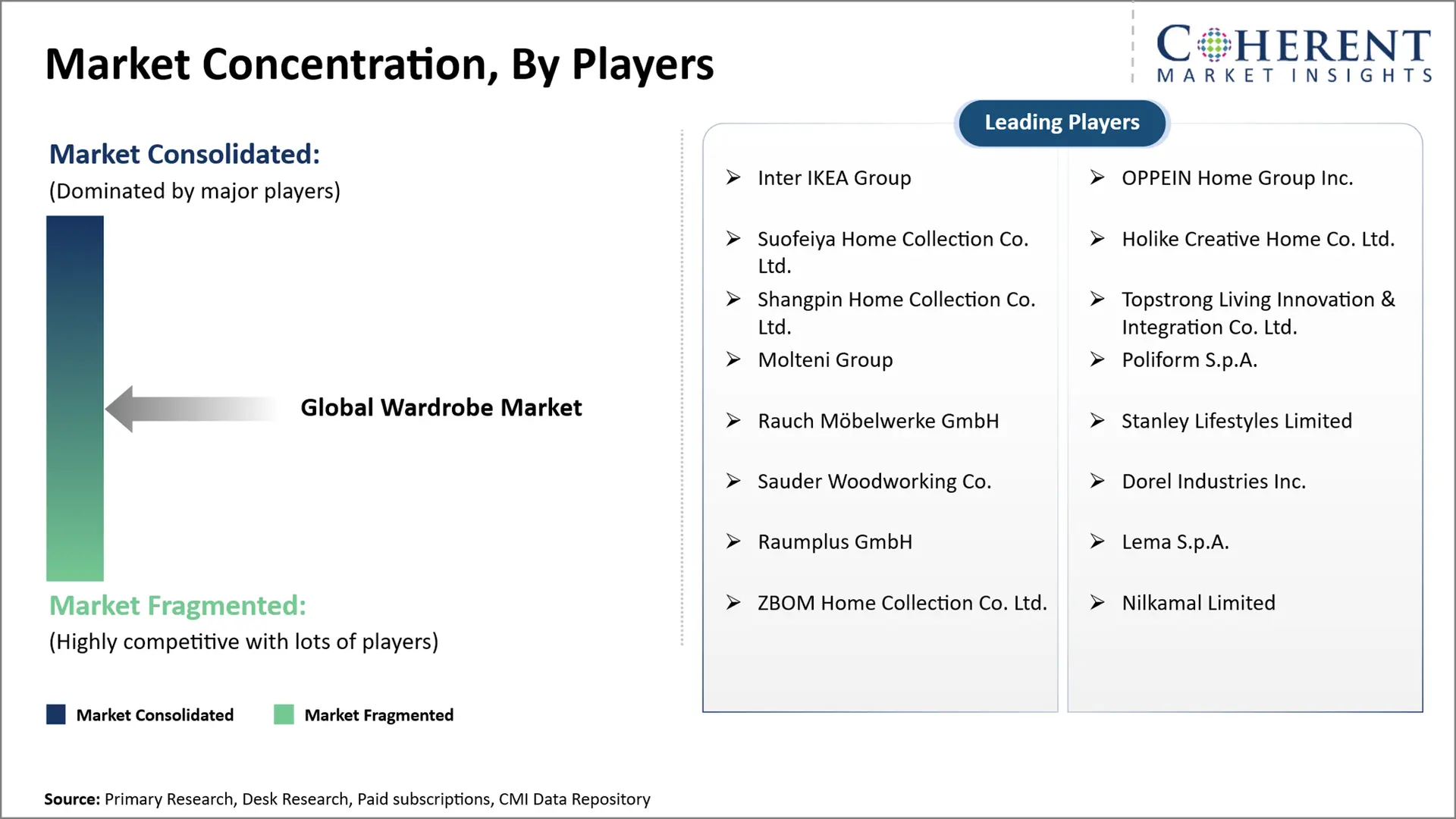
The global wardrobe market appears to be fragmented, involving international furniture retailers, regional cabinet makers, custom joinery experts and local installation companies. The competition is determined by the consistent production and distribution, the transparency of pricing, the flexibility of the design and the durability of the product. Large manufacturers have the advantage of being able to buy in bulk and have well-established retail networks. Local specialists compete by interacting directly with their customers, having shorter lead times for customizing products and having a complete understanding of their local market.
Key focus areas include
- The same panel sizes, drilling accuracy and finishing standards are preserved during their manufacturing, which improves the reliability of the product.
- Supply chain resilience: The availability of a variety of decorative boards, hardware and metal profiles reduces the risk of supplier disruptions.
- Shipping efficiency: The proper shipping setups and protective packaging reduce the chances of damage in transit and replacement costs.
- Product testing: The key to meaningful quality differentiation is structural stability, shelf-load capacity and fitting durability.
- Retailers can use existing distribution networks to produce wardrobes under their own brands in private-label manufacturing.
- Regional product localization: The product’s dimensions, finishes, and hardware specifications are customized to the housing needs of the local area to enhance the product’s suitability.
- Warranty and spare part: Providing compatible replacement parts reduces the cost of repairing product failures and increases customer loyalty.
Market Report Scope
Global Wardrobe Market Report Coverage | |||
Report Coverage | Details | ||
Base Year | 2025 | Market Size in 2026: | USD 74.02 Bn |
Historical Data For: | 2020 to 2024 | Forecast Period: | 2026 To 2033 |
Forecast Period 2026 To 2033 CAGR: | 6.79% | 2033 Value Projection: | USD 117.24 Bn |
Geographies covered: |
| ||
Segments covered: |
| ||
Companies covered: | Inter IKEA Group, OPPEIN Home Group Inc., Suofeiya Home Collection Co. Ltd., Holike Creative Home Co. Ltd., Shangpin Home Collection Co. Ltd., Topstrong Living Innovation & Integration Co. Ltd., Molteni Group, Poliform S.p.A., Rauch Möbelwerke GmbH, Stanley Lifestyles Limited, Sauder Woodworking Co., Dorel Industries Inc., Raumplus GmbH, Lema S.p.A., ZBOM Home Collection Co. Ltd., Nilkamal Limited | ||
Growth Drivers: |
| ||
Restraints & Challenges: |
| ||
Analyst Opinion (Expert Opinion)
- Wardrobe manufacturers will likely feel more pressure to prove value through the reliable completion of projects, not just product appearance. Companies that can integrate design approval, production scheduling, installation verification and warranty resolution into one service process should raise customer confidence. On projects where there are a lot of suppliers and contractors involved in installation, operational accountability can become a growing differentiator.
- The rise of integrated production and fulfillment networks may impact conventional relationships between independent dealers and wardrobe manufacturers. Dealers may take on more customer-facing design and service work, while centralized facilities do the complex fabrication. This model could pose a threat to small workshops that produce all their parts in-house, but it could also open up opportunities for specialist installation companies that work with standard manufacturing partners.
- Before pouring money into costly automation features, manufacturers should focus on panel stability, structural safety checks, dependable component procurement and warranty management. Margins require investment in supplier diversification and quality control systems. It is also important for companies to maintain flexible manufacturing equipment, and not rely too much on specialized designs that could become commercially obsolete or difficult to maintain.
Speak to the analyst
Want personalized insights?
Take the findings above to one of our principal consultants, or have the report rebuilt around the segments, geographies and competitors you actually track.
Market Segmentation
- Product Type Insights (Revenue, USD Bn, 2021 - 2033)
- Ready-Made Wardrobes
- Modular Wardrobes
- Customized Wardrobes
- Installation Insights (Revenue, USD Bn, 2021 - 2033)
- Freestanding Wardrobes
- Built-In Wardrobes
- Door Type Insights (Revenue, USD Bn, 2021 - 2033)
- Hinged Door Wardrobes
- Sliding Door Wardrobes
- Open and Other Wardrobes
- Material Insights (Revenue, USD Bn, 2021 - 2033)
- Wood and Engineered Wood
- Metal
- Glass
- Plastic and Other Materials
- Operation Insights (Revenue, USD Bn, 2021 - 2033)
- Manual Wardrobes
- Automated and Smart Wardrobes
- End User Insights (Revenue, USD Bn, 2021 - 2033)
- Residential
- Commercial
- Sales Channel Insights (Revenue, USD Bn, 2021 - 2033)
- Offline Retail
- Online Retail
- Regional Insights (Revenue, USD Bn, 2021 - 2033)
- North America
- U.S.
- Canada
- Latin America
- Brazil
- Argentina
- Mexico
- Rest of Latin America
- Europe
- Germany
- U.K.
- Spain
- France
- Italy
- Russia
- Rest of Europe
- Asia Pacific
- China
- India
- Japan
- Australia
- South Korea
- ASEAN
- Rest of Asia Pacific
- Middle East
- GCC Countries
- Israel
- Rest of Middle East
- Africa
- South Africa
- North Africa
- Central Africa
- North America
- Key Players Insights
- Inter IKEA Group
- OPPEIN Home Group Inc.
- Suofeiya Home Collection Co. Ltd.
- Holike Creative Home Co. Ltd.
- Shangpin Home Collection Co. Ltd.
- Topstrong Living Innovation & Integration Co. Ltd.
- Molteni Group
- Poliform S.p.A.
- Rauch Möbelwerke GmbH
- Stanley Lifestyles Limited
- Sauder Woodworking Co.
- Dorel Industries Inc.
- Raumplus GmbH
- Lema S.p.A.
- ZBOM Home Collection Co. Ltd.
- Nilkamal Limited
Sources
Primary Research Interviews
- Wardrobe manufacturers, modular furniture producers, and custom cabinetry specialists
- Furniture retailers, interior designers, distributors, and installation contractors
Stakeholders
- Ready-made, modular, and customized wardrobe manufacturers
- Residential developers, furniture suppliers, homeowners, and commercial buyers
End-use Sectors
- Residential housing, apartments, villas, and renovation projects
- Hotels, serviced apartments, offices, and institutional facilities
Regulatory and Industry Bodies
- Bureau of Indian Standards (BIS)
- U.S. Environmental Protection Agency (EPA)
- European Commission
- European Furniture Industries Confederation (EFIC)
Databases
- UN Comtrade and ITC Trade Map furniture trade statistics
- Eurostat PRODCOM and U.S. Census Bureau housing and manufacturing data
- National housing, furniture production, retail sales, and construction databases
Magazines and Journals
- Furniture Today
- Woodworking Network
- Journal of Wood Science
- Wood Material Science & Engineering
Associations
- American Home Furnishings Alliance (AHFA)
- Furniture Industry Research Association (FIRA)
- European Furniture Industries Confederation (EFIC)
Public Domain Sources
- Furniture production, wardrobe pricing, housing construction, and renovation statistics
- Wood and engineered-board prices, furniture trade data, consumer expenditure, and retail distribution trends
Key Standards and Regulations
- BIS IS 17634:2022 – Storage Units and applicable Furniture Quality Control Order
- EN 14749:2016+A1:2022 – Domestic and Kitchen Storage Units Safety Requirements
- U.S. EPA TSCA Title VI – Formaldehyde Emission Standards for Composite Wood Products
- EU REACH – Applicable Formaldehyde Restrictions for Furniture and Wood-Based Articles
Proprietary Elements
- CMI Data Analytics Tool
- Proprietary research repository, supplemented by primary interviews, wardrobe pricing analysis, furniture production estimates, distribution mapping, and competitive intelligence.
Get access to 250+ pages report
Every segment, forecast, competitor profile and data table behind the analysis above — available for instant download.
- ESOMAR Member
- ISO 9001:2015 Certified
- D-U-N-S Registered
- GDPR & CCPA Compliant
Frequently Asked Questions
The CAGR of global wardrobe market is projected to be 6.79% from 2026 to 2033.
The global wardrobe market is estimated to be valued at USD 74.02 Bn in 2026 and is expected to reach USD 117.24 Bn by 2033.
The major factors driving the global wardrobe market growth include growing demand for modular and space-saving wardrobes in urban homes, along with increasing home renovation activities and higher consumer spending on customized storage furniture.
Fluctuating wood and engineered-board prices increasing wardrobe manufacturing costs and High installation costs and space constraints affecting customized wardrobe adoption are the major factors hampering the growth of global wardrobe market.
In terms of product type, ready-made wardrobes are estimated to dominate the market revenue share in 2026.
Inter IKEA Group, OPPEIN Home Group Inc., Suofeiya Home Collection Co. Ltd., Holike Creative Home Co. Ltd., Shangpin Home Collection Co. Ltd., Topstrong Living Innovation & Integration Co. Ltd., Molteni Group, Poliform S.p.A., Rauch Möbelwerke GmbH, Stanley Lifestyles Limited, Sauder Woodworking Co., Dorel Industries Inc., Raumplus GmbH, Lema S.p.A., ZBOM Home Collection Co. Ltd., Nilkamal Limited are the major players.
Asia Pacific is expected to lead the global wardrobe market in 2026.