

Zero-Glide HFO Refrigerants Market Size and Share Analysis – 2026 To 2033
The global Zero-Glide HFO Refrigerants Market size is estimated to be valued at USD 2.35 Bn in 2026 and is expected to reach USD 5.18 Bn by 2033, exhibiting a compound annual growth rate (CAGR) of 12.0% from 2026 to 2033. The increasing adoption of low global warming potential (GWP) refrigerants, stringent environmental regulations promoting phase-down of high GWP hydrofluorocarbons (HFCs), rising demand for energy-efficient refrigeration and air conditioning systems, and growing adoption of HFO-based refrigerants in automotive air conditioning and industrial cooling applications are the major growth drivers for this market. The U.S. Environmental Protection Agency (EPA) supports the transition to lower-GWP refrigerant alternatives, including hydrofluoroolefins (HFOs), as required by the American Innovation and Manufacturing (AIM) Act which mandates an 85% phasedown in HFC production and consumption by 2036.
Key Takeaways of the Global Zero-Glide HFO Refrigerants Market (2026–2033)
- The HFO-1234yf segment is expected to account for 76.0% of the global Zero-Glide HFO Refrigerants Market share in 2026. Increasing replacement of high-GWP R-134a refrigerants in automotive air conditioning systems is driving segment growth. In a 2026 assessment, Japan’s Ministry of Economy, Trade and Industry (METI) said the shift to R-1234yf (GWP of about 1) helped achieve a 75.3% year-on-year fall in fluorinated gasses contained in imported automotive air conditioning equipment in fiscal year 2024, measured in CO₂ equivalents.
- The Automotive Air Conditioning segment is expected to occupy 70.0% of the market share in 2026. The segment is growing on account of the rising regulatory restrictions on conventional HFC refrigerants and the increasing adoption of low GWP cooling technologies in passenger vehicles. The U.S. Environmental Protection Agency (EPA) has established a GWP limit of 150 for refrigerants used in new light-duty passenger vehicle air conditioning systems for model year 2025, accelerating the transition to compliant refrigerants such as R-1234yf.
- The Automotive Industry segment is expected to hold 70.0% of the global market share in 2026. The market is growing due to the rising demand for replacement refrigerants and servicing of the existing vehicle fleet. In September 2024, Chemours announced a retrofit solution to enable older R-134a vehicles to transition to its low-GWP Opteon YF (R-1234yf) refrigerant, creating additional opportunities in the automotive aftermarket.
- North America is anticipated to hold the largest share of the global Zero-Glide HFO Refrigerants Market, with a projected market share of 35.0% in 2026. Demand for refrigeration and cooling equipment with low-GWP technologies is increasing, with strict refrigerant regulations boosting regional demand. On May 26, 2026, the U.S. EPA issued a final rule reconsidering certain HFC Technology Transitions requirements, including provisions affecting industrial refrigeration, chillers and commercial cooling systems. This underlines the importance of regulatory compliance in the choice of refrigerant.
- Asia Pacific is projected to account for 30.0% of the global market in 2026 and is anticipated to be the fastest-growing regional market over the 2026–2033 forecast period. Regional growth opportunities are supported by automotive manufacturing capacity expansion and gradual adoption of low-GWP refrigerants. The Asia Pacific region manufactured around 59.2 million vehicles in 2025, up 7.6% from the previous year and over 61% of global vehicle production, indicating a large potential market for next-generation automotive refrigerants, according to the International Organization of Motor Vehicle Manufacturers (OICA).
Segmental Insights
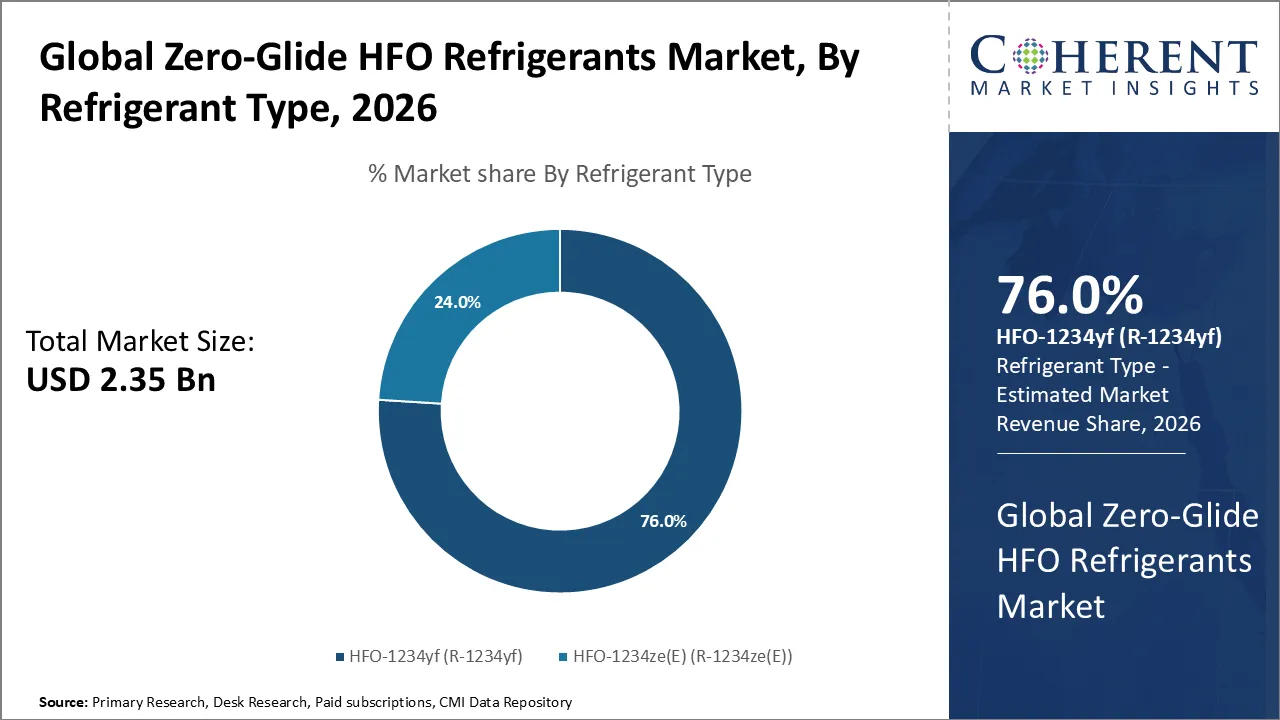
Why Does HFO-1234yf Dominate the Global Zero-Glide HFO Refrigerants Market?
The HFO-1234yf segment is expected to hold a 76.0% share of the global Zero-Glide HFO Refrigerants Market by 2026. It is widely used in passenger vehicle air conditioning systems. It is a common ingredient in the air conditioning system of passenger cars. It has low global warming potential and is compatible with automotive cooling technologies.” R-1234yf is becoming a go-to alternative refrigerant for auto makers to replace traditional R-134a refrigerants to satisfy environmental standards without compromising cooling performance. The segment is well supported by a growing installed base of compatible vehicles, a wide range of OEM approvals and established refrigerant production capacity.
According to Chemours’ 2025 Opteon YF Shop Owners’ Guide, 100 percent of new cars sold in the U.S. in 2025 will be using R-1234yf, and more than 125 million vehicles already operate in the country with this refrigerant, underlining its widespread commercial adoption.
- Current Industry Events of 2026
- Market Size Estimation
- Regional Breakdown
- Competitive Landscape
- Customer Intelligence
- Segmental Analysis
- Pricing Analysis
- Key Market Drivers, Challenges & Future Trends
- Customized Insights Section
Why Does Automotive Air Conditioning Dominate the Global Zero-Glide HFO Refrigerants Market?
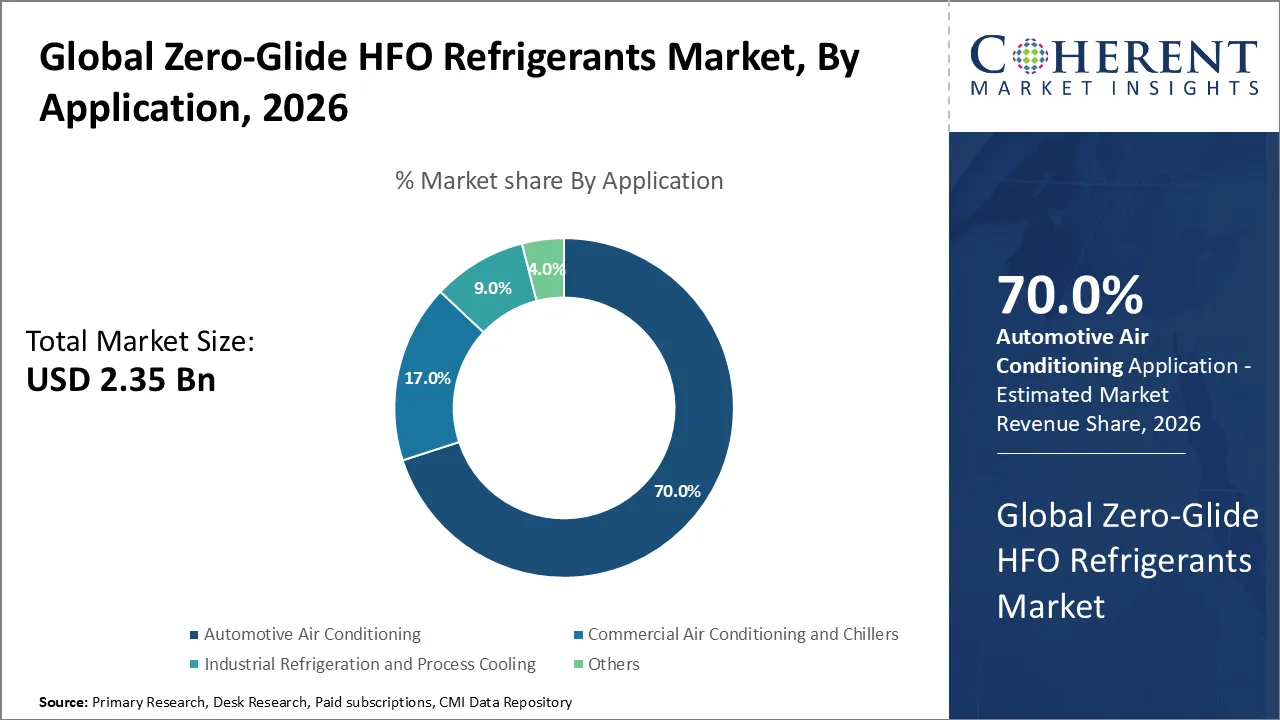
The Automotive Air Conditioning segment is anticipated to command 70.0% of the global Zero-Glide HFO Refrigerants Market share by 2026. Growing installation of low-GWP refrigerants in newly produced passenger cars and light commercial vehicles is driving the segment’s leading position. The shift to HFO-based refrigerants is being sped up by rising car production, the increasing demand for reliable cabin cooling, and the stringency of emission laws. Car makers are putting R-1234yf into air-conditioning systems to meet environmental standards while keeping the refrigeration capacity and energy efficiency. As more vehicles are produced and new thermal management systems are developed, the consumption of refrigerants is also increasing.
According to the U.S. Environmental Protection Agency (EPA) will limit the global warming potential (GWP) of refrigerants to 150 for model year 2025 and newer light-duty passenger vehicles, effective Oct. 24, 2024. The restriction curbs the use of high-GWP HFC refrigerants such as R-134a in new vehicles, fueling demand for low-GWP alternatives such as R-1234yf.
Why Does the Automotive Industry Lead the Global Zero-Glide HFO Refrigerants Market by End User?
The Automotive Industry segment is projected to account for 70.0% share of the global Zero-Glide HFO Refrigerants Market in 2026. The segment is driven by large-scale refrigerant buys from car manufacturers, increased replacement demand from the current vehicle fleets and growing service needs in the aftermarket. Automotive OEMs require refrigerants that meet emissions standards and provide reliable cooling over a range of operating conditions. At the same time, the rising number of vehicles with HFO based systems is driving the demand for refrigerant recovery, recycling and recharge services. Additional opportunities are also being provided to automotive refrigerant suppliers through retrofit technologies and refrigerant servicing infrastructure.
On September 8, 2026, at Automechanika Frankfurt, Solstice Advanced Materials launched its Direct-to-YF retrofit concept, which allows compatible existing R-134a automotive air conditioning systems to be retrofitted to R-1234yf. The company says there is huge potential for future refrigerant conversion and servicing in the European aftermarket with a fleet of over 100 million vehicle air conditioning systems filled with R-134a.
Current Events and Their Impact on the Zero-Glide HFO Refrigerants Market
Current Event | Description and its Impact |
U.S. EPA Revises HFC Refrigerant Transition Regulations Under the AIM Act (May 2026) |
|
European Union Strengthens Refrigerant Restrictions Under F-Gas Regulation (2026–2027) |
|
Zero-Glide HFO Refrigerants Market Dynamics
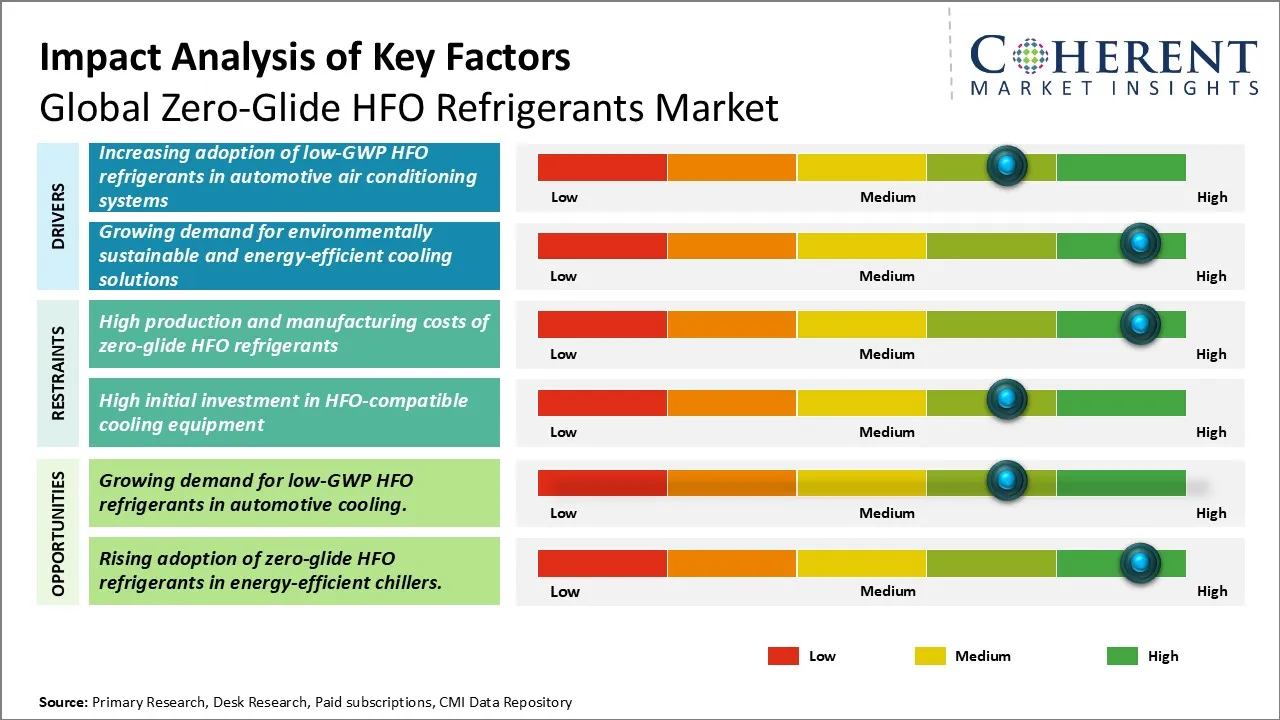
Market Drivers
- Increased automotive production and adoption of low GWP refrigerants: Demand for zero-glide HFO refrigerants, particularly R-1234yf, is being driven by the expanding global automotive manufacturing market. Automotive manufacturers are increasingly using low-GWP refrigerants in vehicle air conditioning systems to comply with environmental regulations and boost sustainability. Increasing output of passenger vehicles, greater demand for cooling of cabin spaces and higher automotive manufacturing activity in emerging economies are supporting consumption of refrigerants. The rise of electric and hybrid vehicles is also creating opportunities for advanced thermal management systems with compatible low-GWP refrigerants. In addition, the increasing vehicle ownership and replacement demand are supporting the long-term growth potential of the market.
- The International Organization of Motor Vehicle Manufacturers (OICA) expects global vehicle production to increase 3.9% to 96.4 million units in 2025 from 92.7 million in 2024. Global vehicle sales were at 99.8 million, up 4.7%, indicating the growing demand for next generation automotive refrigerants.
- Growing demand for energy-efficient and environmentally friendly cooling systems: Increasing emphasis on the reduction of greenhouse gas emissions is accelerating the transition to low-GWP refrigerants in commercial air conditioning and industrial cooling and heat pump applications. Equipment manufacturers are also exploring the replacement of conventional high-GWP HFCs in compatible systems with HFO refrigerants such as R-1234ze(E). Low GWP assists manufacturers in meeting environmental requirements and zero temperature glide characteristics assist in predicting phase change behavior. Adoption is being buoyed by growing investment in energy-efficient chiller technologies, commercial building cooling infrastructure and industrial process temperature control. However, the refrigerant choice will still depend on system design, safety classifications and applicable regulations.
- In July 2026, DSG Scroll Compressor Refrigerant Technical Documentation, Danfoss, identified R-1234ze(E) as a pure HFO refrigerant with zero ozone depletion potential and a GWP of 6 under IPCC AR5, compared to R-134a with a GWP of about 1,300. The company also confirmed its suitability for appropriately designed chillers, refrigeration systems and heat pumps, demonstrating the technological basis for replacing higher GWP refrigerants.
Zero-Glide HFO Refrigerants Market Trends
- Growing adoption of zero-glide HFO refrigerants in data center cooling infrastructure is pushing refrigerant manufacturers to expand their portfolio of refrigerants for high-capacity chillers and mission-critical cooling systems. On August 10, 2026, Chemours announced the introduction of Opteon ZE (R-1234ze(E)) and Opteon 515B for stationary chillers in data centers and commercial HVAC applications. R-515B is a blend of roughly 91.1% R-1234ze(E) and 8.9% R-227ea. This shows an increasing trend toward HFO-based cooling solutions with different safety profiles.
- The increasing use of R-1234ze(E) in high temperature industrial heat pumps is further extending the use of zero-glide refrigerants beyond traditional air conditioning. In July 2025 Daikin launched an upgraded VZ-series heat pump using R-1234ze, which can provide hot water at a temperature as high as 90°C, with cooling and heating capacities ranging from 400 kW to 1,900 kW. This development allows for the use of refrigerant in district heating, industrial processing and heat recovery applications.
- The increasing development of high-capacity and variable speed chillers is pushing the use of zero-glide HFO refrigerants in large commercial and industrial buildings. Carrier has extended its AquaForce 30XW(H)VZE chiller and heat pump range with R-1234ze(E) options on March 25, 2025, to provide cooling capacities of up to 1,635 kW and heating capacities of up to 1,930 kW. The systems have a seasonal energy efficiency ratio (SEER) up to 8.6, meeting the demand for high-performance cooling equipment.
Regional Insights
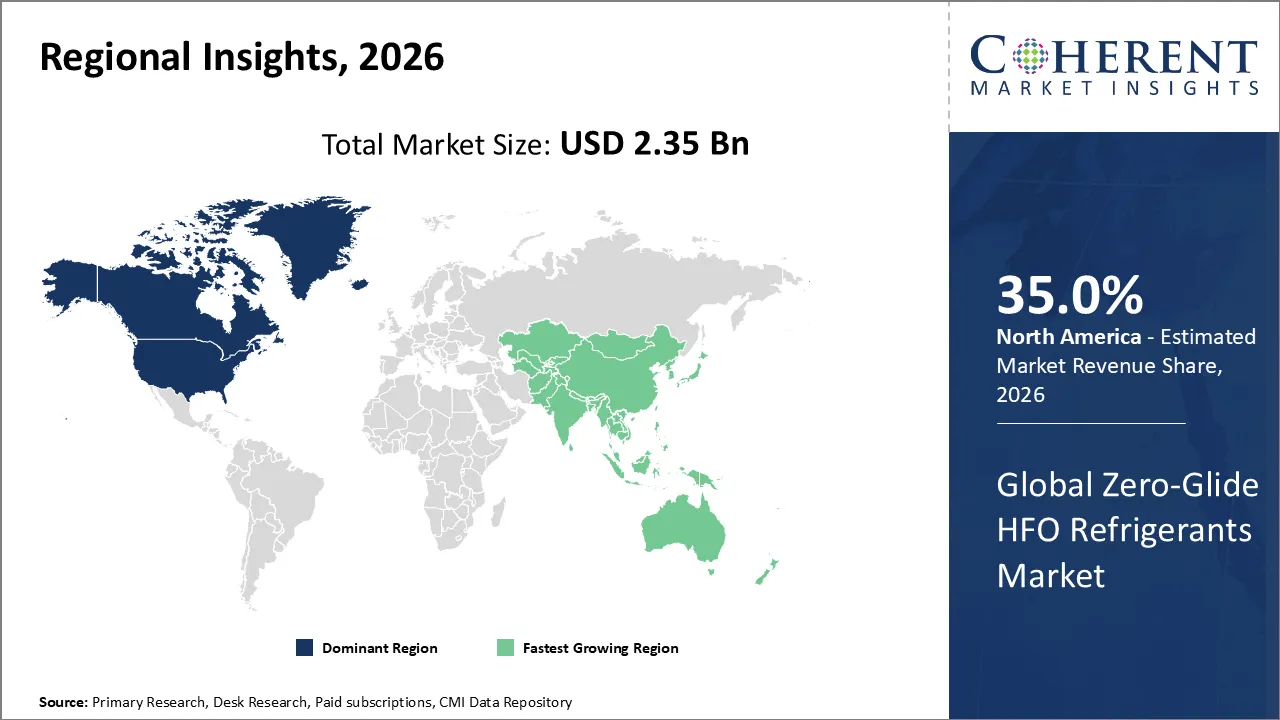
Why Does North America Dominate the Global Zero-Glide HFO Refrigerants Market?
North America is projected to hold the dominant position in the global Zero-Glide HFO Refrigerants Market, with a share of 35.0% in 2026. The region’s strength is backed by the existing automotive air conditioning infrastructure, the prevalence of R-1234yf refrigerants, and the strong demand for refrigerant servicing and replacement. The United States is a significant market with a large installed base of HFO-compatible vehicles and a mature automotive aftermarket. In an effort to serve the needs of the automotive repair shops and commercial refrigeration operators, refrigerant manufacturers and distributors are expanding their recovery, recycling and servicing capabilities. Canada also contributes to regional demand through low-GWP refrigerants used in commercial HVAC equipment and specialized cooling applications. Regional market development is further supported by established refrigerant distribution networks and technical service capabilities.
According to NAPA’s Wholesale Solutions report in March 2026, about 45-50% of the vehicles in operation in the U.S. have R-1234yf air conditioning systems. The growing installed base is driving demand for refrigerant recharge, recovery and aftermarket service across North America.
Why Does Asia Pacific Exhibit the Fastest Growth in the Global Zero-Glide HFO Refrigerants Market?
The Asia Pacific region is expected to be the fastest growing market during the forecast period of 2026-2033, estimated to hold 30.0% of the global market revenue in 2026. Growth in the region is driven by the local manufacture of fourth-generation refrigerants, the increasing development of HFO-compatible automotive cooling components, and investment in specialty fluorochemical production. China is emerging as a key regional manufacturing center, with domestic producers investing in production facilities for R-1234yf and R-1234ze to strengthen local supply chains. Japan’s existing automotive and industrial refrigeration sectors also underpin demand for low-GWP cooling technologies. At the same time, rising investment in advanced fluorochemical manufacturing in emerging Asian economies is anticipated to improve product availability, increase regional competition and encourage the adoption of HFO refrigerants.
The Baotou manufacturing project of Zhejiang Yonghe Refrigerant, once completed, would be capable of producing 20,000 metric tons of HFO-1234yf and 13,000 metric tons of HFO-1234ze per year, according to a filing made with the Shanghai Stock Exchange in October 2026. The proposed 33,000 metric tons of combined annual HFO capacity underscores increasing investment in the production of fourth generation refrigerants in China and the potential for additional supply growth in the region.
Global Zero-Glide HFO Refrigerants Market Outlook for Key Countries
Why is the U.S. a Major Hub in the Zero-Glide HFO Refrigerants Market?
The U.S. Zero-Glide HFO Refrigerants Market is supported by established refrigerant manufacturing infrastructure, growing production of next-generation low-GWP cooling systems and hefty investment in specialty refrigerant technologies. Domestic manufacturers are ramping up HFO production to boost supply chain resilience and to meet demand from automotive OEMs and industrial cooling operators. The development of high performance R-1234yf and R-1234ze (E) refrigerants are also opening up opportunities for equipment manufacturers and providers of specialty chemicals. Increasing commercialization of low-GWP refrigerant technologies is expected to support the U.S. market during the forecast period.
In February 2026, Chemours reported that its Opteon refrigerants business generated USD 1.26 billion in revenue in 2025, an increase of 56.0% year over year from USD 810 million in 2024. The company also announced progress toward the 40% production capacity targeted increase for Opteon YF at its Corpus Christi facility, further demonstrating ongoing investment in U.S. refrigerant manufacturing.
Is China Emerging as a Major Manufacturing Center for Zero-Glide HFO Refrigerants?
China’s Zero-Glide HFO Refrigerants Market is driven by growing domestic production capacity, technological advancement in fluorochemical manufacturing and rising investment in fourth-generation refrigerants. China’s chemical producers are boosting HFO-1234yf and HFO-1234ze production capacity for domestic and export refrigeration markets. The country’s integrated chemical manufacturing infrastructure provides access to feedstocks, processing technologies and export-focused distribution networks. More domestic competition and scale of manufacture may improve availability of refrigerants, while creating a pricing squeeze on international suppliers.
According to a corporate filing, as of October 10, 2026, Chinese refrigerant manufacturers had an annual capacity of about 46,000 metric tons of HFO-1234yf, with plans for an additional 215,900 metric tons of capacity. The disclosed expansion pipeline shows the growing role of China in worldwide manufacturing of fourth-generation refrigerants, but planned capacity does not equate to guaranty production or sales.
Germany Zero-Glide HFO Refrigerants Market Analysis and Trends
Germany’s Zero-Glide HFO Refrigerants Market is driven by a strong base of automotive manufacturing, mature refrigeration engineering know-how, and growing demand for lower-GWP refrigerants across commercial and industrial cooling applications. The change from R-134a to R-1234yf in vehicle air conditioning systems has led to more refrigerant being used across the entire automotive value chain. Germany is also looking at high efficiency chillers, industrial temperature control and heat recovery equipment for R-1234ze(E). Next-generation refrigerants can be incorporated into equipment designs, thanks to the availability of advanced refrigeration components and specialized engineering expertise.
According to the Germany used 2,273 metric tons of R-1234yf in 2024, up 13.3% from 2023, the German Federal Statistical Office (Destatis) said on December 22, 2025. R-1234yf was the most commonly used fluorinated gas among the substances included in the statistics with a share by mass of 80% and thus demonstrates its established position in Germany’s refrigerant market.
U.K. Zero-Glide HFO Refrigerants Market Analysis and Trends
The U.K. Zero-Glide HFO Refrigerants Market is being driven by the modernization of commercial cooling infrastructure, the increasing demand for energy-efficient chillers, and the replacement of traditional refrigerants in large buildings. Healthcare facilities, data centers, commercial properties and industrial processing facilities are among the potential users of R-1234ze(E)-based cooling systems. Low-GWP refrigerants are increasingly being considered by equipment manufacturers to help enable building decarbonization and to limit emissions associated with cooling operations. Likely opportunities for refrigerant suppliers, equipment manufacturers and specialist refrigeration service providers will come through the development of advanced cooling infrastructure.
According to U.K. The Department for Energy Security and Net Zero’s Space Cooling Market Landscape Update, published in September 2026, estimates that the country’s non-residential cooling infrastructure consists of approximately 48,000 chillers, 306,000 variable refrigerant flow systems, and 2.6 million split air conditioning systems, according to 2024 equipment estimates. This large installed base represents an addressable equipment market for low-GWP cooling technologies including R-1234ze(E)-compatible chillers.
Japan Zero-Glide HFO Refrigerants Market Analysis and Trends
The Japan Zero-Glide HFO Refrigerants Market is driven by the development of automotive air conditioning technologies, a strong precision refrigeration manufacturing, and an increasing focus on reducing the environmental impact of cooling systems. Japanese carmakers have been gradually introducing R-1234yf into passenger cars, supporting demand from refrigerant suppliers and automotive component makers. The country’s industrial refrigeration sector also presents opportunities for HFO-based chillers and specialized temperature control equipment. Increasing attention to refrigerant efficiency, equipment safety and the environmental performance of refrigerants over their life cycle is influencing refrigerant selection in automotive and stationary cooling applications.
According to a March 27, 2026, assessment by Japan's Ministry of Economy, Trade and Industry (METI), the climate-weighted quantity of fluorinated refrigerants contained in imported automotive air conditioning equipment declined by 75.3% year on year during fiscal year 2024, from approximately 43,000 to 11,000 metric tons of CO₂ equivalent. METI attributed the reduction primarily to the shift from R-134a toward lower-GWP R-1234yf refrigerants in passenger vehicles.
How is the Expansion of AI Data Center Cooling Infrastructure Creating New Growth Opportunities in the Zero-Glide HFO Refrigerants Market?
The fast-growing AI-driven data centers are creating new growth opportunities in the global Zero-Glide HFO Refrigerants Market. “As more high-performance computing systems, cloud infrastructure and hyperscale data centers are deployed, there is increasing demand for energy-efficient cooling technologies.” Refrigerants such as R-1234ze(E) are gaining interest due to their ultra-low global warming potential and their suitability for properly designed high-capacity chillers. Equipment manufacturers are developing advanced centrifugal chillers with magnetic bearing compressors, variable-speed technologies and intelligent cooling controls to enhance energy performance and operational reliability. The developments are creating opportunities for HFO refrigerant manufacturers to establish long-term supply agreements with chiller manufacturers, data center infrastructure developers and cooling system integrators.
For instance, on February 10, 2026, Trane Technologies announced its HSAG air-cooled magnetic bearing centrifugal chiller for Asia Pacific data centers. The system also supports energy-efficient cooling with R-1234ze refrigerant with a GWP of less than 1 and oil-free magnetic levitation technology. Product launch highlights expanding commercial opportunities for zero-glide HFO refrigerants in hyperscale and mission-critical data center applications
Market Players, Key Development, and Competitive Intelligence
Key Developments
- In August 2026, Zhejiang Juhua disclosed that its subsidiary had begun trial operation of a 10,000 metric ton/year R-1234yf expansion project. The company also reported two operating HFO production units with combined capacity of 15,500 metric tons/year, alongside a further 20,000 metric ton/year R-1234yf facility under construction in Gansu.
- In October 2026, Zhejiang Yonghe confirmed planned production capacity at its Baotou project of 20,000 metric tons/year of HFO-1234yf and 13,000 metric tons/year of HFO-1234ze. The company stated that its fourth-generation refrigerant facilities had not entered production as of June 30, 2026.
Competitive Landscape
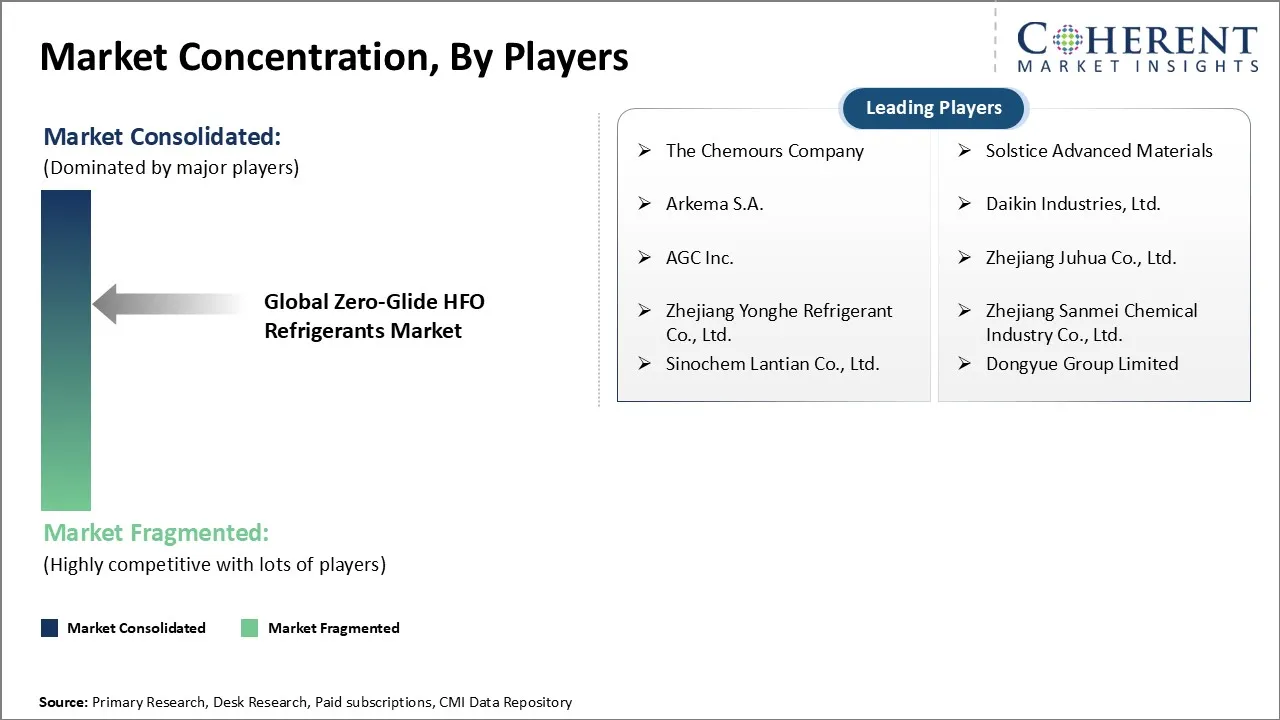
The global Zero-Glide HFO Refrigerants Market is competitive and key manufacturers are focusing on low GWP refrigerants, capacity expansion and technology innovation. The Chemours Company offers Opteon YF and Opteon ZE refrigerants, while Solstice Advanced Materials provides Solstice YF and Solstice ze solutions for automotive and industrial cooling applications. Arkema S.A., AGC Inc. and Daikin Industries, Ltd. are strengthening their positions by developing specialty refrigerant technologies and products. Chinese producers such as Zhejiang Juhua, Zhejiang Yonghe and Zhejiang Sanmei are expanding fourth-generation refrigerant production capabilities. Competition is increasingly driven by refrigerant performance, regulatory compliance, pricing, reliability of supply, and partnerships with automotive and HVAC manufacturers.
Top Manufacturers and Notable Products/Solutions in the Zero-Glide HFO Refrigerants Market
Company/Manufacturer | Notable Product/Brand | Key Features |
The Chemours Company | Opteon™ YF (R-1234yf); Opteon™ ZE (R-1234ze(E)) | Ultra-low GWP, zero temperature glide, automotive air conditioning, stationary chillers, commercial cooling applications |
Solstice Advanced Materials | Solstice® yf (R-1234yf); Solstice® ze (R-1234ze(E)) | Low-GWP refrigerants, automotive cooling, energy-efficient commercial chillers, industrial refrigeration applications. |
Arkema S.A. | HFO-1234yf; Forane® refrigerant portfolio | HFO-1234yf manufacturing capability, specialty fluorochemical production, low-GWP refrigerant technologies |
Daikin Industries, Ltd. | Low-GWP Refrigerant Technologies | Refrigerant research and development, advanced cooling technologies, energy-efficient HVAC systems. Pure HFO commercial product not independently verified. |
AGC Inc. | AMOLEA™ 1234yf | Low-GWP refrigerant, automotive air conditioning, refrigeration applications, reduced environmental impact. |
Zhejiang Juhua Co., Ltd | HFO-1234yf; HFO-1234ze | Fourth-generation refrigerants, domestic production capabilities, manufacturing expansion, low-GWP cooling applications. |
Sinochem Lantian Co., Ltd. | Fourth-Generation Fluorochemical Development | Specialty fluorochemical manufacturing and refrigerant research. A commercial pure R-1234yf/R-1234ze(E) product was not independently verified. |
Dongyue Group Limited | HFO-1234yf (Planned) | Proposed fourth-generation refrigerant production, fluorochemical manufacturing capabilities, low-GWP refrigerant development |
Market Report Scope
Zero-Glide HFO Refrigerants Market Report Coverage
Report Coverage | Details | ||
Base Year: | 2025 | Market Size in 2026: | USD 2.35 Bn |
Historical Data for: | 2020 to 2024 | Forecast Period: | 2026 to 2033 |
CAGR: | 12.0% | 2033 Value Projection: | USD 5.18 Bn |
Geographies covered: |
| ||
Segments covered: |
| ||
Companies covered: | The Chemours Company, Solstice Advanced Materials, Arkema S.A., Daikin Industries, Ltd., AGC Inc., Zhejiang Juhua Co., Ltd., Zhejiang Yonghe Refrigerant Co., Ltd., Zhejiang Sanmei Chemical Industry Co., Ltd., Sinochem Lantian Co., Ltd., and Dongyue Group Limited. | ||
Growth Drivers: |
| ||
Restraints & Challenges: |
| ||
Analyst Opinion (Expert Opinion)
- The global Zero-Glide HFO Refrigerants Market is expected to witness steady growth as manufacturers increasingly prioritize low-GWP refrigerants, energy-efficient cooling technologies, and reduced lifecycle emissions. R-1234yf is expected to maintain a strong position in automotive air conditioning, while R-1234ze(E) offers growth opportunities in commercial chillers and industrial cooling systems. However, future adoption will depend on equipment compatibility, refrigerant costs, and competition from natural refrigerants. According to the United Nations Environment Programme's Global Cooling Watch 2025, global cooling demand could more than triple by 2050 under a business-as-usual scenario, highlighting the importance of sustainable refrigeration technologies.
- The strongest growth opportunities are expected in high-efficiency chillers, industrial heat pumps, and emerging cooling infrastructure across Asia Pacific and North America. Increasing electricity demand for cooling is encouraging equipment manufacturers to evaluate low-GWP refrigerants alongside improved system efficiency. According to the International Energy Agency (IEA), in July 2026, global electricity consumption for space cooling had increased by 50% since 2015, reaching approximately 2,900 TWh. This expanding cooling requirement creates opportunities for HFO refrigerant suppliers in applications where technical compatibility and economic performance support adoption.
- Market participants should focus on refrigerant purity, production cost optimization, supply reliability, environmental compliance, and partnerships with automotive and HVAC manufacturers. Suppliers should also invest in refrigerant recovery technologies and lifecycle environmental assessments to address emerging sustainability concerns. A study published in June 2026 in Environmental Science & Technology Letters estimated that global trifluoroacetic acid (TFA) formation associated with atmospheric degradation of HFO-1234yf could already be 26%–75% of the TFA formation associated with HFC-134a, despite substantially lower HFO-1234yf emissions. These results show the importance of taking into account atmospheric degradation products besides the refrigerant GWP in the long-term product strategies.
Speak to the analyst
Want personalized insights?
Take the findings above to one of our principal consultants, or have the report rebuilt around the segments, geographies and competitors you actually track.
Market Segmentation
- By Refrigerant Type (Revenue, USD Bn, 2021-2033)
- HFO-1234yf (R-1234yf)
- HFO-1234ze(E) (R-1234ze(E))
- By Application (Revenue, USD Bn, 2021-2033)
- Automotive Air Conditioning
- Commercial Air Conditioning and Chillers
- Industrial Refrigeration and Process Cooling
- Others (Heat Pumps and Specialty Cooling Applications)
- By End User (Revenue, USD Bn, 2021-2033)
- Automotive Industry
- Commercial HVAC Industry
- Industrial Manufacturing and Processing
- Others (Specialty Cooling System Operators)
- By Region (Revenue, USD Bn, 2021-2033)
- North America
- U.S.
- Canada
- Latin America
- Brazil
- Mexico
- Argentina
- Rest of Latin America
- Europe
- Germany
- U.K.
- France
- Italy
- Spain
- Russia
- Rest of Europe
- Asia Pacific
- China
- India
- Japan
- Australia
- South Korea
- ASEAN
- Rest of Asia Pacific
- Middle East
- GCC
- Israel
- Rest of Middle East
- Africa
- South Africa
- Central Africa
- North Africa
- North America
- Key Players
- The Chemours Company
- Solstice Advanced Materials
- Arkema S.A.
- Daikin Industries, Ltd.
- AGC Inc.
- Zhejiang Juhua Co., Ltd.
- Zhejiang Yonghe Refrigerant Co., Ltd.
- Zhejiang Sanmei Chemical Industry Co., Ltd.
- Sinochem Lantian Co., Ltd.
- Dongyue Group Limited
Sources
Primary Research Interviews
- HFO refrigerant manufacturers and fluorochemical production managers
- Refrigerant formulation and chemical process engineers
- Automotive air conditioning system manufacturers and technology developers
- Commercial HVAC and industrial refrigeration equipment manufacturers
- R&D heads from specialty fluorochemical companies
- Automotive, commercial HVAC, and industrial cooling procurement managers
- Refrigerant distributors, recovery, recycling, and reclamation service providers
- Key opinion leaders (KOLs) in low-GWP refrigerants and sustainable cooling technologies
Databases
- U.S. Environmental Protection Agency (EPA)
- European Commission – F-Gas Regulation Database
- United Nations Environment Programme (UNEP) – OzonAction
- International Energy Agency (IEA)
- World Bank
- Organisation for Economic Co-operation and Development (OECD)
- UN Comtrade Database
- Eurostat
Magazines
- ACHR NEWS
- Cooling Post
- Refrigeration World
- HVAC&R Nation
- RACA Journal
- Process Cooling
- Chemical Engineering
- Refrigeration and Air Conditioning Magazine
Journals
- International Journal of Refrigeration
- Applied Thermal Engineering
- Energy
- Energy Conversion and Management
- Applied Energy
- Refrigeration Science and Technology
- Journal of Chemical & Engineering Data
- Environmental Science & Technology
Newspapers
- The Wall Street Journal
- Financial Times
- Reuters
- The Economic Times
- Nikkei Asia
- China Daily
Associations
- American Society of Heating, Refrigerating and Air-Conditioning Engineers (ASHRAE)
- Air-Conditioning, Heating, and Refrigeration Institute (AHRI)
- European Partnership for Energy and the Environment (EPEE)
- European Heat Pump Association (EHPA)
- Japan Refrigeration and Air Conditioning Industry Association (JRAIA)
- International Institute of Refrigeration (IIR)
- International Organization of Motor Vehicle Manufacturers (OICA)
- Air Conditioning and Refrigeration European Association (AREA)
Public Domain Sources
- Company Annual Reports and Investor Presentations
- Government Refrigerant Regulations and Environmental Policy Publications
- U.S. EPA – HFC Production, Consumption, and Allowance Data
- European Commission – F-Gas Regulation (EU) 2024/573
- UNEP – Montreal Protocol and Kigali Amendment Reports
- International Energy Agency – Cooling and Energy Efficiency Reports
- Refrigerant Safety and Classification Standards (ASHRAE 15 and 34)
- Refrigerant Technical Data Sheets and Safety Data Sheets (SDS)
- Patent Databases such as WIPO, USPTO, and Google Patents
- Publicly Available Refrigerant Manufacturing Capacity and Investment Announcements
Proprietary Elements
- CMI Data Analytics Tool
- Proprietary CMI Existing Repository of Information for the Last 10 Years
Get access to 250+ pages report
Every segment, forecast, competitor profile and data table behind the analysis above — available for instant download.
- ESOMAR Member
- ISO 9001:2015 Certified
- D-U-N-S Registered
- GDPR & CCPA Compliant
Frequently Asked Questions
The global Zero-Glide HFO Refrigerants Market is expected to reach USD 5.18 Bn by 2033, compared with USD 2.35 Bn in 2026.
Major players operating in the global Zero-Glide HFO Refrigerants Market include The Chemours Company, Solstice Advanced Materials, Arkema S.A., Daikin Industries, Ltd., AGC Inc., Zhejiang Juhua Co., Ltd., Zhejiang Yonghe Refrigerant Co., Ltd., Zhejiang Sanmei Chemical Industry Co., Ltd., Sinochem Lantian Co., Ltd., and Dongyue Group Limited.
High refrigerant production costs, substantial investment in HFO-compatible cooling equipment, flammability-related safety requirements, and competition from natural refrigerants are the major factors hampering market growth.
Increasing adoption of low-GWP refrigerants in automotive air conditioning, stringent environmental regulations, rising demand for energy-efficient cooling systems, and growing investment in sustainable refrigeration technologies are driving market growth.
The global Zero-Glide HFO Refrigerants Market is anticipated to grow at a CAGR of 12.0% from 2026 to 2033.
North America is expected to dominate the global Zero-Glide HFO Refrigerants Market, accounting for an estimated 35.0% market share in 2026, supported by widespread automotive refrigerant adoption and established cooling infrastructure.
Asia Pacific is expected to be the fastest-growing regional market during 2026–2033, supported by expanding automotive manufacturing, increasing HFO refrigerant production capacity, and investments in low-GWP cooling technologies.