

Data Center Cooling Market Size and Forecast – 2026 to 2033
The data center cooling market is estimated to be valued at USD 18.20 Bn in 2026 and is expected to reach USD 43.13 Bn by 2033, exhibiting a compound annual growth rate (CAGR) of 13.1% from 2026 to 2033.
Key Takeaways
- By Component, Solution holds the largest market share of 77.6% in 2026 owing to the rapid growth in data generation & workloads.
- By Type of Cooling, Room-Based Cooling expected to hold largest market share of 62.2% in 2026 owing to its established & mature technology.
- By Industry Vertical, IT and Telecom acquired the prominent market share of 28.1% in 2026 owing to the rapid growth in IT workloads & data traffic.
- By Region, North America dominates the overall market with an estimated share of 38.3% in 2026 owing to the rapid expansion of data centers & digital infrastructure.
Market Overview
The Data Center Cooling Market is rapidly expanding as digitalization, cloud computing, and high-performance computing drive demand. Growing data volumes and high-density server deployments produce substantial heat, leading companies to adopt advanced cooling solutions, including air-based, liquid, and hybrid systems. Organizations are increasingly focusing on energy efficiency, sustainability, and regulatory compliance, boosting the need for smart, cost-effective cooling technologies. The market serves hyperscale, enterprise, colocation, and edge data centers, prioritizing reliability, scalability, and operational efficiency.
Current Events and Its Impact on the Data Center Cooling Market
Current Events | Description and its impact |
Geopolitical Tensions and Supply Chain Disruptions |
|
Economic Trends and Sustainability Initiatives |
|
Regional Infrastructure Development and Urbanization |
|
Role of AI (Artificial Intelligence) in Data Center Cooling Industry
Artificial intelligence is playing a transformative role in the data center cooling industry by enabling smarter, more efficient thermal management. AI-driven systems analyze real-time data from sensors, workloads, and environmental conditions to predict heat patterns and dynamically adjust cooling operations. This reduces energy consumption, lowers operational costs, and minimizes carbon emissions. AI also supports predictive maintenance by identifying potential equipment failures before they occur, improving reliability and uptime. As data centers grow in scale and complexity, AI helps operators balance performance, resilience, and sustainability while meeting stricter energy-efficiency and transparency requirements.
In April 2025, ABB announced a strategic investment via ABB Motion Ventures in OctaiPipe, a UK-based company specializing in AI-driven software for optimizing data center cooling. The collaboration aims to provide data center operators with intelligent solutions to improve energy efficiency, enhance operational resilience, and support increasing sustainability and transparency requirements.
Artificial Intelligence transforms data center cooling by enabling smarter and more efficient thermal management. AI-powered systems monitor real-time sensor data to optimize airflow, fan speeds, and coolant flow, cutting energy use and boosting reliability. Predictive algorithms forecast temperature changes and workload variations, allowing operators to adjust settings proactively to prevent overheating and equipment failure. By adopting AI, data centers improve operational efficiency, reduce costs, and advance sustainability, while maintaining consistent performance and scalable cooling across hyperscale, enterprise, colocation, and edge facilities. For instance, in December 2025, Siemens and nVent are collaborating to create a liquid cooling and power architecture for 100 MW hyperscale AI data centers, supporting large-scale liquid-cooled AI systems like NVIDIA GB200 NVL72
- Current Industry Events of 2026
- Market Size Estimation
- Regional Breakdown
- Competitive Landscape
- Customer Intelligence
- Segmental Analysis
- Pricing Analysis
- Key Market Drivers, Challenges & Future Trends
- Customized Insights Section
Segmental Insights
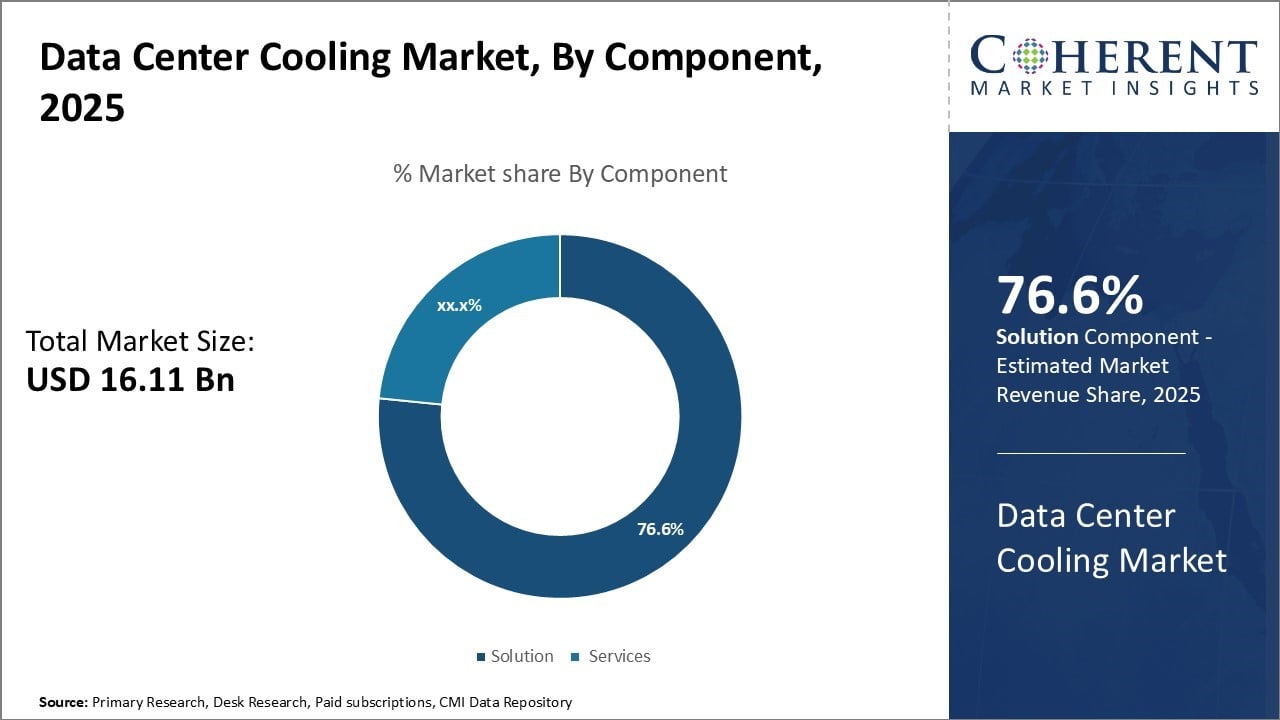
Data Center Cooling Market Insights, By Component - Solution contributes the highest share of the market owing to its increased rack power densities
Solution holds the largest market share of 77.6% in 2026. Rapid growth in digital services, cloud computing, and high-performance applications is driving the demand for data center cooling solutions as they produce substantial heat. Increasing server densities and the expansion of hyperscale and edge data centers push organizations to implement efficient thermal management. Companies are focusing on energy-efficient, sustainable, and cost-effective cooling systems to lower operational costs and minimize environmental impact. They are adopting innovations such as liquid cooling, hybrid systems, and AI-driven management to enhance reliability, optimize performance, and scale IT infrastructure effectively. For instance, in September 2025, Flex, a global leader in data center infrastructure, has launched its new Modular Rack-Level Cooling Distribution Unit (CDU) as the latest addition to its cooling portfolio.
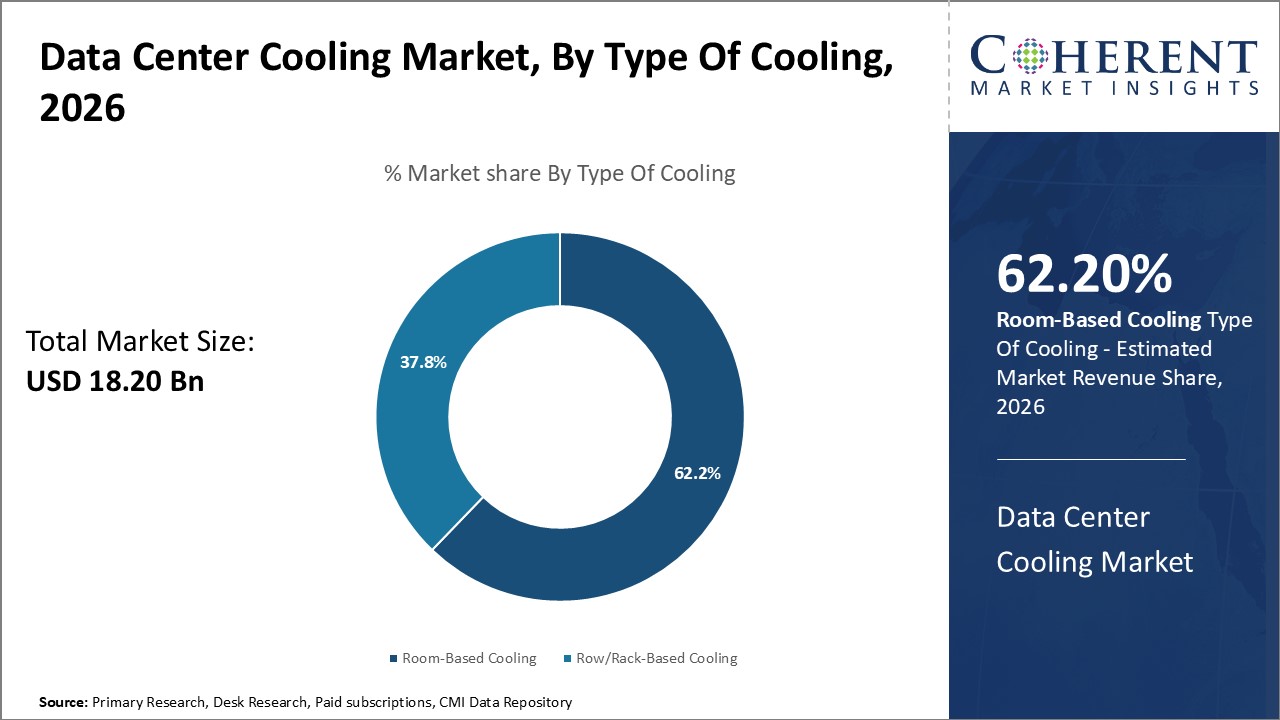
Data Center Cooling Market Insights, By Type of Cooling - Room-Based Cooling contribute the highest share of the market owing to its compatibility with legacy infrastructure
Room-Based Cooling expected to hold largest market share of 62.2% in 2026. Data centers adopt room-based cooling because it offers proven reliability, simple design, and compatibility with existing infrastructure. Centralized air handling systems efficiently manage temperature across halls, particularly in facilities with moderate server densities. Organizations choose this approach for its lower upfront costs, easy installation, and straightforward maintenance. Enhancements like hot/cold aisle containment, variable-speed fans, and smart controls improve energy efficiency. These advantages make room-based cooling a practical, cost-effective solution for enterprise, colocation, and legacy data center operations. For instance, in June 2025, Korean telco LG Uplus has launched a next-generation liquid cooling demonstration room at its Pyeongchon 2 Internet Data Center in Anyang, Gyeonggi Province.
Data Center Cooling Market Insights, By Industry Vertical - IT and Telecom contribute the highest share of the market owing to its 5G rollout & telecom network demands
IT and Telecom acquired the prominent market share of 28.1% in 2026. The IT and telecom sectors drive demand for data center cooling as expanding digital services, cloud computing, and high-speed networks produce significant heat. Growing server densities from 5G, edge deployments, and IT workloads like AI, big data, and virtualization push organizations to implement efficient thermal management. Companies focus on energy-efficient, reliable cooling solutions to ensure uptime and control operational costs. They increasingly adopt innovations such as liquid cooling, hybrid systems, and intelligent controls to enhance performance, scalability, and sustainability in IT and telecom data centers. For instance, in August 2025, Techno Digital, the digital infrastructure division of India’s Techno Electric & Engineering Company Limited (TEECL), has inaugurated its 36MW data centre at SIPCOT IT Park in Chennai.
Regional Insights
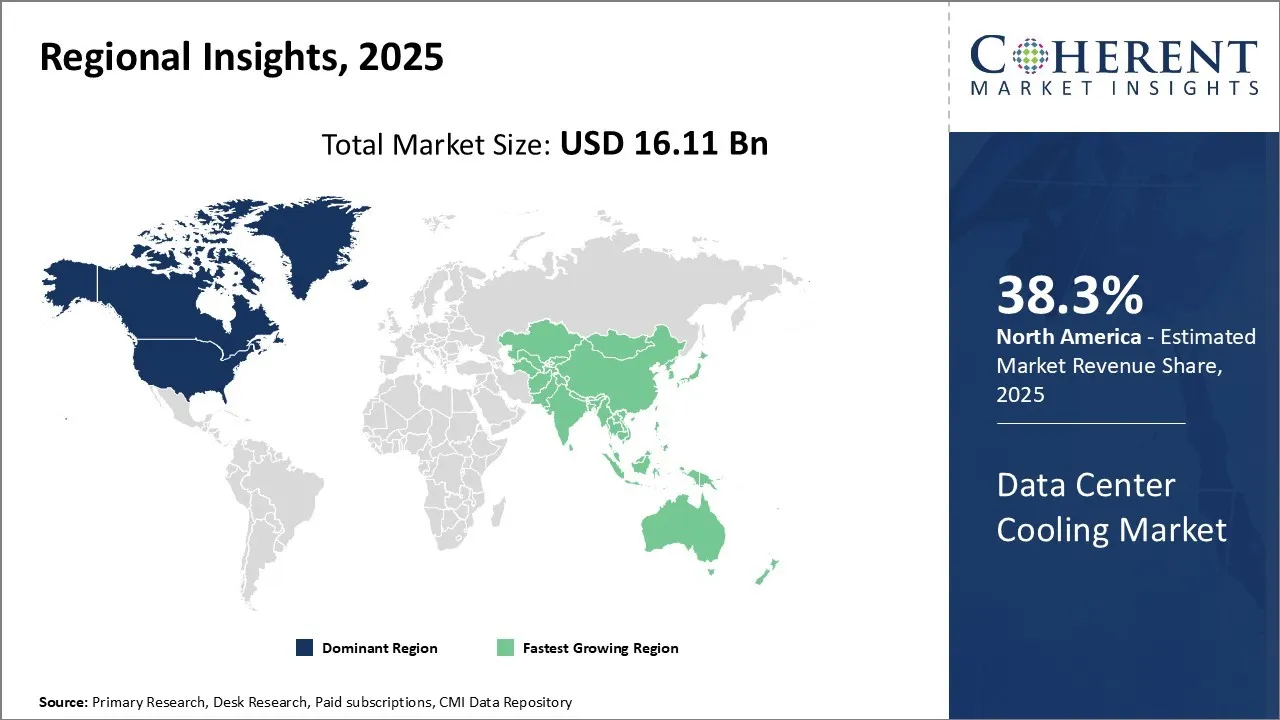
North America Data Center Cooling Market Trends
North America dominates the overall market with an estimated share of 38.3% in 2026. The North America data center cooling market is shifting toward energy-efficient, sustainable, and advanced thermal management solutions. Growing demand for hyperscale and cloud data centers, along with high-density server deployments, prompts companies to adopt liquid, hybrid, and AI-driven cooling technologies. As edge and modular data centers expand, operators implement flexible, compact cooling systems. They also use smart controls and predictive maintenance to enhance performance, lower operational costs, and achieve environmental objectives across enterprise, colocation, and cloud infrastructures. For instance, in July 2026, Modine (NYSE: MOD), a global leader in thermal management solutions, has announced a multimillion-dollar investment to expand U.S. manufacturing capacity for Airedale by Modine™ data center cooling products.
Asia Pacific Data Center Cooling Market Trends
The Asia Pacific data center cooling market is expanding swiftly as digital transformation, cloud services, and high-performance computing boost regional demand. Organizations are developing hyperscale and edge data centers, which drives the use of energy-efficient, scalable cooling technologies like liquid, hybrid, and AI-assisted systems. Focusing on sustainability and regulatory compliance, operators adopt eco-friendly solutions. They also employ smart controls and predictive maintenance to manage temperatures effectively, reduce operational costs, and ensure reliable, high-performance operations across enterprise, colocation, and cloud data center environments. For instance, in November 2026, Johnson Controls, a global provider of building and infrastructure systems, has launched the Silent-Aire Coolant Distribution platform in India, expanding its thermal management solutions for high-density and AI-driven data centers.
United States Data Center Cooling Market Trends
The United States data center cooling market is progressing in tandem with the expansion of cloud computing, digital services, and high-performance computing. The growth of hyperscale and enterprise data centers is promoting the deployment of advanced cooling technologies, including liquid, hybrid, and AI-enabled systems. Operators are emphasizing energy efficiency, sustainability, and regulatory compliance, while incorporating smart controls and predictive maintenance to optimize operational performance. The increasing presence of edge and modular data centers is encouraging the adoption of flexible, compact cooling solutions that ensure reliable and cost-effective operations across diverse facilities. For instance, in June 2026, Ecolab Inc., a global leader in water, hygiene, and infection prevention solutions, has launched a new technology to enhance high-performance data center cooling.
China Data Center Cooling Market Trends
The China data center cooling market is growing rapidly as cloud computing, digital services, and high-performance computing expand across the region. Companies developing hyperscale and enterprise data centers are driving the adoption of advanced cooling solutions, including liquid, hybrid, and AI-assisted systems. Operators are prioritizing energy efficiency, environmental sustainability, and regulatory compliance while using smart controls and predictive maintenance to optimize operations. The expansion of edge and modular facilities is encouraging the deployment of flexible, compact cooling technologies that deliver reliable and cost-effective performance across diverse data center environments. For instance, in October 2026, China’s Hainan province has launched the world’s first commercial underwater data centre as part of its push to expand the blue economy and attract foreign investment in the country’s largest pilot free-trade zone.
End-user Feedback and Unmet Needs in the Data Center Cooling Market
End-user Feedback and Unmet Needs
- Demand for Energy Efficiency: End users consistently highlight the need for cooling solutions that reduce power consumption without compromising performance. Many data centers face rising operational costs due to inefficient cooling, prompting demand for systems that optimize airflow, integrate smart controls, and support sustainability goals while maintaining consistent thermal management.
- Adaptability to High-Density Loads: With increasing server densities and high-performance computing deployments, users require cooling systems that can handle concentrated heat. Traditional solutions often struggle with localized hotspots, making scalable, flexible technologies like in-row or liquid cooling essential to meet evolving infrastructure demands.
- Ease of Maintenance and Reliability: Operators emphasize the importance of reliable cooling systems with minimal downtime and straightforward maintenance procedures. Complex setups, frequent failures, or hard-to-service components can disrupt operations, highlighting the need for robust designs and predictive maintenance tools.
Data Center Cooling Market Trend
Shift Toward Energy-Efficient Solutions
Data center operators increasingly adopt energy-efficient cooling systems to manage rising electricity costs and meet sustainability goals. Technologies such as liquid cooling, variable-speed fans, and advanced airflow management are gaining traction. Companies are implementing smart controls and AI-based optimization to reduce power consumption while maintaining stable temperatures, supporting green initiatives, and enhancing operational efficiency across hyperscale, enterprise, colocation, and edge data centers.
Adoption of Liquid and Hybrid Cooling
High-density server deployments and GPU-intensive workloads drive the adoption of liquid and hybrid cooling solutions. These technologies provide superior heat dissipation compared to traditional air-based methods. Data centers are integrating these solutions to handle localized hotspots, improve reliability, and optimize floor space, ensuring that modern workloads like AI, big data, and cloud computing operate efficiently without thermal constraints.
Data Center Cooling Market Opportunity
Growth of Hyperscale and Cloud Data Centers
The increasing deployment of hyperscale and cloud data centers presents a significant opportunity for cooling solution providers. As these facilities expand to support AI, big data, and enterprise workloads, demand for advanced, scalable cooling technologies rises. Providers can offer high-efficiency air-based, liquid, and hybrid cooling systems to address concentrated heat loads, improve energy efficiency, and support uninterrupted operations across large-scale data center environments
Market Report Scope
Data Center Cooling Market Report Coverage
| Report Coverage | Details | ||
|---|---|---|---|
| Base Year: | 2025 | Market Size in 2026: | USD 18.20 Bn |
| Historical Data for: | 2020 To 2024 | Forecast Period: | 2026 To 2033 |
| Forecast Period 2026 to 2033 CAGR: | 13.1% | 2033 Value Projection: | USD 43.13 Bn |
| Geographies covered: |
| ||
| Segments covered: |
| ||
| Companies covered: | Air Enterprises, Asetek, Inc., Climaveneta, Coolcentric, Daikin Industries Ltd, Dell Technologies Inc., Fujitsu, Hitachi, Ltd., Johnson Controls, Liquid Cool Solutions Inc., Mitsubishi Electric Corp., Munters Group AB , Nortek Air Solutions, LLC, NTT Ltd., Rittal GmBH & Co. KG, Schneider Electric SE, STULZ GMBH, Telx Inc., and Vertiv Co. | ||
| Growth Drivers: |
| ||
| Restraints & Challenges: |
| ||
Data Center Cooling Market News
- In April 2025, ABB has invested in UK-based OctaiPipe through ABB Motion Ventures to provide data center operators with AI-driven tools for energy savings, operational resilience, and sustainability.
- In October 2025, GS Caltex has launched Kixx DLC Fluid PG25, a direct liquid cooling solution for data centers, using propylene glycol and OAT additives to boost energy efficiency and protect against corrosion.
Analyst Opinion (Expert Opinion)
- The evolution of data center cooling is no longer incremental but structural, driven by the physical limits of legacy air systems in the face of escalating compute densities and sustainability mandates. Traditional perimeter air cooling, long sufficient for sub‑20 kW racks, is demonstrably inadequate as hyperscale and AI workloads routinely push rack densities well beyond 50 kW, forcing operators to rethink thermal infrastructure. Independent analyses show that AI‑optimized cooling approaches such as direct‑to‑chip liquid cooling are being prioritized, with spending on liquid solutions forecast to grow at three to four times the rate of air cooling through the end of the decade, reflecting hyperscaler commitment to more efficient thermal management.
- Despite these performance advantages, the market is constrained by significant technical and economic barriers that distinguish meaningful adoption from rhetorical interest. Advanced cooling systems typically entail substantial upfront costs, with scores of mid‑tier and legacy facilities unable to justify these capital expenditures absent clear total‑cost‑of‑ownership advantages; industry surveys identify high initial expense and retrofit complexity as the top two adoption inhibitors.
- Strategic differentiation among operators also illustrates the divergence in cooling philosophies. Microsoft’s hybrid air–liquid solutions — criticized internally as “wasteful” — underscore the tension between flexibility, sustainability, and operational risk management, while others pursue closed‑loop, waterless designs to meet water‑scarcity constraints in key geographies. Meanwhile, cutting‑edge innovation such as microfluidic cooling channels that reduce peak silicon temperatures by up to 65 % demonstrates that the industry still has disruptive potential beyond today’s liquid immersion paradigms.
Speak to the analyst
Want personalized insights?
Take the findings above to one of our principal consultants, or have the report rebuilt around the segments, geographies and competitors you actually track.
Market Segmentation
- Component Insights (Revenue, USD Bn, 2021 - 2033)
- Solution
- Air Conditioners
- Chillers
- Air Handling Units
- Liquid Cooling Systems
- Others
- Services
- Installation & Deployment
- Support & Consulting
- Maintenance Services
- Type of Cooling Insights (Revenue, USD Bn, 2021 - 2033)
- Room-Based Cooling
- Row/Rack-Based Cooling
- Industry Vertical Insights (Revenue, USD Bn, 2021 - 2033)
- BFSI
- IT and Telecom
- Manufacturing
- Retail
- Healthcare
- Energy and Utilities
- Others (Government & Defense, Education)
- Regional Insights (Revenue, USD Bn, 2021 - 2033)
- North America
- U.S.
- Canada
- Latin America
- Brazil
- Argentina
- Mexico
- Rest of Latin America
- Europe
- Germany
- U.K.
- Spain
- France
- Italy
- Russia
- Rest of Europe
- Asia Pacific
- China
- India
- Japan
- Australia
- South Korea
- ASEAN
- Rest of Asia Pacific
- Middle East & Africa
- South Africa
- GCC Countries
- Israel
- Rest of Middle East & Africa
- Key Players Insights
- Air Enterprises
- Asetek, Inc.
- Climaveneta
- Coolcentric
- Daikin Industries Ltd
- Dell Technologies Inc.
- Fujitsu
- Hitachi, Ltd.
- Johnson Controls
- Liquid Cool Solutions Inc.
- Mitsubishi Electric Corp.
- Munters Group AB
- Nortek Air Solutions, LLC
- NTT Ltd.
- Rittal GmBH & Co. KG
- Schneider Electric SE
- STULZ GMBH
- Telx Inc.
- Vertiv Co.
Sources
Primary Research interviews
- Data Center Operations Managers
- Facility Managers
- HVAC Engineers
- IT Infrastructure Managers
- Equipment Manufacturers’ Technical Teams
Databases
- IEEE Xplore Digital Library
- ASHRAE Databases
- ScienceDirect
- SpringerLink
- PubMed (for thermal management studies)
Magazines
- Data Center Knowledge
- Mission Critical Magazine
- Data Center Dynamics Magazine
- Cooling Technology Today
Journals
- Applied Thermal Engineering
- Energy and Buildings
- Journal of Thermal Science and Engineering Applications
- International Journal of Heat and Mass Transfer
Newspapers
- The Wall Street Journal (Technology & Energy sections)
- Financial Times (Technology & Infrastructure sections)
- The New York Times (Business & Technology sections)
Associations
- ASHRAE (American Society of Heating, Refrigerating and Air-Conditioning Engineers)
- Uptime Institute
- Green Grid
- IEEE (Institute of Electrical and Electronics Engineers)
Public Domain sources
- Government energy and infrastructure reports
- U.S. Department of Energy (DOE) publications
- Environmental Protection Agency (EPA) reports
- National Renewable Energy Laboratory (NREL) publications
- Open-access technical papers and patents
Proprietary Elements
- CMI Data Analytics Tool
- Proprietary CMI Existing Repository of information for last 8 years
Get access to 250+ pages report
Every segment, forecast, competitor profile and data table behind the analysis above — available for instant download.
- ESOMAR Member
- ISO 9001:2015 Certified
- D-U-N-S Registered
- GDPR & CCPA Compliant
Missing comfort of reading report in your local language? Find your preferred language:
Transform your Strategy with Exclusive Trending Reports
Frequently Asked Questions
The Data Center Cooling Market is estimated to be valued at USD 18.20 Bn in 2026, and is expected to reach USD 43.13 Bn by 2033.
The CAGR of the Data Center Cooling Market is projected to be 13.1% from 2026 to 2033.
Growing demand for cloud computing services and adoption of artificial intelligence and edge computing are the major factors driving the growth of the data center cooling market.
Rising cooling demands with increased data processing and strain on infrastructure from next-gen servers and cloud services are the major factors hampering the growth of the data center cooling market.
In terms of component, solution is estimated to dominate the market revenue share in 2026.
Air Enterprises, Asetek, Inc., Climaveneta, Coolcentric, Daikin Industries Ltd, Dell Technologies Inc., Fujitsu, Hitachi, Ltd., Johnson Controls, Liquid Cool Solutions Inc., Mitsubishi Electric Corp., Munters Group AB, Nortek Air Solutions, LLC, NTT Ltd., Rittal GmBH & Co. KG, Schneider Electric SE, STULZ GMBH, Telx Inc., and Vertiv Co. are the major players.
North America is expected to lead the data center cooling market in 2026.