

Axillary Crutches Market Size and Share Analysis- 2026 To 2033
The Axillary Crutches Market size is anticipated to grow at a CAGR of 5.2%, with a market value of approximately USD 2.53 Bn in 2026, and is expected to reach approximately USD 3.61 Bn by 2033. The primary growth drivers are largely defined by the rising prevalence of mobility impairments, increasing incidence of orthopedic injuries and lower-limb surgeries, growing geriatric population, and rising demand for cost-effective ambulatory and rehabilitation aids. According to the World Health Organization (WHO), more than 2.5 Bn people globally currently need one or more assistive products, and this requirement is projected to exceed 3.5 Bn people by 2050.
Key Takeaways
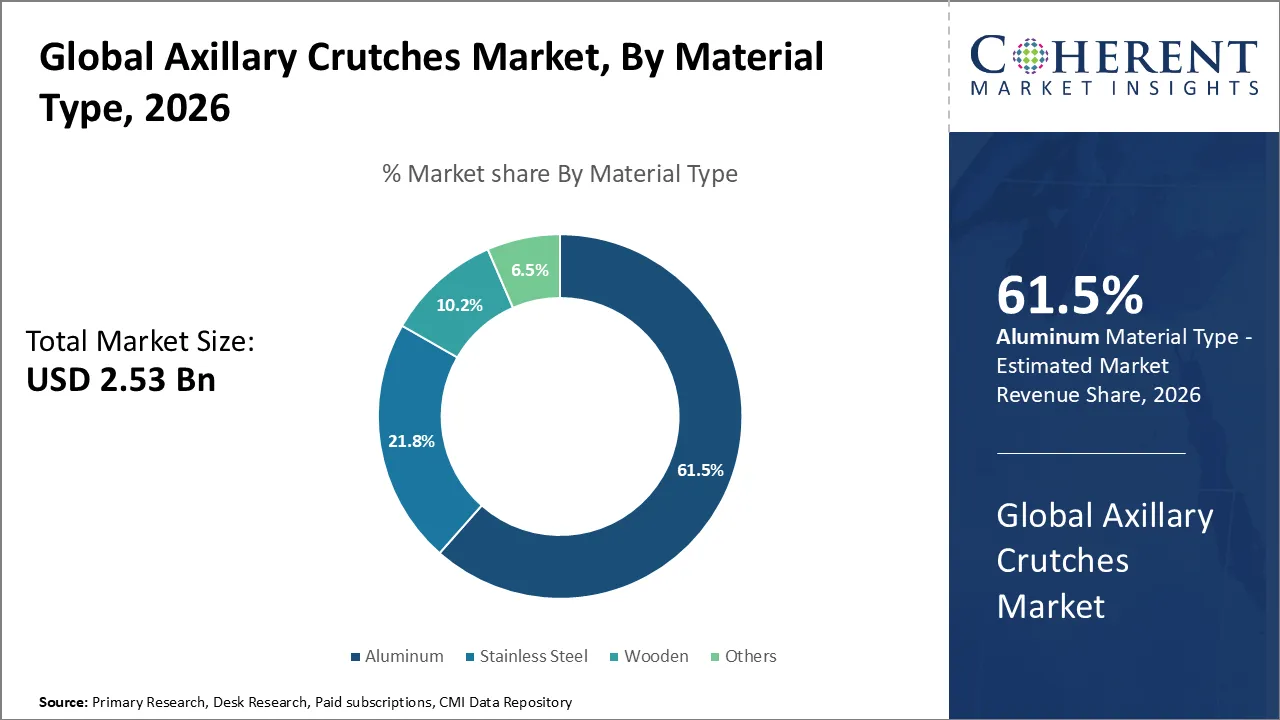
- The aluminum segment is likely to dominate the market with 61.5% in 2026. The segment’s growth is owing to aluminum’s lightweight construction, corrosion resistance, high durability, easier height adjustment, and widespread use in reusable and foldable axillary crutches. Medline’s 2026 Durable Medical Equipment catalog lists standard aluminum axillary crutches with a double-extruded center tube for load-bearing strength and a 300-lb weight capacity across tall, adult, and youth sizes.
- The adult segment is set to lead with 84.0% in 2026. The segment’s growth is owing to the higher incidence of orthopedic procedures, trauma-related lower-limb injuries, age-associated mobility limitations, and post-surgical rehabilitation requirements among adults. According to the American Academy of Orthopaedic Surgeons’ 2025 American Joint Replacement Registry report, more than 4.4 million hip and knee arthroplasty procedures performed in 2024 were included in its analysis, representing an 8.8% increase compared with the previous report.
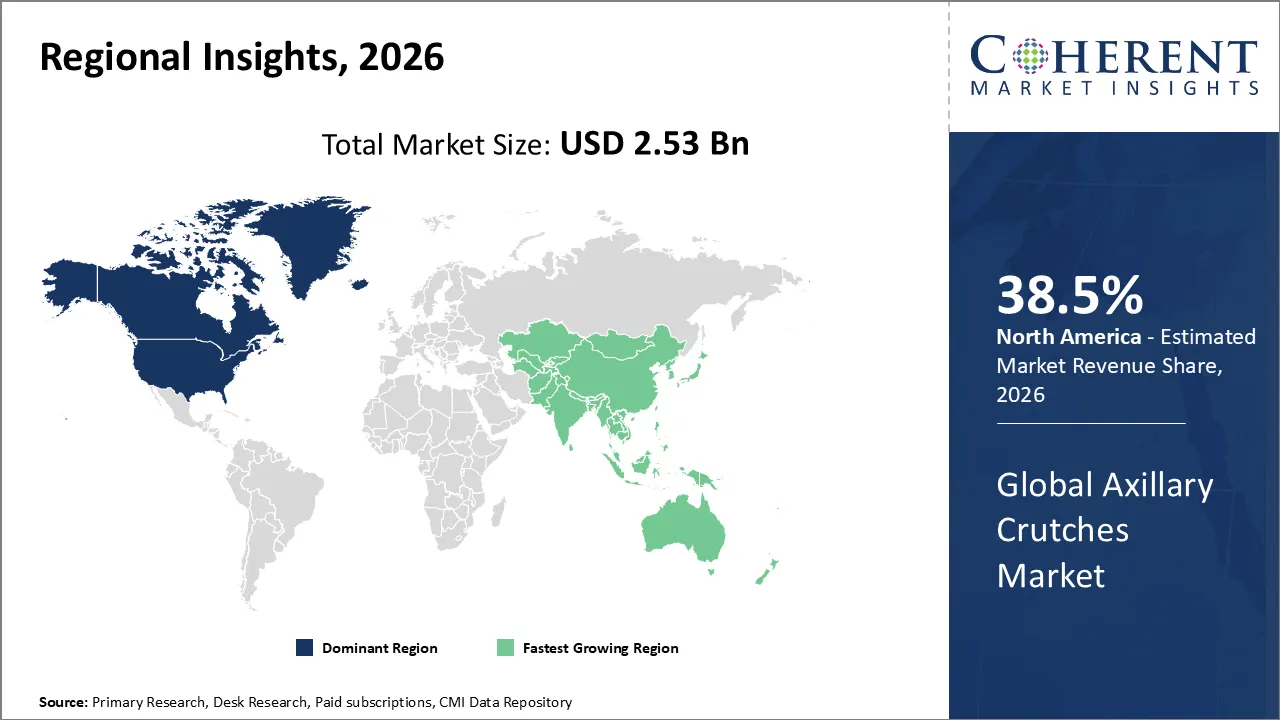
- North America is expected to acquire the prominent share of 38.5% in 2026. The region’s growth is owing to high orthopedic procedure volumes, well-established rehabilitation infrastructure, broad availability of mobility-assistance products, and strong access to hospital and outpatient care. According to the AAOS, its American Joint Replacement Registry database now encompasses more than 4.6 million cumulative hip and knee arthroplasty procedures, highlighting the substantial orthopedic treatment and rehabilitation base in the U.S.
Market Drivers
Rising Orthopedic Procedures and Post-Surgical Rehabilitation Needs are Driving the Axillary Crutches Market
The Axillary Crutches Market is witnessing steady growth owing to the rising volume of orthopedic procedures, lower-limb surgeries, fractures, and rehabilitation cases that require temporary or medium-term mobility support. Axillary crutches are widely used during recovery following hip, knee, ankle, and lower-extremity procedures, as they help reduce weight-bearing pressure while supporting patient mobility.
The CDC states that more than 14 million adults aged 65 years and older, or about 1 in 4 older adults, report a fall each year in the U.S. Falls are the leading cause of both fatal and nonfatal injuries among older adults and frequently result in fractures and temporary mobility limitations requiring walking aids.
Increasing Injury Burden and Age-Related Mobility Limitations are Expanding Demand for Crutches
The rising prevalence of traumatic injuries and age-related mobility impairment is another key factor boosting the Axillary Crutches Market. Crutches are often needed after fractures, soft-tissue injuries, lower-limb traumas, falls to offer temporary mobility assistance and offload the injured limb.
According to the World Health Organization (WHO) estimates that each year, 20 million to 50 million people suffer non-fatal road traffic injuries. Many of them will have disabilities that will require treatment and rehabilitation. Trauma-related injuries are common, and patients who experience them comprise a recurring population that requires temporary ambulatory assistance during rehabilitation.
According to WHO’s October 2025 update, the number of people aged 60 years and above is projected to increase from 1 billion in 2020 to 1.4 billion by 2030 and to 2.1 billion by 2050. Older adults are particularly at risk for falls, fractures and mobility limitations.
Current Events and Their Impact on the Axillary Crutches Market
Current Event | Description and its Impact |
CMS Updates Medicare DMEPOS Fee Schedule and Payment Policies for 2026 |
|
European Commission Proposes Simplification of EU Medical Device Regulations (2025–2026) |
|
- Current Industry Events of 2026
- Market Size Estimation
- Regional Breakdown
- Competitive Landscape
- Customer Intelligence
- Segmental Analysis
- Pricing Analysis
- Key Market Drivers, Challenges & Future Trends
- Customized Insights Section
Segmental Insights
Why is Aluminum Acquiring the Largest Share?
On the basis of material type, the aluminum segment is projected to account for the largest Axillary Crutches Market share of 61.5% in 2026. The segment’s growth is owing to aluminum’s lightweight structure, corrosion resistance, ease of height adjustment, durability, and favorable strength-to-weight performance for routine ambulatory use across hospitals, rehabilitation centers, and homecare settings.
Carex currently markets folding underarm crutches made from lightweight aluminum, adjustable from 41 to 58 inches, and specifically designed for users recovering from lower-body injury or surgery. The folding design also enables storage in cars, closets, and overhead compartments, illustrating how aluminum supports portability-oriented product innovation.
Why is the Adult Segment Holding the Largest Market Share?
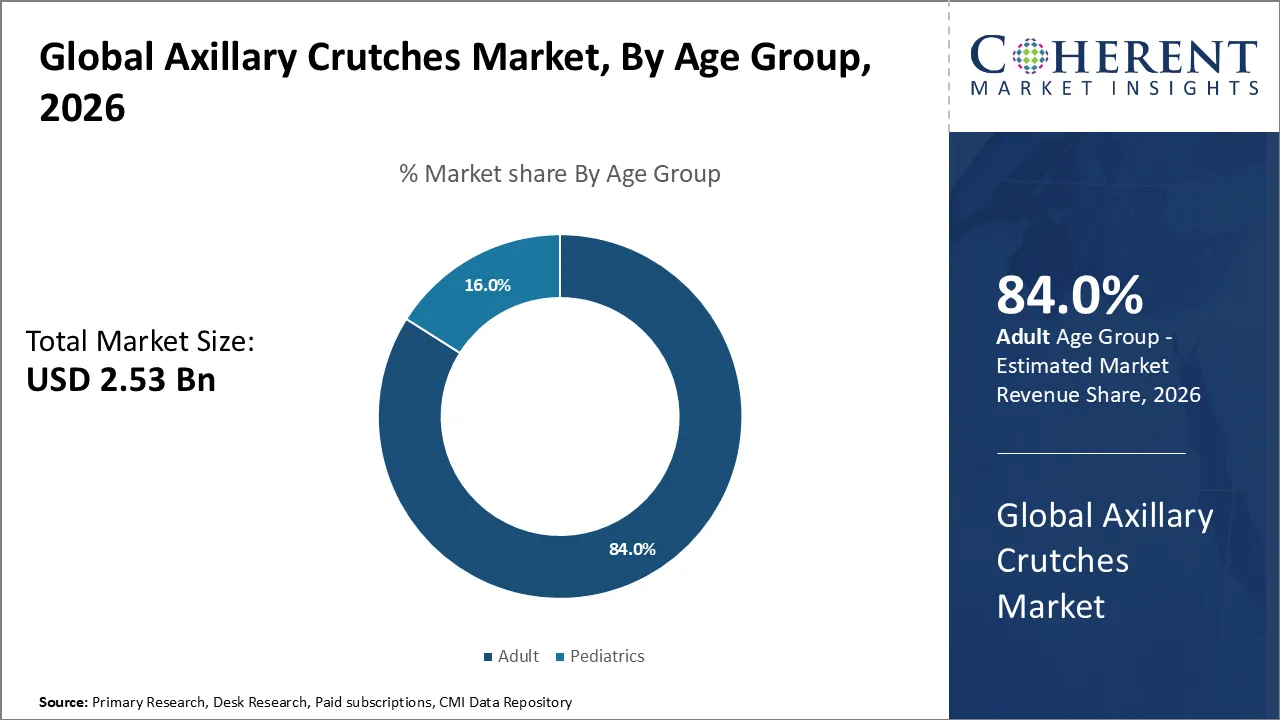
On the basis of age group, the adult segment is set to lead the Axillary Crutches Market with a major 84.0% share in 2026. The segment’s growth is owing to the substantially larger incidence of orthopedic surgery, fractures, sports and road injuries, falls, and age-related mobility limitations among the adult population. Adults also constitute the principal patient group requiring temporary partial or non-weight-bearing assistance following hip, knee, ankle, and other lower-extremity procedures.
The adult segment is further supported by the high burden of fall-related injuries among older adults. The U.S. Centers for Disease Control and Prevention (CDC) reported in 2024 that falls were the cause of approximately 4.5 million emergency department visits for adults aged 65 years and older. According to the CDC, nearly 319,000 older adults are hospitalized for hip fractures each year, highlighting the size of the population that requires assistance with mobility while recovering.
In September 2026, Drive Medical (Medical Depot Inc.) highlighted updated ergonomic specifications for its MD by Drive Air-Crutch, an adult-oriented axillary crutch designed to improve comfort during injury recovery. The company reported that the product offers 21% more underarm pad surface area and 57.9% thicker padding than a standard crutch pad, while reducing pressure through the hand and wrist by 27.6% compared with a standard crutch.
Axillary Crutches Market Trends
- The increasing focus on biomechanical unloading and gait rehabilitation is strengthening the clinical relevance of crutch-assisted mobility. In 2026, a randomized controlled trial of patients with early to middle-stage osteonecrosis of the femoral head found that standardized crutch-assisted walking improved pain, gait performance, and hip function, suggesting crutches can be used as a low-cost conservative rehabilitation intervention.
- Market interest is increasing in energy absorbing and shock reducing axillary crutch technologies. In January 2025, researchers presented a prototype spring loaded module for axillary crutches to reduce the impact forces transmitted during crutch assisted gait. The development is in line with the increased interest in R&D to improve comfort and reduce repetitive loading of the upper extremities during long term use of crutches.
- Increasing focus on balance, gait stability and safer mobility is leading to comparative assessment of traditional axillary crutches with newer assistive devices. Research indexed in NIH shows standard axillary crutch gait led to an 84% increase in whole-body angular momentum compared to hands-free crutches, indicating balance-control issues that are motivating additional innovations in standard axillary-crutch design.
Regional Insights
North America Dominates Owing to Established DME Reimbursement and Distribution Infrastructure
North America is expected to account for the prominent 38.5% share of the Axillary Crutches Market in 2026. The region’s dominance is owing to its well-established durable medical equipment reimbursement framework, extensive hospital and rehabilitation network, broad retail availability of mobility aids, and strong presence of established medical-device distributors and manufacturers.
In the U.S., crutches are included within Medicare’s Mobility Assistive Equipment (MAE) coverage framework when a beneficiary has a mobility limitation that restricts mobility-related activities of daily living. This established reimbursement pathway strengthens access to prescribed mobility products through the DME channel.
The U.S. Centers for Medicare & Medicaid Services (CMS) also maintains dedicated national datasets covering 100% of final-action DMEPOS non-institutional claim lines for Original Medicare beneficiaries, organized by supplier, product/service code, payments, and utilization. In January 2026, CMS further updated its DMEPOS Master List by adding 18 HCPCS codes, with the changes becoming effective in April 2026, demonstrating the continued evolution of the country’s structured medical-equipment reimbursement ecosystem.
Asia Pacific Axillary Crutches Market Trends
Asia Pacific is expected to be the fastest-growing regional market for axillary crutches over the forecast period. Growth is being supported by expanding rehabilitation services, improving access to assistive technology, rapidly ageing populations, rising healthcare expenditure, and government efforts to integrate rehabilitation into primary and community healthcare systems.
According to the World Health Organization, people aged 60 years and above accounted for 12.2% of the South-East Asian population in 2024, with this proportion projected to rise to 22.9% by 2050.
In October 2025, WHO launched its Framework on Provision of Rehabilitation Services in the Southeast Asia Region, which explicitly calls on Member States to scale up rehabilitation at primary and community-care levels and to further enhance the availability and accessibility of assistive technology within rehabilitation services.
Established DME Coverage and Large Ambulatory-Disability Base Support the Axillary Crutches Market in the United States
The U.S. Axillary Crutches Market is driven by a large population base requiring mobility assistance, existing reimbursement channels and a strong durable medical equipment ecosystem. According to the U.S. Department of Veterans Affairs, in fiscal year 2025 more than 50% of Veterans treated across the Veterans Health Administration received 24.5 million prosthetic devices, items, and services through the Prosthetic and Sensory Aids Service.
China Axillary Crutches Market Trends
China is expected to witness strong growth in the Axillary Crutches Market owing to expanding rehabilitation-assistive-device policies, rising elderly-care requirements, and government efforts to improve access to mobility products.
In September 2025, China’s State Council called for faster development of the rehabilitation and assistive-device industry and specifically emphasized improving the subsidy system for relevant devices while meeting increasingly diverse demand among people with disabilities and older adults.
Who are the Major Companies in Axillary Crutches Industry
Some of the major key players in Axillary Crutches Market are Cardinal Health, Inc., Ossenberg GmbH, Invacare Corporation, Millennial Medical, LLC, NOVA Medical Products, Carex Health Brands Inc., GF Health Products, Inc., MIKIRAD Grzegorz Kicior, and Ergoactives.
Key News
- In December 2025, Millennial Medical highlighted its in-Motion underarm and forearm crutches, emphasizing ergonomic handles, underarm supports, and designs intended to reduce strain on the wrists and shoulders.
- In September 2025, Invacare Europe initiated partnerships with pharmacies to bring mobility and care products closer to communities, expanding access through community-based channels.
Market Report Scope
Axillary Crutches Market Report Coverage
Report Coverage | Details | ||
Base Year: | 2025 | Market Size in 2026: | USD 2.53 Bn |
Historical Data for: | 2020 to 2024 | Forecast Period: | 2026 to 2033 |
CAGR: | 5.2% | 2033 Value Projection: | USD 3.61 Bn |
Geographies covered: |
| ||
Segments covered: |
| ||
Companies covered: | Cardinal Health, Inc., Ossenberg GmbH, Invacare Corporation, Millennial Medical, LLC, NOVA Medical Products, Carex Health Brands Inc., GF Health Products, Inc., MIKIRAD Grzegorz Kicior, and Ergoactives. | ||
Growth Drivers: |
| ||
Restraints & Challenges: |
| ||
Analyst Opinion
- The Axillary Crutches Market is expected to remain supported by the large and persistent global need for rehabilitation. According to the World Health Organization (WHO), an estimated 2.6 billion people worldwide had health conditions that could benefit from rehabilitation in 2025, with demand expected to rise further as populations age and the burden of noncommunicable diseases increases.
- The market also benefits from the enormous unmet need for assistive products worldwide. In February 2025, the WHO reported that more than 2.5 billion people require assistive technology, but in some settings, access is as low as 3%. The gap points to large long-term potential for growth in affordable, mass distributible mobility products, especially in low- and middle-income countries where access to even basic walking aids is limited.
- The adult population is expected to remain the core demand base for axillary crutches, supported by the concentration of rehabilitation needs among working-age and older adults. WHO’s recent rehabilitation financing guidance notes that while rehabilitation requirements increase with age, the absolute need for rehabilitation is greatest among adults, with musculoskeletal disorders accounting for the largest share of rehabilitation need worldwide.
Speak to the analyst
Want personalized insights?
Take the findings above to one of our principal consultants, or have the report rebuilt around the segments, geographies and competitors you actually track.
Market Segmentation
- By Material Type (Revenue, USD Bn, 2021-2033)
- Aluminum
- Stainless Steel
- Wooden
- Others
- By Age Group (Revenue, USD Bn, 2021-2033)
- Adult
- Pediatrics
- Global Axillary Crutches Market, By Region (Revenue, USD Bn, 2021-2033)
- North America
- U.S.
- Canada
- Latin America
- Brazil
- Mexico
- Argentina
- Rest of Latin America
- Europe
- Germany
- U.K.
- France
- Italy
- Spain
- Russia
- Rest of Europe
- Asia Pacific
- China
- India
- Japan
- Australia
- South Korea
- ASEAN
- Rest of Asia Pacific
- Middle East
- GCC
- Israel
- Rest of Middle East
- Africa
- South Africa
- Central Africa
- North Africa
- North America
Sources
Primary Research Interviews
- Orthopedic surgeons and trauma specialists
- Physiotherapists and rehabilitation specialists
- Hospital procurement managers and DME purchasing teams
- Mobility aid and crutch manufacturers
- Medical device distributors and rehabilitation equipment suppliers
- Homecare equipment providers
- Occupational therapists and mobility-assistance professionals
- Key opinion leaders (KOLs) in orthopedic rehabilitation and assistive technology
Databases
- World Health Organization (WHO)
- Centers for Medicare & Medicaid Services (CMS)
- U.S. Centers for Disease Control and Prevention (CDC)
- U.S. Census Bureau
- World Bank
- Organisation for Economic Co-operation and Development (OECD)
- U.S. Food and Drug Administration (FDA)
Magazines
- HME Business
- HomeCare Magazine
- Rehab Management
- Mobility Management
- Medical Device and Diagnostic Industry (MD+DI)
Journals
- Journal of Rehabilitation Medicine
- Clinical Biomechanics
- Archives of Physical Medicine and Rehabilitation
- Journal of Orthopaedic Research
- Gait & Posture
- Disability and Rehabilitation: Assistive Technology
Newspapers
- The New York Times
- The Wall Street Journal
- Financial Times
- The Guardian
- The Economic Times
Associations
- American Academy of Orthopaedic Surgeons (AAOS)
- American Physical Therapy Association (APTA)
- Rehabilitation Engineering and Assistive Technology Society of North America (RESNA)
- International Society of Physical and Rehabilitation Medicine (ISPRM)
- American Occupational Therapy Association (AOTA)
- National Association for Home Care & Hospice (NAHC)
Public Domain Sources
- Company Annual Reports and Investor Presentations
- Company Product Catalogs and Technical Datasheets
- Government Rehabilitation and Assistive Technology Publications
- Medicare DMEPOS Coverage and Fee Schedule Publications
- Regulatory and Medical Device Registration Databases
- Hospital and Rehabilitation Center Publications
- Publicly Available Product Launches, Safety Notices, and Company Press Releases
Proprietary Elements
- CMI Data Analytics Tool
- Proprietary CMI Existing Repository of Information for the Last 10 Years
Get access to 250+ pages report
Every segment, forecast, competitor profile and data table behind the analysis above — available for instant download.
- ESOMAR Member
- ISO 9001:2015 Certified
- D-U-N-S Registered
- GDPR & CCPA Compliant
Missing comfort of reading report in your local language? Find your preferred language:
Transform your Strategy with Exclusive Trending Reports
Frequently Asked Questions
The Axillary Crutches Market is expected to reach approximately USD 3.61 Bn by 2033, from around USD 2.53 Bn in 2026.
Major players operating in the global Axillary Crutches Market include Cardinal Health, Inc., Ossenberg GmbH, Invacare Corporation, Millennial Medical, LLC, NOVA Medical Products, Carex Health Brands Inc., GF Health Products, Inc., MIKIRAD Grzegorz Kicior, and Ergoactives.
The key factors hampering market growth include discomfort and underarm pressure during prolonged use, risk of nerve compression, and improper weight bearing.
The rising incidence of orthopedic injuries and lower-limb surgeries, increasing demand for post-surgical rehabilitation and mobility support, growing geriatric population, and expanding need for affordable ambulatory aids are driving the Axillary Crutches Market.
The Axillary Crutches Market is anticipated to grow at a CAGR of 5.2% between 2026 and 2033.
Among regions, North America is expected to account for the largest market share, with approximately 38.5% in 2026. The region’s dominance is supported by established DME reimbursement, strong rehabilitation infrastructure, broad availability of mobility aids, and developed healthcare distribution networks.
Asia Pacific is expected to be the fastest-growing regional market over the forecast period, supported by expanding rehabilitation services, improving access to assistive technology, aging populations, and government initiatives to strengthen rehabilitation and community healthcare.