

Closed MRI Systems Market Size and Share Analysis- Growth Trends and Forecasts (2026-2033)
The Closed MRI Systems Market size is anticipated to grow at a CAGR of 6.6% with USD 5.7 Bn in 2026 and is expected to reach USD 8.9 Bn in 2033. The primary drivers are defined by the growing burden of neurological disorders, cancer, cardiovascular conditions, musculoskeletal injuries, and age-related diseases, alongside expanding hospital infrastructure, rising demand for high-resolution imaging, and adoption of helium-efficient, AI-enabled closed MRI platforms. According to WHO, more than 3 billion people worldwide are living with a neurological condition, thereby highlighting the substantial need for accurate diagnostic imaging, disease monitoring, treatment planning, and advanced closed MRI capacity across developed and emerging healthcare systems.
Key Takeaways
- The 1.5 tesla segment is likely to dominate the market with 47.8% in 2026. The segment’s growth is owing to the broad clinical applicability, lower installation costs, reliable image quality, and widespread availability across hospitals and diagnostic centers.
- The brain segment is set to lead with 28.4% in 2026. The segment’s growth is owing to the increasing prevalence of neurological disorders, stroke, brain tumors, multiple sclerosis, and demand for high-resolution neuroimaging. More than one in three people worldwide are affected by neurological conditions.
- The hospitals segment is set to lead with 53.4% in 2026. The segment’s growth is owing to the high patient volumes, advanced imaging infrastructure, multidisciplinary clinical services, and rising investments in hospital-based diagnostic capabilities.
- North America is expected to acquire the prominent share of 37.8% in 2026. The region’s growth is owing to the advanced healthcare infrastructure, high MRI utilization, favorable reimbursement, and rapid adoption of AI-enabled and helium-efficient MRI systems. Under Original Medicare, beneficiaries are responsible for 20% of MRI scan costs after meeting the 2025 Part B deductible of $257.
Segmental Insights
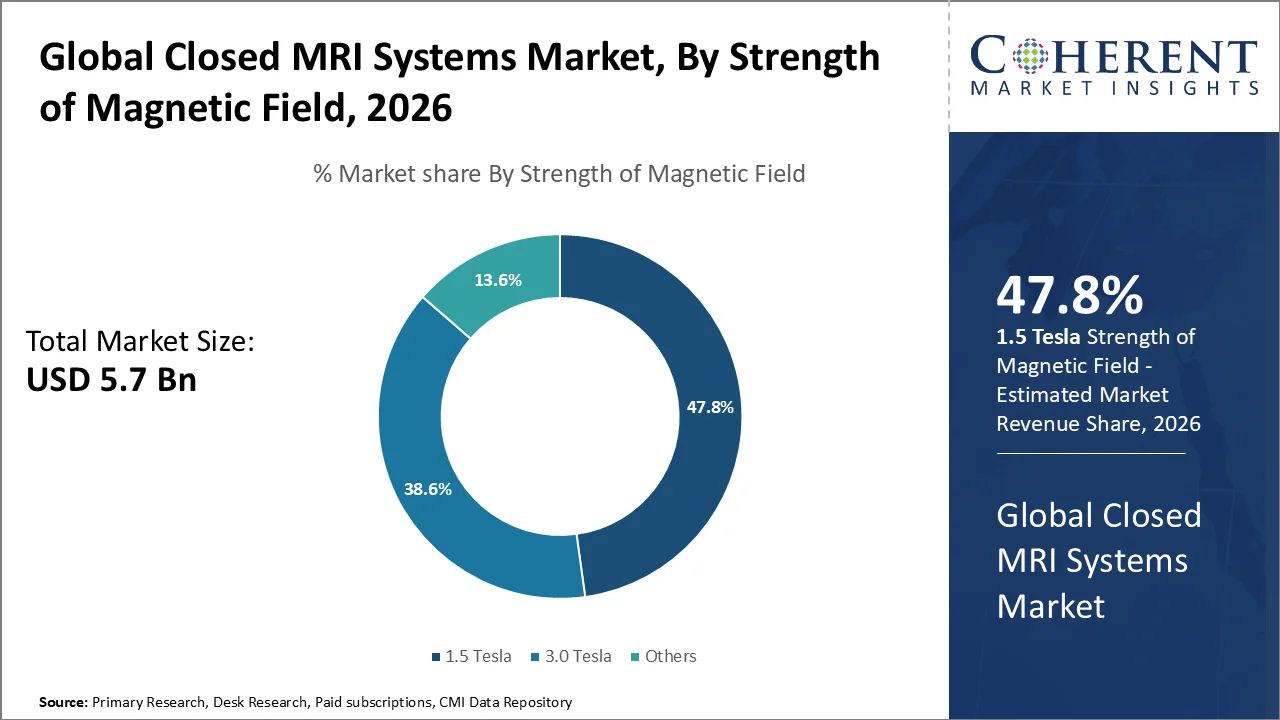
Why is 1.5 Tesla Segment Acquiring the Largest Share?
On the basis of strength of magnetic field, the 1.5 tesla segment is projected to account for the largest Closed MRI Systems Market share of 47.8% in 2026. The segment’s growth is owing to the ability to offer an established balance between image quality, examination speed, acquisition cost, power consumption, infrastructure requirements, and clinical flexibility.
In January 2026, Siemens Healthineers received FDA clearance for its 70-centimeter MAGNETOM Flow 1.5T platform. The system uses only 0.7 liters of liquid helium and eliminates the conventional quench pipe. Siemens has also stated that its energy management technologies can reduce annual consumption compared with earlier system generations.
- Current Industry Events of 2026
- Market Size Estimation
- Regional Breakdown
- Competitive Landscape
- Customer Intelligence
- Segmental Analysis
- Pricing Analysis
- Key Market Drivers, Challenges & Future Trends
- Customized Insights Section
Brain hold the Largest Market Share
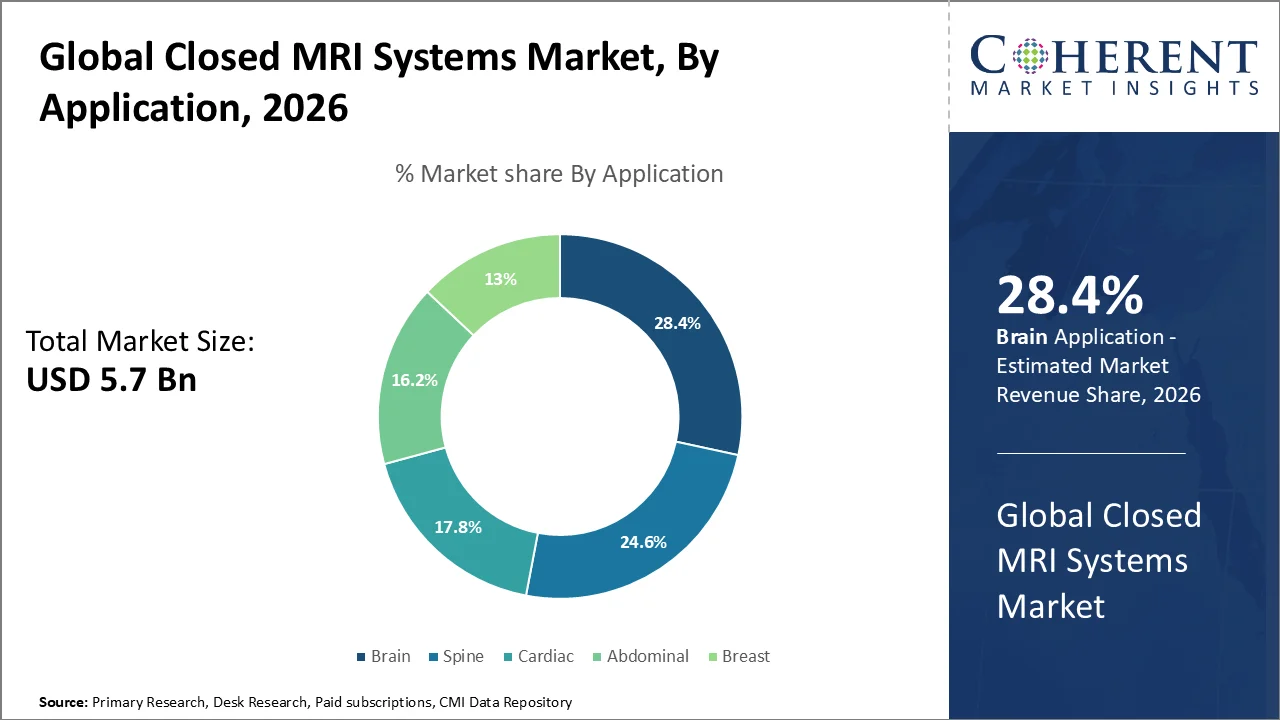
On the basis of application, the brain segment lead with a major 28.4% share in 2026. The growth is owing to the high prevalence of neurological disorders, growing stroke and dementia incidence, increasing use of MRI in tumor characterization, and broader adoption of diffusion, perfusion, functional, and spectroscopy protocols.
According to the World Health Organization, neurological disorders are responsible for more than 11 million deaths annually. Dementia alone affected approximately 57 million people, while nearly 10 million new dementia cases occur each year. These figures indicate a sustained diagnostic requirement for brain MRI across emergency care, neurology, oncology, geriatrics, pediatrics, and neurodegenerative disease management.
Market Drivers
Rising Innovations in Sustainable and AI-enabled Imaging are Transforming the Closed MRI Systems Market in the United States
The United States represents a major center for closed MRI innovation because of its extensive hospital network, high imaging intensity, established research ecosystem, and relatively rapid adoption of advanced radiology technologies. Manufacturers are introducing sealed magnets, wide-bore architectures, automated scan planning, deep-learning reconstruction, motion correction, and energy-management functions. These features improve image quality, reduce repeat scans, simplify patient positioning, and expand access to MRI in facilities where conventional helium-intensive systems may be difficult to install. OECD assessments also identify the U.S. as having one of the highest MRI equipment densities among member countries.
In February 2026, GE HealthCare received U.S. FDA clearances for SIGNA Sprint with Freelium, SIGNA Bolt, and SIGNA One. SIGNA Sprint incorporates a sealed 1.5T magnet designed to reduce dependence on helium, while SIGNA Bolt is a next-generation 3T platform intended for high-performance clinical and research imaging. SIGNA One integrates workflow tools across the imaging pathway. GE HealthCare stated that these clearances support its strategy around sustainability, productivity, advanced diagnostics, and modernization of its MRI portfolio.
Helium-independent MRI: A Major Breakthrough in the Closed MRI Systems Market
Conventional superconducting closed MRI systems have historically required large quantities of liquid helium to maintain the magnet at extremely low temperatures. This creates installation requirements, quench-pipe infrastructure, refill risks, supply exposure, and lifecycle expenses. Helium-independent and sealed-for-life magnet technologies address these constraints by permanently containing a much smaller volume of helium within the magnet. The resulting systems can be lighter, easier to site, less dependent on specialized infrastructure, and more suitable for community hospitals or diagnostic centers with limited installation space.
In November 2025, Philips unveiled BlueSeal Horizon, the first helium-free 3.0T MRI innovation platform. The system combines a sealed 3T magnet with AI-supported clinical and workflow capabilities for neurological, vascular, musculoskeletal, as well as complex whole-body imaging. The firm identified the platform as a work in progress, meaning commercial availability remained subject to regulatory and market requirements.
Current Events and Their Impact
Current Event | Description and its Impact |
2026 FDA Quality Management System Regulation Implementation in the U.S.
|
|
2025 FDA Cybersecurity Guidance for Connected Medical Devices |
|
Closed MRI Systems Market Trends
- Rising adoption of high-field 1.5T and 3.0T closed MRI systems supports detailed neurological, musculoskeletal, cardiac, and oncology imaging.
- Wider bores, quieter scanning, faster protocols, and feet-first examination capabilities assist in reducing claustrophobia, motion artifacts, repeat scans, as well as patient discomfort.
- Artificial intelligence-based reconstruction and automated positioning improve image sharpness, shorten acquisition times, and standardize workflows. The FDA-cleared SmartSpeed Precise applies machine-learning reconstruction across Philips 1.5T and 3.0T systems to improve signal-to-noise ratio and reduce artifacts.
- Increasing use of closed MRI systems for cancer detection, treatment planning, and therapy monitoring is expanding the demand across hospitals and diagnostic imaging centers. MRI provides high-resolution soft-tissue imaging without ionizing radiation. Globally, approximately 20 million new cancer cases and 9.7 million cancer-related deaths were recorded in 2022, thereby highlighting the growing need for cutting edge diagnostic imaging services.
- Low-helium sealed magnets and energy-efficient designs are becoming important procurement priorities by reducing infrastructure needs and supporting installation. In February 2026, GE HealthCare announced FDA clearances for SIGNA Sprint with Freelium, a sealed 1.5T system using less than 1% of conventional helium, SIGNA Bolt 3T, and the AI-driven SIGNA One platform. Medicare Part B covers medically necessary MRI examinations; after the deductible, patients pay 20% of the Medicare-approved amount at eligible facilities.
Regional Insights
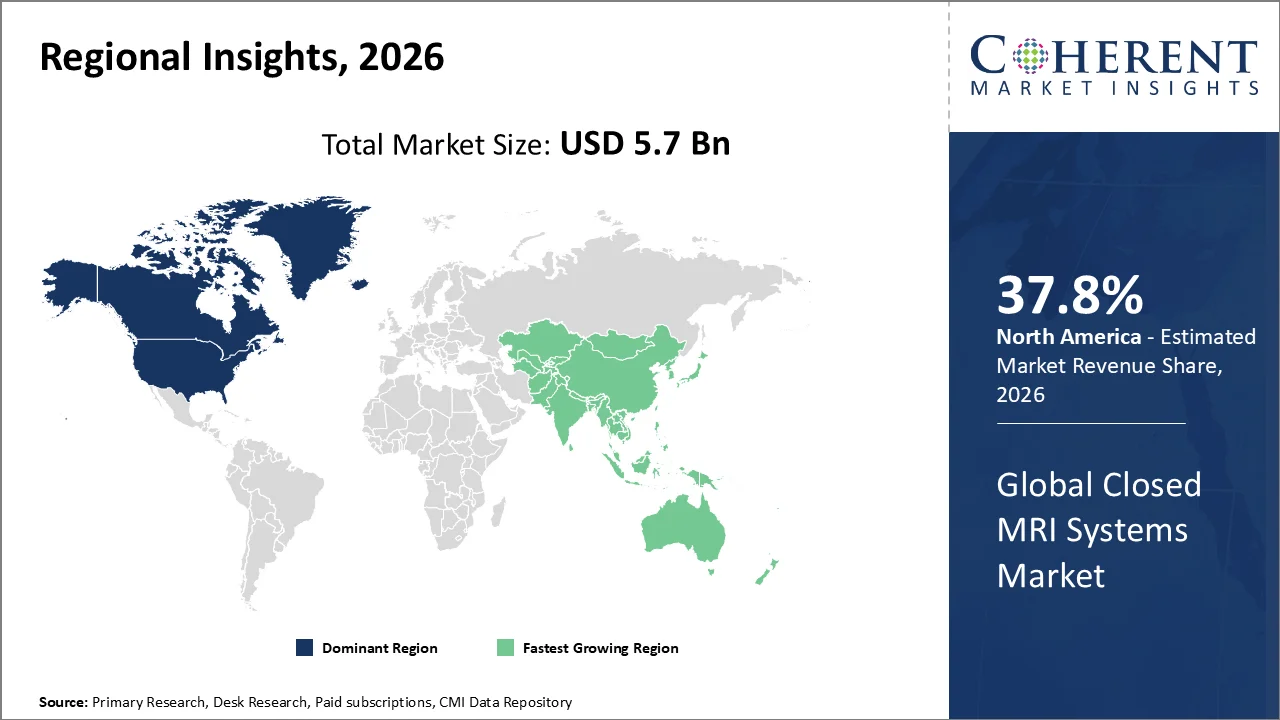
North America Dominates Owing to the High MRI Utilization and Technology Upgrades
The North America region accounts for 37.8% of the market share in 2026. The region’s growth is owing to the high diagnostic-imaging volumes, replacement of aging scanners, hospital investment in advanced 1.5T and 3.0T platforms, and persistent capacity gaps.
Canadian Institute for Health Information data show that Canada completed 16% more MRI and CT scans in 2024 than in 2019, indicating rising utilization across provincial health systems. However, access constraints remain substantial. The CIHI reported in June 2026 that one in ten Canadians requiring an MRI waited more than 200 days, thereby reinforcing the need for additional closed-bore MRI capacity and faster workflows.
In July 2023, Fujifilm received FDA 510(k) clearance for ECHELON Synergy, its 1.5T closed MRI system featuring a 70 cm horizontal bore. The system incorporates deep-learning reconstruction, automated patient positioning, flexible coils, accelerated acquisition, and workflow functions designed to improve image quality, examination efficiency, and patient comfort.
Asia Pacific Closed MRI Systems Market Trends
Asia Pacificis expected to witness strong growth in market over the forecast period. The region’s growth is owing to the hospital construction, rising insurance penetration, increasing neurological and cancer burdens, aging populations, urban diagnostic-center expansion, and efforts to improve access to advanced medical imaging.
OECD data indicate that Japan has approximately 57 MRI units per million population, while Cambodia, Pakistan, Myanmar, the Philippines, Sri Lanka, and Bangladesh report fewer than one unit per million. This substantial gap demonstrates both regional inequality and long-term equipment potential.
The region is also becoming an important MRI innovation and manufacturing center. United Imaging Healthcare reported research and development expenditure of CNY 2.26 billion in 2024, an increase of 17.84% year over year. The company’s portfolio includes 1.5T, 3T, and 5T MRI systems and AI-supported imaging technologies.
High Diagnostic Demand and FDA-Cleared Systems are Accelerating the Closed MRI Systems Market in United States
In the United States, the Closed MRI Systems Market is influenced by the high diagnostic utilization, extensive hospital infrastructure, and continued replacement of aging scanners. The American Hospital Association’s 2026 Fast Facts reported 35.7 million hospital admissions, thereby indicating a substantial patient base requiring neurological, musculoskeletal, cardiac, abdominal, as well as oncology imaging.
In June 2025, the U.S. FDA cleared Siemens Healthineers’ MAGNETOM Flow.Ace and MAGNETOM Flow.Plus, both 1.5T, 60-centimeter-bore MRI systems. The sealed, quench-pipe-free magnets and workflow technologies can simplify installation, improve operational efficiency, and encourage hospitals and outpatient imaging centers to expand or modernize closed MRI capacity nationwide over coming years.
China Closed MRI Systems Market Trends
China is emerging as a major growth market for Closed MRI Systems. The growth is owing to the expanding healthcare infrastructure, rising demand for advanced cancer and neurological imaging, and domestic innovation in high-field scanners. By the end of 2025, China had 1.108 million medical and health institutions, thereby supporting the broader installation opportunities across hospitals as well as diagnostic centers.
In February 2025, Fudan University Shanghai Cancer Center launched a full-body 5.0T MRI scanner for ultra-high-resolution tumor imaging. The system improves visualization of tumor boundaries, internal structures, and surrounding tissues, strengthening precision diagnosis and research while encouraging hospitals to upgrade conventional closed MRI platforms nationwide more rapidly.
Who are the Major Companies in Closed MRI Systems Industry
Some of the major key players in Closed MRI Systems Market are Hitachi, Siemens Healthineers, Canon Medical Systems, GE Healthcare, Philips, Aspect Imaging, Bruker, Aurora Imaging Technology and Esaote S.P.A.
Key News
- In May 2026, Philips announced Titanion MR, an ultra-high-gradient 0T closed MRI platform designed for quantitative and microstructural imaging. The system combines 150 mT/m gradient strength, AI-enabled SmartSpeed reconstruction, whole-body biomarker imaging, and lower infrastructure requirements. Titanion remains a work-in-progress product and is not yet commercially available.
- In November 2025, Siemens Healthineers introduced MAGNETOM Free.XL, a 0.55T MRI platform featuring a 100 cm flared bore for interventional and diagnostic imaging. The proposed system uses DryCool technology, AI-powered Deep Resolve reconstruction, needle-guidance software, and an integrated interventional MRI suite jointly developed with Cook Medical. The system remains under development.
Market Report Scope
Closed MRI Systems Market Report Coverage
| Report Coverage | Details | ||
|---|---|---|---|
| Base Year: | 2025 | Market Size in 2026: | USD 5.7 Bn |
| Historical Data for: | 2020 To 2024 | Forecast Period: | 2026 To 2033 |
| Forecast Period 2026 to 2033 CAGR: | 6.6% | 2033 Value Projection: | USD 8.9 Bn |
| Geographies covered: |
| ||
| Segments covered: |
| ||
| Companies covered: | Hitachi, Siemens Healthineers, Canon Medical Systems, GE Healthcare, Philips, Aspect Imaging, Bruker, Aurora Imaging Technology and Esaote S.P.A. | ||
| Growth Drivers: |
| ||
| Restraints & Challenges: |
| ||
Analyst Opinion
- The Closed MRI Systems Market growth is primarily driven by the sustained diagnostic need. Around 1.71 billion people worldwide live with musculoskeletal conditions, including low back pain, fractures, osteoarthritis, and neck pain. This substantial disease burden supports continued demand for high-resolution MRI examinations across hospitals and diagnostic imaging centers.
- MRI utilization is expanding across healthcare systems. Canada recorded 2.21 million MRI examinations in 2022–2023, equal to 55.6 exams per 1,000 people and 4.3% above 2019–2020 levels. Rising examination volumes strengthen replacement demand and hospital investment.
- Technology is shifting purchasing toward faster, more efficient closed platforms. AI-based reconstruction, automated positioning, wider bores, reduced-helium magnets, and shorter protocols improve throughput and patient experience. These improvements reduce operating constraints while preserving imaging, supporting adoption of 1.5T and 3T systems across neurology, oncology, musculoskeletal, cardiovascular, and whole-body diagnostic applications.
Speak to the analyst
Want personalized insights?
Take the findings above to one of our principal consultants, or have the report rebuilt around the segments, geographies and competitors you actually track.
Market Segmentation
- Strength of Magnetic Field Insights (Revenue, USD Bn, 2026-2033)
- 1.5 Tesla
- 3.0 Tesla
- Others
- Application Insights (Revenue, USD Bn, 2026-2033)
- Brain
- Spine
- Cardiac
- Breast
- Abdominal
- End User Insights (Revenue, USD Bn, 2026-2033)
- Hospitals
- Diagnostic Centers
- Research Institutes
- Regional Insights (Revenue, USD Bn, 2026 - 2033)
- North America
- U.S.
- Canada
- Latin America
- Brazil
- Argentina
- Mexico
- Rest of Latin America
- Europe
- U.K.
- Germany
- Italy
- France
- Russia
- Spain
- Rest of Europe
- Asia Pacific
- China
- India
- Japan
- ASEAN
- Australia
- South Korea
- Rest of Asia Pacific
- Middle East
- GCC
- Israel
- Rest of Middle East
- Africa
- North Africa
- Central Africa
- South Africa
- North America
- Key Players Insights
- Hitachi
- Siemens Healthineers
- Canon Medical Systems
- GE Healthcare
- Philips
- Aspect Imaging
- Bruker
- Aurora Imaging Technology
- Esaote S.P.A.
Sources
Primary Research Interviews
- Radiologists
- MRI technologists and radiographers
- Neurologists and neurosurgeons
- Hospital administrators
- Diagnostic imaging center managers
- Medical imaging procurement managers
- MRI equipment manufacturers
- Medical imaging equipment distributors
- Key opinion leaders (KOLs) in radiology and diagnostic imaging
Databases
- World Health Organization (WHO)
- Organisation for Economic Co-operation and Development (OECD)
- National Institutes of Health (NIH)
- National Institute of Biomedical Imaging and Bioengineering (NIBIB)
- U.S. Food and Drug Administration (FDA)
- Centers for Medicare & Medicaid Services (CMS)
- Eurostat
Magazines
- Radiology Business
- Diagnostic Imaging
- Health Imaging
- AuntMinnie
- Applied Radiology
Journals
- Radiology
- European Radiology
- Journal of Magnetic Resonance Imaging
- Magnetic Resonance in Medicine
- American Journal of Roentgenology
- European Journal of Radiology
Newspapers
- The New York Times
- The Guardian
- The Wall Street Journal
- Financial Times
Associations
- Radiological Society of North America
- American College of Radiology
- International Society for Magnetic Resonance in Medicine
- European Society of Radiology
- Society for Imaging Informatics in Medicine
- American Society of Radiologic Technologists
Public Domain Sources
- Company Annual Reports and Investor Presentations
- Government Health Ministry Publications
- FDA Medical Device Databases
- Clinical Trial Registries Such as ClinicalTrials.gov
- National Healthcare Infrastructure and Medical Equipment Statistics
- Hospital Procurement and Public Tender Databases
Proprietary Elements
- CMI Data Analytics Tool, Proprietary CMI Existing Repository of Information for Last 10 Years
Get access to 250+ pages report
Every segment, forecast, competitor profile and data table behind the analysis above — available for instant download.
- ESOMAR Member
- ISO 9001:2015 Certified
- D-U-N-S Registered
- GDPR & CCPA Compliant
Missing comfort of reading report in your local language? Find your preferred language:
Transform your Strategy with Exclusive Trending Reports
Frequently Asked Questions
The Closed MRI Systems Market is expected to reach USD 8.9 Billion in 2033.
The Closed MRI Systems Market is anticipated to grow at a CAGR of 6.6% between 2026 and 2033.
Among regions, North America is expected to account for a largest market share in the global Closed MRI Systems Market over the forecast period.
The market outlook is positive owing to the rising chronic diseases, expanding AI-assisted image reconstruction, and an ongoing demand for high-field (1.5T and 3.0T) systems used in oncology and neurology.
The closed MRI systems market refers to the global industry segment dedicated to manufacturing, selling, and servicing traditional, tube-like Magnetic Resonance Imaging (MRI) machines.
The superior magnetic field strength, faster scan times, and high diagnostic precision is boosting the demand for Closed MRI Systems.
The high capital and maintenance costs, limited helium availability, declining procedure reimbursement rates, and patient discomfort from the enclosed, claustrophobic design are the key factors hampering growth of the market.