

Compensation Software Market Size and Share Analysis - 2026 To 2033
The global compensation software market size is estimated to be valued at USD 1,892.4 Mn in 2026 and is projected to grow at a compound annual growth rate (CAGR) of 11.0% during the forecast period (2026-2033), surpassing USD 3,980 Mn by 2033. This growth is mostly due to attributed to increasing adoption of cloud-based Human Capital Management (HCM) solutions, rising demand for data-driven and automated compensation planning, and the need for greater pay transparency and compliance with evolving labor regulations across organizations.
Key Takeaways from the Compensation Software Market Report
- Cloud-based compensation software is expected lead the market with a share of 72% in 2026 due to growing SaaS adoption, faster deployment, and lower IT infrastructure costs compared to on-premise systems. For example, Gartner estimates that over 85% of organizations will adopt a cloud-first strategy by 2025, supporting the transition toward cloud-based deployment models.
- North America is projected to retain its dominance over the global compensation software industry with a share of 36% in 2026 due to early adoption of HR tech, strong presence of vendors like Workday, Oracle, SAP, and ADP, and well-developed enterprise compensation systems.
- Asia Pacific compensation software market is poised to exhibit fastest CAGR of 12% during the forecast period, thanks to rapid enterprise digitization, a growing IT sector, and increasing adoption of cloud-based HR tools by SMEs. For example, 85% of business leaders in Asia Pacific report that their organizations have already begun adoption of cloud computing.
Compensation Software Market Overview
The global compensation software market is expected to grow rapidly during the forecast period. This is mostly due to rising adoption of cloud-based HR solutions, increasing demand for automated payroll and incentive management systems, and growing need for data-driven compensation planning across organizations.
Companies are replacing manual spreadsheets with automated compensation platforms to reduce errors and save time. This shift towards adopting automation across enterprises is expected to boost growth of compensation software market during the forecast period.
Compensation management software is an important component of Human Capital Management (HCM) systems and plays a key role in talent management and employee retention. It helps organizations manage employee compensation, including salaries, bonuses, and incentives, based on job roles, responsibilities, and company pay structures.
Access to compensation software is typically provided to HR managers, while other managers may also be granted access depending on organizational permissions. Compensation management tools are often part of broader HCM suites that may also include payroll, benefits administration, and time and attendance management. However, standalone compensation software primarily focuses on pay planning, salary benchmarking, budgeting, and incentive management.
Many organizations prefer integrated HCM suites to reduce integration challenges and maintain consistent HR data across functions. Adoption of compensation management software is increasing across enterprises of various sizes as it improves transparency as well as supports structured, performance-based compensation planning.
Segmental Insights
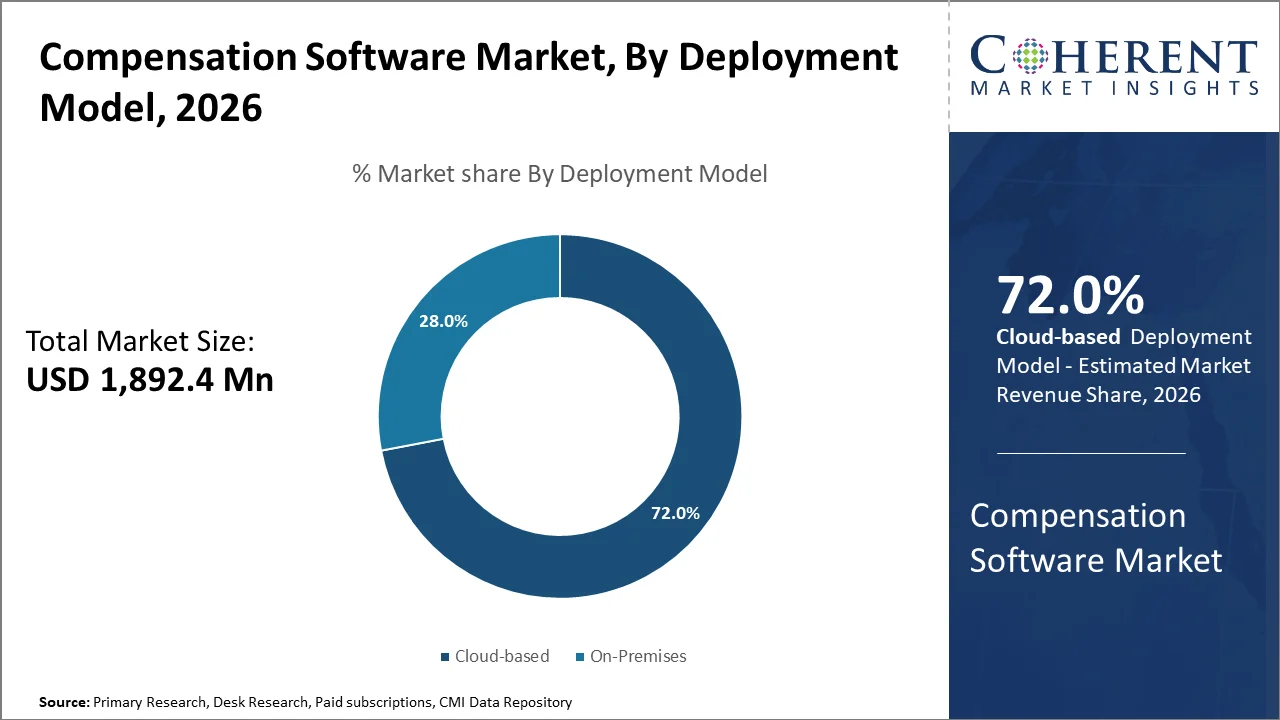
Which Deployment Model Dominates the Compensation Software Market?
Cloud-Based Compensation Software to Hold the Largest Market Share
According to Coherent Market Insights’ latest compensation software market analysis, cloud-based segment is set to account for a dominant market of 72% in 2026. This dominance can be attributed to growing preference among organizations for scalable, cost-effective, and easy-to-deploy solutions that eliminate the need for heavy on-premise infrastructure.
Cloud-based compensation software offers real-time access to payroll and reward data, seamless integration with HR systems, and enhanced flexibility for remote and hybrid work environments. In addition, it supports faster updates, automated compliance management, and advanced analytics capabilities, which help enterprises improve decision-making as well as ensure fair, transparent compensation practices. In April 2026, Payscale launched the Payscale Intelligence Cloud, a unified compensation intelligence platform designed to help organizations make faster and data-driven pay decisions.
- Current Industry Events of 2026
- Market Size Estimation
- Regional Breakdown
- Competitive Landscape
- Customer Intelligence
- Segmental Analysis
- Pricing Analysis
- Key Market Drivers, Challenges & Future Trends
- Customized Insights Section
Compensation Software Market Growth Drivers
Rising Demand for Automation in HR and Payroll
Rising demand for automated compensation processes is expected to drive growth of the compensation software market during the forecast period. Automation helps streamline compensation planning and execution, including policy implementation, compliance management, and other HR processes. It reduces paperwork, improves efficiency, and provides a centralized platform for managing employee compensation, thereby lowering administrative costs and minimizing manual errors. In April 2026, Sage launched Sage HCM, a human capital management solution designed for mid-market organizations in North America, expanding its accounting, HR, and payroll technology offerings.
Moreover, the growing adoption of digital HR technologies is also supporting market growth. Organizations are increasingly implementing cloud-based HR solutions to streamline workforce management processes. In addition, the rising use of mobile and digital platforms for HR operations is encouraging the adoption of integrated HR systems, enabling more efficient and data-driven compensation management.
Compensation Software Market Opportunities
Increasing Complexity of Compensation Structures
Organizations today are increasingly adopting complex pay models such as performance-based bonuses, stock options, equity compensation, variable pay, commissions, and region-based salary adjustments. This growing complexity requires advanced software solutions to manage compensation accurately and efficiently. Thus, increasing complexity in compensation structures is expected to create lucrative growth opportunities for the compensation software market during the forecast period.
Compensation Software Market Trends
Rise of AI, Analytics, and Predictive Compensation
Rising adoption of artificial intelligence and machine learning is a key growth-shaping trend in the compensation software market. Modern compensation platforms are increasingly incorporating AI-driven salary benchmarking, predictive pay modeling, and advanced compensation analytics. These tools have the tendency to help organizations improve pay decision-making by enabling data-driven insights, scenario modeling, and more dynamic compensation planning, reducing reliance on static annual review cycles.
For example, in February 2026, Such innovations are expected to boost compensation software market revenue during the forthcoming period.
Current Events and Their Impact on the Compensation Software Market
Current Event | Description and its Impact |
AI-driven demand accelerating payroll & HCM software adoption (Workday earnings, 2026) |
|
Payroll system fragmentation is increasing errors and compliance risk |
|
Regional Insights
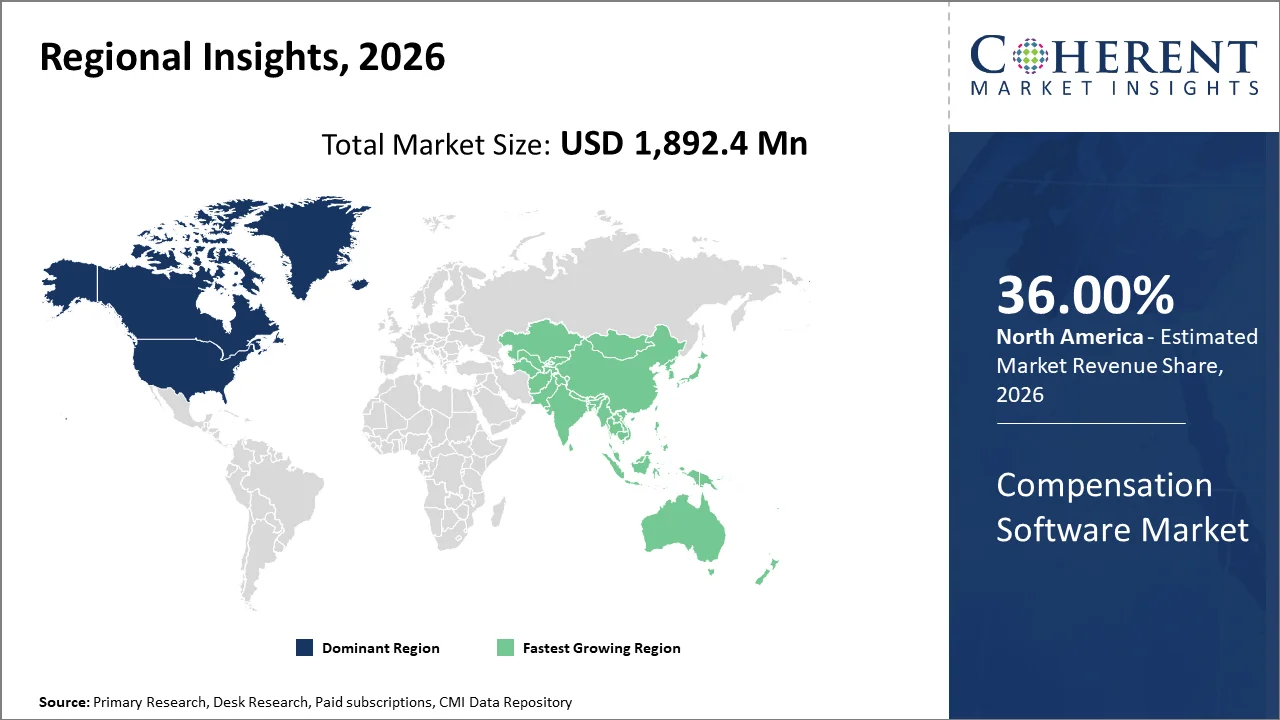
North America Remains a Prominent Market for Compensation Software
North America is expected to dominate the global compensation software market, capturing a share of 36% in 2026. This is mostly due to increasing adoption of advanced HR technologies and strong pay transparency regulations. Rapid shift toward cloud-based HR systems, widespread use of AI for salary benchmarking, and increasing focus on pay equity compliance are also boosting market growth in the region.
Rising cost and complexity of hiring, which is pushing companies to adopt automation in compensation planning, is also boosting North America software compensation market. According to SHRM, the average cost per hire in the United States was nearly $4,700, reflecting the growing expenses associated with recruitment and talent acquisition. Rising hiring costs are encouraging organizations to adopt more efficient compensation and workforce management systems to improve employee retention as well as control labor expenses.
Asia Pacific Remains at the Epicenter of Compensation Software Market Growth
Asia Pacific is anticipated to emerge as the fastest-growing market for compensation software solutions during the forecast period, registering a CAGR of 12.0%. This growth can be attributed to rapid enterprise digitalization and expanding workforce across countries like China, India, and Japan.
In addition, rising adoption of cloud HR platforms, growing demand for automated payroll systems, and increasing use of compensation tools by multinational companies are boosting Asia Pacific compensation software market. Similarly, rapid shift toward digital payments and large-scale workforce formalization is creating need for structured and automated compensation systems to manage large, mobile, and diverse employee bases efficiently.
Compensation Software Market Outlook – Country-wise
U.S. Compensation Software Market Trends
The U.S. is expected to remain a leading market for compensation management software during the assessment period. This is due to increasing high enterprise digital maturity, strong regulatory focus on pay transparency, and widespread adoption of cloud-based HR systems. Key trends include rapid use of AI-powered compensation planning tools and growing demand for pay equity analytics.
China Compensation Software Market Forecast
China accounts for a prominent share of the Asia Pacific compensation software market. This is mostly due to a highly digital workforce, strong mobile-first ecosystem, and rapid enterprise automation. Integration of AI in HR platforms and fast adoption of cloud payroll systems across large enterprises are also boosting market growth in China.
Who are the Major Companies in the Compensation Software Market?
Some of the major players in compensation software market are ADP LLC, Oracle Corporation, SAP Success Factors, Ultimate Software, and Workday Inc., HRsoft, Kinixsys, Kronos, Beqom, Halogen Software, Willis Towers Watson, Greytip Software, SumHR, Talentsoft, BullseyeEngagement, JSM Technologies Decusoft, Peoplefluent, Execupay, PayScale, CWS Software, Cornerstone, Curo, Harvest HCM, Nitso Technologies, and Lumesse.
Key Strategies Adopted by Industry Players
Top compensation software companies are adopting various strategies to expand their regional presence as well as boost their sales growth. These include new product launches, mergers, acquisitions, partnerships, facility expansions, and distribution agreements. They are also integrating advanced technologies like artificial intelligence (AI), machine learning (ML), and predictive analytics to enhance compensation planning accuracy and automation.
Recent Developments in the Compensation Software Market
- In February 2026, WTW launched Rewards AI, a generative AI-powered compensation platform for HR and compensation professionals. The platform helps companies analyze pay data, improve compensation planning, and support better workforce decisions.
- In October 2025, Performio launched AI-powered features for its incentive compensation management platform. The new features help businesses automate commission planning, improve sales compensation processes, and increase efficiency.
- In October 2025, ADP acquired Pequity, a compensation management software provider. The acquisition expanded ADP’s compensation planning and pay management tools for enterprise and multinational clients.
Market Report Scope
Compensation Software Market Report Coverage
| Report Coverage | Details | ||
|---|---|---|---|
| Base Year: | 2025 | Market Size in 2026: | USD 1,892.4 Mn |
| Historical Data for: | 2020 To 2024 | Forecast Period: | 2026 To 2033 |
| Forecast Period 2026 to 2033 CAGR: | 11.0% | 2033 Value Projection: | USD 3,980 Mn |
| Geographies covered: |
| ||
| Segments covered: |
| ||
| Companies covered: | ADP LLC, Oracle Corporation, SAP Success Factors, Ultimate Software, and Workday Inc., HRsoft, Kinixsys, Kronos, Beqom, Halogen Software, Willis Towers Watson, Greytip Software, SumHR, Talentsoft, BullseyeEngagement, JSM Technologies Decusoft, Peoplefluent, Execupay, PayScale, CWS Software, Cornerstone, Curo, Harvest HCM, Nitso Technologies, and Lumesse | ||
| Growth Drivers: |
| ||
| Restraints & Challenges: |
| ||
Analyst Opinion (Expert Opinion)
- Organizations are rapidly shifting from spreadsheets to automated compensation planning tools to improve pay transparency, budgeting accuracy, and workforce planning. Large enterprises dominate usage due to complex salary structures and multi-region compliance needs.
- Cloud-based deployment is becoming the default model. Cloud solutions now account for the majority of adoption because they offer faster implementation, easier integration with HR suites, and scalability for global workforces. Many firms are moving away from on-premise systems due to cost and maintenance efficiency.
- On a global scale, there are more than 3.5 billion people that are in employment, which results in a huge need for proper systems of payments.
- AI and analytics are reshaping compensation decisions. Modern platforms increasingly use AI for pay benchmarking, merit recommendations, and equity analysis. This is shifting compensation from static annual cycles to continuous, data-driven decision-making integrated with performance systems.
Speak to the analyst
Want personalized insights?
Take the findings above to one of our principal consultants, or have the report rebuilt around the segments, geographies and competitors you actually track.
Market Segmentation
- By Deployment Model Insights ( Revenue, USD Mn, 2021 - 2033)
- On-premises
- Cloud-based
- By Region Insights ( Revenue, USD Mn, 2021 - 2033)
- North America
- U.S.
- Canada
- Latin America
- Brazil
- Argentina
- Mexico
- Rest of Latin America
- Europe
- Germany
- U.K.
- Spain
- France
- Italy
- Russia
- Rest of Europe
- Asia Pacific
- China
- India
- Japan
- Australia
- South Korea
- ASEAN
- Rest of Asia Pacific
- Middle East & Africa
- GCC Countries
- Israel
- Rest of Middle East & Africa
- North America
Sources
Primary Research interviews
- Interviews and discussions with HR managers, compensation & benefits specialists, payroll administrators, CHROs, and enterprise software users across SMEs and large enterprises.
Databases
- Government labor statistics databases
- Corporate filings databases
- Open payroll and employment datasets
- Company annual reports
- Financial disclosures
- Global workforce statistics portals
Magazines
- HR Technology-focused magazines
- Business technology publications
- Enterprise IT magazines
- Payroll/HR digital transformation publications
Journals
- Peer-reviewed journals on human resource management
- Organizational behaviour
- Workforce analytics
- Information systems
- Enterprise software development
Newspapers
- Leading business and financial newspapers covering technology adoption, workforce trends, compensation practices, and enterprise software news.
Associations
- Human resource management associations
- Payroll and compensation professional bodies
- IT software industry associations
- Workforce development organizations.
Public Domain sources
- Government labor departments
- International labor organizations
- Regulatory filings
- Open corporate reports
- Policy documents
- Publicly available research papers and statistics
Proprietary Elements
- CMI Data Analytics Tool
- Proprietary CMI Existing Repository of information for last 10 years.
Get access to 250+ pages report
Every segment, forecast, competitor profile and data table behind the analysis above — available for instant download.
- ESOMAR Member
- ISO 9001:2015 Certified
- D-U-N-S Registered
- GDPR & CCPA Compliant
Missing comfort of reading report in your local language? Find your preferred language:
Transform your Strategy with Exclusive Trending Reports
Frequently Asked Questions
The global market is estimated to be valued at USD 1,892.4 Mn in 2026.
The global Compensation Software Market value is expected to reach USD 3,980 Mn by 2033.
The global market is poised to exhibit a CAGR of 11.0% from 2026 to 2033.
Major growth factors include rising demand for automated compensation processes, increasing complexity of compensation structures, and adoption of AI-based compensation software solutions.
Cloud-based segment is set to dominate the market with a share of 72% in 2026.
Some major companies in the Compensation Software Market include ADP LLC, Oracle Corporation, SAP Success Factors, Ultimate Software, Workday Inc., HRsoft, Kinixsys, Kronos, Beqom, Halogen Software, Willis Towers Watson, Greytip Software, SumHR, Talentsoft, BullseyeEngagement, JSM Technologies Decusoft, Peoplefluent, Execupay, PayScale, CWS Software, Cornerstone, Curo, Harvest HCM, Nitso Technologies, and Lumesse.
North America is expected to lead the market with a share of 36% in 2026.