

Digital Fluoroscopy System Market Size and Forecast — 2026 - 2033
The Global Digital Fluoroscopy System Market size is estimated to be valued at USD 1.25 billion in 2026 and is expected to reach USD 2.05 billion by 2033, exhibiting a compound annual growth rate (CAGR) of 7.3% from 2026 to 2033.
Overview
Key drivers of the Digital Fluoroscopy System market include the rising prevalence of chronic diseases requiring real-time imaging, such as gastrointestinal, cardiovascular, and orthopedic conditions. Growing demand for minimally invasive diagnostic and interventional procedures is significantly boosting adoption. Technological advancements, including enhanced image resolution, lower radiation exposure, and integration with digital imaging systems, are improving clinical efficiency and patient safety. Expanding healthcare infrastructure, especially in emerging economies, is increasing equipment installation. Rising geriatric population and higher diagnostic imaging volumes further support demand. Additionally, growing preference for cost-effective, time-efficient imaging solutions and continuous upgrades of hospital radiology departments are accelerating market growth globally.
Key Takeaways
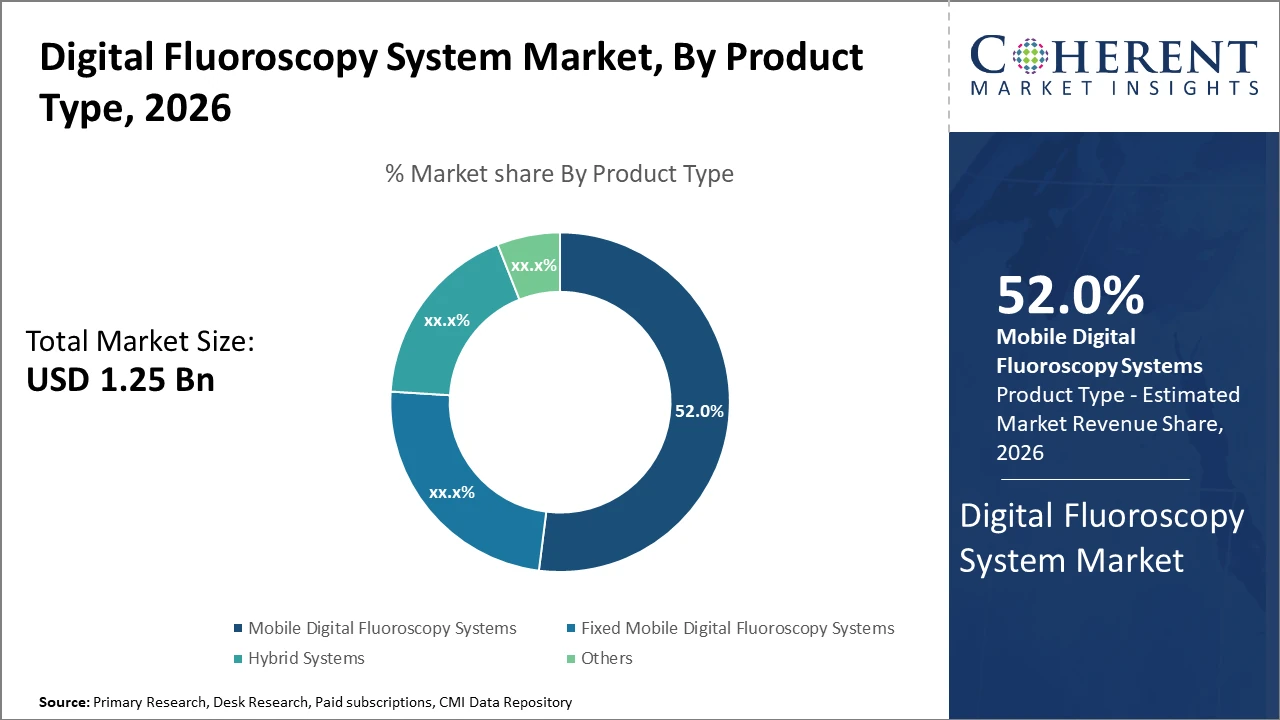
Mobile Digital Fluoroscopy Systems account for more than 52% of the market share, driven by their portability, operational flexibility, and increasing adoption in ambulatory surgical centers and outpatient settings.
Orthopedics is the fastest-growing application segment, supported by rising volumes of fracture management procedures, sports injury treatments, and minimally invasive orthopedic surgeries worldwide.
Hospitals remain the dominant end-user segment due to the extensive use of digital fluoroscopy systems across departments such as cardiology, orthopedics, gastroenterology, and interventional radiology.
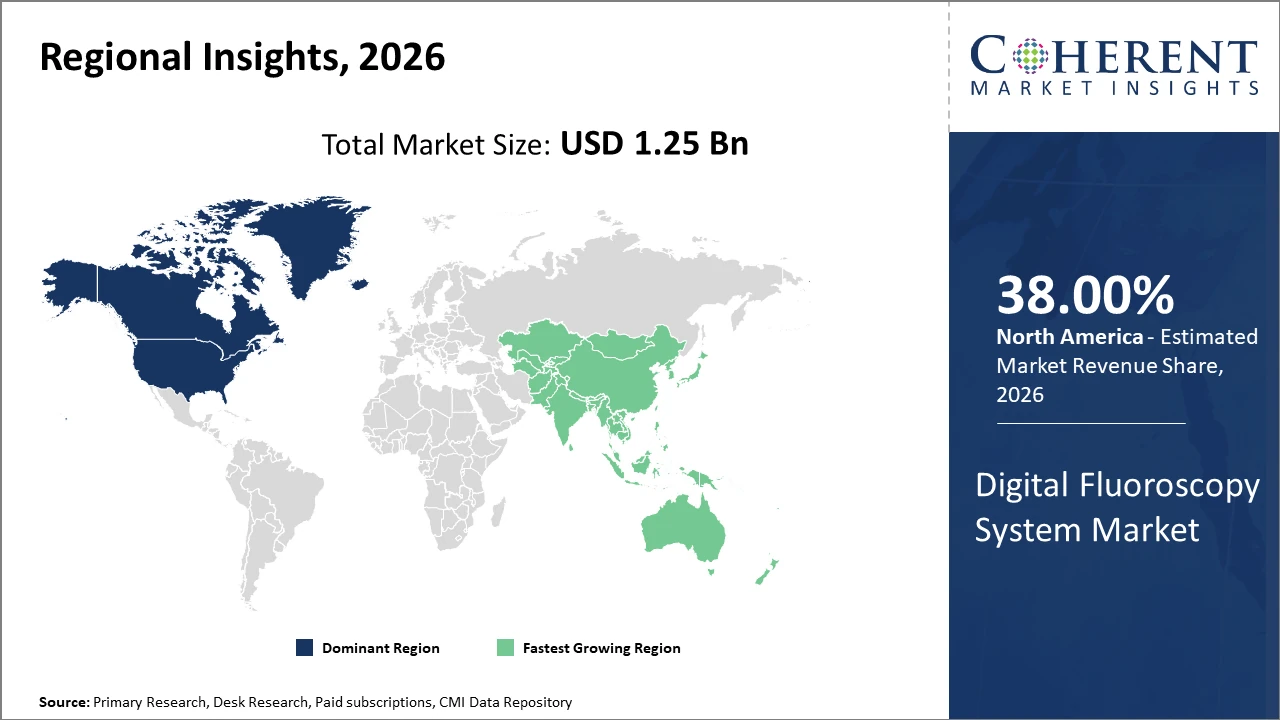
North America leads the global market with the largest revenue share, supported by advanced healthcare infrastructure and rapid technology adoption, while Asia Pacific is the fastest-growing region, registering a CAGR above 8% due to expanding healthcare access, rising investments, and supportive government initiatives in countries such as China and India.
Digital Fluoroscopy System Market Segmentation Analysis
Digital Fluoroscopy System Market Insights, By Product Type
Mobile Digital Fluoroscopy Systems lead the market with approximately 52% of total revenue, driven by their portability, flexibility, and ability to support a wide range of clinical applications across hospitals, emergency departments, and ambulatory surgical centers. Their mobility improves workflow efficiency and enhances patient care in dynamic healthcare environments. Hybrid Systems represent the fastest-growing product segment, combining fluoroscopy with advanced imaging technologies such as CT or MRI to deliver comprehensive diagnostic and interventional capabilities. Fixed Digital Fluoroscopy Systems continue to play a vital role in high-volume hospitals due to their reliability and imaging performance.
Digital Fluoroscopy System Market Insights, By Application
Orthopedics is the dominant application segment in the Digital Fluoroscopy System market, driven by the growing number of fracture repair procedures, joint replacements, and trauma-related surgeries that require real-time imaging for accurate implant placement and surgical guidance. The increasing prevalence of musculoskeletal disorders and sports injuries further supports segment growth. Cardiovascular applications represent the fastest-growing segment, fueled by the rising incidence of heart disease and expanding use of minimally invasive procedures such as angioplasty and stenting. Gastroenterology continues to generate steady demand for diagnostic and therapeutic procedures, while urology and other specialized fields increasingly utilize fluoroscopic guidance for improved procedural accuracy and outcomes.
Digital Fluoroscopy System Market Insights, By End User
Hospitals hold the largest share of the Digital Fluoroscopy System market due to their extensive use of imaging technologies across multiple departments, including orthopedics, cardiology, gastroenterology, and interventional radiology. Continuous investments in advanced diagnostic equipment and imaging infrastructure further strengthen their market position. Ambulatory Surgical Centers (ASCs) are the fastest-growing end-user segment, supported by the increasing adoption of minimally invasive outpatient procedures that require compact and mobile fluoroscopy systems. Diagnostic centers contribute steadily through imaging and monitoring services, while clinics generate stable demand, particularly for orthopedic, pain management, and specialized procedural applications.
Digital Fluoroscopy System Market Trends
Healthcare providers are increasingly demanding digital fluoroscopy systems that deliver higher image quality while minimizing patient and operator radiation exposure.
Integration of artificial intelligence (AI) and deep learning technologies is improving diagnostic accuracy, workflow efficiency, and automated anomaly detection in imaging procedures.
Portable and mobile digital fluoroscopy systems are experiencing strong adoption, particularly in outpatient facilities, ambulatory surgical centers, and emergency care settings.
Growing preference for minimally invasive procedures is driving demand for advanced fluoroscopy systems capable of providing real-time, high-definition imaging guidance.
Hybrid operating rooms equipped with multiple imaging modalities, including advanced fluoroscopy systems, are becoming the standard for complex surgical and interventional procedures.
Continuous advancements in flat-panel detector technology, image processing software, and dose optimization features are further enhancing system performance and clinical outcomes.
Digital Fluoroscopy System Market Insights, By Geography
North America Digital Fluoroscopy System Market Analysis and Trends
North America dominates the Digital Fluoroscopy System market, accounting for approximately 38% of global market share in 2026. The region's leadership is supported by advanced healthcare infrastructure, high healthcare spending, and widespread adoption of innovative medical imaging technologies. Strong demand from cardiovascular, orthopedic, and interventional radiology departments continues to drive system utilization across hospitals and specialty care centers. Government initiatives supporting medical device innovation and favorable reimbursement frameworks further contribute to market growth. In addition, the presence of leading imaging technology manufacturers and large healthcare networks encourages continuous investment in advanced fluoroscopy systems, strengthening North America's position as a key regional market.
Asia Pacific Digital Fluoroscopy System Market Analysis and Trends
Asia Pacific is expected to be the fastest-growing region in the Digital Fluoroscopy System market, registering a CAGR of over 8% between 2026 and 2033. Growth is driven by rapid expansion of healthcare infrastructure, increasing investments in hospitals and diagnostic centers, and rising awareness of advanced medical imaging technologies. Government initiatives aimed at improving access to quality healthcare and diagnostic services in countries such as India and China are further supporting market development. The growing prevalence of chronic diseases and demand for minimally invasive procedures are accelerating system adoption. Additionally, multinational manufacturers are strengthening regional distribution networks and aftersales support to capture emerging opportunities.
Digital Fluoroscopy System Market Outlook for Key Countries
USA Digital Fluoroscopy System Market Analysis and Trends
The United States represents the largest revenue contributor to the Digital Fluoroscopy System market, driven by advanced healthcare infrastructure, strong reimbursement support, and rapid adoption of innovative imaging technologies. The growing number of minimally invasive procedures has significantly increased demand for real-time imaging solutions across hospitals and specialty centers. Continued investments in research and development have accelerated the integration of artificial intelligence, advanced image processing, and radiation dose reduction technologies into fluoroscopy systems. The presence of major medical imaging companies and extensive healthcare networks further supports market expansion. These factors collectively reinforce the U.S. position as a key driver of global market growth.
Germany Digital Fluoroscopy System Market Analysis and Trends
Germany represents one of the leading markets for Digital Fluoroscopy Systems in Europe, supported by its advanced healthcare infrastructure, strong medical technology sector, and high adoption of diagnostic imaging equipment. Demand is driven by the increasing prevalence of cardiovascular, orthopedic, and gastrointestinal disorders requiring image-guided interventions. Hospitals and specialized clinics continue to invest in advanced fluoroscopy systems featuring flat-panel detectors, AI-assisted imaging, and radiation dose optimization technologies. A key market trend is the growing preference for minimally invasive procedures, which require high-quality real-time imaging. Additionally, government support for healthcare modernization and digitalization is expected to sustain market growth.
Analyst Opinion
The growing adoption of minimally invasive surgeries has increased demand for digital fluoroscopy systems, with image-guided procedures rising by approximately 15% globally in 2025.
Technological advancements and heightened market competition reduced average fluoroscopy system prices by nearly 8% in 2024, improving affordability and adoption in emerging markets.
Countries such as India and Brazil recorded around 20% year-over-year growth in fluoroscopy system imports in 2026, driven by expanding healthcare infrastructure and demand for digital diagnostics.
Flat-panel detector (FPD) technology has become the industry standard, accounting for over 60% of global installations in 2025 due to its superior image quality, dose efficiency, and broad clinical applicability.
- Current Industry Events of 2026
- Market Size Estimation
- Regional Breakdown
- Competitive Landscape
- Customer Intelligence
- Segmental Analysis
- Pricing Analysis
- Key Market Drivers, Challenges & Future Trends
- Customized Insights Section
Market Scope
| Report Coverage | Details | ||
|---|---|---|---|
| Base Year: | 2025 | Market Size in 2026: | USD 1.25 billion |
| Historical Data for: | 2020 To 2024 | Forecast Period: | 2026 To 2033 |
| Forecast Period 2026 to 2033 CAGR: | 7.3% | 2033 Value Projection: | USD 2.05 billion |
| Geographies covered: |
| ||
| Segments covered: |
| ||
| Companies covered: | GE Healthcare, Philips Healthcare, Siemens Healthineers, Hologic Inc., Shimadzu Corporation, Samsung Medison, Esaote S.p.A., FUJIFILM Holdings Corporation | ||
| Growth Drivers: |
| ||
Digital Fluoroscopy System Market Growth Factors
The Digital Fluoroscopy System market is driven by the increasing prevalence of chronic diseases, particularly cardiovascular, orthopedic, and gastrointestinal disorders that require advanced imaging for accurate diagnosis and image-guided interventions. Rising healthcare investments by governments and private organizations are expanding access to modern diagnostic technologies, especially across North America and Asia Pacific. Technological advancements such as low-dose radiation imaging, flat-panel detectors, and AI-assisted image processing are improving patient safety and clinical outcomes, encouraging broader adoption. Additionally, the growing shift toward outpatient care and minimally invasive procedures is increasing demand for mobile and hybrid fluoroscopy systems, supporting long-term market growth and revenue expansion.
Digital Fluoroscopy System Market Development
In December 2024, at RSNA 2024, Siemens Healthineers launched the Luminos Q.namix1 platform for advanced fluoroscopy and radiography. The system integrates both functions into a single platform to reduce time, space, and costs. It aims to address productivity challenges in radiology departments caused by complex workflows and system operations.
Key Players
Leading Companies of the Market
GE Healthcare
Philips Healthcare
Siemens Healthineers
Shimadzu Corporation
Hologic Inc.
Samsung Medison
Esaote S.p.A.
FUJIFILM Holdings Corporation
Leading companies in the Digital Fluoroscopy System market are adopting a combination of product innovation, strategic partnerships, geographic expansion, and technology integration to strengthen their competitive positions. Manufacturers are increasingly investing in artificial intelligence-enabled imaging platforms, advanced detector technologies, and workflow automation solutions to improve diagnostic accuracy, enhance operational efficiency, and support clinical decision-making. At the same time, companies are expanding their presence in high-growth regions through collaborations with local distributors, healthcare providers, and hospital networks. These strategies have enabled market participants to increase customer reach, improve service capabilities, accelerate adoption of advanced fluoroscopy systems, and reinforce their market share in both developed and emerging healthcare markets.
Digital Fluoroscopy System Market Future Outlook
The Digital Fluoroscopy System market is expected to witness sustained growth over the coming years, driven by increasing demand for minimally invasive procedures and advanced real-time imaging technologies. Rising prevalence of cardiovascular, orthopedic, and gastrointestinal disorders will continue to support the need for fluoroscopy-guided diagnostics and interventions. Technological advancements, including artificial intelligence, flat-panel detectors, low-dose radiation systems, and hybrid imaging platforms, are expected to improve clinical outcomes and workflow efficiency. Expanding healthcare infrastructure in emerging economies and growing investments in diagnostic imaging equipment will create new growth opportunities. Additionally, the shift toward outpatient care settings will further accelerate market adoption globally.
Digital Fluoroscopy System Market Historical Analysis
The Digital Fluoroscopy System market has evolved significantly over the past decade, driven by continuous advancements in medical imaging technology and growing demand for image-guided procedures. Early adoption was concentrated in large hospitals and specialized diagnostic centers, particularly in North America and Europe. The transition from conventional fluoroscopy to digital systems improved image quality, reduced radiation exposure, and enhanced workflow efficiency, accelerating market penetration. Rising prevalence of cardiovascular, orthopedic, and gastrointestinal disorders further increased demand for real-time imaging solutions. Additionally, advancements in flat-panel detector technology, improved reimbursement policies, and expanding healthcare infrastructure contributed to steady market growth across developed and emerging regions.
Sources
Primary Research Interviews:
Radiologists, interventional radiologists, cardiologists, orthopedic surgeons, gastroenterologists, hospital imaging directors, diagnostic center administrators, medical device manufacturers, distributors, and healthcare procurement specialists involved in the adoption and utilization of digital fluoroscopy systems.
Biomedical engineers, medical imaging researchers, fluoroscopy technology specialists, regulatory consultants, clinical investigators, healthcare IT professionals, and R&D directors specializing in diagnostic imaging systems, flat-panel detector technologies, AI-assisted imaging, radiation dose optimization, and image-guided interventions.
Magazines:
Imaging Technology News (ITN) – Insights into medical imaging innovations, fluoroscopy technologies, and radiology market developments.
Radiology Today – Coverage of advancements in diagnostic imaging, interventional radiology, and healthcare imaging trends.
AuntMinnie – Updates on radiology technologies, medical imaging systems, and clinical imaging applications.
Journals:
Radiology – Research on diagnostic imaging technologies, fluoroscopy applications, and image-guided procedures.
Journal of Vascular and Interventional Radiology – Studies focused on fluoroscopy-guided interventions, imaging techniques, and procedural outcomes.
European Radiology – Research related to advanced imaging systems, radiation safety, and innovations in radiological practice.
Newspapers:
Financial Times – Coverage of medical device investments, mergers and acquisitions, and healthcare technology market trends.
Reuters – Reporting on imaging system launches, regulatory approvals, and developments within the medical device industry.
Bloomberg – Insights into strategic partnerships, technological innovations, and expansion activities of leading imaging equipment manufacturers.
Associations:
Radiological Society of North America – Research developments, imaging standards, and advancements in diagnostic radiology.
o American College of Radiology – Clinical guidelines, imaging best practices, and radiology technology updates.
Society of Interventional Radiology – Information on image-guided procedures, fluoroscopy applications, and interventional radiology innovations.
Get access to 250+ pages report
Every segment, forecast, competitor profile and data table behind the analysis above — available for instant download.
- ESOMAR Member
- ISO 9001:2015 Certified
- D-U-N-S Registered
- GDPR & CCPA Compliant
Missing comfort of reading report in your local language? Find your preferred language:
Transform your Strategy with Exclusive Trending Reports
Frequently Asked Questions
The market is led by major medical imaging companies such as Samsung Medison, Siemens Healthineers, GE HealthCare, and Philips Healthcare. These companies hold significant market shares due to their comprehensive product portfolios, strong global distribution networks, and continuous investments in imaging innovation.
The Digital Fluoroscopy System market is projected to grow from USD 1.25 billion in 2026 to approximately USD 2.05 billion by 2033, registering a CAGR of 7.3% during the forecast period.
Hospitals represent the largest end-user segment, driven by extensive utilization of digital fluoroscopy systems across orthopedics, cardiology, gastroenterology, urology, and interventional radiology departments.
Market trends are expected to include increased adoption of AI-powered imaging solutions, expansion of portable and mobile fluoroscopy systems, wider implementation of low-dose imaging technologies, and growing deployment of hybrid operating rooms equipped with advanced imaging platforms.
The market is highly competitive, with manufacturers focusing on technological innovation, product differentiation, and service capabilities. Key challenges include stringent regulatory requirements, high equipment costs, and the need to optimize image quality while minimizing radiation exposure.
Leading companies commonly pursue product innovation, strategic partnerships, regional expansion, distributor collaborations, and targeted solutions for specific clinical applications. These strategies help strengthen market presence, improve customer reach, and capitalize on growing demand for advanced imaging technologies.