

Hyperspectral Imaging Market Size and Forecast – 2026 to 2033
The Global Hyperspectral Imaging Market is estimated to be valued at USD 304.0 Mn in 2026 and is expected to reach USD 869.5 Mn by 2033, exhibiting a compound annual growth rate (CAGR) of 16.2% from 2026 to 2033.
Key Takeaways
- Based on Type, the Hyperspectral Imaging Cameras segment is expected to contribute the highest share of the market with 44.6% in 2026 owing to the integration of artificial intelligence.
- Based on Application, the Disease Diagnosis segment is expected to contribute the highest share of the market with 36.7% in 2026 on account of the enhanced diagnostic precision.
- Based on End User, the Hospitals segment is expected to contribute the highest share with 42.6% in 2026 owing to its enhanced diagnostic accuracy.
- By Regions, North America is expected to top the global market with 32.8% share in 2026 owing to its robust government funding and defense investments.
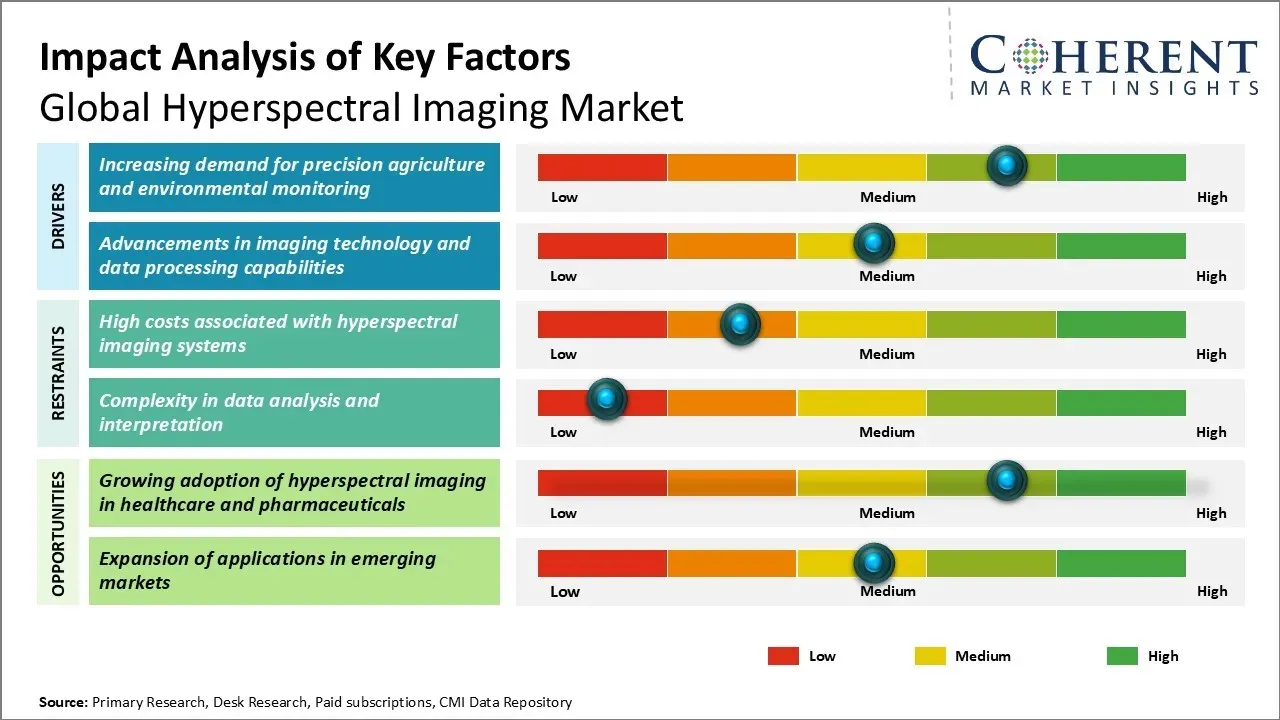
Market Overview
Hyperspectral imaging in healthcare uses advanced technology to capture a wide spectrum of light across many narrow bands, enabling detailed analysis of tissues and organs. It helps in detecting abnormalities like tumors, monitoring wound healing, guiding surgeries with precision, and aiding early cancer detection. this non-invasive technique enhances diagnostics and supports more accurate, personalized medical care. The growth of the global hyperspectral imaging market demand is driven by rising demand for personalized medicine as hyperspectral imaging supports personalized treatment plans by providing more accurate, patient-specific data. healthcare providers are increasingly focusing on early detection of diseases, where hyperspectral imaging can play a significant role.
Current Events and their Impact on the Hyperspectral Imaging Market
Current Events | Description and its impact |
Geopolitical Developments |
|
Economic and Market Dynamics |
|
Industry Collaborations and Funding |
|
End-user Feedback and Unmet Needs in the Hyperspectral Imaging Market
- Need for Cost-Effective Solutions: End-users often highlight the high cost of hyperspectral imaging systems as a major barrier to wider adoption. Organizations, especially in healthcare and agriculture, seek more affordable options without compromising image quality. Cost-effective models would enable broader accessibility and integration into routine operations across multiple sectors.
- Demand for User-Friendly Interfaces: Users across industries report challenges with the complexity of HSI software and data interpretation. They call for intuitive user interfaces and streamlined workflows to reduce training time and enable faster adoption. Simplified platforms would help non-experts operate the systems effectively and make real-time decisions confidently.
- Limited Portability and Integration: Many end-users express the need for more portable and compact HSI devices. Existing systems can be bulky and difficult to deploy in field conditions. Users also seek better integration with other imaging and sensing platforms to enable multi-modal analysis in real-time applications such as agriculture, forensics, and remote sensing.
- Current Industry Events of 2026
- Market Size Estimation
- Regional Breakdown
- Competitive Landscape
- Customer Intelligence
- Segmental Analysis
- Pricing Analysis
- Key Market Drivers, Challenges & Future Trends
- Customized Insights Section
Role of Artificial Intelligence (AI) in Hyperspectral Imaging Industry
Artificial Intelligence plays a transformative role in the hyperspectral imaging industry by enhancing data processing, interpretation, and decision-making. AI algorithms, particularly deep learning models, can efficiently analyze the vast and complex datasets generated by hyperspectral sensors, identifying patterns and extracting meaningful insights with high accuracy. This enables real-time applications in sectors like agriculture, food quality assessment, environmental monitoring, and medical diagnostics.
In October 2024, researchers at the University of Illinois Urbana-Champaign made a significant advancement in food quality assessment by developing an AI-powered technique that transforms standard RGB images into hyperspectral data using deep machine learning. This breakthrough enables accurate, non-invasive evaluation of food quality.
Segmental Insights
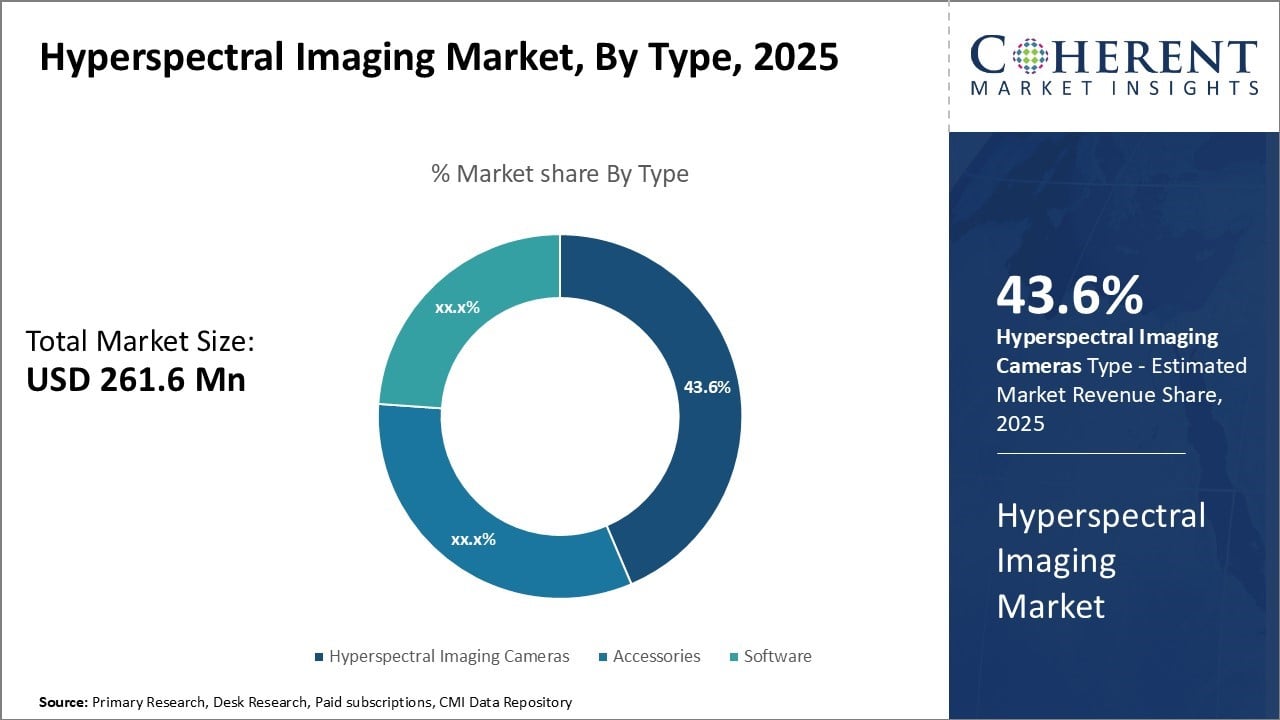
Hyperspectral Imaging Market Insights, By Type: Hyperspectral Imaging Cameras contribute the highest share of the market owing to its advancing technology
The hyperspectral imaging cameras segment is expected to contribute the highest share of the market with 44.6% in 2026. Hyperspectral imaging cameras have seen significant improvements in spatial, spectral, and temporal resolution capabilities. The integration of more powerful processors and advanced sensors has enabled cameras to capture imagery with finer spatial details and narrower wavelength bands. This high-resolution spectral data provides more accurate composition analysis. Additionally, improved computing power allows cameras to process and analyze imagery much faster. This faster processing speed supports real-time applications such as surgical guidance. Leading manufacturers are also developing smaller and more portable lens optimized for specific application needs.
For instance, in October 2024, Specim, a subsidiary of Konica Minolta, unveiled the FX50 hyperspectral camera specifically for black plastic sorting. The camera uses mid-wave infrared (MWIR) hyperspectral imaging (HSI) technology to effectively tackle the challenges associated with sorting black plastics.
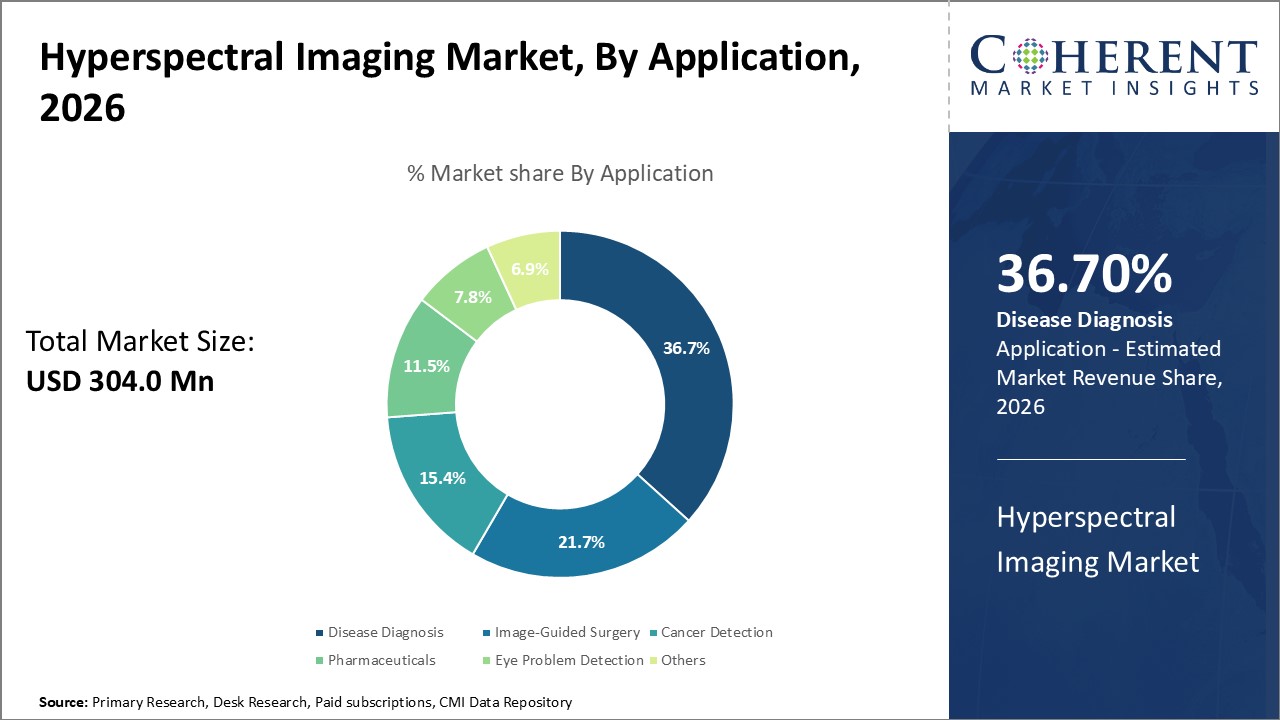
Hyperspectral Imaging Market Insights, By Application: Disease Diagnosis contribute the highest share of the market owing to its early disease diagnosis
Disease diagnosis segment is expected to contribute the highest share of the market with 36.7% in 2026. This is because hyperspectral imaging shows promise for early and non-invasive disease screening. It can detect subtle biochemical changes in tissues indicative of various conditions. Hyperspectral data provides diagnostic clues not visible to the naked eye. This capability enables early diagnosis when treatment outcomes are most favorable. It could transform fields such as oncology and dermatology by improving screening accuracy and catching diseases at their earliest and most treatable phases. Widespread early detection through this technology may significantly improve patient survival rates and reduce healthcare costs over conventional methods. As such, disease diagnosis currently receives the most research interest and investment to exploit hyperspectral imaging's potential for transforming preventive care.
Dr. Baowei Fei’s team at UT Dallas developed a prototype hyperspectral imaging system using 18 LEDs emitting wavelengths from 405 to 910 nanometers. A monochrome camera captures images as each LED sequentially illuminates tissue, creating a full hyperspectral dataset. They tested the system on normal and cancerous tissue samples from surgeries, evaluated the impact of various imaging conditions, and compared the results to a standard hyperspectral camera.
Hyperspectral Imaging Market Insights, By End-User: Hospitals contribute the highest share of the market owing to its technological integration boosts hospital adoption
The hospitals segment is expected to contribute the highest share with 42.6% in 2026. While research centers pioneer hyperspectral applications, hospitals represent the largest customer base for clinical adoption. However, traditional medical facilities face barriers integrating new technologies. Hyperspectral systems must offer practical advantages over standard practices. Recent trends now better facilitate hospital implementation. Manufacturers create user-friendly devices with intuitive interfaces similar to existing equipment. They design products requiring minimal training. Streamlined analysis and visualization software automates processes to seamlessly fit into busy operations. Hyperspectral can also enhance computer-aided diagnosis systems hospitals already use. Furthermore, some companies offer diagnostic services utilizing off-site hyperspectral labs.
Regional Insights
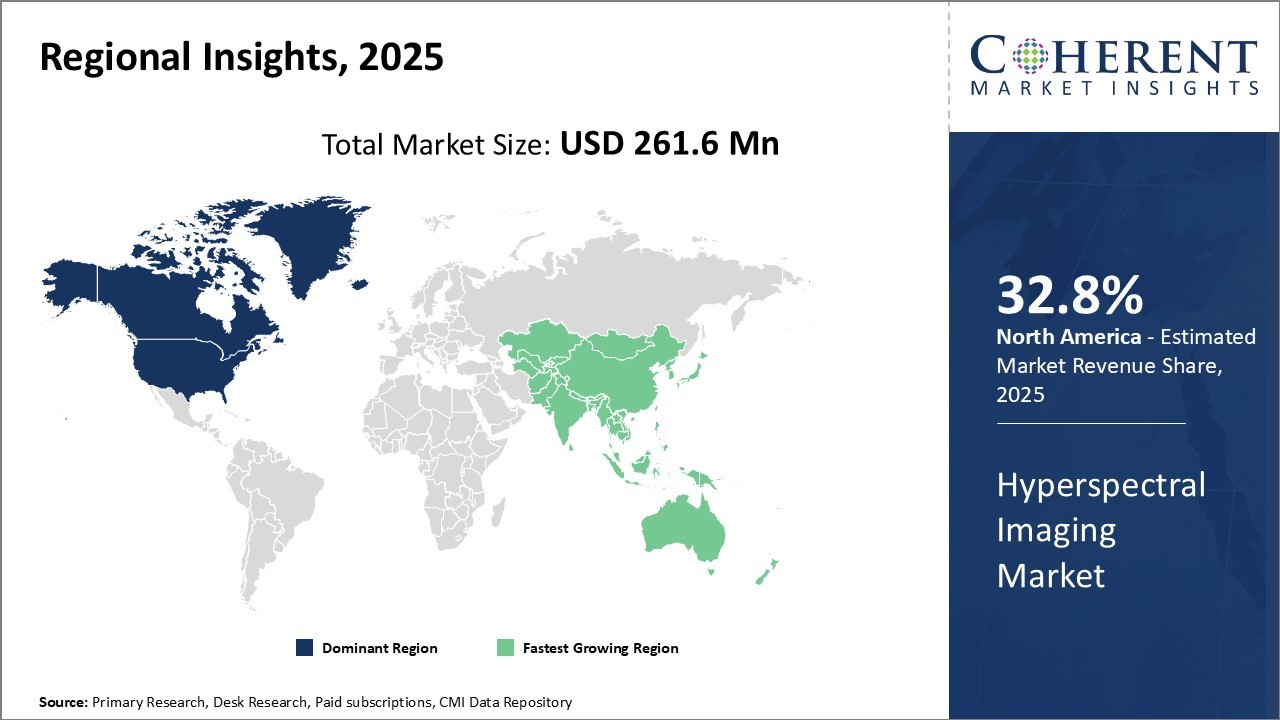
North America Hyperspectral Imaging Market Trends
Strong government funding, especially in defense and aerospace, drives North America’s hyperspectral imaging market, advancing surveillance and reconnaissance technologies. Cutting-edge healthcare infrastructure in the region integrates hyperspectral imaging to enhance diagnostics and surgical procedures. Leading research institutions and industry players collaborate actively to accelerate innovation. The market also expands as agriculture and environmental sectors adopt hyperspectral technology to promote sustainable practices.
For instance, Orbital Sidekick (OSK), the global leader in space-based commercial hyperspectral monitoring, launched GHOSt 3, the third satellite in its planned GHOSt™ (Global Hyperspectral Observation Satellite) constellation, aboard the Transporter 8 rideshare mission.
Asia Pacific Hyperspectral Imaging Market Trends
The Asia Pacific region is rapidly expanding its industrial base, which drives higher demand for hyperspectral imaging in quality inspection and process monitoring. Electronics, manufacturing, and pharmaceutical industries actively adopt HSI to enhance product quality, minimize defects, and boost operational efficiency, significantly fueling market growth. Meanwhile, healthcare facilities across Asia Pacific increasingly implement hyperspectral imaging for non-invasive diagnostics, early disease detection, and surgical guidance. This technology enables precise tissue analysis and monitoring, improves patient outcomes, and reduces the need for invasive procedures, leading to its growing acceptance in medicine. For instance, in January 2026, Google-backed Indian space tech startup Pixxel unveiled three of its six hyperspectral imaging satellites, achieving a significant milestone for the company and the country’s expanding private space sector.
United States Hyperspectral Imaging Market Trends
The U.S. government invests heavily in hyperspectral imaging for defense and aerospace uses such as surveillance, reconnaissance, and border security. These investments fuel technological advancements and market growth, establishing the U.S. as a leader in military-grade HSI systems and promoting innovation through partnerships with private companies. Healthcare providers use this technology to support non-invasive procedures and enhance accuracy in detecting conditions like cancer and cardiovascular diseases, leading to better patient outcomes and broader clinical adoption nationwide.
India Hyperspectral Imaging Market Trends
India’s hyperspectral imaging market is gaining strong momentum as various industries increase their usage. Organizations like ISRO are adopting advanced imaging technologies for earth observation and resource mapping, driving growth. In agriculture, stakeholders use hyperspectral imaging to improve precision farming by analyzing crop health and monitoring soil conditions. Defense and security agencies actively apply this technology for surveillance and reconnaissance. Additionally, expanding domestic manufacturing and increased R&D investments are fueling innovation and accelerating commercial adoption across multiple sectors. For instance, the Indian Space Research Organisation's trusted PSLV rocket launched from the first launchpad at Sriharikota, carrying India's first hyperspectral imaging satellite (HysIS), an advanced Earth observation satellite, along with 30 foreign satellites.
Market Players, Key Development, and Competitive Intelligence
Hyperspectral Imaging Market News
- In January 2025, Xplore Inc., a dual-use space company in Bellevue, Wash., announced that it successfully launched and operates its first hyperspectral satellite, XCUBE-1 PST, as part of the Bandwagon-2 rideshare mission with SpaceX, facilitated by Maverick Space Systems. The company deployed the satellite into a mid-inclination orbit from Vandenberg Space Force Base in California.
- In July 2024, Specim, a leading provider of advanced hyperspectral imaging solutions, recently launched a new macro lens for its Specim FX10 hyperspectral camera. The macro lens enables the camera to focus on small objects and capture fine details with high-resolution hyperspectral images in the visible and near-infrared (VNIR) regions.
Analyst Opinion (Expert Opinion)
- Hyperspectral imaging is no longer a niche technology—it is quietly becoming a backbone of industrial quality control and environmental surveillance. For example, researchers in Finland demonstrated that HSI could identify microplastic particles in water with over 95% accuracy, a breakthrough that traditional optical methods consistently fail to achieve. In an era of heightened ESG scrutiny, this is not just innovation—it’s competitive advantage.
- Defense is HSI’s mature vertical, and with good reason. The U.S. Department of Defense has deployed hyperspectral sensors on drones and satellites for real-time threat detection and camouflage penetration—something traditional RGB or even thermal imaging cannot deliver. The military’s adoption signals one key truth: hyperspectral isn’t just precise—it’s indispensable when lives are on the line.
- Companies like Pixxel are using hyperspectral satellites to detect crop stress before symptoms are visible to the human eye. A Brazilian sugarcane grower reported a 10% yield boost simply by adjusting irrigation based on HSI data. This isn’t a proof of concept—this is data-backed ROI.
Speak to the analyst
Want personalized insights?
Take the findings above to one of our principal consultants, or have the report rebuilt around the segments, geographies and competitors you actually track.
Market Report Scope
Hyperspectral Imaging Market Report Coverage
| Report Coverage | Details | ||
|---|---|---|---|
| Base Year: | 2025 | Market Size in 2026: | USD 304.0 Mn |
| Historical Data for: | 2020 To 2024 | Forecast Period: | 2026 To 2033 |
| Forecast Period 2026 to 2033 CAGR: | 16.2% | 2033 Value Projection: | USD 869.5 Mn |
| Geographies covered: |
| ||
| Segments covered: |
| ||
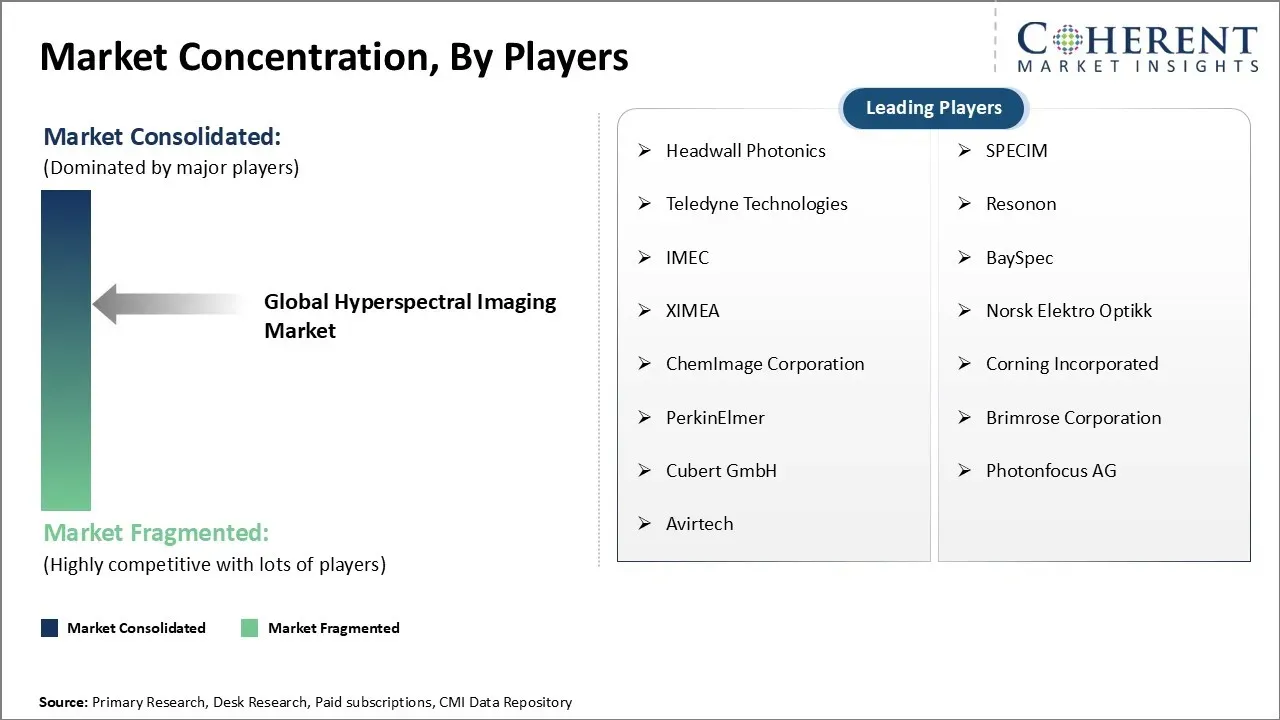
| Companies covered: | Headwall Photonics, SPECIM, Teledyne Technologies, Resonon, IMEC, BaySpec, XIMEA, Norsk Elektro Optikk, ChemImage Corporation, Corning Incorporated, PerkinElmer, Brimrose Corporation, Cubert GmbH, Photonfocus AG, and Avirtech | ||
| Growth Drivers: |
| ||
| Restraints & Challenges: |
| ||
Hyperspectral Imaging Market Trend
Rising Adoption in Precision Agriculture
Farmers and agritech companies increasingly adopt hyperspectral imaging to optimize crop management and resource use. HSI helps monitor plant health, detect diseases early, and assess soil conditions with high accuracy. This allows for more targeted interventions, reducing waste and improving yields. Governments and private stakeholders support this shift through research and pilot programs. As the agriculture sector focuses more on sustainability and food security, hyperspectral imaging continues to gain traction as a key enabler of precision farming practices.
Market Segmentation
- Type Insights (Revenue, USD Mn, 2021 - 2033)
- Hyperspectral Imaging Cameras
- Accessories
- Software
- Application Insights (Revenue, USD Mn, 2021 - 2033)
- Disease Diagnosis
- Image-Guided Surgery
- Cancer Detection
- Pharmaceuticals
- Eye Problem Detection
- Others (Assessing Tissue Perfusion, Evaluation Teeth Structure)
- End User Insights (Revenue, USD Mn, 2021 - 2033)
- Hospitals
- Diagnostic Centers
- Research Centers
- Others
- Regional Insights (Revenue, USD Mn, 2021 - 2033)
- North America
- U.S.
- Canada
- Latin America
- Brazil
- Argentina
- Mexico
- Rest of Latin America
- Europe
- Germany
- U.K.
- Spain
- France
- Italy
- Russia
- Rest of Europe
- Asia Pacific
- China
- India
- Japan
- Australia
- South Korea
- ASEAN
- Rest of Asia Pacific
- Middle East
- GCC Countries
- Israel
- Rest of Middle East
- Africa
- South Africa
- North Africa
- Central Africa
- North America
- Key Players Insights
- Headwall Photonics
- SPECIM
- Teledyne Technologies
- Resonon
- IMEC
- BaySpec
- XIMEA
- Norsk Elektro Optikk
- ChemImage Corporation
- Corning Incorporated
- PerkinElmer
- Brimrose Corporation
- Cubert GmbH
- Photonfocus AG
- Avirtech
Sources
Primary Research Interviews
- Industry experts and engineers from leading hyperspectral imaging technology firms
- Academic researchers specializing in spectroscopy and remote sensing
- End-users from healthcare, agriculture, and defense sectors
- Government officials involved in aerospace and environmental monitoring projects
Databases
- NASA Earthdata
- USGS Spectral Library
- ESA (European Space Agency) Earth Observation Data
- PubMed for medical imaging research data
Magazines
- Photonics Spectra
- Imaging Technology News
- Agriculture Today
- Defense News
Journals
- IEEE Transactions on Geoscience and Remote Sensing
- Journal of Applied Remote Sensing
- Sensors (MDPI)
- Remote Sensing of Environment
Newspapers
- The New York Times – Technology section
- The Guardian – Science and Environment
- Reuters – Technology and Space
- The Wall Street Journal – Healthcare and Technology
Associations
- International Society for Optics and Photonics (SPIE)
- American Society for Photogrammetry and Remote Sensing (ASPRS)
- Optical Society of America (OSA)
- Society for Imaging Science and Technology (IS&T)
Public Domain Sources
- US Government research publications (NIH, DOE, NOAA)
- Open-access scientific repositories (arXiv, PubMed Central)
- Satellite imagery archives (Landsat, Sentinel)
- United Nations Environment Programme reports
Proprietary Elements
- CMI Data Analytics Tool, and Proprietary CMI Existing Repository of information for last 8 years
Get access to 250+ pages report
Every segment, forecast, competitor profile and data table behind the analysis above — available for instant download.
- ESOMAR Member
- ISO 9001:2015 Certified
- D-U-N-S Registered
- GDPR & CCPA Compliant
Missing comfort of reading report in your local language? Find your preferred language:
Transform your Strategy with Exclusive Trending Reports
Frequently Asked Questions
The Hyperspectral Imaging Market is estimated to be valued at USD 304.0 Mn in 2026, and is expected to reach USD 869.5 Mn by 2033.
The CAGR of the Hyperspectral Imaging Market is projected to be 16.2% from 2026 to 2033.
Increasing demand for precision agriculture and environmental monitoring and advancements in imaging technology and data processing capabilities are the major factors driving the growth of the global hyperspectral imaging market.
High costs associated with hyperspectral imaging systems and complexity in data analysis and interpretation are the major factors hampering the growth of the global hyperspectral imaging market.
In terms of type, the hyperspectral imaging cameras segment is estimated to dominate the market revenue share in 2026.
Headwall Photonics, SPECIM, Teledyne Technologies, Resonon, IMEC, BaySpec, XIMEA, Norsk Elektro Optikk, ChemImage Corporation, Corning Incorporated, PerkinElmer, Brimrose Corporation, Cubert GmbH, Photonfocus AG, and Avirtech are the major players.
North America is expected to lead the global hyperspectral imaging market in 2026.