

Orthopedic Medical Imaging Market Size and Forecast — 2026-2033
The Global Orthopedic Medical Imaging Market size is estimated to be valued at USD 8.54 billion in 2026 and is expected to reach USD 16.12 billion by 2033, exhibiting a compound annual growth rate (CAGR) of 9.5% from 2026 to 2033.
Overview
Orthopedic medical imaging devices include systems such as digital X-rays, MRI, CT, ultrasound, and fluoroscopy units specialized for musculoskeletal visualization. These products are engineered for high-resolution imaging of bones, joints, ligaments, and soft tissues to aid in diagnosis, surgical planning, and post-operative assessment. Advanced models integrate 3D reconstruction, motion analysis, and AI-based diagnostic assistance for enhanced accuracy in orthopedic evaluations.
Key Takeaways
X-ray modality holds the dominant share of 46% in the market, driven by its cost-effectiveness and widespread availability, while MRI is the fastest-growing subsegment due to its superior diagnostic capabilities.
Trauma imaging leads applications with significant demand for acute injury assessment; sports medicine imaging is rapidly expanding, reflecting enlarging orthopedics patient bases.
Hospitals capture the largest revenue share in end-users, leveraging a comprehensive diagnostic infrastructure, whereas ambulatory surgery centers witness the fastest growth, fueled by outpatient treatment shifts.
North America dominates the market with over 40% revenue share due to advanced healthcare infrastructure and high adoption of cutting-edge technologies, while Asia Pacific is the fastest-growing region, posting an impressive CAGR attributed to rising healthcare investments and expanding geriatric population.
Orthopedic Medical Imaging Market Segmentation Analysis
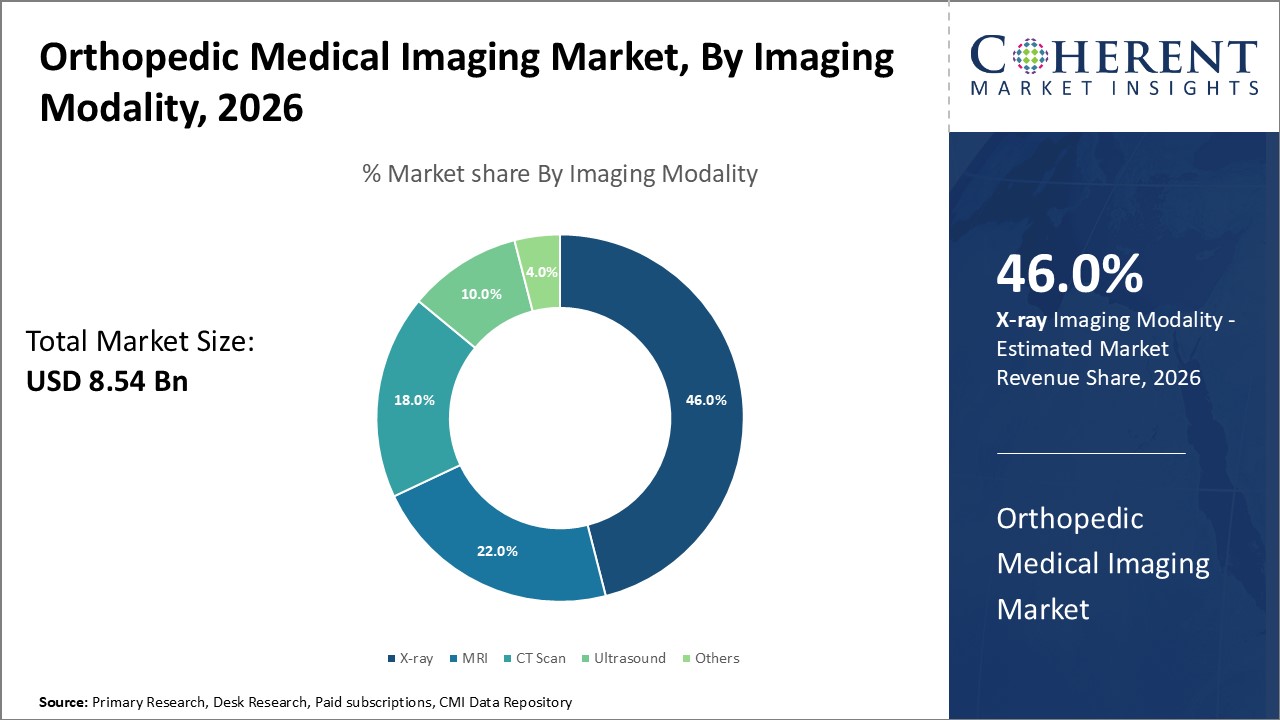
Orthopedic Medical Imaging Market Insights, Imaging Modality
In terms of imaging modality, X-ray dominates the market share with 46%. The widespread use of digital X-ray systems stems from their cost-efficiency and rapid image acquisition, making them indispensable in trauma assessment and routine orthopedic diagnostics. The fastest growing subsegment is MRI, favored for its superior soft tissue contrast and capability to visualize cartilage, ligaments, and bone marrow changes. MRI adoption has accelerated thanks to new ultra-high field magnets, enhancing image resolution. CT scans provide detailed bone imaging and are crucial for complex fracture mapping, though their growth is outpaced by MRI’s expanding indications.
Orthopedic Medical Imaging Market Insights, By Application
Trauma imaging is the dominant segment, as rapid and precise bone fracture visualization remains essential in emergency care, accounting for approximately 40% of diagnostic volume. This segment is driven by rising incidence rates of traffic accidents and fall-related injuries globally. Sports medicine imagery is the fastest-growing subsegment due to increased global participation in athletic activities and heightened focus on soft tissue and ligament injuries. Degenerative diseases, including osteoarthritis and osteoporosis, represent a large and stable usage area, especially in aging populations demanding early-stage diagnosis and monitoring.
Orthopedic Medical Imaging Market Insights, By End-User
Hospitals dominate the market share due to their comprehensive diagnostic infrastructure and high patient turnover, often accounting for approximately 50% of overall imaging procedures. They typically invest in full-scale imaging portfolios covering all modalities. Ambulatory surgery centers are currently the fastest-growing end-user segment, expanding rapidly as outpatient procedures become more prevalent for orthopedic surgeries and interventions, necessitating point-of-care imaging solutions. Diagnostic centers serve as crucial accessibility points offering cost-efficient and specialized imaging services, maintaining a solid market presence.
Orthopedic Medical Imaging Market Trends
Orthopedic medical imaging market trends are increasingly shaped by the integration of AI-based diagnostics and portable imaging systems, enhancing real-time clinical decision-making.
For instance, Philips Healthcare’s introduction of AI algorithms to speed fracture detection cut diagnostic times by 20% in 2025 in European hospitals.
Additionally, the uptake of portable digital X-rays in ambulatory care centers rose by nearly 18% in North America, underscoring the shift toward decentralized imaging services.
Orthopedic Medical Imaging Market Insights, By Geography
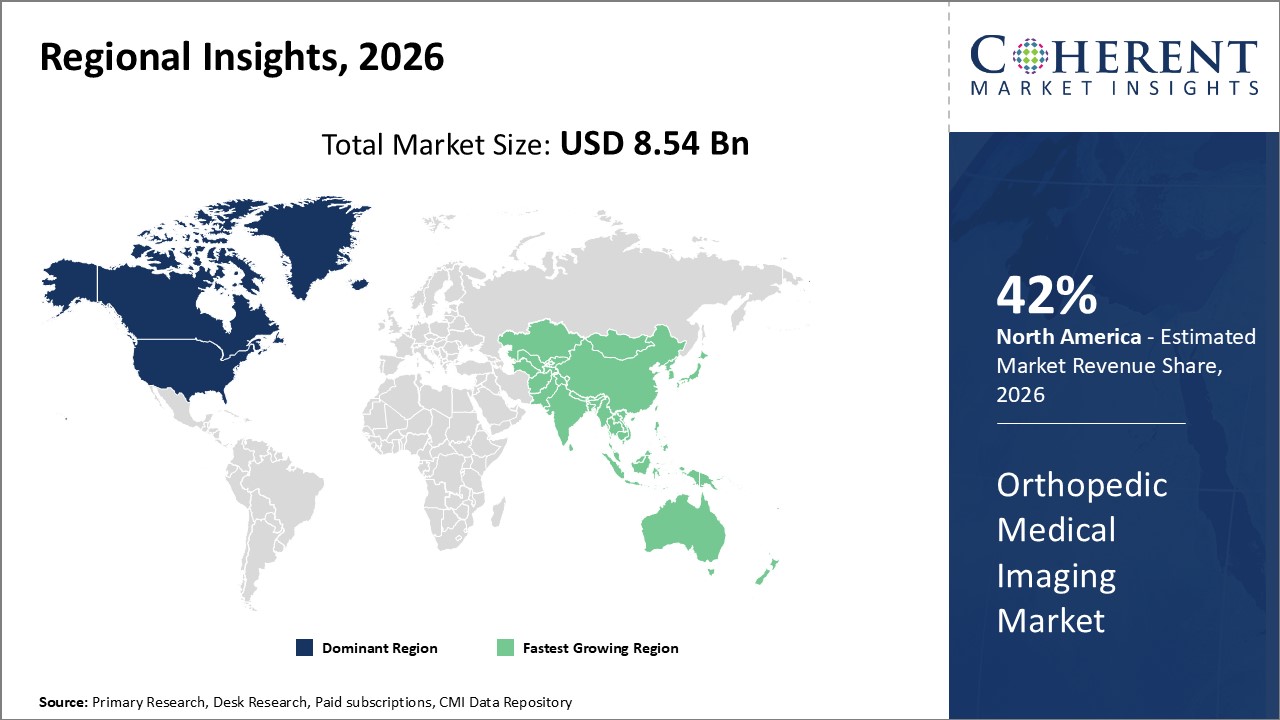
North America Orthopedic Medical Imaging Market Analysis and Trends
North America dominates the orthopedic medical imaging market with approximately 42% market share, supported by robust healthcare infrastructure, high patient awareness, and significant R&D investments. The U.S. remains the key contributor, driven by well-established hospitals and imaging centers adopting cutting-edge modalities promptly. Leading companies such as GE Healthcare and Siemens Healthineers maintain strong regional footprints, introducing AI-driven equipment and expanding outpatient care partnerships.
Asia Pacific Orthopedic Medical Imaging Market Analysis and Trends
Asia Pacific exhibits the fastest growth with a CAGR exceeding 11%, buoyed by growing healthcare expenditure, expanding middle-class population, and increasing prevalence of orthopedic conditions due to lifestyle changes. Countries like India and China have witnessed accelerated adoption of digital imaging technologies supported by government healthcare initiatives, enhancing diagnostic accessibility. Local companies and international players collaboratively expand market penetration through innovations tailored for cost-sensitive environments.
Orthopedic Medical Imaging Market Outlook for Key Countries
USA Orthopedic Medical Imaging Market Analysis and Trends
The U.S. orthopedic medical imaging market benefits from comprehensive insurance coverage and substantial public and private healthcare investments. High rates of osteoarthritis and sports injuries amplify imaging demand, with over 25 million musculoskeletal imaging procedures performed annually in 2025 alone. Market players have prioritized AI-enabled MRI and portable X-ray technologies to improve diagnostic efficiency. The U.S. government's push for value-based healthcare further drives the adoption of imaging solutions that facilitate better clinical outcomes and cost management.
Germany Orthopedic Medical Imaging Market Analysis and Trends
Germany leads Europe with a robust healthcare system emphasizing advanced diagnostics, accounting for over 15% market share in the regional orthopedic imaging sector. The country’s stringent regulatory landscape ensures high-quality imaging device standards, supporting demand for MRI and CT scans in orthopedic clinics. Recent government funding initiatives aimed at digitizing healthcare infrastructure have spurred procurement of next-generation imaging equipment, enhancing early diagnosis of degenerative joint diseases and post-surgical assessments.
Analyst Opinion
The rising adoption of advanced imaging modalities such as 3D CT scans and high-resolution MRI is a critical supply-side indicator fueling market share growth. Notably, the number of MRI scanners dedicated to musculoskeletal imaging saw a 15% increase worldwide in 2025 alone, indicating a strong capacity expansion in orthopedic diagnostics. For example, several state-of-the-art centers in Europe reported a 12% uptick in MRI-based orthopedic examinations within the first half of 2026, underlining this trend.
Demand-side dynamics reveal that outpatient orthopedic clinics and ambulatory surgery centers are increasingly integrating portable digital X-ray systems, which rose by nearly 18% in sales between 2023 and 2025 in North America. This shift supports growing demand for cost-efficient and rapid diagnostic services tailored to outpatient care, directly impacting the orthopedic medical imaging market revenue.
The rise in degenerative joint diseases and traumatic injuries globally generates expansive use cases beyond traditional hospital settings. Countries like India and Brazil have documented over a 21% increase in orthopedic imaging procedures from 2023 to 2026, driven primarily by higher incidence rates of osteoarthritis and sports-related injuries, reflecting an expanding market scope.
Micro trends show a marked increase in the adoption of artificial intelligence (AI) tools for image analysis, improving diagnostic precision and reducing turnaround times. A recent pilot study in Japan utilizing AI algorithms in orthopedic MRI interpretation resulted in a 26% faster diagnosis workflow in 2025, demonstrating significant efficiency gains that are rapidly becoming market growth strategies.
- Current Industry Events of 2026
- Market Size Estimation
- Regional Breakdown
- Competitive Landscape
- Customer Intelligence
- Segmental Analysis
- Pricing Analysis
- Key Market Drivers, Challenges & Future Trends
- Customized Insights Section
Market Scope
| Report Coverage | Details | ||
|---|---|---|---|
| Base Year: | 2025 | Market Size in 2026: | USD 8.54 billion |
| Historical Data for: | 2020 To 2024 | Forecast Period: | 2026 To 2033 |
| Forecast Period 2026 to 2033 CAGR: | 9.5% | 2033 Value Projection: | USD 16.12 billion |
| Geographies covered: |
| ||
| Segments covered: |
| ||
| Companies covered: | Siemens Healthineers, GE Healthcare, Philips Healthcare, Canon Medical Systems Corporation, FUJIFILM Holdings Corporation, Carestream Health, Hologic, Inc., Samsung Medison Co., Ltd., Hitachi, Ltd., Shimadzu Corporation, Mindray Medical International Limited, Esaote SpA, Neurosoft | ||
| Growth Drivers: |
| ||
Orthopedic Medical Imaging Market Growth Factors
The surge in sports-related orthopedic injuries across all age groups is significantly driving demand for specialized imaging, supported by a 17% rise in imaging procedures related to sports medicine from 2023 to 2026 globally. Aging demographics also contribute heavily, as degenerative connective tissue disorders increased the utilization rate of diagnostic imaging by 21% in North America alone in recent years. Technological advancements, especially in MRI and low-dose CT scans, have enhanced image quality while reducing patient exposure to radiation, broadening their adoption. Furthermore, increasing healthcare expenditure across the Asia Pacific and Middle East markets bolsters infrastructure development, enabling wider access to advanced orthopedic imaging.
Orthopedic Medical Imaging Market Development
September, 2026: Planmed XFI full‑body weight‑bearing CT scanner cleared by FDA. Planmed announced that the U.S. FDA has granted 510(k) clearance for its Planmed XFI®, a cone‑beam CT scanner capable of imaging the entire body in upright (standing), seated, or supine positions.
January, 2023: Adaptix received U.S. FDA 510(k) clearance for its Digital Tomosynthesis Orthopedic Imaging System, which is the first medical product from the company to receive U.S. clearance. The portable, low-dose system provides 3D X-ray imaging of hands, elbows, and feet, and is designed to be used at the point of care.
Key Players
Leading Companies of the Market
Siemens Healthineers
GE Healthcare
Philips Healthcare
Canon Medical Systems Corporation
FUJIFILM Holdings Corporation
Carestream Health
Hologic, Inc.
Samsung Medison Co., Ltd.
Hitachi, Ltd.
Shimadzu Corporation
Mindray Medical International Limited
Esaote SpA
Neurosoft
Competitive strategies among prominent market players include Siemens Healthineers’ recent launch of AI-enabled imaging platforms that improved diagnostic accuracy by 22% in clinical trials over 2025–2026. GE Healthcare’s strategic collaborations with orthopedic surgery centers in the U.S. fostered real-time imaging integration during minimally invasive procedures, resulting in enhanced procedure efficiency. Meanwhile, Philips Healthcare has focused on expanding its portable X-ray systems in emerging markets, securing a 12% increase in sales figures in Asia Pacific in 2025.
Orthopedic Medical Imaging Market Future Outlook
Future orthopedic imaging devices will feature higher resolution, AI-assisted diagnostic algorithms, and enhanced interoperability with surgical navigation systems. 3D and 4D imaging, motion analysis, and augmented reality visualization will improve preoperative planning and personalized implant design. The adoption of cloud-based image sharing and integration with robotic surgery systems will enable real-time collaboration between surgeons and radiologists. Miniaturization of imaging hardware and the emergence of handheld devices will allow point-of-care orthopedic assessments, while AI-based automation will significantly reduce diagnostic time and enhance accuracy.
Orthopedic Medical Imaging Market Historical Analysis
Orthopedic imaging systems evolved from analog X-ray units into sophisticated digital imaging platforms capable of 3D visualization. The introduction of computed tomography (CT) and magnetic resonance imaging (MRI) revolutionized bone and joint diagnostics, while digital radiography improved image clarity and reduced radiation exposure. During the 2000s, imaging software began incorporating computer-aided diagnosis and surgical planning tools, making these devices critical for orthopedic evaluation and intervention. Portable ultrasound and fluoroscopy systems further expanded imaging applications for real-time intraoperative guidance.
Sources
Primary Research interviews:
Radiologists
Orthopedic Surgeons
Medical Imaging Technicians
Healthcare IT Managers
Databases:
NCBI
WHO Medical Imaging Database
Magazines:
Diagnostic Imaging
Radiology Today
HealthTech
Imaging Economics
Journals:
Journal of Orthopaedic Research
European Radiology
Journal of Digital Imaging
Bone & Joint Journal
Newspapers:
The Economic Times (Healthcare)
The Guardian (Medical Science)
Business Standard (Health)
The New York Times (Health Section)
Associations:
Radiological Society of North America (RSNA)
European Society of Radiology
American Academy of Orthopaedic Surgeons (AAOS)
International Society for Magnetic Resonance in Medicine (ISMRM)
Get access to 250+ pages report
Every segment, forecast, competitor profile and data table behind the analysis above — available for instant download.
- ESOMAR Member
- ISO 9001:2015 Certified
- D-U-N-S Registered
- GDPR & CCPA Compliant
Missing comfort of reading report in your local language? Find your preferred language:
Transform your Strategy with Exclusive Trending Reports
Frequently Asked Questions
Leading companies such as Siemens Healthineers, GE Healthcare, and Philips Healthcare dominate the market, leveraging advanced imaging technologies and strategic collaborations to enhance their market shares.
The market size is projected to grow from USD 8.54 billion in 2026 to USD 16.12 billion by 2033, reflecting a CAGR of 9.5%, fueled by increased adoption of advanced imaging modalities and expanding clinical use cases.
Hospitals currently hold the largest share; however, ambulatory surgery centers and orthopedic clinics present fast-growing opportunities driven by increasing outpatient orthopedic treatments.
Trends will skew toward AI-enabled imaging, portable diagnostic devices for point-of-care use, and telemedicine integration, accelerating diagnostic accuracy and service accessibility.
The market is moderately consolidated with key players competing through innovation, partnerships, and geographic expansion. Challenges include high equipment costs and regulatory compliance complexities.
Strategies include product innovation with AI capabilities, collaborations with healthcare providers to streamline clinical workflows, and market expansion through targeted outreach in emerging regions.