

Image Guided Therapy System Market Size and Forecast — 2026 - 2033
The Global Image Guided Therapy System Market size is projected to be valued at USD 7.25 billion in 2026 and is anticipated to reach USD 11.85 billion by 2033, growing at a compound annual growth rate (CAGR) of 7.4% during the forecast period from 2026 to 2033.
Overview
The Image Guided Therapy Systems Market is primarily driven by the rising demand for minimally invasive procedures, increasing prevalence of chronic diseases such as cancer, cardiovascular, and neurological disorders, and rapid advancements in imaging technologies including MRI, CT, ultrasound, and AI-integrated navigation systems. Growing geriatric populations and expanding healthcare infrastructure are further accelerating adoption across hospitals and ambulatory surgical centers. In addition, increased investments in cancer radiotherapy initiatives, hybrid operating rooms, and robotic-assisted surgeries are enhancing procedural accuracy and patient outcomes. Supportive government healthcare policies, higher healthcare spending, and continuous product innovations by leading medical technology companies are also significantly contributing to global market growth.
Key Takeaways
Fluoroscopy retains dominance with 40% of market share, reflecting its widespread use in cardiovascular and orthopedic interventions. Computed tomography is the fastest-growing subsegment, driven by enhanced 3D imaging capabilities critical in oncology and neurosurgery.
Cardiovascular interventions hold the largest market size, while oncology shows rapid growth due to advancements in targeted radiation therapies. Neurosurgery applications are expanding steadily with innovations in neuro-navigation.
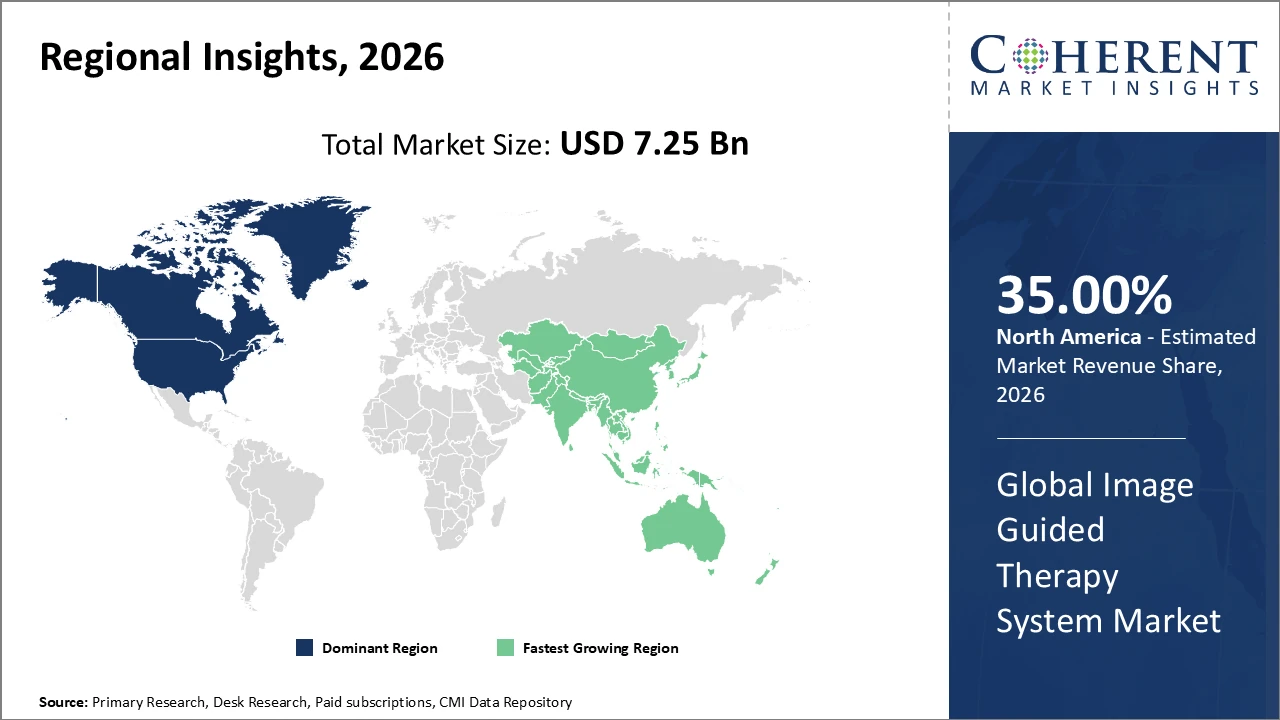
Regionally, North America dominates with over 35% market share, driven by advanced healthcare infrastructure and high adoption of innovative technologies. Asia Pacific exhibits the highest CAGR, supported by rising healthcare investments, increased procedure volumes, and government initiatives in countries like India and China to improve healthcare access.
Image Guided Therapy System Market Segmentation Analysis
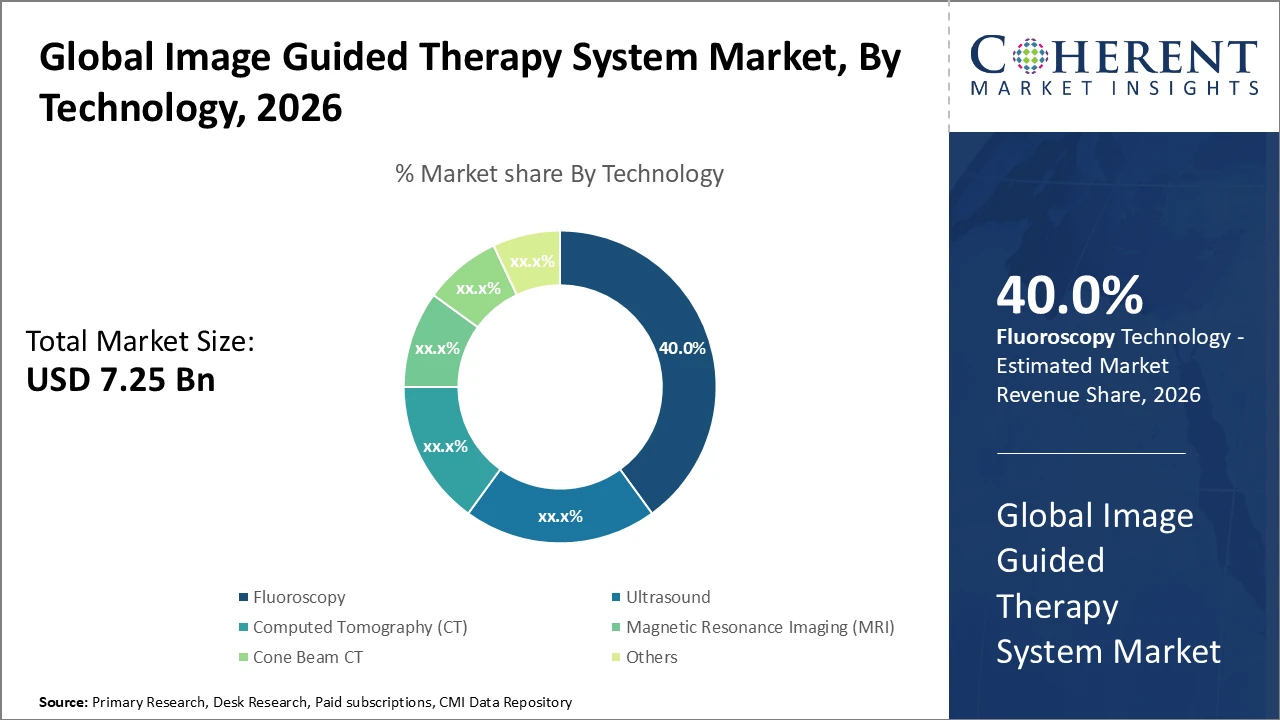
Image Guided Therapy System Market Insights, By Technology
Fluoroscopy leads the market with a 40% share, driven by real-time imaging capabilities and extensive use in cardiovascular and orthopedic procedures, forming the foundation of interventional systems. CT is the fastest-growing segment, supported by advanced 3D reconstruction for precise tumor targeting and complex neurosurgical guidance. Ultrasound is valued for its portability and non-ionizing nature, enabling minimally invasive procedures in urology and vascular interventions. MRI, though limited by longer procedural times, remains essential for soft tissue visualization in neurosurgery. CBCT is increasingly used in dental and maxillofacial surgeries for high-resolution 3D imaging, while emerging modalities like photoacoustic imaging indicate future market potential.
Image Guided Therapy System Market Insights, By End User
Hospitals dominate the market due to their comprehensive service offerings and capacity to invest in advanced imaging infrastructure, supporting diverse applications across multiple departments. Ambulatory Surgical Centers are the fastest-growing segment, fueled by the shift toward outpatient procedures and cost-effective solutions, particularly in cardiovascular and orthopedic interventions. Specialized clinics cater to niche areas such as oncology and neurology, leveraging compact, tailored systems for targeted treatments. Research institutes play a supporting role by facilitating clinical trials and early adoption of innovative technologies. Growth in ambulatory settings highlights evolving healthcare models that prioritize minimally invasive, efficient, and patient-centered care delivery.
Image Guided Therapy System Market Insights, By Application
Cardiovascular applications dominate the market due to the high volume of interventional catheterizations and valve replacement procedures requiring precise image guidance. Oncology is the fastest-growing segment, driven by advanced radiation therapy, biopsy guidance systems, and increasing cancer prevalence alongside precision medicine initiatives. Neurosurgery benefits from enhanced neuro-navigation and minimally invasive tumor resections, improving procedural accuracy. Orthopedic procedures rely on intraoperative fluoroscopy and CT for complex fracture repairs and joint replacements. Urology focuses on ultrasound-guided interventions for prostate and kidney treatments. The 'Others' category includes emerging applications such as gastrointestinal procedures and image-guided pain management, reflecting expanding clinical adoption.
Image Guided Therapy System Market Trend
Widespread adoption of AI-powered diagnostic assistance is improving procedural accuracy, with Philips Healthcare’s AI-integrated imaging system achieving a 14% reduction in diagnostic times in 2026.
Increased implementation of hybrid operating rooms is driving procedural efficiency, exemplified by GE Healthcare’s modular room installations in Europe, which boosted interventional volumes by 10%.
Emerging cloud-based tele-imaging solutions are facilitating remote consultations, particularly beneficial in geographically dispersed regions, as observed in North America.
Image Guided Therapy System Market Insights, By Geography
North America Image Guided Therapy System Market Analysis and Trends
In North America, the Image Guided Therapy System market is dominated by a well-established healthcare infrastructure, significant R&D investments, and rapid adoption of advanced technologies. The United States represents over 70% of the regional market, driven by government support, extensive reimbursement policies, and a high volume of interventional procedures each year. Major companies, including Siemens Healthineers and Medtronic, have strengthened their market position through localized manufacturing, service networks, and strategic collaborations with healthcare providers. The combination of technological innovation, strong regulatory frameworks, and widespread clinical adoption ensures North America remains a leading and influential region in the global image-guided therapy market.
Asia Pacific Image Guided Therapy System Market Analysis and Trends
The Asia Pacific region is experiencing the fastest growth in the Image Guided Therapy System market, with a CAGR exceeding 9%. This expansion is driven by rising healthcare expenditures, growing hospital infrastructure, and an increasing prevalence of chronic diseases. China and India are leading contributors, supported by proactive government policies and expanding private sector participation. The regional market is further strengthened by collaborations between global technology providers and local healthcare institutions, facilitating technology transfer, training, and adoption of advanced imaging systems. These factors collectively create a dynamic ecosystem, positioning Asia Pacific as a key growth frontier in the global market.
Image Guided Therapy System Market Outlook for Key Countries
USA Image Guided Therapy System Market Analysis and Trends
The USA continues to lead the global Image Guided Therapy System market, primarily fueled by high demand in cardiovascular and oncology procedures. In 2025, cardiovascular interventions represented approximately 65% of all installed systems nationwide, reflecting the prevalence of catheterizations and valve replacement procedures. The market is reinforced by the presence of key players like Philips Healthcare and GE Healthcare, alongside early adoption of innovative hybrid operating rooms. Supportive government policies promoting minimally invasive surgeries, advanced imaging reimbursement programs, and strong healthcare infrastructure further drive market expansion. These factors collectively position the U.S. as the largest and most influential market globally.
Germany Image Guided Therapy System Market Analysis and Trends
Germany holds a significant position in the European Image Guided Therapy System market, driven by advanced healthcare infrastructure, high technology adoption, and strong investment in medical research. Hospitals and specialized clinics increasingly implement hybrid operating rooms and AI-assisted navigation systems for cardiovascular, neurosurgical, and oncological procedures. The market benefits from supportive government healthcare policies, well-established reimbursement frameworks, and collaborations between global device manufacturers and local providers. Emerging trends include the integration of 3D imaging, robotic-assisted interventions, and cloud-based tele-imaging solutions. Continuous innovation, coupled with growing procedure volumes, positions Germany as a key growth market within Europe’s image-guided therapy sector.
Analyst Opinion
Increased adoption in cardiovascular interventions drives market share expansion, with approximately 62% of installed image-guided therapy systems used for cardiovascular procedures in 2025, supported by the rising prevalence of cardiovascular diseases globally. Interventional cardiology is expected to lead market revenue.
Technological advancements, such as hybrid operating rooms integrating imaging and surgical capabilities, have boosted market revenue, with investments rising 18% in 2024. These systems enhance procedural visibility, reduce operation time, and improve clinical outcomes, supporting market growth strategies.
Expanding oncology applications, especially in image-guided radiation therapy, contributed significantly to market size, with a 15% increase in utilization in 2026.
Regional infrastructure development influences market dynamics, with Asia Pacific experiencing a 22% rise in demand in 2025 due to growing healthcare facilities and awareness, indicating sustained growth potential in the region.
- Current Industry Events of 2026
- Market Size Estimation
- Regional Breakdown
- Competitive Landscape
- Customer Intelligence
- Segmental Analysis
- Pricing Analysis
- Key Market Drivers, Challenges & Future Trends
- Customized Insights Section
Market Scope
| Report Coverage | Details | ||
|---|---|---|---|
| Base Year: | 2025 | Market Size in 2026: | USD 7.25 billion |
| Historical Data for: | 2020 To 2024 | Forecast Period: | 2026 To 2033 |
| Forecast Period 2026 to 2033 CAGR: | 7.4% | 2033 Value Projection: | USD 11.85 billion |
| Geographies covered: |
| ||
| Segments covered: |
| ||
| Companies covered: | Siemens Healthineers, GE Healthcare, Philips Healthcare, Hologic Inc., Shimadzu Corporation, Stryker Corporation, Terumo Corporation, Samsung Medison, Canon Medical Systems, Elekta AB | ||
| Growth Drivers: |
| ||
Image Guided Therapy System Market Growth Factors
The growing prevalence of chronic conditions, including cardiovascular diseases and cancer, is driving demand for minimally invasive procedures, thereby boosting adoption of image-guided therapy systems. Rising global healthcare expenditure, highlighted by a 9.5% increase in Asia Pacific in 2024, supports the expansion of hospital infrastructure and procedural capacity. Continuous technological innovations, such as AI integration and robotic-assisted navigation, improve procedural precision while minimizing risks and recovery times. Additionally, streamlined regulatory approvals in emerging economies have accelerated market adoption, creating new revenue opportunities. These factors collectively contribute to sustained growth and broader acceptance of image-guided therapy systems worldwide.
Image Guided Therapy System Market Development
In March 2026, Royal Philips announced the launch of IntraSight Plus, an intuitive interventional guidance platform cleared for clinical use in the U.S. and Europe following CE mark and FDA 510(k) approval. The redesigned system integrates advanced diagnostic and treatment-planning tools to enhance efficiency, simplicity, and precision within a single platform.
Key Players
Leading Companies of the Market
Siemens Healthineers
GE Healthcare
Philips Healthcare
Hologic, Inc.
Shimadzu Corporation
Terumo Corporation
Stryker Corporation
Samsung Medison
Canon Medical Systems
Elekta AB
Market players have actively focused on research and development collaborations and product diversification to strengthen their market presence. In 2026, Siemens Healthineers introduced the ARTIS icono system, enhancing imaging precision and workflow efficiency, which contributed to a 12% increase in their market share in North America. Similarly, Medtronic’s 2025 acquisition of a radiology software provider allowed the company to expand its integrated therapy solutions, particularly in oncology and neurosurgery, significantly improving its competitive position in Europe. These strategic initiatives highlight the emphasis on innovation and expansion to capture broader market opportunities.
Image Guided Therapy System Market Future Outlook
The future of the Image Guided Therapy System market is expected to be driven by increasing demand for minimally invasive procedures and precision medicine. Advances in artificial intelligence, augmented reality, and robotic-assisted surgery will enhance real-time imaging and procedural accuracy. Integration of multi-modality imaging and cloud-based analytics will improve workflow efficiency and patient outcomes. Growth will also be supported by rising incidence of chronic diseases, aging populations, and expanding healthcare infrastructure in emerging markets. Additionally, ongoing innovations in software platforms, navigation systems, and hybrid operating rooms are likely to create new opportunities, making the market more competitive and technologically advanced by the end of the decade.
Image Guided Therapy System Market Historical Analysis
The Image Guided Therapy System market has experienced steady growth over the past decade, driven by advancements in medical imaging and minimally invasive technologies. Initially focused on neurosurgery and cardiovascular interventions, these systems gradually expanded into oncology, orthopedics, and interventional radiology. Improvements in CT, MRI, ultrasound, and fluoroscopy integration enabled higher procedural accuracy and reduced patient risk. Key players invested heavily in research and development, introducing navigation platforms, robotic-assisted systems, and software solutions to enhance clinical outcomes. Increasing awareness among healthcare providers, rising chronic disease prevalence, and a shift toward outpatient procedures collectively shaped the market’s historical growth trajectory.
Sources
Primary Research Interviews:
Interventional radiologists, neurosurgeons, cardiovascular surgeons, and oncologists using image-guided therapy systems in clinical procedures.
Hospital administrators, procurement managers, and supply chain professionals responsible for acquiring imaging and navigation systems.
Product managers, R&D specialists, and regulatory experts from companies developing image-guided therapy systems, surgical navigation platforms, and hybrid operating room solutions.
Magazines:
Medical Device & Diagnostic Industry (MD+DI) – Coverage of innovations, product development, and market trends in image-guided therapy and surgical devices.
Orthopedic Design & Technology – Insights on image-guided interventions in orthopedic surgeries.
Healthcare Packaging – Focus on packaging, sterilization, and safety standards of imaging devices and surgical tools.
Journals:
Journal of Image Guided Surgery – Research on navigation systems, minimally invasive interventions, and imaging technologies.
Clinical Radiology – Studies on the efficacy and safety of image-guided procedures.
International Journal of Medical Devices – Design, performance, and regulatory compliance of image-guided therapy systems.
Newspapers:
The Financial Times – Global healthcare market trends, mergers, and investments in medical imaging technologies.
Reuters – Updates on FDA approvals, clinical trials, and innovations in image-guided therapy.
Bloomberg – Market performance, corporate strategies, and technological advancements in the surgical navigation sector.
Associations:
Society of Interventional Radiology (SIR) – Guidelines and research on minimally invasive, image-guided procedures.
American Society of Radiologic Technologists (ASRT) – Standards and training for imaging system use in therapy.
International Organization for Standardization (ISO) – Standards for quality, safety, and regulatory compliance of medical imaging and surgical devices.
Get access to 250+ pages report
Every segment, forecast, competitor profile and data table behind the analysis above — available for instant download.
- ESOMAR Member
- ISO 9001:2015 Certified
- D-U-N-S Registered
- GDPR & CCPA Compliant
Missing comfort of reading report in your local language? Find your preferred language:
Transform your Strategy with Exclusive Trending Reports
Frequently Asked Questions
Leading companies include Siemens Healthineers, Philips Healthcare, GE Healthcare, Medtronic, and Canon Medical Systems, recognized for their advanced technology and expansive product portfolios.
The market size is projected to grow from USD 7.25 billion in 2026 to USD 11.85 billion by 2033, with a CAGR of 7.4%, driven by rising demand for minimally invasive therapies and technological innovation.
Hospitals dominate usage due to comprehensive surgical and diagnostic capabilities, while ambulatory surgical centers are rapidly expanding owing to outpatient procedure trends.
Integration of AI, hybrid operating rooms, and cloud-based imaging solutions will continue to accelerate, expanding applications across cardiovascular, oncology, and neurosurgical specialties.
The landscape is characterized by technological innovation, strategic collaborations, and regional expansion. Challenges include high capital costs and regulatory hurdles in emerging regions.
Market players focus on partnerships with healthcare providers, investment in R&D for system integration, and regional expansion to untapped markets, leveraging local regulatory frameworks.