

Live Cell Imaging Market Size and Share Analysis - (2026 - 2023)
The global live cell imaging market was valued at USD 2,541.6 Mn in 2026 and is forecast to reach a value of USD 4,134.6 Mn by 2033 at a CAGR of 7.2% between 2026 and 2033.
Key Takeaways
- Based on Product Type, the Equipment segment is expected to lead the market with 55.7% share in 2026.
- Based on Application, the Cell Biology segment is expected to hold 37.5% share in 2026.
- Based on Region, North America is set to lead the live cell imaging market with 42% share in 2026. While, Asia Pacific is anticipated to be the fastest growing region.
Market Overview
The global live cell imaging market is experiencing strong growth owing to the increase in disease burden and growing geriatric population across the globe. Moreover, rise in adoption of high-content screening techniques in drug discovery is expected to boost the growth of the market. However, factors such as high cost of high-content screening systems & shortage of skilled professionals are expected to restrain growth of the live cell imaging market.
Current Events and Its Impacts on the Live Cell Imaging Market
Current Event | Description and its Impact |
AI and Machine Learning Integration in Microscopy |
|
Regulatory Changes in Drug Development and Medical Device Approval |
|
Which Companies Are Driving the Surge in Live Cell Imaging Investments in 2025?
Company | Region | Year | Funding Round | Amount Raised | Focus Area |
Stately Bio | Palo Alto, USA | 2025 | Seed | $12M | AI-powered live cell imaging for regenerative medicine and cell therapy |
Confocal.nl | Amsterdam, EU | 2024 | Series A | €5M (~$5.4M) | Advanced confocal microscopes for live cell imaging research |
CytoTronics | USA | 2024 | Series A | Not disclosed | Semiconductor-based imaging platforms for cell biology |
Durham Startup (Vireo) | North Carolina, USA | 2025 | Seed | Not disclosed | Miniaturized video microscopes with AI-driven real-time live cell imaging |
Tomocube | South Korea | 2025 | Expansion | ~$20M (est.) | Holotomography systems for label-free live cell imaging |
Asia-Pacific Biotech Hubs | Singapore, Japan, South Korea | 2025 | Multiple rounds | >$500M collectively | Imaging-related investments across startups and research hubs (AI + microscopy) |
- Current Industry Events of 2026
- Market Size Estimation
- Regional Breakdown
- Competitive Landscape
- Customer Intelligence
- Segmental Analysis
- Pricing Analysis
- Key Market Drivers, Challenges & Future Trends
- Customized Insights Section
Segmental Insights
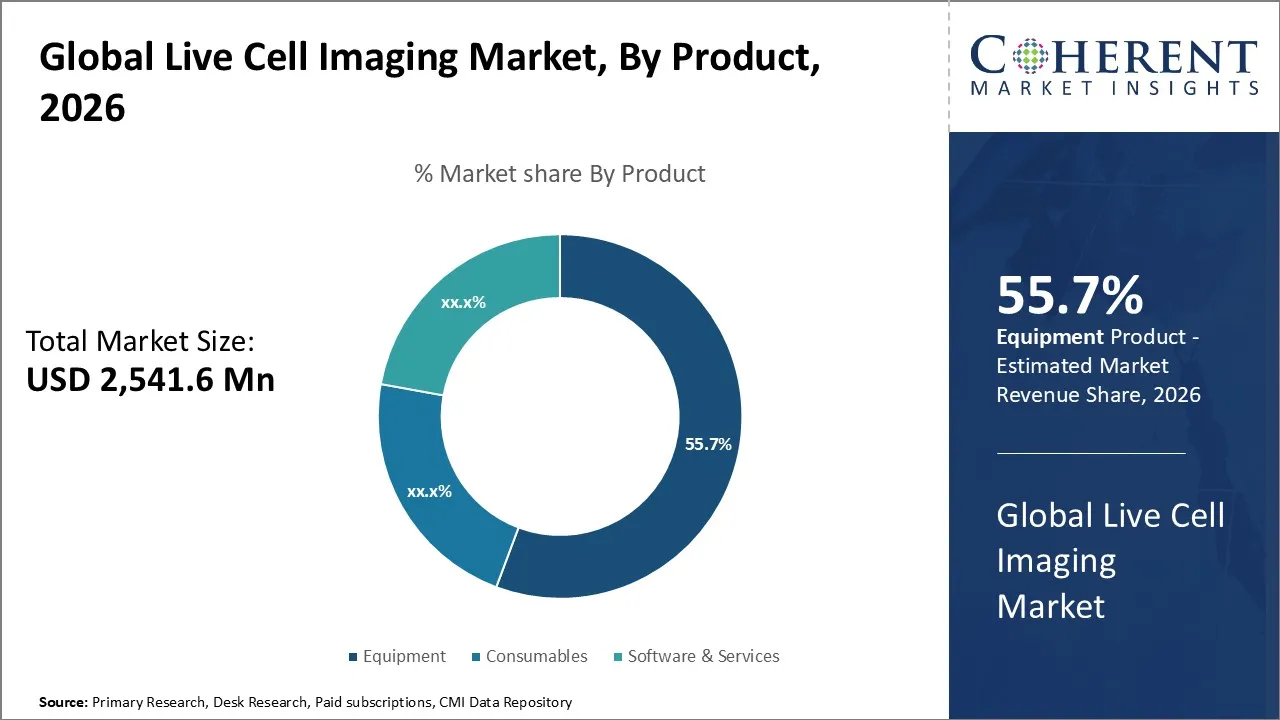
Live Cell Imaging Market Insights, By Product-Equipment dominance driven by demand for advanced microscopes and imaging systems
In terms of product , the equipment segment is expected to dominate the live cell imaging market with 55.7% share in 2026, making up almost half of the total share. Researchers are relying increasingly on high-resolution, real-time visualization tools to study cellular processes with precision and reproducibility, reflecting advanced microscopes, imaging platforms, and integrated systems.
For instance, the HT-X1 Mini Holotomography system from Tomocube is meant to make advanced 3D live-cell imaging available to all labs. The HT-X1 is compact yet powerful. It takes high-resolution pictures with less complexity and cost. This new technology opens up more research opportunities by allowing more labs around the world to study how cells work with the latest tools.
Live Cell Imaging Market Insights, By Application - Cell biology leads, essential for studying cellular structures and disease mechanisms
In terms of application, the cell biology segment is expected to dominate the application segment with 37.5% share in 2026. Its popularity is caused by the frequency it is used to study cellular structures, signaling pathways, and the way diseases work. The segment benefits from live cell imaging popularity, due to there is higher demand for cancer research, immunology, and infectious disease studies.
For instance, in December 2025, BD announced new cell analyzer configurations that will provide labs of all sizes more advanced features. The goal of the launch is to make cutting-edge technologies easier to get to, which will help with a wide range of research needs and make things operate more smoothly. This new feature gives labs with different needs more options, which strengthens BD's position in cellular analysis.
Regional Insights
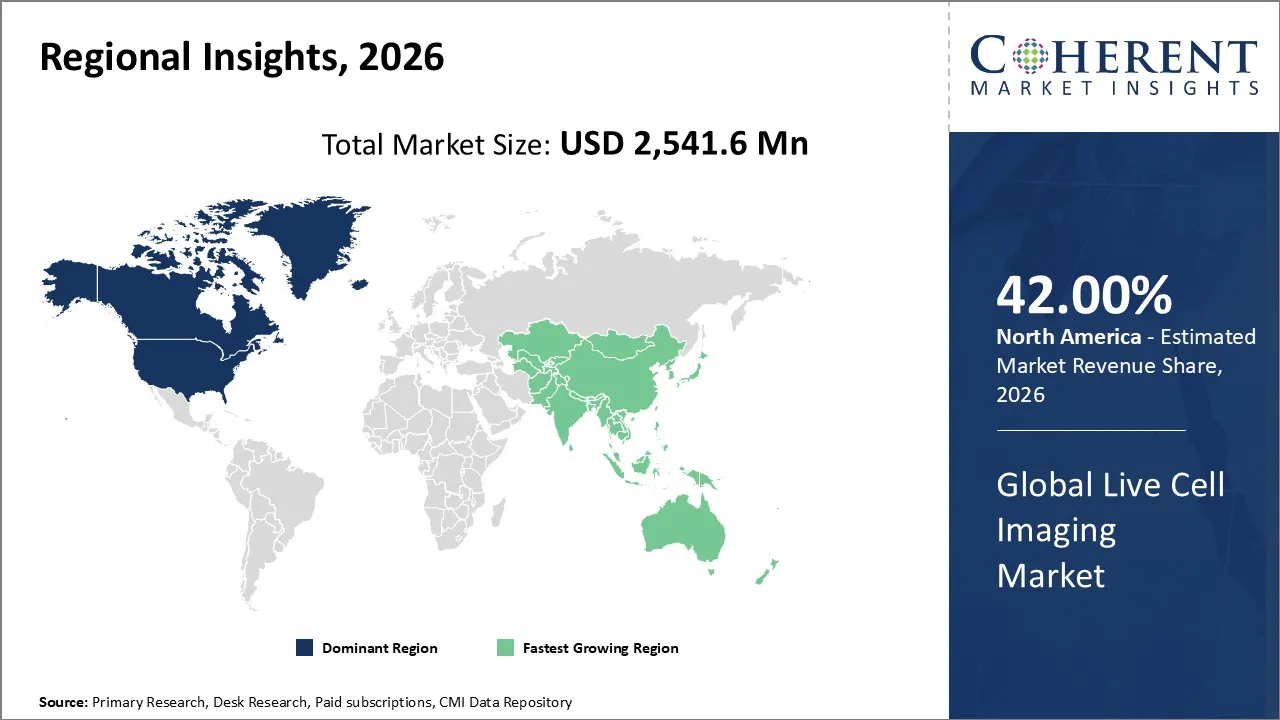
North America Live Cell Imaging Market Analysis & Trends
In 2026, North America is going to be the leader in the Live Cell Imaging Market because it has a well-developed healthcare system, an ample amount of government and private funding, and a significant amount of biotechnology and pharmaceutical research and development. The presence of major players in the industry and a growing interest in personalized medicine is also driving demand, securing a 42% share of the global market.
For instance, in February 2025, Ramona, a startup in Durham, has released Vireo, a new live-cell imaging system that is meant to speed up and increase the number of cells that can be analyzed. Vireo speeds up drug discovery by using small video microscopes and AI-powered image processing. The new idea gets around problems like the risk of photodamage and low resolution, making research more efficient.
Asia Pacific Live Cell Imaging Market Analysis & Trends
Asia Pacific is expected to exhibit the fastest growth, due to pharmaceutical and biotechnology research is growing quickly, government funding is increasing, and healthcare infrastructure investments are growing. The fastest growth of stem cell biology, cancer research, and personalized medicine is happening in China, India, and Japan.
For instance, in July 2025, At MM 2025, Thermo Fisher Scientific launched new electron microscopes that will make it easier for more people to conduct advanced research. These new systems are meant to make high-end imaging more accessible to more labs by giving them more powerful tools. This will encourage innovation and allow scientists to push the limits of cellular and molecular analysis.
Live Cell Imaging Market Outlook Country-Wise
The U.S. Live Cell Imaging Market Trends
The U.S. is going to have considerable amounts of demand for Live Cell Imaging in 2026 because it has a lot of government and private funding, a significant amount of biotechnology and pharmaceutical research and development, and a huge amount of advanced healthcare infrastructure. The U.S. is the leading contributor in the world because it has a lot of big companies and focuses on precision medicine.
In April 2025, The FDA granted Roche's VENTANA TROP2 (EPR20043) RxDx Device the Breakthrough Device Designation. This is the first AI-driven computational pathology companion diagnostic for non-small cell lung cancer. The device combines immunohistochemistry with digital pathology algorithms to make diagnoses more accurate and help doctors choose the best treatment for each patient. This strengthens Roche's position as a leader in cancer research.
Japan Live Cell Imaging Market Trends
Japan's demand for Live Cell Imaging is growing in 2026 as the government is strongly supporting biomedical research, the healthcare system is getting better, and increased money is going into regenerative medicine. Japan is a major growth hub in Asia-Pacific because it focuses on stem cell biology, cancer research, and precision medicine.
For instance, in October 2025, The FluoView FV5000 is a new imaging system from Evident Scientific that changes the way confocal and multiphoton microscopy work. It has better resolution, speed, and flexibility, which helps researchers push the limits of cellular research. The FV5000 gives scientists advanced tools that help them learn more, which leads to breakthroughs in life sciences and biomedical research.
Market Report Scope
Live Cell Imaging Market Report Coverage
| Report Coverage | Details | ||
|---|---|---|---|
| Base Year: | 2025 | Market Size in 2026: | USD 2,541.6 Mn |
| Historical Data for: | 2020 To 2024 | Forecast Period: | 2026 To 2033 |
| Forecast Period 2026 to 2033 CAGR: | 7.2% | 2033 Value Projection: | USD 4,134.6 Mn |
| Geographies covered: |
| ||
| Segments covered: |
| ||
| Companies covered: | Thermo Fisher Scientific Inc., Merck KgaA, PerkinElmer Inc., Nikon Instruments Inc., Live Cell Instrument, Olympus Corporation, Danaher Corporation, CytoSMART Technologies, ZEISS Group, and Becton, Dickinson and Company, among others | ||
| Growth Drivers: |
| ||
| Restraints & Challenges: |
| ||
Global Live Cell Imaging Market Drivers
Advancements in Imaging Technologies
Microscopy techniques like time-lapse imaging, Forster Resonance Energy Transfer (FRET), Fluorescence Recovery After Photobleaching (FRAP), and high-content screening have changed the way scientists study cells. With these new tools, scientists can watch living things change in real time with more accuracy than ever before. In consequence of this, more pharmaceutical and biotech companies are using these tools, which is increasing the Live Cell Imaging market growth. Better imaging capabilities not only help find new drugs, but they also open up new uses in stem cell and cancer research.
Rising Incidence of Chronic Diseases
The rise in chronic diseases like cancer, heart disease, and neurological disorders around the world has made the need for better research tools even greater. Live cell imaging allows scientists observe the way diseases progress and how cells respond to treatments in real time, making it important in drug development. Healthcare systems and research institutions are spending an excessive amount of funds on technologies that support personalized medicine and speed up the development of targeted treatments. This growing reliance is driving the live cell imaging market demand.
Global Live Cell Imaging Market Opportunities
Expansion in Personalized Medicine
Personalized medicine is increasingly prevalent in healthcare around the world. This means that treatments are made to fit each patient based on their genetic and cellular profiles. Live cell imaging is a key part of this change as it allows scientists observe the way cells react to drugs in real time, which leads to more accurate treatment plans. This feature improves drug discovery processes and helps create therapies that are more specific. The Live Cell Imaging Market forecast anticipates that strong growth will be driven by personalized medicine initiatives as more and more companies in the pharma and biotech industries start using it.
Analyst Opinion (Expert Opinion)
- The live cell imaging market is growing quickly as it is being used increasingly in drug discovery, life sciences research, and biotechnology. Market analyses consistently indicate that live cell imaging technologies are essential for observing dynamic cellular processes such as migration, division, and response to stimuli, which are crucial for fundamental biology and translational medicine research. North America is still the largest region that drives market demand, supported by dense research institutions as well as excellent funding for biomedical research and advanced microscopy use.
- Equipment is still the most important part of the live cell imaging ecosystem, reflecting more people are using advanced microscopy platforms that combine time-lapse and high-content screening methods. Consumables and software are also vital, especially as more advanced imaging workflows depend on cloud-based analysis and AI-enabled solutions to make sense of complicated cellular data. Time-lapse microscopy and high-content analysis are two of the most important types of technology. They can be used for a wide range of research needs, from studying how cells move to profiling their phenotypes. Cell biology and drug discovery are two of the main areas where demand is high. The majority of the market is used by academic and pharmaceutical end users.
- Overall, the live cell imaging market shows strong technological integration and regional diversification. There is strong demand from research-heavy environments, and there are signs of growth in the Asia-Pacific research sectors.
Speak to the analyst
Want personalized insights?
Take the findings above to one of our principal consultants, or have the report rebuilt around the segments, geographies and competitors you actually track.
Global Live Cell Imaging Market: Key Developments
- In September 2025, QAI Ventures inaugurated its Asia-Pacific headquarters in Singapore, which will help it have a bigger global presence in quantum innovation. The new hub will accelerate investments, partnerships, and the sale of quantum technologies throughout the region. This strategic move makes Singapore a key place for quantum research and business growth.
- In March 2025, Nikon Instruments selected Moffitt Cancer Center to be its newest Nikon Center of Excellence, giving researchers access to cutting-edge microscopy tools. The partnership will improve cancer research by providing cutting-edge imaging tools, such as confocal and live cell imaging systems. This will encourage new ideas in cellular biology and speed up discoveries in oncology.
Market Segmentation
- By Product
- Equipment
- Consumables
- Software
- Services
- By Application
- Cell Biology
- Developmental Biology
- Stem Cell Biology
- Drug Discovery
- Other Applications
- By Region
- North America
- U.S.
- Canada
- Latin America
- Brazil
- Argentina
- Mexico
- Rest of Latin America
- Europe
- Germany
- U.K.
- Spain
- France
- Italy
- Russia
- Rest of Europe
- Asia Pacific
- China
- India
- Japan
- Australia
- South Korea
- ASEAN
- Rest of Asia Pacific
- Middle East & Africa
- GCC Countries
- Israel
- Rest of Middle East & Africa
- North America
- Global Live Cell Imaging Market: Key Companies Insights
- Thermo Fisher Scientific Inc.
- Merck KgaA
- PerkinElmer Inc.
- Nikon Instruments Inc.
- Live Cell Instrument
- Olympus Corporation
- Danaher Corporation
- CytoSMART Technologies
- ZEISS Group
- Becton, Dickinson and Company
Sources
Primary Research Interviews
- Live Cell Imaging Device Manufacturers
- Microscopy & Imaging System Integrators
- Fluorescence & Confocal Microscopy Technology Providers
- Cell Biology & Life Sciences Researchers
- Academic & Industrial Bioimaging Consultants
- Others
Databases
- Bloomberg Terminal
- Thomson Reuters Eikon
- IHS Markit
- Euromonitor International
- S&P Global Market Intelligence
- Others
Magazines
- Nature Methods
- The Scientist
- BioTechniques Magazine
- Lab Manager Magazine
- Others
Journals
- Journal of Cell Biology
- Nature Communications – Life Sciences
- Cell Reports
- Journal of Microscopy
- Others
Newspapers
- Financial Times
- The Wall Street Journal
- Reuters
- Bloomberg News
- Others
Associations
- American Society for Cell Biology (ASCB)
- European Microscopy Society (EMS)
- Society for Laboratory Automation and Screening (SLAS)
- International Society for Advancement of Cytometry (ISAC)
- Others
Public Domain Sources
- U.S. National Institutes of Health (NIH) – Bioimaging Resources
- European Molecular Biology Laboratory (EMBL) – Imaging Facilities
- National Institute of Biomedical Imaging and Bioengineering (NIBIB)
- World Health Organization (WHO) – Life Sciences Publications
- National Center for Biotechnology Information (NCBI)
- Others
Proprietary Elements
- CMI Data Analytics Tool
- Proprietary CMI Existing Repository of Information for the Last 8 Years
Live cell imaging is the study of cellular structure and function in living cells via microscopy. It is used to obtain a better understanding of biological function through the study of cellular dynamics. In addition to basic research, live cell imaging plays an important role in drug discovery and development.
Get access to 250+ pages report
Every segment, forecast, competitor profile and data table behind the analysis above — available for instant download.
- ESOMAR Member
- ISO 9001:2015 Certified
- D-U-N-S Registered
- GDPR & CCPA Compliant
Missing comfort of reading report in your local language? Find your preferred language:
Transform your Strategy with Exclusive Trending Reports
Frequently Asked Questions
The global Live Cell Imaging Market size was valued at USD 2,541.6 Mn in 2026 and is expected to reach USD 4,134.6 Mn in 2033.
Advancements in imaging technologies and rising incidence of chronic diseases is fueling the growth of the market.
The equipment segment is the leading product segment in the market.
High cost of advanced imaging systems is a major factor restraining growth of the market.
Major players operating in the market are Thermo Fisher Scientific Inc., Merck KgaA, PerkinElmer Inc., Nikon Instruments Inc., Live Cell Instrument, Olympus Corporation, Danaher Corporation, CytoSMART Technologies, ZEISS Group, and Becton, Dickinson and Company, among others.