

Automatic Cell Imaging System Market Size and Forecast — 2026 - 2033
The Global Automatic Cell Imaging System Market size is estimated to be valued at USD 1.75 billion in 2026 and is expected to reach USD 3.25 billion by 2033, exhibiting a compound annual growth rate (CAGR) of 9.2% from 2026 to 2033.
Overview
The Automatic Cell Imaging System Market is driven by the growing adoption of high-throughput screening in drug discovery, cancer research, and regenerative medicine, where rapid and accurate cellular analysis is critical. Increasing demand for automated, reproducible, and real-time imaging solutions reduces manual errors and enhances research efficiency. Technological advancements in AI-powered image analysis, fluorescence imaging, and high-content screening enable precise cell characterization and monitoring. Rising investments in biotechnology, life sciences, and academic research, coupled with the need for standardized protocols in clinical diagnostics and personalized medicine, further fuel market growth globally, particularly in North America and Asia Pacific.
Key Takeaways
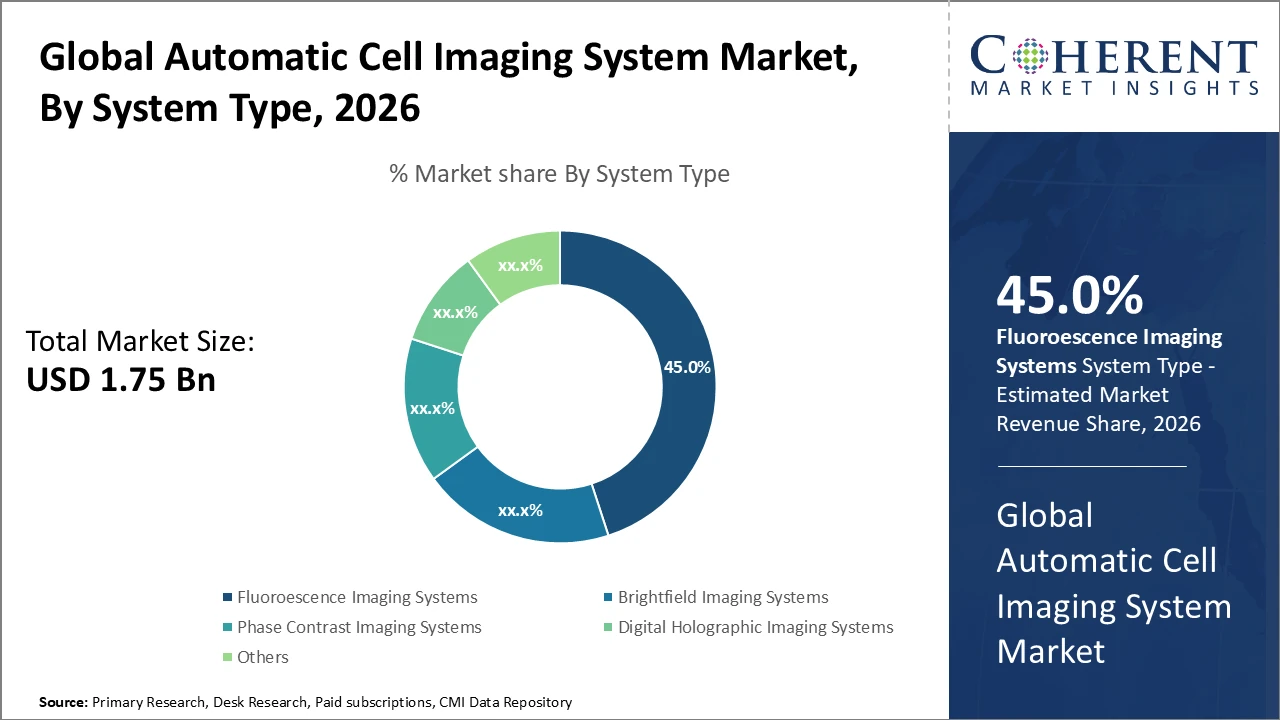
Fluorescence imaging systems dominate the Automatic Cell Imaging System Market with approximately 45% market share due to their ability to simultaneously detect multiple biomarkers and provide highly accurate cellular analysis for advanced research applications.
Drug discovery represents the fastest-growing application segment, supported by increasing demand for high-throughput screening technologies, precision oncology research, and accelerated pharmaceutical development processes.
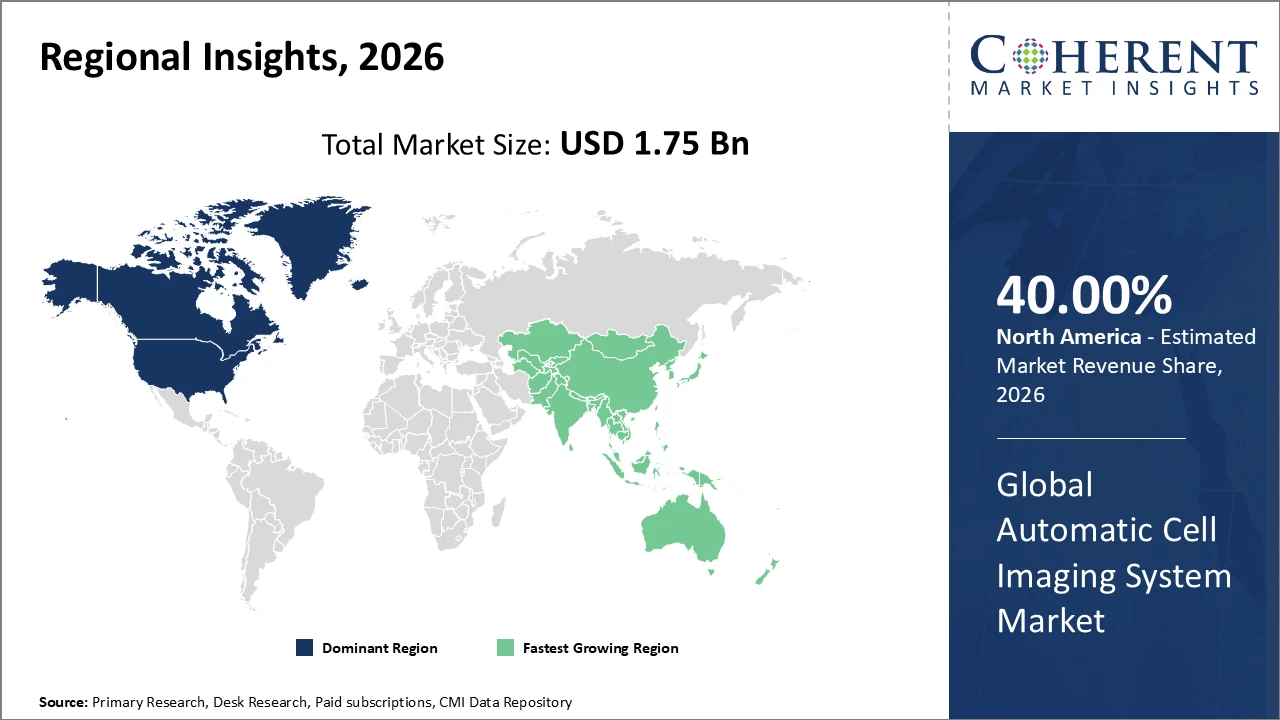
North America accounts for more than 40% of global market revenue in 2026, driven by advanced research infrastructure, strong biotechnology investments, and substantial funding for life sciences and precision medicine research.
Asia Pacific is the fastest-growing regional market, fueled by rapidly expanding biopharmaceutical industries in China and India, rising healthcare expenditures, and supportive government initiatives promoting biotechnology innovation and laboratory automation technologies.
Automatic Cell Imaging System Market Segmentation Analysis
Automatic Cell Imaging System Market Insights, By System Type
Fluorescence Imaging Systems lead the Automatic Cell Imaging System Market with nearly 45% market share due to their exceptional ability to visualize multiple cellular structures and biomarkers with high sensitivity and precision. These systems are extensively used in cancer research, drug discovery, and molecular biology applications where accurate cellular analysis is essential. Digital holographic imaging systems represent the fastest-growing subsegment because they enable label-free, non-invasive live-cell imaging and real-time cellular monitoring. Brightfield imaging systems remain widely adopted for routine laboratory applications because of their affordability and operational simplicity, while phase contrast imaging systems provide enhanced visualization of transparent cells. Additional niche imaging technologies support specialized biomedical and regenerative research applications.
Automatic Cell Imaging System Market Insights, By Application
Drug discovery dominates the Automatic Cell Imaging System Market due to rising demand for high-throughput screening, automated cellular analysis, and precise mechanism-of-action studies within pharmaceutical and biotechnology research. Automatic imaging systems significantly improve efficiency in monitoring cell behavior, toxicity responses, and drug interactions during development processes. Stem cell research is the fastest-growing application segment, driven by increasing investments in regenerative medicine, personalized therapies, and advanced live-cell imaging technologies. Cancer research continues to represent a major market segment because of expanding oncology research funding and precision medicine initiatives. Immunology studies are also gaining momentum due to growing focus on infectious disease research, while neurobiology and microbiology applications further contribute to market expansion.
Automatic Cell Imaging System Market Insights, By End User
Pharmaceutical and biotechnology companies dominate the Automatic Cell Imaging System Market due to their extensive reliance on advanced imaging technologies for drug discovery, biomarker quantification, toxicity testing, and cellular analysis. These organizations continuously invest in automated imaging platforms to accelerate research efficiency and improve precision in pharmaceutical development. Contract research organizations represent the fastest-growing subsegment as increasing outsourcing of preclinical research, screening services, and laboratory analysis drives demand for high-throughput imaging systems. Academic research institutes continue to contribute significantly through government-funded research programs and biotechnology innovation initiatives. Clinical laboratories primarily utilize automatic cell imaging systems for diagnostic and translational research applications, while specialized institutions support niche biomedical research activities.
Automatic Cell Imaging System Market Trends
The Automatic Cell Imaging System Market is increasingly integrating AI-driven imaging analysis platforms, significantly improving imaging accuracy, automation efficiency, and high-throughput cellular analysis capabilities across research laboratories worldwide.
Adoption of cloud-based data storage and analytical platforms is accelerating, enabling real-time collaboration, faster image processing, and improved accessibility for global biotechnology and pharmaceutical research teams.
Multi-modal imaging systems combining fluorescence, brightfield, and advanced imaging technologies are transforming complex cellular studies by enabling comprehensive and simultaneous cellular analysis within drug development and biomedical research workflows.
Leading companies are heavily investing in research and development to enhance automation, imaging precision, and software integration capabilities in response to growing demand for advanced laboratory automation and precision medicine applications.
Automatic Cell Imaging System Market Insights, By Geography
North America Automatic Cell Imaging System Market Analysis and Trends
North America dominates the Automatic Cell Imaging System Market, accounting for more than 40% of global market revenue due to its advanced biotechnology ecosystem, strong pharmaceutical research infrastructure, and extensive government funding for life sciences innovation. The region benefits from the presence of leading market players, research universities, and biotechnology startups actively developing advanced imaging and laboratory automation technologies. Academic-industry collaborations and supportive regulatory frameworks continue to accelerate innovation and commercialization of high-content imaging systems. Increasing investments in precision medicine, cancer research, and AI-powered laboratory solutions further strengthen regional market leadership. The United States remains the primary contributor to market growth and technological advancement across North America.
Asia Pacific Automatic Cell Imaging System Market Analysis and Trends
Asia Pacific is the fastest-growing region in the Automatic Cell Imaging System Market, projected to register a CAGR exceeding 12% due to rapid expansion of pharmaceutical manufacturing, biotechnology research activities, and healthcare infrastructure development. Countries such as China and India are witnessing increasing investments in clinical trials, precision medicine, and laboratory automation technologies, significantly boosting demand for advanced cell imaging systems. Government initiatives supporting biotechnology innovation and research collaborations further strengthen market growth across the region. In addition, expanding academic research institutes, growing biopharmaceutical production capabilities, and rising adoption of AI-based imaging technologies continue to accelerate the use of automatic cell imaging systems throughout Asia Pacific.
Automatic Cell Imaging System Market Outlook for Key Countries
USA Automatic Cell Imaging System Market Analysis and Trends
The United States plays a central role in the Automatic Cell Imaging System Market due to extensive investments in biotechnology research, regenerative medicine, and oncology studies, contributing nearly half of the regional market revenue in 2026. Increasing adoption of AI-powered imaging platforms has significantly improved laboratory automation, accelerating drug discovery and cellular analysis workflows across pharmaceutical and research institutions. Government support programs, including imaging infrastructure funding initiatives from the National Institutes of Health, continue to strengthen innovation and advanced research capabilities. Companies such as Thermo Fisher Scientific and Molecular Devices remain key innovators through continuous product development, strategic collaborations, and deployment of next-generation imaging technologies.
Germany Automatic Cell Imaging System Market Analysis and Trends
Germany’s Automatic Cell Imaging System Market is experiencing strong growth due to rising investments in biotechnology research, pharmaceutical development, and precision medicine applications. The country’s advanced healthcare infrastructure and robust life sciences ecosystem support increasing adoption of automated imaging technologies across research laboratories, hospitals, and biopharmaceutical companies. High-content screening systems, fluorescence imaging platforms, and AI-integrated cell analysis solutions are gaining significant traction for drug discovery and regenerative medicine applications. Germany also benefits from the presence of major microscopy and imaging technology manufacturers, strengthening domestic innovation capabilities. Growing demand for automated laboratory workflows, cell therapy research, and digital pathology solutions continues to accelerate market expansion across the country.
Analyst Opinion
Rising demand for high-throughput screening in drug discovery is significantly driving the Automatic Cell Imaging System Market, with increasing numbers of pharmaceutical companies adopting automated imaging platforms to accelerate drug candidate analysis and laboratory automation workflows.
Technological advancements and economies of scale have reduced system costs, improving affordability and accelerating adoption of automatic cell imaging systems across emerging biotechnology and pharmaceutical research hubs, particularly within Asia Pacific markets.
Import activity for advanced imaging systems has increased substantially in developing economies such as India and Brazil, supported by expanding oncology, immunology, and life sciences research initiatives alongside growing healthcare research infrastructure investments.
Advancements in nano-scale and high-resolution imaging technologies are expanding the use of automatic cell imaging systems in single-cell analysis and precision cellular research, increasing demand for specialized imaging instruments across biomedical and regenerative medicine applications.
- Current Industry Events of 2026
- Market Size Estimation
- Regional Breakdown
- Competitive Landscape
- Customer Intelligence
- Segmental Analysis
- Pricing Analysis
- Key Market Drivers, Challenges & Future Trends
- Customized Insights Section
Market Scope
| Report Coverage | Details | ||
|---|---|---|---|
| Base Year: | 2025 | Market Size in 2026: | USD 1.75 billion |
| Historical Data for: | 2020 To 2024 | Forecast Period: | 2026 To 2033 |
| Forecast Period 2026 to 2033 CAGR: | 9.2% | 2033 Value Projection: | USD 3.25 billion |
| Geographies covered: |
| ||
| Segments covered: |
| ||
| Companies covered: | Thermo Fisher Scientific, GE Healthcare, PerkinElmer Inc., Olympus Corporation, Bruker Corporation, Nikon Corporation, Danaher Corporation, ZEISS Group, QIAGEN N.V. | ||
| Growth Drivers: |
| ||
Automatic Cell Imaging System Market Growth Factors
The Automatic Cell Imaging System Market is experiencing strong growth due to increasing investments in oncology, stem cell research, and regenerative medicine, all of which require advanced imaging technologies for accurate cellular characterization and analysis. Growing emphasis on laboratory automation is also accelerating market adoption, as research institutions and pharmaceutical companies seek to improve workflow efficiency, reduce manual errors, and enhance high-throughput screening capabilities. Continuous advancements in imaging software, AI-driven analytical tools, and data processing algorithms are significantly improving the quality and speed of cellular analysis, enabling more actionable research insights. In addition, supportive government initiatives and funding programs focused on precision medicine, biotechnology innovation, and imaging infrastructure development continue to strengthen investment and long-term expansion opportunities across the global market.
Automatic Cell Imaging System Market Development
In May 2025, Araceli Biosciences launched Endeavor, a live-cell system enabling ultra-high-throughput kinetic imaging for AI-driven drug discovery.
Key Players
Leading Companies of the Market
Thermo Fisher Scientific
GE Healthcare
PerkinElmer Inc.
Olympus Corporation
Bruker Corporation
Nikon Corporation
Danaher Corporation
ZEISS Group
QIAGEN N.V.
Competitive strategies in the Automatic Cell Imaging System Market increasingly focus on strategic partnerships, acquisitions, and technology integration to strengthen market presence and expand application capabilities. Collaborations between imaging system providers and major biopharmaceutical companies have accelerated the development of integrated imaging and drug screening platforms, supporting higher contract acquisition rates and broader adoption across pharmaceutical research environments. Companies such as Thermo Fisher Scientific have expanded their product portfolios through the integration of AI-powered imaging analysis and automation software, improving user efficiency, data interpretation, and laboratory workflow optimization. These innovation-driven strategies are also helping companies generate recurring revenue through advanced software services, cloud-based analytics, and long-term research partnerships.
Automatic Cell Imaging System Market Future Outlook
The Automatic Cell Imaging System Market is expected to witness strong growth in the coming years due to increasing demand for automated cellular analysis, precision medicine, and high-throughput drug discovery technologies. Advancements in artificial intelligence, machine learning, and cloud-based imaging analytics are anticipated to significantly improve imaging accuracy, workflow automation, and real-time data interpretation across research and clinical laboratories. Expanding applications in cancer research, regenerative medicine, stem cell therapy, and personalized diagnostics will continue driving market demand globally. In addition, increasing investments in biotechnology infrastructure and the growing adoption of AI-integrated high-content screening platforms are expected to accelerate innovation and long-term market expansion across healthcare and pharmaceutical industries.
Automatic Cell Imaging System Market Historical Analysis
The Automatic Cell Imaging System Market has experienced significant growth over the past decade due to increasing demand for advanced laboratory automation, high-throughput screening, and precision cellular analysis. Initially, adoption was concentrated in academic research and pharmaceutical laboratories for basic microscopy and cell monitoring applications. Over time, technological advancements introduced AI-powered imaging, fluorescence-based analysis, and automated high-content screening systems that improved accuracy, speed, and reproducibility. North America historically dominated the market because of strong biotechnology research funding and advanced healthcare infrastructure, while Europe maintained steady growth through pharmaceutical innovation. Recently, Asia Pacific has emerged as a rapidly expanding market driven by biotechnology investments, rising clinical research activities, and growing pharmaceutical manufacturing capabilities.
Sources
Primary Research Interviews:
Biotechnology researchers, laboratory managers, pharmaceutical companies, and clinical diagnostics professionals utilizing automatic cell imaging systems for drug discovery, cancer research, and cellular analysis applications.
Supply chain executives, imaging technology developers, and procurement specialists responsible for sourcing microscopy components, imaging sensors, AI software, and laboratory automation equipment.
Market analysts, R&D directors, and regulatory experts involved in life sciences innovation, digital pathology, high-content screening technologies, and laboratory workflow automation.
Magazines:
BioTechniques – Updates on cell imaging technologies, microscopy innovations, and laboratory automation trends.
Genetic Engineering & Biotechnology News – Insights into biotechnology research, AI-driven imaging systems, and pharmaceutical R&D developments.
Laboratory Equipment Magazine – Coverage of automated laboratory systems, digital imaging technologies, and analytical instrument advancements.
Journals:
Nature Methods – Research on advanced imaging technologies, cellular analysis techniques, and automated microscopy applications.
Journal of Cell Biology – Studies focused on cell imaging, fluorescence microscopy, and cellular behavior analysis.
Cytometry Part A – Research covering high-content imaging, flow cytometry, and automated cell analysis technologies.
Newspapers:
Financial Times – Coverage of biotechnology investments, pharmaceutical innovation, and healthcare technology developments.
Reuters – Reporting on imaging system product launches, laboratory automation trends, and developments in the biotechnology sector.
Bloomberg – Insights into mergers, acquisitions, R&D investments, and strategic expansion activities within the life sciences and medical imaging industries.
Associations:
International Society for Advancement of Cytometry – Research developments, conferences, and innovation updates related to cellular imaging and analytical technologies.
American Association for Cancer Research – Insights into cancer research technologies, imaging applications, and precision medicine advancements.
European Molecular Biology Organization – Research initiatives, biotechnology innovation updates, and developments in advanced cellular imaging systems.
Get access to 250+ pages report
Every segment, forecast, competitor profile and data table behind the analysis above — available for instant download.
- ESOMAR Member
- ISO 9001:2015 Certified
- D-U-N-S Registered
- GDPR & CCPA Compliant
Missing comfort of reading report in your local language? Find your preferred language:
Transform your Strategy with Exclusive Trending Reports
Frequently Asked Questions
Leading companies in the Automatic Cell Imaging System Market include Thermo Fisher Scientific, PerkinElmer, and Danaher Corporation, all of which maintain strong market positions through continuous innovation, AI integration, and strategic research collaborations.
The Automatic Cell Imaging System Market is projected to reach USD 3.25 billion by 2033, expanding at a CAGR of 9.2% from 2026 to 2033.
Pharmaceutical and biotechnology companies represent the largest growth opportunity due to increasing investments in drug discovery, regenerative medicine, cell therapy development, and high-throughput screening technologies.
Future market trends will focus on AI-driven imaging platforms, multi-modal imaging technologies, cloud-based analytical systems, and advanced automation solutions designed to improve laboratory efficiency and cellular analysis accuracy.
The market is highly competitive with rapid technological innovation and strong research investments, while key challenges include high implementation costs, complex system integration, and the requirement for highly skilled laboratory professionals.
Major companies commonly adopt strategies such as product innovation, strategic partnerships, regional expansion, AI software integration, enhanced service offerings, and collaborations with pharmaceutical and research organizations to strengthen market presence.