

Biotechnology Instruments Market Size and Forecast – 2026 to 2033
Biotechnology Instruments Market is estimated to be valued at USD 74.77 Bn in 2026 and is expected to reach USD 142.04 Bn in 2033, exhibiting a compound annual growth rate (CAGR) of 9.6% from 2026 to 2033.
Key Takeaways
- By Product, Lab Automation Instruments acquired the prominent share in 2026 owing to the growing need for speed, accuracy & high throughput in R&D & drug discovery.
- By End-Use, Hospitals & Healthcare Facilities dominates the overall market with an estimated share of 46.6% in 2026 owing to the rising burden of chronic & complex diseases.
- By Region, North America hold the largest market share of 47.2% in 2026 owing to its robust public-private R&D investment.
Market Overview
Advancements in genomics, proteomics, and molecular diagnostics are driving strong growth in the biotechnology instruments market. Pharmaceutical and healthcare sectors are actively adopting these instruments to meet the rising demand for precision medicine and address the growing burden of chronic diseases. Researchers are expanding their activities, while innovations like automation, AI integration, and lab-on-chip systems are boosting lab efficiency and accuracy.
Current Events and their Impact on the Biotechnology Instruments Market
Current Events | Description and its impact |
Geopolitical Developments Affecting Biotechnology Instruments Supply Chains |
|
Technological Innovations and Integrations |
|
Economic and Funding Trends Influencing R&D and Market Growth |
|
Integration of Artificial Intelligence (AI) in Biotechnology Instruments
AI plays a transformative role in the biotechnology market by accelerating research, improving diagnostics, and enabling personalized medicine. Through machine learning and data analytics, AI helps identify patterns in complex biological data, speeding up drug discovery and development. In diagnostics, AI enhances accuracy by analyzing medical images, genetic data, and biomarkers. It also powers wearable biosensors for real-time health monitoring and chronic disease management.
In July 2025, Trinity Biotech plc, a biotechnology company specializing in diagnostics and diabetes management, announced CGM+, its next-generation AI-powered continuous glucose monitoring (CGM) system. Now in advanced development, CGM+ is a wearable biosensor platform that integrates multi-sensor data and real-time analytics.
- Current Industry Events of 2026
- Market Size Estimation
- Regional Breakdown
- Competitive Landscape
- Customer Intelligence
- Segmental Analysis
- Pricing Analysis
- Key Market Drivers, Challenges & Future Trends
- Customized Insights Section
End-user Feedback and Unmet Needs in the Biotechnology Instruments Market
- Demand for User-Friendly Interfaces: End-users often report that complex interfaces in biotechnology instruments hinder workflow efficiency. Researchers and technicians prefer intuitive, easy-to-navigate software and touch-screen interfaces that reduce training time and minimize operational errors, particularly in high-throughput laboratories or academic settings with frequent personnel changes.
- Need for Affordable Solutions: Cost remains a major barrier for small labs, educational institutions, and startups. Many end-users express the need for affordable biotechnology instruments that deliver essential functionality without compromising data accuracy. Budget constraints often force organizations to delay upgrades or rely on outdated equipment.
- Limited After-Sales Support: Users frequently cite inadequate after-sales service and delayed technical support as significant pain points. Timely maintenance, troubleshooting, and availability of spare parts are crucial for uninterrupted operations, especially in clinical and pharmaceutical labs where instrument downtime can affect critical timelines.
Segmental Insights
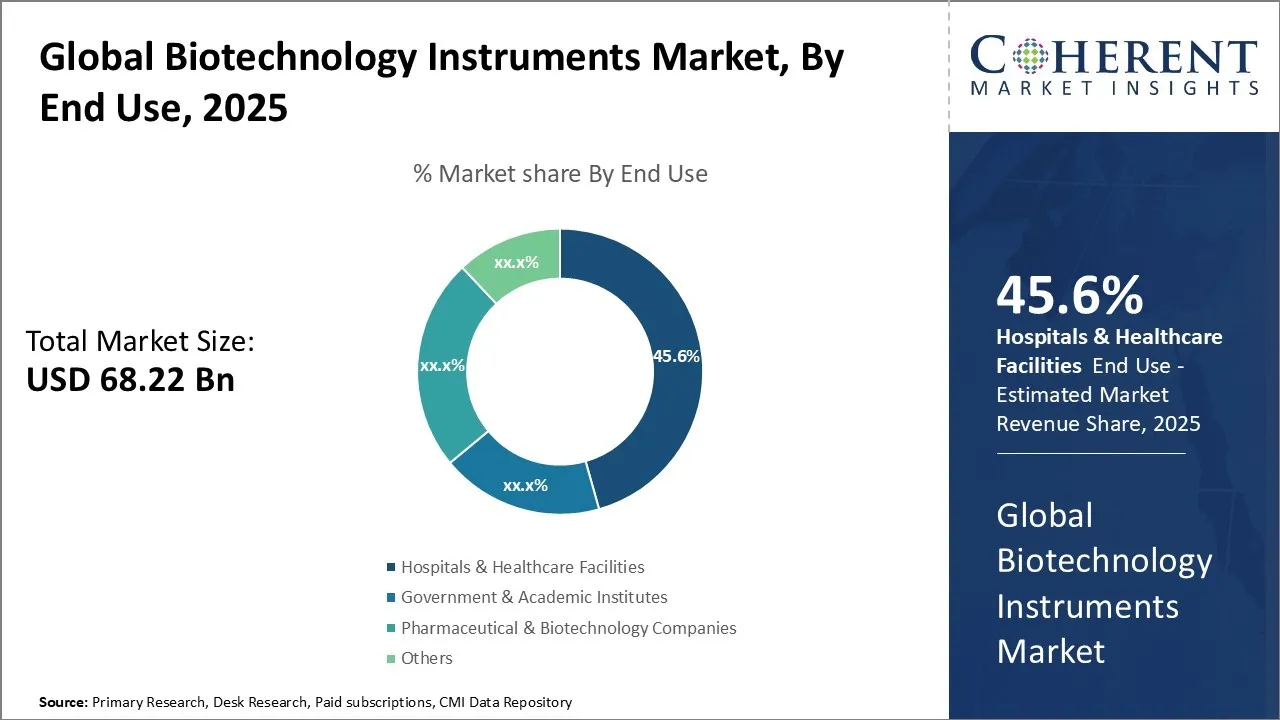
Biotechnology Instruments Market Insights, By End-Use: Hospitals & Healthcare Facilities contribute the highest share of the market owing to its emergence of point-of-care (POC) testing
Hospitals & Healthcare Facilities dominates the overall market with an estimated share of 46.6% in 2026. Healthcare facilities and hospitals are increasing their use of biotechnology instruments to meet the growing demand for fast and accurate diagnostics, particularly for chronic and infectious diseases. They are adopting advanced tools to support personalized treatments through genetic and molecular diagnostics. Innovations in point-of-care testing, automation, and imaging are helping medical teams improve patient care and streamline clinical workflows. As hospital admissions rise and the population ages, healthcare providers are investing more in efficient diagnostic and monitoring technologies. For instance, in January 2024, Roche, the global leader in biotechnology and in-vitro diagnostics, inaugurated its Digital Centre of Excellence in Pune, India. This milestone strengthens Roche’s presence in India and demonstrates the company’s active commitment to building a hub for digital talent and thought leadership in healthcare.
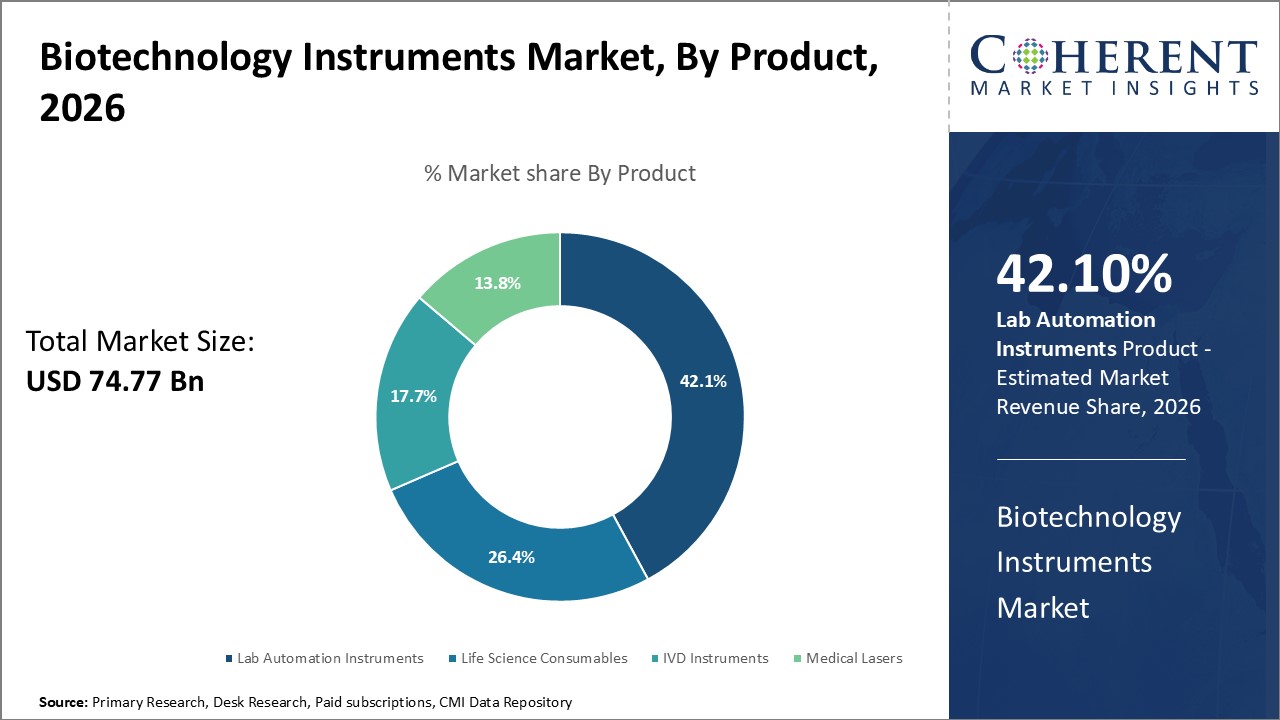
Biotechnology Instruments Market Insights, By Product: Lab Automation Instruments contribute the highest share of the market owing to its rise of personalized medicine & biomarker detection
Biotech and research labs are increasingly adopting lab automation instruments to achieve high-throughput analysis, enhance accuracy, and minimize human error in diagnostics and research. The growing focus on personalized medicine and faster drug discovery is accelerating this shift. Developers are advancing robotics, AI, and microfluidics to optimize workflows and boost productivity. Laboratories are also prioritizing standardized, reproducible results and operational efficiency, which further motivates them to integrate automated systems into their processes. For instance, in April 2025, QIAGEN planned to launch three new sample preparation instruments to expand and enhance its automated sample preparation portfolio. These systems aim to bring greater efficiency and sustainability to laboratory workflows.
Regional Insights
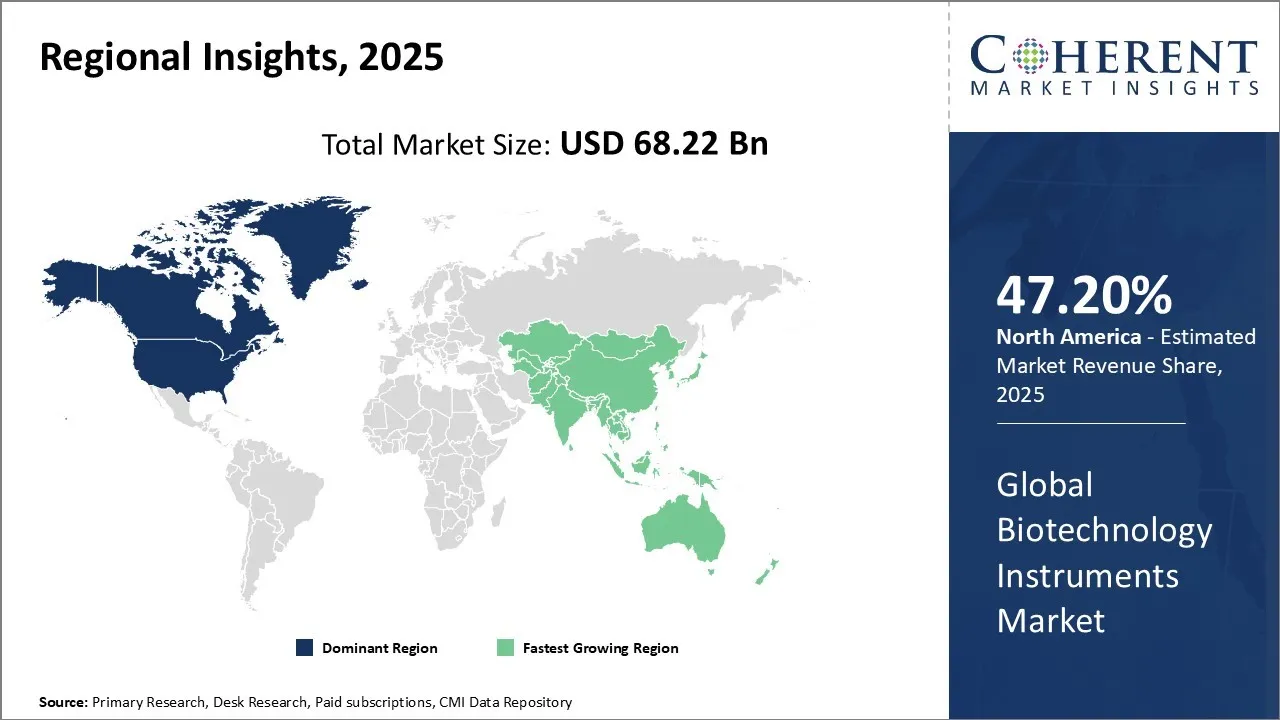
North America Biotechnology Instruments Market Trends
North America holds the largest market share of 47.20% in 2026. Strong research infrastructure, high healthcare spending, and widespread adoption of advanced technologies are driving steady growth in the North America biotechnology instruments market. Government and private sector investments actively support innovation in genomics, diagnostics, and personalized medicine. Leading industry players continue to expand their product portfolios through collaborations and acquisitions. Biotech companies, research institutions, and academic centers in the region are fueling increasing demand for these instruments.
For instance, Otometrics, a global manufacturer of audiology instrumentation and software solutions, has launched the next-generation Bio-logic® solutions. Working in collaboration with its technology partner, Germany-based PATH MEDICAL, Otometrics is delivering four modular solutions that are integrated into its product family in Tennessee.
Europe Biotechnology Instruments Market Trends
European healthcare systems are actively focusing on personalized treatment strategies. Hospitals and laboratories are integrating cutting-edge biotechnology instruments that enable genetic and molecular analysis to deliver precise diagnostics and therapies. Regulatory bodies like the European Medicines Agency (EMA) set clear guidelines to ensure the safety and effectiveness of these instruments. This supportive regulatory environment drives innovation and motivates manufacturers to develop high-quality, compliant products that meet stringent standards. For instance, in September 2024, Thermo Fisher Scientific’s PPD™ clinical research business, announced that it is expanding its global laboratory services by opening a new bioanalytical lab in GoCo Health Innovation City in Gothenburg, Sweden. The lab will provide pharmaceutical and biotech customers with advanced laboratory services and state-of-the-art instrumentation.
United States Biotechnology Instruments Market Trends
U.S. companies develop automated lab systems, AI-powered analysis, and next-generation sequencing instruments that boost research throughput, precision, and efficiency. Laboratories and healthcare providers rely on these innovations to meet the rising demand for faster, more accurate biotechnological analyses. The U.S. healthcare system actively integrates biotechnology instruments for personalized diagnostics and therapies. Increased use of genetic and molecular testing supports targeted treatments, enhances patient outcomes, and drives demand for advanced analytical tools. For instance, in January 2026, the U.S. Department of Commerce announced that it will implement new export controls on specific biotechnology equipment, citing national security concerns related to artificial intelligence and data science.
India Biotechnology Instruments Market Trends
The Indian government drives biotechnology growth through initiatives such as the Biotechnology Industry Research Assistance Council (BIRAC) and the “Make in India” campaign. These programs increase funding, build infrastructure, and encourage public-private collaborations, accelerating the nationwide use of advanced biotechnology instruments. At the same time, a growing number of biotech startups focused on diagnostics, agriculture, and environmental solutions are reshaping the industry. Innovation hubs and incubators actively support this growth by demanding compact, cost-effective, and versatile instruments for early-stage research and prototyping, especially in tier 2 and tier 3 cities. For instance, in February 2026, Miltenyi Biotec, a global leader in cell and gene therapy (CGT) solutions, unveiled India’s first dedicated cell and gene therapy center of excellence (CoE) in Hyderabad. The facility includes a showroom showcasing advanced MACS® instruments, a CliniMACS Prodigy® platform for therapy development and manufacturing, and offers interactive training opportunities.
Market Report Scope
Biotechnology Instruments Market Report Coverage
| Report Coverage | Details | ||
|---|---|---|---|
| Base Year: | 2025 | Market Size in 2026: | USD 74.77 Bn |
| Historical Data for: | 2020 To 2024 | Forecast Period: | 2026 To 2033 |
| Forecast Period 2026 to 2033 CAGR: | 9.6% | 2033 Value Projection: | USD 142.04 Bn |
| Geographies covered: |
| ||
| Segments covered: |
| ||
| Companies covered: | AngioDynamics, Cynosure, LLC, Lumenis, Candela Medical, Novanta, Inc., Iridex, Alcon, Inc., and Zimmer Biomet, among others | ||
| Growth Drivers: |
| ||
| Restraints & Challenges: |
| ||
Biotechnology Instruments Market Trend
- Rise in Personalized Medicine and Genomic Research
Biotechnology instruments are experiencing higher demand due to the growing focus on personalized medicine and genomic research. Institutions are investing in advanced tools like DNA sequencers, PCR systems, and microarray analyzers to decode individual genetic profiles. This trend is shaping healthcare by enabling targeted therapies, early disease detection, and tailored treatment plans. As the need for precision increases, laboratories and hospitals continue upgrading their infrastructure with cutting-edge instruments to support genetic analysis and personalized diagnostics.
- Increased Investment in Biopharmaceutical Manufacturing
The biopharmaceutical sector is driving substantial demand for biotechnology instruments across upstream and downstream processing. With the surge in vaccine development, monoclonal antibodies, and biosimilars, manufacturers are relying on fermentation systems, cell counters, and chromatography equipment. These tools help ensure high-yield production, consistent quality, and compliance with international standards. Companies are expanding their manufacturing capabilities, pushing the need for robust instrumentation to scale up processes, improve productivity, and reduce contamination risks in biologics production.
Biotechnology Instruments Market News
- In July 2025, Bio-Rad Laboratories, Inc., a global leader in life science research and clinical diagnostics products, launched four new Droplet Digital™ PCR (ddPCR™) platforms. The new instruments include the QX Continuum™ ddPCR system and the QX700™ series of ddPCR platforms.
- In February 2025, Agiliti, a leading manufacturer and provider of medical device solutions to the U.S. healthcare industry, launched Essentia™—a versatile, multi-acuity bed frame designed to support a broad range of patients across various hospital settings.
- In April 2024, LICORbio, formerly known as LI-COR Biotechnology and a global pioneer in life science instrumentation, launched two new Odyssey® F biomolecular imaging systems. These models deliver significantly faster scans, enhanced value, expanded assay support, and the exceptional dynamic range and data reliability that researchers have come to expect from LICORbio.
- In April 2024, Waters Corporation unveiled Alliance iS Bio HPLC System, which offers new capabilities to tackle the operational and analytical challenges faced by biopharma quality control (QC) laboratories. The new HPLC system combines advanced bio-separation technology with built-in instrument intelligence features.
Analyst Opinion (Expert Opinion)
- The biotechnology instruments market is no longer just about precision and performance—it’s about accessibility, agility, and integration. The days when sophisticated equipment catered only to top-tier research labs are behind us. Today, demand is shifting towards instruments that are compact, affordable, and digitally enabled, especially in emerging markets like India where over 150 new life sciences research labs were established in 2023 alone. These aren’t anecdotal upgrades—they represent a structural shift toward decentralizing biotech infrastructure and pushing innovation beyond metro cities.
- For example, Mylab Discovery Solutions is a sharp case in point. In just six weeks, the company developed and secured regulatory approval for India’s first indigenous COVID-19 RT-PCR test kit, demonstrating the ability of local players to outpace global incumbents when incentives, infrastructure, and need align. It also showcased the kind of instrumentation innovation that thrives under pressure—modular, rapid, and regulator-ready. This isn’t a one-off success but a reflection of the kind of responsive product development that is now expected across diagnostics and genomics.
- With nearly 45% of research and diagnostic labs in India now adopting Laboratory Information Management Systems (LIMS), any instrument lacking real-time data compatibility or cloud sync capabilities risks becoming obsolete. Instruments are no longer standalone tools—they are components in an interoperable workflow. Manufacturers who haven’t embedded this thinking into product design will see a steep decline in long-term relevance.
Speak to the analyst
Want personalized insights?
Take the findings above to one of our principal consultants, or have the report rebuilt around the segments, geographies and competitors you actually track.
Market Segmentation
- Global Biotechnology Instruments Market, By Product (Revenue, USD Bn, 2021 - 2033)
- Lab Automation Instruments
- Proteomics
- Genomics
- Sequencing
- Spatial Cell Analysis
- Others
- Life Science Consumables
- IVD Instruments
- Medical Lasers
- Therapeutics
- Ophthalmics
- Ablation
- Lab Automation Instruments
- Global Biotechnology Instruments Market, By End-Use (Revenue, USD Bn, 2021 - 2033)
- Government & Academic Institutes
- Pharmaceutical & Biotechnology Companies
- Hospitals & Healthcare Facilities
- Others
- Global Biotechnology Instruments Market, By Geography (Revenue, USD Bn, 2021 - 2033)
- North America
- U.S.
- Canada
- Latin America
- Brazil
- Argentina
- Mexico
- Rest of Latin America
- Europe
- Germany
- U.K.
- Spain
- France
- Italy
- Russia
- Rest of Europe
- Asia Pacific
- China
- India
- Japan
- Australia
- South Korea
- ASEAN
- Rest of Asia Pacific
- Middle East
- GCC Countries
- Israel
- Rest of Middle East
- Africa
- South Africa
- North Africa
- Central Africa
- North America
- Key Players Insights
- AngioDynamics
- Cynosure, LLC.
- Lumenis
- Candela Medical
- Novanta, Inc.
- Iridex
- Alcon, Inc.
- Zimmer Biomet
Sources
Primary Research Interviews
- In-depth interviews with senior executives of biotechnology instrument manufacturers and distributors
- Discussions with lab managers and procurement heads at hospitals, CROs, and academic research institutions
- Insights from principal investigators at leading biotech research labs and government-funded projects
- Feedback from startup founders in diagnostics, genomics, and agricultural biotechnology
Databases
- IndiaStat
- PubMed Central (PMC)
- World Bank Open Data
- Ministry of Science & Technology – Biotech Projects Portal
- National Centre for Biotechnology Information (NCBI)
- Union Budget and Annual Reports from Department of Biotechnology (DBT)
Magazines
- Biospectrum India
- Nature India
- Biotech Express
- Express Pharma
- India Today (Science & Technology Section)
Journals
- Journal of Biotechnology
- Indian Journal of Medical Research
- Nature Biotechnology
- Current Science (Indian Academy of Sciences)
- Trends in Biotechnology
Newspapers
- The Hindu – Science & Tech
- The Times of India – Health & Biotech Section
- Business Standard – Life Sciences Coverage
- The Economic Times – Biotech and Pharma Reports
- Mint – Diagnostics and Healthcare Innovation
Associations
- Association of Biotechnology Led Enterprises (ABLE)
- Biotechnology Industry Research Assistance Council (BIRAC)
- Federation of Indian Chambers of Commerce & Industry (FICCI) – Biotech Division
- Confederation of Indian Industry (CII) – Lifesciences & Biotech Wing
- Indian Pharmaceutical Association (IPA)
Public Domain Sources
- Press Information Bureau (PIB) – Government of India
- CSIR – Open Access Repository
- Department of Biotechnology (DBT) – Official Website and Reports
- WHO India Country Office Reports
- India’s National Health Portal
Proprietary Elements
- CMI Data Analytics Tool, and Proprietary CMI Existing Repository of information for last 8 years
Get access to 250+ pages report
Every segment, forecast, competitor profile and data table behind the analysis above — available for instant download.
- ESOMAR Member
- ISO 9001:2015 Certified
- D-U-N-S Registered
- GDPR & CCPA Compliant
Missing comfort of reading report in your local language? Find your preferred language:
Transform your Strategy with Exclusive Trending Reports
Frequently Asked Questions
The Biotechnology Instruments Market is estimated to be valued at USD 74.77 Bn in 2026, and is expected to reach USD 142.04 Bn by 2033.
The CAGR of the Biotechnology Instruments Market is projected to be 9.6% from 2026 to 2033.
Rising prevalence of chronic diseases and increasing demand for point-of-care (POC) tests/devices is fueling the growth of the market.
Hospitals & healthcare facilities segment is the leading end user segment in the market.
High cost of biotechnology instruments and dearth of skilled professionals are some major factors restraining growth of the market.
Major players operating in the market are AngioDynamics, Cynosure, LLC.., Lumenis, Candela Medical, Novanta, Inc., Iridex, Alcon, Inc., and Zimmer Biomet, among others.