

Fluoroscopy Devices Market Size and Forecast – 2026 to 2033
The Fluoroscopy Devices Market is anticipated to grow at a CAGR of 7.3% with USD 11.2 Bn in 2026 and is expected to reach USD 18.3 Bn in 2033. Rising prevalence of chronic diseases, increasing demand for minimally invasive procedures, and ongoing technological advancements in imaging systems drive the fluoroscopy devices market. According to the CDC, over 90% of adults aged 65 years and older have at least one chronic health condition.
Key Takeaways
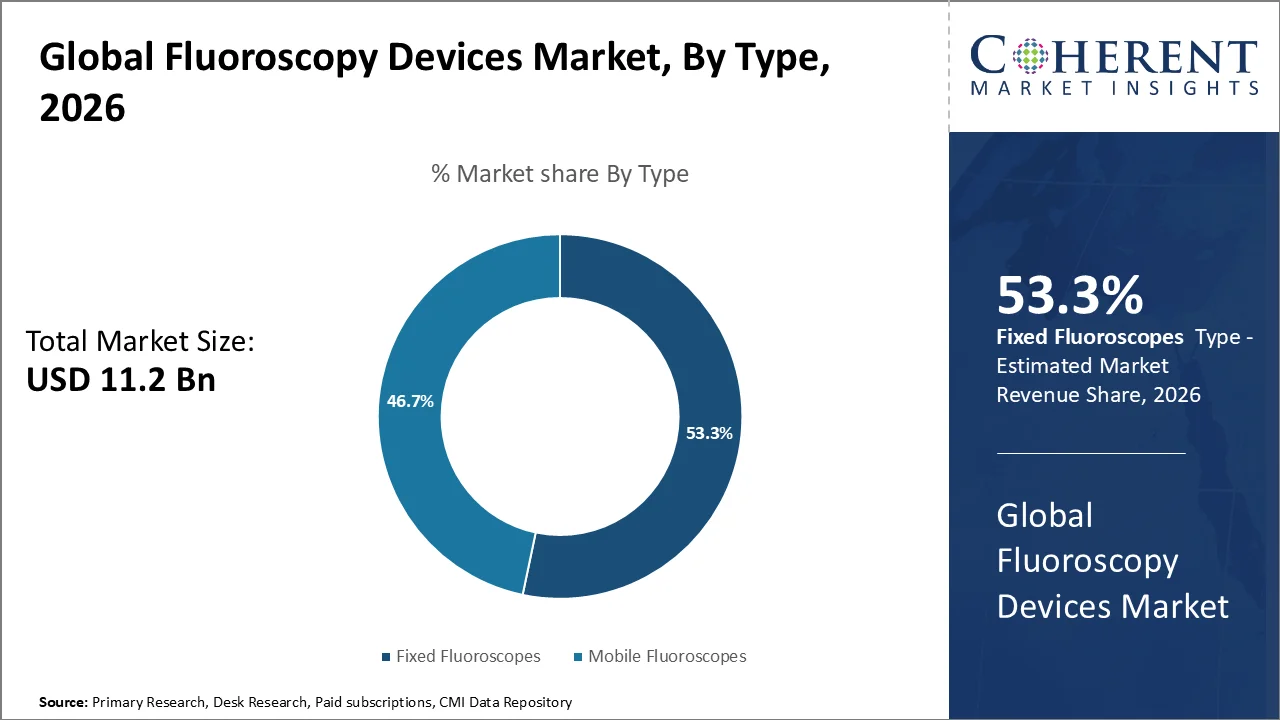
- Fixed Fluoroscopes hold the largest market share of 53.3% in 2026, owing to the rising burden of chronic diseases and increasing demand for high-volume diagnostic and interventional procedures. According to the World Health Organization, chronic diseases account for approximately 74% of global deaths, driving the need for advanced imaging systems in hospitals and specialty centers. Fixed fluoroscopy systems are preferred due to their superior image quality, higher throughput, and integration with hybrid operating rooms.
- Cardiovascular applications are expected to hold the largest market share of 32.2% in 2026, owing to the surge in interventional cardiology procedures. Cardiovascular diseases remain the leading cause of death globally, responsible for nearly 17.9 million deaths annually, according to the World Health Organization. The growing volume of minimally invasive procedures such as angioplasty, catheterization, and transcatheter valve interventions continues to increase demand for fluoroscopic guidance.
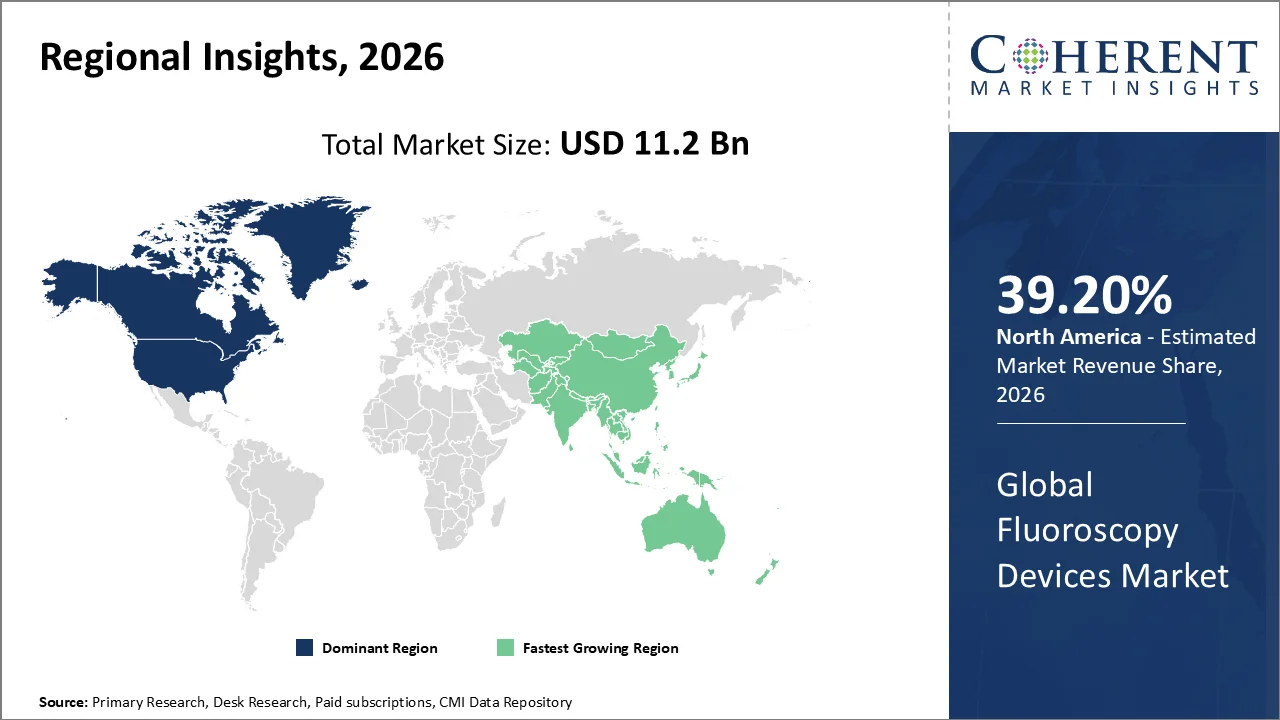
- North America is expected to acquire the dominant share of 39.2% in 2026, owing to rapid technological innovation, favorable reimbursement policies, and high healthcare expenditure. The Centers for Medicare & Medicaid Services reports that healthcare spending in the United States exceeded US$ 5 trillion, representing nearly 18% of GDP, supporting widespread adoption of advanced fluoroscopy systems. Additionally, the region performs millions of image-guided procedures annually, reinforcing its leadership in the market.
Current Events and Their Impact on the Fluoroscopy Devices Market
Current Event | Description and its Impact |
CMS Expansion of Reimbursement for Structural Heart Procedures (U.S., 2024–2026) |
|
Implementation of the European Medical Device Regulation (MDR) |
|
Segmental Insights
- Current Industry Events of 2026
- Market Size Estimation
- Regional Breakdown
- Competitive Landscape
- Customer Intelligence
- Segmental Analysis
- Pricing Analysis
- Key Market Drivers, Challenges & Future Trends
- Customized Insights Section
Why is Fixed Fluoroscopes Acquiring the Largest Market Share?
Fixed Fluoroscopes hold the largest market share of 53.3% in 2026. Rising prevalence of chronic diseases, increasing demand for minimally invasive procedures, and expanding use of image-guided interventions drive the fixed fluoroscopes segment in the fluoroscopy devices market. Hospitals prefer fixed systems because they handle high patient volumes and deliver superior image quality and stability. Manufacturers enhance adoption by introducing digital detectors and dose reduction features. Expanding healthcare infrastructure, growing investments in advanced imaging facilities, and an aging population further sustain demand for fixed fluoroscopy systems. In September 2025, Biotronik launched Solia CSP S, a new conduction system pacing lead that combines a fixed screw design with a stylet-driven implantation system. It is designed to simplify CSP procedures while improving physician control and precision.
Cardiovascular expected to hold largest market share
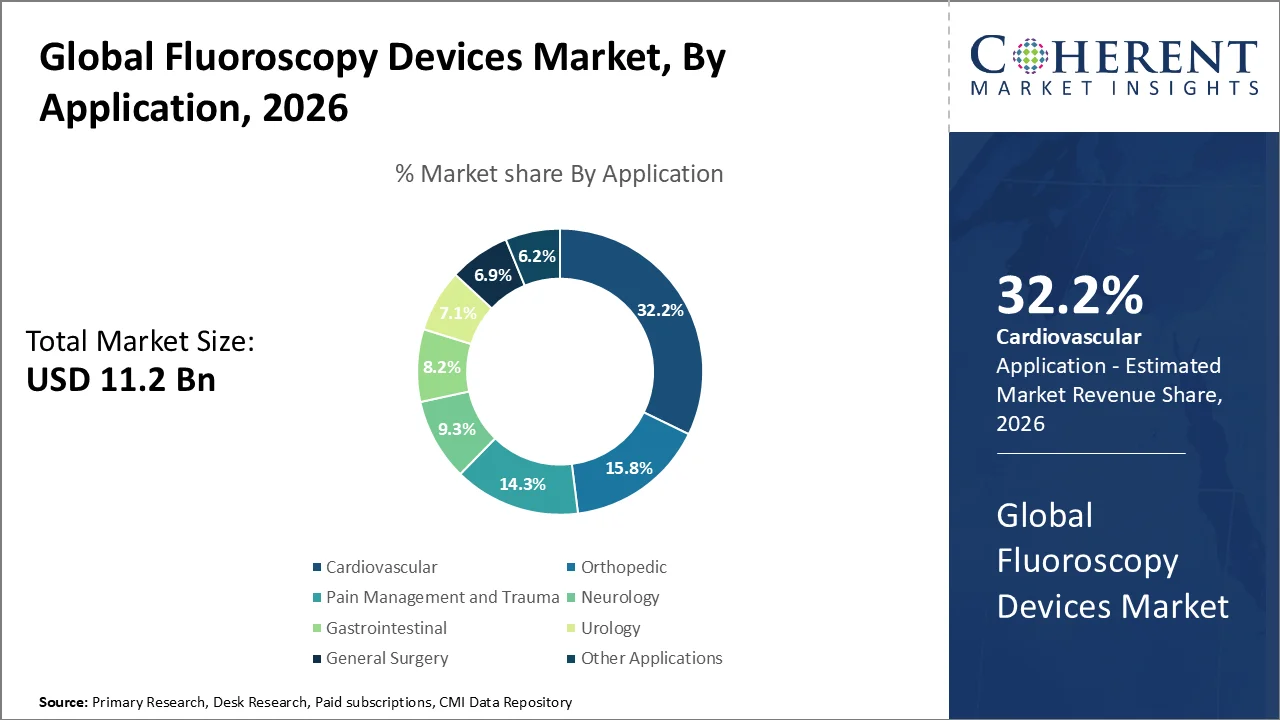
Cardiovascular expected to hold largest market share of 32.2% in 2026 owing to the demand for precision and real-time visualization. Rising prevalence of heart diseases drives the growth of the cardiovascular segment in the Fluoroscopy Devices Market, along with increasing demand for minimally invasive procedures and ongoing advancements in imaging technology. Fluoroscopy provides real-time visualization during cardiac interventions, which improves precision and enhances patient outcomes. Healthcare providers expand infrastructure, adopt interventional cardiology practices, and address the needs of an aging population, further boosting demand, while manufacturers continue to innovate to improve image quality and reduce radiation exposure, making these devices more efficient and widely accepted. For instance, in February 2025, Johnson & Johnson MedTech launched the Cereglide 92 Catheter System for treating acute ischemic stroke. The system includes a 0.92” catheter and the Innerglide 9 delivery aid, designed to help clinicians navigate neurovascular procedures and provide strong distal support for treating complications such as aneurysms.
Fluoroscopy Devices Market Trends
- Rising demand for minimally invasive procedures such as angioplasty, catheterization, and interventional radiology is increasing the adoption of fluoroscopy systems, improving procedural accuracy and reducing recovery time. Cardiovascular diseases cause approximately 17.9 million deaths annually worldwide, while the number of catheter-based interventions continues to rise globally, making fluoroscopy an essential imaging modality for real-time procedural guidance.
- Growing preference for mobile and compact fluoroscopy systems in hospitals and outpatient settings improves accessibility and supports point-of-care imaging. The expansion of ambulatory surgery centers (ASCs) is accelerating this trend, with the United States now operating more than 6,000 Medicare-certified ASCs, creating substantial demand for mobile C-arms and compact fluoroscopy units.
- Integration of advanced imaging technologies, including digital flat-panel detectors and AI-assisted imaging, enhances real-time visualization, workflow efficiency, and diagnostic precision. Modern digital fluoroscopy systems can reduce radiation exposure by 70% compared to conventional imaging systems while maintaining high image quality, encouraging healthcare providers to upgrade existing equipment.
Regional Insights
North America dominates owing to strong reimbursement and favorable healthcare spending
North America is expected to acquire the dominant share of 39.20% in 2026. Increasing prevalence of chronic diseases drives demand for advanced diagnostic and interventional imaging across North America’s fluoroscopy devices market. Chronic diseases are the leading cause of death and disability in the United States, affecting 60% of adults, with 40% living with multiple chronic conditions, and are the primary contributor to healthcare spending. Hospitals and specialty clinics increasingly adopt these systems as minimally invasive surgeries and real-time imaging guidance gain popularity. Technological advancements such as portable C-arms and digital imaging systems improve procedural efficiency and accuracy in complex interventions. Growing healthcare infrastructure investment, a rising elderly population, and more trauma and orthopedic procedures further fuel overall market demand and regional expansion. For instance, FUJIFILM Medical Systems U.S.A. has launched the Persona RF PREMIUM in the United States. The radiography and fluoroscopy system delivers real-time imaging for multiple body systems and organs, supporting hospitals and medical centers of all sizes.
Asia Pacific Fluoroscopy Devices Market Trends
Rising prevalence of chronic diseases drives demand for advanced diagnostic imaging across Asia Pacific, while an aging population increases the need for minimally invasive procedures. Healthcare providers expand and modernize hospital infrastructure and invest more in radiology departments, which accelerates adoption of fluoroscopy systems. Technological innovations like digital fluoroscopy and real-time imaging improve clinical efficiency and workflow. Growing awareness of early disease detection and the increasing use of interventional radiology further boost market growth across the Asia Pacific region. For instance, Johnson & Johnson MedTech has launched the VARIPULSE Platform in Asia-Pacific for catheter ablation of atrial fibrillation (AFib). The platform enables safe, efficient, patient-centric treatment with minimal to no fluoroscopy exposure and supports both deep and conscious sedation.
United States Fluoroscopy Devices Market Trends
Rising demand for minimally invasive diagnostic and interventional procedures across hospitals and specialty clinics drives the United States fluoroscopy devices market. The growing burden of chronic conditions, including cardiovascular and gastrointestinal diseases, increases procedure volumes. Gastrointestinal (GI) diseases constitute a significant global health burden, affecting nearly 40% of the population worldwide. These conditions contribute to approximately 8 million deaths annually and represent over one-third of all prevalent medical disorders, driving substantial demand for diagnostic and interventional healthcare services. Advancements in digital imaging, flat-panel detectors, and real-time visualization improve accuracy and efficiency. A rising geriatric population, expanding healthcare infrastructure, and wider use in ambulatory surgical centers also support growth. Ongoing innovation in radiation dose reduction and AI-enabled imaging further accelerates clinical adoption. For instance, Shimadzu Medical Systems USA, a division of Shimadzu Precision Instruments, has launched the SC15 in the United States. The mobile C-arm X-ray fluoroscopy system is mainly used in orthopedic surgery and allows flexible positioning as it rotates around the patient.
Japan Fluoroscopy Devices Market Trends
Rising cases of cardiovascular and gastrointestinal disorders drive demand for real-time imaging in Japan’s fluoroscopy devices market. An expanding elderly population increases the need for diagnostic and interventional procedures. Hospitals modernize continuously and adopt minimally invasive techniques, boosting equipment use. Healthcare providers integrate advanced imaging systems in tertiary centers. Domestic and global manufacturers innovate and improve image quality and workflow efficiency. Regulatory support, clinical research, and ongoing hospital investments further strengthen technology upgrades across the healthcare system.
Who are the Major Companies in Fluoroscopy Devices Industry
Some of the major key players in Fluoroscopy Devices are Hologic Inc., Siemens Healthcare GmbH, Shimadzu Medical, Koninklijke Philips NV, FUJIFILM Holdings Corporation, Carestream Health, Canon Medical Systems Corporation, General Electric Company (GE Healthcare), and ATON GmbH (Ziehm Imaging Inc. and OrthoScan, Inc.).
Key News
- In January 2025, At RSNA, Siemens Healthineers introduced the Luminos Q.namix platform for next-generation fluoroscopy and radiography. The versatile platform is designed to combine both functionalities to save time, space, and costs. Complex workflows and system controls often impair productivity in radiology departments.
Market Report Scope
Fluoroscopy Devices Market Report Coverage
| Report Coverage | Details | ||
|---|---|---|---|
| Base Year: | 2025 | Market Size in 2026: | USD 11.2 Bn |
| Historical Data for: | 2020 To 2024 | Forecast Period: | 2026 To 2033 |
| Forecast Period 2026 to 2033 CAGR: | 7.3% | 2033 Value Projection: | USD 18.3 Bn |
| Geographies covered: |
| ||
| Segments covered: |
| ||
| Companies covered: | Hologic Inc., Siemens Healthcare GmbH, Shimadzu Medical, Koninklijke Philips NV, FUJIFILM Holdings Corporation, Carestream Health, Canon Medical Systems Corporation, General Electric Company (GE Healthcare), and ATON GmbH (Ziehm Imaging Inc. and OrthoScan, Inc.). | ||
Analyst Opinion
- Fluoroscopy device demand is fundamentally driven by procedural necessity rather than discretionary adoption. Cardiovascular diseases alone account for approximately 17.9 million deaths annually worldwide, with a large share requiring catheter-based imaging guidance, directly reinforcing continuous reliance on fluoroscopic systems in interventional cardiology labs.
- Fluoroscopy remains indispensable in high-volume interventional procedures such as angioplasty and stent placement, where real-time imaging accuracy directly impacts outcomes. For example, over 3 million percutaneous coronary interventions (PCIs) are performed globally each year, each heavily dependent on fluoroscopic guidance, making replacement or substitution clinically impractical.
- The shift toward minimally invasive surgery is structurally strengthening fluoroscopy utilization across specialties. Clinical studies show minimally invasive procedures can reduce hospital stays by up to 60% compared to open surgery, accelerating adoption in orthopedics, gastroenterology, and urology where fluoroscopic navigation is essential for device placement and intraoperative decision-making.
Speak to the analyst
Want personalized insights?
Take the findings above to one of our principal consultants, or have the report rebuilt around the segments, geographies and competitors you actually track.
Market Segmentation
- By Type (Revenue, USD Bn, 2021-2033)
- Fixed Fluoroscopes
- Mobile Fluoroscopes
- By Application (Revenue, USD Bn, 2021-2033)
- Orthopedic
- Cardiovascular
- Pain Management and Trauma
- Neurology
- Gastrointestinal
- Urology
- General Surgery
- Other Applications
- By Region (Revenue, USD Bn, 2021-2033)
- North America
- U.S.
- Canada
- Latin America
- Brazil
- Mexico
- Argentina
- Rest of Latin America
- Europe
- Germany
- U.K.
- France
- Italy
- Spain
- Russia
- Rest of Europe
- Asia Pacific
- China
- India
- Japan
- Australia
- South Korea
- ASEAN
- Rest of Asia Pacific
- Middle East
- GCC
- Israel
- Rest of Middle East
- Africa
- South Africa
- Central Africa
- North Africa
- North America
Sources
Primary Research interviews
- Interventional radiologists and cardiologists
- Hospital radiology department heads
- Medical imaging technicians and radiology nurses
- Procurement managers in hospitals and diagnostic centers
- Biomedical equipment distributors and suppliers
Databases
- National health statistics databases (government health portals)
- Hospital procurement and tender databases
- Medical device regulatory approval databases
- Clinical trial registries related to imaging technologies
- Patent databases for imaging and fluoroscopy technologies
Magazines
- Medical imaging and radiology trade magazines
- Healthcare technology magazines
- Diagnostic imaging equipment publications
- Biomedical engineering magazines
Journals
- Peer-reviewed radiology journals
- Medical physics journals
- Interventional cardiology journals
- Biomedical engineering and imaging science journals
- Clinical diagnostic imaging research journals
Newspapers
- Leading national newspapers with healthcare sections
- Business newspapers covering medical technology developments
- Financial newspapers reporting on healthcare infrastructure investments
Associations
- Radiology and medical imaging professional associations
- Interventional cardiology societies
- Hospital and healthcare provider associations
- Biomedical engineering professional bodies
- Medical device industry associations
Public Domain sources
- Government health ministry publications
- World health statistics reports
- Hospital infrastructure reports published by public institutions
- Regulatory authority guidelines and approvals for imaging devices
- Academic institution research repositories
Proprietary Elements
- CMI Data Analytics Tool
- Proprietary CMI Existing Repository of information for last 10 years
Get access to 250+ pages report
Every segment, forecast, competitor profile and data table behind the analysis above — available for instant download.
- ESOMAR Member
- ISO 9001:2015 Certified
- D-U-N-S Registered
- GDPR & CCPA Compliant
Missing comfort of reading report in your local language? Find your preferred language:
Transform your Strategy with Exclusive Trending Reports
Frequently Asked Questions
The Fluoroscopy Devices Market is anticipated to grow at a CAGR of 7.3% with USD 11.2 Bn in 2026 and is expected to reach USD 18.3 Bn in 2033.
Rise in prevalence of cardiovascular diseases and increase in geriatric population across the globe is fueling the market.
The fixed fluoroscopes segment is the leading product segment in the market.
Side effects and risk of radiation exposure and rise in adoption of refurbished fluoroscopy devices are major factors restraining the market.
Major players operating in the market are Hologic Inc., Siemens Healthcare GmbH, Shimadzu Medical, Koninklijke Philips NV, FUJIFILM Holdings Corporation, Carestream Health, Canon Medical Systems Corp., General Electric Company (GE Healthcare), and ATON GmbH (Ziehm Imaging Inc. and OrthoScan, Inc.).