

Optical Imaging Market Size and Forecast — 2026 - 2033
The Global Optical Imaging Market size is estimated to be valued at USD 9.2 billion in 2026 and is expected to reach USD 18.3 billion by 2033, exhibiting a compound annual growth rate (CAGR) of 10.5% from 2026 to 2033
Overview
Optical imaging products are widely used in medical diagnostics, research, and industrial inspection to visualize tissues, cells, and materials with high resolution. Key products include optical coherence tomography (OCT) systems, hyperspectral imaging devices, near-infrared spectroscopy (NIRS) instruments, fluorescence imaging systems, and photoacoustic imaging equipment. These technologies enable non-invasive imaging, real-time monitoring, and early disease detection, particularly in fields such as ophthalmology, oncology, neurology, and cardiology. Advanced optical imaging solutions integrate AI-based analysis, high-speed sensors, and improved imaging software to enhance accuracy and efficiency. Growing demand for minimally invasive diagnostics, technological advancements, and increasing research activities are driving the adoption of optical imaging products across healthcare and life-science industries.
Key Takeaways
The Biomedical Imaging segment remains the dominant contributor due to continuous innovation and its growing integration into standard medical diagnostic procedures, accounting for nearly half of the medical device market revenue.
Optical Coherence Tomography leads the technology segment, supported by its superior depth penetration and extensive application in ophthalmology diagnostics.
The Hospitals & Clinics end-user segment is experiencing the fastest growth due to increasing investments in advanced healthcare infrastructure and diagnostic equipment.
North America holds the largest regional market share, supported by strong research and development capabilities and a favorable regulatory environment.
Asia Pacific is expected to register the fastest CAGR, driven by government initiatives, expanding healthcare access, and rising medical technology adoption.
Europe maintains steady demand due to its well-established industrial base and continued use of optical imaging technologies in manufacturing and environmental monitoring.
Optical Imaging Market Segmentation Analysis
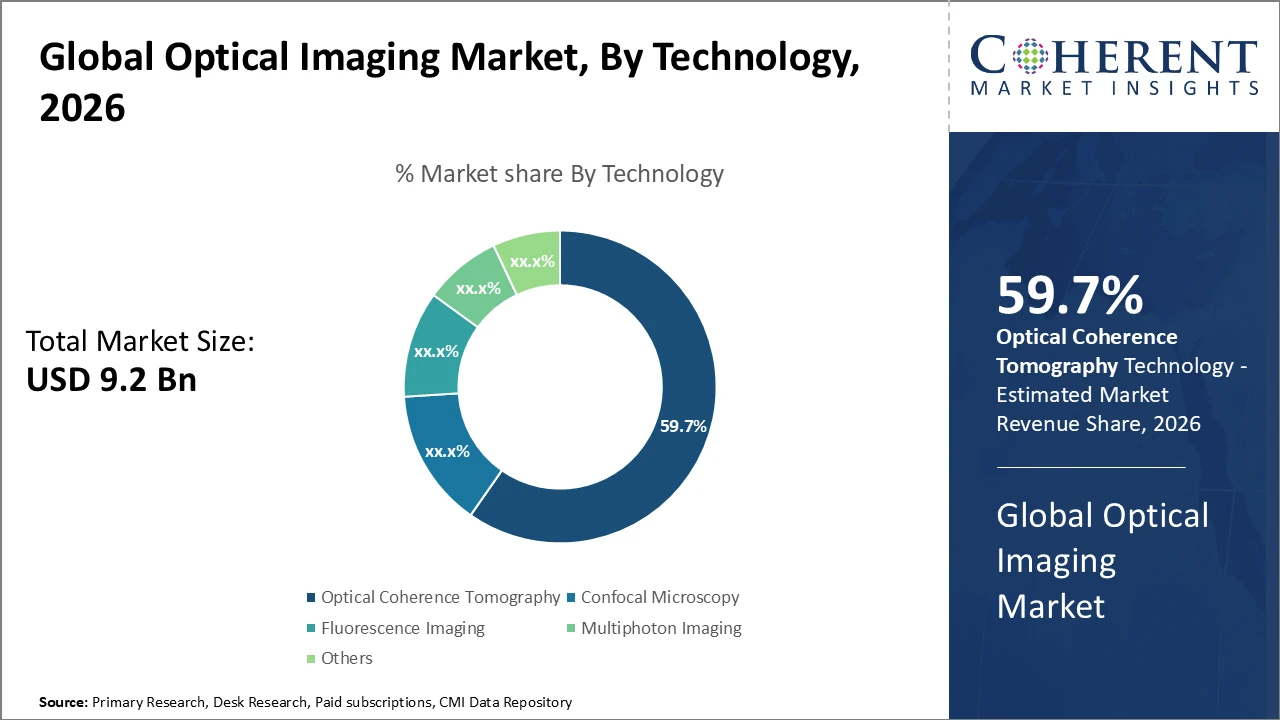
Optical Imaging Market Insights, By Technology
Optical Coherence Tomography dominates the optical imaging market due to its ability to generate high-resolution cross-sectional images, making it widely used in ophthalmology and cardiovascular diagnostics. Confocal Microscopy represents the fastest-growing subsegment, supported by advancements in live-cell imaging and real-time diagnostic capabilities in research laboratories. Fluorescence Imaging is extensively applied in molecular and cellular studies, enabling visualization of biological processes with high specificity. Multiphoton Imaging also plays an important role in deep-tissue imaging for biomedical research and neuroscience applications. Additionally, the Others category includes emerging and niche optical imaging technologies that complement established imaging techniques across healthcare, research, and industrial sectors.
Optical Imaging Market Insights, By End User
Hospitals & Clinics represent the largest end-user segment in the optical imaging market, as they are the primary adopters of advanced imaging technologies for disease diagnosis, monitoring, and treatment planning. Research Institutes are the fastest-growing segment, supported by rising investments and funding for innovative imaging techniques and scientific studies. Pharmaceutical Companies increasingly utilize optical imaging in drug discovery, development, and clinical trials to improve research efficiency. Industrial Manufacturing uses optical imaging for precision inspection, quality control, and defect detection in production processes. The Others segment includes specialized sectors and emerging fields that adopt customized optical imaging solutions for unique research and operational requirements.
Optical Imaging Market Insights, By Application
Biomedical Imaging holds the largest share of the optical imaging market due to its essential role in disease diagnosis, treatment planning, and therapeutic monitoring. The Industrial Inspection subsegment is witnessing rapid growth as manufacturers increasingly rely on optical imaging technologies for precision measurement, defect detection, and quality assurance. In Defense & Security, optical imaging systems are widely used for surveillance, reconnaissance, and target identification. Environmental Monitoring applications utilize optical imaging techniques to detect pollutants, assess air and water quality, and study ecological changes. The Others segment includes emerging applications in agriculture, academic research, and scientific experimentation, expanding the overall scope and adoption of optical imaging technologies.
Optical Imaging Market Trends
The optical imaging market is being significantly influenced by the increasing integration of artificial intelligence and machine learning technologies, which have improved imaging precision and diagnostic confidence between 2024 and 2026.
Hospitals using AI-guided optical coherence tomography systems have reported improvements in diagnostic accuracy of up to 18%, supporting wider clinical adoption.
Another major trend is the rising adoption of hybrid optical imaging systems that combine multiple modalities, such as optical imaging with ultrasound, to deliver more comprehensive and detailed diagnostic results.
These hybrid imaging solutions achieved an estimated market penetration of around 12% by 2025 as healthcare providers seek more efficient diagnostic technologies.
The growing availability of portable optical imaging devices is also transforming the market by enabling decentralized healthcare services and point-of-care diagnostics.
This trend is particularly strong in the Asia Pacific region, where portable solutions are improving healthcare accessibility and accelerating market expansion.
Optical Imaging Market Insights, By Geography
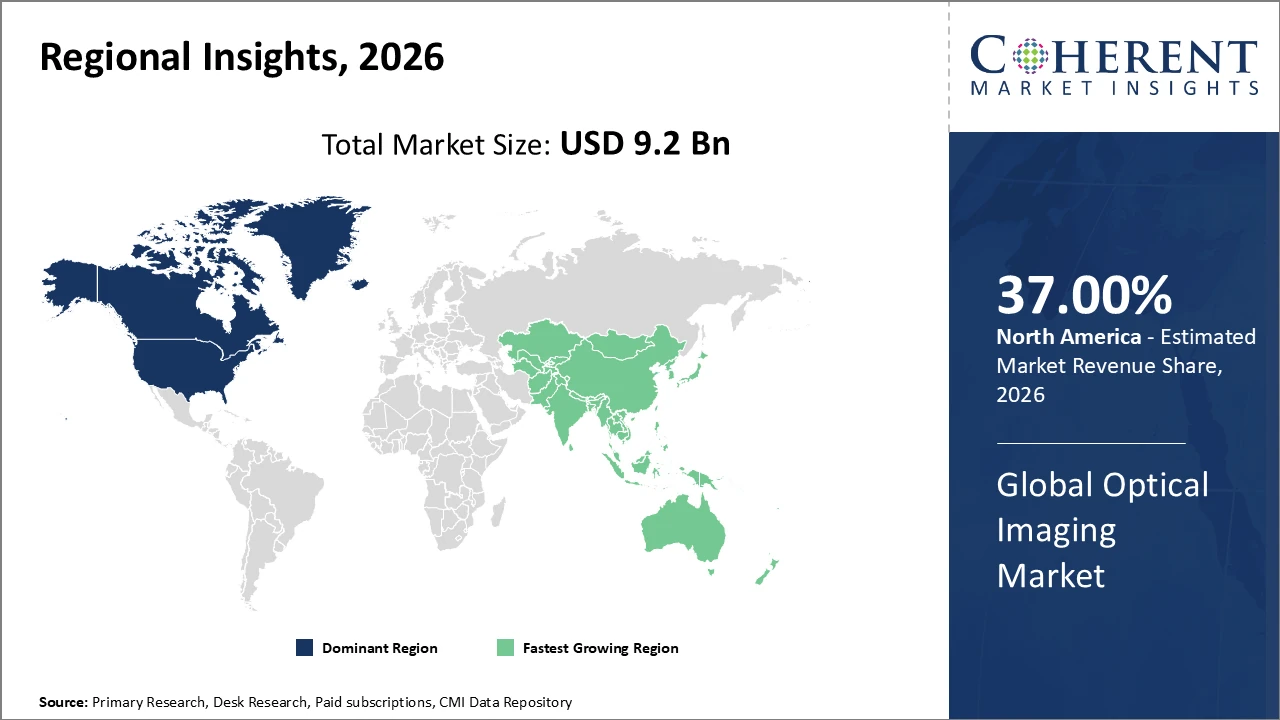
North America Optical Imaging Market Analysis and Trends
North America dominates the optical imaging market due to its high healthcare spending, advanced technological infrastructure, and strong support for medical innovation. The region benefits from well-established healthcare systems, significant research funding, and early adoption of advanced diagnostic technologies. Supportive government initiatives and favorable regulatory frameworks also encourage the development and commercialization of new imaging solutions. North America accounts for nearly 37% of the global market share, with the United States serving as the primary contributor. The presence of leading market players, prominent research institutions, and ongoing technological advancements continues to drive product development, clinical adoption, and overall market growth across the region.
Asia Pacific Optical Imaging Market Analysis and Trends
The Asia Pacific region is experiencing the fastest growth in the optical imaging market, with a CAGR exceeding 12%. This growth is driven by the rising adoption of advanced medical devices and the rapid expansion of healthcare infrastructure across developing economies. Countries such as India and China are investing heavily in modern diagnostic technologies to improve healthcare accessibility and quality. Government initiatives that encourage technology adoption and support medical innovation further contribute to market expansion. Additionally, increasing industrial applications, along with growing environmental monitoring requirements, are strengthening the demand for optical imaging technologies, making Asia Pacific a key growth hub in the global optical imaging market.
Optical Imaging Market Outlook for Key Countries
USA Optical Imaging Market Analysis and Trends
The United States optical imaging market is driven by strong research and development investments and the presence of major industry players such as Siemens Healthineers and Canon Inc. These companies are continuously developing advanced imaging technologies designed for applications in oncology, cardiology, and other clinical specialties. Supportive regulatory frameworks, including FDA approvals and favorable reimbursement policies, have accelerated the adoption of new optical imaging systems in hospitals and diagnostic centers. In 2025, installations of advanced optical coherence tomography devices in U.S. hospitals increased by nearly 22%, highlighting the country’s strong demand for innovative imaging solutions and reinforcing its leading position in global market revenue and technological advancement.
Germany Optical Imaging Market Analysis and Trends
Germany’s optical imaging market is characterized by steady growth, driven by its mature healthcare system, advanced industrial base, and strong research ecosystem. Biomedical imaging dominates demand, supported by hospitals and research institutions adopting high-resolution technologies for diagnostics and therapeutic monitoring. Industrial applications, including quality control and defect detection, further contribute to market expansion. The country benefits from robust R&D investments, innovation in imaging modalities, and collaborations between academia and industry. Technological trends such as AI integration, hybrid imaging systems, and portable devices are gradually being adopted. Overall, Germany maintains stable growth, balancing healthcare, industrial, and research-driven demand for optical imaging solutions.
Analyst Opinion
Expansion of production capacity in the optical imaging sector reflects increased investments in manufacturing advanced imaging sensors and systems. Leading industry players expanded production lines by nearly 15% in 2025, enabling wider deployment in medical diagnostics and supporting revenue growth.
Pricing analysis shows a gradual decline in unit costs for optical imaging components, driven by advancements in semiconductor technologies and material sciences. Between 2024 and 2026, component prices fell by approximately 7%, allowing companies to offer more cost-competitive solutions across applications such as precision agriculture and automotive inspection.
Demand-side trends highlight growing use in healthcare, particularly for non-invasive cancer detection and cardiovascular assessments. Clinical institutions reported a 20% increase in optical imaging system installations in 2026, underscoring the technology’s role in improving diagnostic accuracy and driving market revenue.
Micro-indicators reveal significant adoption of portable and handheld imaging devices, with shipments rising 35% year-on-year in 2025. This shift toward mobile solutions reflects changing customer preferences, greater accessibility, and sustained market growth.
- Current Industry Events of 2026
- Market Size Estimation
- Regional Breakdown
- Competitive Landscape
- Customer Intelligence
- Segmental Analysis
- Pricing Analysis
- Key Market Drivers, Challenges & Future Trends
- Customized Insights Section
Market Scope
| Report Coverage | Details | ||
|---|---|---|---|
| Base Year: | 2025 | Market Size in 2026: | USD 9.2 billion |
| Historical Data for: | 2020 To 2024 | Forecast Period: | 2026 To 2033 |
| Forecast Period 2026 to 2033 CAGR: | 10.5% | 2033 Value Projection: | USD 18.3 billion |
| Geographies covered: |
| ||
| Segments covered: |
| ||
| Companies covered: | Canon Inc., Nikon Corporation, Siemens Healthcare, Coherent Inc., Thorlabs Inc., OptoMedic Ltd., Andor Technology, Bruker Corporation, PerkinElmer Inc., GE Healthcare | ||
| Growth Drivers: |
| ||
Optical Imaging Market Growth Factors
Rising demand for non-invasive diagnostic procedures is a key driver of optical imaging market growth, as these technologies offer high-resolution insights without radiation exposure. In 2026, European hospitals reported double-digit increases in optical coherence tomography use for retinal disease screening. Industrial automation and quality inspection in manufacturing further boost adoption, leveraging optical imaging’s precision and speed. Technological innovations, particularly AI integration for enhanced image processing, are improving efficiency, with early adopters achieving 15–20% gains in 2025. Additionally, expanding applications in environmental monitoring, such as real-time pollutant detection, are diversifying end-user bases and sustaining global revenue growth.
Optical Imaging Market Development
In May 2025, OZ Optics Limited launched the In-Line Multimode Fiber Speckle Homogenizer, a high-performance device designed to reduce modal noise in multimode fibers, achieving over 90% speckle reduction at a 100 Hz imaging frequency.
Key Players
Leading Companies of the Market
Canon Inc.
Nikon Corporation
OptoMedic Ltd.
Thorlabs Inc.
GE Healthcare
Siemens Healthcare
PerkinElmer Inc.
Coherent Inc.
Andor Technology
Bruker Corporation
Several leading companies have pursued synergistic growth strategies by partnering with healthcare providers to co-develop customized optical imaging solutions, improving end-user integration and market penetration. For instance, in 2025, Siemens Healthineers collaborated with a US-based cancer research hospital, resulting in a 12% increase in adoption of its optical coherence tomography devices and positively influencing its market share. Strategic acquisitions have also played a key role in expanding technological capabilities; in 2024, Carl Zeiss AG acquired a niche microscopy firm, strengthening its product portfolio and reinforcing its leadership position in advanced biomedical imaging solutions.
Optical Imaging Market Future Outlook
The optical imaging market is poised for strong growth, driven by rising demand for non-invasive diagnostics, technological innovations, and expanding applications across healthcare, industrial, and environmental sectors. Integration of artificial intelligence and machine learning is expected to enhance image accuracy, speed, and analytical capabilities, while hybrid and portable imaging systems will improve accessibility and decentralized healthcare delivery. Emerging markets in Asia Pacific and Latin America offer significant growth potential due to expanding healthcare infrastructure and government support. Continuous investments in R&D, coupled with strategic partnerships and acquisitions, will further advance product offerings, ensuring sustained market expansion and diversified revenue streams in the coming years.
Optical Imaging Market Historical Analysis
The optical imaging market has experienced steady growth over the past decade, driven by advancements in imaging technologies and increasing healthcare demands. Historically, biomedical imaging dominated the market, with hospitals and research institutions adopting optical coherence tomography, confocal microscopy, and fluorescence imaging for diagnostics and therapeutic monitoring. Industrial applications, including quality inspection and defect detection, also contributed to market expansion. Early adoption of portable and handheld imaging devices began to gain traction, improving accessibility and workflow efficiency. Investments in research and development, coupled with collaborations between technology providers and healthcare institutions, laid the foundation for innovation and market growth, shaping the current competitive landscape.
Sources
Primary Research Interviews:
Optical imaging device manufacturers and distributors
Medical device manufacturers and distributors
Hospitals, outpatient clinics, and home healthcare providers
Magazines:
Laser Focus World – Optical & Medical Imaging Technologies
Medical Device & Diagnostic Industry (MD+DI) – Imaging Innovations
Imaging Technology News – Clinical and Industrial Imaging Trends
Digital Health Magazine- AI and Imaging Solutions
Journals:
Journal of Biomedical Optics
Optical Imaging and Microscopy
Lasers in Surgery and Medicine
Photomedicine and Laser Surgery
Frontiers in Medical Technology & Therapeutics
Newspapers:
Financial Times – Medical Imaging & Healthcare Technology
Reuters – Optical Imaging and Diagnostic Devices
The Wall Street Journal – Medical Technology Updates
Bloomberg – Imaging Equipment Innovations
Nikkei Asia – Advanced Medical Devices
Associations:
International Society for Optical Engineering (SPIE) – Biomedical Optics Division
Optical Society (OSA) – Biophotonics and Imaging
American College of Radiology (ACR) – Imaging Technology Committees
European Society of Radiology (ESR) – Advanced Imaging Technologies
International Society for Photomedicine (ISP)
Get access to 250+ pages report
Every segment, forecast, competitor profile and data table behind the analysis above — available for instant download.
- ESOMAR Member
- ISO 9001:2015 Certified
- D-U-N-S Registered
- GDPR & CCPA Compliant
Missing comfort of reading report in your local language? Find your preferred language:
Transform your Strategy with Exclusive Trending Reports
Frequently Asked Questions
The dominant players include Canon Inc., Nikon Corporation, Siemens Healthineers, Coherent Inc., and Bruker Corporation, who leverage technological innovation and strategic partnerships to maintain industry leadership.
The Optical Imaging Market size is poised to grow from USD 9.2 billion in 2026 to USD 18.3 billion by 2033, representing a CAGR of 10.5% fueled by technological advances and broadened application domains.
Hospitals and Clinics, presents the largest growth opportunity due to rising demand for non-invasive diagnostic tools and expanding healthcare infrastructure globally.
Market trends point towards hybrid systems integration, AI-powered image analysis, and portable device miniaturization, all contributing to enhanced accuracy, accessibility, and adoption.
The competitive landscape is marked by intense innovation and consolidation activities. Challenges include high initial device costs and regulatory complexities, which firms are addressing through strategic collaborations and technology optimization.
Leading players pursue partnerships with healthcare institutes, acquisitions to enhance technological portfolios, and targeted product launches focusing on niche applications to maximize market share.