

Medical X-Ray Film Processor Market Size and Share Analysis- 2026 To 2033
The Medical X-Ray Film Processor Market size is anticipated to grow at a CAGR of 4.7%, with USD 1.02 Bn in 2026 and is expected to reach USD 1.41 Bn in 2033. The primary drivers are largely defined by the continued use of conventional and computed radiography systems across hospitals and diagnostic imaging centers, demand for reliable X-ray film processing in healthcare facilities with limited digital imaging infrastructure, rising diagnostic imaging volumes, and continued replacement and maintenance requirements for installed film-processing systems. According to NHS England, 49.5 million diagnostic imaging tests were reported in England during the 12 months from June 2024 to May 2025.
Key Takeaways
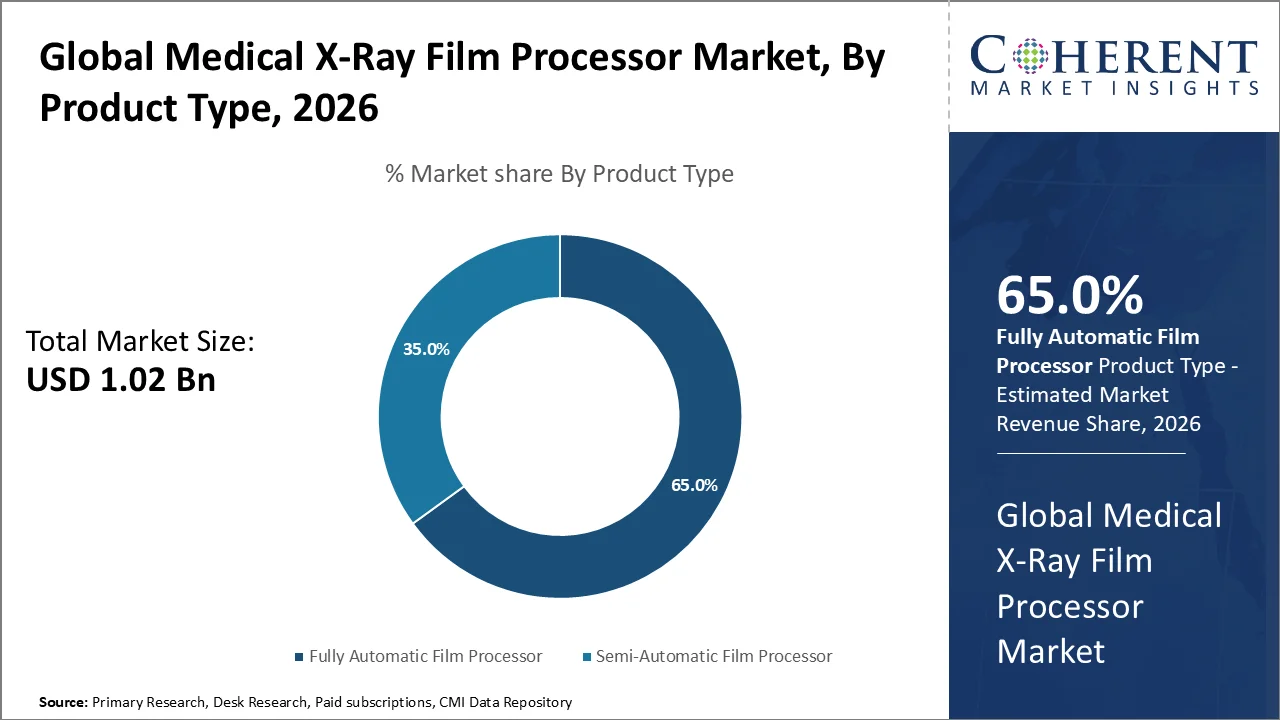
- The fully automatic film processor segment is likely to dominate the market with 65.0% in 2026. The segment’s growth is owing to reduced manual intervention, standardized film development, faster processing cycles, and suitability for facilities handling relatively high radiography workloads. According to NHS England, 1.92 million plain radiography (X-ray) examinations were performed in May 2025, making X-ray the most commonly performed diagnostic imaging procedure during the month.
- The diagnostic center segment is set to lead with 38.0% in 2026. The segment’s growth is owing to concentrated diagnostic imaging volumes, dedicated radiology infrastructure, demand for faster patient throughput, and the presence of specialized imaging facilities. A 2026 study published in the Journal of the American College of Radiology of 46.4 million imaging exams at 167 U.S. radiology facilities, including 86 freestanding imaging centers and 71 community hospitals, underscores the role of standalone imaging facilities in providing diagnostic services.
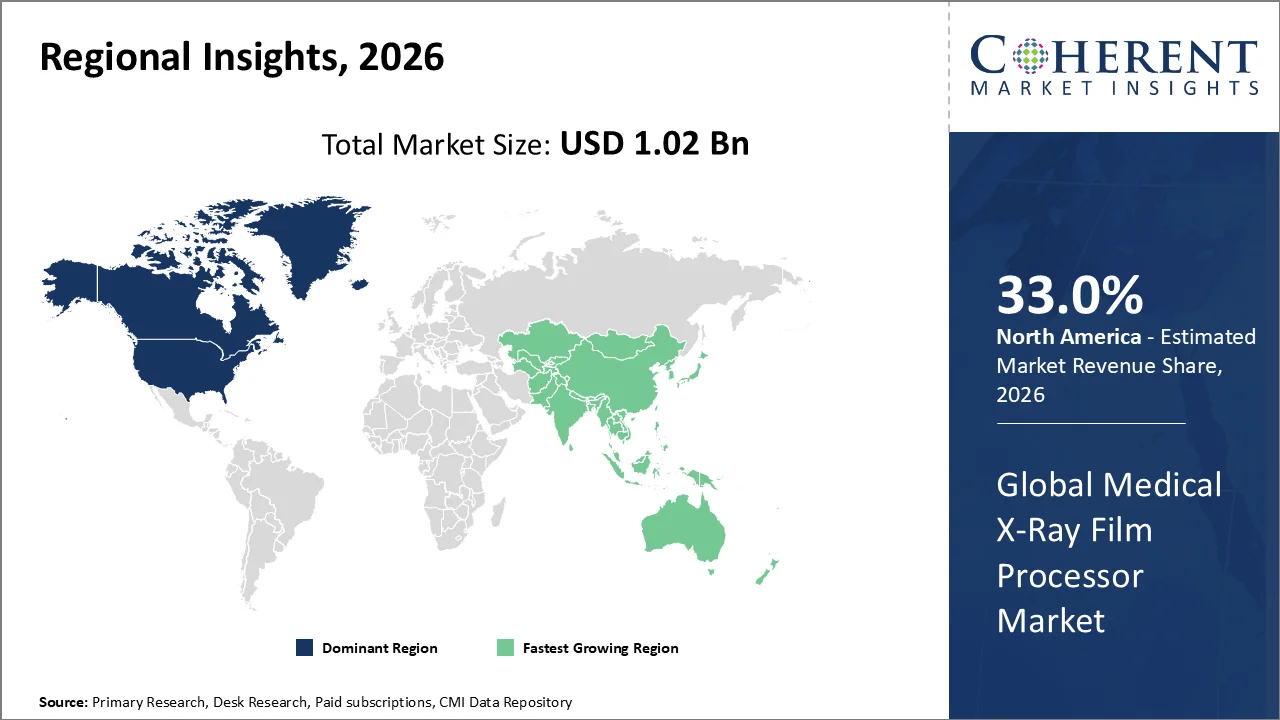
- North America is expected to acquire the prominent share of 33.0% in 2026. The region’s growth is owing to its established diagnostic imaging infrastructure, large radiology service network, high imaging utilization, and substantial healthcare expenditure. According to the OECD Health at a Glance 2025, the U.S. had approximately 86 CT, MRI, and PET imaging units per million population, substantially above the OECD average of 51 units per million population.
Market Drivers
Sustained High Volume of Plain Radiography Procedures is Supporting Medical X-Ray Film Processor Demand
The Medical X-Ray Film Processor Market continues to receive support from the substantial volume of plain radiography procedures performed across hospitals, diagnostic centers, emergency departments, and outpatient healthcare facilities. In facilities that continue to operate conventional film-screen X-ray systems, higher examination volumes increase the requirement for efficient film development, consistent image processing, and replacement or maintenance of automatic film-processing equipment.
According to the Australian Institute of Health and Welfare (AIHW), Australia recorded approximately 11.5 million diagnostic radiography services in 2024–25, making radiography one of the two highest-volume diagnostic imaging categories in the country.
Current Events and Their Impact on the Medical X-Ray Film Processor Market
Current Event | Description and its Impact |
Government of West Bengal Advances Digital X-Ray Deployment Across Public Hospitals (2026) |
|
FDA Maintains Strict Quality-Control Requirements for Screen-Film Mammography Systems (2026) |
|
- Current Industry Events of 2026
- Market Size Estimation
- Regional Breakdown
- Competitive Landscape
- Customer Intelligence
- Segmental Analysis
- Pricing Analysis
- Key Market Drivers, Challenges & Future Trends
- Customized Insights Section
Segmental Insights
Why is Fully Automatic Film Processor Acquiring the Largest Share?
On the basis of product type, the fully automatic film processor segment is projected to account for the largest Medical X-Ray Film Processor Market share of 65.0% in 2026. The segment’s growth is owing to automated developing, fixing, washing, and drying operations, reduced manual film handling, consistent processing quality, and suitability for healthcare facilities requiring rapid and standardized radiographic-film processing.
The U.S. FDA reported approximately 45.0 million annual mammography procedures as of September 1, 2026, across 9,128 certified mammography facilities and 27,793 accredited mammography units. The scale of regulated radiographic imaging activity highlights the importance of reliable and standardized image-processing workflows across the installed imaging infrastructure.
In July 2026, the Armed Forces Medical Store Depot, Delhi Cantt., issued a government e-Marketplace (GeM) procurement tender for 11 Automatic X-Ray Film Processors.
Why do Diagnostic Centers Hold the Largest Market Share?
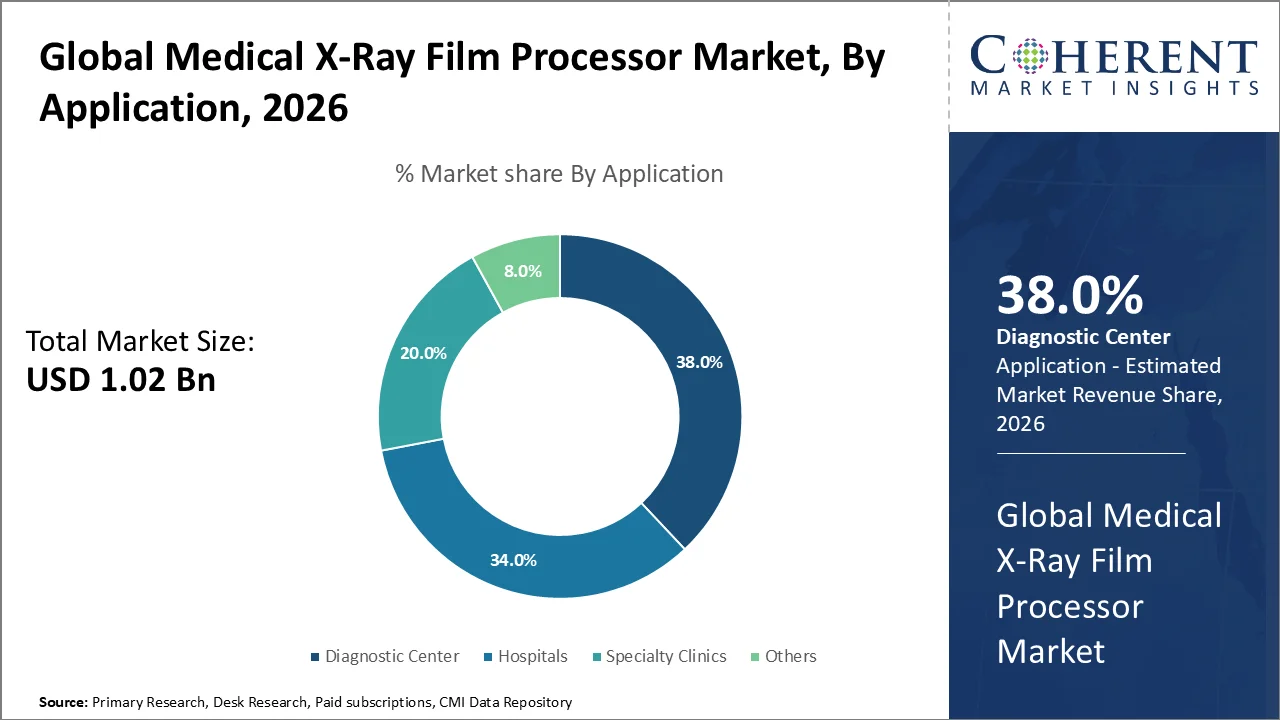
On the basis of application, the diagnostic center segment is projected to lead the Medical X-Ray Film Processor Market with a 38.0% share in 2026. The segment’s growth is owing to concentrated imaging workloads, dedicated radiology infrastructure, higher equipment utilization, faster patient turnover, and increasing demand for diagnostic services outside traditional hospital settings.
In April 2026, the U.K. government announced a £237 million investment in 36 new, expanded or enhanced Community Diagnostic Centers, including four new centers, 17 expanded centers and 15 centers that will be improved. The government also announced a record 29 million diagnostic tests were carried out by the NHS in 2025, showing the growing workload being passed to specialist diagnostic centers.
Medical X-Ray Film Processor Market Trends
- The growing emphasis on environmentally responsible management of X-ray processing chemicals is increasing the focus on silver recovery and controlled disposal systems. In January 2026, the U.K. Environment Agency introduced RPS 360 specifically covering recovery of silver from waste developer and fixer solutions used in photographic and X-ray processing machines.
- The increasing emphasis on imaging-equipment lifecycle management is supporting maintenance and servicing opportunities within the existing film-processor installed base. In May 2025, the World Health Assembly adopted WHA78.13 on strengthening medical imaging capacity, which called on member states to support sustainable investment in imaging equipment, infrastructure, maintenance and quality-management systems.
- The rapid growth of teleradiology and electronic transmission of images is accelerating the long-term evolution away from traditional film-processing workflows. On May 23, 2026, the World Health Assembly adopted WHA79.9 on strengthening equitable access to diagnostic imaging through teleradiology, emphasizing digital technologies and diagnostic-imaging access.
Regional Insights
North America Dominates Owing to the Established Healthcare Infrastructure and Large Imaging Ecosystem
The North America region accounts for 33.0% of the Medical X-Ray Film Processor Market share in 2026. The region’s dominance is owing to its extensive hospital and diagnostic-center infrastructure, high healthcare expenditure, large installed medical-imaging equipment base, and continued servicing and replacement requirements for conventional radiography systems that remain operational.
According to the American Hospital Association (AHA), the U.S. had approximately 6,100 hospitals in 2026, including 5,121 community hospitals. This extensive healthcare-facility network creates a substantial installed base for radiology equipment and associated maintenance and replacement activities.
In October 2025, Rochester, New York-based Carestream Health announced a worldwide price increase across its laser imaging and dental film portfolio following increases in the costs of silver, energy, raw materials, and other resources required for film manufacturing.
Asia Pacific Medical X-Ray Film Processor Market Trends
Asia Pacific is expected to emerge as the fastest-growing region in the Medical X-Ray Film Processor Market during the forecast period and accounted for an estimated 27.0% share in 2026. The region’s growth is owing to expanding public diagnostic services, large patient volumes, increasing radiology infrastructure, medical-device manufacturing initiatives, and the continued presence of conventional radiography systems across parts of emerging Asian healthcare markets.
In July 2026, the Government of India reported that the Production Linked Incentive Scheme for Medical Devices has an outlay of INR 3,420 crore, with 27 applications approved and INR 1,153.07 crore of actual investment reported. The program specifically covers radiology and imaging devices, with domestic production initiated for equipment including
In August 2026, the Ministry of Health and Family Welfare said free diagnostic services, including X-rays and other radiological tests, were being provided across public healthcare facilities, with up to 134 diagnostic tests at district hospitals, 111 at sub-district hospitals and 97 at community health centers.
Large Radiography Base and Federal Procurement Infrastructure Support the Medical X-Ray Film Processor Market in the United States
The U.S. Medical X-Ray Film Processor Market represents a mature market supported by a large radiography-services base, established healthcare infrastructure, and continuing replacement and maintenance requirements for conventional film-processing equipment. Although digital radiography is reducing new wet-film processor installations, federal procurement channels continue to recognize X-ray film, processors, and related supplies as active product categories.
The U.S. Department of Veterans Affairs Federal Supply Schedule 65 V A continues to cover X-ray film, processors, grids, cassettes, illuminators, and related X-ray supplies, with a maximum order threshold of USD 100,000 under the schedule. This indicates that film-processing products remain within the active federal medical-procurement framework.
China Medical X-Ray Film Processor Market Trends
China is expected to witness continued opportunities in the Medical X-Ray Film Processor Market, particularly through the maintenance and replacement of legacy radiography infrastructure in lower-tier healthcare facilities. However, rapid government-led deployment of digital radiography is gradually shifting the market away from conventional chemical film processing and toward aftermarket servicing and replacement demand.
In August 2025, China launched a nationwide campaign to upgrade primary healthcare infrastructures, allocating about RMB 8.8 billion in central funds in 2025 to support county hospitals and key township health centers. The program specifically includes expansion of county-level medical imaging resource-sharing centers, increasing access to radiological diagnostics across underserved areas.
Who are the Major Companies in Medical X-Ray Film Processor Industry
Some of the major key players in Medical X-Ray Film Processor Market are Z&Z Medical Inc., LAC Medical Supplies Sdn Bhd, Carestream Health, ARI Medical Technology Co., Ltd., Colenta, PROTEC GmbH & Co. KG, DaitoMitech, Konica Minolta, Inc.
Key News
- In August 2025, Carestream Health announced an upgrade to its Horizon X-ray System, adding a new six-way floating table designed to improve patient positioning, workflow efficiency, image quality, and examination throughput.
- In November 2025, Konica Minolta Healthcare Americas launched the KDR FMT and KDR FMT+ digital radiography systems at RSNA 2025. The KDR FMT targets low- to mid-volume imaging facilities, while the KDR FMT+ adds motorized movement and automatic detector tracking for higher-volume practices.
Market Report Scope
Medical X-Ray Film Processor Market Report Coverage
| Report Coverage | Details | ||
|---|---|---|---|
| Base Year: | 2025 | Market Size in 2026: | USD 1.02 Bn |
| Historical Data for: | 2020 To 2024 | Forecast Period: | 2026 To 2033 |
| Forecast Period 2026 to 2033 CAGR: | 4.7% | 2033 Value Projection: | USD 1.41 Bn |
| Geographies covered: |
| ||
| Segments covered: |
| ||
| Companies covered: | Z&Z Medical Inc., LAC Medical Supplies Sdn Bhd, Carestream Health, ARI Medical Technology Co., Ltd., Colenta, PROTEC GmbH & Co. KG, DaitoMitech, Konica Minolta, Inc. | ||
| Growth Drivers: |
| ||
| Restraints & Challenges: |
| ||
Analyst Opinion
- The Medical X-Ray Film Processor Market is expected to remain a specialized replacement and aftermarket-driven market rather than a broad new-installation market. Continued procurement of conventional X-ray films demonstrates that a meaningful film-screen installed base remains operational. In May 2025, AIIMS Bhopal issued a rate-contract tender for X-ray films, indicating that radiographic film remained in use in a large public hospital system.
- Public hospitals in emerging markets are expected to offer the most resilient demand for film processors, servicing, spare parts and associated consumables. Dhubri Medical College and Hospital, Assam floated rate contract for X-ray and CT scan films for INR 30 lakh in Feb 2025. Such procurement indicates that traditional film output still has commercial value in certain government healthcare facilities, reinforcing ongoing lifecycle demand for compatible processing and imaging equipment.
- The market is simultaneously facing a structural transition toward dry-film and digital radiography, which will gradually limit new wet-film processor installations. In July 2026, Indira Gandhi Hospital, Delhi, announced procurement of digital medical X-ray films compatible with a Konica Minolta Dry Pro 0873 imager, while the same hospital also listed a separate tender for X-ray films.
Speak to the analyst
Want personalized insights?
Take the findings above to one of our principal consultants, or have the report rebuilt around the segments, geographies and competitors you actually track.
Market Segmentation
- By Product Type (Revenue, USD Bn, 2021-2033)
- Semi-Automatic Film Processor
- Fully Automatic Film Processor
- By Application (Revenue, USD Bn, 2021-2033)
- Hospitals
- Specialty Clinics
- Diagnostic Center
- Others
- By Region (Revenue, USD Bn, 2021-2033)
- North America
- U.S.
- Canada
- Latin America
- Brazil
- Mexico
- Argentina
- Rest of Latin America
- Europe
- Germany
- U.K.
- France
- Italy
- Spain
- Russia
- Rest of Europe
- Asia Pacific
- China
- India
- Japan
- Australia
- South Korea
- ASEAN
- Rest of Asia Pacific
- Middle East
- GCC
- Israel
- Rest of Middle East
- Africa
- South Africa
- Central Africa
- North Africa
- North America
Sources
Primary Research Interviews
- Radiologists and radiology department heads
- X-ray technicians and radiologic technologists
- Medical X-ray equipment manufacturers
- X-ray film processor manufacturers and suppliers
- Diagnostic imaging center managers
- Hospital procurement and biomedical engineering teams
- Medical imaging equipment distributors and service providers
- Key opinion leaders (KOLs) in diagnostic imaging and radiography
Databases
- World Health Organization (WHO)
- Organisation for Economic Co-operation and Development (OECD)
- Centers for Medicare & Medicaid Services (CMS)
- U.S. Food and Drug Administration (FDA)
- Australian Institute of Health and Welfare (AIHW)
- NHS England Diagnostic Imaging Dataset
- PubMed / National Library of Medicine
Magazines
- Diagnostic Imaging
- Radiology Business
- AuntMinnie
- Medical Device Network
- Healthcare Purchasing News
- MedicalExpo e-Magazine
Journals
- Radiology
- Journal of the American College of Radiology
- European Radiology
- Journal of Digital Imaging
- Medical Physics
- British Journal of Radiology
Newspapers
- Reuters
- Financial Times
- The Economic Times
- The Guardian
- The Wall Street Journal
Associations
- Radiological Society of North America (RSNA)
- American College of Radiology (ACR)
- American Society of Radiologic Technologists (ASRT)
- European Society of Radiology (ESR)
- International Society of Radiology (ISR)
- Society for Imaging Informatics in Medicine (SIIM)
Public Domain Sources
- Company Annual Reports and Investor Presentations
- Company Product Catalogs and Technical Datasheets
- Government Healthcare Procurement and Tender Portals
- FDA and Other Medical Device Regulatory Databases
- Hospital and Diagnostic Center Procurement Notices
- Government Diagnostic Imaging Statistics and Healthcare Infrastructure Reports
- Peer-Reviewed Radiology and Medical Imaging Publications
- Environmental Regulations Related to X-ray Film Processing Chemicals and Silver Recovery
Proprietary Elements
- CMI Data Analytics Tool
- Proprietary CMI Existing Repository of Information for the Last 10 Years
Get access to 250+ pages report
Every segment, forecast, competitor profile and data table behind the analysis above — available for instant download.
- ESOMAR Member
- ISO 9001:2015 Certified
- D-U-N-S Registered
- GDPR & CCPA Compliant
Missing comfort of reading report in your local language? Find your preferred language:
Transform your Strategy with Exclusive Trending Reports
Frequently Asked Questions
The Medical X-Ray Film Processor Market is expected to reach USD 1.41 Bn in 2033.
Major players operating in the global Medical X-Ray Film Processor Market include Z&Z Medical Inc., LAC Medical Supplies Sdn Bhd, Carestream Health, ARI Medical Technology Co., Ltd., Colenta, PROTEC GmbH & Co. KG, DaitoMitech, and Konica Minolta, Inc.
The high equipment and maintenance costs, rapid shift toward digital radiography, declining demand for conventional X-ray films, and increasing chemical handling and disposal requirements are the key factors hampering market growth.
The rising volume of X-ray diagnostic procedures, continued use of conventional film-based radiography systems, growing demand from hospitals and diagnostic centers, and replacement and maintenance requirements for installed film processors are driving market growth.
The Medical X-Ray Film Processor Market is anticipated to grow at a CAGR of 4.7% between 2026 and 2033.
Among regions, North America is expected to account for the largest share of the global Medical X-Ray Film Processor Market, with an estimated 33.0% share in 2026.
Asia Pacific is expected to emerge as the fastest-growing region during the forecast period, supported by expanding diagnostic services, rising radiology infrastructure, large patient volumes, and continued investment in medical imaging equipment.