

Global Proton Therapy Market Size and Share Analysis – Growth Trends and Forecasts (2026-2033)
Proton Therapy Market is estimated to be valued at USD 3,993.8 Mn in 2026 and is expected to reach USD 9,512.9 Mn in 2033, exhibiting a compound annual growth rate (CAGR) of 13.2% from 2026 to 2033.
Key Takeaways
- Based on Set Up Type, Single Room Segment is expected to hold a dominant position in the global proton therapy market with 71.0% shares during the forecast period. This is due to the low cost of single room proton therapy as compared to multiple room proton therapy.
- North America is expected to hold a dominant position in the global proton therapy market with 45.5% during the forecast period. This is due to the increasing prevalence of lung cancer.
Market Overview
The proton therapy market is driven by the growing global incidence of cancer, the increased demand for precision oncology, and the growing demand for minimally invasive cancer treatment with fewer side effects. Proton treatment, with its targeted beam of radiation avoiding harm to surrounding healthy tissue, is rapidly picking up speed as a state-of-the-art alternative for conventional radiotherapy, especially for pediatric cancers and tumors near sensitive organs. Pencil beam scanning, image-guided therapy, and small proton system developments are making installations less expensive and more cost-efficient for hospitals and cancer centers. Also, reimbursement policies of the government, facilitative reimbursement systems in developed markets, and growing investments in cancer treatment centers are fueling adoption worldwide.
Current Events and Its Impact on Proton Therapy Market
Current Events | Description and its impact |
BayCare Cancer Institute Shakes Ground for First Proton Therapy Facility |
|
Penn Medicine Breaks Ground on New Proton Therapy Center
|
|
Pipeline Analysis: Proton Therapy Market
The market pipeline for proton therapy is growing fast as private players and healthcare systems increasingly make advanced modalities of cancer therapy a priority. Several companies are now working on next-generation proton therapy systems with a focus on increased precision, cost-effectiveness, and smaller footprint. All these developments will help to make proton therapy more viable for mid-sized hospitals and community-based cancer centers, in addition to the large academic centers that have traditionally embraced the technology.
Innovators such as Varian (Siemens Healthineers), IBA (Ion Beam Applications), Mevion Medical Systems, and Hitachi are developing compact proton treatment machines that have less room space, less energy, and lower cost of installation. For example, Mevion's S250-FIT system, now in clinical investigation, is envisioned to fit right into existing radiation oncology departments, solving the space and infrastructure constraints that make it more difficult to expand adoption.
AI-based treatment planning and adaptive therapy modules are also being included in future systems to support real-time dose adjustment and enhanced patient outcomes. Additionally, current clinical trials are investigating the efficacy of proton therapy in the treatment of more cancer sites, such as breast, pancreatic, and recurrent tumors, with the possibility of broadening its clinical indications.
On the regulatory side, various companies' products are at late-stage FDA and CE approvals, specifically in the U.S., Europe, and in certain regions of Asia-Pacific. Public-private collaborations as well as rising capital expenditure on oncology infrastructure are also accelerating the development and rollout of such systems. This pipeline overall indicates a healthy and dynamic landscape with an aim to enhance accessibility, affordability, and clinical effectiveness of proton therapy globally.
- Current Industry Events of 2026
- Market Size Estimation
- Regional Breakdown
- Competitive Landscape
- Customer Intelligence
- Segmental Analysis
- Pricing Analysis
- Key Market Drivers, Challenges & Future Trends
- Customized Insights Section
Patent Landscape
The proton therapy sector is characterized by a surge in filings for sophisticated radiation delivery apparatus, treatment planning codes, and novel hardware components aimed at improving the accuracy and effectiveness of proton therapy. These leading industry players such as Varian (Siemens Healthineers), IBA (Ion Beam Applications), Mevion Medical Systems, Hitachi, and Sumitomo Heavy Industries hold a vast portfolio of patents in crucial technologies such as pencil beam scanning, beam modulation, gantry designs, and patient positioning systems.
New patents have focused on the integration of artificial intelligence (AI) and machine learning into treatment planning to more closely customize dose delivery and dynamically adjust therapies in real time. Other advances include miniaturized proton therapy units reducing facility size and installation costs, easing adoption hurdles in smaller clinics and emerging markets. Patents on automated quality assurance and imaging-guided proton therapy also highlight the push for more effective and safer treatments.
Geographically, the highest patent activity is found in the United States, Europe, and Asia-Pacific regions, which are areas where technological advancement and market need are most prevalent. Established players as well as start-up companies have seen increased filings at the U.S. Patent and Trademark Office (USPTO) and European Patent Office (EPO) with focus on specific solutions such as proton arc therapy and combination with immunotherapy.
The ever-evolving patent environment brings into focus a competitive drive to seize intellectual property enhancing treatment accuracy, patient throughput, and business affordability. Companies are also pursuing cross-licensing and alliances to accelerate innovation's tempo. Overall, the patent environment is crucial in shaping the technological innovations and business strategies in the proton therapy market.
Global Proton Therapy Market – Driver
- Increasing number of healthcare facilities offering proton therapy
Due to the increasing prevalence of cancer, the market's key players are focusing on increasing the number of healthcare facilities through growth strategies such as collaboration as well as acquisition. For instance, in 2024, Mevion Medical Systems partnered with Nebraska Medicine to integrate the MEVION S250‑FIT compact proton therapy system into the Fred & Pamela Buffett Cancer Center in Omaha, enhancing access to precision proton treatments, including pencil beam scanning capabilities.
Global Proton Therapy Market: Key Trends
- High need for proton therapy, key market players increasing their footprint in developing nations
Rising demand of proton therapy, key players are focusing on collaboration as well as acquisition by expanding their presence in emerging such as Africa, Asia, etc., economies is expected to experience considerable expansion in global proton therapy market.
Global Proton Therapy Market: Restraint
- Infrastructural Challenges in Healthcare Facilities
Proton therapy is highly priced and requires advanced infrastructure for installation. Space requirements for a proton center depend on the number and size of treatment rooms as well as other medical and patient areas. The system demands significant square footage to accommodate large accelerators necessary for generating high-energy proton beams. To address this, companies are innovating with compact proton therapy systems capable of delivering high-energy photons in smaller clinical spaces.
For instance, in December 2020, according to an article published by Intech Open, The University of Texas (Monroe Dunaway) MD Anderson Cancer Center proton facility became the first within an NCI-designated comprehensive cancer center to house a proton unit spanning 96,000 square feet, including specialized rooms with fixed beams and gantries. This infrastructural evolution is particularly relevant to the proton therapy market for sarcoma, where precise targeting of tumors in sensitive locations is critical, and space-optimized solutions can significantly enhance access to care.
Segmental Insights
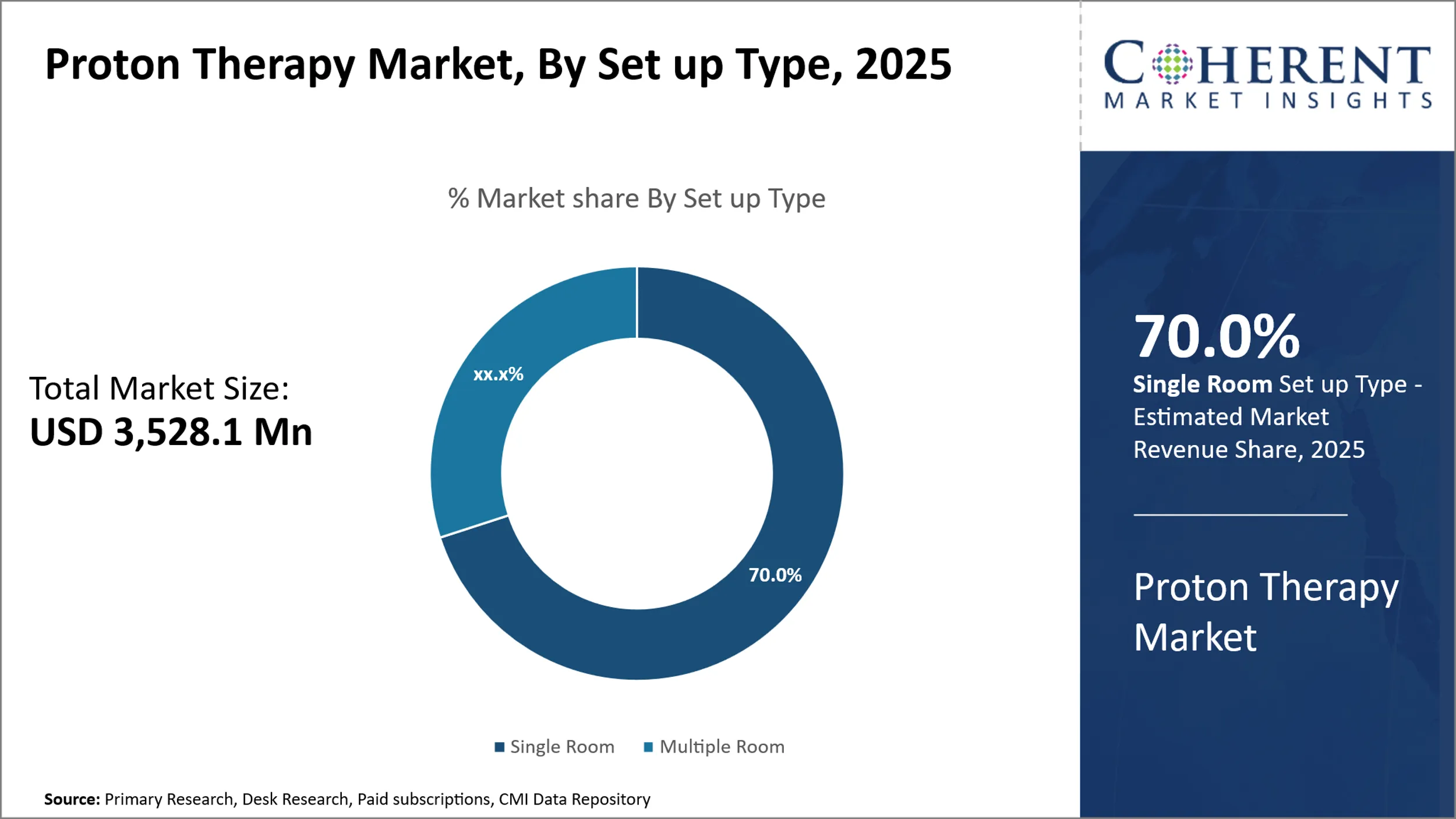
Proton Therapy Market Insights, By set up type
The market is segmented into single room and multi room. Out of which, single room segment is expected to hold a dominant position in the global proton therapy market during the forecast period and this is attributed to the low cost of single room proton therapy as compared to multiple room proton therapy.
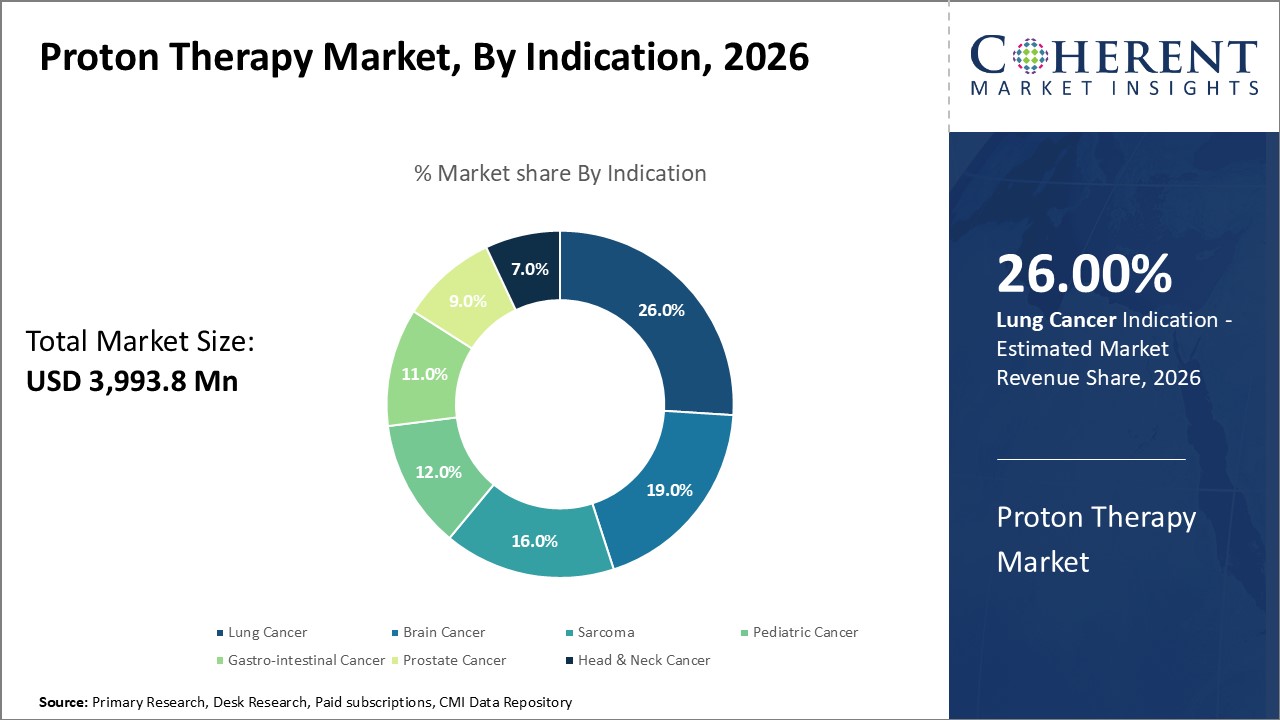
Proton Therapy Market Insights, By Indication
By Indication the market is segmented into Head & Neck Cancer, Brain Cancer, Sarcoma, Pediatric Cancer, Gastro-intestinal Cancer, Prostate Cancer, and Lung Cancer. Out of which, the lung cancer segment is expected to hold a dominant position in the global proton therapy market during the forecast period and this is attributed to the increasing prevalence of lung cancer.
Global Proton Therapy Market Cross Sectional Analysis
Rising incidence of cancer in emerging economies, supportive reimbursement policies and growth strategy such as acquisition by key players is also expected to boost demand for proton therapy in North America region. For instance, in May 2022, IBA Radiopharma Solutions, a medical technology company and provider of proton therapy solutions for the treatment of cancer, announced it had acquired Modus Medical Devices Inc. (Modus QA), a Canadian company based in United Kingdom, specialized in phantoms for quality assurance for radiation therapy.
Regional Insights
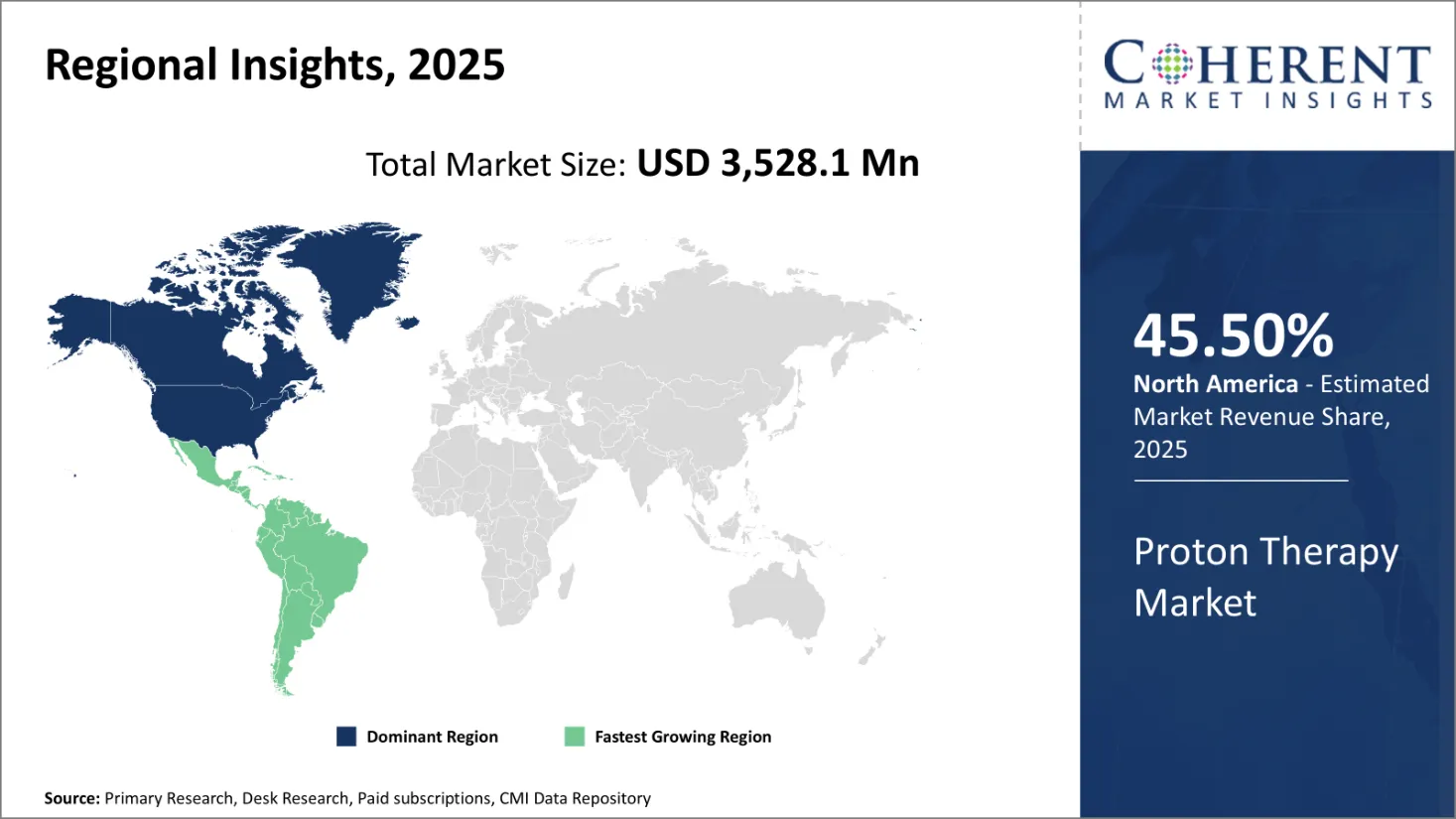
North America Proton Therapy Market- Regional Analysis
North America is estimated to hold a dominant position in the global proton therapy market over the forecast period. North America is estimated to hold 45.50% of the market share in 2026. The North America proton therapy market is expected to witness significant growth in the coming years, driven by factors such as the increasing prevalence of cancer and the rising demand for proton therapy. Thus, the rise in global proton therapy market growth over the forecast period.
Global Proton Therapy Market Dominating Countries
United States Proton Therapy Market Analysis and Trend
The United States accounts for the most operational proton therapy centers in the world. Robust government support, cutting-edge healthcare infrastructure, and investment by private health providers have driven adoption. The U.S. has a huge patient base as well as extensive clinical research confirming proton therapy's effectiveness for various types of cancers.
Japan Proton Therapy Market Analysis and Trend
Japan leads the proton therapy market, aided by having adopted the technology early and continued to develop it through corporations such as Hitachi and Sumitomo Heavy Industries. Government efforts towards improving access to cancer treatment as well as reimbursement schemes have spurred growth in proton therapy centers nationwide, especially for pediatric and head-and-neck cancer.
Germany Proton Therapy Market Analysis and Trend
Germany is the leading market in Europe for proton therapy, with strong healthcare infrastructures and good private and public investments. German hospitals are recognized for the combination of cutting-edge proton therapy with traditional oncology treatment, further supported by continuing clinical trials and equipment development by European producers.
Market Report Scope
Proton Therapy Market Report Coverage
| Report Coverage | Details | ||
|---|---|---|---|
| Base Year: | 2025 | Market Size in 2026: | USD 3,993.8 Mn |
| Historical Data for: | 2020 To 2024 | Forecast Period: | 2026 To 2033 |
| Forecast Period 2026 to 2033 CAGR: | 13.2% | 2033 Value Projection: | USD 9,512.9 Mn |
| Geographies covered: |
| ||
| Segments covered: |
| ||
| Companies covered: | Major players operating in the global proton therapy market include Hitachi Ltd., Ion Beam Applications S.A, Mevion Medical Systems, Mitsubishi Electric Corporation, Provision Healthcare, ProTom International, Sumitomo Heavy Industries, Varian Medical Systems, Optivus Proton Therapy, Inc., and Advanced Oncotherapy plc. | ||
| Growth Drivers: |
| ||
| Restraints & Challenges: |
| ||
Global Proton Therapy Market: Key Developments
- In April 2025, Penn Medicine began construction on the Roberts Proton Therapy Center at Penn Presbyterian Medical Center, scheduled to open in 2027 as the system's fourth facility, with two Proteus®ONE systems for increased capacity and treatment accuracy.
- In 2024, BayCare initiated construction of its inaugural proton therapy center with Mevion's compact S250‑FIT system at St. Joseph's Hospital in Tampa Bay, with the goal of opening for treatments in fall 2025 to greatly enhance access to precision cancer care in the area.
Analyst View
- The proton therapy market is also experiencing considerable growth fueled by the rising incidence of cancer and the rise in demand for precision radiation therapy treatments. As a state-of-the-art modality, proton therapy provides improved tumor targeting with reduced damage to nearby healthy tissues, which is an important driver fueling its uptake in oncology centers worldwide. Furthermore, increasing patient and healthcare provider awareness of the advantages of proton therapy is also driving market growth.
- Nonetheless, the prohibitive installation and operation prices of proton therapy machines are a major limitation, making it difficult to access widely, particularly in developing countries. The requirement of considerable infrastructure and expertise in training also increases the challenges confronting healthcare providers. Notwithstanding the challenges, continuous technological developments to lower costs and increase treatment effectiveness create profitable opportunities for market players.
- Geographically, North America is the strongest market with the presence of sophisticated healthcare infrastructure, supportive reimbursement policies, and best proton therapy centers. At the same time, the Asia-Pacific region is becoming the most rapidly growing market driven by rising investments in healthcare, growing cancer patient populations, and increased availability of advanced treatment technologies. China and India are the major drivers of this growth, encouraged by government efforts to boost cancer care facilities.
Market Segmentation
- Global Proton Therapy Market, By Set-up Type (Revenue, USD Mn, 2021 - 2033)
- Single Room
- Multiple Room
- Global Proton Therapy Market, By Indication (Revenue, USD Mn, 2021 - 2033)
- Head & Neck Cancer
- Sarcoma
- Pediatric Cancer
- Gastro-intestinal Cancer
- Prostate Cancer
- Lung Cancer
- Global Proton Therapy Market, By Region (Revenue, USD Mn, 2021 - 2033)
- North America
- U.S.
- Canada
- Latin America
- Brazil
- Argentina
- Mexico
- Rest of Latin America
- Europe
- Germany
- U.K.
- Spain
- France
- Italy
- Russia
- Rest of Europe
- Asia Pacific
- China
- India
- Japan
- Australia
- South Korea
- ASEAN
- Rest of Asia Pacific
- Middle East
- GCC Countries
- Israel
- Rest of Middle East
- Africa
- South Africa
- North Africa
- Central Africa
- North America
- Company Profiles
- Hitachi Ltd.
- Ion Beam Applications SA
- Mevion Medical Systems
- Mitsubishi Electric Corporation
- Provision Healthcare
- Protom International
- Sumitomo Heavy Industries
- Varian Medical Systems
- Optivus Proton Therapy, Inc.
- Advanced Oncotherapy plc.
Sources
Primary Research Interviews
- Medical Device Manufacturers and Equipment Suppliers
- Healthcare Providers and Proton Therapy Centers
- Oncologists and Radiation Therapy Specialists
- Healthcare Technology Consultants
- Others
Databases
- Global Health Observatory (GHO) Database
- Healthcare Cost and Utilization Project (HCUP)
- National Cancer Institute (NCI) Database
- Medical Device Database (FDA)
- Others
Magazines
- Medical Device + Diagnostic Industry (MD+DI)
- Healthcare Finance Magazine
- Oncology Times
- Medical Economics
- Others
Journals
- International Journal of Radiation Oncology
- Journal of Medical Physics
- Cancer Research Journal
- Others
Newspapers
- Healthcare Finance News
- Modern Healthcare
- Medical Device News
- Healthcare IT News
- Others
Associations
- International Association of Medical Physics (IAMP)
- American Society for Radiation Oncology (ASTRO)
- National Association for Proton Therapy (NAPT)
- International Cancer Research Foundation
- Others
Public Domain Sources
- World Health Organization (WHO) Publications
- National Institutes of Health (NIH) Reports
- Centers for Disease Control and Prevention (CDC)
- Food and Drug Administration (FDA) Guidelines
- Others
Proprietary Elements
- CMI Data Analytics Tool
- Proprietary CMI Existing Repository of information for last 8 years
*Definition: Proton therapy, also known as proton beam therapy, is a radiation treatment that precisely delivers a beam of protons to disrupt and destroy tumor cells. Compared with traditional radiation, protons have unique properties that allow doctors to better target radiation to the size and shape of the tumor. The proton beam kills the tumor cells and spares more of the surrounding healthy tissue. Proton beam therapy works by disrupting the tumor’s DNA and destroying tumor cells. Protons are separated from hydrogen atoms and sped up in a particle accelerator such as a synchrotron or cyclotron. A special device — usually a gantry that can rotate 360 degrees— uses a large magnet to focus the stream of protons into a thin beam, just 5 millimeters wide. The radiation from protons damages the DNA of the tumor, making the tumor unable to repair itself or grow new cells. This means a tumor stops growing and starts shrinking. The effects of proton radiation vary depending on the size of the tumor, its location, and other factors.
Get access to 250+ pages report
Every segment, forecast, competitor profile and data table behind the analysis above — available for instant download.
- ESOMAR Member
- ISO 9001:2015 Certified
- D-U-N-S Registered
- GDPR & CCPA Compliant
Missing comfort of reading report in your local language? Find your preferred language:
Transform your Strategy with Exclusive Trending Reports
Frequently Asked Questions
The Proton Therapy Market size is estimated to be valued at USD 3,993.8 Mn in 2026, and is expected to reach USD 9,512.9 Mn by 2033.
The CAGR of the global Market is projected to be 13.2% from 2026 to 2033.
Increasing number of healthcare facilities offering proton therapy and the increase in the prevalence of cancer is expected to drive the market growth.
What are the different types of proton therapy systems available (e.g., cyclotron, synchrotron)? Proton therapy systems typically use cyclotrons, synchrotrons, or synchrocyclotrons to accelerate protons, with each offering varying benefits in energy efficiency, footprint, and beam control.
Cancer treatment poses a significant economic burden globally, and while proton therapy has higher upfront costs, it may reduce long-term expenses through fewer side effects and lower rates of secondary treatment.
No, while proton therapy shows clinical advantages in reducing toxicity for certain cancers (e.g., pediatric, brain, and head-and-neck), definitive evidence of superior survival rates across all cancers remains limited and is still under investigation.
Infrastructural challenges in healthcare facilities like installation space and cost of proton therapy are expected to hinder the market over the forecast period.