

Eczema Therapeutics Market Size and Forecast – 2026 to 2033
The Eczema Therapeutics Market is anticipated to grow at a CAGR of 9.7% with USD 21.8 Bn in 2026 and is expected to reach USD 48.7 Bn in 2033. The rising prevalence of atopic dermatitis, increasing awareness of chronic skin disorders, and growing demand for targeted biologic and small-molecule therapies drive the eczema therapeutics market. According to the Allergy & Asthma Network, approximately 6.6 million adults have moderate-to-severe atopic dermatitis (AD). The condition is more prevalent in women than men, with 86% of patients experiencing daily itch and over 50% reporting that symptoms interfere with daily activities.
Key Takeaways
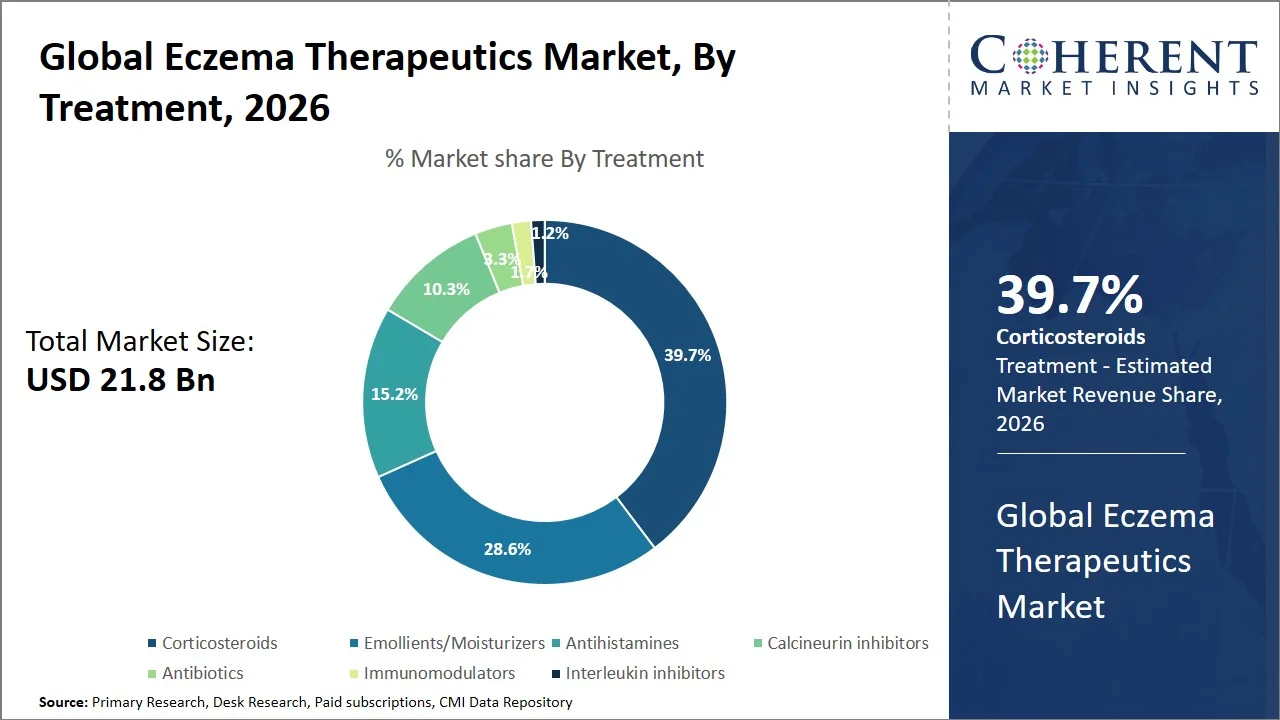
- Corticosteroids hold the largest market share of 39.7% in 2026 owing to the rising prevalence of eczema. Globally, eczema affects 10–20% of children and 2–10% of adults.
- Hospital and Clinics expected to hold largest market share of 42.2% in 2026 owing to its growing demand for specialized dermatology care.
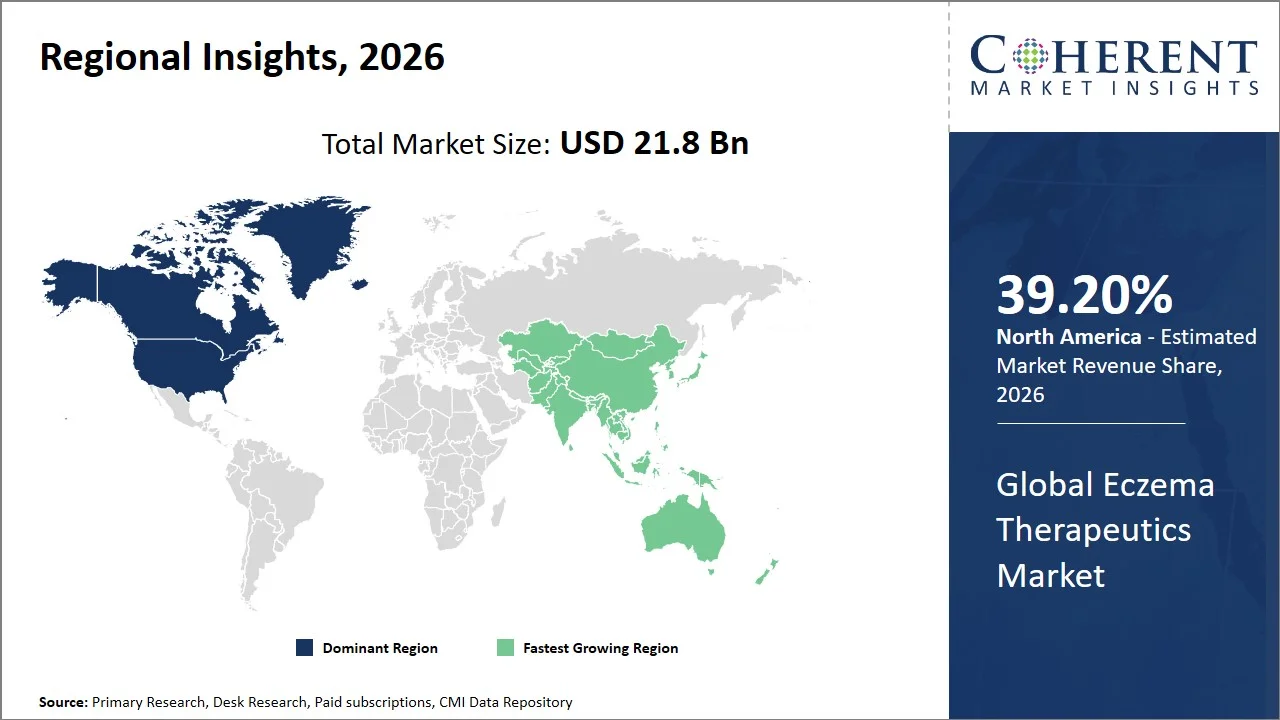
- North America is expected to acquire the dominant share of 39.2% in 2026 owing to the growing prevalence of disease. In the U.S., approximately 31.6 million people, or about 10% of the population, are affected by eczema.
Current Events and Their Impact on the Eczema Therapeutics Market
Current Event | Description and its Impact |
U.S. FDA approves extended maintenance dosing for EBGLYSS (June 2026) |
|
American Academy of Dermatology (AAD) 2025 Focused Guideline Update |
|
Segmental Insights
- Current Industry Events of 2026
- Market Size Estimation
- Regional Breakdown
- Competitive Landscape
- Customer Intelligence
- Segmental Analysis
- Pricing Analysis
- Key Market Drivers, Challenges & Future Trends
- Customized Insights Section
Why is Corticosteroids Acquiring the Largest Market Share?
Corticosteroids hold the largest market share of 39.7% in 2026. Healthcare providers continue to drive demand for corticosteroids in the eczema therapeutics market by prescribing them for their proven ability to quickly reduce inflammation, itching, and skin irritation during eczema flare-ups. Physicians rely on corticosteroids as a first-line treatment because manufacturers offer them in multiple strengths and formulations, while generic versions improve affordability and accessibility across healthcare settings. Established clinical guidelines, extensive physician experience, and widespread availability in hospitals, clinics, and retail pharmacies further strengthen their use. Manufacturers also continue to improve topical formulations, enhancing patient comfort, treatment adherence, and therapeutic outcomes. For instance, in December 2025, Upsher-Smith Laboratories unveiled Kymbee, an oral tablet formulation of deflazacort, in the U.S. for patients aged 5 and older with Duchenne muscular dystrophy (DMD). Deflazacort is a corticosteroid already used in DMD treatment and is available under brands such as Emflaza.
Hospital and Clinics expected to hold largest market share
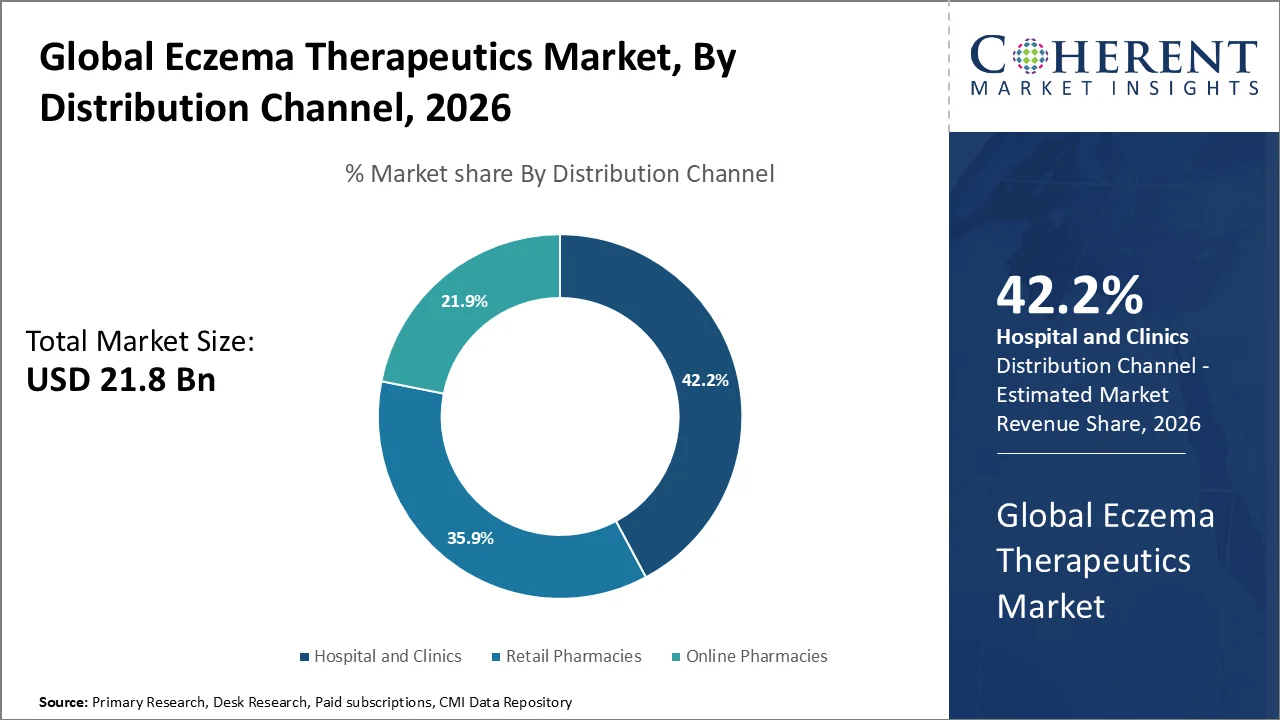
Hospital and Clinics expected to hold largest market share of 42.2% in 2026 owing to its improved diagnostic capabilities. Hospitals and clinics strengthen the eczema therapeutics market by delivering comprehensive diagnostic services, specialist consultations, and advanced treatment options for patients with mild to severe eczema. Dermatologists and healthcare professionals increasingly manage complex cases, prescribe biologics and other targeted therapies, and provide continuous patient monitoring through personalized treatment plans. Multidisciplinary teams improve disease management and long-term outcomes. Healthcare providers also expand dermatology services, enhance diagnostic capabilities, and promote greater awareness of eczema management, further increasing the importance of hospitals and clinics in treatment delivery.
Eczema Therapeutics Market Trends
- Rising adoption of biologic therapies and Janus kinase (JAK) inhibitors is transforming the treatment of moderate-to-severe eczema by offering targeted disease control with improved long-term outcomes.
- Growing preference for personalized treatment approaches, based on disease severity, patient age, and comorbidities, is improving treatment effectiveness, adherence, and quality of life.
- Increasing use of teledermatology and digital health platforms enables remote consultations, timely diagnosis, prescription management, and continuous monitoring of patients with chronic eczema.
- Rising prevalence of atopic dermatitis continues to drive demand for eczema therapeutics worldwide. According to the National Eczema Association, eczema affects more than 31 million people in the United States, while atopic dermatitis impacts up to 20% of children and around 10% of adults, increasing the need for effective long-term treatment strategies.
- Expanding insurance coverage and patient assistance programs are improving access to advanced eczema therapies, including biologics and targeted treatments. Favorable reimbursement policies in developed healthcare markets and manufacturer-sponsored support programs are helping reduce treatment costs and encouraging wider adoption of innovative therapeutics. Medicare covers medically necessary eczema treatments, including medicated creams, oral medications, dupilumab (Dupixent) injections, and phototherapy. Coverage is available through Original Medicare with Part D or a Medicare Advantage plan with prescription drug benefits, though out-of-pocket costs may apply.
Regional Insights
North America dominates owing to growing awareness and early diagnosis
North America is expected to acquire the dominant share of 39.20% in 2026. Healthcare systems in North America drive the eczema therapeutics market by managing a high burden of atopic dermatitis through strong healthcare infrastructure and broad access to specialized dermatology care. Physicians quickly adopt advanced therapies such as biologics and JAK inhibitors, supported by active research and development efforts. Insurance providers improve patient access through favorable coverage and reimbursement policies. Healthcare professionals increase awareness and promote early diagnosis, while leading pharmaceutical companies invest in innovation and clinical trials that continuously expand available treatment options. For instance, in April 2026, Biocon Limited launched Bosaya and Aukelso in the United States. Bosaya, a biosimilar to Prolia, and Aukelso, a biosimilar to Xgeva, are available nationwide through specialty pharmacies and healthcare providers. The company reports that dermatologic reactions, including dermatitis, rashes, and eczema, may occur, and advises discontinuing Bosaya if severe symptoms develop.
Asia Pacific Eczema Therapeutics Market Trends
Rising cases of atopic dermatitis drive the Asia Pacific eczema therapeutics market, while rapid urbanization and increasing pollution exposure worsen skin conditions. People show greater awareness of skin health, which increases treatment seeking. Healthcare providers expand dermatology infrastructure and improve access to care, strengthening demand for therapies. Pharmaceutical companies introduce advanced biologics such as Dupilumab and promote targeted treatment options that improve patient outcomes. Governments also support better chronic disease management, and rising diagnosis rates further stimulate overall market growth. For instance, Emcutix Biopharmaceuticals Ltd., a subsidiary of Emcure Pharmaceuticals Ltd., has launched the AquaOat range powered by NanoCeLiD technology. The formulation uses nanotechnology and lipid chemistry to enhance ceramide delivery into deeper skin layers and includes colloidal oatmeal for soothing effects. AquaOat targets unmet needs in eczema patients, including those with atopic dermatitis, contact dermatitis, and urticaria.
United States Eczema Therapeutics Market Trends
Rising cases of atopic dermatitis drive demand for eczema therapeutics in the United States, while growing awareness among patients and clinicians improves diagnosis rates. Atopic dermatitis is the most common type of eczema, affecting an estimated 16.5 million U.S. adults, including 6.6 million with moderate to severe disease. Healthcare providers increasingly adopt advanced biologics and targeted treatments, including monoclonal antibodies and JAK inhibitors, which fuels market growth. Strong healthcare infrastructure and supportive reimbursement policies encourage treatment uptake. High dermatology consultation rates, continuous research efforts, frequent product approvals, and an expanding pediatric patient base further strengthen the growth of eczema therapeutics in the US market. For instance, in March 2026, LEO Pharma Korea launched Anzupgo Cream (delgocitinib), Korea’s first topical pan-JAK inhibitor and a steroid-free treatment for chronic hand eczema. Approved by the MFDS on Sept. 8, 2025, it treats moderate to severe cases in adults who do not respond to or cannot use topical steroids.
Japan Eczema Therapeutics Market Trends
Key drivers of the Japan eczema therapeutics market include rising cases of atopic dermatitis, which increase demand for effective treatments, along with growing awareness of skin health among the population. A strong healthcare system actively supports dermatology services, while an aging population and higher urban pollution levels worsen disease incidence. Major cities, particularly Tokyo, continue to face high levels of PM2.5, sulfur oxides, and nitrogen oxides. In 2023, Tokyo's average PM2.5 concentration was 1.9 times higher than the World Health Organization's recommended safety limit.
Who are the Major Companies in Eczema Therapeutics Industry
Some of the major key players in Eczema Therapeutics are Sanofi S.A., Encore Dermatology Inc, AbbieVie Inc., F. Hoffmann-La Roche AG, Novartis AG, Regeneron Pharmaceuticals Inc., Astellas Pharma Inc., Anacor Pharmaceuticals Inc., Meda AB, GlaxoSmithKline plc, AstraZeneca plc, and Pfizer Inc.
Key News
- In July 2025, Turn Therapeutics has initiated a randomized, double-blind, vehicle-controlled Phase 1/2 trial of GX-03, a topical treatment targeting IL-36 and IL-31, for moderate-to-severe atopic dermatitis. The study began dosing on July 11 in Dallas and will enroll 114 adults over an 8-week treatment period, with change in EASI scores as the primary endpoint.
Market Report Scope
Eczema Therapeutics Market Report Coverage
| Report Coverage | Details | ||
|---|---|---|---|
| Base Year: | 2025 | Market Size in 2026: | USD 21.8 Bn |
| Historical Data for: | 2020 To 2024 | Forecast Period: | 2026 To 2033 |
| Forecast Period 2026 to 2033 CAGR: | 9.7% | 2033 Value Projection: | USD 48.7 Bn |
| Geographies covered: |
| ||
| Segments covered: |
| ||
| Companies covered: | Sanofi S.A., Encore Dermatology Inc, AbbieVie Inc., F. Hoffmann-La Roche AG, Novartis AG, Regeneron Pharmaceuticals Inc., Astellas Pharma Inc., Anacor Pharmaceuticals Inc., Meda AB, GlaxoSmithKline plc, AstraZeneca plc, and Pfizer Inc. | ||
Analyst Opinion
- Eczema therapeutics demand is fundamentally driven by disease burden rather than discretionary growth. Atopic dermatitis affects over 200 million people globally, with a substantial proportion experiencing moderate-to-severe forms that require long-term pharmacological intervention, particularly in developed healthcare systems like Japan. This persistent clinical load ensures sustained treatment demand rather than cyclical market expansion.
- Japan represents a high-treatment-intensity market where dermatology visits for atopic dermatitis are consistently elevated due to early diagnosis culture and specialist access. Clinical registries indicate that a significant share of pediatric eczema patients continue to require therapy into adulthood, reinforcing chronic treatment dependency rather than episodic care.
- Biologics and targeted immunomodulators are reshaping treatment expectations, with drugs such as dupilumab demonstrating sustained symptom control in a majority of moderate-to-severe patients in clinical studies. This level of efficacy is driving a structural shift away from traditional topical corticosteroids toward long-term systemic management, increasing therapeutic penetration across refractory cases.
Speak to the analyst
Want personalized insights?
Take the findings above to one of our principal consultants, or have the report rebuilt around the segments, geographies and competitors you actually track.
Market Segmentation
- By Treatment (Revenue, USD Bn, 2021-2033)
- Corticosteroids
- Emollients/Moisturizers
- Antihistamines
- Calcineurin inhibitors
- Antibiotics
- Immunomodulators
- Interleukin inhibitors
- By Distribution Channel (Revenue, USD Bn, 2021-2033)
- Hospital and Clinics
- Retail Pharmacies
- Online Pharmacies
- By Region (Revenue, USD Bn, 2021-2033)
- North America
- U.S.
- Canada
- Latin America
- Brazil
- Mexico
- Argentina
- Rest of Latin America
- Europe
- Germany
- U.K.
- France
- Italy
- Spain
- Russia
- Rest of Europe
- Asia Pacific
- China
- India
- Japan
- Australia
- South Korea
- ASEAN
- Rest of Asia Pacific
- Middle East
- GCC
- Israel
- Rest of Middle East
- Africa
- South Africa
- Central Africa
- North Africa
- North America
Sources
Primary Research interviews
- Dermatologists and allergists practicing in hospital and clinical settings
- Pharmacy chain managers and dermatology-focused retail pharmacists
- Patients diagnosed with mild, moderate, and severe eczema (atopic dermatitis)
- Clinical researchers involved in dermatology drug development
- Hospital procurement and formulary decision-makers
Databases
- PubMed (National Library of Medicine)
- ClinicalTrials.gov
- World Health Organization (WHO) Global Health Observatory
- National Institutes of Health (NIH) databases
- Government health statistics portals (e.g., CDC, NHS, MoHFW India)
- Drug regulatory databases (e.g., FDA, EMA public records)
Magazines
- Dermatology Times
- Medical News Today (Dermatology section)
- Health Affairs (health policy and clinical insights)
- Pharmaceutical industry magazines focusing on dermatology therapies
- General medical science magazines covering skin health advancements
Journals
- Journal of the American Academy of Dermatology (JAAD)
- British Journal of Dermatology
- Journal of Dermatological Treatment
- JAMA Dermatology
- Clinical, Cosmetic and Investigational Dermatology
Newspapers
- The New York Times (Health section)
- The Guardian (Science and Health coverage)
- The Hindu (Science & Health)
- The Indian Express (Health section)
- Financial Times (Healthcare and Pharma coverage)
Associations
- American Academy of Dermatology (AAD)
- European Academy of Dermatology and Venereology (EADV)
- National Eczema Association
- Indian Association of Dermatologists, Venereologists and Leprologists (IADVL)
- World Allergy Organization (WAO)
Public Domain sources
- Government health ministry publications and reports
- WHO reports and epidemiological updates
- Open-access epidemiological datasets on skin diseases
- National census and public health survey data
- Regulatory approval summaries and drug labels in public domain
Proprietary Elements
- CMI Data Analytics Tool
- Proprietary CMI Existing Repository of information for last 10 years
Get access to 250+ pages report
Every segment, forecast, competitor profile and data table behind the analysis above — available for instant download.
- ESOMAR Member
- ISO 9001:2015 Certified
- D-U-N-S Registered
- GDPR & CCPA Compliant
Missing comfort of reading report in your local language? Find your preferred language:
Transform your Strategy with Exclusive Trending Reports
Frequently Asked Questions
The Eczema Therapeutics Market is anticipated to grow at a CAGR of 9.7% with USD 21.8 Bn in 2026 and is expected to reach USD 48.7 Bn in 2033.
The market is estimated to be valued at USD 21.8 Bn in 2026.
Sanofi S.A., Encore Dermatology Inc, AbbieVie Inc., F. Hoffmann-La Roche AG, Novartis AG, Regeneron Pharmaceuticals Inc., Astellas Pharma Inc., Anacor Pharmaceuticals Inc., Meda AB, GlaxoSmithKline plc, AstraZeneca plc, and Pfizer Inc. are some of the prominent players operating in the market over the forecast period.
The market is expected to be valued at USD 48.7 Bn in 2033.
North America is the prominent region in the market.
Corticosteroids, which belongs to the treatment segment, is the prominent segment in the market.