

Endometrial Ablation Market Size and Share Analysis - 2026 To 2033
The global endometrial ablation market is estimated to be valued at USD 4.26 Bn in 2026 and is projected to grow at a CAGR of 6.6% during the forecast period, reaching USD 6.67 Bn by 2033. This is attributable to rising prevalence of heavy menstrual bleeding, increasing adoption of minimally invasive procedures as well as technological advancements in endometrial ablation devices.
Key Takeaways from the Endometrial Ablation Market Report
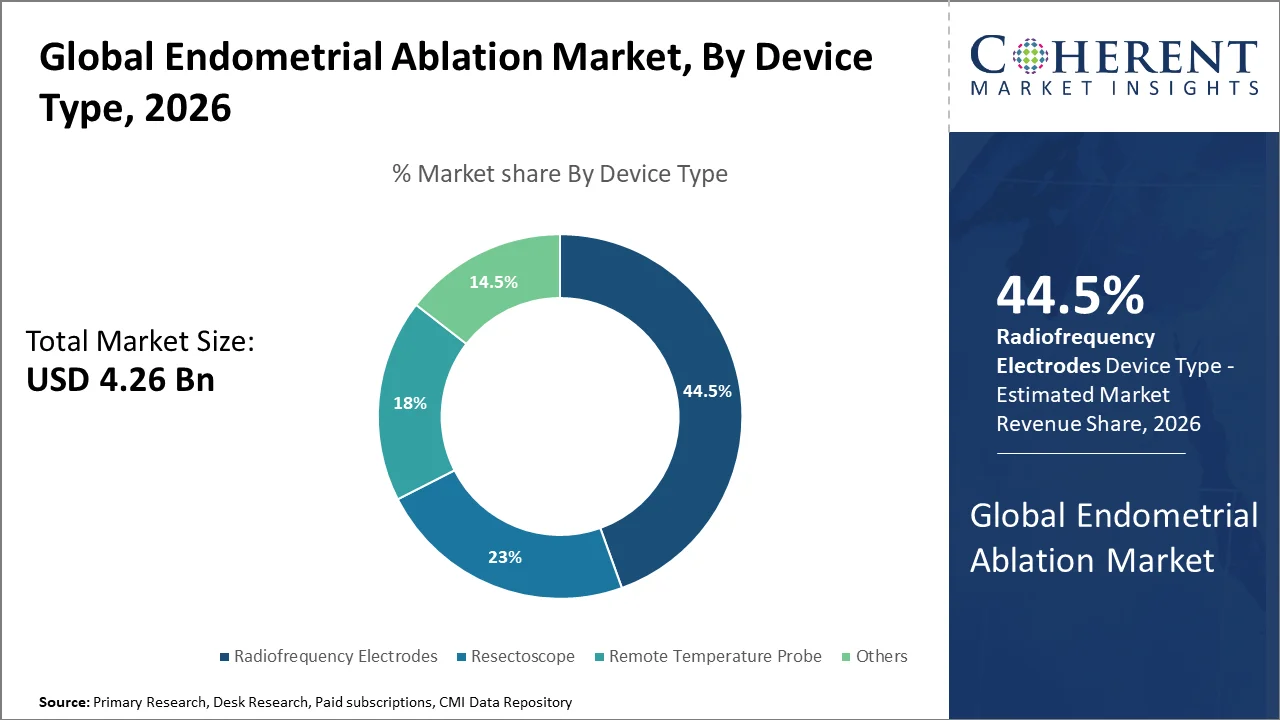
- Radiofrequency electrodes are expected to account for the largest market revenue share of 44.5% in 2026 due to their fast treatment, effectiveness, convenience, and cost efficiency. For example, a 2025 study of 333 women treated with the NovaSure bipolar radiofrequency electrode system reported 85.1% treatment success, 82.8% requiring no further treatment, and 91.8% avoiding surgery
- Radiofrequency electrosurgery ablation is expected to dominate the market with a share of 45% in 2026 because it provides rapid treatment and broad endometrial coverage. A clinical trial found that bipolar radiofrequency treatment was 6.2 minutes faster than thermal balloon ablation and provided 88% endometrial surface coverage versus 58%.
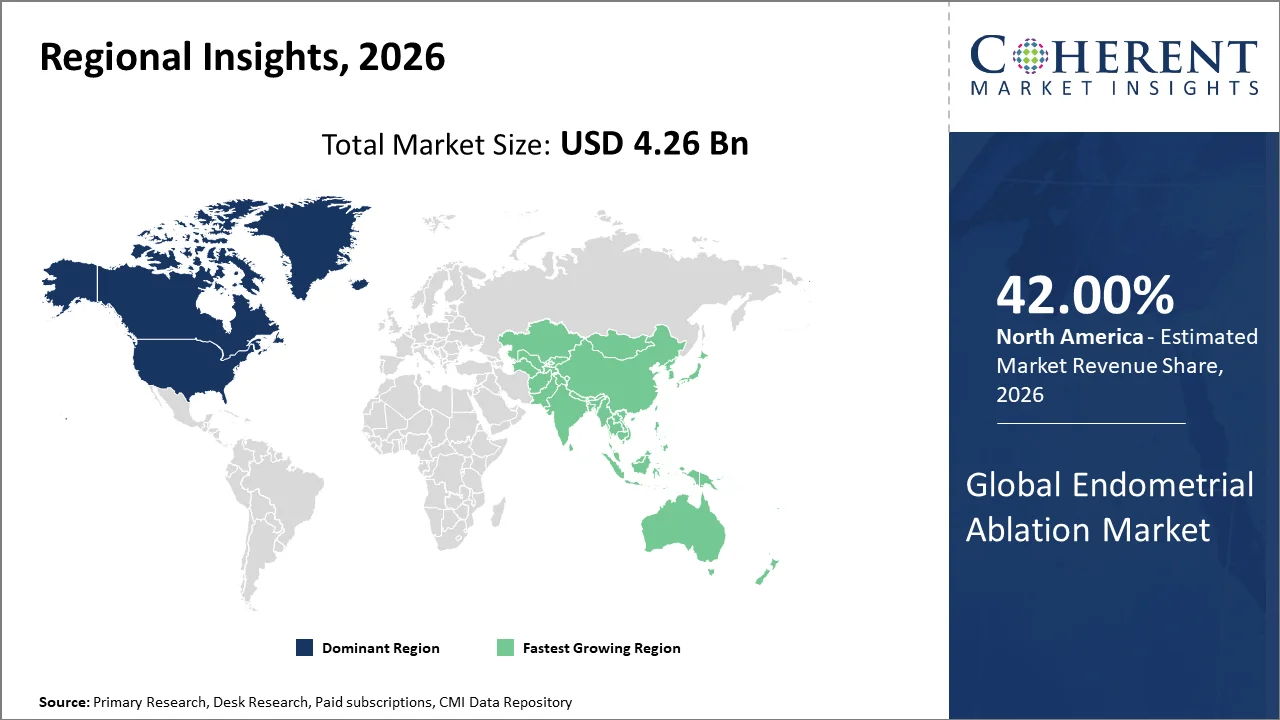
- Regionally, North America is projected to dominate the global endometrial ablation industry with a share of 42.0% in 2026, owing to high adoption of minimally invasive gynecological procedures, favorable reimbursement as well as presence of major endometrial ablation manufacturers. For example, FDA records show continued regulatory activity for endometrial ablation devices in the U.S., including a February 2026 supplement for the Minerva Endometrial Ablation System, supporting continued device availability and adoption in North America.
- Asia Pacific, registering a CAGR of 6.8%, is expected to emerge as the fastest-growing market for endometrial ablation devices, thanks to improving healthcare infrastructure, rising awareness of women's health, increasing adoption of minimally invasive procedures, and growing access to advanced gynecological technologies.
Endometrial Ablation Market Overview
The global endometrial ablation market is poised to register steady growth during the forecast period. This growth is primarily driven by rising incidence of abnormal uterine bleeding, growing preference for minimally invasive treatment options, increasing awareness of endometrial ablation procedures, and technological advancements in ablation devices. In addition, shorter procedure times, reduced recovery periods, and increasing adoption of outpatient gynecological procedures are supporting market growth.
Endometrial ablation is a procedure that destroys the inner lining of the uterus to reduce heavy menstrual bleeding. It is generally considered when heavy bleeding is not adequately controlled with medication. According to the American College of Obstetricians and Gynecologists (ACOG), the procedure is not recommended for women with certain uterine or endometrial disorders, endometrial hyperplasia, uterine cancer, recent pregnancy, or current or recent uterine infection. Common techniques include radiofrequency, heated fluid, heated balloon, freezing, microwave energy, and electrosurgery.
Endometrial ablation is mainly used to treat heavy menstrual bleeding. According to the Centers for Disease Control and Prevention (CDC), heavy menstrual bleeding affects more than 10 million American women each year, or about 1 in 5 women. Common causes include fibroids, polyps, irregular ovulation, bleeding disorders, certain medications, copper intrauterine devices (IUDs), and endometrial cancer.
Increasing use of radiofrequency ablation for treating heavy menstrual bleeding is expected to support market growth. Radiofrequency systems deliver controlled energy to the uterine lining and provide a minimally invasive treatment option. Regulatory updates for devices such as ChopLogic’s NovaSure also reflect continued regulatory activity around radiofrequency ablation technology.
Segmental Insights
Which Device Type Dominates the Global Endometrial Ablation Market?
Radiofrequency Electrodes Continue to Lead the Market
According to Coherent Market Insights' Endometrial Ablation Market analysis, radiofrequency electrodes are expected to remain the top-selling device type, accounting for a revenue of 44.5% in 2026. This dominance is attributable to their short treatment time, effective endometrial destruction, ease of use, and strong clinical outcomes, which support their widespread adoption for treating heavy menstrual bleeding.
Radiofrequency electrodes deliver controlled radiofrequency energy to the endometrial tissue, enabling targeted and uniform destruction of the uterine lining. Their precise energy delivery, ease of use, and consistent treatment performance make them a widely used device type for endometrial ablation.
- Current Industry Events of 2026
- Market Size Estimation
- Regional Breakdown
- Competitive Landscape
- Customer Intelligence
- Segmental Analysis
- Pricing Analysis
- Key Market Drivers, Challenges & Future Trends
- Customized Insights Section
Which Ablation Method Holds the Largest Endometrial Ablation Market Share?
Radiofrequency Electrosurgery Ablation Holds Over Two-Fifths of the Market
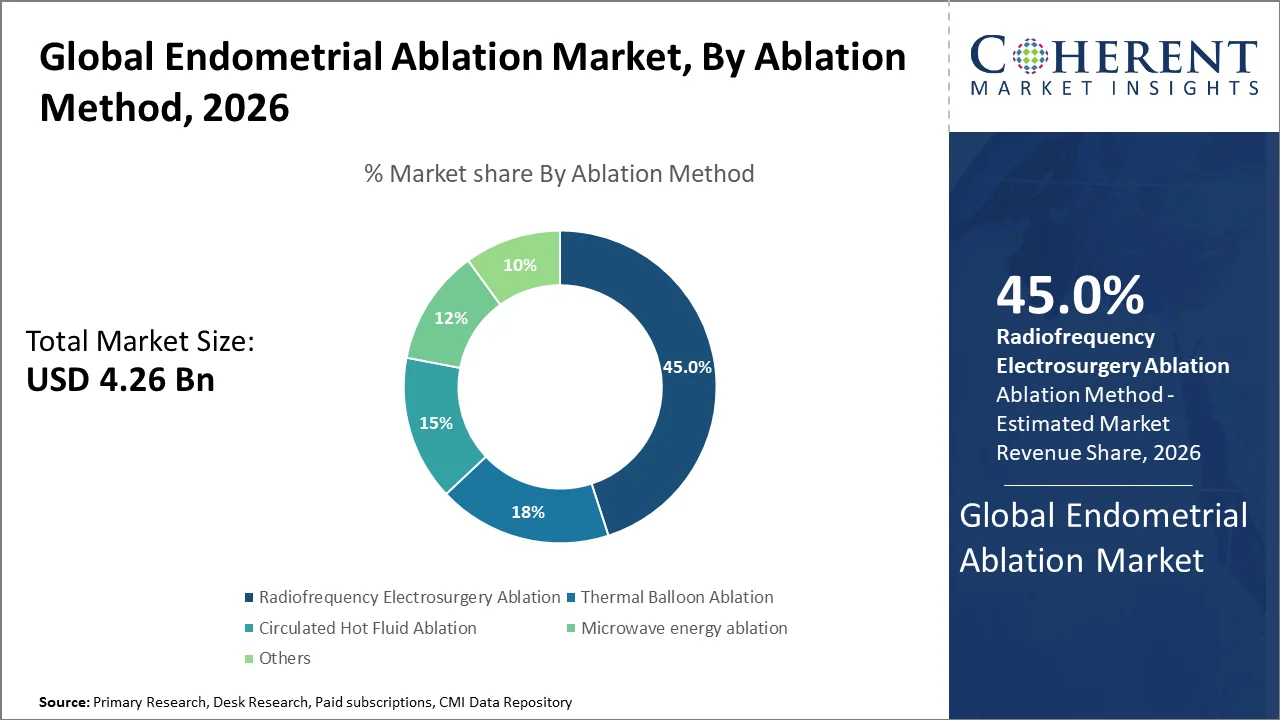
Based on ablation method, radiofrequency electrosurgery ablation is anticipated to lead the market, accounting for a share of 45% in 2026. This can be attributed to its short treatment time, effective endometrial tissue ablation, and consistent treatment outcomes.
Radiofrequency electrosurgery ablation method uses radiofrequency energy to deliver controlled heat to the endometrium, enabling efficient treatment of heavy menstrual bleeding. Its ability to provide uniform treatment with minimal procedure time makes it a preferred option among healthcare providers.
For example, a randomized study found that 43% of women had no menstrual bleeding one year after bipolar radiofrequency ablation, compared with 8% after thermal balloon ablation. In addition, 90% of women were satisfied with the radiofrequency treatment, supporting its effectiveness in treating heavy menstrual bleeding.
Endometrial Ablation Market Growth Drivers
Rising Burden of Heavy Menstrual Bleeding
Heavy menstrual bleeding is a key factor driving demand for endometrial ablation. According to the American College of Obstetricians & Gynecologists (ACOG), about one-third of women seek treatment for heavy menstrual bleeding. As medications are typically tried first, women whose bleeding remains uncontrolled can undergo endometrial ablation to reduce menstrual bleeding. This is expected to fuel growth of endometrial ablation market during the forecast period.
Endometrial Ablation Market Opportunities
Advances in Ablation Technologies
Improvements in radiofrequency, thermal balloon, microwave, and other second-generation techniques are enabling simpler and quicker treatment of heavy menstrual bleeding. NICE recognizes second-generation endometrial ablation as a treatment option for suitable women with heavy menstrual bleeding. Thus, continued technological advancements are expected to create growth opportunities for the endometrial ablation market during the forecast period.
Endometrial Ablation Market Trends
Shift Towards Minimally Invasive Treatment
Growing preference for minimally invasive treatment is a key trend shaping the endometrial ablation market. Endometrial ablation is a minimally invasive procedure that can often be performed on an outpatient basis, with shorter recovery than hysterectomy. This is increasing interest in ablation as an alternative to surgical treatment for heavy menstrual bleeding.
Current Events and Their Impact on the Endometrial Ablation Market
Current Event | Description and its Impact |
New 2026 Evidence on Long-Term Outcomes of Radiofrequency Ablation |
|
FDA Continues Post-Approval Monitoring of Endometrial Ablation Devices |
|
Regional Insights
North America Holds Dominance in the Global Endometrial Ablation Market
America is expected to retain its dominance over the global endometrial ablation market, accounting for a share of 42% in 2026. This is attributable to high burden of heavy menstrual bleeding, growing preference for minimally invasive treatments, strong presence of endometrial ablation equipment manufacturers, and advancements in endometrial ablation technologies.
High prevalence of heavy menstrual bleeding is playing a key role in boosting North America endometrial ablation market. According to the U.S. CDC, heavy menstrual bleeding affects more than 10 million American women each year. The large patient population requiring treatment for prolonged or heavy bleeding supports demand for procedures such as endometrial ablation.
Asia Pacific Becoming Hotbed for Endometrial Ablation Market Players
Asia Pacific endometrial ablation market is anticipated to register a CAGR of 6.8% during the forecast period. This is mostly due to rising burden of heavy menstrual bleeding, improving access to gynecological care, expanding healthcare infrastructure, and increasing adoption of minimally invasive procedures.
Growing burden of heavy menstrual bleeding is a major factor creating demand for endometrial ablation treatments in the region. The WHO reported in June 2026 that almost half of menstruating women in a 2023 study covering 10 cities in South Asia and sub-Saharan Africa experienced heavy menstrual bleeding, which can increase the risk of iron-deficiency anemia. This highlights a substantial need for effective treatment options, including endometrial ablation, in Asian markets.
Endometrial Ablation Market Outlook – Country-wise
U.S. Endometrial Ablation Market Trends
The United States is projected to remain a prominent market endometrial ablation procedures and devices during the assessment period. This is mainly due to rising burden of heavy menstrual bleeding and growing preference for minimally invasive, outpatient treatments. Endometrial ablation is gaining traction across the United States as it can be performed without incisions. This, in turn, is positively impacting sales of endometrial ablation devices in the nation.
China Endometrial Ablation Market Forecast
China’s endometrial ablation market is poised to grow steadily during the assessment period. This is attributable to the country’s expanding adoption of minimally invasive gynecological procedures and continued efforts to improve access to modern medical technologies. China’s National Health Commission has highlighted minimally invasive surgery as a key performance indicator across public hospitals and maternal and child health institutions, supporting wider use of less invasive surgical approaches.
Who are the Major Companies in the Endometrial Ablation Market?
Some of the major players in endometrial ablation market are RF Medical, Erbe Inc., MedGyn Inc., Ri.Mos. Inc., Biosense Webster Inc., Hansen Medical Inc., Biotronik, Smith & Nephew plc, Arthrex, Wallach.
Key Strategies Adopted by Industry Players
Leading manufacturers of endometrial ablation devices are adopting various organic and inorganic strategies to boost their revenue as well as gain a competitive edge in the industry. These include new product launches and approvals, increasing investments in R&D, acquisitions, partnerships, collaborations, mergers, and distribution agreements.
- In January 2026, Axora Medical acquired the business assets of Minerva Surgical, including its Minerva ES and Genesys HTA endometrial ablation systems. The acquisition is expected to strengthen Axora Medical’s position in the uterine health and endometrial ablation market.
- In February 2026, the U.S. FDA approved a supplier change for selected components of the Minerva Endometrial Ablation Handpiece. The approval supports continued manufacturing and supply of the device.
Market Report Scope
Endometrial Ablation Market Report Coverage
| Report Coverage | Details | ||
|---|---|---|---|
| Base Year: | 2025 | Market Size in 2026: | USD 4.26 Bn |
| Historical Data for: | 2020 To 2024 | Forecast Period: | 2026 To 2033 |
| Forecast Period 2026 to 2033 CAGR: | 6.6% | 2033 Value Projection: | USD 6.67 Bn |
| Geographies covered: |
| ||
| Segments covered: |
| ||
| Companies covered: | RF Medical, Erbe Inc., MedGyn Inc., Ri.Mos. Inc., Biosense Webster Inc., Hansen Medical Inc., Biotronik, Smith & Nephew plc, Arthrex, and Wallach. | ||
| Growth Drivers: |
| ||
| Restraints & Challenges: |
| ||
Analyst Opinion (Expert Opinion)
- Heavy menstrual bleeding creates a strong treatment need. WHO reports that many people who menstruate experience heavy menstrual bleeding, which can contribute to iron-deficiency anemia. This supports continued demand for treatments such as endometrial ablation.
- Endometrial ablation can provide effective bleeding control. In a randomized trial, 93.1% of women treated with the Minerva system met the study’s success criteria at one year, supporting demand for effective ablation devices.
- Radiofrequency ablation offers strong clinical outcomes. A randomized trial found that 56% of women receiving bipolar radiofrequency ablation had no menstrual bleeding after 12 months, compared with 23% after balloon ablation. This can encourage use of radiofrequency-based devices.
- Shorter, office-based procedures can support adoption. Clinical evidence shows that some modern ablation systems can be performed quickly in an office setting, reducing the need for more intensive surgical treatment. This convenience can support wider use of minimally invasive ablation devices.
Speak to the analyst
Want personalized insights?
Take the findings above to one of our principal consultants, or have the report rebuilt around the segments, geographies and competitors you actually track.
Market Segmentation
- By Device Type (Revenue, USD Bn, 2021-2033)
- Resectoscope
- Remote temperature probe
- Radiofrequency electrodes
- Others
- By Ablation Method (Revenue, USD Bn, 2021-2033)
- Thermal balloon ablation
- Radiofrequency electrosurgery ablation
- Circulated hot fluid ablation
- Microwave energy ablation
- Cryotherapy ablation
- By End User (Revenue, USD Bn, 2021-2033)
- Hospitals
- Pharmaceutical companies
- Clinical laboratories
- By Region Insights (Revenue, USD Bn, 2021-2033)
- North America
- U.S.
- Canada
- Latin America
- Brazil
- Argentina
- Mexico
- Rest of Latin America
- Europe
- Germany
- U.K.
- Spain
- France
- Italy
- Russia
- Rest of Europe
- Asia Pacific
- China
- India
- Japan
- Australia
- South Korea
- ASEAN
- Rest of Asia Pacific
- Middle East
- GCC Countries
- Israel
- Rest of Middle East
- Africa
- South Africa
- North Africa
- Central Africa
Sources
Primary Research interviews
- Gynecologists
- Obstetricians
- Gynecologic surgeons
- Hospital procurement professionals
- Medical device distributors
- Endometrial ablation device manufacturers
Databases
- U.S. FDA databases
- PubMed
- ClinicalTrials.gov
- WHO Global Health Observatory
- World Bank Data
- OECD Health Statistics
Magazines
- Contemporary OB/GYN
- OBG Management
- MedTech Dive
- Medical Device Network
- MDDI
Journals
- Obstetrics & Gynecology
- American Journal of Obstetrics & Gynecology
- BJOG: An International Journal of Obstetrics & Gynaecology
- Fertility and Sterility
- Journal of Minimally Invasive Gynecology
- International Journal of Gynecology & Obstetrics
Newspapers
- The New York Times
- The Guardian, Reuters
- The Wall Street Journal
- The Washington Post
Associations
- American College of Obstetricians and Gynecologists (ACOG)
- American Society for Reproductive Medicine (ASRM)
- Society of Gynecologic Surgeons (SGS)
- International Society for Gynecologic Endoscopy (ISGE)
- Royal College of Obstetricians and Gynaecologists (RCOG)
Public Domain sources
- U.S. Food and Drug Administration (FDA)
- Centers for Disease Control and Prevention (CDC)
- National Institutes of Health (NIH)
- National Center for Health Statistics (NCHS)
- World Health Organization (WHO)
- European Medicines Agency (EMA)
- National health ministry and government statistical databases
Proprietary Elements
- CMI Data Analytics Tool
- Proprietary CMI Existing Repository of information for last 10 years
Get access to 250+ pages report
Every segment, forecast, competitor profile and data table behind the analysis above — available for instant download.
- ESOMAR Member
- ISO 9001:2015 Certified
- D-U-N-S Registered
- GDPR & CCPA Compliant
Missing comfort of reading report in your local language? Find your preferred language:
Transform your Strategy with Exclusive Trending Reports
Frequently Asked Questions
Endometrial ablation is a minimally invasive procedure that destroys the lining of the uterus to reduce or stop heavy menstrual bleeding.
The endometrial ablation market includes devices, systems, and related products used to perform endometrial ablation procedures for treating heavy menstrual bleeding.
The global market is estimated to be valued at USD 4.26 Bn in 2026.
The global Endometrial Ablation Market value is expected to reach USD 6.67 Bn by 2033.
The global market is poised to exhibit a CAGR of 6.6% from 2026 to 2033.
Major growth factors include growing prevalence of heavy menstrual bleeding, rising preference for minimally invasive treatments, increasing awareness of endometrial ablation, and technological advances in ablation devices.
Radiofrequency electrodes are set to lead the market with a share of 44.5% in 2026.