

Highway Crash Cushion Market Size and Share Analysis - Growth Trends and Forecast (2026 - 2033)
The Highway Crash Cushion Market is estimated to register a CAGR of 4.9% at USD 1,956.8 Mn market size in 2026 and is projected to achieve a valuation of USD 2,737.6 Mn by 2033. Factors such as emphasis on safety infrastructure for roads, increased activity in highway construction projects, stringent governmental regulations for crash prevention systems, and investment in traffic management systems are expected to propel growth in the market. In 2026–27, the Ministry of Road Transport and Highways allocated ₹1.22 lakh crore (US$13.6 billion) for roads and bridges, a 5% increase over the revised 2025–26 estimate. The funding supports national highway development, expressway construction, lane expansion, and improved connectivity in left-wing extremism-affected areas, underscoring the government's focus on transport infrastructure development.
Key Takeaways from the Highway Crash Cushion Market Report (2026)
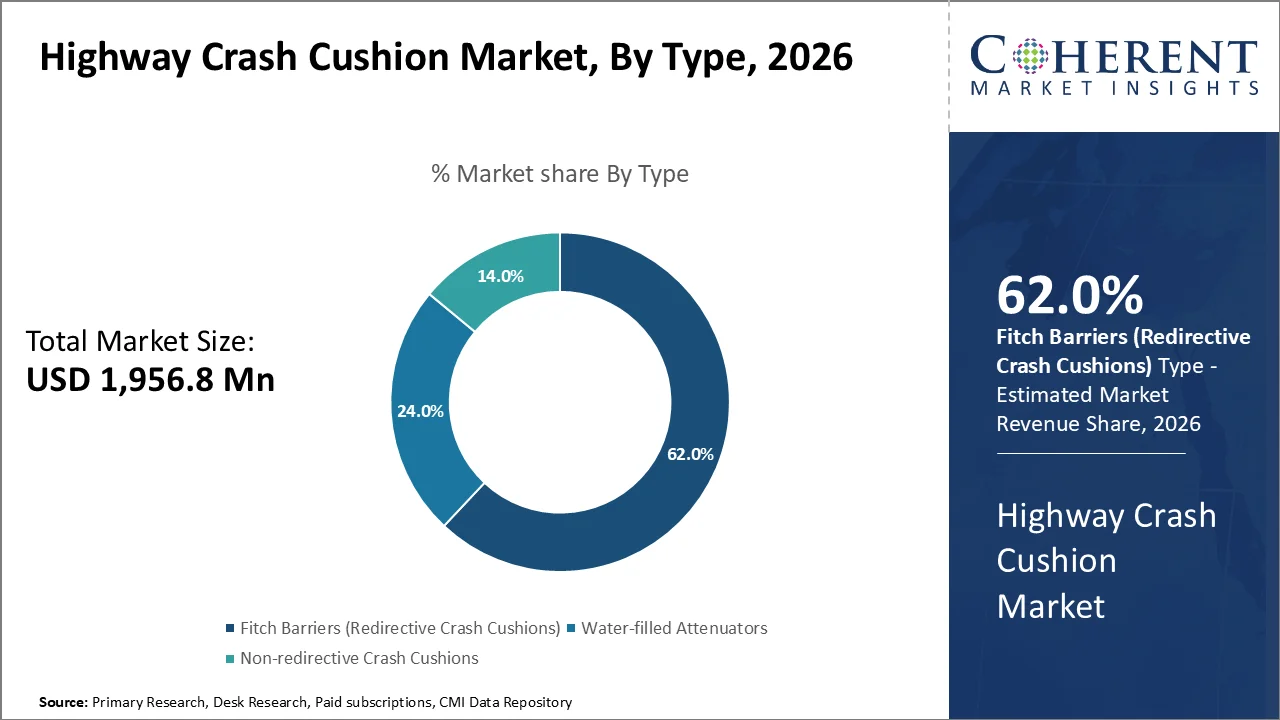
- The Fitch Barriers (Redirective Crash Cushions) segment will dominate the market, with 62% of the market share forecasted for 2026 due to its effectiveness in redirect vehicles safely away from fixed roadside hazards while dissipating impact energy. The U.S. Federal Highway Administration states that crash cushions and attenuator systems are essential roadside safety features whose main role is to dissipate energy and minimize chances of causing fatal injuries during high-speed crashes.
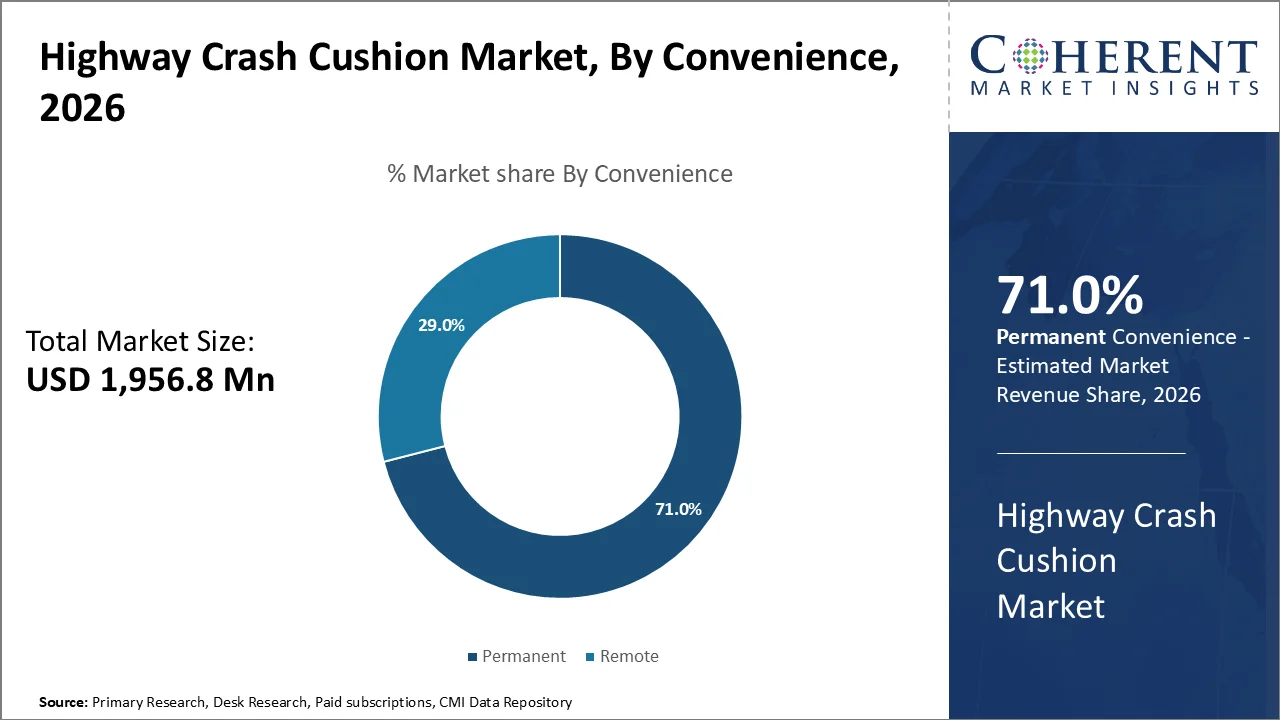
- The Permanent segment is leading, accounting for 71% of the market share by 2026, owing to the increasing focus of highway agencies on long-lasting installation of crash protection systems rather than using temporary methods. It is evident from the guidelines set by the FHWA that the stationary crash cushions are being used in permanent highway applications.
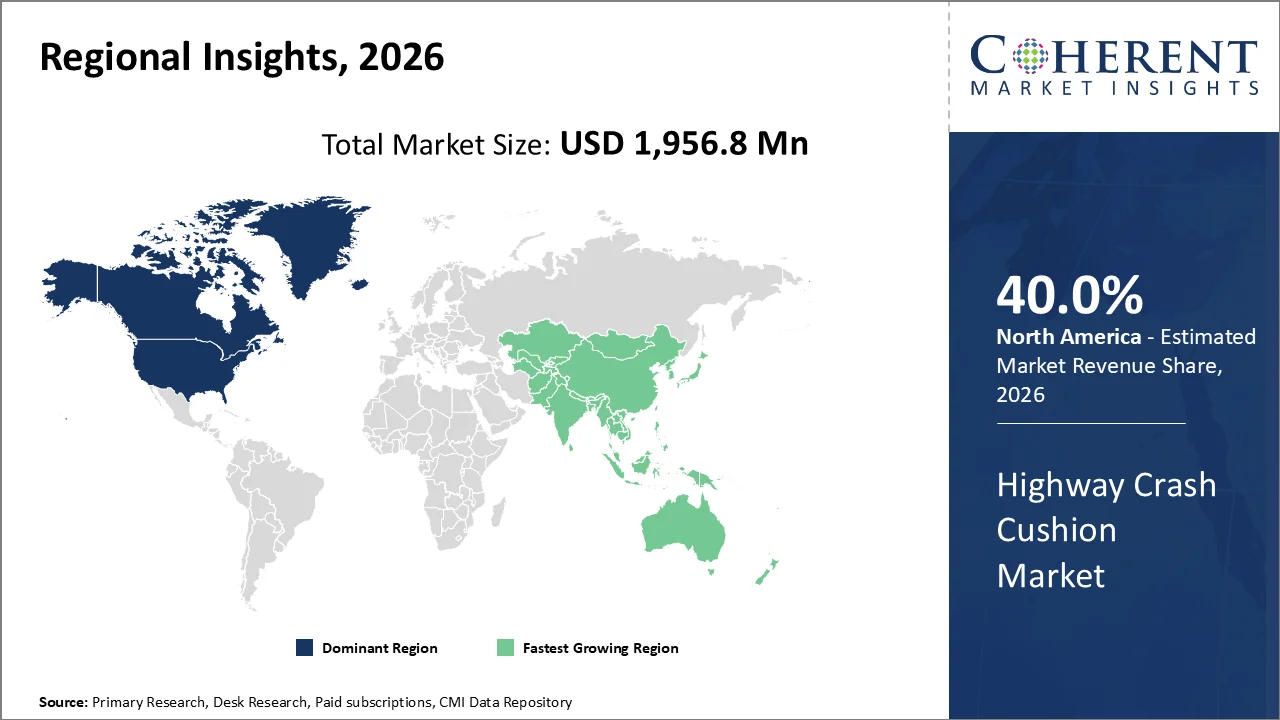
- North America is anticipated to hold a leading position in the Highway Crash Cushion Market in 2026 with a market share of 40%. The presence of well-developed infrastructure facilities in addition to stringent national road safety regulations will fuel the regional growth.
Segmental Insights
Why Fitch Barriers Segment is Leading the Highway Crash Cushion Market?
The Fitch Barriers (Redirective Crash Cushions) segment will have the largest market share, contributing roughly 62% of the global Highway Crash Cushion Market in 2026. The high efficacy of these barriers to redirect vehicles and minimize crashes in highway conditions is the reason for the large market share commanded by them. They are extensively used for protecting motorists in the median area of highways, ramp terminations, and fixed object protection areas because of the high impact energy absorption capacity of these barriers.
According to the FHWA of the United States, the effectiveness of roadside safety systems such as barrier and impact attenuation systems is essential in mitigating the severity of roadway departure crashes, which constitute a significant portion of fatalities on highways in the country. This demonstrates the need for such systems as Fitch barriers to be incorporated into highway safety systems.
- Current Industry Events of 2026
- Market Size Estimation
- Regional Breakdown
- Competitive Landscape
- Customer Intelligence
- Segmental Analysis
- Pricing Analysis
- Key Market Drivers, Challenges & Future Trends
- Customized Insights Section
Why Does the Permanent Segment Dominate the Market?
The Permanent segment dominates the Highway Crash Cushion Market around 71% market share in 2026 since the highway authorities are focusing more on installing permanent crash cushion systems rather than the moveable or temporary one. Permanent Crash cushions are widely employed in high-risk areas such as the end of the bridge piers, medians, toll plazas, and interchanges.
In September 2024, the U.S. Federal Highway Administration (FHWA) updated its Crash Cushion Webinar and Design Guidance Materials, reinforcing that crash cushions can be classified and deployed as “permanent installations” in highway safety design when used for long-term protection of fixed roadside hazards such as bridge piers, gore areas, and ramp terminals.
Rising Road Traffic Fatalities and Road Departure Crashes Driving Safety Infrastructure Demand
Rising cases of road accidents and incidents of vehicles leaving the roadway are the main reasons for growth in the Highway Crash Cushion market. The crash cushions and impact attenuators help absorb energy from the high-speed impact and reduce fatalities involving collisions with fixed roadside objects.
Based on research by the World Health Organization (WHO), it is estimated that road traffic accidents claim an average of 1.19 million lives each year, thus making road safety infrastructure a very important issue when it comes to public safety worldwide.
Expansion of Highway Infrastructure and Controlled-Access Expressways
Highway construction and development have been rapid, leading to high demand for permanent crash cushions. These devices have become mandatory in modern highway design, mainly at median strips, ramp ends, toll plazas, and bridge approaches.
As indicated by the U.S. Department of Transportation (FHWA Roadway Safety Data Program), roadside safety hardware forms an important part of highway design guidelines designed to ensure crash survivability along fast-moving roads by incorporating energy absorption engineering concepts.
Current Events and Their Impact
Current Event | Description and its Impact |
U.S. Infrastructure Investment and Jobs Act (IIJA) Highway Safety Funding Expansion |
|
Rising Global Road Traffic Fatalities and Road Departure Crash Focus (WHO & FHWA Data) |
|
Highway Crash Cushion Market Trends
- High risk of roadway departure crashes makes the use of crash cushions necessary. According to the FHWA, roadway departure crashes contribute significantly to the total fatalities on the highways, thus making safety barriers necessary.
- Transition to MASH-rated safety hardware is becoming mandatory. FHWA is promoting the adoption of more advanced crash tested crash cushions on the highway networks.
- The construction of express highways and roadways leads to more installations. Union Road Transport and Highways Minister Nitin Gadkari on Friday (6 March) announced that three major elevated corridor projects in Pune will be launched within the next 30 days, with tenders already finalised for stretches connecting Kharadi-Shirur, Bhairobanala-Yavat, and Talegaon-Chakan-Shikrapur.
- Increased need for fast replacement modular crash cushion systems. Advanced technology helps reduce delays due to impact and increases highway maintenance efficiency.
- Development in urban road safety developments enhances the application process. The growing number of vehicles in toll zones and at intersection junctions is prompting the use of crash cushions in urban areas.
- Switch towards crash cushions designed to deflect crashes. Crash cushions that are advanced are often used in high-speed areas in order to minimize crash severity.
- Growing number of road deaths maintaining steady demands. WHO claims that there are about 1.19 million annual road traffic fatalities worldwide.
Regional Insights
North America dominates owing to stringent highway safety regulations and extensive infrastructure development
North America is projected to dominate the Highway Crash Cushion Market with around 40% share in 2026, backed up by the presence of well-established highways, stringent regulatory framework for ensuring safety on roads, and installation of road side safety equipment in compliance with MASH standards prescribed by the Federal Highway Administration.
In November 2025, the U.S. Federal Highway Administration (FHWA) launched the “Crash Responder Safety Week 2025” initiative, emphasizing expanded deployment of roadside safety hardware including crash cushions, impact attenuators, and work-zone protection systems across highways in the United States.
Asia Pacific is the fastest-growing region in the Highway Crash Cushion Market
Asia Pacific is expected to be the fastest-growing one between 2026 and 2033 due to significant development of expressway, bypass, and highways within China, India, and Southeast Asia. The growing number of cars, traffic congestion, and measures taken by the authorities to ensure road safety will contribute to increased usage of crash cushions.
According to the World Bank Transport Overview, developing economies in Asia are heavily investing in transport infrastructure expansion, including highways and controlled-access road systems, which directly increases demand for roadside safety hardware such as crash cushions.
U.S. Highway Crash Cushion Market Trends
The United States Highway Crash Cushion Market is witnessing steady growth, spurred by constant modernization of highways, stringent government safety norms, and extensive installation of safety equipment on interstate highways. The market growth is fueled by the safety requirements set forth by the FHWA, as well as the replacement of existing crash attenuation systems with MASH-compliant crash cushions.
In December 2025,
Japan Highway Crash Cushion Market Trends
The Japan Highway Crash Cushion Market is witnessing significant growth, aided by deteriorating infrastructure, dense urban traffic, and increasing government concern towards enhancing road safety. The Japan expressway system is in need of crash cushions because of high traffic speed and limited space on urban roads.
As per reports from the MLIT of Japan, constant efforts are being put into making the expressways safer through improvements in roadside facilities and crash prevention measures, especially on urban expressways and in areas of exit from tunnels because they pose high accident severity risks.
Who are the Major Companies in Highway Crash Cushion Industry
Some of the major key players in Highway Crash Cushion are Road Systems, Inc., Energy Absorption Systems, Barrier Systems, Inc., Trinity Highway Products, SCI Products, Tata steel Europe, NV Bekaert S.A., Valmont Industries, Inc., Trinity Industries Inc. and Nucor Corporation.
Industry News
- In May 2025, TrafFix Devices introduced the Delta TL-2+ Crash Cushion, the first TL-2 non-gating redirective crash cushion to pass MASH testing at 50 mph.
- In October 2025, Gregory Highway Products announced expansion of its crash cushion portfolio through a distributor partnership with Hill & Smith, adding Smart Cushion® and SmartPod™ attenuator systems.
- In December 2025, Lindsay Transportation Solutions launched the TAU-M Wide™ 72-inch crash cushion, a MASH TL-3 compliant system designed for wider highway hazards such as bridge piers and toll plazas.
Market Report Scope
Highway Crash Cushion Market Report Coverage
| Report Coverage | Details | ||
|---|---|---|---|
| Base Year: | 2025 | Market Size in 2026: | USD 1,956.8 Mn |
| Historical Data for: | 2020 To 2024 | Forecast Period: | 2026 To 2033 |
| Forecast Period 2026 to 2033 CAGR: | 4.9% | 2033 Value Projection: | USD 2,737.6 Mn |
| Geographies covered: |
| ||
| Segments covered: |
| ||
| Companies covered: | Road Systems, Inc., Energy Absorption Systems, Barrier Systems, Inc., Trinity Highway Products, SCI Products, Tata steel Europe, NV Bekaert S.A., Valmont Industries, Inc., Trinity Industries Inc. and Nucor Corporation | ||
| Growth Drivers: |
| ||
| Restraints & Challenges: |
| ||
Analyst Opinion
- Highway crash cushion market growth is inherently based on the imperative need for road safety, rather than discretionary expenditures, since roadway departure crashes have continued to be responsible for a significant percentage of highway deaths around the world.
- Crash cushions have now been regarded as an essential part of the highway safety infrastructure, as per FHWA's statement that highway accidents due to roadway departure constitute a large proportion of highway injuries and fatalities.
- The market is highly driven by regulatory compliance, through MASH/FHWA guidelines, which have fast-tracked the adoption of modern crash cushioning devices that absorb impact energy and guide errant vehicles safely off highways.
- Analysts note that crash cushion adoption is becoming standardized in highway design manuals, meaning future demand will be driven by infrastructure expansion and replacement cycles rather than new product introduction.
- Growth is also reinforced by continuous highway expansion and urban congestion, where increasing traffic density and higher-speed road networks raise exposure to severe collision points, making crash cushions essential in both new construction and retrofit projects.
- The market is characterized by a recurring replacement cycle business model, as crash cushions often need repair or replacement after impact events, creating steady aftermarket demand for manufacturers and suppliers.
- Overall, the Highway Crash Cushion Market reflects a structural safety-driven industry, where demand is sustained by regulatory compliance, infrastructure growth, and persistent road safety risks rather than short-term consumer trends.
Speak to the analyst
Want personalized insights?
Take the findings above to one of our principal consultants, or have the report rebuilt around the segments, geographies and competitors you actually track.
Market Segmentation
- By Type (Revenue, USD Mn, 2026-2033)
- Non-redirective
- Water-filled Attenuators
- Fitch Barriers
- Redirective Crash Cushions
- By Convenience (Revenue, USD Mn, 2026-2033)
- Remote
- Permanent
- By Region: (Revenue, USD Mn, 2026-2033)
- North America
- U.S.
- Canada
- Latin America
- Brazil
- Mexico
- Argentina
- Rest of Latin America
- Europe
- Germany
- U.K.
- France
- Italy
- Spain
- Russia
- Rest of Europe
- Asia Pacific
- China
- India
- Japan
- Australia
- South Korea
- ASEAN
- Rest of Asia Pacific
- Middle East
- GCC
- Israel
- Rest of Middle East
- Africa
- South Africa
- Central Africa
- North Africa
- North America
- Key Players
- Road Systems, Inc.
- Energy Absorption Systems
- Barrier Systems, Inc.
- Trinity Highway Products
- SCI Products
- Tata Steel Europe
- V. Bekaert S.A.
- Valmont Industries, Inc.
- Trinity Industries Inc.
- Nucor Corporation
Sources
Primary Research Interviews
- Highway safety engineers
- State Department of Transportation (DOT) officials
- Highway construction contractors
- Road infrastructure project managers
- Traffic safety consultants
- Roadside safety hardware manufacturers (OEMs)
Databases
- Federal Highway Administration (FHWA)
- National Highway Traffic Safety Administration (NHTSA)
- World Health Organization (WHO) – Road Safety Data
- World Bank Transport Data
- Organisation for Economic Co-operation and Development (OECD) Transport Statistics
- Bureau of Transportation Statistics (BTS – U.S. DOT)
Magazines
- Traffic Technology International
- Roads & Bridges Magazine
- Equipment World
- World Highways
- Transport Topics
Journals
- Accident Analysis & Prevention
- Journal of Transportation Safety & Security
- Transportation Research Record (TRR)
- Safety Science
- Journal of Infrastructure Systems (ASCE)
Newspapers
- The New York Times (Infrastructure & Transport Section)
- The Wall Street Journal (Transportation & Industry News)
- Financial Times (Infrastructure Investments Coverage)
- Reuters (Transport & Highway Safety Reports)
Associations
- American Association of State Highway and Transportation Officials (AASHTO)
- Federal Highway Administration (FHWA) Programs
- International Road Federation (IRF)
- Transportation Research Board (TRB)
- National Safety Council (NSC)
Public Domain Sources
- U.S. Department of Transportation (DOT) Reports
- Federal Highway Administration (FHWA) Technical Publications
- National Roadway Safety Strategy (NRSS) Documents
- World Bank Infrastructure Reports
- Government transport ministry publications (global)
- Company annual reports and investor presentations (Trinity Industries, Lindsay, Valmont, etc.)
Proprietary Elements
- CMI Data Analytics Tool
- Proprietary CMI Database of 10+ years
Get access to 250+ pages report
Every segment, forecast, competitor profile and data table behind the analysis above — available for instant download.
- ESOMAR Member
- ISO 9001:2015 Certified
- D-U-N-S Registered
- GDPR & CCPA Compliant
Missing comfort of reading report in your local language? Find your preferred language:
Transform your Strategy with Exclusive Trending Reports
Frequently Asked Questions
The Highway Crash Cushion Market is expected to reach USD 2,737.6 Million in 2033, growing from USD 1,956.8 Million in 2026 at a CAGR of 4.9%.
High installation and replacement costs, frequent damage after impact requiring replacement, and budget constraints in developing regions are key factors limiting market growth.
Increasing roadway departure crashes, strict FHWA/MASH safety regulations, highway expansion projects, and rising investments in road safety infrastructure are the main drivers of market growth.
The Highway Crash Cushion Market is anticipated to grow at a CAGR of 4.9% between 2026 and 2033.
North America is expected to dominate the market over the forecast period due to strict road safety regulations, extensive highway infrastructure, and mandatory adoption of crash-tested safety systems.
A Highway Crash Cushion is a roadside safety device designed to absorb impact energy and reduce crash severity when a vehicle collides with fixed roadside objects such as bridge piers, barriers, or median ends.
Crash cushions are commonly installed at highway medians, toll plazas, ramp terminals, bridge ends, and construction work zones to reduce fatal injury risk in high-speed traffic areas.