

South East Asia Corrugated Packaging Market Size and Forecast – 2026 to 2033
The South East Asia Corrugated Packaging Market is anticipated to grow at a CAGR of 6.1% with USD 18.8 Bn in 2026 and is expected to reach USD 24.8 Bn in 2033. Rapid e-commerce growth, expanding food and beverage industries, urbanization, rising demand for convenient packaging, sustainability initiatives, and increasing exports drive the Southeast Asia corrugated packaging market. Global urbanization is accelerating, particularly across Asia and Africa, with approximately 45% of the world’s population currently living in urban areas. This share is projected to rise to around 68%–80% by 2050.
Key Takeaways
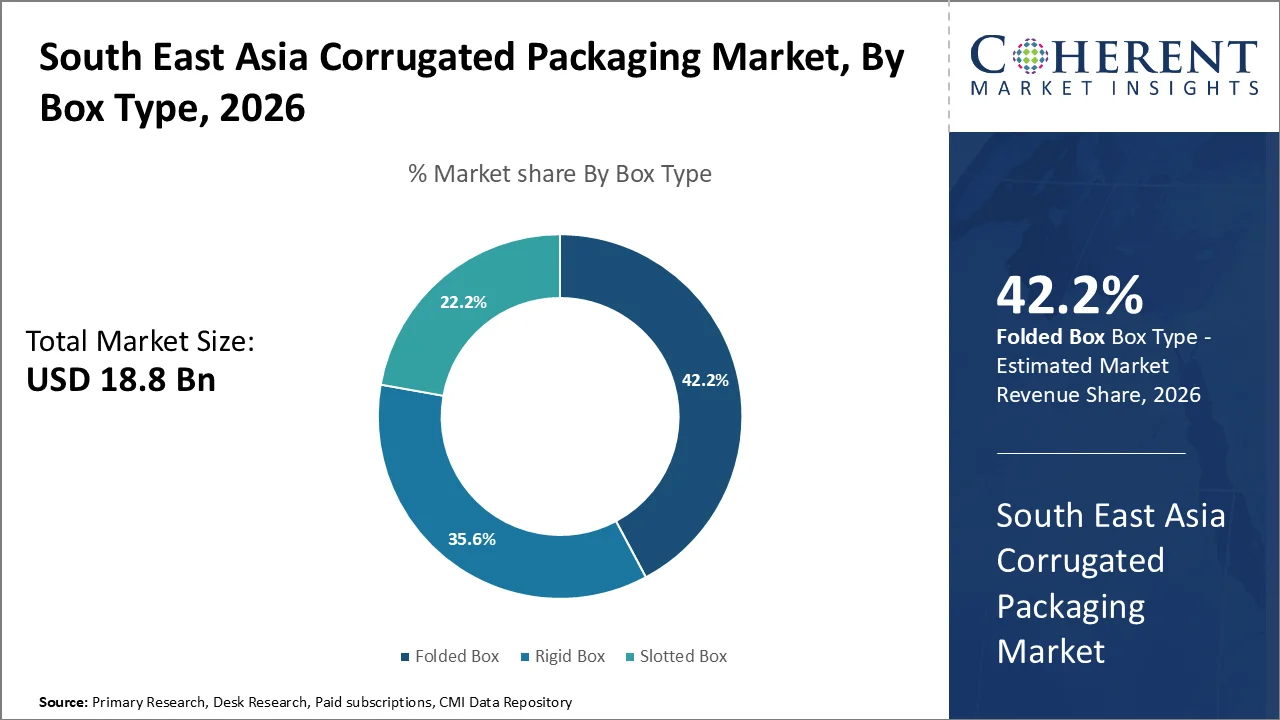
- Folded Box hold the largest market share of 42.2% in 2026 owing to the rapid e-commerce and parcel delivery growth. According to our research, the global Quick E-Commerce (Quick Commerce) market is expected to surpass USD 99.44 Bn in 2026.
- Food and Beverages expected to hold largest market share of 43.6% in 2026 owing to its growth of packaged food consumption. According to an ATNi article, packaged food and beverage sales in India are growing by approximately 15% annually.
- Vietnam is expected to acquire the dominant share of 39.2% in 2026 owing to the export-oriented manufacturing growth. Vietnam’s manufacturing output reached US$104.6 Bn in 2023, representing a 2.61% increase from 2022.
Current Events and Their Impact on the South East Asia Corrugated Packaging Market
Current Event | Description and its Impact |
Extended Producer Responsibility (EPR) Act increases packaging recovery obligations |
|
Beverage Container Return Scheme begins in 2026 |
|
Segmental Insights
- Current Industry Events of 2026
- Market Size Estimation
- Regional Breakdown
- Competitive Landscape
- Customer Intelligence
- Segmental Analysis
- Pricing Analysis
- Key Market Drivers, Challenges & Future Trends
- Customized Insights Section
Why is Folded Box Acquiring the Largest Market Share?
Folded Box holds the largest market share of 42.2% in 2026. The Folded Box segment in the South East Asia Corrugated Packaging Market is growing as e-commerce, FMCG, food and beverage, and modern retail sectors expand. Urbanization and changing consumer lifestyles are driving demand for convenient, lightweight, and protective packaging solutions. Increasing manufacturing and export activities are also boosting the use of corrugated boxes. Sustainability initiatives and restrictions on single-use plastics are prompting businesses to choose recyclable paper-based packaging. In addition, companies are adopting folded boxes for their customizable designs, enhanced printing capabilities, lightweight construction, and logistics efficiency. For instance, in July 2026, PackMojo Limited launched a trading card packaging range for graded slabs, booster boxes, and card decks, with orders starting at 300 units. The company has supplied custom printed packaging to brands since 2018 across more than 40 products. The range supports PSA, BGS, CGC, and SGC slabs, targeting growing demand as major authenticators graded 26.8 million cards in 2025, according to GemRate.
Food and Beverages expected to hold largest market share
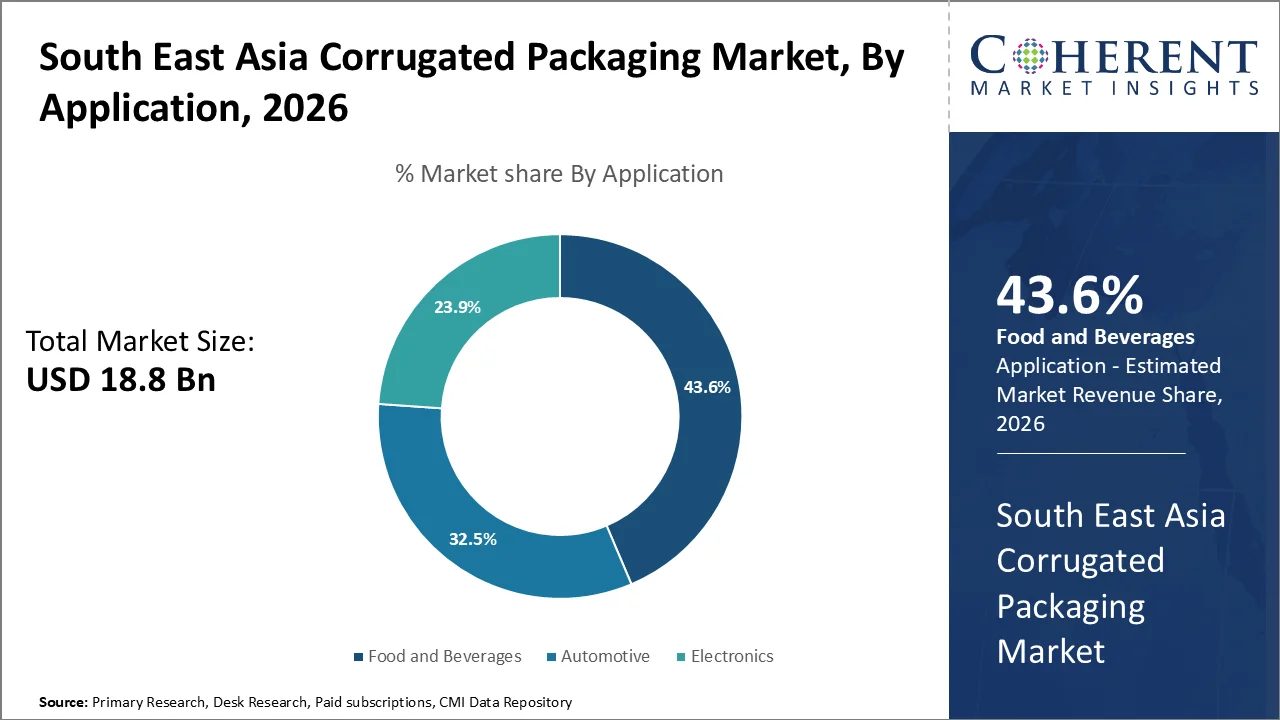
Food and Beverages expected to hold largest market share of 43.6% in 2026 owing to its expansion of cold-chain and food logistics. The Food and Beverage segment in the South East Asia Corrugated Packaging Market is growing as consumers increasingly purchase packaged and processed foods, while food delivery services and modern retail continue to expand. Urbanization and evolving lifestyles are encouraging consumers to choose convenient food products, increasing the need for efficient packaging. Food processors and beverage manufacturers are also expanding their use of corrugated packaging. E-commerce and broader distribution networks are driving demand for durable transport boxes, while sustainability initiatives encourage companies to use recyclable, lightweight, and customized packaging solutions. For instance, Saica Group and Mondelēz have partnered to launch a paper-based packaging solution for multipacks in the confectionery, biscuit, and chocolate markets.
Food and Beverages expected to hold largest market share
Food and Beverages expected to hold largest market share of 43.6% in 2026 owing to its expansion of cold-chain and food logistics. The Food and Beverage segment in the South East Asia Corrugated Packaging Market is growing as consumers increasingly purchase packaged and processed foods, while food delivery services and modern retail continue to expand. Urbanization and evolving lifestyles are encouraging consumers to choose convenient food products, increasing the need for efficient packaging. Food processors and beverage manufacturers are also expanding their use of corrugated packaging. E-commerce and broader distribution networks are driving demand for durable transport boxes, while sustainability initiatives encourage companies to use recyclable, lightweight, and customized packaging solutions. For instance, Saica Group and Mondelēz have partnered to launch a paper-based packaging solution for multipacks in the confectionery, biscuit, and chocolate markets.
South East Asia Corrugated Packaging Market Trends
- Rapid e-commerce growth is increasing demand for corrugated shipping and delivery packaging. Southeast Asia’s digital economy is projected to reach USD 263 billion in GMV in 2024, up 15% year on year, according to Google, Temasek and Bain & Company. This sustained increase in online transactions is supporting demand for corrugated boxes used for order fulfilment, parcel delivery and product protection.
- Food and beverage production remains an important source of packaging demand, particularly in Thailand. Thailand’s food-product exports reached approximately USD 45.0 billion in 2024, compared with US$44.9 billion in 2023, according to Thailand’s Board of Investment. The country is also a major global exporter of processed food products, including canned seafood, rice, sugar, chicken and ready-to-eat meals. The scale of food processing and exports supports continued requirements for corrugated cartons for secondary packaging, transportation and distribution.
- Packaging-waste regulations are increasing pressure on companies to improve packaging reduction and recyclability. In Singapore, the Mandatory Packaging Reporting scheme requires producers, importers and retailers with annual turnover above S$10 million to report packaging data and submit annual 3R plans covering packaging reduction, reuse, recycling and improved recyclability. Packaging waste accounted for approximately one-third of Singapore’s domestic waste disposed of in 2023. These requirements are increasing the emphasis on packaging efficiency and end-of-life recyclability, supporting the adoption of recyclable fiber-based packaging where commercially appropriate.
Regional Insights
Vietnam dominates owing to growth in food & beverage production
Vietnam is expected to acquire the dominant share of 39.2% in 2026. Vietnam’s corrugated packaging market benefits from rapid industrialization, expanding manufacturing, and strong exports of electronics, textiles, food products, and consumer goods. In 2024, Vietnam exported approximately US$200 billion worth of electrical machinery and electronic products. E-commerce platforms and modern retailers are increasing demand for durable, lightweight, and cost-effective packaging solutions. Foreign direct investment is driving new manufacturing facilities and strengthening supply-chain development, which boosts packaging demand. Vietnam’s sustainability initiatives and efforts to reduce plastic use are also encouraging businesses to adopt recyclable corrugated packaging.
Thailand Corrugated Packaging Market Trends
Thailand’s corrugated packaging market benefits from expanding e-commerce, food and beverage production, processed food exports, and consumer goods manufacturing. Businesses across the country rely on strong logistics and retail networks to meet demand for durable, lightweight, and cost-effective packaging. Growing environmental awareness also encourages companies to choose recyclable and paper-based packaging solutions. In addition, small and medium-sized enterprises are expanding, while manufacturers modernize supply chains and respond to rising consumer demand for convenient packaged products, strengthening corrugated packaging adoption across Thailand and Southeast Asia. For instance, Tetra Pak launched its Tetra Rex Plant-based carton with Tetra Pak Craft packaging in Thailand, with Chiangmai Freshmilk becoming the first Thai dairy producer to use it for Mulk pasteurised milk and Mulk+ high-protein milk.
Who are the Major Companies in South East Asia Corrugated Packaging Industry
Some of the major key players in South East Asia Corrugated Packaging are Perhimpunan Industry Corrugated Cardboard Indonesia, PT. IPI (International Packaging Industries Ltd.), The Box Company, Acter Carton Sdn Bhd, FinePac Industries Sdn Bhd, Stanpack Industries Pte Ltd., Tat Seng Packaging Group Ltd, Cheng Heng Paper Product Co. Pte Ltd., and Binh Minh Packaging.
Key News
- In January 2026, Lactasoy’s new Benefitt brand has launched Thailand’s first high-protein UHT milk in SIG SmallBloc 350 ml cartons. Available nationwide at 7-Eleven, Benefitt High Protein UHT Milk delivers 31 grams of protein per pack, meeting growing demand for convenient high-protein beverages.
Market Report Scope
South East Asia Corrugated Packaging Market Report Coverage
| Report Coverage | Details | ||
|---|---|---|---|
| Base Year: | 2025 | Market Size in 2026: | USD 18.8 Bn |
| Historical Data for: | 2020 To 2024 | Forecast Period: | 2026 To 2033 |
| Forecast Period 2026 to 2033 CAGR: | 6.1% | 2033 Value Projection: | USD 24.8 Bn |
| Geographies covered: |
| ||
| Segments covered: |
| ||
| Companies covered: | Perhimpunan Industry Corrugated Cardboard Indonesia, PT. IPI (International Packaging Industries Ltd.), The Box Company, Acter Carton Sdn Bhd, FinePac Industries Sdn Bhd, Stanpack Industries Pte Ltd., Tat Seng Packaging Group Ltd, Cheng Heng Paper Product Co. Pte Ltd., and Binh Minh Packaging. | ||
Analyst Opinion
- E-commerce is no longer simply a demand driver for corrugated packaging; it is changing the specifications converters must produce. Southeast Asia’s digital economy continues to record double-digit growth across gross merchandise value, revenue, and profit, while B2C parcel volumes increased sharply in 2025. In our view, this is pushing converters toward lighter, right-sized, and higher-throughput cartons because packaging efficiency directly affects last-mile logistics costs.
- Food and beverage will remain the volume backbone of the regional corrugated packaging industry because packaging demand follows physical consumption, not just online activity. Food and beverage applications represented 41.58% of regional corrugated packaging demand in 2025, making the segment substantially more important than most emerging end uses. We believe the expansion of supermarkets, quick-service restaurants, food delivery, processed foods, and cold-chain distribution will continue to create recurring requirements for transport cartons and shelf-ready formats.
- Plastic reduction is becoming a structural advantage for corrugated packaging rather than merely a sustainability narrative. Regulatory actions targeting single-use plastics in Indonesia, Vietnam, and Thailand are redirecting packaging decisions toward recyclable fiber-based formats. In our assessment, this regulatory pressure gives corrugated packaging an increasingly defensible position in FMCG and food applications, particularly where brands need packaging that combines recyclability, printability, and distribution strength.
- Indonesia and Vietnam deserve disproportionate attention from investors and converters because their demand is being supported by different but complementary fundamentals. Indonesia accounted for 35.84% of regional corrugated packaging demand in 2025, while Vietnam is identified as the fastest-expanding geographic market in the current industry outlook. In our view, Indonesia offers scale through consumer demand and industrial activity, whereas Vietnam provides stronger upside from manufacturing, exports, and increasingly sophisticated supply chains.
- Packaging optimization is becoming a measurable source of value for food manufacturers, which should accelerate demand for technically engineered corrugated solutions. A reported 2024 specification change by Nestlé Indonesia for instant-noodle packaging reduced packaging-material usage by 12% while improving shelf stability and reportedly generated USD 3.2 million in annual cost savings. We view this type of material optimization as particularly significant because it shifts corrugated packaging from a low-value consumable toward an engineered logistics component where converters can compete on performance rather than price alone.
- The biggest risk to the industry's profitability is not lack of demand but raw-material volatility and customer bargaining power. Kraft liner and recovered paper prices remain exposed to supply-demand imbalances, while major e-commerce and food-delivery operators can exert pricing pressure through fixed annual contracts. Our view is that vertically integrated converters with fiber recovery, strong procurement capabilities, and automated production will be better positioned than smaller converters that compete primarily on box price.
Speak to the analyst
Want personalized insights?
Take the findings above to one of our principal consultants, or have the report rebuilt around the segments, geographies and competitors you actually track.
Market Segmentation
- By Box Type (Revenue, USD Bn, 2021-2033)
- Folded Box
- Rigid Box
- Slotted Box
- By Application (Revenue, USD Bn, 2021-2033)
- Food and Beverages
- Automotive
- Electronics
- By Region
- Cambodia
- Laos
- Myanmar
- Thailand
- Vietnam
Sources
Primary Research interviews
- Corrugated packaging manufacturers and converters across Southeast Asia
- Paper and paperboard manufacturers
- Kraft paper and containerboard producers
- Packaging machinery manufacturers and suppliers
- Raw material and recycled paper suppliers
- Packaging distributors, wholesalers, and trading companies
- End-user companies in food & beverages, FMCG, electronics, e-commerce, pharmaceuticals, agriculture, and industrial goods
- Procurement and supply-chain professionals
- Packaging designers and technical specialists
- Industry experts and former executives
- Logistics and warehousing professionals
- Recycling and waste-management companies
- Interviews with local market participants across Indonesia, Thailand, Vietnam, Malaysia, Philippines, Singapore, Cambodia, and other Southeast Asian markets
Databases
- ASEANstats – International Merchandise Trade Statistics (IMTS)
- ASEANstats – GDP, manufacturing, investment, population, and economic indicators
- UN Comtrade Database
- UN Statistics Division databases
- World Bank DataBank
- International Monetary Fund (IMF) databases
- International Trade Centre (ITC) Trade Map
- FAOSTAT forestry and forest-product statistics
- Food and Agriculture Organization (FAO) databases
- National statistical databases of Southeast Asian countries
- National customs and trade databases
- Country-level manufacturing and industrial production databases
- Import/export databases covering paper, paperboard, containerboard, and packaging-related HS codes
- E-commerce and retail industry datasets
- Foreign direct investment and manufacturing investment databases
- Logistics, freight, and trade-flow databases
ASEANstats specifically provides online databases covering trade in goods, FDI, tourism, GDP and other indicators, including International Merchandise Trade Statistics at detailed tariff-code levels.
Magazines
- Packaging Asia
- Packaging South Asia
- Packaging Europe
- Asia Pacific Packaging
- Paper Asia
- Pulp & Paper International
- Pulp & Paper Technology
- Paper Industry World
- Food Industry Asia
- Asia Food Journal
- Food & Beverage Asia
- Retail Asia
- Logistics Asia
- Supply Chain Asia
- E+T / packaging and manufacturing industry publications
- Regional packaging and converting trade publications
- Country-specific packaging and paper-industry magazines
Journals
- Journal of Applied Packaging Research
- Packaging Technology and Science
- TAPPI Journal
- BioResources
- Journal of Cleaner Production
- Resources, Conservation & Recycling
- Forest Products Journal
- Appita Journal
- International Journal of Sustainable Engineering
- Journal of Industrial Ecology
- Journal of Materials Science
- Academic publications covering paper, pulp, corrugated board, packaging technology, recycling, and sustainability
Newspapers
- The Straits Times
- The Business Times Singapore
- Bangkok Post
- The Nation Thailand
- The Jakarta Post
- Kontan
- The Star Malaysia
- New Straits Times
- The Edge Malaysia
- Manila Bulletin
- Philippine Daily Inquirer
- BusinessWorld Philippines
- Vietnam News
- VnExpress
- Khmer Times
- Nikkei Asia
- Reuters
- Bloomberg
- The Business Times and other regional business publications
Associations
- ASEAN Paper Industry Association
- ASEAN Packaging Federation
- Packaging Federation of India / relevant regional packaging bodies for comparative industry information
- Confederation of Paper Industries and relevant national paper-industry bodies
- Thai Packaging Association
- Malaysian Packaging Industry Association
- Indonesian Packaging Federation
- Singapore Manufacturing Federation
- Philippine Exporters Confederation and relevant packaging-related associations
- Vietnam Packaging Association
- Pulp and Paper Industry associations in individual Southeast Asian countries
- Forest Stewardship Council (FSC)
- Programme for the Endorsement of Forest Certification (PEFC)
- International Corrugated Packaging Alliance and relevant corrugated-industry organizations
- World Packaging Organisation
- International Association of the Deinking Industry (INGEDE)
- Technical Association of the Pulp and Paper Industry (TAPPI)
Public Domain sources
- ASEAN Secretariat and ASEANstats publications
- National statistical offices of Indonesia, Thailand, Vietnam, Malaysia, Philippines, Singapore, Cambodia, Laos, Myanmar, and Brunei
- National customs departments and trade ministries
- Ministries of Industry, Trade, Agriculture, Environment, and Investment
- Central banks of Southeast Asian countries
- World Bank publications and databases
- International Monetary Fund publications and databases
- UN Comtrade
- UN Statistics Division
- FAO publications and statistics
- International Labour Organization (ILO) statistics
- UNIDO industrial statistics
- OECD statistics and publications
- World Trade Organization (WTO) statistics
- International Trade Centre (ITC) resources
- Government gazettes and regulatory notifications
- Public company annual reports and sustainability reports
- Publicly available company presentations and investor disclosures
- Government reports on manufacturing, packaging waste, recycling, circular economy, and sustainability
- Publicly available trade statistics and customs data
- Academic papers, university research, conference proceedings, and institutional publications
- Publicly available industry standards and technical documents
Proprietary Elements
- CMI Data Analytics Tool
- Proprietary CMI Existing Repository of information for last 10 years
Get access to 250+ pages report
Every segment, forecast, competitor profile and data table behind the analysis above — available for instant download.
- ESOMAR Member
- ISO 9001:2015 Certified
- D-U-N-S Registered
- GDPR & CCPA Compliant
Missing comfort of reading report in your local language? Find your preferred language:
Transform your Strategy with Exclusive Trending Reports
Frequently Asked Questions
The South East Asia Corrugated Packaging Market is anticipated to grow at a CAGR of 6.1% with USD 18.8 Bn in 2026 and is expected to reach USD 24.8 Bn in 2033.
The market is primarily driven by expanding e-commerce, rising food and beverage consumption, FMCG distribution, modern retail, manufacturing activity, and growing demand for sustainable packaging.
Food and beverage is one of the strongest demand generators. Processed foods, beverages, food delivery, supermarkets, convenience stores, and expanding distribution networks create recurring demand for transport cartons, secondary packaging, and shelf-ready solutions.
E-commerce is increasing the need for protective, lightweight, and right-sized boxes that can withstand multiple handling and delivery stages.
Indonesia, Vietnam, Thailand, Malaysia, the Philippines, and Singapore are key markets. Indonesia benefits from its large consumer base and manufacturing activity, while Vietnam is supported strongly by export-oriented manufacturing and expanding industrial supply chains.
Brands and retailers increasingly seek recyclable and fiber-based packaging to reduce their dependence on plastics.