

Corrugated Packaging Market Size and Trends - 2026 to 2033
Global corrugated packaging market is estimated to be valued at USD 166.19 Bn in 2026 and is expected to reach USD 227.68 Bn by 2033, exhibiting a compound annual growth rate (CAGR) of 4.6% from 2026 to 2033.
Key Takeaways
- Based on Design, the Single Wall boards segment is expected to lead the market with a 33.3% share in 2026, due to their cost-efficiency and versatility.
- Based on Product Type, the Boxes segment is expected to hold 32% share of the market in 2026, as the most widely used corrugated packaging product across industries.
- Based on End Use, the E-commerce segment is expected to contribute the largest share of the market in 2026, fueled by the boom in online shopping and home deliveries.
- Based on Region, North America is set to lead the market with 35% share in 2026. While, Asia Pacific is anticipated to be the fastest growing region.
Market Overview
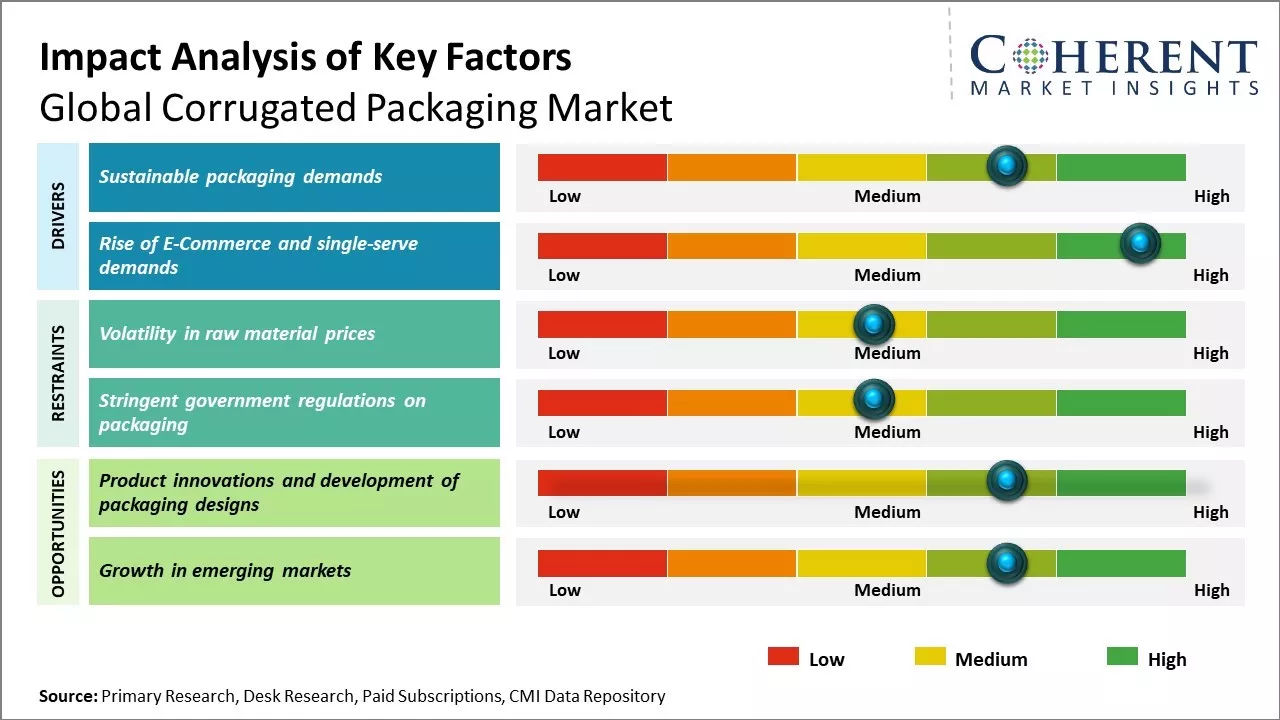
Global corrugated packaging market is expected to show steady growth over the forecast period due to the rising demand from industries such as food and beverages, personal care, healthcare, and retail among others. Key growth drivers include sustainable packaging demands, rise of e-commerce, and single serve demands from various end-use industries. Corrugated packaging offers advantages such as durability, lightweight, recyclability, and cost effectiveness
Current Events and their Impact on the Corrugated Packaging Market
Current Event | Description and its Impact |
Sustainability Regulations and Circular Economy Initiatives |
|
Geopolitical Tensions and Trade Disruptions |
|
Smart Packaging in Corrugated Packaging Market
Smart packaging is transforming the corrugated packaging industry by embedding intelligence and interactivity into traditional box formats. Technologies such as QR codes, RFID tags, and temperature sensors are being integrated into corrugated materials to enhance traceability, product safety, and consumer engagement. These innovations are especially valuable in sectors like food, pharmaceuticals, and e-commerce, where real-time data and transparency are critical. Additionally, digital printing and interactive features allow brands to personalize packaging and improve customer experience. As sustainability and efficiency become top priorities, smart corrugated packaging supports waste reduction and optimized logistics, making it a key driver of innovation in the packaging landscape.
For instance, in August 2025, Opal’s Innovation Expo showcased advanced print and packaging technologies, including smart packaging solutions integrated into corrugated formats. These innovations focus on enhancing functionality, traceability, and consumer engagement through features like QR codes, interactive designs, and sustainable materials, positioning corrugated packaging as a key player in the future of intelligent, eco-friendly logistics.
- Current Industry Events of 2026
- Market Size Estimation
- Regional Breakdown
- Competitive Landscape
- Customer Intelligence
- Segmental Analysis
- Pricing Analysis
- Key Market Drivers, Challenges & Future Trends
- Customized Insights Section
Segmental Insights
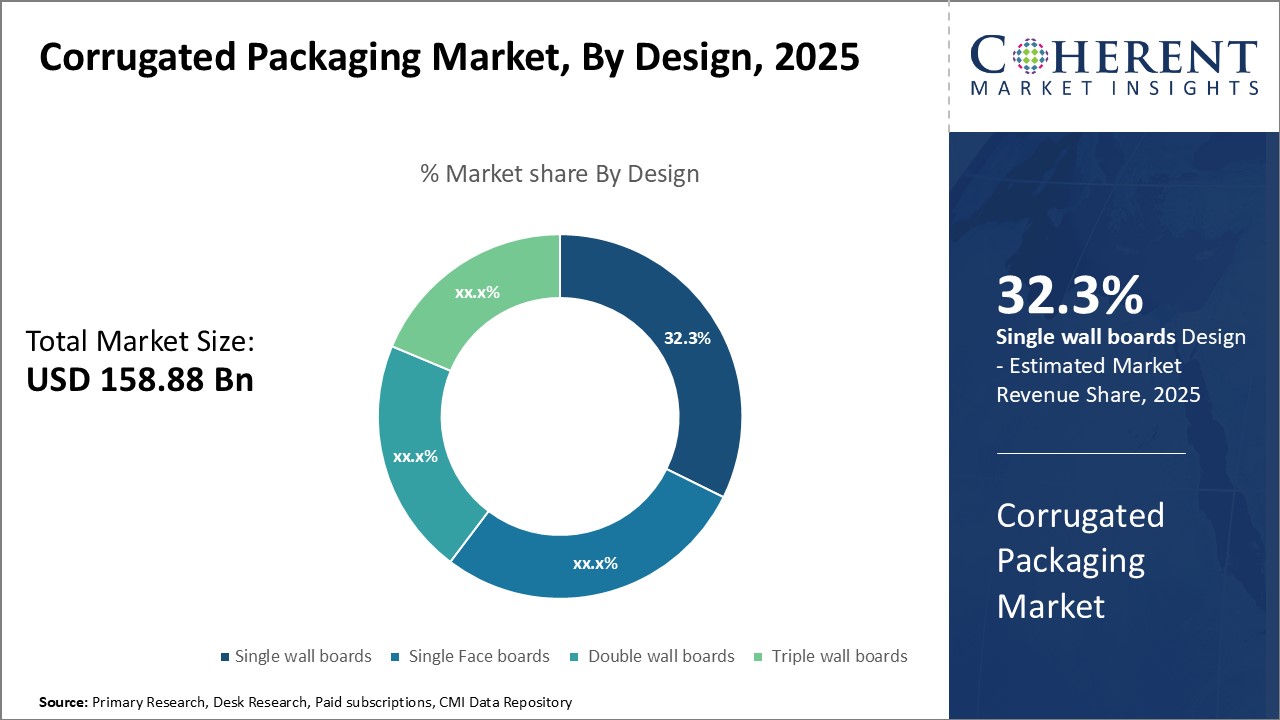
Global Corrugated Packaging Market Insights, By Design: Single Wall Boards Leads Due To Their Cost-Efficiency and Versatility
In terms of design, single wall boards segment is estimated to contribute 33.3% share of the market in 2026. Their widespread adoption is driven by their cost-effectiveness, lightweight structure, and versatility across various packaging needs. These boards are particularly favored in retail and e-commerce sectors, where packaging must balance strength with affordability. Their ability to provide adequate protection for a wide range of products while minimizing material usage makes them a preferred choice for businesses aiming to optimize logistics and reduce environmental impact.
For instance, in October 2025, Ucanpack introduced a new eco-friendly unboxing initiative built around corrugated cardboard packaging and right-sizing techniques. Central to the effort is the use of single wall boards, which offer a lightweight and cost-effective solution for reducing material waste. The initiative aims to enhance sustainability in e-commerce packaging while improving customer experience.
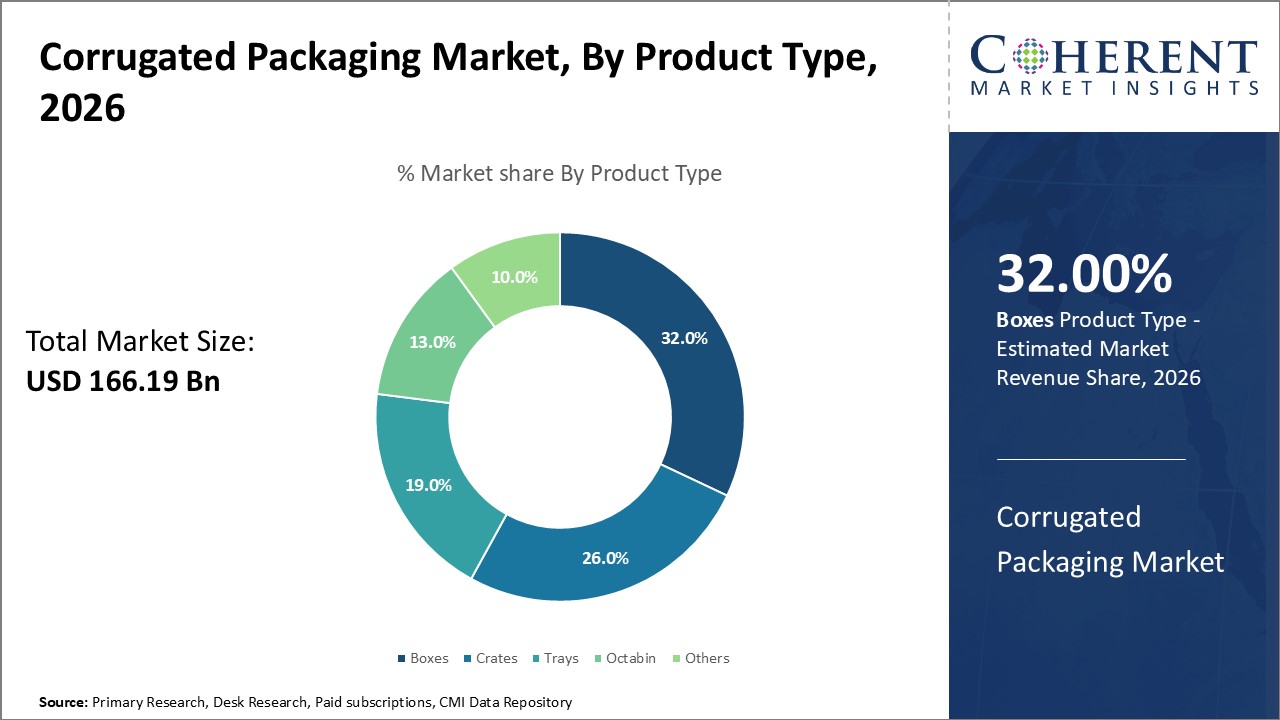
Global Corrugated Packaging Market Insights, By Product Type: Boxes Dominate as the Most Widely Used Corrugated Packaging Product Across Industries
In terms of product type, boxes segment is estimated to contribute 32% share of the market in 2026. Their dominance is attributed to their durability, stackability, and adaptability to different shapes and sizes, making them suitable for nearly every industry. From food and beverage to electronics and healthcare, boxes serve as the backbone of packaging and shipping operations. Their customizable nature also allows brands to enhance customer experience through branded packaging, while their recyclability aligns with growing sustainability goals across the supply chain.
For instance, in March 2025, the Boxery introduced a new line of innovative wholesale corrugated boxes designed to enhance packaging efficiency and sustainability. Featuring customizable options and durable single wall board construction, the launch aims to meet growing demand from e-commerce and retail sectors for cost-effective, eco-friendly packaging solutions that streamline shipping and improve customer experience.
Global Corrugated Packaging Market Insights, By End Use: E-Commerce Drives the Highest Demand, Fueled by The Boom in Online Shopping and Home Deliveries
In terms of end use, the E-commerce segment is estimated to contribute largest share of the market in 2026. The exponential rise in online shopping has created a surge in demand for packaging that is not only protective and functional but also sustainable and aesthetically appealing. Corrugated packaging, especially single wall boxes, meets these requirements by offering strength, recyclability, and branding potential. As consumers increasingly prioritize eco-friendly practices and reliable delivery, businesses are investing heavily in corrugated solutions to meet expectations and reduce their carbon footprint.
Regional Insights
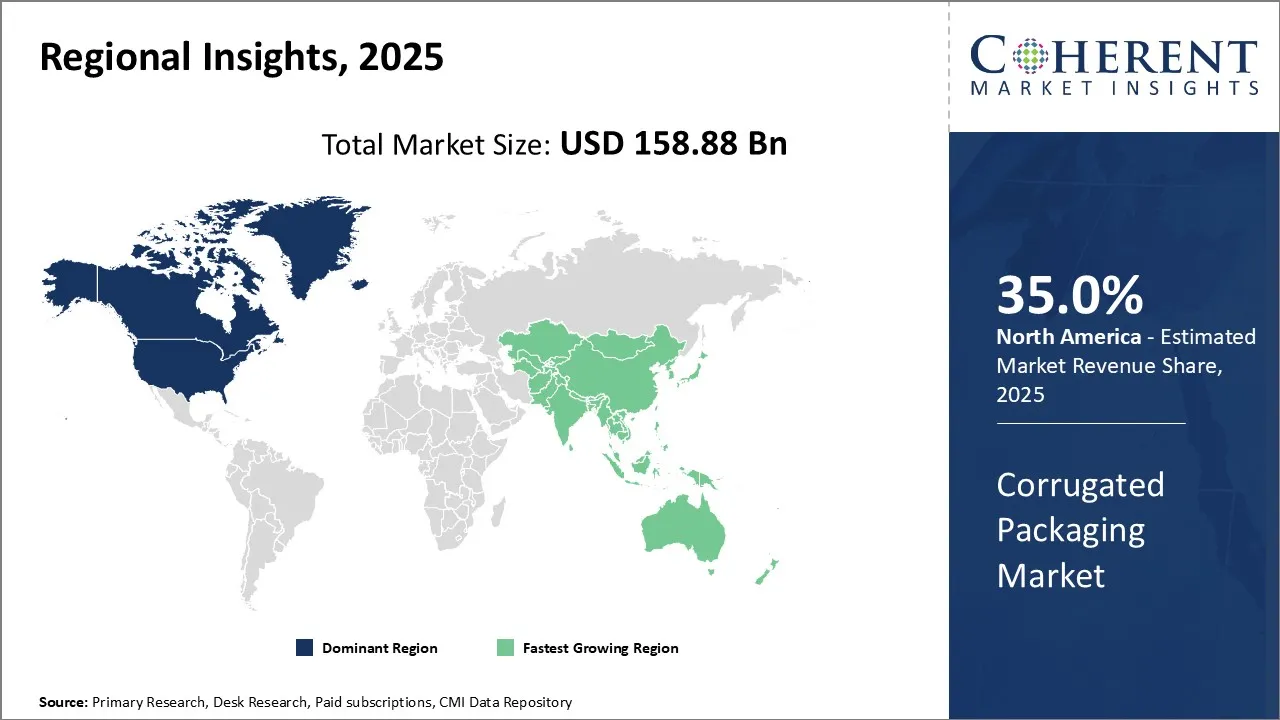
North America Corrugated Packaging Market Analysis & Trends
North America has been dominating the global corrugated packaging market for decades with an estimated market share of 35.0% in 2026. The well-established packaging industry and strong presence of key players in the region have allowed North America to lead in terms of overall market size and revenue share. Majority of the top corrugated packaging brands globally are headquartered in the U.S., giving them competitive advantage in the home market through strong customer relationships, brand recognition and expertise in producing a wide variety of corrugated products. Moreover, the region's well-connected logistics infrastructure and advanced manufacturing capabilities enable seamless supply of packaging solutions to customers across industries such as food and beverages, chemicals, pharmaceuticals, consumer goods, and e-commerce.
For instance, in July 2026, Corrugated Partners LLC made its second U.S. purchase of the Kolbus BX Motion, a state-of-the-art box-making machine. This investment enhances the company’s capacity to produce custom corrugated packaging efficiently, reinforcing its commitment to innovation and growth in the corrugated packaging industry. The move supports rising demand for sustainable, high-speed box production.
Asia Pacific Corrugated Packaging Market Analysis & Trends
Asia Pacific region has emerged as the fastest growing market for corrugated packaging in recent years. Rapid growth of end-user industries coupled with rising domestic consumption has propelled the demand for cost-effective and sustainable packaging formats in Asia Pacific. Two of the world's largest developing economies China and India are spearheading growth in the region supported by their giant manufacturing sectors and growing middle-class populations. E-commerce boom in the region has further boosted the upstream corrugated packaging demand.
For instance, in March 2026, Oji India Packaging inaugurated South Asia’s largest corrugated packaging facility in Sri City, India. The advanced plant is equipped to meet rising demand from sectors like e-commerce, FMCG, and logistics. This strategic expansion underscores Oji’s commitment to sustainable, high-quality packaging solutions and strengthens its footprint in the region’s growing packaging industry.
Corrugated Packaging Market Outlook Country-Wise
The U.S. Corrugated Packaging Market Trends
The U.S. corrugated packaging market is growing due to surging e-commerce, demand for sustainable materials, and innovations in retail-ready packaging. Lightweight, recyclable single wall boards and customizable boxes meet consumer and industry needs for eco-friendly, cost-effective shipping solutions, driving steady market expansion across food, electronics, and logistics sectors.
For instance, in October 2026, Saica Group begun construction on its second U.S. corrugated packaging facility in Anderson, Indiana, investing over $110 million. The new plant will boost production of sustainable corrugated board, reinforcing Saica’s commitment to expanding its North American footprint and meeting growing demand for eco-friendly packaging solutions across industries.
China Corrugated Packaging Market Trends
China’s corrugated packaging market is booming due to rapid e-commerce growth, government push for sustainable logistics, and increased adoption of recycled materials. Initiatives promoting 100% recycled cardboard and biodegradable packaging drive demand, while industries like retail, electronics, and food rely on cost-effective, eco-friendly corrugated solutions to meet consumer and regulatory expectations.
For instance, in April 2026, SinoCorrugated 2026 opened in Shanghai, drawing global attention as one of the largest trade shows for the corrugated packaging industry. The event features cutting-edge machinery, sustainable materials, and advanced technologies, attracting manufacturers, suppliers, and buyers focused on driving innovation and efficiency in corrugated packaging across e-commerce, retail, and logistics sectors.
Market Report Scope
Corrugated Packaging Market Report Coverage
| Report Coverage | Details | ||
|---|---|---|---|
| Base Year: | 2025 | Market Size in 2026: | USD 166.19 Bn |
| Historical Data for: | 2020 To 2024 | Forecast Period: | 2026 To 2033 |
| Forecast Period 2026 to 2033 CAGR: | 4.6% | 2033 Value Projection: | USD 227.68 Bn |
| Geographies covered: |
| ||
| Segments covered: |
| ||
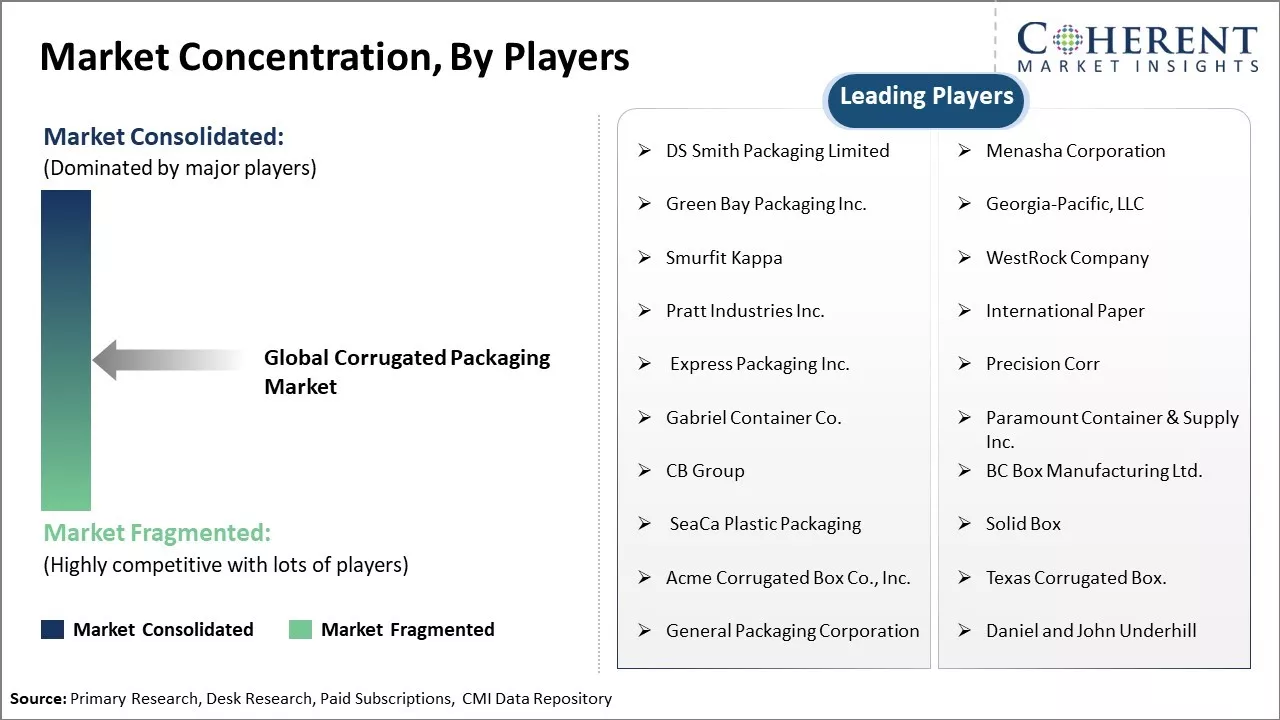
| Companies covered: | DS Smith Packaging Limited, Menasha Corporation, Green Bay Packaging Inc., Georgia-Pacific, LLC, Smurfit Kappa, WestRock Company, Pratt Industries Inc., International Paper, Express Packaging Inc., Precision Corr, Gabriel Container Co., Paramount Container & Supply Inc., CB Group, BC Box Manufacturing Ltd., SeaCa Plastic Packaging, Solid Box, Acme Corrugated Box Co., Inc., Texas Corrugated Box., General Packaging Corporation, Daniel and John Underhill | ||
| Growth Drivers: |
| ||
| Restraints & Challenges: |
| ||
Corrugated Packaging Market Driver
Sustainable packaging demands
The growing concerns over environmental degradation and climate change across the globe have brought packaging sustainability to the forefront. More and more companies are committing to use green packaging materials and solutions in response to rising customer demand for eco-friendly products. Corrugated packaging is widely regarded as one of the most sustainable options due to key advantages such as having a high recycled content, being lightweight yet durable, and being reuse and recyclable. Statistically, corrugated board has a 65-75% recycled content on average. This makes it a very resource efficient material. Additionally, corrugated boxes can withstand multiple handling and transport cycles without degradation in structural performance. After use, corrugated boxes can be recycled numerous times into new fiber boxes thereby achieving an overwhelmingly high recycling rate of over 90%.
Sustainability credentials of corrugated packaging are proving extremely appealing to major FMCG brands, e-commerce giants, and other industries striving to reduce their environmental impact. More than design, price, or any other factor, sustainability has become a strategic priority and a competitive marketing tool. Players across sectors are integrating sustainability into their brand narratives and greening their supply chains. They realize that sustainable packaging helps address stakeholder expectations while capturing a bigger growth of market share for eco-conscious consumers. Regulatory pushes to curb waste and carbon also necessitate sustainable solutions. With its clear sustainability advantages, corrugated packaging stands to benefit tremendously from this powerful macro driver.
Market Concentration and Competitive Landscape
Rise of E-Commerce and single-serve demands
E-commerce boom coupled with changing consumption patterns present a massive growth opportunity for corrugated packaging. With the increase in online shopping, there is a higher demand for secure, damage-resistant, and customized packaging for individual product shipments. E-tailers need packaging that can withstand the complexities of a supply chain that involves multiple handlings from warehouse to doorstep. Corrugated boxes fit the need perfectly with their inherent strength, rigidity, and ability to customize print and size. At the same time, consumers are leaning towards smaller, single-serve, and right-sized packages matching their immediate needs. Goods are preferred in single-item or single-serve packages rather than bulk packs.
This rise of single-serve and custom demand favors corrugated packaging over alternatives like plastic. Producing corrugated boxes is a high volume yet flexible process allowing mass-customization.
Corrugated Packaging Market Opportunity
Product innovations and development of packaging designs
Product innovations and development of packaging designs present a major opportunity for growth in the global corrugated packaging market forecast. With companies across industries focusing increasingly on sustainable and environment-friendly packaging solutions, corrugated packaging is poised to grow substantially. Being one of the most recycled packaging materials in the world, corrugated packaging appeals widely to companies aiming to reduce plastic waste. Recent data from the US Environmental Protection Agency shows the corrugated packaging recycling rate was over 87% in 2020, higher than any other material.
Analyst Opinion (Expert Opinion)
The corrugated packaging sector is undergoing a structural transition from volume-led growth to margin-focused, engineering-driven differentiation. Major producers are prioritizing efficiency and price discipline over capacity expansion, reflecting tighter containerboard supply and uneven regional demand. Recent industry data shows global containerboard production at around 183 million metric tons, translating to roughly 165 million tons of corrugated board, underscoring material constraints and conversion challenges.
Sustainability now defines competitiveness. With cardboard recycling rates surpassing 70% in developed markets, manufacturers investing in high-strength, recycled-content products are securing stronger procurement preference from e-commerce and FMCG sectors. Simultaneously, selective plant closures by leading mills highlight an intentional shift toward optimized grade mix and improved utilization rather than mere scale expansion.
Customer expectations are reshaping operations. E-commerce companies demand right-sized, lightweight boxes and integrated reverse logistics solutions, creating opportunities for converters that blend design, automation, and digital printing. Firms relying solely on tonnage face margin erosion, while those offering engineered, performance-tested packaging solutions maintain pricing power.
In the near term, profitability will hinge on contract flexibility, recycled-fibre process upgrades, and data-driven fulfilment systems. The market is evolving into a technology- and sustainability-led ecosystem, where operational agility and technical capability will define competitive advantage.
Speak to the analyst
Want personalized insights?
Take the findings above to one of our principal consultants, or have the report rebuilt around the segments, geographies and competitors you actually track.
Corrugated Packaging Industry News
- In October 2025, Canon introduced a new digital press designed specifically for corrugated packaging, aiming to enhance print quality and customization. The press enables high-speed, full-color printing on corrugated substrates, supporting brand differentiation and flexible production. This innovation reflects growing demand for personalized, sustainable packaging solutions in e-commerce, retail, and logistics sectors.
- In September 2025, Mondi introduced white digital printing for corrugated packaging, offering enhanced branding possibilities for businesses. This innovation allows for high-quality, customizable designs on brown corrugated board, improving visual impact and flexibility. The technology supports sustainable packaging goals while enabling brands to stand out with vibrant, personalized graphics in retail and e-commerce environments.
- In July 2025, BHS Corrugated launched a new production facility in Turkey, strengthening its global manufacturing network. The hub will enhance regional supply capabilities and support growing demand for corrugated machinery. This strategic expansion underscores BHS Corrugated’s commitment to innovation, efficiency, and closer customer collaboration in the rapidly evolving packaging industry.
- In May 2024, Toyota announced the development of new corrugated packaging solutions that boost load capacity and efficiency.
Market Segmentation
- Design Insights (Revenue, USD Bn, 2026 - 2033)
- Single wall boards
- Single Face boards
- Double wall boards
- Triple wall boards
- Product Type Insights (Revenue, USD Bn, 2026 - 2033)
- Boxes
- Crates
- Trays
- Octabin
- Others (Pallet, etc.)
- End Use Insights (Revenue, USD Bn, 2026 - 2033)
- Food & Beverage
- Electrical & Electronics
- Home care products
- Personal care products
- E-commerce
- Transportation & Logistics
- Healthcare
- Others
- Regional Insights (Revenue, USD Bn, 2026 - 2033)
- North America
- U.S.
- Canada
- Latin America
- Brazil
- Argentina
- Mexico
- Rest of Latin America
- Europe
- Germany
- U.K.
- Spain
- France
- Italy
- Russia
- Rest of Europe
- Asia Pacific
- China
- India
- Japan
- Australia
- South Korea
- ASEAN
- Rest of Asia Pacific
- Middle East & Africa
- GCC Countries
- Israel
- Rest of Middle East & Africa
- Key Players Insights (Revenue, USD Bn, 2021 - 2033)
- DS Smith Packaging Limited
- Menasha Corporation
- Green Bay Packaging Inc.
- Georgia-Pacific, LLC
- Smurfit Kappa
- WestRock Company
- Pratt Industries Inc.
- International Paper
- Express Packaging Inc.
- Precision Corr
- Gabriel Container Co.
- Paramount Container & Supply Inc.
- CB Group
- BC Box Manufacturing Ltd.
- SeaCa Plastic Packaging
- Solid Box
- Acme Corrugated Box Co., Inc.
- Texas Corrugated Box.
- General Packaging Corporation
- Daniel and John Underhill
Source
Primary Research Interviews from the following stakeholders
Stakeholders
- Interviews with corrugated box manufacturers, paperboard mills, packaging converters, logistics and warehousing companies, e-commerce fulfillment centers, and FMCG/retail packaging procurement heads across key regional markets.
Specific stakeholders
- Packaging procurement managers at FMCG and food & beverage companies (e.g., Nestlé, PepsiCo, Hindustan Unilever, Kraft Heinz)
- Supply chain and logistics heads at e-commerce firms (e.g., Amazon, Flipkart, Alibaba, JD.com)
- Operations and packaging engineers at industrial and electronics manufacturers (e.g., Samsung, Whirlpool, Bosch)
- Sustainability and environment managers at retail chains and packaging user industries
- R&D heads and production managers at corrugated box plants and paperboard mills
- Procurement and quality assurance leads at pharmaceutical packaging divisions
- Packaging designers and brand managers at consumer goods and luxury product companies
- Distribution center managers at warehousing and cold chain logistics firms
Databases
- United Nations Comtrade Database
- World Trade Organization (WTO) Trade Statistics
- Food and Agriculture Organization (FAO) Forestry Data
- International Energy Agency (IEA) – Industrial Materials and Energy Use Reports
- Eurostat – Packaging Waste and Paper Production Data
- U.S. Census Bureau – Paper and Packaging Manufacturing Statistics
- Bureau of Economic Analysis (U.S.)
- Japan Paper Association (JPA) Data
- China Customs Statistics
- Directorate General of Commercial Intelligence and Statistics (DGCIS), India
- Korea Customs Service Data Portal
- Central Pulp & Paper Research Institute (CPPRI), India
- Indian Paper Manufacturers Association (IPMA) Data Repository
Magazines
- Packaging World
- Packaging Europe
- PaperAge
- Packaging Strategies
- PrintWeek (Packaging Section)
- Packaging Gateway
- Pulp & Paper International (PPI)
- The Economic Times Packaging Special Reports
- Flexible Packaging Magazine
- Modern Materials Handling (Packaging and Logistics Section)
Journals
- Journal of Packaging Technology and Research (Springer)
- TAPPI Journal (Technical Association of the Pulp and Paper Industry)
- Packaging Technology and Science (Wiley)
- Forest Products Journal
- Journal of Cleaner Production (Packaging & Circular Economy section)
- Waste Management Journal
- Sustainability (MDPI) – Packaging and Materials Division
- Journal of Applied Packaging Research
Newspapers
- The Wall Street Journal – Manufacturing & Supply Chain
- Financial Times – Industrial Materials & Sustainability
- The Economic Times – Packaging & Logistics
- The Hindu Business Line – Industry & Paper Sector
- Business Standard – Manufacturing and Circular Economy Reports
- Nikkei Asia – Paper, Packaging, and Materials
- South China Morning Post – Trade and Industry
Associations
- World Packaging Organisation (WPO)
- Indian Institute of Packaging (IIP)
- TAPPI (Technical Association of the Pulp and Paper Industry)
- European Federation of Corrugated Board Manufacturers (FEFCO)
- Asian Corrugated Case Association (ACCA)
- Corrugated Packaging Alliance (CPA)
- American Forest & Paper Association (AF&PA)
- Paper Packaging Forum (PPF)
- Confederation of Indian Industry (CII) – Paper & Packaging Division
- Institute of Scrap Recycling Industries (ISRI)
Public Domain Sources
- Ministry of Commerce and Industry (Government of India)
- Ministry of Environment, Forest and Climate Change (MoEFCC), India
- U.S. Environmental Protection Agency (EPA) – Packaging Waste and Recycling Reports
- European Environment Agency (EEA) – Circular Economy and Packaging Statistics
- Ministry of Economy, Trade and Industry (METI), Japan
- U.S. International Trade Commission (USITC) – Paper and Packaging Trade Reports
- NITI Aayog – Industrial & Sustainability Reports
- Central Pollution Control Board (CPCB), India – Packaging Waste Management Data
- Reserve Bank of India (RBI) – Industrial Sector and Manufacturing Reports
- European Commission – Packaging Waste Directive Reports
Proprietary Elements
- CMI Data Analytics Tool
- Proprietary CMI Existing Repository of information for last 8 years
Get access to 250+ pages report
Every segment, forecast, competitor profile and data table behind the analysis above — available for instant download.
- ESOMAR Member
- ISO 9001:2015 Certified
- D-U-N-S Registered
- GDPR & CCPA Compliant
Missing comfort of reading report in your local language? Find your preferred language:
Transform your Strategy with Exclusive Trending Reports
Frequently Asked Questions
The Corrugated Packaging Market is estimated to be valued at USD 166.19 Bn in 2026, and is expected to reach USD 227.68 Bn by 2033.
The CAGR of the Corrugated Packaging Market is projected to be 4.6% from 2026 to 2033.
Sustainable packaging demands and rise of e-commerce and single-serve demands are the major factors driving the growth of global corrugated packaging market.
Volatility in raw material prices and stringent government regulations on packaging are the major factors hampering the growth of global corrugated packaging market.
In terms of Design, Single wall boards segment is expected to dominate the market revenue share in 2026.
DS Smith Packaging Limited, Menasha Corporation, Green Bay Packaging Inc., Georgia-Pacific, LLC, Smurfit Kappa, WestRock Company, Pratt Industries Inc., International Paper, Express Packaging Inc., Precision Corr, Gabriel Container Co., Paramount Container & Supply Inc., CB Group, BC Box Manufacturing Ltd., SeaCa Plastic Packaging, Solid Box, Acme Corrugated Box Co., Inc., Texas Corrugated Box., General Packaging Corporation, Daniel and John Underhill are the major players.
North America is expected to lead the global corrugated packaging market.