

Stretch and Shrink Sleeves Packaging Market Size and Share Analysis- 2026 To 2033
The Stretch and Shrink Sleeves Packaging Market size is anticipated to grow at a CAGR of 5.7%, with USD 18.23 Bn in 2026, and is expected to reach USD 26.88 Bn in 2033. The primary drivers are largely defined by the rising demand for packaged food and beverages, increasing emphasis on product branding and shelf visibility, growing adoption of 360-degree packaging designs, and wider use of sleeve packaging across personal care, home care, pharmaceutical, and other consumer products. According to PMMI, the Association for Packaging and Processing Technologies, 68% of beverage companies anticipate moderate-to-significant increases in packaging machinery investment over the next two to three years, and nearly 90% plan to purchase packaging equipment.
Key Takeaways
- Shrink sleeves packaging is expected to dominate product type segment with approx. 68.0% in 2026. The segment’s growth is attributed to its ability to conform to irregular container shapes, provide 360 degree graphics, support tamper-evident packaging and improve product differentiation across beverages, food, personal care and household products. In April 2025, Toyobo’s 20-micron PET shrink-label film received APR Design for Recyclability recognition; the film is more than 50% thinner than conventional 40–45 micron shrink films, demonstrating continued material reduction and recyclability innovation in shrink sleeve packaging.
- The seamless full-body sleeves segment is expected to dominate the packaging type segment with a market share of around 45.0% in 2026. The segment’s dominance is aided by demand for full container decoration, the increased printable surface area, compatibility with complex container geometries and the premium shelf presentation. Coding, labeling and printing technologies were the top packaging equipment investment requirement for beverage companies, with 46% of surveyed companies citing it in PMMI’s 2025 Beverage Industry Packaging Trends.
- Polyethylene terephthalate glycol (PETG) is estimated to dominate the polymer segment with about 38.5% in 2026. It’s dominance is aided by high transparency, good printability, controlled shrink performance and suitability for highly contoured bottles and full body sleeve applications. RecyClass highlights in the 2025 Design Book that PETG sleeves with a density above 1 g/cm3 can prevent PET bottle recycling, pushing more attention from the industry toward detachable, floatable and recycling-compatible sleeve structures.
- Food and beverages are set to dominate the end-use industry segment with approximately 63.5% in 2026. The segment’s growth is owing to high-volume bottled beverage production, frequent new product launches, increasing SKU differentiation, and growing use of sleeves on juices, dairy products, sauces, ready-to-drink beverages, and other packaged foods. According to PMMI, beverage manufacturers expect the use of flexible packaging to increase by around 30%, reflecting the continuing transition toward versatile packaging formats.
- Asia Pacific is expected to acquire the prominent share of approximately 41.1% in 2026. The region’s dominance is owing to its large food and beverage manufacturing base, expanding packaged consumer goods industry, high PET bottle consumption, and strong packaging-conversion infrastructure across China, Japan, India, and Southeast Asia. According to the Japan Soft Drink Association’s 2026 statistics, PET bottles accounted for 80.1% of Japan’s soft-drink production by container type in 2025, while the industry introduced 1,022 new products during the year, supporting sustained demand for bottle labeling and sleeve-decoration solutions.
Market Drivers
Growing Packaged Beverage Consumption is Accelerating Demand for Stretch and Shrink Sleeve Packaging
The Stretch and Shrink Sleeves Packaging Market is witnessing a rise due to the ongoing growth of packaged beverages, where sleeves are used for bottle decoration, product differentiation, tamper evidence and high-impact branding. Shrink sleeves are ideal for beverages because they fit PET, glass and metal containers, and they can be fully decorated 360 degrees while the graphics remain intact in cold and wet retail conditions.
According to the International Bottled Water Association (IBWA), U.S. bottled water consumption increased 2.9% in 2024 to a record 16.4 billion gallons, while per-capita consumption surpassed 47 gallons for the first time. The increasing volume of bottled beverages expands the installed base of containers requiring labels and decoration, supporting demand for shrink and stretch sleeve formats.
In February 2026, CCL Label expanded its Tibi, Spain operations, adding high-performance printing presses and expanded die-cutting capabilities specifically to strengthen local production of shrink sleeves and in-mold labels for food and beverage applications.
Recyclability and Circular Packaging Requirements are Driving Innovation in Sleeve Materials
Increasing emphasis of regulations on packaging recyclability is emerging as a key driver of material innovation in the Stretch and Shrink Sleeves Packaging Market. The sleeve producers are developing thinner films and floatable polyolefin structures, and crystallizable PET sleeves, removable designs and recycling compatible inks to preserve the branding benefits of full-body sleeves, while increasing their compatibility with plastic recycling streams.
The European Union Packaging and Packaging Waste Regulation (PPWR) came into force across the EU on 12 August 2026. It requires all packaging to be recyclable by 2030 and establishes minimum requirements for the use of recycled plastic in plastic packaging. The requirements are leading beverage, food, personal care and household-product brands to use sleeve constructions that are easier to separate and recycle.
In April 2025, Toyobo’s SC836-20 PET shrink-label film was recognized for APR Design for Recyclability. The film is only 20 micrometers thick, over 50% thinner than conventional PET shrink films at about 40-45 micrometers.
Current Events and Their Impact on the Stretch and Shrink Sleeves Packaging Market
Current Event | Description and its Impact |
California SB 54 Permanent Packaging EPR Regulations Take Effect (May 2026) |
|
UK Introduces Recyclability-Based Modulated Packaging Fees Under Extended Producer Responsibility (2026) |
|
- Current Industry Events of 2026
- Market Size Estimation
- Regional Breakdown
- Competitive Landscape
- Customer Intelligence
- Segmental Analysis
- Pricing Analysis
- Key Market Drivers, Challenges & Future Trends
- Customized Insights Section
Segmental Insights
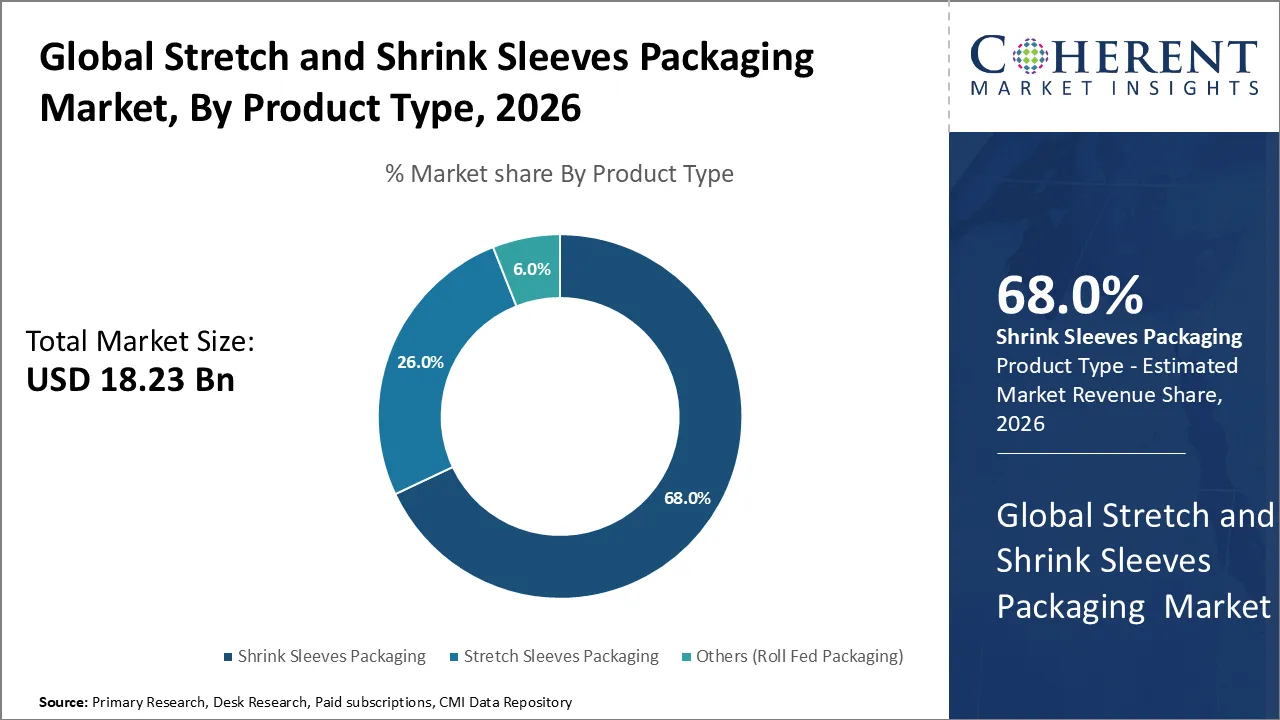
Why is Shrink Sleeves Packaging Acquiring the Largest Share?
On the basis of product type, the shrink sleeves packaging segment is projected to account for the largest Stretch and Shrink Sleeves Packaging Market share of approximately 68.0% in 2026. The segment’s growth is owing to its strong conformity to irregular and highly contoured containers, 360-degree printable surface, high-quality graphics, tamper-evident functionality, and suitability across PET bottles, glass containers, cans, and other packaging formats.
According to FINAT’s 2025 European Label Forum industry report, the global label industry consumes approximately 74 billion square meters of material annually, of which shrink sleeve labeling accounts for around 20%. This demonstrates the significant commercial scale already achieved by shrink sleeves within the broader labeling ecosystem.
In March 2026, CCL Industries announced the acquisition of Sleever International, which operated 11 manufacturing facilities across eight countries and generated approximately CAD 213 million in 2025 sales. CCL stated that the companies’ combined sleeve product lines represented approximately CAD 700 million in 2025 sales.
Why are Seamless Full-Body Sleeves Acquiring the Largest Share?
On the basis of packaging type, seamless full-body sleeves are expected to dominate with approximately 45.0% market share in 2026. The segment’s growth is owing to its ability to cover almost the entire container, maximize branding space, accommodate complex bottle geometries, support premium graphics, and combine product decoration with tamper-evident and functional packaging features.
High-speed packaging technology is making full-body sleeve formats increasingly viable for mass-volume applications. In April 2025, Krones completed production of its 1,000th Sleevematic sleeve-labeling machine, highlighting the installed scale of industrial sleeve application technology.
Why is Polyethylene Terephthalate Glycol (PETG) Acquiring the Largest Share?
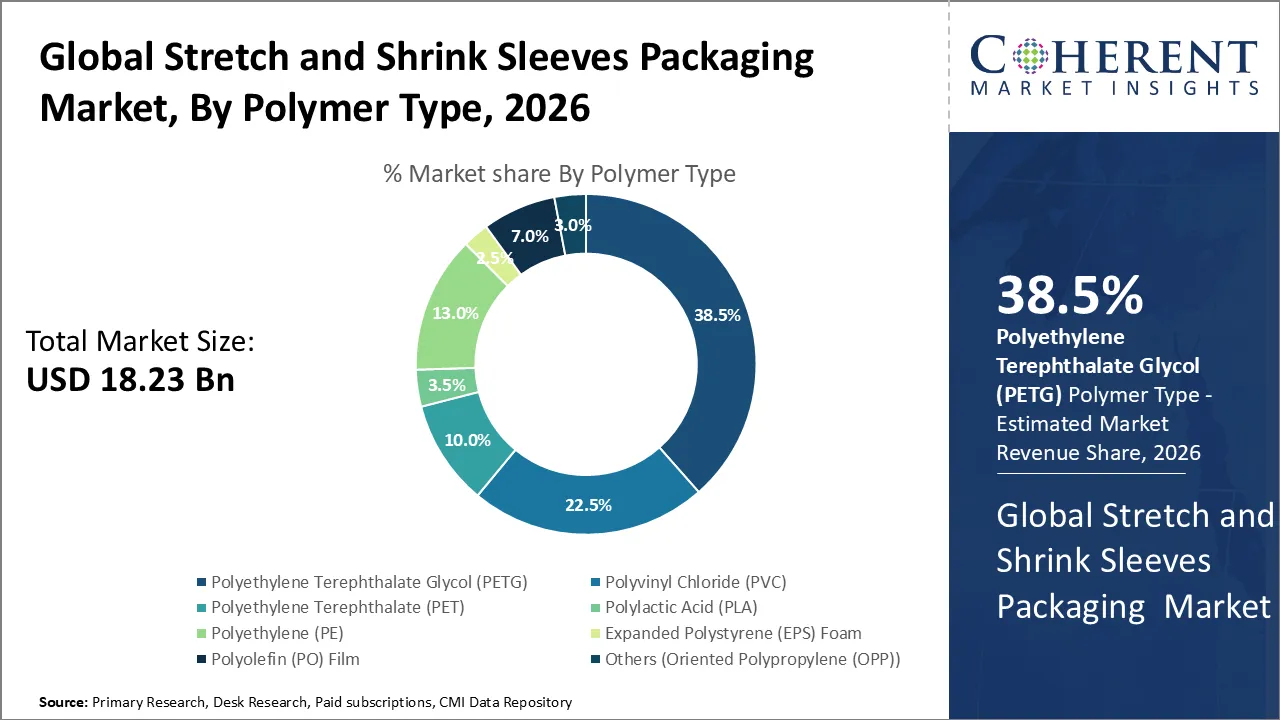
On the basis of polymer type, polyethylene terephthalate glycol (PETG) is estimated to account for the largest share of approximately 38.5% in 2026. The segment’s growth is owing to PETG’s high transparency, excellent printability, strong transverse shrink characteristics, dimensional consistency, and ability to tightly conform around highly contoured and complex-shaped containers.
Eastman also notes that next-generation crystallizable PET sleeve materials positioned as replacements for conventional PETG can provide up to 75% ultimate shrinkage and more than 500% machine-direction elongation at break in many cases, indicating how PETG’s established combination of shrink performance, toughness, and print quality continues to serve as a performance benchmark for emerging sleeve polymers.
Why are Food and Beverages Acquiring the Largest Share?
On the basis of end-use industry, the food and beverages segment is projected to hold the largest Stretch and Shrink Sleeves Packaging Market share of approximately 63.5% in 2026. The segment’s growth is owing to the high consumption of bottled beverages, dairy products, juices, sauces, condiments, functional drinks, and other packaged food products that require high-speed labeling, product differentiation, and moisture-resistant decoration.
According to the U.S. Census Bureau’s February 2026 Manufacturers’ Shipments, Inventories and Orders report, U.S. food-product manufacturers recorded shipments of approximately USD 1.072 trillion in 2025, compared with USD 1.069 trillion in 2024.
Stretch and Shrink Sleeves Packaging Market Trends
- The increasing adoption of shrink sleeve labels for 360-degree decoration and complex-shaped containers is strengthening their position across beverages, food, household chemicals, and personal care packaging.
- The growing emphasis on recyclable shrink sleeve structures is accelerating the transition from conventional difficult-to-separate films toward crystallizable PET, washable inks, and recycling-compatible materials. Eastman’s Embrace Encore crystallizable PET can be recycled together with PET bottles when used with washable inks and provides up to 75% ultimate shrinkage, allowing brands to retain high-performance full-body decoration while improving PET recycling compatibility.
- The increasing demand for shorter print runs, multiple SKUs, and faster packaging changeovers is encouraging greater use of digital and hybrid printing technologies for shrink sleeves. In its 2026 industry outlook for India, Labels & Labeling reported that the market shifted during 2025 from predominantly long production runs toward a short-run, multi-SKU model, with converters increasingly adopting mid-web platforms for short-run shrink sleeve and flexible-packaging production.
Regional Insights
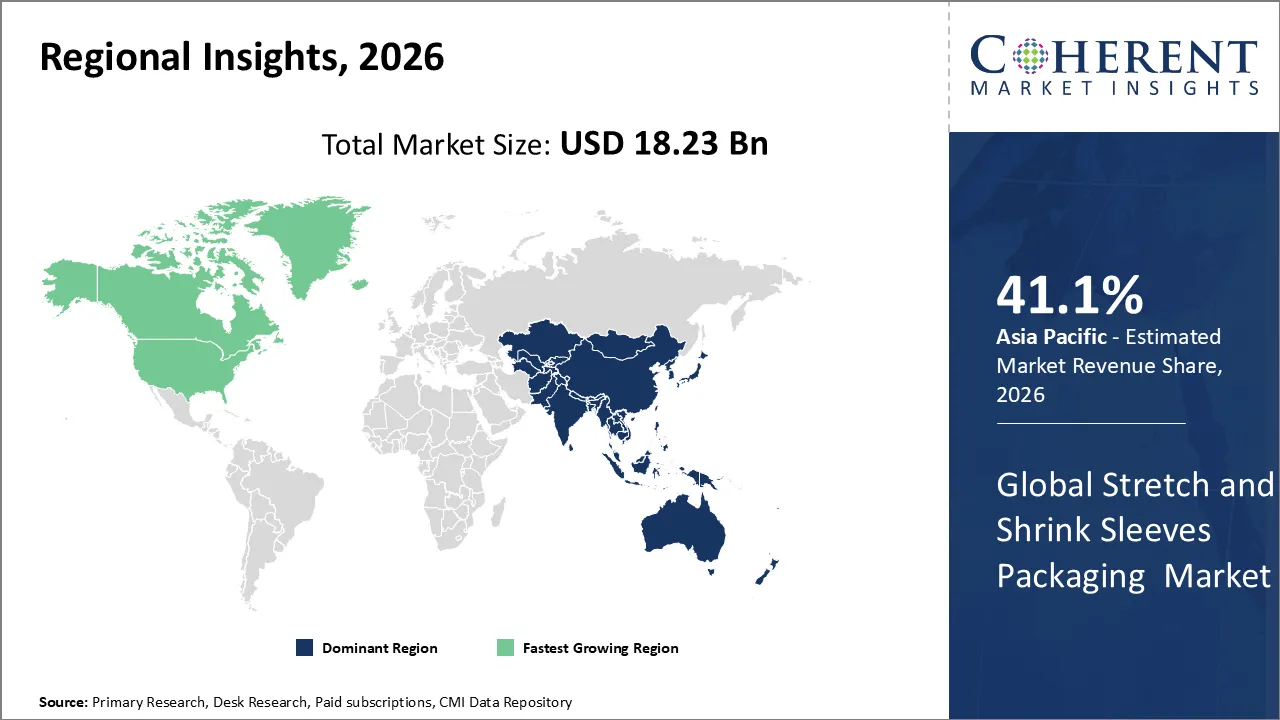
Asia Pacific Dominates Owing to the Large Manufacturing Base and Expanding Consumer Packaging Industry
The Asia Pacific region accounts for approximately 41.1% of the Stretch and Shrink Sleeves Packaging Market share in 2026. The region’s dominance is owing to its large food and beverage manufacturing base, expanding FMCG industry, high-volume PET bottle consumption, rapid urbanization, and strong packaging-converting infrastructure across China, India, Japan, and Southeast Asia.
According to the United Nations Industrial Development Organization (UNIDO) International Yearbook of Industrial Statistics 2025, Asia and Oceania accounted for 57.2% of global manufacturing value added in 2024, compared with less than half a decade earlier, while the region represented 47.2% of worldwide manufactured-goods exports.
Investment in packaging is also growing in key Asian economies. In June 2026, Siegwerk acquired Hi-Tech Inks in India, establishing the largest flexible-packaging inks business in the country with >20% market-share and 1,700 employees.
North America Stretch and Shrink Sleeves Packaging Market Trends
North America is expected to witness strong growth in the Stretch and Shrink Sleeves Packaging Market over the forecast period, supported by advanced label-converting infrastructure, high penetration of packaged food and beverages, early adoption of digital printing, demand for premium product decoration, and continued investment in sustainable sleeve technologies.
Technology investment among North American label converters remains active. According to LPC’s 2026 Trendline study, based on survey responses and in-depth discussions with more than 70 narrow-web label converters across the U.S. and Canada, shows that converters are still investing in automation, productivity improvements, and new printing technologies, even with more scrutiny on capital spending.
In February 2026, U.S.-based Inovar Packaging Group acquired Kiliper Corporation, enhancing its capabilities in stretch sleeves, roll-fed labels and printed films, and its Midwest manufacturing footprint.
Recyclable Sleeve Technologies and Domestic Converting Investment are Accelerating the Stretch and Shrink Sleeves Packaging Market in the United States
The U.S. Stretch and Shrink Sleeves Packaging Market is witnessing strong growth owing to the large consumer packaged goods industry, increasing demand for 360-degree container decoration, expansion of short-run and multi-SKU packaging, and growing adoption of recyclable sleeve structures. Sustainability requirements are particularly encouraging converters and brand owners to shift toward recyclable PET-compatible sleeves, floatable films, washable inks, and higher recycled-content packaging.
According to the U.S. Plastics Pact’s 2024–25 Impact Report, released in January 2026, 54% of plastic packaging placed on the market by participating companies was reusable, recyclable, or compostable. Average use of post-consumer recycled or responsibly sourced bio-based content also increased from 8% to 14%. These improvements are strengthening demand for shrink and stretch sleeve solutions that do not interfere with bottle recycling.
In July 2026, New York-based Source One Packaging installed a new OMET X6 flexographic press specifically to expand production capacity for custom-printed shrink sleeves, labels, roll stock, and flexible packaging.
China Stretch and Shrink Sleeves Packaging Market Trends
China is expected to remain a major growth market for stretch and shrink sleeves owing to its extensive packaging-conversion base, large-scale food and beverage production, expanding consumer goods manufacturing, and significant exports of packaging products. High-volume packaged-product manufacturing creates recurring requirements for labels and sleeves across beverages, food, personal care, household products, and other FMCG applications.
According to the China Packaging Federation, China had 20,230 packaging enterprises above designated size in 2025, generating approximately RMB 2.05 trillion in operating revenue. The country’s packaging-industry exports reached approximately USD 45.41 billion in 2025, increasing 2.76% year-on-year. This large converter and manufacturing ecosystem provides a substantial production base for advanced labeling and sleeve-packaging technologies.
Who are the Major Companies in Stretch and Shrink Sleeves Packaging Industry
Some of the major key players in Stretch and Shrink Sleeves Packaging Market are Verst Logistics, Inc., CCL Industries, Huhtamaki Group, Eurofilms, Berry Global Inc., The Dow Chemical Company, Hipac Packaging Solutions, Cenveo Corporation, Intertape Polymer Group, Fuji Seal International, Inc., and Macfarlane Group plc.
Key News
- In September 2025, Verst Logistics, Inc. opened a new 331,683-square-foot packaging, distribution, and fulfillment facility in Glendale, Arizona. The facility serves as an operational hub for shrink sleeve labeling, bundle wrapping, and carton packing, strengthening the company’s shrink-sleeve contract packaging capacity and expanding its presence in the western U.S.
- In September 2025, Dow launched DOWSIL 5-1050 Polymer Processing Aid, specifically engineered for blown and stretch film applications. The fluoropolymer-free processing aid reduces melt fracture, film haze, die buildup, and extrusion pressure, supporting production of higher-quality stretch and flexible packaging films while responding to evolving regulatory requirements.
Market Report Scope
Stretch and Shrink Sleeves Packaging Market Report Coverage
Report Coverage | Details | ||
Base Year: | 2025 | Market Size in 2026: | USD 18.23 Bn |
Historical Data for: | 2020 to 2024 | Forecast Period: | 2026 to 2033 |
CAGR: | 5.7% | 2033 Value Projection: | USD 26.88 Bn |
Geographies covered: |
| ||
Segments covered: |
| ||
Companies covered: | Verst Logistics, Inc., CCL Industries, Huhtamaki Group, Eurofilms, Berry Global Inc., The Dow Chemical Company, Hipac Packaging Solutions, Cenveo Corporation, Intertape Polymer Group, Fuji Seal International, Inc., and Macfarlane Group plc. | ||
Growth Drivers: |
| ||
Restraints & Challenges: |
| ||
Analyst Opinion
- The Stretch and Shrink Sleeves Packaging Market is increasingly shifting from purely graphics-driven packaging toward recycling-compatible full-body decoration. Brand owners still require 360-degree visibility and complex-container coverage, but sleeve materials are now being evaluated on whether they can pass through existing PET recycling systems. In April 2026, Amcor launched its EcoGuard recyclable cPET shrink sleeve for North America that can be recycled with PET bottles in existing PET streams and is APR Design compliant and prequalified by How2Recycle.
- Sustainability requirements are also creating stronger commercialization opportunities for stretch sleeves where manufacturers want to avoid heat shrinking and increase recycled content. In March 2025, Coveris introduced SleeveFlexR Stretch with up to 75% recycled content, and other variants with 35% and 50% recycled content. The solution uses recovered printed sleeve waste that is de-inked and converted back into PCR resin for new stretch sleeves.
Speak to the analyst
Want personalized insights?
Take the findings above to one of our principal consultants, or have the report rebuilt around the segments, geographies and competitors you actually track.
Market Segmentation
- By Product Type (Revenue, USD Bn, 2021-2033)
- Stretch Sleeves Packaging
- Shrink Sleeves Packaging
- Others (Roll Fed Packaging)
- By Packaging Type (Revenue, USD Bn, 2021-2033)
- Stretch Sleeves Packaging
- Single
- Bi-Pack
- Multi Pack
- Shrink Sleeves Packaging
- Seamless Full Body Sleeves
- Tamper Evident Shrink Bands
- Multipack & Club-pack Sleeves
- Shrink Sleeve Prototypes and Mockups
- Stretch Sleeves Packaging
- By Polymer Type (Revenue, USD Bn, 2021-2033)
- Polyvinyl Chloride (PVC)
- Polyethylene Terephthalate (PET)
- Polylactic Acid (PLA)
- Polyethylene Terephthalate Glycol (PETG)
- Polyethylene (PE)
- Expanded Polystyrene (EPS) Foam
- Polyolefin (PO) Film
- Others (Oriented Polypropylene (OPP))
- By End Use Industry (Revenue, USD Bn, 2021-2033)
- Food and Beverages
- Personal Care
- Chemical
- Pharmaceutical
- Others (Paints)
- By Region (Revenue, USD Bn, 2021-2033)
- North America
- U.S.
- Canada
- Latin America
- Brazil
- Mexico
- Argentina
- Rest of Latin America
- Europe
- Germany
- U.K.
- France
- Italy
- Spain
- Russia
- Rest of Europe
- Asia Pacific
- China
- India
- Japan
- Australia
- South Korea
- ASEAN
- Rest of Asia Pacific
- Middle East
- GCC
- Israel
- Rest of Middle East
- Africa
- South Africa
- Central Africa
- North Africa
- North America
Sources
Primary Research Interviews
- Shrink sleeve and stretch sleeve manufacturers
- Flexible packaging film manufacturers
- Label converters and printing companies
- Packaging machinery and sleeve applicator manufacturers
- Polymer, resin, and specialty film suppliers
- Food and beverage packaging procurement managers
- Personal care, pharmaceutical, and household product packaging managers
- Packaging sustainability and recycling experts
- Distributors and contract packaging service providers
- Key opinion leaders (KOLs) in flexible packaging and labeling
Databases
- World Bank
- United Nations Industrial Development Organization (UNIDO)
- U.S. Census Bureau
- Eurostat
- Organisation for Economic Co-operation and Development (OECD)
- UN Comtrade Database
- U.S. International Trade Commission (USITC)
- National Bureau of Statistics of China
Magazines
- Labels & Labeling
- Packaging Europe
- Packaging World
- Flexible Packaging
- Packaging Strategies
- Plastics Today
- Food & Beverage Packaging
Journals
- Packaging Technology and Science
- Journal of Applied Polymer Science
- Polymer Testing
- Journal of Plastic Film & Sheeting
- Resources, Conservation and Recycling
- Waste Management
- International Journal of Advanced Manufacturing Technology
Newspapers
- The Wall Street Journal
- Financial Times
- Reuters
- The Economic Times
- Nikkei Asia
- South China Morning Post
Associations
- Flexible Packaging Association (FPA)
- FINAT – European Association for the Self-Adhesive Label Industry
- Association of Plastic Recyclers (APR)
- PMMI – The Association for Packaging and Processing Technologies
- RecyClass
- Plastics Industry Association
- International Bottled Water Association (IBWA)
- China Packaging Federation
- U.S. Plastics Pact
Public Domain Sources
- Company Annual Reports and Investor Presentations
- Company Product Catalogs and Technical Datasheets
- Sleeve Film and Polymer Product Specifications
- Government Packaging and Recycling Regulations
- Extended Producer Responsibility (EPR) Regulations
- Packaging and Packaging Waste Regulation (PPWR) Publications
- Patent Databases such as WIPO, USPTO, and Google Patents
- Packaging Machinery Specifications and Equipment Brochures
- Recycling Design Guidelines and Recyclability Assessment Reports
- Publicly Available Sustainability and ESG Reports
Proprietary Elements
- CMI Data Analytics Tool
- Proprietary CMI Existing Repository of Information for the Last 10 Years
Get access to 250+ pages report
Every segment, forecast, competitor profile and data table behind the analysis above — available for instant download.
- ESOMAR Member
- ISO 9001:2015 Certified
- D-U-N-S Registered
- GDPR & CCPA Compliant
Missing comfort of reading report in your local language? Find your preferred language:
Transform your Strategy with Exclusive Trending Reports
Frequently Asked Questions
The Stretch and Shrink Sleeves Packaging Market is expected to reach USD 26.88 Bn in 2033, compared with USD 18.23 Bn in 2026.
Major players operating in the global Stretch and Shrink Sleeves Packaging Market include Verst Logistics, Inc., CCL Industries, Huhtamaki Group, Eurofilms, Berry Global Inc., The Dow Chemical Company, Hipac Packaging Solutions, Cenveo Corporation, Intertape Polymer Group, Fuji Seal International, Inc., and Macfarlane Group plc.
The high initial investment in sleeve labeling and shrink tunnel equipment and recycling challenges associated with multi-material sleeve structures are the key factors hampering growth of the market.
The increasing demand for 360-degree product branding and decoration and rising consumption of packaged food and beverages are the major factors driving growth of the Stretch and Shrink Sleeves Packaging Market.
The Stretch and Shrink Sleeves Packaging Market is anticipated to grow at a CAGR of 5.7% between 2026 and 2033.
Among regions, Asia Pacific is expected to account for the largest market share, with approximately 41.1% in 2026. The region’s dominance is supported by its large food and beverage manufacturing base, expanding FMCG industry, high-volume PET bottle consumption, and strong packaging-conversion infrastructure.
Stretch and shrink sleeves are flexible labeling and decoration formats applied around containers. Stretch sleeves use the elasticity of the film to fit around the container, whereas shrink sleeves conform tightly to the container after shrinking, enabling full-body decoration, 360-degree graphics, and coverage of complex container shapes.