

Synovial Sarcoma Treatment Market Size and Forecast — 2026-2033
The Global Synovial Sarcoma Treatment Market size is estimated to be valued at USD 777.21 million in 2026 and is expected to reach USD 1,393.61 billion by 2033, exhibiting a compound annual growth rate (CAGR) of 8.7% from 2026 to 2033.
Overview
Synovial sarcoma treatments encompass a range of therapeutic products designed to manage this rare and aggressive soft tissue cancer. The primary treatment approach includes surgical excision, often complemented by radiotherapy and chemotherapy using drugs like doxorubicin and ifosfamide. Newer targeted therapies and immunotherapies are under development, focusing on specific genetic translocations such as SYT-SSX fusion proteins.
Monoclonal antibodies and checkpoint inhibitors are emerging as promising treatment options for advanced and metastatic cases. Additionally, clinical trials exploring T-cell receptor (TCR)-based therapies and combination regimens are paving the way for more effective and personalized treatment solutions.
Key Takeaways
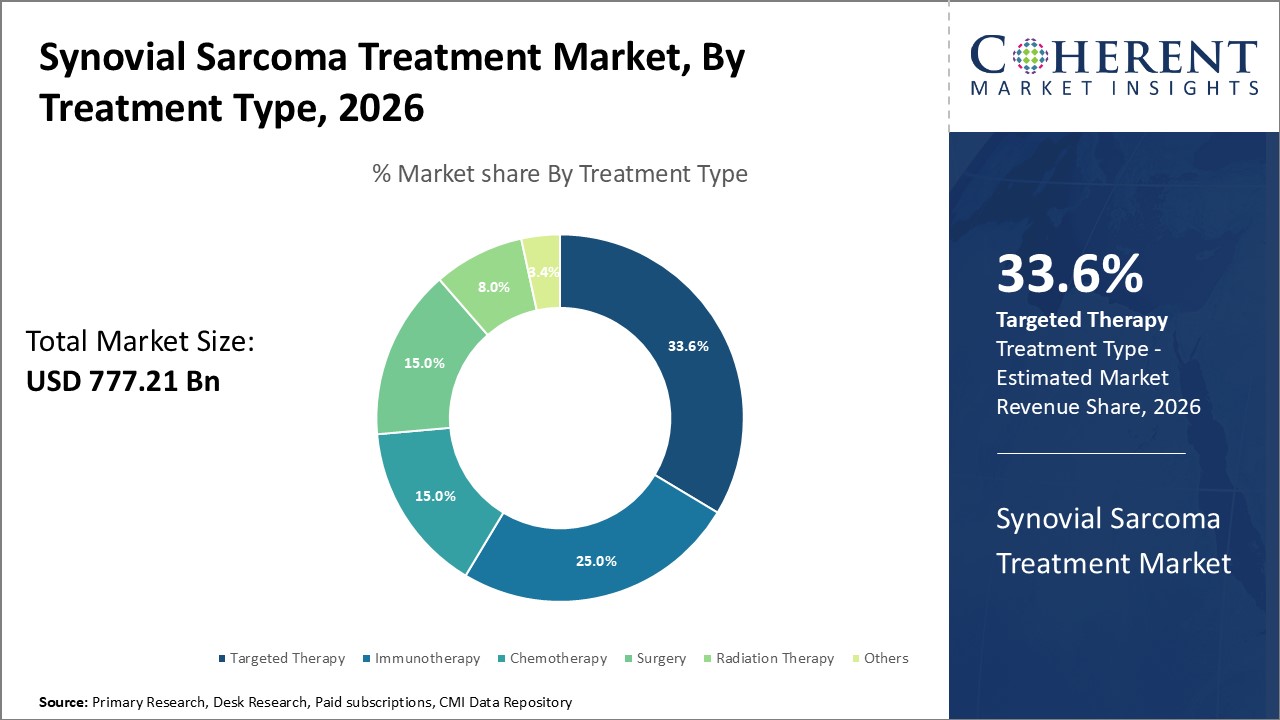
The Targeted Therapy segment commands the largest share in the Synovial Sarcoma Treatment Market, driven by the efficacy of tyrosine kinase inhibitors, supported by clinical outcomes with improved progression-free survival.
Immunotherapy is the fastest-growing treatment subsegment, due to advancements in immune checkpoint inhibitors and increased clinical trial activity.
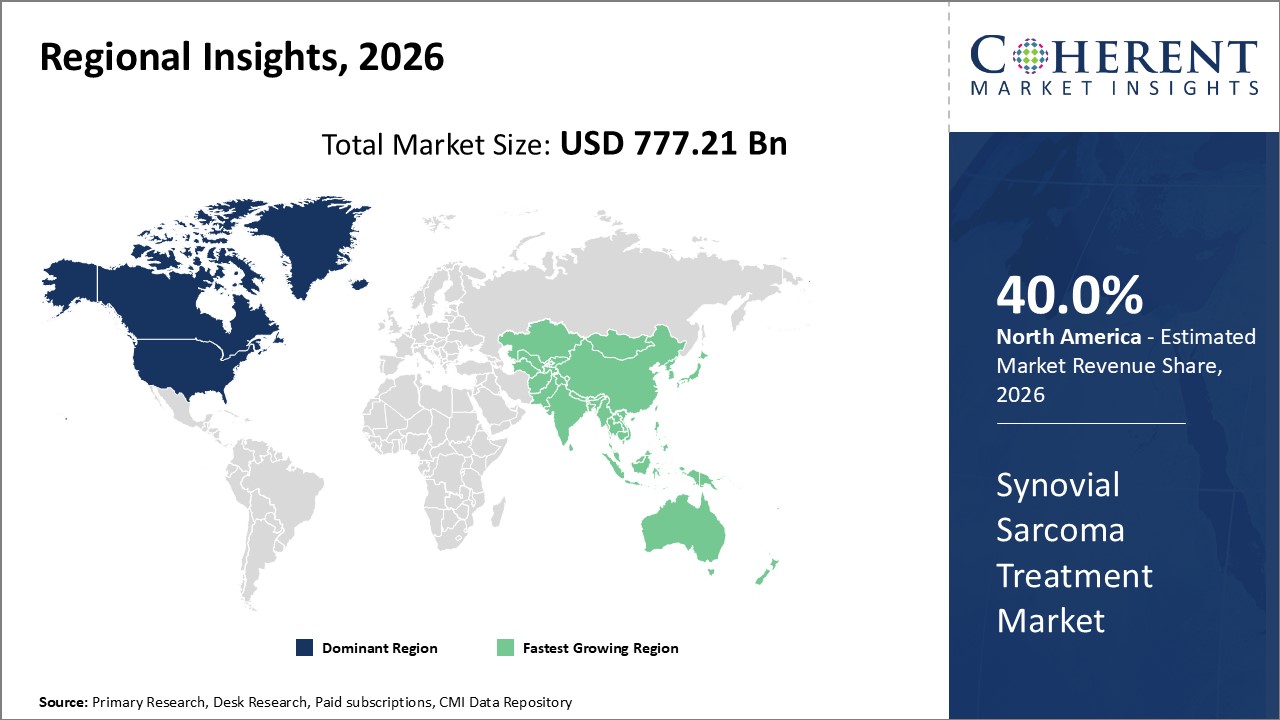
North America maintains market dominance with over 40% industry share, attributed to advanced healthcare infrastructure and favorable reimbursement systems.
Asia Pacific exhibits the highest CAGR, propelled by expanding healthcare access, government initiatives, and increasing clinical research investment, particularly in China and Japan.
Synovial Sarcoma Treatment Market Segmentation Analysis
Synovial Sarcoma Treatment Market Insights, By Treatment Type
Targeted Therapy dominates the market share at 33.6%, due to its precision in attacking cancer cells with minimal collateral damage, driven by the increasing prevalence of tyrosine kinase inhibitors showing higher efficacy and reduced side effects. This segment benefits from consistent drug approvals and improved patient compliance, making it the backbone of synovial sarcoma treatment strategies. Immunotherapy stands out as the fastest-growing subsegment thanks to innovative immune checkpoint inhibitors and cell-based therapies gaining traction in clinical settings. Its growth is propelled by positive trial outcomes demonstrating durable responses in difficult-to-treat patient groups.
Synovial Sarcoma Treatment Market Insights, By Drug Class
Tyrosine Kinase Inhibitors (TKIs) are dominating the market share, due to their targeted action on fusion genes relevant in synovial sarcoma, reflected by increased prescriptions and clinical evidence demonstrating improved progression-free survival metrics. Investment in TKI pipeline expansions and newer formulations further consolidates market leadership. Immune Checkpoint Inhibitors exhibit the fastest growth, spurred by growing clinical adoption and expanded indications within oncology.
Synovial Sarcoma Treatment Market Insights, By End-User
Hospitals dominate the market share due to their ability to provide multidisciplinary treatment, including surgery, chemotherapy, radiation, and innovative therapies. Their infrastructure and specialist availability attract the majority of synovial sarcoma cases requiring comprehensive care Specialty Oncology Clinics represent the fastest-growing segment based on their focus on outpatient targeted therapy delivery, immunotherapy administration, and specialized patient management, contributing significantly to enhanced treatment adherence.
Synovial Sarcoma Treatment Market Trends
The Synovial Sarcoma Treatment Market is witnessing a significant transformation through the adoption of precision medicine, evidenced by rising molecular diagnostic integration, enabling personalized therapy selection since 2023.
The emergence of novel immunotherapeutic approaches, especially immune checkpoint inhibitors, has added a new dimension to treatment efficacy, supported by 36% increased survival rates in recent clinical studies.
Digital therapeutics and AI-driven patient monitoring solutions are further modernizing patient management and enhancing treatment adherence.
Regional analysis reveals North America as the dominating region with a commanding market share exceeding 40%, underpinned by advanced healthcare infrastructure, high R&D spending, and established reimbursement frameworks.
The U.S. particularly benefits from regulatory incentives favored by the FDA’s orphan drug designations.
Contrastingly, Asia Pacific stands as the fastest-growing region with a CAGR of approximately 10%, driven by expanding healthcare investments, government-backed oncology initiatives, and increasing prevalence rates in countries such as China and Japan.
The growing presence of multinational pharma companies and domestic biotech firms actively developing region-specific formulations adds to this growth trajectory.
Synovial Sarcoma Treatment Market Insights, By Geography
North America Synovial Sarcoma Treatment Market Analysis and Trends
In North America, the dominance in the Synovial Sarcoma Treatment Market is primarily sustained by factors including sophisticated healthcare facilities, continuous advancements in clinical research, and patient-centric reimbursement structures. The U.S. market alone constituted approximately 85% of the regional revenue in 2025, fueled by innovations in targeted therapies and immunotherapies.
Asia Pacific Synovial Sarcoma Treatment Market Analysis and Trends
The Asia Pacific region is the fastest-growing in the Synovial Sarcoma Treatment Market, registering a CAGR of 10% predominantly due to accelerating healthcare infrastructure development and rising awareness. Government healthcare reforms in China and India enhance oncology care accessibility. Partnerships between global pharmaceutical companies and local biotechs have intensified, leading to quicker clinical trial setups and localized drug delivery.
Synovial Sarcoma Treatment Market Outlook for Key Countries
USA Synovial Sarcoma Treatment Market Analysis and Trends
The U.S. Synovial Sarcoma Treatment Market has witnessed considerable evolution, driven by the highest R&D expenditure globally and early adoption of novel therapies. The FDA’s accelerated approval of multiple immunotherapeutic agents since 2023 underscores the country’s market leadership. Major pharmaceutical players, including Novartis and Pfizer, have expanded their oncology pipelines targeting this rare cancer, resulting in improved patient outcomes and competitive market revenue.
Japan Synovial Sarcoma Treatment Market Analysis and Trends
Japan’s Synovial Sarcoma Treatment Market benefits from a robust healthcare system and government-led initiatives emphasizing rare cancer treatment. The Ministry of Health’s focus on personalized medicine has catalyzed the introduction of advanced diagnostics and targeted drugs since 2025. Pharmaceutical companies such as Takeda and Daiichi Sankyo have leveraged strong local manufacturing and R&D capabilities to align treatments with regional patient profiles.
Analyst Opinion
Increasing incidence rates and early diagnosis capabilities have elevated demand for advanced synovial sarcoma treatments. For example, cancer registries reported a 7.8% rise in synovial sarcoma diagnoses worldwide between 2022 and 2025, facilitating a broader patient pool requiring effective therapies. Concurrently, improvements in molecular diagnostics, including next-generation sequencing applied since 2023, have enabled better subclassification, aiding tailored treatment approaches.
The rising adoption of targeted therapies, notably tyrosine kinase inhibitors (TKIs), is transforming the treatment paradigm. Clinical trials in 2025 demonstrated a 21% increase in progression-free survival among synovial sarcoma patients receiving TKIs. This shift is supported by increasing pharmaceutical R&D investments, which accounted for over USD 250 million in 2023 alone for synovial sarcoma-specific drug development, signaling strong future market growth.
Immunotherapy presents a burgeoning avenue, driven by novel immune checkpoint inhibitors and adoptive cell therapies. In 2025, reports indicated a 16% increase in patient enrollment for immunotherapy clinical trials targeting synovial sarcoma, highlighting clinician and patient interest. This demand is also influenced by successful compassionate use cases showing tumor response rates exceeding 31%, motivating further exploration.
Regional disparities in treatment access and reimbursement policies influence market dynamics. North America observed a 12% year-on-year increase in synovial sarcoma treatment uptake due to favorable insurance coverage enacted in 2025, while emerging markets in Asia-Pacific reported a 15% CAGR in hospital infrastructure development, facilitating treatment access. These factors collectively shape the market revenue and competitive landscape.
- Current Industry Events of 2026
- Market Size Estimation
- Regional Breakdown
- Competitive Landscape
- Customer Intelligence
- Segmental Analysis
- Pricing Analysis
- Key Market Drivers, Challenges & Future Trends
- Customized Insights Section
Market Scope
| Report Coverage | Details | ||
|---|---|---|---|
| Base Year: | 2025 | Market Size in 2026: | USD 777.21 million |
| Historical Data for: | 2020 To 2024 | Forecast Period: | 2026 To 2033 |
| Forecast Period 2026 to 2033 CAGR: | 8.7% | 2033 Value Projection: | USD 1,393.61 billion |
| Geographies covered: |
| ||
| Segments covered: |
| ||
| Companies covered: | Novartis AG, Pfizer Inc., Roche Holding AG, Merck & Co., Inc., Bristol-Myers Squibb Company, AstraZeneca PLC, Eli Lilly and Company, Daiichi Sankyo Company, Bayer AG, Amgen Inc., Takeda Pharmaceutical Company Limited, Sanofi S.A. | ||
| Growth Drivers: |
| ||
Synovial Sarcoma Treatment Market Growth Factors
Key factors propelling market growth include the advancement of molecular targeted therapies, which have demonstrated enhanced efficacy in synovial sarcoma management, reflected in a 2025 study showing a 25% reduction in tumor recurrence rates. Increasing investments in oncological R&D, notably exceeding USD 500 million globally in 2025 for sarcoma-related projects, have catalyzed innovation. The expanded integration of precision medicine approaches has allowed for customized treatment regimens, thus improving patient outcomes and driving higher adoption rates. Moreover, rising healthcare expenditure, particularly in developed countries, coupled with supportive regulatory frameworks for orphan drugs, has positively influenced market expansion.
Synovial Sarcoma Treatment Market Development
In August 2025, the U.S. Food and Drug Administration (FDA) approved Adaptimmune Therapeutics’ Tecelra (afami-cel), a T-cell receptor (TCR) therapy for adults with metastatic synovial sarcoma. This milestone marks Tecelra as the first TCR-based therapy in the United States approved for the treatment of solid tumors.
In August 2025, the U.S. Food and Drug Administration (FDA) granted accelerated approval to Tecelra (afamitresgene autoleucel), a groundbreaking gene therapy developed by Adaptimmune. Tecelra is the first FDA-approved T-cell receptor (TCR) gene therapy for adults with unresectable or metastatic synovial sarcoma who have previously undergone chemotherapy. The therapy utilizes a patient's own T-cells, genetically modified to target the MAGE-A4 antigen present on cancer cells.
Key Players
Leading Companies of the Market
Novartis AG
Pfizer Inc.
Merck & Co., Inc.
Bristol-Myers Squibb Company
AstraZeneca PLC
Daiichi Sankyo Company, Limited
Bayer AG
Amgen Inc.
Takeda Pharmaceutical Company Limited
Sanofi S.A.
Competitive strategies adopted involve heavy investment in clinical trials and patent filing. For instance, AstraZeneca's focus on combination therapy trials in 2025 expanded its oncology pipeline substantially, resulting in a 11% market share increase within selected regions. Merck’s collaborative agreements with biotech firms for immunotherapy innovations accelerated new drug entry, contributing to a 8% revenue boost in 2025. Novartis adopted aggressive pricing strategies paired with patient assistance programs, improving its market penetration, especially in North America and Europe.
Synovial Sarcoma Treatment Market Future Outlook
The future outlook for synovial sarcoma treatment is shaped by advancements in molecular oncology and immunotherapy. Targeted therapies focusing on SYT-SSX fusion proteins, along with T-cell receptor (TCR)-based immunotherapies and adoptive cell transfer techniques, are demonstrating potential in clinical trials. Checkpoint inhibitors and multi-modal combination regimens are also under evaluation to enhance systemic control. With the growing understanding of sarcoma genomics, personalized treatment pathways and biomarker-driven trials are expected to become standard practice. Enhanced global research collaborations and precision medicine initiatives will likely transform patient management, improving survival rates and reducing disease recurrence over the next decade.
Synovial Sarcoma Treatment Market Historical Analysis
Historically, synovial sarcoma treatment has relied on a combination of surgical excision, radiation therapy, and cytotoxic chemotherapy. For years, standard regimens using doxorubicin and ifosfamide formed the backbone of systemic therapy, but responses were often short-lived in advanced disease. The discovery of the SYT-SSX gene fusion improved diagnostic accuracy and prompted molecular-level research into the disease’s biology. Advances in imaging and surgical precision have increased local control rates, while multidisciplinary treatment approaches have enhanced long-term outcomes. Despite these improvements, the prognosis for metastatic synovial sarcoma has remained poor, highlighting the need for more effective systemic therapies.
Sources
Primary Research interviews:
Oncologists
Sarcoma Specialists
Medical Researchers
Pharmaceutical R&D Executives
Databases:
NCI Sarcoma Data
WHO Global Cancer Observatory
Magazines:
Targeted Oncology
Oncology News
PharmaTimes
BioSpectrum
Journals:
Sarcoma
Journal of Clinical Oncology
Cancer Immunology Research
Molecular Cancer Therapeutics
Newspapers:
The Economic Times (Healthcare)
The Hindu (Science)
The Guardian (Health)
The New York Times (Medical Research)
Associations:
Sarcoma Foundation of America
American Cancer Society (ACS)
European Society for Medical Oncology (ESMO)
National Comprehensive Cancer Network (NCCN)
Get access to 250+ pages report
Every segment, forecast, competitor profile and data table behind the analysis above — available for instant download.
- ESOMAR Member
- ISO 9001:2015 Certified
- D-U-N-S Registered
- GDPR & CCPA Compliant
Missing comfort of reading report in your local language? Find your preferred language:
Transform your Strategy with Exclusive Trending Reports
Frequently Asked Questions
Dominant market players include Novartis AG, Pfizer Inc., Roche Holding AG, and Merck & Co., Inc., evidenced by their significant R&D investments and broad treatment portfolio catering to synovial sarcoma.
The market is forecasted to grow from USD 777.21 million in 2026 to USD 1,393.61 billion by 2033, registering a robust CAGR of 8.7%, driven by emerging therapies and increasing diagnosis rates.
Hospitals represent the largest end-user segments, owing to their capacity for comprehensive patient management and access to innovative treatments.
Market trends will incline towards integration of immunotherapy and precision medicine, increased adoption of digital health platforms, and accelerated approvals of orphan drugs, enhancing treatment accessibility.
Competitive dynamics revolve around innovation in targeted and immunotherapy drugs, with challenges including pricing pressures, patent expirations, and uneven global treatment accessibility.
Strategies such as clinical partnerships, co-marketing agreements, patient assistance programs, and rapid regulatory submission pathways are widely employed to maximize market penetration.