

Transit Cards Market Size and Share Analysis- Growth Trends and Forecasts (2026-2033)
The Transit Cards Market size is anticipated to grow at a CAGR of 6.79% with USD 87.65 Bn in 2026 and is expected to reach USD 138.76 Bn in 2033. The primary drivers are defined by expanding transportation networks, rising ridership, automated fare collection adoption, and demand for convenient cashless travel. Visa also reported that 94% of transit riders expect public transport to offer contactless payments, while over 750 transit systems support contactless fare acceptance. This is strengthening demand for smart transit cards and integrated payment solutions across metro, bus, rail, ferry, and multimodal transport networks. provide the links
Key Takeaways
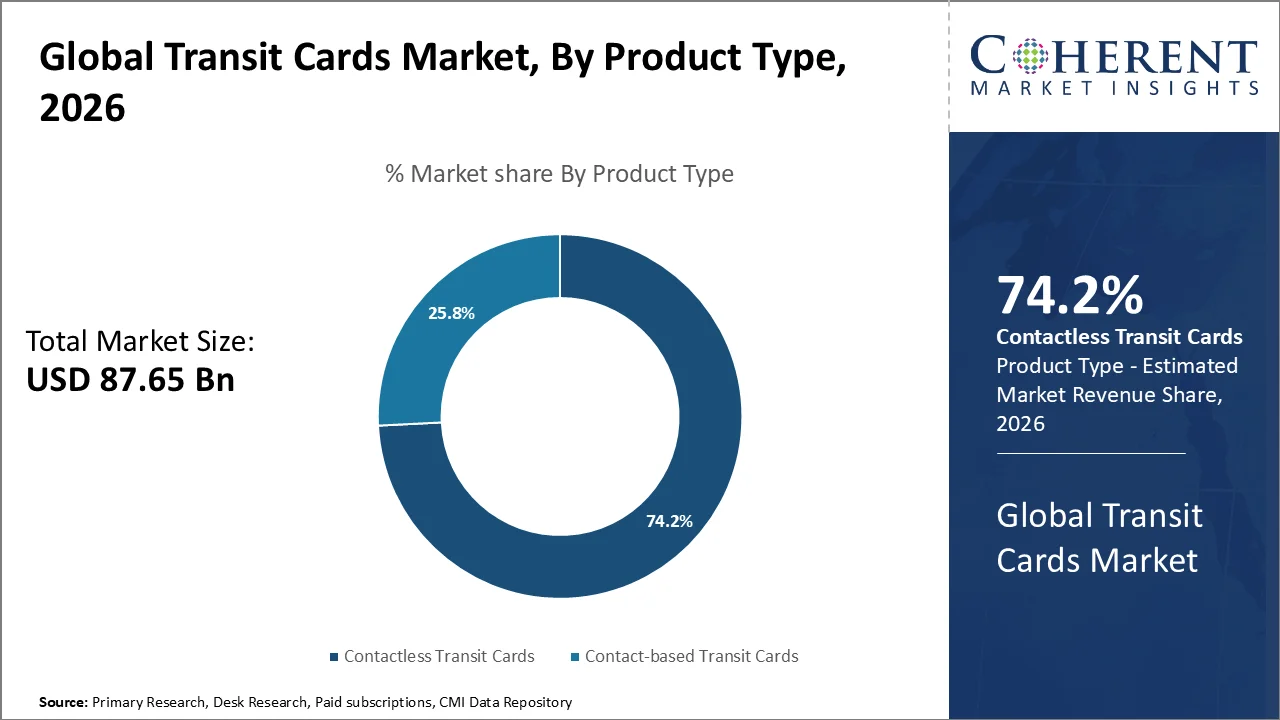
- The contactless transit cards segment is likely to dominate the market with 74.2% in 2026. The segment’s growth is owing to the faster tap-and-go fare collection, reduced boarding time, and cashless mobility adoption.
- IC micro processor cards segment is set to lead with 62.8% in 2026. The segment’s growth is owing to the secure authentication, fare-data processing, and interoperability across transit networks. EMVCo highlights growing adoption of contactless chip technology across mass transit systems for seamless and secure payment transactions.
- Asia Pacific is expected to acquire the prominent share of 41.6% in 2026. The region’s growth is owing to the expanding metro networks, large commuter volumes, and government-backed smart ticketing programs. In April 2026 alone, Chennai Metro recorded 45.18 lakh NCMC card journeys, out of 90.18 lakh total passenger journeys.
Segmental Insights
Why is Contactless Transit Cards Segment Acquiring the Largest Share?
On the basis of product type, the contactless transit cards segment is projected to account for the largest Transit Cards Market share of 74.2% in 2026. The segment’s growth is owing to the transport agencies expanding tap-and-go fare collection because it reduces ticketing friction, speeds boarding, and supports interoperable payment across rail and bus networks.
Transport for London reported in January 2025 that more than 700 stations across London and southeast England accepted pay-as-you-go contactless travel, demonstrating the scale achieved by account-based fare systems.
In the U.S., Washington Metropolitan Area Transit Authority stated that customers completed more than 6 million trips using its Tap. Ride. Go. contactless payment service following its May 2025 rail launch. A further development came in November 2025, when WMATA extended Tap. Ride. Go. to Metrobus, allowing riders to pay directly with contactless credit or debit cards, Apple Pay, or Google Pay, strengthening demand for contactless fare infrastructure globally.
- Current Industry Events of 2026
- Market Size Estimation
- Regional Breakdown
- Competitive Landscape
- Customer Intelligence
- Segmental Analysis
- Pricing Analysis
- Key Market Drivers, Challenges & Future Trends
- Customized Insights Section
IC Micro Processor Cards hold the Largest Market Share
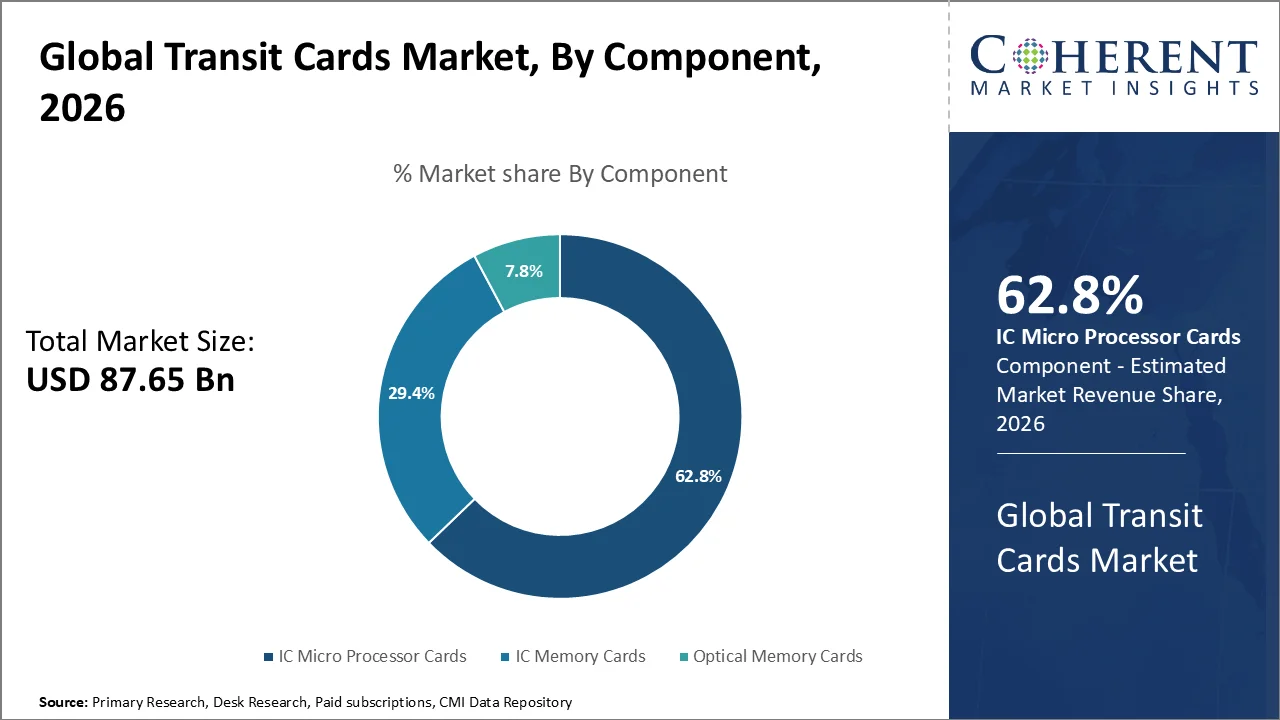
On the basis of component, IC micro processor cards segment lead with a major 62.8% share in 2026. The growth is owing to the embedded processing capability, secure EMV authentication, contactless fare validation, and ability to store multiple transit applications.
In July 2026, Delhi Transport Corporation moved forward with the deployment of the NCMC-based “Pink Saheli” Smart Card, with dedicated card-distribution centres and operational instructions requiring eligible passengers to tap the smart card for fare processing. The system uses the NCMC chip-based architecture, directly supporting deployment of IC microprocessor-enabled transit cards for secure identification and automated fare transactions.
Market Drivers
Rising Innovations in Interoperable Mobility Cards are Transforming the Transit Cards Market in India
India is emerging as one of the key innovation centers for interoperable transit cards through the National Common Mobility Card (NCMC) initiative. The system was designed as a vendor-agnostic, interoperable fare-payment framework capable of supporting metro, bus, suburban railway, toll, parking and retail transactions using a single contactless credential. The Ministry of Housing and Urban Affairs states that NCMC was developed to address limitations associated with cash collection and operator-specific closed-loop cards while enabling seamless travel across participating transportation systems.
The architecture also supports offline stored-value transactions, an important capability in transit environments where continuous network connectivity cannot always be guaranteed. NPCI states that RuPay Contactless cards compatible with NCMC can contain operator-specific services such as monthly passes and seasonal tickets while supporting transit and retail payments.
In March 2026, PhonePe launched the RuPay On-The-Go Card, an NCMC-compatible prepaid transit card. The card supports offline contactless fare payments, can hold up to ₹2,000 in stored value, and supports offline transactions of up to ₹500. Its initial deployment focused on Hyderabad Metro with plans for broader integration across additional Indian transit providers.
Account-Based and Open-Loop Ticketing: A Major Breakthrough in the Transit Cards Market
Account-Based Ticketing (ABT) represents one of the most important technological shifts affecting transit cards. Under traditional card-centric systems, fare value and travel entitlements are primarily stored on the physical card. ABT moves much of this intelligence to a centralized back office, allowing the card, bank card, mobile wallet or wearable to function primarily as a secure identifier or payment credential.
UITP identifies account-based ticketing, EMV payments, open-loop fare collection, NFC, secure elements and mobile ticketing as major technologies reshaping fare management. ABT allows the operators to introduce automatic fare capping, multimodal journeys, remote entitlement management and more flexible concession programs. For passengers, this reduces the need to understand complex ticket products before travelling.
In September 2025, Cubic Transportation Systems launched Open Payments on the Umo Mobility platform, allowing passengers to use contactless bank cards, mobile wallets and smartwatches. The platform also supports closed-loop, open-loop, hybrid and ticket-based models.
Current Events and Their Impact on the Transit Cards Market
Current Event | Description and its Impact |
2025 New York MTA MetroCard Phase-Out and OMNY Transition
|
|
2025–2026 India National Common Mobility Card (NCMC) Expansion |
|
Transit Cards Market Trends
- Rising adoption of contactless and open-loop transit cards enables faster fare payments, reduces boarding times, and improves passenger convenience across public transportation networks.
- Increasing deployment of interoperable smart cards allows commuters to access buses, metros, railways, and other mobility services through unified fare-payment platforms.
- Integration of transit cards with smartphones, digital wallets, and wearable devices strengthens cashless mobility, providing passengers with convenient account management and seamless payments.
- Growing urban public transportation usage accelerates demand for automated fare collection and smart transit cards worldwide. In New York, approximately 87% of subway and bus trips were completed using tap-and-ride technology in October 2025, while the OMNY contactless system surpassed 3 billion taps, demonstrating rapid passenger migration toward digital fare payment.
- Supportive government initiatives promoting integrated and cashless transportation systems broaden transit card adoption across emerging economies. In April 2026, Maharashtra introduced an NCMC-enabled RuPay On-The-Go smart card scheme, supporting interoperable fare payments across transportation modes. Such initiatives encourage standardized payment infrastructure, improve fare transparency, and accelerate adoption of smart transit cards among daily commuters.
Regional Insights
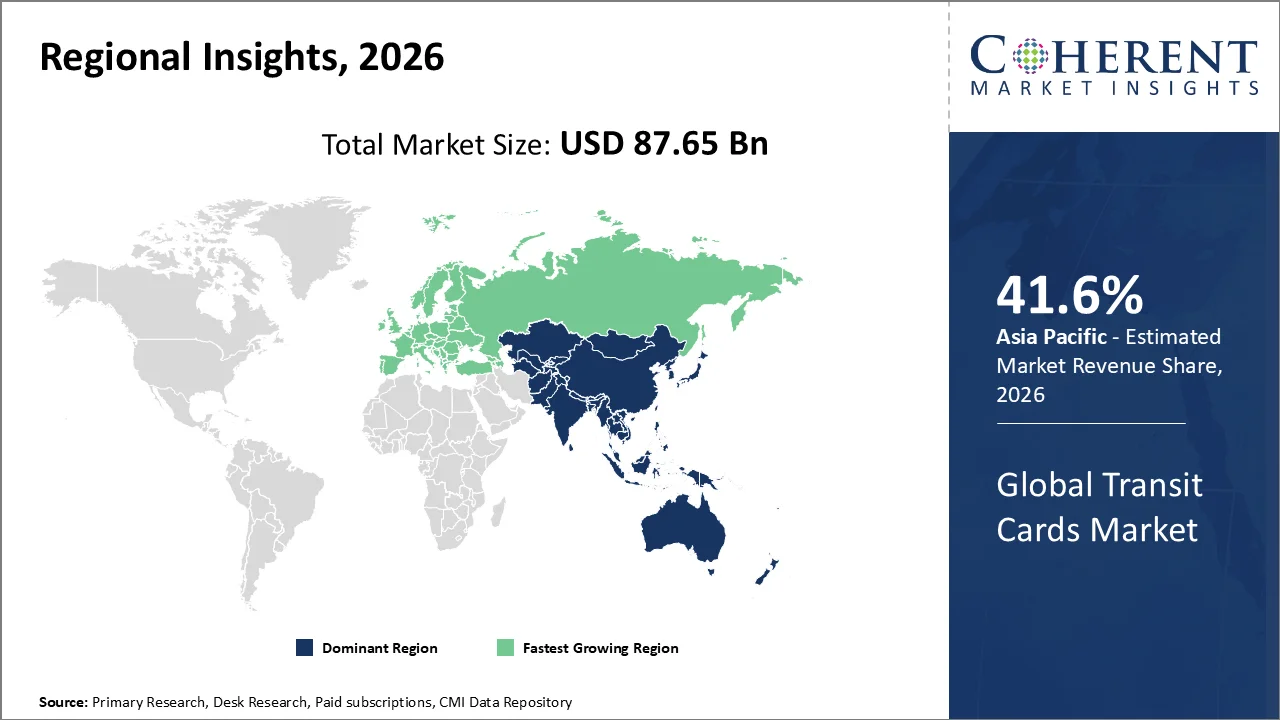
Asia Pacific Dominates Owing to the Dense Urban Transit Networks and Expanding Smart-Ticketing Infrastructure
The Asia Pacific region accounts for 41.6% of the market share in 2026. The region’s growth is owing to the dense urban transit networks, expanding smart-ticketing infrastructure, and rising adoption of interoperable fare media.
In India, the Press Information Bureau reported in March 2026 that the National Common Mobility Card was operational across 11 metro projects and 11 bus corporations, demonstrating wider integration of card-based fare systems across transport modes. Singapore’s Land Transport Authority states that its MRT network carries more than 3 million riders daily, providing a large recurring transaction base for stored-value and contactless fare cards.
In May 2025, LTA expanded its SimplyGo system to accept American Express contactless cards for public transport fare payments, alongside existing card options.
Europe Transit Cards Market Trends
Europe is expected to witness strong growth in market over the forecast period. The region’s growth is owing to the rapid transition from traditional stored-value cards toward interoperable contactless, account-based, and mobile ticketing across major public transport networks.
Transport for London reported in January 2026 that more than 90% of Tube and bus journeys are now made using contactless payment or Oyster cards, demonstrating the maturity of card-based fare collection and sustained demand for secure ticketing infrastructure.
This investment supports continued modernization, system scalability, and wider acceptance of contactless fare payment.
Expansion of Nationwide Transit Card Interoperability and Mobile Integration is Accelerating the Transit Cards Market in China
In China, the Transit Cards Market is influenced by nationwide interoperability, mobile wallet integration, and policies promoting seamless public transport payments. According to Beijing’s official government portal, upgraded Yikatong transit cards carrying the China T-union logo can be used across more than 300 cities, including Shanghai, Guangzhou, Shenzhen, Nanjing, Hangzhou, and Chengdu.
Italy Transit Cards Market Trends
Italy Transit Cards Market is expanding as transit agencies broaden contactless fare media and electronic validation. In Rome, ATAC reports that more than 2,700 contactless validators were activated across the metro network and surface vehicles, enabling credit, debit and prepaid card payments throughout the system.
In December 2025, Conduent launched an integrated EMV contactless system in Italy with Brescia Mobilità and Arriva Italia, enabling a single contactless payment journey across two participating transport networks. Conduent states that its fare-collection systems operate across more than 400 public-transit networks globally.
Who are the Major Companies in Transit Cards Industry
Some of the major key players in Transit Cards Market are Datacard Group, Gemalto N.V, Giesecke & Devrient GmbH, Beijing Watchdata Co., Ltd., Cardlogix Corporation, Infineon Technologies AG, Eastcompeace Smart Card Co., Ltd, and 4G Identity Solutions Pvt.
Key News
- In May 2026, LA Metro launched contactless credit and debit fare payment together with its official mobile application. The initiative is designed to reduce lines and make the system easier for residents and visitors to use.
- In April 2026, MTA introduced the AAR OMNY ID Card, providing Access-A-Ride customers with an optional cashless fare payment method. The card replaces legacy IDs and MetroCards, supports preloaded balances, automatic fare deduction, and free-trip benefits across eligible MTA services.
- In March 2026, Metlink introduced contactless Visa and Mastercard payments across Wellington buses and trains, enabling passengers to tag on and off using bank cards, phones, or smartwatches. The rollout represents the first step toward New Zealand’s Motu Move system.
Market Report Scope
Transit Cards Market Report Coverage
| Report Coverage | Details | ||
|---|---|---|---|
| Base Year: | 2025 | Market Size in 2026: | USD 87.65 Bn |
| Historical Data for: | 2020 To 2024 | Forecast Period: | 2026 To 2033 |
| Forecast Period 2026 to 2033 CAGR: | 6.79% | 2033 Value Projection: | USD 138.76 Bn |
| Geographies covered: |
| ||
| Segments covered: |
| ||
| Companies covered: | Datacard Group, Gemalto N.V, Giesecke & Devrient GmbH, Beijing Watchdata Co., Ltd., Cardlogix Corporation, Infineon Technologies AG, Eastcompeace Smart Card Co., Ltd, and 4G Identity Solutions Pvt | ||
| Growth Drivers: |
| ||
| Restraints & Challenges: |
| ||
Analyst Opinion
- Transit cards are driven by the scale of everyday urban mobility. Globally, metro systems alone span 247 networks across 202 cities, serving urban areas with more than 1 billion people. This means the market is not growing only because of digital-payment trends — it is supported by the recurring need to process enormous volumes of passenger journeys quickly and efficiently.
- Transit cards remain deeply embedded in established public-transport ecosystems. In Hong Kong, more than 24 million Octopus cards and products are in circulation, with approximately 15 million transactions processed every day and a penetration rate of around 98%. These figures demonstrate the scalability of stored-value and contactless transit-card systems.
- Contactless and account-based fare payments are gaining significant traction, transforming conventional transit cards into broader tap-and-go mobility platforms. By December 2025, around 94% of New York City subway and bus trips were being paid through tap-and-ride systems. This high adoption is expected to accelerate demand for NFC-enabled cards, smart fare media, interoperable ticketing, and integrated payment infrastructure across both developed and emerging public-transit networks.
Speak to the analyst
Want personalized insights?
Take the findings above to one of our principal consultants, or have the report rebuilt around the segments, geographies and competitors you actually track.
Market Segmentation
- By Product Type (Revenue, USD Bn, 2021-2033)
- Contactless Transit Cards
- Contact-based Transit Cards
- By Component (Revenue, USD Bn, 2021-2033)
- IC Micro Processor Cards
- IC Memory Cards
- Optical Memory Cards
- By Region (Revenue, USD Bn, 2021-2033)
- North America
- U.S.
- Canada
- Latin America
- Brazil
- Mexico
- Argentina
- Rest of Latin America
- Europe
- Germany
- U.K.
- France
- Italy
- Spain
- Russia
- Rest of Europe
- Asia Pacific
- China
- India
- Japan
- Australia
- South Korea
- ASEAN
- Rest of Asia Pacific
- Middle East
- GCC
- Israel
- Rest of Middle East
- Africa
- South Africa
- Central Africa
- North Africa
- North America
Sources
Primary Research Interviews
- Public transit authority officials
- Automated fare collection system managers
- Transit card manufacturers and solution providers
- Smart ticketing technology vendors
- Fare collection system integrators
- Metro, bus, and rail operators
- Payment technology and contactless payment providers
- Transport technology consultants and industry experts
Databases
- World Bank
- Organisation for Economic Co-operation and Development (OECD)
- Eurostat
- United Nations Department of Economic and Social Affairs (UN DESA)
- National transportation and public transit statistical databases
Magazines
- Mass Transit Magazine
- Metro Magazine
- Intelligent Transport
- Railway Technology Magazine
Journals
- Transportation Research Part A: Policy and Practice
- Journal of Public Transportation
- Public Transport
- Transport Policy
- Transportation Research Record
Newspapers
- The New York Times
- The Guardian
- The Wall Street Journal
- Financial Times
Associations
- International Association of Public Transport (UITP)
- American Public Transportation Association (APTA)
- Smart Ticketing Alliance
- Calypso Networks Association
- International Association for Transportation Ticketing (IATT)
Public Domain Sources
- Company Annual Reports and Investor Presentations
- Government Transportation Department Publications
- Public Transit Authority Annual Reports and Ridership Statistics
- Automated Fare Collection Tender and Procurement Documents
- National and Municipal Public Transport Statistics
- Smart Mobility and Digital Ticketing Policy Documents
Proprietary Elements
- CMI Data Analytics Tool
- Proprietary CMI Existing Repository of Information for Last 10 Years
Get access to 250+ pages report
Every segment, forecast, competitor profile and data table behind the analysis above — available for instant download.
- ESOMAR Member
- ISO 9001:2015 Certified
- D-U-N-S Registered
- GDPR & CCPA Compliant
Missing comfort of reading report in your local language? Find your preferred language:
Transform your Strategy with Exclusive Trending Reports
Frequently Asked Questions
The Transit Cards Market is expected to reach USD 138.76 Bn in 2033.
Major players operating in the global Transit Cards Market include Datacard Group, Gemalto N.V, Giesecke & Devrient GmbH, Beijing Watchdata Co., Ltd., Cardlogix Corporation, Infineon Technologies AG, Eastcompeace Smart Card Co., Ltd, and 4G Identity Solutions Pvt.
The rapid shift toward smartphone and contactless bank card payments (open-loop systems), high setup and infrastructure maintenance costs for transit authorities, strict data privacy regulations, and security concerns regarding financial data loss are the key factors hampering growth of the market.
The rapid urbanization, rising commuter mobility, government push for cashless and smart cities, and the deployment of fast contactless automated fare collection (AFC) systems is boosting the demand for Transit Cards.
The Transit Cards Market is anticipated to grow at a CAGR of 6.79% between 2026 and 2033.
Among regions, Asia Pacific is expected to account for a largest market share in the global Transit Cards Market over the forecast period.
The market outlook remains positive due to rapid urbanization, smart city initiatives, and a widespread shift toward cashless, contactless digital payments.