

Tubeless Insulin Pump Market Size and Share Analysis - 2026 To 2033
The Tubeless Insulin Pump Market size is anticipated to grow at a CAGR of 20.1% with USD 3.17 Bn in 2026 and is expected to reach USD 11.41 Bn in 2033. The primary drivers are defined by rising diabetes prevalence, growing demand for discreet and user-friendly insulin delivery, increasing adoption of automated glucose management systems, and expanding reimbursement and digital-health support. According to the International Diabetes Federation, approximately 589 million adults aged 20–79 was living with diabetes worldwide in 2024. This is strengthening demand for disposable pods, patch pumps, handheld controllers, continuous glucose monitoring integration, smartphone connectivity, personalized dosing features, and direct-to-patient distribution across hospitals, pharmacies, e-commerce platforms, and diverse regional global healthcare markets.
Key Takeaways
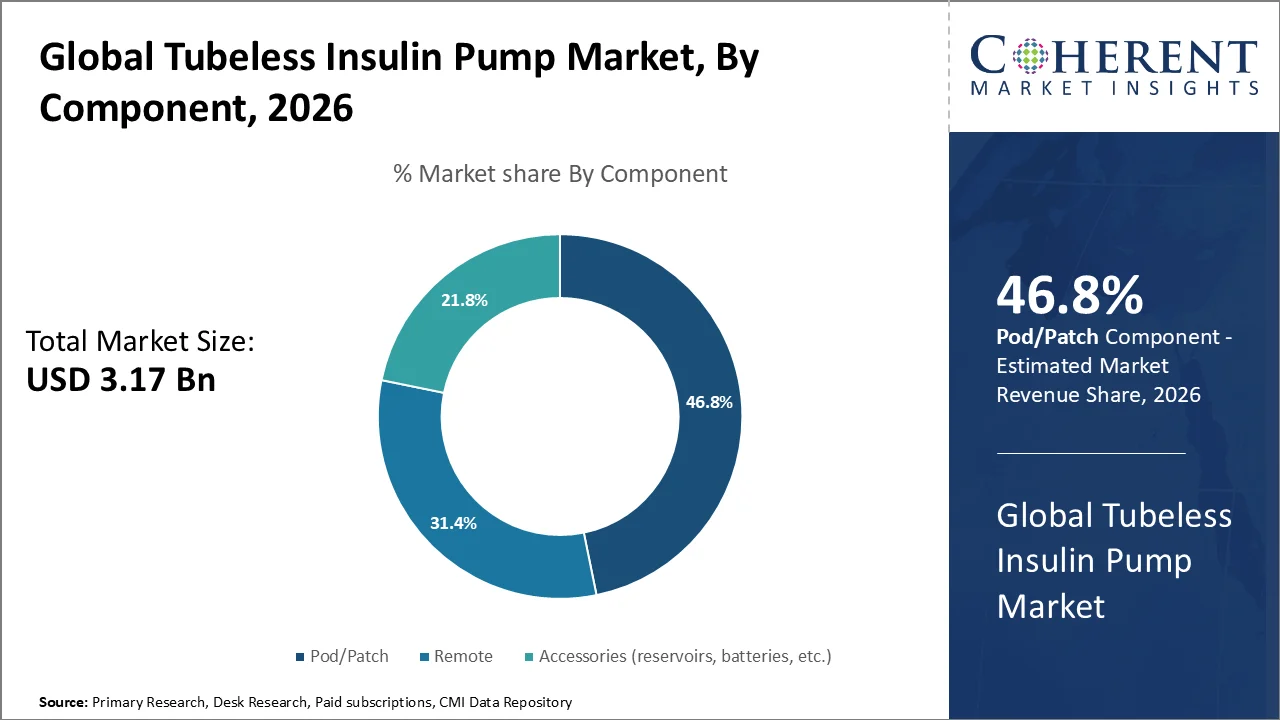
- The pod/patch segment is likely to dominate the market with 46.8% in 2026. The segment’s growth is owing to the wearable, tube-free design, disposable configuration, and integration with continuous glucose monitoring.
- The hospitals segment is set to lead with 55.6% in 2026. The segment’s growth is owing to the high diabetes patient volumes, availability of endocrinologists, and structured pump initiation and training programs.
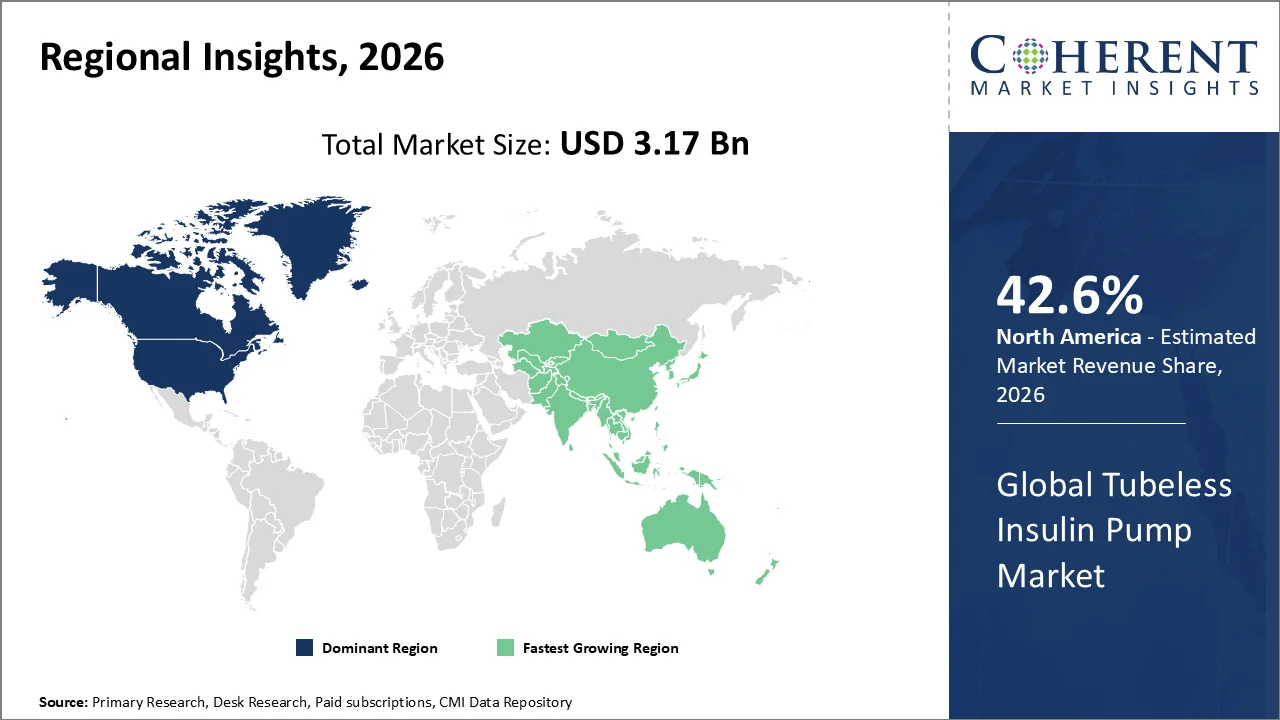
- North America is expected to acquire the prominent share of 42.6% in 2026. The region’s growth is owing to the substantial diabetes burden, favorable reimbursement, and early adoption of automated insulin technologies.
Segmental Insights
Why is Pod/Patch Segment Acquiring the Largest Share?
On the basis of component, the pod/patch segment is projected to account for the largest Tubeless Insulin Pump Market share of 46.8% in 2026. The segment’s growth is owing to its compact, body-worn design, elimination of external tubing, simplified insulin delivery, and compatibility with automated glucose-management systems.
The demand is supported by a substantial insulin-dependent population. The CDC estimated that 29.7 million Americans had diagnosed diabetes, while 1.7 million adults reported having type 1 diabetes and using insulin. Pod-based systems also reduce repeated injection burden and provide programmable basal and bolus dosing during everyday activities.
- Current Industry Events of 2026
- Market Size Estimation
- Regional Breakdown
- Competitive Landscape
- Customer Intelligence
- Segmental Analysis
- Pricing Analysis
- Key Market Drivers, Challenges & Future Trends
- Customized Insights Section
Hospitals hold the Largest Market Share
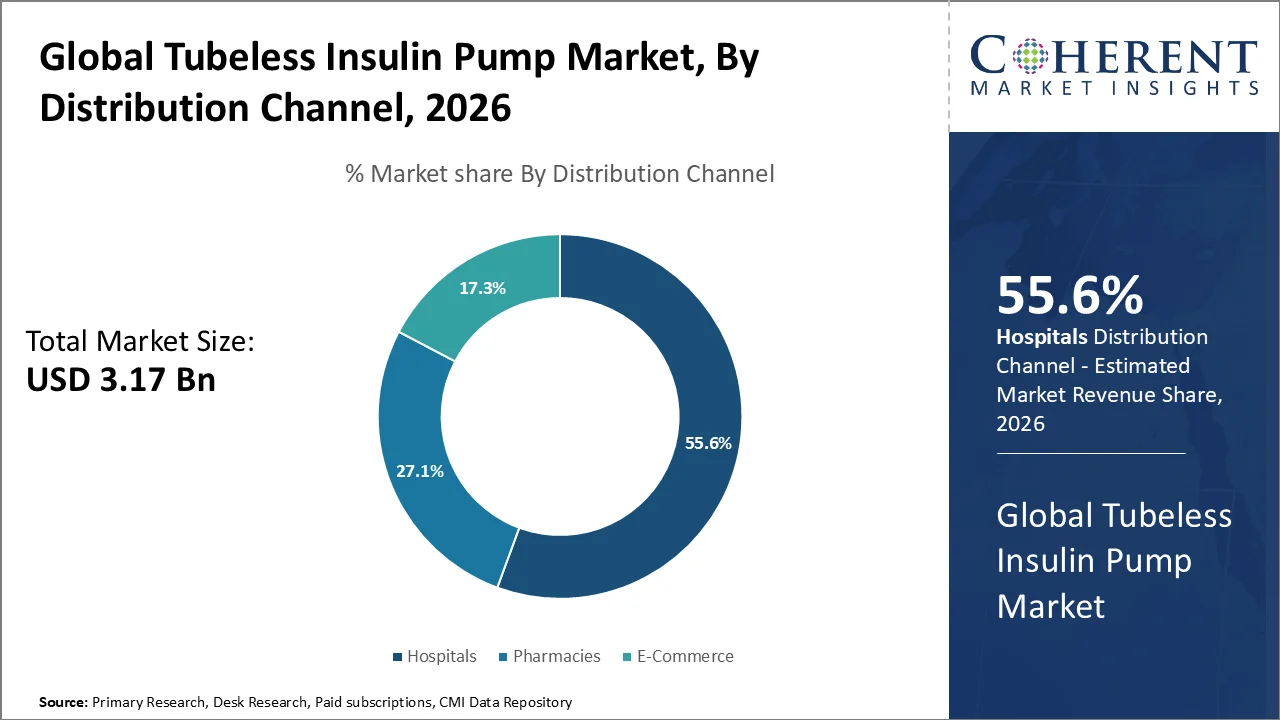
On the basis of distribution channel, the hospitals segment lead with a major 55.6% share in 2026. The growth is owing to the hospital endocrinology departments, diabetes clinics, and trained educators that assess pump suitability, prescribe and procure devices, initiate therapy, configure basal and bolus settings, and monitor patients during their transition from injections.
CDC surveillance also recorded 8.25 million hospital discharges involving diabetes as any listed diagnosis among U.S. adults, highlighting hospitals’ central role in complication management, insulin-therapy optimization, and the distribution of advanced diabetes-management devices.
ClinicalTrials.gov lists a multicenter, randomized crossover study evaluating the Omnipod 5 SmartAdjust 2.0 system in people with type 1 or type 2 diabetes. Such hospital-supported clinical evaluation, procurement, prescription, device dispensing, onboarding, and follow-up strengthen hospitals as a major distribution channel for modern tubeless insulin-pump technologies worldwide.
Market Drivers
Continuous Glucose Monitor Integration Is Transforming the Tubeless Insulin Pump Market in the U.S.
Continuous glucose monitor integration is transforming tubeless insulin pumps in the U.S. It allows for real-time glucose-responsive insulin delivery. Integrated systems continuously transmit glucose readings to an embedded dosing algorithm, which can increase, decrease, or temporarily suspend insulin delivery according to the predicted glucose movement.
Dexcom G7 provides glucose readings every five minutes and features a 30-minute warm-up period, a 12-hour replacement grace period, and an all-in-one sensor that is 60% smaller than Dexcom G6. These features reduce interruptions between sensor sessions and make connected pump therapy more convenient and discreet for patients.
In June 2025, Insulet made the Omnipod 5 iPhone application with Dexcom G7 integration available to all eligible U.S. users. The integration allows patients to connect the Dexcom G7 sensor with the tubeless Omnipod 5 system and also manage the insulin delivery directly through a compatible iPhone.
Tubeless Automated Insulin Delivery: A Major Breakthrough in the Market
Tubeless automated insulin delivery integrates three core technologies: an on-body pump, a continuous glucose monitor, and an algorithm that automatically modifies insulin delivery. Unlike conventional pumps, the wearable pod is attached directly to the skin and does not require external infusion tubing. The system receives glucose information from a compatible sensor and delivers small insulin adjustments based on the user’s glucose target and predicted glucose direction.
In March 2026, Insulet announced results from its EVOLUTION 2 feasibility study of a fully closed-loop system for adults with type 2 diabetes. Participants achieved 68% time in range without delivering meal boluses. In May 2026, the company initiated the EVOLVE pivotal study and stated that it plans to support an FDA filing in 2027. These advances could make pump therapy more practical for type 2 diabetes patients who find carbohydrate counting, correction calculations, or mealtime dosing difficult.
Current Events and Their Impact on the Tubeless Insulin Pump Market
Current Event | Description and its Impact |
2025 Medicare Part D Redesign and Insulin Cost-Sharing Changes in the U.S.
|
|
2026 FDA Cybersecurity Guidance for Connected Medical Devices |
|
Tubeless Insulin Pump Market Trends
- The rising demand for wearable, tubeless insulin delivery devices is improving the overall convenience, mobility, treatment adherence, as well as discretion for diabetes patients.
- The integration of tubeless pumps with continuous glucose monitors and automated insulin delivery algorithms is allowing for real time dose adjustment and better glycemic control.
- Smartphone-controlled pumps, waterproof pods, extended wear duration, and wider sensor compatibility is strengthening the product adoption among children, adults, and active users.
- The growing diabetes prevalence is expanding the patient pools and increasing the demand for insulin management solutions. The CDC’s 2026 update estimates 40.1 million people in the U.S. have diagnosed or undiagnosed diabetes, representing 12.0% of the population, while 2.1 million people have type 1 diabetes. Tubeless automated systems are expanding into insulin-requiring type 2 diabetes, with Omnipod 5 cleared for about six million U.S. patients.
- The supportive insurance coverage and pharmacy-based reimbursement is broadening the access to disposable patch pumps, thus boosting market participation. Medicare Part D plans may cover certain disposable Medicare also limits covered insulin costs to USD 35 per month, although the patch pump device may cost more.
Regional Insights
North America Dominates Owing to the Early Technology Adoption and Favorable Commercial Access
The North America region accounts for 42.6% of the market share in 2026. The region’s growth is owing to the high diagnosed diabetes burden, established endocrinology networks, strong adoption of CGM, early FDA authorization of interoperable systems, and widespread availability of tubeless pumps through prescription and pharmacy channels.
The IDF separately estimates that 38.5 million adults aged 20–79 were living with diabetes in the U.S. in 2024 and that the country had the highest diabetes-related healthcare expenditure globally.
In June 2026, Modular Medical announced U.S. commercial availability of its FDA-cleared Pivot tubeless insulin patch pump. Designed for insulin-dependent adults using daily injections, Pivot offers a removable two-part design, 3 mL reservoir, flexibility, and phased expansion beginning in Q4 2026.
Asia Pacific Tubeless Insulin Pump Market Trends
Asia Pacificis expected to witness strong growth in market over the forecast period. The region’s growth is owing to the large diabetes population, rising healthcare expenditure, increasing adoption of CGM, expansion of private hospitals, improving awareness of pump therapy, and entry of international and regional patch-pump manufacturers.
China and India represent the largest long-term opportunity. The IDF estimates that China had 148 million adults aged 20–79 living with diabetes in 2024, the highest number worldwide, while India had 89.8 million, the second-highest total. India’s diabetes population is projected to reach approximately 156.7 million by 2050.
In November 2025, Renu MedTech unveiled InsuPatch, a tubeless insulin patch pump developed for India. The system targets precise, stable insulin delivery with low power consumption and is designed for local climate, clothing, daily routines, and significantly lower pricing access.
Early Regulatory Approvals and Large Insulin-treated Population is Accelerating the Tubeless Insulin Pump Market in United States
The U.S. is the largest individual market for tubeless insulin pumps because of early regulatory approvals, pharmacy-based access, extensive CGM adoption, and a large insulin-treated population. The CDC estimated that 115.2 million people in the country had prediabetes in 2023. Diabetes prevalence and the number of patients progressing to insulin treatment create a substantial recurring requirement for pumps, pods, sensors, and associated software.
In May 2026, Beta Bionics updated commercialization plans for its Mint tubeless insulin patch pump, targeting U.S. launch by June 2027, subject to FDA clearance. Mint is expected to feature smartphone control, CGM compatibility, a 200-unit reservoir, and three-day wear.
Australia Tubeless Insulin Pump Market Trends
Australia is emerging as an important Asia Pacific market owing to its established diabetes services, public and private healthcare infrastructure, high digital-health adoption, and early availability of advanced pump and CGM technologies. The International Diabetes Federation estimates that approximately 1.7 million Australian adults aged 20–79 were living with diabetes in 2024. The total is projected to increase to approximately 2.2 million by 2050.
In March 2025, Insulet commercially launched Omnipod 5 in Australia with compatibility for Dexcom G6 and G7 sensors and announced plans to add Abbott’s FreeStyle Libre 2 Plus. The launch enabled Australian patients to access a tubeless automated insulin delivery system using multiple CGM options.
Who are the Major Companies in Inflatable Tent Industry
Some of the major key players in Tubeless Insulin Pump Market are Medtronic Plc., Medtrum Technologies, Inc., Tandem Diabetes Care, Insulet Corporation, and Animas Corporation.
Key News
- In July 2026, Insulet launched the Omnipod 5 automated insulin delivery system and Omnipod Discover platform in Spain, expanding tubeless diabetes technology access. The launch made Spain Omnipod 5’s twentieth market and enabled compatibility with Abbott and Dexcom glucose sensors.
- In July 2026, Medtrum advanced its 300-unit tubeless patch pump toward a German launch after presenting it at DDG 2026 and securing reimbursement-directory inclusion. The higher-capacity TouchCare Nano option supports larger insulin needs and strengthens the company’s European diabetes-technology expansion.
Market Report Scope
Tubeless Insulin Pump Market Report Coverage
| Report Coverage | Details | ||
|---|---|---|---|
| Base Year: | 2025 | Market Size in 2026: | USD 3.17 Bn |
| Historical Data for: | 2020 To 2024 | Forecast Period: | 2026 To 2033 |
| Forecast Period 2026 to 2033 CAGR: | 20.1% | 2033 Value Projection: | USD 11.41 Bn |
| Geographies covered: |
| ||
| Segments covered: |
| ||
| Companies covered: | Medtronic Plc., Medtrum Technologies, Inc., Tandem Diabetes Care, Insulet Corporation, and Animas Corporation. | ||
| Growth Drivers: |
| ||
| Restraints & Challenges: |
| ||
Analyst Opinion
- The Tubeless Insulin Pump Market growth is supported by the growing type 1 diabetes burden. Around 9.2 million people across all age groups live with type 1 diabetes worldwide. Demand is not driven by convenience alone—it is supported by lifelong insulin-delivery needs and the requirement for consistent glucose management.
- Children and adolescents represent a major addressable patient population. Approximately 1.8 million young people worldwide live with type 1 diabetes and may require frequent insulin administration, continuous glucose monitoring, and long-term support from parents, caregivers, and healthcare professionals.
- Modern tubeless automated insulin delivery is gaining significant traction, with real-world evidence showing time in range improving from 57.3% to 67.3% after adoption. Better glucose control, discreet wearability, fewer injections, and integration with continuous glucose monitoring are expected to further support market growth, encouraging broader use among children and adults and strengthening demand across hospitals, pharmacies, and digital distribution channels globally.
Speak to the analyst
Want personalized insights?
Take the findings above to one of our principal consultants, or have the report rebuilt around the segments, geographies and competitors you actually track.
Market Segmentation
- By Component (Revenue, USD Bn, 2021-2033)
- Pod/Patch
- Remote
- Accessories (reservoirs, batteries, etc.)
- By Distribution Channel (Revenue, USD Bn, 2021-2033)
- Hospitals
- Pharmacies
- E-commerce
- Global Tubeless Insulin Pump Market, By Region (Revenue, USD Bn, 2021-2033)
- North America
- U.S.
- Canada
- Latin America
- Brazil
- Mexico
- Argentina
- Rest of Latin America
- Europe
- Germany
- U.K.
- France
- Italy
- Spain
- Russia
- Rest of Europe
- Asia Pacific
- China
- India
- Japan
- Australia
- South Korea
- ASEAN
- Rest of Asia Pacific
- Middle East
- GCC
- Israel
- Rest of Middle East
- Africa
- South Africa
- Central Africa
- North Africa
- North America
Sources
Primary Research Interviews
- Endocrinologists
- Diabetologists
- Certified diabetes care and education specialists
- Hospital administrators
- Diabetes clinic managers
- Insulin pump users and caregivers
- Medical device distributors
- Healthcare procurement professionals
- Payers and reimbursement experts
- Key opinion leaders (KOLs) in diabetes management
Databases
- World Health Organization (WHO)
- International Diabetes Federation (IDF) Diabetes Atlas
- Centers for Disease Control and Prevention (CDC)
- National Institutes of Health (NIH)
- U.S. Food and Drug Administration (FDA)
- Organisation for Economic Co-operation and Development (OECD)
Magazines
- Endocrine News
- Diabetes Self-Management
- diaTribe
- MedTech Dive
Journals
- Diabetes Care
- Diabetes Technology & Therapeutics
- Journal of Diabetes Science and Technology
- The Lancet Diabetes & Endocrinology
- Diabetologia
Newspapers
- The New York Times
- The Guardian
- The Wall Street Journal
- Financial Times
Associations
- American Diabetes Association (ADA)
- European Association for the Study of Diabetes (EASD)
- International Diabetes Federation (IDF)
- Diabetes Technology Society (DTS)
- Association of Diabetes Care & Education Specialists (ADCES)
Public Domain Sources
- Company annual reports and investor presentations
- Government health ministry publications
- FDA medical device and regulatory databases
- National diabetes registries
- Reimbursement and insurance policy documents
- Clinical trial registries such as ClinicalTrials.gov
Proprietary Elements
- CMI Data Analytics Tool
- Proprietary CMI Existing Repository of Information for Last 10 Years
Get access to 250+ pages report
Every segment, forecast, competitor profile and data table behind the analysis above — available for instant download.
- ESOMAR Member
- ISO 9001:2015 Certified
- D-U-N-S Registered
- GDPR & CCPA Compliant
Missing comfort of reading report in your local language? Find your preferred language:
Transform your Strategy with Exclusive Trending Reports
Frequently Asked Questions
The Tubeless Insulin Pump Market is expected to reach USD 11.41 Bn in 2033.
Major players operating in the global Tubeless Insulin Pump Market include Medtronic Plc., Medtrum Technologies, Inc., Tandem Diabetes Care, Insulet Corporation, and Animas Corporation.
The high device and consumable costs, limited insurance reimbursement policies, and technical and clinical risks like diabetic ketoacidosis the key factors hampering growth of the market.
The rising global prevalence of diabetes, continuous technological innovations in wearable medical devices, and a strong patient preference for discreet and convenient insulin delivery is boosting the demand for Inflatable Tent.
The Tubeless Insulin Pump Market is anticipated to grow at a CAGR of 20.1% between 2026 and 2033.
Among regions, North America is expected to account for a largest market share in the global Tubeless Insulin Pump Market over the forecast period.
The global Tubeless Insulin Pump Market is on a steady upward trajectory owing to the growing diabetes rates and technological upgrades.