

Medical Gas Analyzers Market Size and Forecast — 2026 - 2033
The Global Medical Gas Analyzers Market size is estimated to be valued at USD 1.56 billion in 2026 and is expected to reach USD 2.45 billion by 2033, exhibiting a compound annual growth rate (CAGR) of 6.7% from 2026 to 2033.
Overview
The global medical gas analyzers market is witnessing steady growth due to increasing demand for accurate gas monitoring in hospitals, ambulatory surgical centers, and diagnostic laboratories. These analyzers are widely used to measure oxygen, carbon dioxide, nitrous oxide, and anesthetic gases, ensuring patient safety and regulatory compliance during surgeries and respiratory therapies. Rising surgical procedures, expansion of healthcare infrastructure, and growing prevalence of chronic respiratory diseases are major growth drivers. Technological advancements such as infrared and electrochemical sensing technologies, portable analyzers, and automated monitoring systems are further supporting market expansion. North America leads the market, while Asia-Pacific is emerging rapidly.
Key Takeaways
The multi-gas analyzer segment dominates the market, driven by multifunctionality and efficiency in hospital and clinical settings.
Infrared technology remains the leading choice due to its accuracy, reliability, and non-intrusive measurement capability.
North America holds the largest market share, supported by advanced healthcare infrastructure and strict regulatory frameworks promoting adoption.
Asia Pacific, particularly China and India, is the fastest-growing region, fueled by increasing healthcare investments, expanding medical facilities, and rising demand for advanced diagnostics.
Medical Gas Analyzers Market Segmentation Analysis
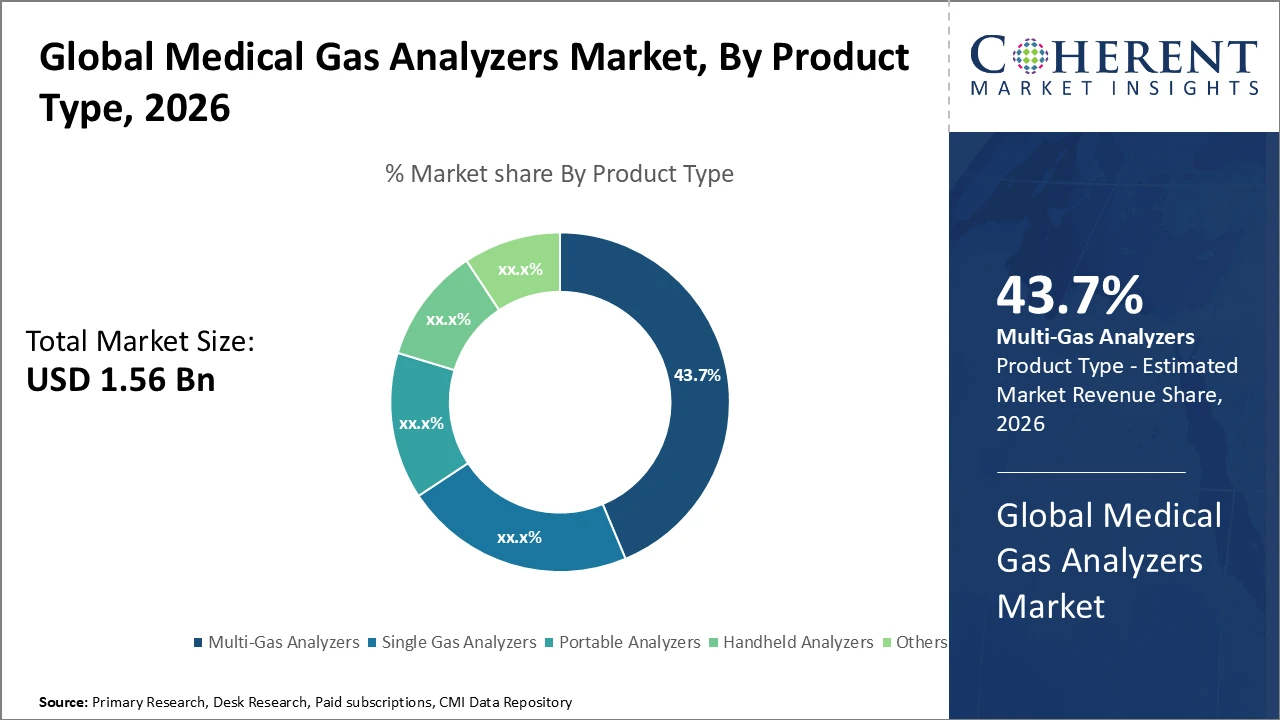
Medical Gas Analyzers Market Insights, By Product Type
Multi-Gas Analyzers dominate the medical gas analyzers market due to their ability to monitor multiple gases simultaneously, enhancing efficiency and reducing errors in clinical settings. Hospitals increasingly adopt these devices for monitoring oxygen, carbon dioxide, and nitrogen in a single platform, minimizing operational footprint. Portable Analyzers represent the fastest-growing subsegment, driven by demand in emergency and ambulatory care for rapid deployment and convenience. Single Gas Analyzers remain relevant for applications requiring specific gas measurement, while Handheld Analyzers are preferred for compact, point-of-care use.
Medical Gas Analyzers Market Insights, By Technology
Infrared Gas Analyzers dominate the medical gas analyzers market due to their non-invasive measurement methods, high sensitivity, and versatility across multiple gases, making them a preferred choice in hospitals for reliable and accurate monitoring. Electrochemical Gas Analyzers are the fastest-growing subsegment, driven by cost-effectiveness and precision in detecting specific gases such as oxygen and carbon monoxide.
Medical Gas Analyzers Market Insights, By End User
Hospitals account for the largest market share due to the high complexity and volume of surgical procedures, which require precise gas monitoring and strict adherence to safety regulations. Ambulatory Surgical Centers represent the fastest-growing subsegment, driven by the trend toward outpatient procedures and cost-efficient healthcare delivery. Diagnostic Laboratories primarily use medical gas analyzers for research and quality control, while Research Institutions adopt advanced analyzers to enhance the accuracy of studies involving medical gas mixtures.
Medical Gas Analyzers Market Trends
Integration of AI-powered analytics within medical gas analyzers enables proactive maintenance and anomaly detection, enhancing reliability and operational efficiency. Siemens Healthineers’ AI-integrated analyzers were adopted by over 250 medical centers globally during 2025-2026, reducing downtime by around 20%.
Growing emphasis on sustainability is driving the development of low-energy consuming devices that comply with green standards, aligning with environmental regulations and hospital efficiency goals.
Miniaturization of analyzers is a key trend, with increasing demand for portable and handheld devices in emergency medicine. Sales of portable analyzers grew by 18% in 2026 compared to 2024.
Medical Gas Analyzers Market Insights, By Geography
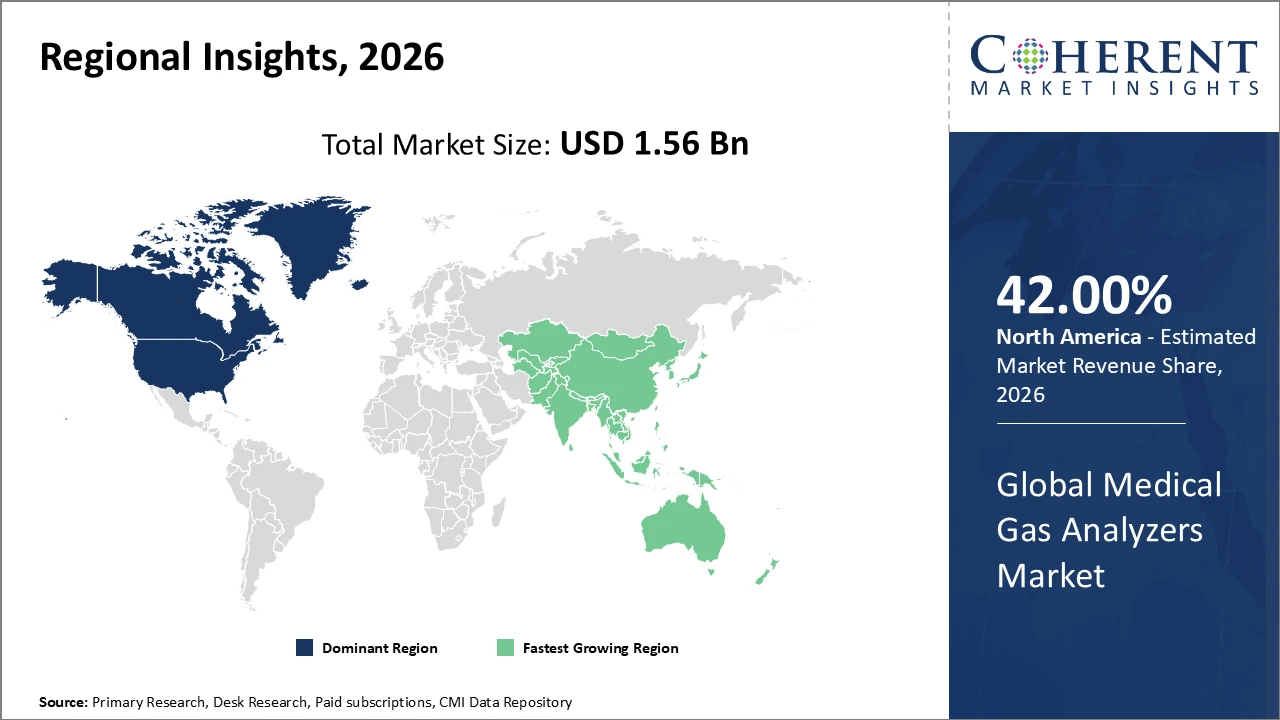
North America Medical Gas Analyzers Market Analysis and Trends
In North America, the Medical Gas Analyzers market is led by advanced healthcare infrastructure, a high prevalence of chronic and acute conditions necessitating continuous gas monitoring, and stringent regulatory oversight from bodies such as the FDA. The region accounted for roughly 42% of the global market share in 2026. Major players like GE Healthcare and Honeywell have strengthened their presence through targeted investments in product innovation, AI-enabled analytics, and comprehensive service networks. Additionally, hospitals and specialized care centers increasingly adopt multi-gas and portable analyzers, further solidifying North America’s position as the dominant regional market for medical gas analyzers.
Asia Pacific Medical Gas Analyzers Market Analysis and Trends
The Asia Pacific region demonstrates the fastest growth in the medical gas analyzers market, with a CAGR of approximately 9.1%. This expansion is fueled by rapid urbanization, rising healthcare access in rural areas, and supportive government initiatives in countries such as China and India. Significant investments in hospital infrastructure, alongside increasing awareness of medical gas safety and compliance, further bolster market adoption. Key industry players are strategically enhancing regional partnerships and establishing local manufacturing facilities to meet growing demand efficiently. These factors collectively position Asia Pacific as a high-potential market for medical gas analyzer solutions.
Medical Gas Analyzers Market Outlook for Key Countries
USA Medical Gas Analyzers Market Analysis and Trends
The USA’s medical gas analyzers market is witnessing steady growth, fueled by substantial healthcare expenditure and strict regulatory standards. By 2025, over 85% of U.S. hospitals had adopted multi-gas analyzers, driven by patient safety initiatives and reimbursement policies favoring advanced monitoring technologies. Companies such as Siemens Healthineers and Drägerwerk have tailored service models for the U.S. market, focusing on reducing operational costs, enhancing analyzer uptime, and providing rapid maintenance support. Additionally, increasing adoption of portable and handheld analyzers in emergency care and ambulatory settings further strengthens market expansion, positioning the U.S. as a key contributor to global medical gas analyzer revenues.
Germany Medical Gas Analyzers Market Analysis and Trends
Germany’s medical gas analyzers market demonstrates steady growth, driven by a strong healthcare infrastructure, high hospital density, and stringent patient safety regulations. Hospitals remain the primary end users, with increasing adoption of multi-gas and infrared analyzers to ensure accurate monitoring during surgeries and critical care. The market is witnessing innovation-led expansion, with companies like Drägerwerk and Siemens Healthineers introducing AI-enabled and portable analyzers tailored for German clinical standards. Rising government investments in hospital modernization, coupled with growing awareness of gas monitoring safety protocols, are further bolstering demand. Overall, Germany remains a mature yet innovation-focused market within Europe’s medical gas analyzer landscape.
Analyst Opinion
Increasing adoption of multi-gas analyzers is driving market growth, with these systems accounting for 54% of total share in 2025. A 2024 U.S. hospital case study showed a 30% reduction in gas monitoring errors after deployment.
Pricing trends favor mid-tier analyzers with advanced features, with a 12% price decline between 2024 and 2026 improving accessibility for mid-sized hospitals. Imports from China and India contributed 28% of global revenue in 2025.
Emerging markets, particularly Asia Pacific, are witnessing strong demand, with India and China recording 15%–18% year-on-year growth in installations in 2025 due to healthcare infrastructure expansion.
Supply-side disruptions from semiconductor shortages in early 2024 temporarily impacted production, but recovery occurred by Q3 2025 as U.S. manufacturers expanded capacity, stabilizing supply chains.
- Current Industry Events of 2026
- Market Size Estimation
- Regional Breakdown
- Competitive Landscape
- Customer Intelligence
- Segmental Analysis
- Pricing Analysis
- Key Market Drivers, Challenges & Future Trends
- Customized Insights Section
Market Scope
| Report Coverage | Details | ||
|---|---|---|---|
| Base Year: | 2025 | Market Size in 2026: | USD 1.56 billion |
| Historical Data for: | 2020 To 2024 | Forecast Period: | 2026 To 2033 |
| Forecast Period 2026 to 2033 CAGR: | 6.7% | 2033 Value Projection: | USD 2.45 billion |
| Geographies covered: |
| ||
| Segments covered: |
| ||
| Companies covered: | Siemens Healthineers, GE Healthcare, ABB Ltd., Nova Biomedical, BOC Healthcare, Horiba, Ltd., Danaher Corporation, Thermo Fisher Scientific Inc., Emerson Electric Co. | ||
| Growth Drivers: |
| ||
Medical Gas Analyzers Market Growth Factors
The growing complexity of surgical procedures and the need for precise anesthetic gas monitoring are key drivers of market expansion, prompting hospitals to invest in analyzers that ensure accurate gas delivery. In 2025, North American hospital procurement budgets for medical gas analyzers increased by around 14%. Regulatory mandates, including FDA and European Medical Device Regulation updates since 2024, have further accelerated adoption. Technological innovations, such as integration with hospital information systems and portable designs, are creating new opportunities. Additionally, rising healthcare spending in emerging economies led India and China to boost investments by nearly 20% in critical care analyzers in 2026.
Medical Gas Analyzers Market Development
In April 2026, Perma Pure and Maxtec merged under the new parent company, Salaera, creating a global platform focused on advanced breath and gas system technologies for respiratory care, diagnostics, life sciences, air-quality monitoring, and industrial gas analysis.
Key Players
Leading Companies of the Market
Siemens Healthineers
GE Healthcare
ABB Ltd.
Nova Biomedical
BOC Healthcare
Horiba, Ltd.
Danaher Corporation
Thermo Fisher Scientific Inc.
Emerson Electric Co.
Several leading companies in the medical gas analyzers market are focusing on aggressive innovation and strategic expansion to strengthen their competitive position. Siemens Healthineers introduced a new range of smart gas analyzers with AI-enabled predictive analytics in 2025, helping reduce maintenance downtime by 22% across hospitals using its systems. Drägerwerk expanded its distribution network across Asia Pacific, increasing its regional market share by 8% in 2026 through improved accessibility and localized support. Meanwhile, Honeywell integrated IoT capabilities into its analyzer portfolio in 2024, enabling remote monitoring solutions that were adopted by over 100 hospitals globally within two years.
Medical Gas Analyzers Market Future Outlook
The Medical Gas Analyzers Market is poised for substantial growth, driven by increasing demand for point-of-care diagnostics, advanced monitoring in critical care, and integration with hospital information systems. Emerging trends include portable and wireless analyzers, AI-assisted predictive analytics, and multi-gas simultaneous measurement capabilities, enhancing clinical efficiency and patient safety. Rising prevalence of chronic respiratory and cardiovascular conditions, coupled with the expansion of home healthcare services, further fuels market adoption. Additionally, regulatory support for accurate gas monitoring and investments in healthcare infrastructure across Asia Pacific and Latin America are expected to create new revenue opportunities, positioning the market for steady global expansion through 2033.
Medical Gas Analyzers Market Historical Analysis
The Medical Gas Analyzers Market has experienced steady growth over the past decade, driven by increasing hospitalizations, surgical procedures, and intensive care needs. Between 2018 and 2025, advancements in analyzer accuracy, miniaturization, and integration with digital monitoring systems enhanced clinical adoption, particularly in developed regions like North America and Europe. Rising awareness of patient safety and compliance with regulatory standards for medical gases further supported market expansion. Historically, critical care and anesthesia applications dominated demand, while point-of-care and portable analyzers gradually gained traction. Incremental R&D investments and technological innovations laid the foundation for the current robust and diversified market landscape.
Sources
Primary Research Interviews:
Engineers, R&D managers, and product developers from companies manufacturing medical gas analyzers and related monitoring equipment.
Technical specialists from hospitals, surgical centers, and laboratories using medical gas analyzers.
Industry experts from firms providing critical care monitoring systems, anesthesia delivery devices, and point-of-care diagnostic solutions.
Magazines:
MD+DI (Medical Device and Diagnostic Industry) – Updates on product innovations, analyzer launches, and clinical applications.
Clinical Laboratory News – Trends in patient monitoring, gas analysis technologies, and device adoption.
Hospital Management Asia – Insights into hospital equipment procurement and analyzer usage in clinical settings.
Journals:
Journal of Clinical Monitoring and Computing – Research on gas analyzer performance, accuracy, and clinical outcomes.
Anesthesia & Analgesia – Studies on medical gas monitoring in surgical and ICU environments.
Critical Care Medicine – Insights on respiratory support and anesthesia gas monitoring interventions.
Newspapers:
The Wall Street Journal – Company strategies, mergers, and investments in medical gas analyzer manufacturers.
Financial Times – Market trends, regulatory updates, and global demand for monitoring equipment.
Reuters – News on technological advancements, product launches, and healthcare standards.
Bloomberg – Corporate performance and global market insights in medical device and analyzer segments.
Associations:
American Society of Anesthesiologists (ASA) – Guidelines on anesthesia and medical gas monitoring standards.
Association for the Advancement of Medical Instrumentation (AAMI) – Standards and safety protocols for gas analyzers and monitoring equipment.
World Health Organization (WHO) – Global guidelines and safety recommendations for medical gas usage and monitoring.
Get access to 250+ pages report
Every segment, forecast, competitor profile and data table behind the analysis above — available for instant download.
- ESOMAR Member
- ISO 9001:2015 Certified
- D-U-N-S Registered
- GDPR & CCPA Compliant
Missing comfort of reading report in your local language? Find your preferred language:
Transform your Strategy with Exclusive Trending Reports
Frequently Asked Questions
Major players include Siemens Healthineers, Nova Biomedical, BOC Healthcare, and GE Healthcare, each offering extensive portfolios spanning multi-gas, single-gas, and portable analyzers with advanced technological features.
The market is expected to reach USD 2.45 billion by 2033, growing at a CAGR of 6.7% from 2026, driven by rising hospital investments, regulatory compliance, and technological adoption.
Hospitals hold the largest growth potential due to complex procedures, patient safety mandates, and the need for continuous gas monitoring.
Key trends include IoT-enabled analyzers, portable and handheld devices, AI integration for predictive maintenance, and seamless connection with hospital information systems.
The market is highly competitive, with players focusing on innovation and strategic partnerships; challenges include supply chain disruptions, pricing pressures, and adherence to evolving regulatory standards.
Companies emphasize regional expansion, strategic alliances, continuous R&D, and the launch of advanced analyzers to enhance accessibility, operational efficiency, and patient safety compliance.