Key Takeaways
- IEC and NEMA systems were developed from different design philosophies. Both are used to deliver reliable electrical performance.
- NEMA equipment is generally larger and built around broader operating margins. It is widely used across North American industrial facilities.
- IEC systems are typically more compact and are common in international markets. Enclosure space is often a factor in those applications.
- The differences between IEC vs NEMA electrical standards go beyond physical dimensions. Sizing methods vary. Protection strategies differ. Serviceability and enclosure design do as well.
- IP vs NEMA enclosure ratings are frequently discussed together. They were not developed to evaluate exactly the same conditions.
- IEC-based designs are often associated with lower material usage and smaller panel footprints.
- NEMA continues to be a common choice where ruggedness matters. Flexibility and maintenance accessibility remain important considerations in many facilities.
- Application requirements usually influence the decision more than the standard itself.
- Location matters. Compliance requirements matter. Operating conditions and maintenance expectations also play a role in the final selection.
Introduction: Two Philosophies, One Goal
When discussing industrial electrical systems, two standards appear more often than any others: IEC and NEMA.
Both were developed around the same basic objective. Electrical equipment must operate safely, consistently, and reliably in real-world environments.
NEMA (National Electrical Manufacturers Association) standards, has long been the dominant framework throughout the U.S. and much of North America.
IEC standards, developed by the International Electrotechnical Commission, are used across Europe, Asia, and many other international markets.
The distinction is not simply regional.
Equipment designed around NEMA requirements is often built with a broader operating range in mind.
IEC equipment tends to be selected more closely around the application itself. Ratings, duty requirements, and component selection are often tied directly to the expected workload.
The effects show up in places that are not always obvious at first.
Panel layouts. Enclosure size. Spare-parts inventories. Maintenance planning.
Manufacturing companies increasingly work across multiple markets. A machine designed in one country may be installed somewhere else entirely. Different standards often end up inside the same project.
For machine builders, electrical engineers, and export-focused manufacturers, familiarity with both systems is becoming routine.
Design Philosophy: Over-built vs. Right-sized
The differences between IEC and NEMA electrical standards are easiest to see in the way equipment is selected.
NEMA: The “Tank” Approach
NEMA equipment is often described as over-built.
The term is usually not intended as criticism.
Many NEMA components are designed with additional operating margin. Loads change. Applications evolve. Equipment is sometimes asked to do more than originally expected.
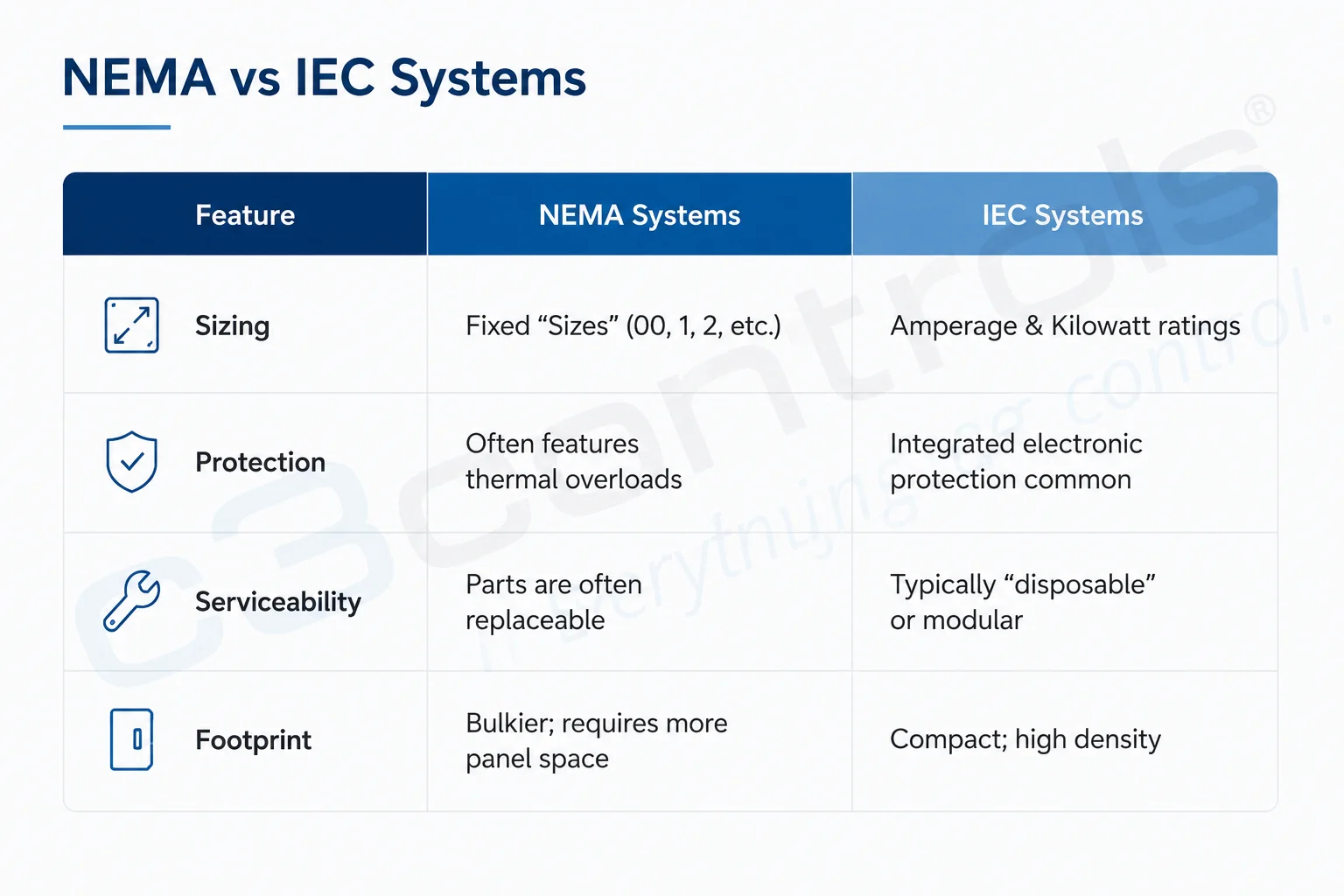
A NEMA motor starter can often cover a wider horsepower range than a comparable IEC device.
Heavy industrial facilities have traditionally been comfortable with that approach.
- Operating conditions are not always predictable.
- Neither are future modifications.
- Equipment may remain in service for many years.
- Sometimes much longer than originally planned.
The extra margin generally comes with larger physical dimensions. Control panels built around NEMA equipment often require more space than comparable IEC-based designs.
Not every facility views that as a problem.
IEC: The “Scalpel” Approach
IEC standards developed around a different philosophy.
Instead of building additional capacity into the component, the goal is usually to match the component more closely to the application.
- Duty cycle matters.
- Operating conditions matter.
- Load characteristics matter.
- Equipment is often smaller as a result.
OEM manufacturers producing equipment for international markets have helped drive widespread adoption of IEC-based designs. Compact control panels are common. So are applications where enclosure space is limited from the beginning.
The differences become more noticeable when panels become crowded.
- Smaller components allow more devices to fit inside the same enclosure.
- Selection also becomes more important.
- Design margins are generally narrower.
- A poorly selected component has less room to hide.
Key Technical Comparisons
Many of the visible components look surprisingly similar.
A contractor still functions as a contractor. A motor starter still performs the same basic job.
The differences are usually found elsewhere.
Sizing
Walking through an older North American manufacturing facility and oversized equipment is not unusual.
That preference influenced NEMA sizing.
Instead of selecting from highly specific ratings for every application, devices were grouped into standard size categories capable of covering a broader range of motor horsepower requirements.
Plant operators often appreciated the flexibility.
IEC sizing developed differently.
Selection is normally based on the actual electrical demands of the application. Current ratings, operating conditions, and expected duty all influence the final choice.