Every production environment generates heat. The question is whether your cooling system is keeping up.
In laser cutting, injection molding, and semiconductor processing, temperature control isn't a background concern rather it's directly tied to yield, cycle time, and how long your equipment lasts. A few degrees of drift doesn't show up as a single catastrophic failure. It shows up as slightly longer cycles, slightly higher defect rates, and maintenance intervals that creep closer together. The cost is real; it's just spread thin enough to ignore until it isn't.
For mid-scale facilities without access to centralized water infrastructure, air cooled industrial water chillers have become the practical default — easier to install, simpler to maintain, and competitive on total cost of ownership. Whether one belongs in your facility depends on your heat load, your environment, and your operational priorities. That's what this guide works through.
What Is an Air Cooled Industrial Water Chiller?
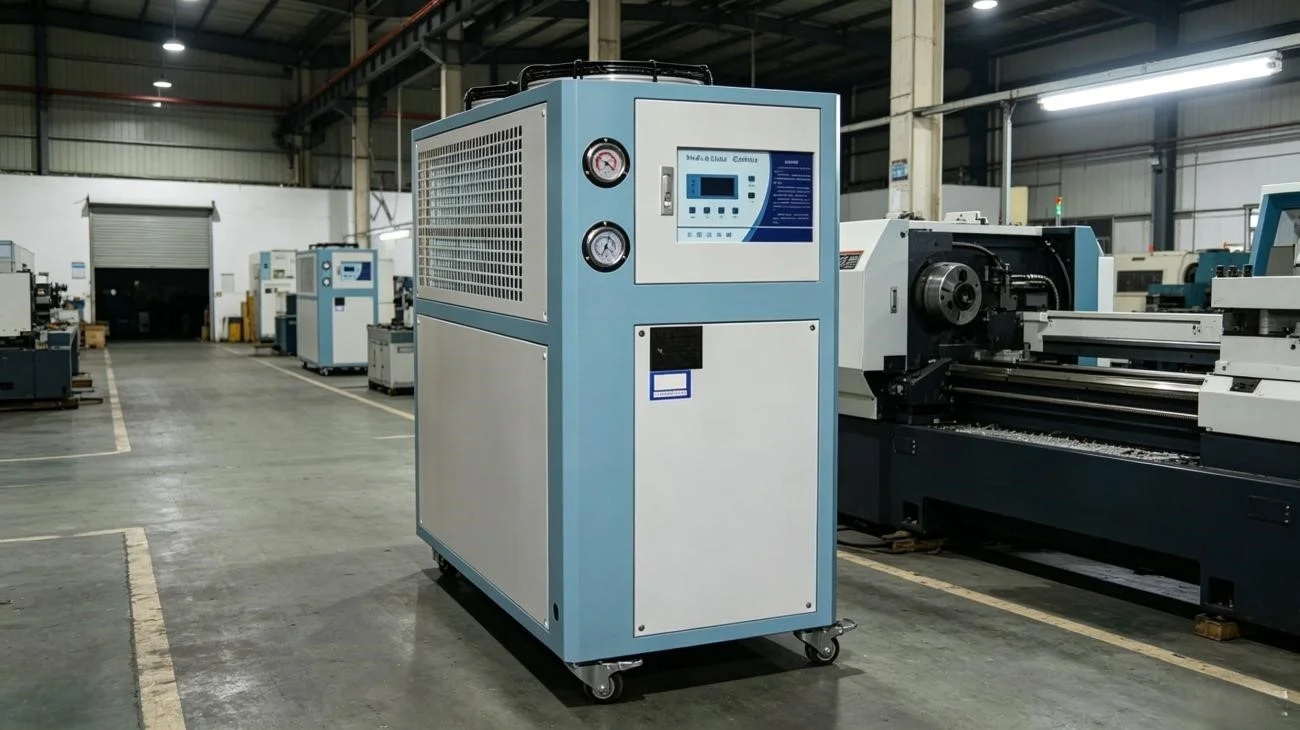
An air cooled industrial water chiller is a self-contained refrigeration system that removes heat from process water and dissipates it directly into the ambient air without requiring an external water source for heat rejection.
How it works: Refrigerant absorbs heat from the process fluid via an evaporator. The heated refrigerant is then compressed and routed to an air-cooled condenser, where fans blow ambient air across the coils to release the heat. The cooled refrigerant cycles back to repeat the process.
Key components include
- Hermetic or semi-hermetic compressor (scroll or reciprocating type)
- Air-cooled condenser with axial fans
- Shell-and-tube or brazed-plate evaporator
- Expansion valve and refrigerant circuit
- Microprocessor-based temperature controller
Most air cooled chillers in this category range from 0.5 to 20 tons, which covers the majority of small-to-mid-scale industrial needs. Operating temperatures typically fall between 3°C and 45°C, and higher-end models with PID control can hold setpoints within ±0.5°C.
The bigger advantage is what they don't require. No cooling tower. No condenser water loop. No water treatment program. Commissioning comes down to connecting power, process water supply, and return lines — and the unit runs. For facilities that lack water infrastructure or simply want to avoid the ongoing cost of managing it, that independence is worth a lot.
Air Cooled vs. Water Cooled Chiller: Key Comparison
Both technologies deliver reliable industrial cooling, but their suitability varies sharply by application context. The table below captures the five dimensions that matter most at the decision stage:
|
Factor
|
Air Cooled Chiller
|
Water Cooled Chiller
|
|
Installation
|
Simple; no cooling tower or condenser water piping required
|
Complex; requires cooling tower, pump, and extensive piping
|
|
Upfront Cost
|
Lower capital expenditure
|
Higher initial investment
|
|
Water Consumption
|
Minimal — process water only
|
High; significant evaporative losses through cooling tower
|
|
Maintenance
|
Condenser coil cleaning and periodic fan inspection
|
Cooling tower water treatment, pump maintenance, water quality management
|
|
Energy Efficiency
|
Moderate; performance influenced by ambient temperature
|
Higher COP in stable indoor environments with controlled condensing temperatures
|
|
Ideal Capacity Range
|
0.5 Ton to 20 Ton
|
20 Ton and above
|
Beyond the table, two practical points are worth noting.
First, footprint: air cooled units are compact and placement-flexible — outdoor installation is common and often preferable — whereas water cooled systems require dedicated mechanical room space for the tower and associated equipment.
Second, ambient sensitivity: air cooled performance does decline in high ambient temperatures, which means proper site selection and airflow planning are essential steps, not afterthoughts. For facilities in water-scarce regions, subject to water use regulations, or simply looking to minimize infrastructure complexity, air cooled technology is the more pragmatic path in the sub-20 Ton range.
Sizing and Capacity Spectrum
Micro to Small-Scale (0.5 Ton to 5 Ton / 1–6 HP)
For precision laboratories, single CNC spindles, or small injection molding machines, a compact air cooled chiller delivers tight temperature control — up to ±0.5°C on higher-spec models — without sacrificing valuable floor space.
- 3 HP / 2.5 Ton air cooled chillers
Single laser systems or lab cooling where footprint matters as much as output
- 4 HP / 3.5 Ton & 5 HP / 4 Ton air cooled chillers
Mid-scale plastic processing and multi-head laser cutting lines with capacity margin built in
Mid to Large-Scale (5 Ton to 20 Ton / up to 20 HP)
For heavy-duty operations running 24/7 — plastics injection molding lines, multi-station fiber laser systems, or centralized cooling across multiple production lines — rugged scroll compressors from Copeland or Danfoss handle sustained heat loads without performance degradation.
- 10–20 Ton (12–20 HP) air cooled chillers
Consolidates what would otherwise require multiple smaller units, simplifying maintenance and reducing overall system complexity
4 Critical Factors to Consider Before Buying
This is the section that drives your decision. Work through each factor systematically before committing to a configuration.
1. Site Conditions
Space and placement. Air cooled chillers need room to breathe — typically 1 to 1.5 meters of clearance on intake sides and above for condenser airflow. That said, they can go outdoors or in any well-ventilated area, which gives facilities with tight mechanical rooms more options than tower-dependent systems ever would.
Ambient temperature. This is the one spec buyers most often overlook. Condenser capacity drops as ambient temperature rises, and manufacturer ratings are usually tested at 35°C. If your site runs hotter than that — whether from climate or nearby heat-generating equipment — the rated capacity isn't your actual capacity. Derate before you size.
Water availability. In regions with water restrictions or high municipal water costs, the closed-loop design of an air cooled chiller has real value. Process water circulates internally with minimal losses. There's no cooling tower makeup water to manage, no treatment program to maintain, and no consumption to report.
2. Process Requirements
Cooling capacity: Accurately calculate your total heat load in Tons or kW, accounting for all heat sources: process heat, pump heat, and pipeline heat gain. Apply a 10–15% margin and size to that figure — not the bare minimum. Under sizing leads to insufficient cooling and continuous full-load operation; oversizing causes short-cycling and premature compressor wear.
Temperature precision: Temperature precision is the next variable to pin down. Laser cutting, pharmaceutical manufacturing, and precision injection molding typically require ±1°C or better. Entry-level units usually deliver ±2°C; models with PID controllers can reach ±0.5°C. Know what your process actually needs before comparing specs.
Continuous operation: Consider how your operation runs. A facility on shift cycles has different demands than one running 24/7. For continuous-duty applications, dual-compressor configurations are worth the premium — one circuit rests while the other runs, and the system lasts significantly longer as a result.
3. Budget and Operating Costs
Air cooled chillers carry lower upfront installation costs — no cooling tower civil works, no condenser water piping, and no chemical treatment program. Operating costs are slightly higher per ton due to lower COP compared to water cooled systems, but for capacities in the 1–15 Ton range, the total cost of ownership over a 10-year horizon typically favors air cooled technology. Factor in water costs, water treatment chemicals, and tower maintenance labor when making the comparison as these are often underestimated in initial budget projections.
4. Industry Applications
Injection molding lives and dies by temperature consistency. Hold the mold steady, and cycle times shorten, scrap rates drop. Let it drift, and you're pulling bad parts off the line. Laser cutting and welding have a different vulnerability — resonators and optical components don't tolerate heat well. By the time thermal drift shows up as a visible defect, the damage is already done. Food and beverage lines have a different concern: temperature control here is as much about regulatory compliance as it is about product quality. Pharmaceutical manufacturing takes that further, where GMP requirements mean cooling systems for reactors, fermenters, and clean rooms need to be documented, validated, and consistently within spec.
Key Parameters and Purchasing Guidance
Selecting the right air cooled industrial water chiller comes down to matching specifications to your actual process requirements — not just nominal tonnage.
Critical parameters to evaluate
- Ton/HP rating: Common industrial sizes run 2.5 Ton (3 HP), 3.5 Ton (4 HP), 4 Ton (5 HP), continuing up to 20 Ton (20 HP). Match to your derated heat load, not the bare process requirement.
- Temperature control range: Standard operating range is 3°C–45°C. Confirm the unit maintains setpoint accuracy across your full range of seasonal ambient variation — not just at nominal test conditions.
- Compressor brand and type: Scroll compressors from Copeland, Danfoss, or Panasonic offer higher reliability, quieter operation, and better part-load efficiency versus reciprocating types. This is one area where brand specification directly affects long-term performance.
- Controller capability: Microprocessor controllers with digital display, alarm outputs, and remote monitoring or BACnet/Modbus connectivity are preferable for industrial integration. Verify alarm logging and fault history access.
- Refrigerant type: R-410A and R-32 are the current environmentally compliant standards. Avoid units using legacy R-22 or R-404A — replacement refrigerant costs and availability will create increasing operational challenges.
Common selection mistakes to avoid
- Sizing to peak load without duty cycle analysis — intermittent processes that short-cycle an air cooled chiller will see dramatically reduced compressor life.
- Overlooking ambient temperature derating — a unit rated at 5 Ton at 35°C may deliver only 4.2 Ton at 42°C ambient. Know your site conditions.
- Evaluating purchase price without total cost of ownership — a compressor upgrade that adds 8% to the unit price typically pays back within 18–24 months at continuous duty.
Conclusion
There is no universally "best" water chiller — only the one that best fits your facility's conditions, process requirements, and long-term operating economics. For the majority of small-to-mid-scale industrial applications, an air cooled industrial water chiller delivers the right combination of installation simplicity, water efficiency, and cost-effective performance.

