

In dynamic product environments, managers tend to have confusion over roles and responsibilities, misaligned priorities, and late product launches. These types of challenges make it difficult for organizations to convert insights into actions. So, knowing the difference between a product owner and a product manager in your organization will help you determine which one is right to grow your company’s success. Additionally, tools like Yellowfin BI, Tableau, Power BI, etc. help improve decision-making processes, turn insights into to-do lists, and keep projects on track.
How are Product Owner and Product Manager Roles Defined?
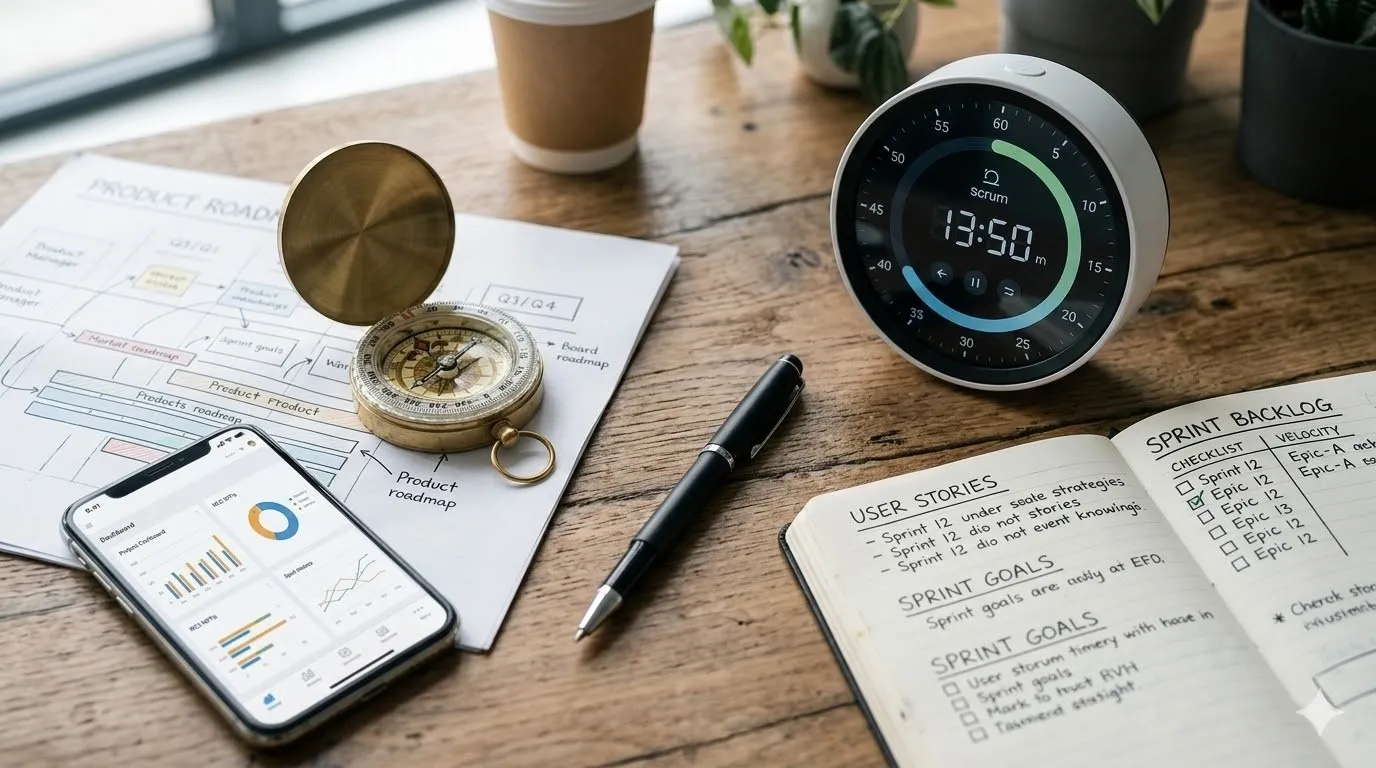
Ideally, the two roles provide product success but at different ends. Therefore, to learn more about product owner vs product manager, it is vital to learn more about their origins and their focus.
Product Owner
For an Agile and Scrum product, the Product Owner represents the customer within the development team.
- Represents stakeholders and end users to rearrange the product backlog.
- Defines the feature done, which makes deliverables match business value.
- Organizes sprint, develops user stories.
Product Manager
The strategist hat is utilized by Product Managers who are responsible for the product life-cycle, from idea to the point of sunset. Therefore, they play a vital role in technology and start-up firms.
- Conducts market research, competitive analysis, and roadmap planning.
- Balances the user needs, business interest, and technicality.
- Collaborates with sales, marketing, and engineering teams.
What’s the Major Difference Between a Product Owner and a Product Manager?
Scope, authority, and skills reduce the product owner vs product manager debate to a few things. Here's a clear comparison:
|
Aspect |
Product Owner |
Product Manager |
|
Focus |
Backlog and sprint execution |
Full product lifecycle and strategy |
|
Reporting Line |
Often to the Scrum Master or the dev lead |
Typically, to the VP of Product or C-suite |
|
Key Skills |
Prioritization, user story writing |
Market analysis, road-mapping, metrics |
|
Authority |
Tactical decisions in Agile teams |
Strategic influence across organizations |
What are the Key Responsibilities of a Product Owner and a Product Manager?
Every day activities show more distinction between the product owner and product manager roles.
Product Owner Day-to-Day
- Break epic stories into action stories that have acceptance criteria.
- Get stand-up and also be available to conduct retrospectives to clear any blockers.
- Authenticate releases to business ROI.
Examples: In a financial tech app burst, the PO ensures that the fraud-detection features offered by the app have an accuracy of 99% on release.
Product Manager Day-to-Day
- Pivot strategies based on KPIs like churn and NPS.
- Conduct customer interviews and A/B tests.
- Buy-in and budget pitch to executives.
Example: A PM, at an e-commerce platform, spots rising cart abandonment via analytics, then blueprints custom recommendations.
How do Product Owner and Manager Responsibilities Differ Across Companies?
The duties of product owners and product managers may vary with the size and structure of the company, yet the main duties remain unchanged.
Startup
- In many cases, the two roles may be assigned to one person because of the lack of resources.
- Focus is on speed, market fit, and early user feedback
Mid-sized Company
- Separating PM and PO enables better execution and strategic planning.
- Collaboration ensures smoother sprints and an aligned roadmap
Large Enterprise
- There are several POs and PMs for various products or teams.
- Clear KPIs, structured processes, and advanced analytics tools are crucial.
When to Hire a Product Owner vs Product Manager?
Selecting between a product owner vs product manager is based on your phase and company. Thus, the PM vision is required in early-stage teams, whereas PO accuracy is required in scaling organizations.
|
Product Owner |
Product Manager |
|
Your development team has no direction. |
Product strategy doesn’t meet business objectives. |
|
Sprints tend to either perform below expectations or not at all. |
Product decisions are not based on customer insights. |
|
Client feedback is not turning into action work. |
Want to expand your product or enter into new markets |
Combining both motives in product-led organizations and product strategy leads to outcomes. For vision, leaders begin with PMs and add POs for execution.
How do Product Owners and Managers Work Collectively?
Although they play different roles, Product Owners and Product Managers need to work closely together to deliver value. Here’s how they work together:
What they have in common
- Help you execute on customer needs and measurable outcomes
- Measure the identical key metrics (retention, activation, revenue)
- Answer to business results
How they collaborate daily
- PM & PO: From the 6-month High-Level Roadmap to the Sprint Backlog
- PO issues operational stops → PM pivots or resets priorities
- Daily standups both for alignment
- Joint roadmap refinement
In real teams, roles are often combined; one person does both until the business grows enough to hire specialists.
What are the Common Challenges Faced by Product Owner and a Product Manager?
Even the product owners and managers encounter problems that may delay delivery or affect the strategy. Thus, learning about these pitfalls will assist groups in making plans and working with each other.
Product Owner
- Overloaded backlog without clear priorities
- Conflicting stakeholder demands
- Challenges in balancing short-term delivery with long-term vision
Product Manager
- Insufficient insight into technical constraints
- Breach of Development Team Stage Execution
- Lack of sufficient analytics tools to measure success
Which One Does Your Team Need?

Determine your areas of pain to be in this checklist:
- High development rate yet poor market fit? It is wise to consider a Product Manager first.
- Good vision and sprint backlogs? → Introduce Product Owner.
- Budget tight? Begin by having a PM who is versatile and capable of PO.
Conclusion
The product owner vs product manager is not about taking sides; it is a matter of identifying roles to fit your purposes. Hence, POs are relentless; PMs are aggressive in their strategy. Their combination drives product-led growth. To handle complex data and competing priorities, match the right role with a modern BI and analytics platform such as Yellowfin BI, Tableau, etc., which could turn insights into action so your team can make informed decisions and perform performance management.
Disclaimer: This post was provided by a guest contributor. Coherent Market Insights does not endorse any products or services mentioned unless explicitly stated.






 Contact Us