

Backlinks still decide who wins the click, even as AI summaries, ads, and endless SERP clutter push organic links lower. In a 2026 Editorial.Link survey, 73.2 percent of SEO leaders said high-quality links increase their odds of appearing in AI search snapshots. For enterprise sites, one toxic backlink risks a manual penalty, while a single authority mention can unlock millions in pipeline. We assessed ten vendors on link quality, ROI, enterprise readiness, pricing clarity, and support, then ranked the six partners that meet Fortune-level standards. Let's dive in.
How we picked the winners
We started where any enterprise team would: the data. First, we pulled the top twenty Google results for queries such as "enterprise link building services" and "best link outreach agency." Most pages were thinly veiled pitch decks, often written by agencies crowning themselves number one. Few tackled the headaches that Fortune-level brands face: capacity, compliance checks, or rock-solid SLAs.
Next, we listened to practitioners. Six authoritative listicles and four Reddit r/SEO threads highlighted recurring pain points: inflated "DA 50-plus" guest posts on zero-traffic sites, pricey retainers that lock you in, and the ever-present fear of hidden PBN footprints. These frontline stories kept our scoring system honest.
Finally, we verified claims with hard evidence. We sifted through public case studies, Clutch reviews, and, when needed, direct emails to sales reps to pin down real pricing and recent results. If a vendor could not supply an enterprise case study or transparent pricing range, we cut it.
The five-point scorecard
- Link quality and relevance (30 percent)
- Measured ROI from published case studies (25 percent)
- Enterprise readiness (scale, compliance, multilingual reach) (20 percent)
- Pricing transparency and value (15 percent)
- Support depth and reporting rigor (10 percent)
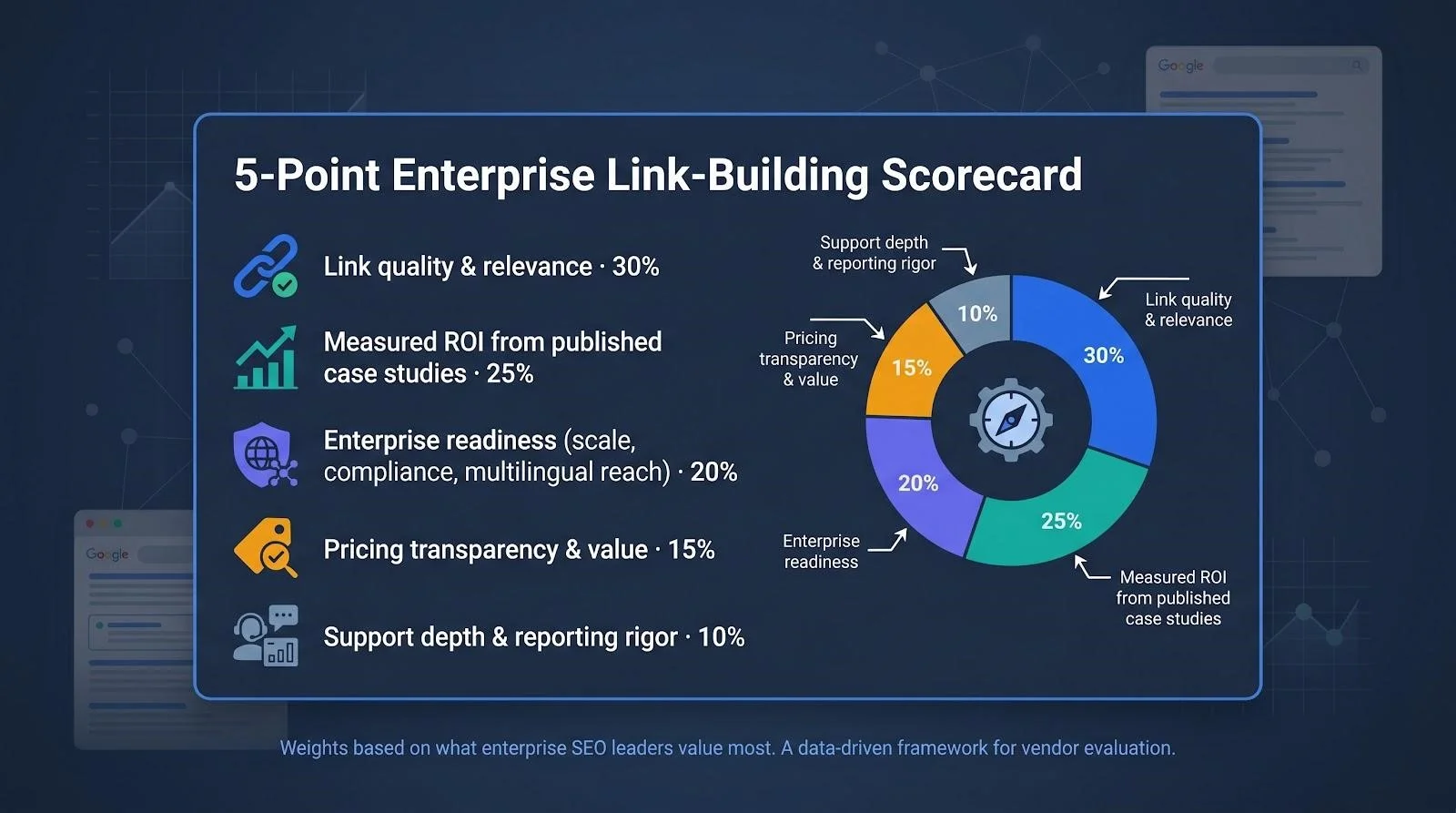
This framework mirrors what 85 percent of SEO experts still value most: links that meaningfully strengthen brand authority. We applied it to an initial list of ten respected agencies and shortlisted the six that cleared every bar.
The result is a ranked lineup you can trust, free of pay-to-play placements and packed with metrics you can drop straight into an RFP.
1. Outreach Labs: links that rank in Google and get cited by AI from the same campaign
Outreach Labs is built around a single bet that other agencies still treat as a side feature: a campaign should pay off twice. The same outreach push that earns enterprise rankings should also surface your brand inside ChatGPT, Perplexity, and Google AI Overviews, in the same week, not 60 days later. Founder Ajay Paghdal has run SEO programs for over a decade, and a senior strategist (no juniors) owns every account.
The proof is in recent enterprise campaigns. A global IT-distribution enterprise landed 63 links with 43 in Google's top 10, including 24 at position #1, and 52 AI citations across buyer queries. A compliance-automation SaaS earned 36 links and showed up across 320 distinct AI queries, named in 136 of them. A consumer VPN provider hit 63 links, 54 top-10 rankings, 29 at #1, and 104 AI citations, named in 70. The pattern enterprise buyers care about: top-10 rankings AND AI mentions, tracked from one program.
The approach threads the risk-vs-impact-vs-investment needle. Every prospect is screened off the client's own SERP scrapes, content is written so both the client and the guest site benefit, anchor distribution follows a documented plan, and the link mix is re-evaluated quarterly. No PBN footprints, no templated blasts, no pattern-matching that scares Google.
Pricing is published and budget-based: $850, $1,499, $2,999, $4,999, and $6,999 per month. Each link's value (DR, traffic, type) is deducted from the monthly budget, unspent budget rolls over, and there are no contracts. Most tiers carry a one-time setup fee. That structure beats FatJoe on quality, beats Authority Builders on transparency, and undercuts uSERP and Page One Power at the enterprise end while delivering the GEO layer those competitors don't bundle.
Choose Outreach Labs when you need rankings AND AI visibility on the same timeline, with a senior strategist running the account and pricing you can sign off on without a procurement cycle.
2. Page One Power: fully managed firepower for big brands
Page One Power pairs scale with editorial discipline. The Boise agency secures more than fifteen thousand links each year across a thousand client campaigns. One Fortune-level ecommerce site gained more than one hundred DR-78-average links in twelve months and lifted non-brand traffic by thirty-five percent.
The model blends custom content with outreach. Strategists build data studies and interactive tools, then outreach specialists pitch them to journalists, universities, and niche blogs. Links land inside evergreen resources, not churn-and-burn guest posts, which strengthens both rankings and referral traffic.
Enterprise fit comes standard. Each account receives a dedicated pod, SEO strategist, project manager, and outreach team, that plugs into existing workflows. Legal teams can pre-approve anchor text, and security reviews follow documented processes.
Investment reflects scope. Industry reviews place entry retainers around three thousand five hundred dollars per month, rising with volume or content production. Typical engagements run six to twelve months, long enough for compounding gains yet still procurement-friendly.
Choose Page One Power when your SEO department wants a plug-and-play extension that delivers authoritative links at scale without constant oversight.
3. Siege Media: content-driven PR that earns links and headlines
While some agencies chase backlinks, Siege Media crafts stories publishers want to feature. The San Diego team blends newsroom instincts with SEO rigor, turning data studies, interactive tools, and striking infographics into coverage on Forbes, TechCrunch, and key industry trades.
Results back the approach. A project-management SaaS client recorded a 493 percent lift in traffic value for its resources section in six months. Fintech brand Stash saw a 540 percent surge in organic traffic within one year of its campaign. Numbers like these move executive teams faster than a spreadsheet of guest posts.
Partnership feels like hiring a mini content studio. Strategists mine proprietary data for headlines, designers create visuals worth embedding, and outreach specialists secure placements inside real journalism. Each link arrives with both authority and referral traffic, lifting credibility alongside rankings.
Investment matches ambition. Engagements start near five to ten thousand dollars per month, bundling content production and outreach. Pricing is campaign-based, not cost-per-link, and brands that fund two flagship assets per quarter usually see the strongest returns.
Choose Siege Media when you want to turn in-house data into press-worthy narratives that translate visibility into compounding ranking gains.
4. uSERP: high-authority editorial links for SaaS and tech
When your product targets developers, founders, or IT leaders, links belong in the publications those audiences visit. uSERP has spent the past five years building relationships across tech media, including HubSpot, Entrepreneur, ZDNet, and TechCrunch. Rather than publishing generic guest posts, the team places your experts inside editorial features, podcast transcripts, and thought-leadership columns.
The numbers back the approach. Industry reviews credit uSERP with securing domain-rating-eighty-plus links for brands such as Robinhood and monday.com, with starter retainers near ten thousand dollars per month for focused outreach.
Each campaign begins with a performance brief that ties link targets to revenue goals. Trying to rank "cloud backup software" or lower customer acquisition cost on a funnel page? Strategists map keywords to content assets and craft outreach angles that deliver fresh quotes or proprietary data. Because these links live in content that already earns organic traffic, you gain ranking signals and qualified referral sessions.
There are limits. Monthly volume usually stays in the single digits, and the roster tilts toward English-language tech sites. Brands that require dozens of links per quarter often pair uSERP with a capacity provider. For B2B software firms chasing competitive keywords, however, few agencies match this consistency of high-authority placements.
Select uSERP when logo placement inside trusted tech journalism matters more than maximizing raw link count.
5. Fatjoe: fast, menu-based links for teams with a plan
When you already have target pages mapped and require reliable capacity, Fatjoe delivers. The U.K. marketplace lets you log in, order ten DA-forty guest posts or thirty niche edits, and track each placement from draft to live link in a tidy dashboard.
Productized pricing keeps costs clear. As of 2026 a DR-thirty guest post runs about one hundred thirty dollars, while a DR-fifty option costs roughly three hundred seventy, based on independent pricing roundups. No retainers and no discovery calls. You simply add items to the cart and check out.
Link quality sits in the "good but not Forbes" tier. Placements come from real blogs with modest organic traffic rather than household names. That range supports anchor-text diversity and mid-tier keyword battles; a PR-focused agency can secure marquee coverage when brand prestige matters.
Speed comes at the cost of guidance. Fatjoe does not choose anchors, audit toxic links, or align with legal teams. Best results appear when an in-house SEO or external strategist defines the roadmap, then uses Fatjoe to fulfil bulk orders at scale.
Lean enterprise teams value Fatjoe as an affordable bolt-on for steady link velocity while higher-touch partners pursue headline placements.
6. The Upper Ranks: white-glove outreach for risk-sensitive niches
When Google penalties or regulators wait around the corner, enterprises look to The Upper Ranks. Founded in 2011 by David Farkas, this boutique agency is known for meticulous manual outreach and uncompromising ethics. Health, finance, and other YMYL brands value a process that vets every prospect for topical relevance, outbound-link hygiene, and real traffic before any email leaves the inbox. If a target site requests payment or adds sponsored tags, the placement is rejected.
Conservatism limits monthly volume to about five to fifteen links, yet every backlink can pass a manual spam audit. Clients praise the hands-on approach. The founder joins kickoff calls, and senior specialists send weekly notes that include domain screenshots and outreach justifications. A recent healthcare engagement recorded a 455 percent increase in organic traffic over twenty-six months through high-authority, relevant placements.
Pricing is premium and custom. Industry chatter places retainers between five and ten thousand dollars, reflecting the labor required for genuine white-hat sourcing. For publicly traded fintechs, regulated healthcare portals, or brands recovering from past penalties, the investment secures peace of mind.
Choose The Upper Ranks when link quality, compliance, and long-term trust outweigh a push for high monthly counts.
DIY vs. managed link building: where the ROI really lands
Running outreach in-house feels appealing. You steer every email, anchor, and risk factor. Yet when salaries, software, and learning curves hit the ledger, costs surge. Two mid-level outreach specialists plus Pitchbox, Ahrefs, and BuzzStream exceed one hundred twenty thousand dollars a year before overhead.
Agencies distribute those fixed costs across many clients. More than half of enterprise SEO teams now outsource at least part of the program. A five-thousand-dollar monthly retainer with a top vendor often delivers the same twenty-plus DR-seventy links that in-house teams struggle to earn, while marketers stay focused on CRO, product launches, or the next core update.
Returns mirror the savings. Conservative agency campaigns frequently drive thirty to one hundred percent organic traffic growth within a year, thanks to established publisher relationships and repeatable processes. Internal teams may match that performance later, but ramp-up can take twelve months or longer, especially without existing journalist contacts.
Control remains the primary trade-off. Legal may request outreach previews, and compliance can whitelist target domains. Experienced agencies build approval gates into workflows. When branding is hypersensitive or sign-off cycles run long, a hybrid model, strategy inside, labor outside, often fits best.
Bottom line: compare fully loaded staff costs against a retainer before hiring. If authoritative links are required this quarter and infrastructure is missing, an experienced service usually offers the faster, more economical route to measurable lift.
Turn links into headlines: sync SEO with PR and content
Backlinks carry the most weight when they travel with a strong narrative. When the PR team pitches a data study, reporters publish the story, and each article delivers both brand exposure and an authoritative link that lifts rankings. In many enterprises, however, SEO, PR, and content calendars operate on separate tracks.
Start by setting shared objectives. If the communications team plans a sustainability report for quarter three, invite the SEO lead at project kickoff. That collaboration shapes data angles that resonate with journalists and search algorithms. On launch day, outreach emails provide ready-made headlines for writers and embedded citations for Google to crawl.
Next, build assets designed for linking. Visualisations, interactive tools, and proprietary benchmarks give publishers something worth referencing. Siege Media's case archive shows organic traffic quadrupling after a single data-driven asset earned more than fifty tier-one links. Even a well-designed PDF with original statistics frequently outperforms a series of generic blog posts.
Loop social channels into the plan. A chart that earns shares on LinkedIn often attracts editors, sparking follow-up coverage and additional backlinks. A joint study by BuzzSumo and Backlinko found that infographics and "Why" posts generate twenty-five percent more backlinks than standard articles.
Finally, codify brand safety. Provide partners with a site blacklist, approved messaging, and legal boilerplate before outreach begins. That preparation turns last-minute reviews into a simple go-live checklist and keeps compliance teams comfortable.
When PR, content, and SEO collaborate, every campaign works twice: earning authority links today and planting evergreen media mentions that drive traffic long after the press release fades.
Conclusion
Enterprise link building lives under a bright spotlight. One misstep, a paid link disguised as editorial content or an outreach list scraped without consent, can trigger lawyers, regulators, or frustrated users.
Start with data hygiene. An outreach partner stores contact lists in secure, role-based systems and respects opt-out rules such as GDPR. If a vendor requests corporate email credentials or blasts from a free Gmail account, walk away.
Next, vet every prospect for spam signals. Look beyond domain rating. Scan outbound-link patterns, check for casino or crypto ads, and confirm real organic traffic. Industry surveys show ninety-four percent of link builders prioritise topical relevance over raw volume to avoid algorithmic penalties.
Brand safety relies on contextual fit. A healthcare backlink on a site that promotes disinformation damages authority more than it helps rankings. Provide partners with a blacklist of topics, politics, adult content, unverified medical claims, and insist on final approval for high-profile placements.
Finally, embed Google's rules in contracts. State that all links are earned rather than purchased and include a clause for immediate removal if tactics break search guidelines. Leading agencies already offer this safeguard.
With compliance checkpoints baked into the playbook, link building changes from risky growth hack to an asset legal and PR teams proudly endorse.