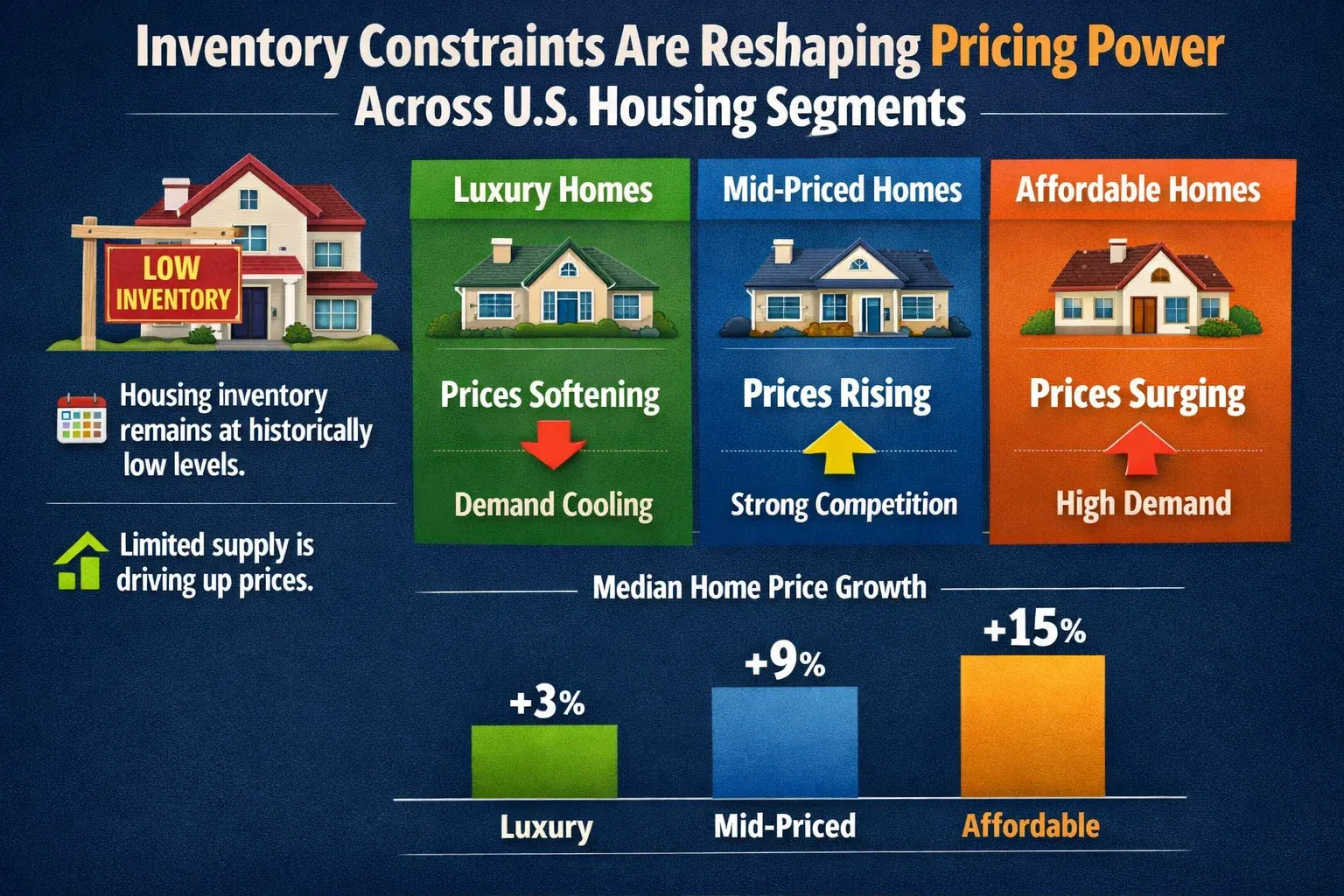
Low inventory and housing scarcity in the U.S. housing market have forced it to undergo a structural transformation driven by persistent inventory shortages and have evolved into a powerful positioning mechanism. Limited availability has naturally increased the perception of exclusivity, allowing properties to be displayed as premium opportunities rather than standard listings.
Buyers tend to place increased valuation on available houses, especially when they realize that their choices are limited in options, and this tends to justify higher prices, hence enhancing the power of the sellers and revisiting the price elasticity.
Imbalance in the U.S. Housing Market Inventory
The level of housing inventory present across the U.S. is significantly lower than historical averages, particularly after the migration patterns of post-pandemic times. In New York and San Francisco, active listing has decreased, and suburban areas have been under a squeeze of pressure. Conservatively resilient country marketplaces are also becoming tighter, because of the augmented lifestyle movement and second residence ownership.
Reduced pace of construction activity, increased cost of materials, labor shortages, and long and tedious approval processes have limited the development of new housing. Some other sources of this imbalance include zoning restrictions and scarcity of land in the high-demand areas.
Also, the mortgage rate lock-in effect has deterred homeowners who are already in the market to sell the property. Most of the sellers are still reluctant to part with low-interest loans collateralized in past years, which lowers resale inventory.
These combined forces have created supply compression and scarcity across the U.S. housing segments.
How Inventory Constraints Strengthen Seller Pricing Power?
Fewer listings have naturally increased the competition among buyers and have shifted the pricing discussions from negotiations to value. The sellers and developers are focusing on lifestyle benefits, future appreciation potential, and community advantages narratives, and not defending prices.
Properties in high-demand zones are displayed as “rare opportunities” and are receiving multiple offers within a small-time frame from buyers, reducing the need for price negotiations or promotional discounts. The scarcity has become a powerful positioning tool for marketers, reducing price sensitivity and strengthening buyer confidence.
The U.S. housing inventory shortfall is between 1.5 to 5.5 million units, about 3.7% of the current supply. An additional 2 to 3 million housing units are required to fix the shortage and restore affordability.
The strongest and most competitive pricing pressure is on entry-level and affordable housing due to high demand from first-time buyers and limited supply. The marketing campaigns within this segment target the urgency, financing partnerships, and affordability positioning in order to speed the decision-making process.
The middle ground housing campaigns are dedicated to family-oriented infrastructure, local services, and resale value. The suburban developments are also increasing on steady rate based on the lifestyle-oriented branding.
The luxurious real estate has a selective pricing capability that is motivated by the location, exclusivity, and superior features. Limited inventory enhances prestige, allowing premium branding strategies to dominate. The luxury housing market has witnessed an increase of 32% in 2025 and a nearly 24% increase in dollar volume.
The low housing inventory in the U.S. housing market segment has altered the buyer’s purchasing perception and psychology. The buyers have shifted from analytical comparisons to emotionally driven choices, with FOMO serving as the primary motivator.
The decision-making cycles are reduced, and the buyers have become flexible regarding features, prices, and the location of the property. Most of the buyers are now paying over-market prices to win over properties. Online tours, distance transactions, and computer-based paperwork have facilitated quick purchases. While pre-approvals and cash offers are now common in markets.
Long-Term Market Outlook and Pricing Sustainability
Led by persistent inventory shortage, the buyers are shifting to brand-led real estate models, preferring firms with a strong reputation, reliable listing access, and a transparent process. In the long-term sustainability will depend on interest rate, policy reforms, housing development initiatives, relationship-building, database management, and community engagement.
The firms are building a sustainable demand ecosystem by investing in buyer education, market intelligence, and regular communication.
Conclusion
The housing market in the present day relies more on velocity than on volume to succeed. Strategically handled inventory shortages are drivers of brand differentiation and market leadership. With inventory issues still unresolved, marketing of real estate will be further developed in terms of experience and relationship-based approaches. Brands that dictate demand pipelines will gain pricing power.
FAQs
What is the reason behind the imbalance in the U.S. housing segments?
The reason behind the imbalance in the demand and supply in the U.S. housing market segment lies in several factors, such as high mortgage rates, shortage of labour, high material costs, zoning restrictions, and long approval processes.
How are real estate marketers adapting their sales funnels?
To operate efficiently, the real estate marketers are redesigning their sales funnels around early engagement and pipeline development through pre-launching campaigns and AI-driven CRM platforms.
Will pricing power remain strong if housing inventory increases in the future?
While the housing supply may ease the extreme pressure points, the well-positioned brands will continue to have stronger pricing because even in a balanced market, the key drivers like perception, trust, and experience-driven marketing will remain constant.
is a dedicated content writer with a passion for creating high-quality, engaging, and informative content. Specializing in blog posts, press releases, and news articles, she excels at delivering content that not only captivates readers but also drives meaningful results. With a keen eye for detail and a creative approach, Money ensures that every project is carefully crafted to align with audience needs and industry trends. Her ability to simplify complex topics while maintaining clarity and interest makes her a standout in the content creation space. Her writing expertise spans several key industries, including construction engineering, smarft technologies, and agrochemicals.
Constantly staying updated on the latest industry trends, Money is committed to producing content that informs, entertains, and educates. Her unique approach combines creativity with a deep understanding of digital marketing, ensuring her work helps clients enhance their online presence. Money’s passion for writing is reflected in every piece she produces, as she strives to engage readers with fresh, insightful, and impactful content. Her dedication to continuous learning and adapting to new trends makes her a trusted expert in the field.