

Global 3D Printing Medical Devices Market Size and Forecast – 2026 To 2033
The global 3D printing medical devices market is expected to grow from USD 5.28 Bn in 2026 to USD 15.31 Bn by 2033, registering a compound annual growth rate (CAGR) of 16.4% from 2026 to 2033. The market for 3D printing medical devices is poised for significant expansion, fueled by the surging demand for patient-specific and personalized medical devices that improve surgical precision and clinical outcomes.
According to the U.S. Food and Drug Administration (FDA), more than 100 medical devices manufactured using additive manufacturing technologies had received U.S. FDA clearance as of November 2023, highlighting the growing regulatory acceptance of 3D-printed medical devices in clinical practice.
Key Takeaways of the Global 3D Printing Medical Devices Market
- Implants are projected to hold 30.5 % of the global 3D printing medical devices market share in 2026, making it the dominant device type segment across North America due to the growing adoption of patient-specific orthopedic and spinal implants. For instance, the U.S. Food and Drug Administration (FDA) states that additive manufacturing has become the preferred manufacturing method for products such as metal spine cages, supporting the clinical adoption of 3D-printed implants.
- Stereolithography (SLA) is projected to hold 25.0 % of the global 3D printing medical devices market share in 2026, making it the dominant technology segment across Europe due to its superior precision in manufacturing dental devices, surgical guides, and anatomical models. For instance, the European Commission's Medical Device Regulation (EU MDR 2017/745) establishes harmonized quality and safety requirements for advanced manufacturing technologies, including 3D-printed medical devices, supporting wider clinical adoption across the European Union.
- Orthopedics is projected to hold 34.0 % of the global 3D printing medical devices market share in 2026, making it the dominant application segment across Asia Pacific due to the rising demand for customized orthopedic implants and patient-specific surgical planning solutions. For instance, Japan's Ministry of Health, Labour and Welfare (MHLW) has established regulatory pathways for patient-specific medical devices, facilitating the clinical adoption of customized orthopedic technologies, including 3D-printed implants.
- North America maintains its dominance with an expected share of 40.5 % in 2026, bolstered by the region's mature regulatory framework, widespread clinical adoption of patient-specific medical devices, and strong translational research ecosystem. For instance, the U.S. National Institutes of Health (NIH), through the National Institute of Biomedical Imaging and Bioengineering (NIBIB), supports the Point-of-Care Technologies Research Network (POCTRN), which advances the clinical translation of innovative technologies including 3D printing solutions for personalized medical devices and surgical applications.
- Asia Pacific is expected to exhibit the fastest growth with an estimated contribution of 27.0 % share in 2026, driven by expanding healthcare infrastructure, growing adoption of personalized medicine, and supportive regulatory frameworks for additive manufacturing. For instance, in 2025, South Korea's Ministry of Food and Drug Safety (MFDS) continued implementing its Guideline for Technical Documentation of 3D-Printed Medical Devices, providing standardized evaluation requirements for safety, performance, and quality, thereby accelerating the commercialization of patient-specific medical devices.
- Expansion of Point-of-Care Manufacturing: The increasing adoption of point-of-care (PoC) manufacturing within hospitals is accelerating the use of 3D printing for producing patient-specific anatomical models, surgical guides, and customized implants on-site. This approach shortens production timelines, improves surgical planning, and reduces dependence on external manufacturing, making additive manufacturing an integral part of advanced clinical workflows.
- Rising Adoption in Pediatric and Rare Disease Applications: 3D printing presents significant opportunities in pediatric and rare disease treatments, where conventional medical devices often fail to accommodate unique patient anatomies. The technology enables rapid fabrication of customized implants, prosthetics, and surgical models tailored to individual anatomical requirements, improving treatment precision and expanding applications in highly specialized clinical procedures.
Segmental Insights
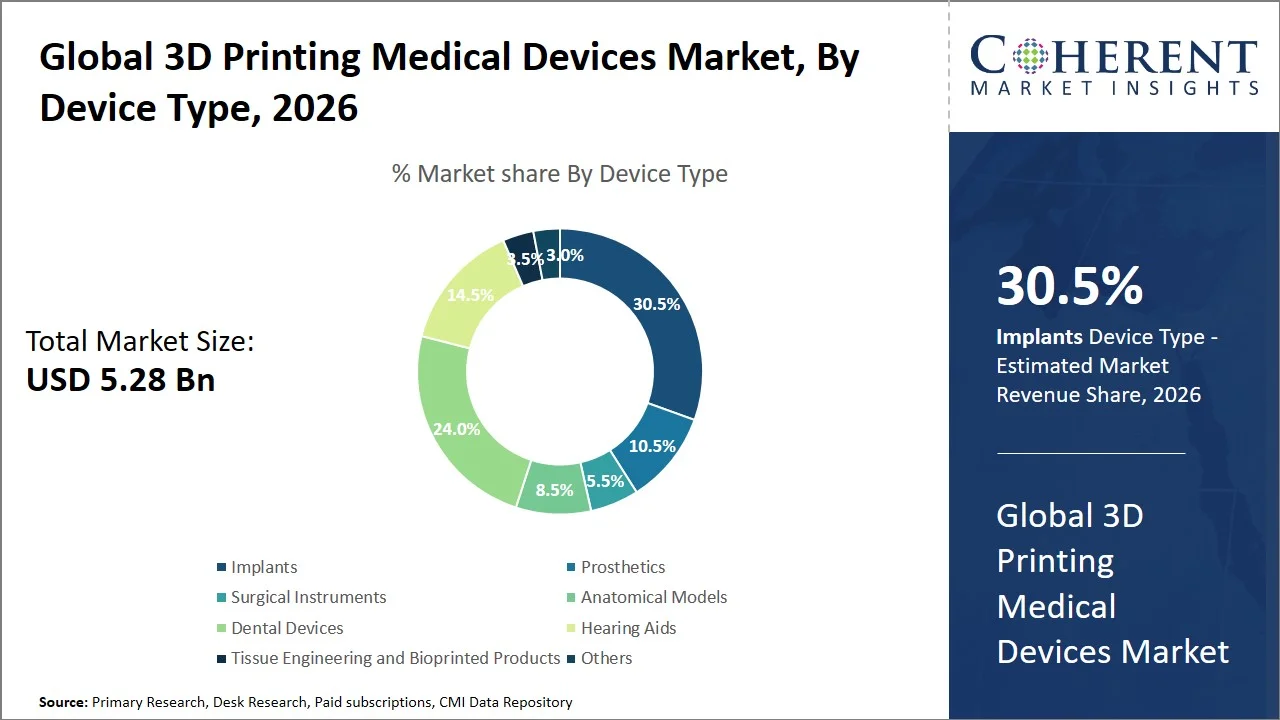
Why Do Implants Dominate the Global 3D Printing Medical Devices Market?
Implants are projected to hold a market share of 30.5% in 2026, driven by rising preference for personalized implants for orthopedic, spinal, craniofacial, and dental applications that results in an anatomical fit and improves osseointegration with improved long-term outcomes. Also, additive manufacturing helps to create intricate design in implants with the use of biocompatible materials and results in reduced lead times of manufacturing with better surgical precision. For instance, in July 2024, Triastek signed a research collaboration and platform technology licensing deal with BioNTech on 3D printing oral RNA therapeutics, highlighting a growing footprint of additive manufacturing technologies into new-generation, customized healthcare solutions.
- Current Industry Events of 2026
- Market Size Estimation
- Regional Breakdown
- Competitive Landscape
- Customer Intelligence
- Segmental Analysis
- Pricing Analysis
- Key Market Drivers, Challenges & Future Trends
- Customized Insights Section
Why Does Stereolithography (SLA) Represent the Largest Technology Segment in the 3D Printing Medical Devices Market?
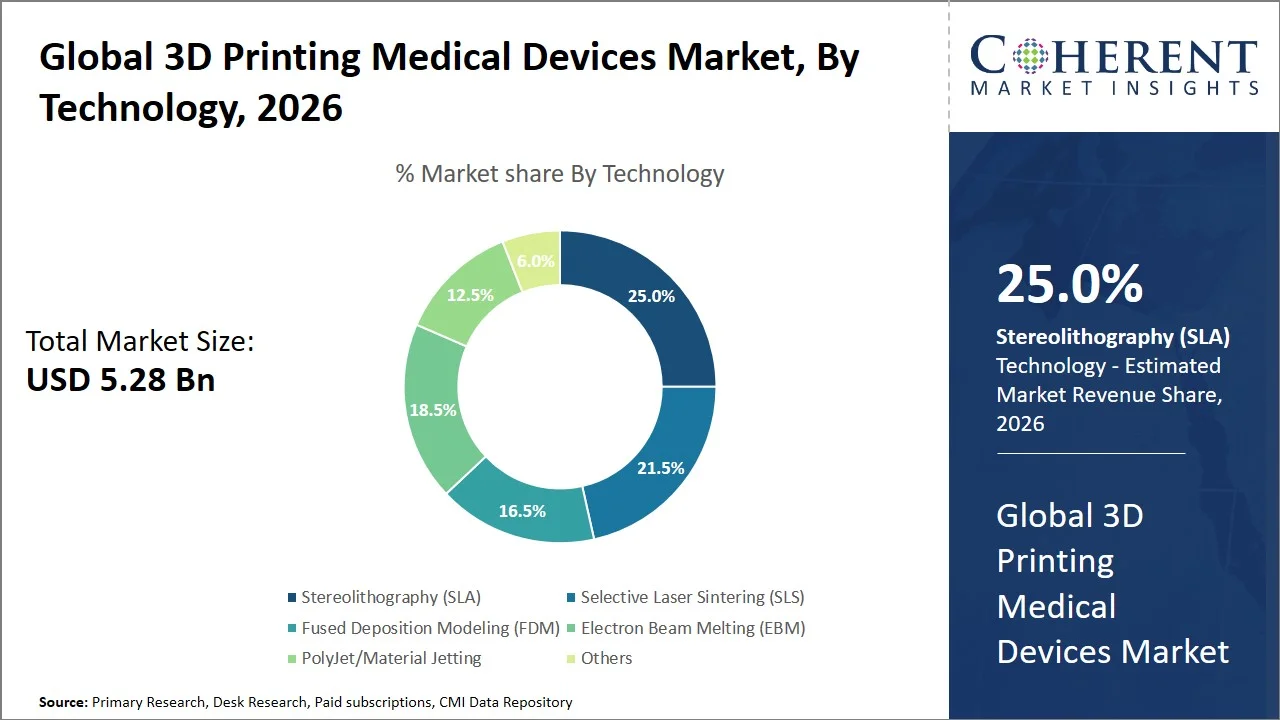
Stereolithography (SLA) is projected to hold a market share of 25.0% in 2026, due to its high degree of dimensional accuracy, finer resolution, and ability to create complex geometries with better surface finishes. Stereolithography (SLA) is widely used for the production of anatomical models, surgical guides, hearing aids and dental models where high level of precision is mandatory. For instance, in April 2024, Formlabs introduced Form 4B, a Stereolithography (SLA) medical and dental 3D printer that can produce medical and dental surgical guides, dental models, splints, retainers and anatomical models in biocompatible resins at dramatically higher print speeds with comparable accuracy for a dental lab and clinical settings.
Orthopedics Segment Dominates the Global 3D Printing Medical Devices Market
The orthopedics segment is projected to hold a market share of 34.0% in 2026, driven by the escalating demand for patient-specific implants, surgical guides, and anatomical models to facilitate enhanced implant fitting, surgical precision, and post-surgery outcomes. Furthermore, the application of additive manufacturing is being adopted for the production of a porous light weighted implant for enhancing osseointegration while supporting minimally invasive orthopedic surgery procedures. For instance, in February 2025, Restor3d obtained FDA 510(k) clearance for its VELYS Patient-Specific Restor3d Hip System, an acetabular implant created using 3D printing, enabling individualized solutions for challenging hip reconstructive surgeries.
Currents Events and their Impact
Current Events | Description and its Impact |
European Commission Begins Implementation of the European Health Data Space (EHDS) Regulation (March 2025) |
|
U.S. FDA Releases Draft Guidance on Artificial Intelligence-Enabled Device Software Functions (January 2025) |
|
3D Printing Medical Devices Market Dynamics
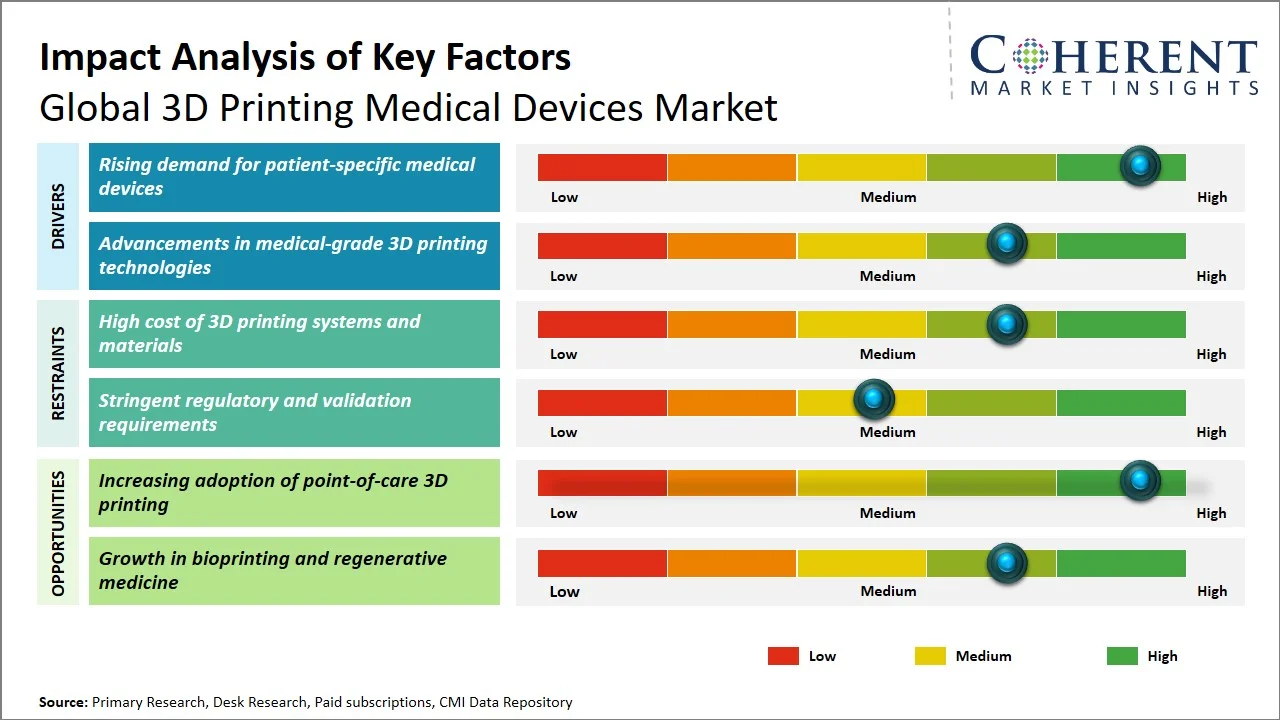
Market Drivers
- Rising demand for patient-specific medical devices: The increasing emphasis on personalized healthcare is accelerating the adoption of patient-specific implants, prosthetics, surgical guides, and anatomical models manufactured using 3D printing. By leveraging CT and MRI imaging data, additive manufacturing enables precise device customization, improving implant fit, surgical accuracy, and clinical outcomes while reducing procedure complexity. For instance, the U.S. Food and Drug Administration (FDA) recognizes patient-matched medical devices as a distinct category and outlines specific regulatory considerations for devices designed using individual patient anatomical data, supporting their safe and effective clinical adoption.
- Advancements in medical-grade 3D printing technologies: Continuous advancements in medical-grade 3D printing technologies are improving the precision, mechanical performance, and manufacturing efficiency of patient-specific medical devices. Innovations in metal additive manufacturing, biocompatible materials, and high-resolution printing are expanding applications across orthopedic, spinal, craniofacial, and dental procedures. For instance, in December 2025, the U.S. FDA granted 510(k) clearance to the SpineLinc Anterior Cervical Implant System, a 3D-printed cervical interbody fusion device manufactured using additive manufacturing technology, highlighting the growing regulatory acceptance of next-generation 3D-printed implant technologies.
Emerging Trends
- Multi-Material 3D Printing for Advanced Medical Devices: Medical device manufacturers are increasingly adopting multi-material 3D printing to produce devices with varying mechanical properties within a single build. This technology enables the fabrication of complex implants, prosthetics, and surgical instruments that better replicate human tissue characteristics, improving device functionality and clinical performance.
- Sustainable Additive Manufacturing in Medical Device Production: Sustainability is becoming a key focus in 3D medical device manufacturing through the use of recyclable materials, bio-based polymers, and waste-minimizing production processes. Manufacturers are increasingly optimizing additive manufacturing workflows to reduce material consumption, energy usage, and production waste while meeting stringent environmental and regulatory requirements.
Regional Insights
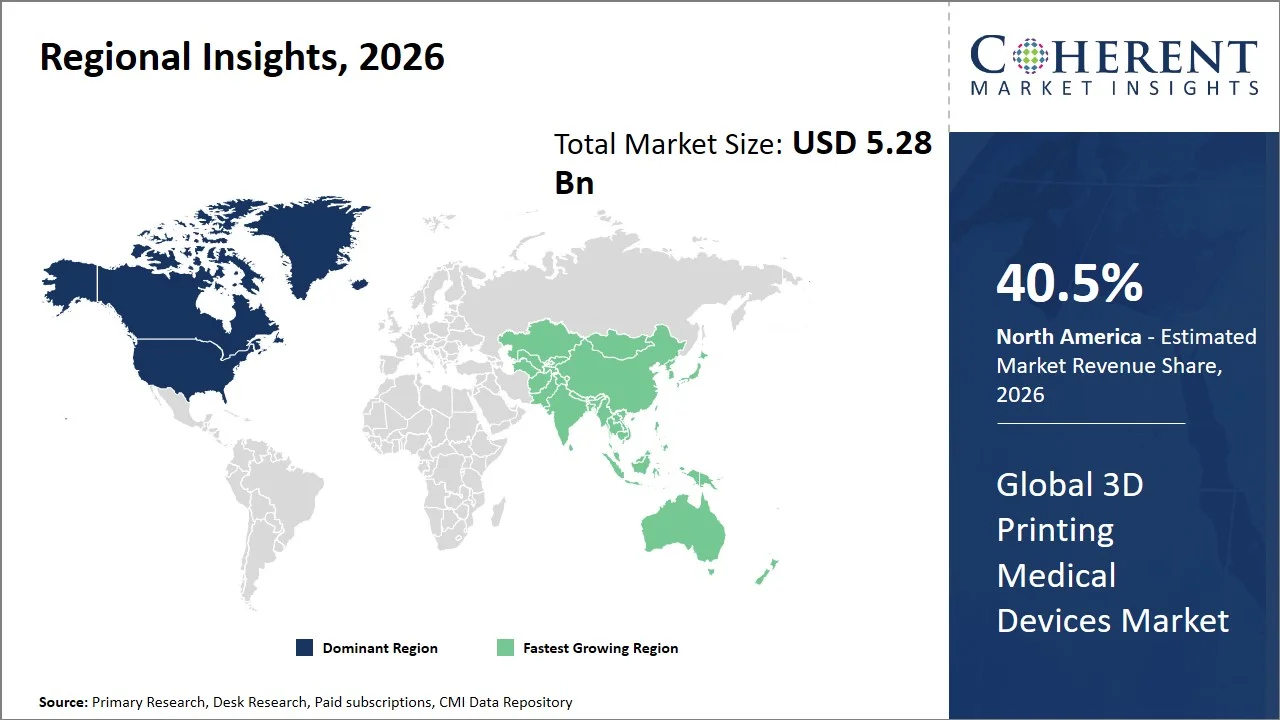
Why is North America a Strong Market for 3D Printing Medical Devices?
North America leads the global 3D printing medical devices market, accounting for an estimated 40.5% share in 2026, due to the adoption of additive manufacturing techniques at the early stages for various orthopedic, dental, cranio-maxillofacial and surgical planning applications in the region. Patient-specific implants, anatomical models, and guides are being widely implemented in orthopedic, surgical, dentistry and cranio-maxillofacial procedures. This aids in enhancing surgical precision and reducing procedural time, in addition to improving patient outcomes. Furthermore, the U.S. Food and Drug Administration (FDA) has continuously been updating its guidelines concerning additive manufacturing, this is anticipated to further propel market growth, as the regulatory pathway for novel 3D printed medical device products are clearly established. For instance, the U.S. Food and Drug Administration provides technical guidance on “Technical Considerations for Additive Manufactured Medical Devices”, outlining standards and best practices to facilitate and promote the safe and effective development and marketing of 3D-printed medical devices covering design, manufacture, testing, and characterization. The guidance is expected to further accelerate innovation and clinical adoption across the region.
Why Does the Asia Pacific 3D Printing Medical Devices Market Exhibit High Growth?
The Asia Pacific 3D printing medical devices market is expected to exhibit the fastest growth with an estimated contribution of 27.0% share to the global market in 2026, due to the rising penetration of patient-specific implants, surgical guides and anatomical models into rapidly expanding healthcare systems. The region is estimated to grow significantly due to rising healthcare expenditure, ease of availability of complex surgical machinery and growing patient demand for customized healthcare solutions. Additionally, governments across the region are increasing their funding of additive manufacturing research and providing incentives for local capabilities that reduce reliance on imports, ultimately building stronger local manufacturing supply chains and increasing technology capacity.
For instance, led by the Ministry of Electronics and Information Technology (MeitY), India's National Strategy for Additive Manufacturing (NSAM) intends to foster broad adoption of additive manufacturing technologies across the nation, enhancing the self-reliance of indigenous industries, curb imports, and drive the technology adoption for key strategic industries such as healthcare. (Source: National Center For Additive Manufacturing)
Global 3D Printing Medical Devices Market Outlook for Key Countries
Why is the U.S. Leading Innovation and Adoption in the 3D Printing Medical Devices Market?
The U.S dominates the 3D printing medical devices market due to the growing adoption of patient-specific implants for orthopedics, anatomical models, and surgical guides by premier healthcare organizations in the country. The market is facilitated by digital imaging technologies coupled with Computer-Aided Design (CAD) software to help produce custom-manufactured medical devices with increased precision for complex medical procedures. Furthermore, the country also benefits from the early adoption of on-site point-of-care 3D printing in hospitals, allowing faster surgical planning, reduces lead time and supports personalization for patient medical devices.
Is Japan a Favorable Market for 3D Printing Medical Devices Market?
Japan represents an excellent market opportunity for 3D printing medical devices driven by its demand for customized, personalized orthopedic, dental, and craniofacial solutions, requiring high degree of accuracy. The nation’s mature manufacturing sector facilitates the development of sophisticated medical grade additively manufactured devices, and wider applications are developing through growing usage of digital dentistry, and personalize implants. Integration of 3D printing with surgical planning procedures and clinical setting within hospitals is also increasing adoption of market products.
Is China Emerging as a Key Growth Hub for the 3D Printing Medical Devices Market?
China is positioned as a key growth hub in the global 3D printing medical devices market driven by the growing adoption of additive manufacturing for orthopedic, dental, and maxillofacial indications. With increased integration of 3D printing in medical Imaging and surgical planning process, 3D printing will contribute to better results through creating personalized patient-specific implant and anatomical models. The growing number of native 3D printing medical device manufacturers (such as AK Medical Holdings, Shanghai Rebone Biomaterials, and Medprin Biotech) and the point of care 3D printing in hospitals will facilitate commercializing the devices at an increased pace.
Why Does Germany Top the European 3D Printing Medical Devices Market?
Germany leads the European 3D printing medical devices market driven by the early widespread adoption of additive technologies, specifically in orthopedic surgery, dental and craniofacial reconstruction procedures due to its high level of advancement and its superior precision engineering. The country's extensive clinical experience with patient specific implants, as well as anatomical models and surgical guides, allow for better precision in procedural intervention. Moreover, its existing strong medical device manufacturing base along with prompt integration of digitally designed workflow with additive manufacturing ensures rapid commercialization of these devices.
Is the 3D Printing Medical Devices Market Developing in India?
India has emerged as a favorable market for 3D printing medical devices due to the high-use of patient-specific implants, anatomical models and surgical guides for dental and reconstructive surgeries as well as orthopedic procedures. Medical centers and hospitals are increasingly implementing additive manufacturing in their planning for surgical procedures in an attempt to achieve better accuracy and to cut down procedure time. Further, rise of home-based medical device manufacturing and the penetration of digital technologies in the healthcare system in India are boosting the sales of 3D-printed medical devices.
Evolution of Clinical Applications in the Global 3D Printing Medical Devices Market (2020–2033)
Clinical Application | Current Adoption (2020–2025) | Key Benefit | Future Outlook (2026–2033) |
Patient-specific Implants | Widely adopted in orthopedics & craniofacial surgery | Improved implant fit and clinical outcomes | Expansion into cardiovascular and oncology implants |
Surgical Guides | Standard in complex orthopedic and dental procedures | Greater surgical precision and reduced operating time | Routine use in minimally invasive surgeries |
Anatomical Models | Increasing use for surgical planning and education | Better pre-operative visualization | AI-assisted surgical planning models |
Prosthetics & Orthotics | Customized production gaining momentum | Faster production and improved patient comfort | Mass personalization through digital workflows |
Bioprinting | Primarily research-stage | Tissue engineering and regenerative medicine | Early commercialization of functional tissues |
How is the increasing adoption of point-of-care 3D printing creating new growth opportunities in the 3D printing medical devices market?
The growing implementation of point-of-care (PoC) 3D printing in the healthcare sector is generating ample opportunities in the 3D printing medical devices market by providing scope to the healthcare centers to prepare customized surgical guides, anatomical models and implants at the site of care. Such manufacturing reduces the manufacturing lead time, assists in the improvement of surgical planning and reduces reliance on external supply chains. For instance, in December 2024, Materialise unveiled its integrated Mimics platform that allows clinicians to streamline the on-demand manufacturing of personalized medical devices by integrating the imaging, design and 3D printing workflow. The platform is expected to accelerate the uptake of in-hospital 3D printing and enhance clinician workflow efficiency.
Market Players, Key Development, and Competitive Landscape
Key Developments
- In June 2025, Ricoh established Ricoh 3D for Healthcare, LLC to strengthen its healthcare-focused additive manufacturing business and accelerate the adoption of point-of-care 3D printing solutions. The new subsidiary is dedicated to delivering patient-specific anatomical models, surgical planning solutions, and integrated workflow services for hospitals and healthcare providers. By expanding in-hospital additive manufacturing capabilities, the initiative aims to improve surgical precision, streamline clinical workflows, and advance personalized patient care across a wide range of medical specialties.
- In April 2025, 3D Systems, Inc. announced that its point-of-care additive manufacturing solution enabled the world's first on-site production of patient-specific facial implants within a hospital setting. The solution combines advanced 3D printing technology, medical imaging software, and medical-grade materials to support the in-house manufacture of customized cranio-maxillofacial implants. This innovation significantly reduces production lead times, minimizes dependence on external manufacturing, and enables faster, personalized treatment while enhancing surgical accuracy and clinical outcomes.
Competitive Landscape
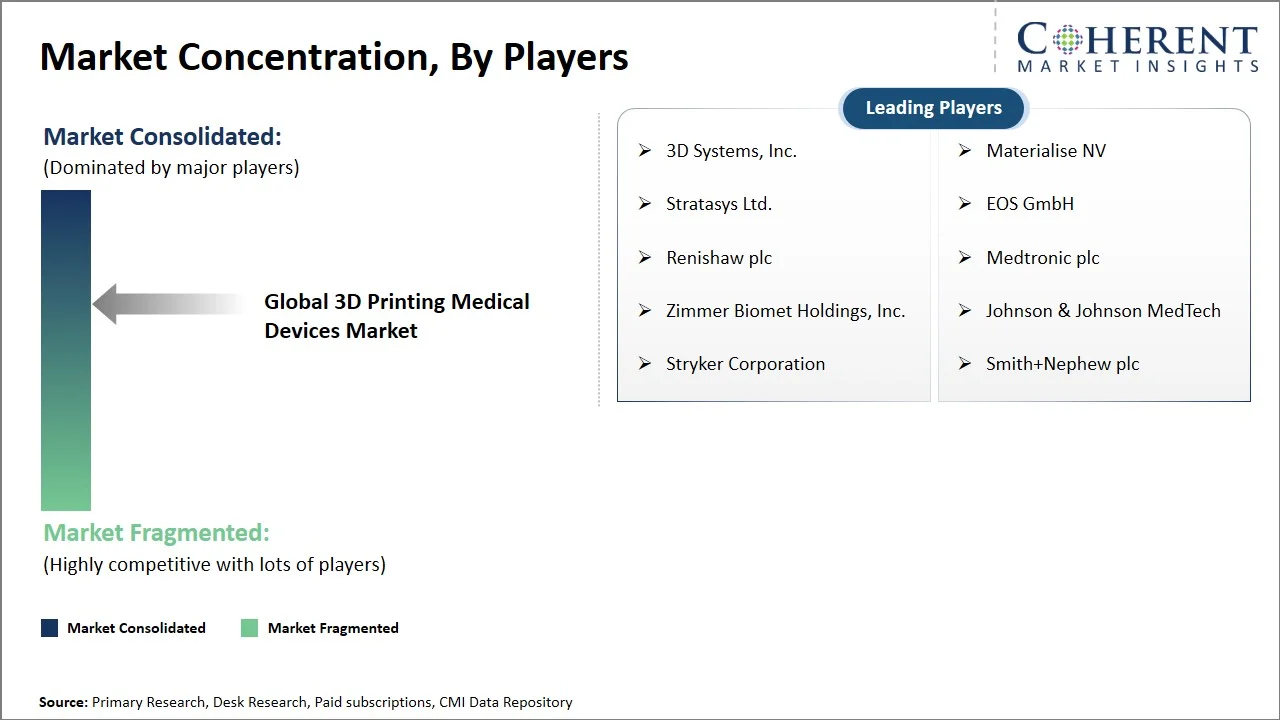
The global 3D printing medical devices market is moderately consolidated, with market participants competing through continuous innovation in additive manufacturing technologies, expansion of patient-specific device portfolios, and integration of digital design workflows into clinical practice. Companies are increasingly focusing on obtaining regulatory approvals for customized medical devices, strengthening point-of-care manufacturing capabilities, and expanding the use of advanced biomaterials to enhance product performance. Strategic priorities also include collaborations with healthcare providers to accelerate the adoption of personalized medical solutions. Key focus areas include:
- Development of patient-specific implants and prosthetics
- Expansion of point-of-care 3D printing capabilities
- Innovation in biocompatible and high-performance printing materials
- Regulatory approvals for customized medical devices
- Integration of AI, medical imaging, and digital design workflows
- Expansion into bioprinting and regenerative medicine applications
Market Report Scope
3D Printing Medical Devices Market Report Coverage
| Report Coverage | Details | ||
|---|---|---|---|
| Base Year: | 2025 | Market Size in 2026: | USD 5.28 Bn |
| Historical Data for: | 2020 To 2024 | Forecast Period: | 2026 To 2033 |
| Forecast Period 2026 to 2033 CAGR: | 16.4% | 2033 Value Projection: | USD 15.31 Bn |
| Geographies covered: |
| ||
| Segments covered: |
| ||
| Companies covered: | 3D Systems, Inc., Materialise NV, Stratasys Ltd., EOS GmbH, Renishaw plc, Medtronic plc, Zimmer Biomet Holdings, Inc., Johnson & Johnson MedTech, Stryker Corporation, and Smith+Nephew plc | ||
| Growth Drivers: |
| ||
| Restraints & Challenges: |
| ||
Analyst Opinion (Expert Opinion)
- The future of the 3D printing medical devices market will be shaped by the transition from prototyping to large-scale clinical manufacturing of patient-specific medical devices. Advancements in medical-grade materials, AI-assisted design, and point-of-care manufacturing are expected to make additive manufacturing an integral part of personalized healthcare, particularly for complex surgical procedures and customized implants.
- The maximum opportunities will probably exist within metal 3D-printed implants for orthopedic and cranio-maxillofacial applications in the U.S., where strong regulatory support, advanced healthcare infrastructure, and increasing adoption of patient-specific surgical solutions are accelerating clinical implementation. Emerging opportunities are also expected in hospital-based point-of-care manufacturing across Europe and Asia Pacific.
- In order to obtain a competitive advantage, market participants should prioritize the development of validated medical-grade materials, strengthen regulatory compliance capabilities, and integrate digital imaging, AI-driven design, and end-to-end additive manufacturing workflows. Collaborating with hospitals and healthcare providers to expand point-of-care 3D printing capabilities and personalized device manufacturing will be critical for long-term market differentiation.
Speak to the analyst
Want personalized insights?
Take the findings above to one of our principal consultants, or have the report rebuilt around the segments, geographies and competitors you actually track.
Market Segmentation
- Device Type Insights (Revenue, USD Bn, 2021 - 2033)
- Implants
- Prosthetics
- Surgical Instruments
- Anatomical Models
- Dental Devices
- Hearing Aids
- Tissue Engineering and Bioprinted Products
- Others
- Technology Insights (Revenue, USD Bn, 2021 - 2033)
- Stereolithography (SLA)
- Selective Laser Sintering (SLS)
- Fused Deposition Modeling (FDM)
- Electron Beam Melting (EBM)
- PolyJet/Material Jetting
- Others
- Application Insights (Revenue, USD Bn, 2021 - 2033)
- Orthopedics
- Dentistry
- Craniomaxillofacial (CMF)
- Cardiovascular
- Surgical Planning and Medical Education
- Others
- End User Insights (Revenue, USD Bn, 2021 - 2033)
- Hospitals and Surgical Centers
- Dental Laboratories and Clinics
- Medical Device Manufacturers
- Academic and Research Institutes
- Others
- Regional Insights (Revenue, USD Bn, 2021 - 2033)
- North America
- U.S.
- Canada
- Latin America
- Brazil
- Argentina
- Mexico
- Rest of Latin America
- Europe
- Germany
- U.K.
- Spain
- France
- Italy
- Russia
- Rest of Europe
- Asia Pacific
- China
- India
- Japan
- Australia
- South Korea
- ASEAN
- Rest of Asia Pacific
- Middle East
- GCC Countries
- Israel
- Rest of Middle East
- Africa
- South Africa
- North Africa
- Central Africa
- North America
- Key Players Insights
- 3D Systems, Inc.
- Materialise NV
- Stratasys Ltd.
- EOS GmbH
- Renishaw plc
- Medtronic plc
- Zimmer Biomet Holdings, Inc.
- Johnson & Johnson MedTech
- Stryker Corporation
- Smith+Nephew plc
Sources
Primary Research Interviews
- Medical device manufacturers specializing in 3D printing technologies
- Additive manufacturing engineers and product development specialists
- Orthopedic, dental, cranio-maxillofacial, and cardiovascular surgeons
- Biomedical engineers and hospital-based 3D printing laboratory managers
- Medical imaging and surgical planning software experts
- Regulatory and quality assurance professionals for medical devices
Stakeholders
- 3D printing medical device manufacturers
- Hospitals, academic medical centers, and specialty surgical centers
- Dental clinics and dental laboratories
- Contract manufacturing organizations (CMOs) and additive manufacturing service providers
- Medical imaging and surgical planning software providers
- Research institutes and universities specializing in biomedical engineering
- End-use Sectors
- Hospitals and health systems
- Dental hospitals, clinics, and laboratories
- Ambulatory surgical centers (ASCs)
- Academic medical centers and teaching hospitals
- Medical device manufacturing facilities
- Research institutions and innovation centers
- Regulatory & Health Bodies
- U.S. Food and Drug Administration (FDA)
- European Commission – Directorate-General for Health and Food Safety (DG SANTE)
- European Medicines Agency (EMA)
- Medicines and Healthcare products Regulatory Agency (MHRA), UK
- Pharmaceuticals and Medical Devices Agency (PMDA), Japan
- National Medical Products Administration (NMPA), China
- Therapeutic Goods Administration (TGA), Australia
Databases
- U.S. FDA 510(k), De Novo & PMA Medical Device Databases
- U.S. FDA Medical Device Recalls Database
- EUDAMED (European Database on Medical Devices)
- ClinicalTrials.gov
- WHO Global Health Observatory (GHO)
- OECD Health Statistics Database
- NIH RePORTER Database
- United Nations Comtrade Database
- World Bank Open Data
- Eurostat Database
- ASTM International Standards Database (Additive Manufacturing Standards)
- ISO Standards Database (ISO/TC 261 – Additive Manufacturing)
Magazines
- Medical Device and Diagnostic Industry (MD+DI)
- Medical Design Technology
- Healthcare Packaging
- Biomedical Instrumentation & Technology,
Journals
- Journal of Medical Devices
- Biofabrication Journal
- Additive Manufacturing Journal
Associations
- Medical Device Manufacturers Association (MDMA)
- Radiological Society of North America (RSNA)
- American Medical Association (AMA)
- Association for the Advancement of Medical Instrumentation (AAMI)
Public Domain Sources
- U.S. Food and Drug Administration (FDA)
- World Health Organization (WHO)
- National Institutes of Health (NIH)
- European Medicines Agency (EMA)
Proprietary Elements
- CMI Data Analytics Tool, Proprietary CMI Existing Repository of information for last 10 years.
Get access to 250+ pages report
Every segment, forecast, competitor profile and data table behind the analysis above — available for instant download.
- ESOMAR Member
- ISO 9001:2015 Certified
- D-U-N-S Registered
- GDPR & CCPA Compliant
Missing comfort of reading report in your local language? Find your preferred language:
Transform your Strategy with Exclusive Trending Reports
Frequently Asked Questions
The global 3D printing medical devices market is estimated to be valued at USD 5.28 Bn in 2026 and is expected to reach USD 15.31 Bn by 2033.
Implants dominate due to the increasing demand for patient-specific orthopedic, spinal, craniofacial, and dental implants that offer superior anatomical fit, enhanced surgical precision, and improved long-term clinical outcomes.
3D printing medical devices are patient-specific or standardized medical products manufactured using additive manufacturing technology to create complex structures layer by layer from digital designs.
The CAGR of the global 3D printing medical devices market is projected to be 16.4% from 2026 to 2033.
Stereolithography (SLA) is widely used for manufacturing high-precision dental models, surgical guides, anatomical models, and other medical devices requiring excellent surface finish and accuracy.
Titanium alloys are preferred because they provide high strength, excellent biocompatibility, corrosion resistance, and osseointegration, making them ideal for long-term orthopedic and spinal implants.
Rising demand for patient-specific medical devices, and advancements in medical-grade 3D printing technologies are the major factors driving the growth of the global 3D printing medical devices market.