

Sterilization Equipment and Disinfectants Market Size and Share Analysis - 2026 To 2033
The global sterilization equipment and disinfectants market is estimated to be valued at approximately USD 19.2 Bn in 2026 and USD 29.9 Bn by 2033, growing at a compound annual growth rate (CAGR) of 6.6% during the forecast period. This is attributable to increasing focus on infection prevention, rising demand for sterilization in healthcare facilities, and growing use of advanced sterilization and disinfection technologies. According to the WHO, more than 300 million surgical procedures are performed each year globally, creating substantial demand for sterilization and reprocessing of medical instruments to ensure patient safety.
Key Takeaways from the Sterilization Equipment and Disinfectants Market Report
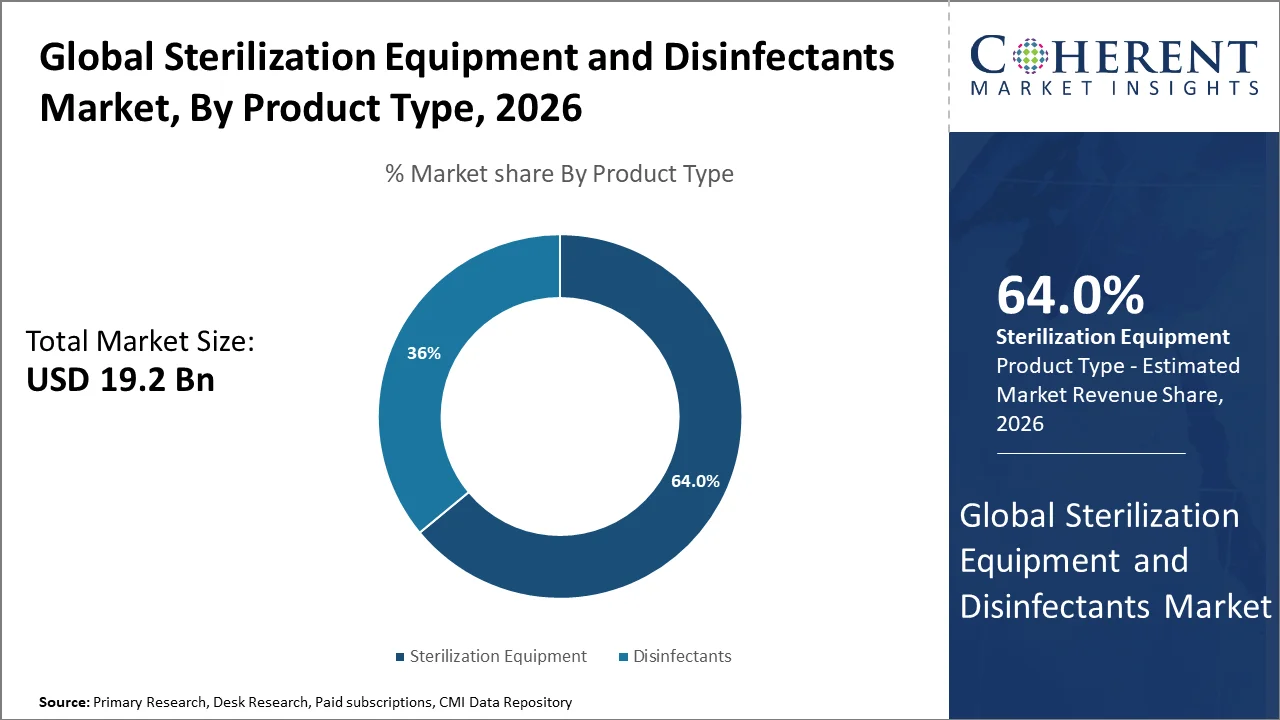
- Sterilization equipment segment is projected to account for the largest market revenue share of 64% in 2026 due to growing use of sterilization equipment in hospitals, pharmaceutical manufacturing, and medical device facilities to prevent infections and ensure product safety. For example, WHO reports that around 9 million healthcare-associated infections occur annually in Europe, highlighting the need for effective infection-control measures.
- Chemical method is slated to lead the market with a share of 52% in 2026 because it can effectively treat heat-sensitive medical devices and surfaces that cannot withstand high temperatures. For instance, the FDA reports that more than 20 Bn medical devices sold annually in the U.S. are sterilized with ethylene oxide (EtO).
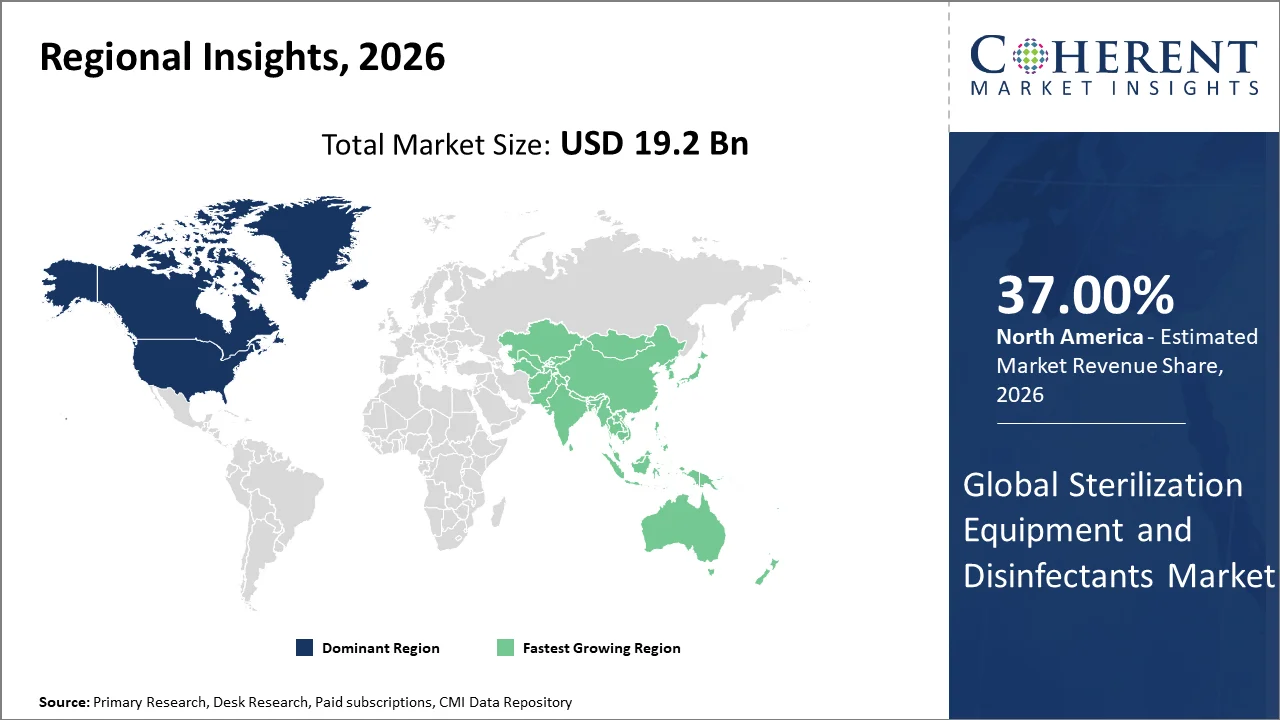
- Regionally, North America is expected to dominate the global sterilization equipment and disinfectants industry with a share of 37.0% in 2026, owing to stringent infection-control standards and high adoption of advanced sterilization technologies. For example, the CDC reports that approximately 46.5 million surgical procedures are performed annually in the U.S., with sterilization and disinfection essential to prevent medical devices from transmitting infections.
- Asia Pacific, registering a CAGR of 8.2%, is anticipated to emerge as the fastest growing market for sterilization equipment and disinfectants during the forecast period, thanks to rising healthcare spending, expanding healthcare infrastructure, increasing awareness of infection control, and growing demand for advanced sterilization technologies.
Sterilization Equipment and Disinfectants Market Overview
The global sterilization equipment and disinfectants market is poised to register steady growth during the forecast period. This growth is primarily driven by rising focus on infection prevention and control in healthcare settings, increasing healthcare-associated infections, increasing integration of automation and smart disinfection technologies, and growing need for effective sterilization and disinfection of medical instruments and equipment.
The World Health Organization (WHO) highlights healthcare-associated infections as a major challenge and emphasizes stronger infection prevention and control practices. This, in turn, is fueling demand for sterilization equipment and disinfectants. In addition, the CDC recommends sterilization of critical medical and surgical devices and disinfection of other patient-care equipment based on infection risk.
Sterilization is a process that destroys or eliminates all forms of microbial life using physical or chemical methods. In contrast, disinfection eliminates many or all pathogenic microorganisms on inanimate objects but generally does not destroy bacterial spores. Sterilization provides a broader level of microbial control than disinfection.
Autoclaves use pressurized steam to sterilize heat-resistant instruments, laboratory materials, and other suitable items. Different sterilization techniques offer distinct advantages depending on the material and application. For heat-sensitive materials that may be damaged by high temperatures, low-temperature sterilization methods, including chemical sterilization, are preferred.
Increasing need to prevent healthcare-associated infections (HAIs) supports the use of sterilization and disinfection in healthcare facilities. Greater emphasis on infection prevention and control is encouraging healthcare facilities to adopt reliable sterilization and disinfection systems. This is expected to boost growth of sterilization equipment and disinfectants market during the forecast period.
Increasing demand for advanced sterilization technologies is also supporting market growth. Healthcare providers are adopting technologies such as vaporized hydrogen peroxide, hydrogen peroxide gas plasma, ozone, and peracetic acid to sterilize devices that cannot withstand conventional steam sterilization.
Similarly, growing adoption of automated sterilization systems is set to boost revenue growth. Automated and digitally monitored systems help improve cycle consistency, reduce manual handling as well as support better sterilization monitoring, encouraging their adoption in modern healthcare facilities.
To capitalize on emerging opportunities, leading sterilization equipment manufacturers are introducing advanced solutions. For instance, in December 2025, Getinge introduced Automatiq, a new family of automated solutions for sterile reprocessing. The solutions are designed to help Central Sterile Services Departments (CSSDs) make reprocessing safer, more consistent as well as less labor-intensive.
Segmental Insights
Which Product Type Dominates the Global Sterilization Equipment and Disinfectants Market?
Sterilization Equipment Leads with Over Three-Fifths of Market Share
Based on product type, sterilization equipment segment is set to account for a revenue share of 64% in 2026. This dominance can be attributed to widespread use of equipment such as autoclaves, hot air ovens, and filters in healthcare facilities for sterilizing medical instruments and materials.
Demand for sterilization equipment is also increasing due to the growing need for reliable and repeatable sterilization of reusable medical devices. Sterilization equipment helps healthcare facilities reduce the risk of infections and maintain safe clinical practices, supporting its widespread adoption.
- Current Industry Events of 2026
- Market Size Estimation
- Regional Breakdown
- Competitive Landscape
- Customer Intelligence
- Segmental Analysis
- Pricing Analysis
- Key Market Drivers, Challenges & Future Trends
- Customized Insights Section
What Drives the Adoption of Chemical Sterilization?
Effective Sterilization of Heat-Sensitive Devices Drives Chemical Sterilization Adoption
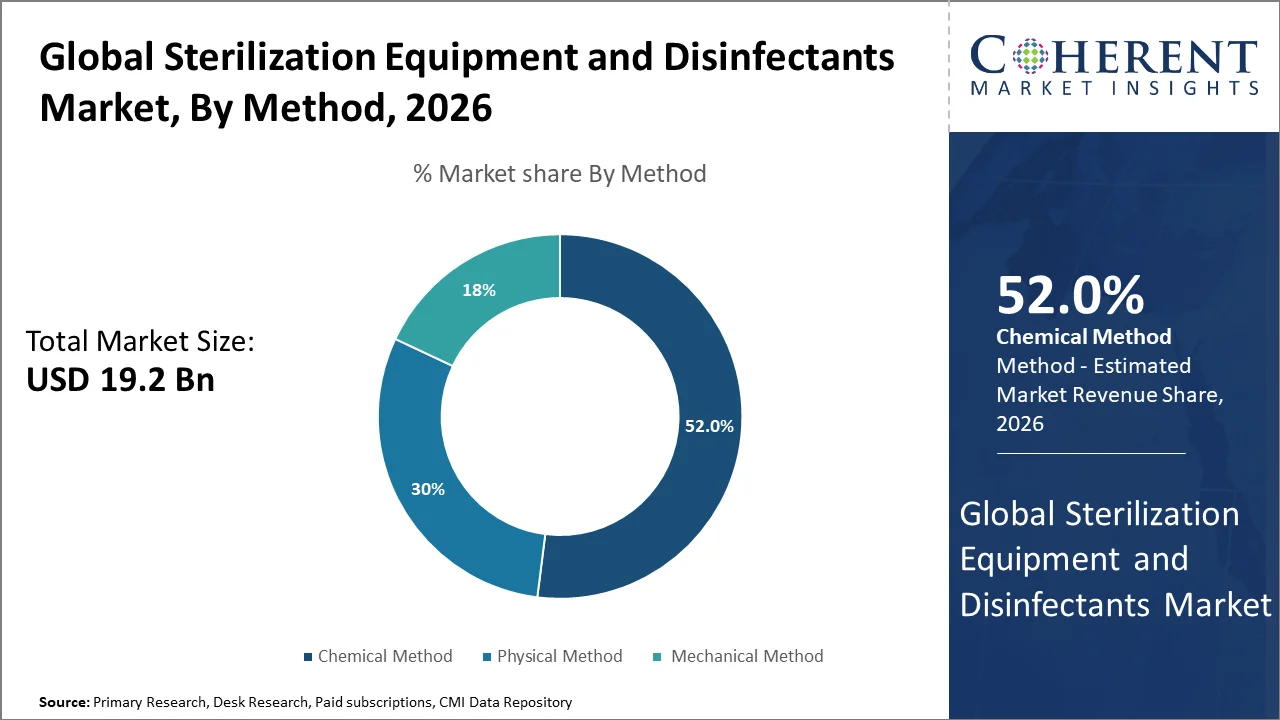
According to Coherent Market Insights' sterilization equipment and disinfectants market analysis, chemical method is expected to lead the market with a share of 52% in 2026. This can be attributed to growing use of chemical sterilization for heat-sensitive medical devices that cannot withstand high temperatures used in steam or dry-heat sterilization. Chemical methods can help sterilize complex instruments while reducing the risk of heat-related damage.
Chemical sterilization is particularly useful for devices made from plastics, polymers, and other heat-sensitive materials used in healthcare settings. Increasing use of these devices, along with the need for effective infection control and safe sterilization of reusable medical equipment, is expected to support adoption of chemical sterilization methods during the forecast period.
For example, the U.S. FDA reports that more than 20 billion medical devices are sterilized using ethylene oxide (EtO) each year, representing approximately 50% of medical devices requiring sterilization. The FDA also notes that EtO is suitable for devices made from polymers and plastics because it can sterilize many devices without damaging them.
Sterilization Equipment and Disinfectants Market Growth Drivers
Rising Healthcare-associated Infections (HAIs)
Increasing incidence of healthcare-associated infections (HAIs) is providing a strong impetus for the growth of sterilization equipment and disinfectants market. According to the World Health Organization (WHO), around 1 in 10 patients globally is affected by HAIs. This is increasing the need for effective sterilization and disinfection practices in hospitals and other healthcare facilities, thereby driving demand for sterilization equipment and disinfectants.
Sterilization Equipment and Disinfectants Market Trends
Shift Towards Ethylene Oxide (EtO) Alternatives
Rising adoption of EtO alternatives is an emerging trend in the sterilization equipment and disinfectants market. Increasing regulatory and environmental pressure to reduce ethylene oxide emissions is driving the development and adoption of alternative sterilization technologies, including vaporized hydrogen peroxide, radiation, and nitrogen dioxide. For example, the U.S. FDA is working with industry stakeholders to reduce reliance on EtO and support the development and evaluation of alternative sterilization technologies.
Current Events and Their Impact on the Sterilization Equipment and Disinfectants Market
Current Event | Description and its Impact |
FDA Adds New Disinfectant Device Classification – 2026 |
|
WHO 2026 Campaign Highlights Infection Prevention |
|
Regional Insights
North America Remains the Leading Market for Sterilization Equipment and Disinfectants
America is expected to retain its dominance over the global sterilization equipment and disinfectants market, accounting for a share of 37.00% in 2026. This is attributable to high healthcare spending, stringent infection-control standards, and increasing use of sterilization and disinfection technologies in hospitals and other healthcare facilities.
High burden of healthcare-associated infections (HAIs) is a major factor fueling demand for sterilization and disinfectants in the region. According to the WHO, 7 out of every 100 patients in acute-care hospitals in high-income countries acquire at least one HAI during their hospital stay. Effective sterilization and disinfection are therefore essential to reduce infection risks and support patient safety.
Asia Pacific Sterilization Equipment and Disinfectants Market Trends
Asia Pacific sterilization equipment and disinfectants market is anticipated to register a CAGR of 6.6% during the forecast period. This is mostly due to expanding healthcare infrastructure, rising surgical procedures, increasing focus on infection prevention, and growing adoption of modern sterilization technologies.
Growing need to prevent healthcare-associated infections is boosting sales of sterilization equipment and disinfectants in the region. The more than twice the rate reported in high-income countries. This highlights the need for stronger infection-prevention practices, including effective sterilization and disinfection of medical equipment.
Sterilization Equipment and Disinfectants Market Outlook – Country-wise
U.S. Sterilization Equipment and Disinfectants Market Trends
The United States is projected to remain a prominent market for sterilization equipment and disinfectants during the assessment period. This is mainly due to high volume of surgical and invasive medical procedures, strict infection-control practices, and growing adoption of advanced low-temperature sterilization technologies. The U.S. performs approximately 46.5 million surgical procedures annually, creating sustained demand for reliable sterilization and disinfection solutions.
China Sterilization Equipment and Disinfectants Market Forecast
China is emerging as the most lucrative market for sterilization equipment and disinfectant companies. This is attributable to expansion and modernization of healthcare facilities, increasing adoption of advanced medical devices, rising surgical activity as well as greater emphasis on hospital infection prevention. The country's growing healthcare infrastructure is also supporting demand for automated and efficient sterilization and disinfection systems.
Who are the Major Companies in the Sterilization Equipment and Disinfectants Market?
Some of the major players in sterilization equipment and disinfectants Market are 3M Company, STERIS Corporation, Getinge Group, Cantel Medical Corporation, Andersen Products Inc., Advanced Sterilization Products, and HARTMANN GROUP.
Key Strategies Adopted by Industry Players
Leading manufacturers of sterilization equipment and disinfectants are adopting various organic and inorganic strategies to boost their revenue as well as gain a competitive edge in the industry. These include new product launches and approvals, increasing investments in R&D, acquisitions, partnerships, collaborations, mergers, and distribution agreements.
- In June 2026, Advanced Sterilization Products (ASP) acquired a majority stake in UV Smart, a European leader in high-level disinfection technology. The acquisition expands ASP’s portfolio with UV-C disinfection solutions for medical equipment and supports its infection-prevention business.
- In April 2026, STERIS launched the VHP LTS60 Low Temperature Sterilizer in North America. The compact system uses vaporized hydrogen peroxide (VHP) technology for terminal sterilization of heat-sensitive materials.
- In November 2025, Getinge introduced a new version of its Solsus 66 Steam Sterilizer. The updated sterilizer was designed to meet the evolving efficiency needs of Central Sterile Supply Departments (CSSDs).
Market Report Scope
Sterilization Equipment and Disinfectants Market Report Coverage
| Report Coverage | Details | ||
|---|---|---|---|
| Base Year: | 2025 | Market Size in 2026: | USD 19.2 Bn |
| Historical Data for: | 2020 To 2024 | Forecast Period: | 2026 To 2033 |
| Forecast Period 2026 to 2033 CAGR: | 6.6% | 2033 Value Projection: | USD 29.9 Bn |
| Geographies covered: |
| ||
| Segments covered: |
| ||
| Companies covered: | 3M Company, STERIS Corporation, Getinge Group, Cantel Medical Corporation, Andersen Products Inc., Advanced Sterilization Products, and HARTMANN GROUP | ||
| Growth Drivers: |
| ||
| Restraints & Challenges: |
| ||
Analyst Opinion (Expert Opinion)
- Infection prevention remains a basic healthcare need. Hospitals must regularly sterilize medical instruments and disinfect surfaces to reduce the risk of infections, supporting steady demand for sterilization equipment and disinfectants.
- Healthcare-associated infections remain a key concern. An estimated 518,000 HAIs in U.S. acute care hospitals in 2023, supporting continued demand for sterilization equipment and disinfectants used in infection prevention.
- Surgical procedures support sterilization demand. As hospitals perform more surgeries and invasive procedures, the need to properly sterilize surgical instruments and medical devices is expected to increase, supporting market growth.
- Demand is shifting toward advanced sterilization technologies. Growing use of heat-sensitive and complex medical devices is increasing the need for low-temperature technologies such as hydrogen peroxide and ethylene oxide sterilization.
Speak to the analyst
Want personalized insights?
Take the findings above to one of our principal consultants, or have the report rebuilt around the segments, geographies and competitors you actually track.
Market Segmentation
- By Product Type (Revenue, USD Bn, 2021-2033)
- Sterilization Equipment
- Autoclaves
- Hot Air Ovens
- Filtration Sterilization Equipment
- Disinfectants
- Sterilization Equipment
- By Method (Revenue, USD Bn, 2021-2033)
- Physical Method
- Dry heat sterilization
- Moist heat sterilization
- Ionizing radiation sterilization
- Chemical Method
- Gaseous sterilization
- Liquid Chemical Disinfectants
- Mechanical Method
- Filtration Sterilization
- Physical Method
- By End User (Revenue, USD Bn, 2021-2033)
- Hospitals
- Pharmaceutical Companies
- Clinical Laboratories
- By Region Insights (Revenue, USD Bn, 2021-2033)
- North America
- U.S.
- Canada
- Latin America
- Brazil
- Argentina
- Mexico
- Rest of Latin America
- Europe
- Germany
- U.K.
- Spain
- France
- Italy
- Russia
- Rest of Europe
- Asia Pacific
- China
- India
- Japan
- Australia
- South Korea
- ASEAN
- Rest of Asia Pacific
- Middle East
- GCC Countries
- Israel
- Rest of Middle East
- Africa
- South Africa
- North Africa
- Central Africa
Sources
Primary Research interviews
- Hospital infection control professionals, sterilization department managers, healthcare procurement managers, medical device manufacturers, sterilization equipment manufacturers, disinfectant manufacturers, distributors, and regulatory experts
Databases
- U.S. FDA databases
- U.S. EPA databases, PubChem
- ClinicalTrials.gov
- UN Comtrade
- U.S. Census Bureau
- Eurostat
- World Bank
- OECD databases
Magazines
- Infection Control Today
- Healthcare Purchasing News
- Medical Design & Development (MD+DI)
- Becker’s Hospital Review
- Healthcare Executive
Journals
- American Journal of Infection Control
- Journal of Hospital Infection
- Infection Control & Hospital Epidemiology
- Antimicrobial Resistance & Infection Control
- Journal of Applied Microbiology.
Newspapers
- Reuters
- The New York Times
- The Guardian
- The Washington Post
- Financial Times.
Associations
- Association for the Advancement of Medical Instrumentation (AAMI)
- Association for Professionals in Infection Control and Epidemiology (APIC)
- World Federation for Hospital Sterilisation Sciences (WFHSS), Healthcare Infection Society (HIS)
- International Society for Infectious Diseases (ISID)
Public Domain sources
- U.S. Food and Drug Administration (FDA)
- U.S. Environmental Protection Agency (EPA)
- Centers for Disease Control and Prevention (CDC)
- World Health Organization (WHO)
- European Chemicals Agency (ECHA)
- European Centre for Disease Prevention and Control (ECDC)
- U.S. Department of Health and Human Services (HHS)
- National Institutes of Health (NIH)
Proprietary Elements
- CMI Data Analytics Tool
- Proprietary CMI Existing Repository of information for last 10 years
Get access to 250+ pages report
Every segment, forecast, competitor profile and data table behind the analysis above — available for instant download.
- ESOMAR Member
- ISO 9001:2015 Certified
- D-U-N-S Registered
- GDPR & CCPA Compliant
Missing comfort of reading report in your local language? Find your preferred language:
Transform your Strategy with Exclusive Trending Reports
Frequently Asked Questions
The sterilization equipment and disinfectants market includes equipment, systems, and chemical products used to sterilize medical instruments and disinfect healthcare equipment, surfaces, and other environments. These products help reduce the risk of infection transmission.
The global market is estimated to be valued at USD 19.2 Bn in 2026.
The global Sterilization Equipment and Disinfectants Market value is expected to reach USD 29.9 Bn by 2033.
The global market is poised to exhibit a CAGR of 6.6% from 2026 to 2033.
Major growth factors include rising focus on infection prevention and control, increasing healthcare-associated infections, growing number of surgical and diagnostic procedures, increasing use of reusable medical devices, and technological advances in sterilization equipment and disinfectants.
Sterilization equipment segment is projected to lead the market with a share of 64% in 2026.
Some major companies in the Sterilization Equipment and Disinfectants Market include 3M Company, STERIS Corporation, Getinge Group, Cantel Medical Corporation, Andersen Products Inc., Advanced Sterilization Products, and HARTMANN GROUP.