

High Level Disinfection Services Market Size and Forecast – 2026 to 2033
The High Level Disinfection Services Market is anticipated to grow at a CAGR of 9.2% with USD 13.4 Bn share in 2026 and is expected to reach USD 21.8 Bn in 2033. Rising prevalence of healthcare-associated infections, stricter regulatory standards, increasing surgical procedures, and greater awareness of infection control drive the High Level Disinfection (HLD) services market. According to the HAI Hospital Prevalence Survey, approximately 1 in 31 hospitalized patients has at least one healthcare-associated infection on any given day.
Key Takeaways
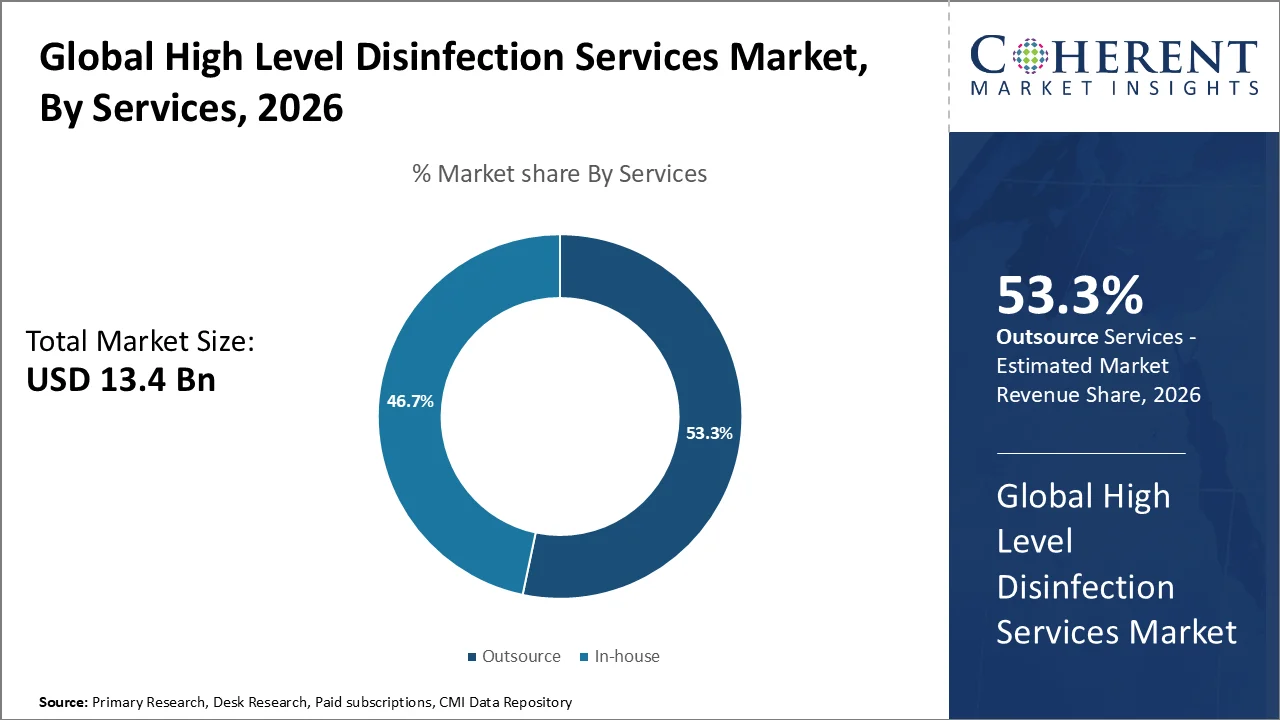
- Outsource hold the largest market share of 53.3% in 2026 owing to its cost efficiency & resource optimization. Outsourcing hospital disinfection and environmental services (EVS) can help reduce Hospital-Acquired Infection (HAI) rates through standardized cleaning protocols, automated compliance monitoring, and consistent performance tracking.
- Formaldehyde expected to hold the largest market share of 39.8% in 2026 owing to the strong broad-spectrum efficacy. According to the Centers for Disease Control and Prevention, formaldehyde is used as a high-level disinfectant and sterilant in both liquid and gaseous forms.
- Hospitals and clinics acquired the prominent market share of 41.4% in 2026 owing to its high patient volume & infection risk.
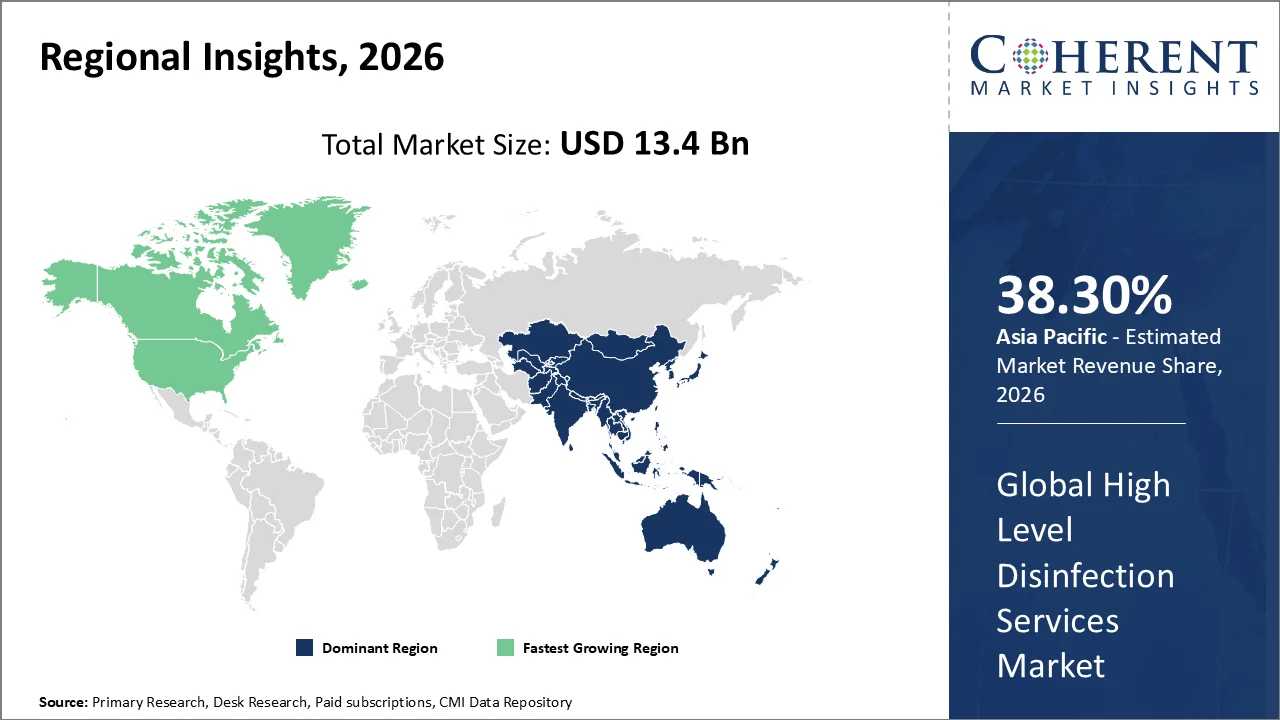
- Asia Pacific is expected to acquire the dominant share of 38.3% in 2026 owing to the rapid healthcare infrastructure expansion. India’s healthcare infrastructure spending recorded strong double-digit growth, with the Union Budget allocating about INR 98,300 crore to the health sector.
Current Events and Their Impact on the High Level Disinfection Services Market
Current Event | Description and its Impact |
FDA Reprocessing and Sterilization Oversight Tightening |
|
Healthcare-Associated Infection (HAI) Reporting Mandates |
|
Segmental Insights
- Current Industry Events of 2026
- Market Size Estimation
- Regional Breakdown
- Competitive Landscape
- Customer Intelligence
- Segmental Analysis
- Pricing Analysis
- Key Market Drivers, Challenges & Future Trends
- Customized Insights Section
Why is Outsource Acquiring the Largest Market Share?
Outsource hold the largest market share of 53.3% in 2026. Hospitals drive outsourcing in the High-Level Disinfection (HLD) services market by prioritizing cost efficiency, operational flexibility, and access to specialized expertise. They rely on third-party providers to deliver advanced disinfection technologies and maintain compliance with strict infection control regulations, which reduces the burden on in-house staff. Growing concerns about hospital-acquired infections and rising procedural volumes further push hospitals toward outsourcing. They also benefit from faster turnaround times, improved scalability, and the ability to concentrate more on core patient care activities. For instance, in April 2026, Freudenberg Medical, a global contract design and manufacturing partner for the medical device and biopharma industry, launches CleanAssure, a new ISO Class 5 controlled cleanroom. The facility produces clean and sterile single-use assemblies specifically for biopharmaceutical customers.
Formaldehyde expected to hold the largest market share
Formaldehyde expected to hold the largest market share of 39.8% in 2026 owing to the effectiveness in fumigation & large-area disinfection. Formaldehyde supports demand in the High-Level Disinfection (HLD) services market by delivering strong broad-spectrum antimicrobial efficacy, including effectiveness against spores. Healthcare facilities use it to disinfect heat-sensitive medical instruments and perform large-area fumigation. Its low cost and wide availability attract providers in resource-constrained settings. Healthcare workers continue to rely on it due to established protocols and familiarity. The European Union is the second-largest formaldehyde-producing region after Asia, with annual output exceeding 4 million tons (100% concentration), accounting for about 30% of global production. The EU market generates roughly €9.5 billion in annual sales of formaldehyde-based chemicals, with production spread across 22 of 27 member states. Within Europe, Germany is the largest producer, followed by Italy, Spain, the Netherlands, and the UK.
Which End User segment dominates the market?
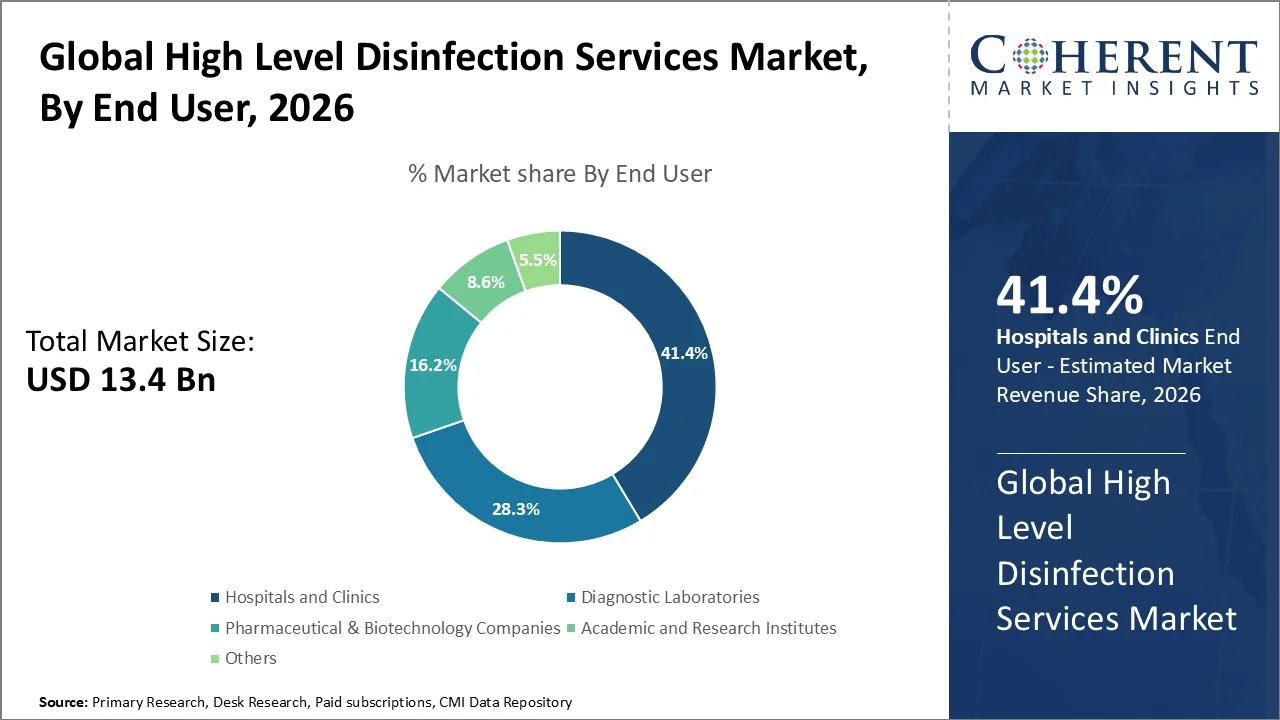
Hospitals and clinics acquired the prominent market share of 41.4% in 2026. Hospitals drive the High-Level Disinfection (HLD) services market by handling high patient volumes and actively reducing the risk of hospital-acquired infections. They frequently disinfect surgical instruments, endoscopes, and other reusable medical devices to ensure patient safety. According to the our research, the Reprocessing and Reuse of Single Use Medical Devices industry is estimated to reach USD 36.7 Bn by 2033. Strict infection control regulations and accreditation standards compel hospitals to adopt reliable HLD practices. Increasing surgical procedures, expanding healthcare infrastructure, and the need for quick equipment turnaround further boost demand. Hospitals also use these services to enhance operational efficiency and maintain high-quality care standards.
High Level Disinfection Services Market Trends
- Growth in minimally invasive procedures increases demand for device reprocessing
The World Health Organization reports that surgical procedures are increasing globally, with more than 300 million surgeries performed annually. Many involve heat-sensitive reusable devices such as endoscopes. - Post-pandemic infection control standardization
The World Health Organization introduced updated Infection Prevention and Control (IPC) guidelines during and after COVID-19, reinforcing environmental cleaning and disinfection protocols in healthcare settings. - Standardization and professional certification in healthcare environmental hygiene. The introduction of structured certification programs for healthcare cleaning and disinfection professionals reflects a broader industry move toward formalizing training and competency standards. In May 2026, the Association for Cleaning and Facility Solutions announced the launch of the ISSA Healthcare Environmental Hygiene Professional Certification, a three-tier training program aimed at standardizing environmental hygiene practices for healthcare EVS teams and professionals responsible for cleaning, disinfection, and patient care.
Regional Insights
Asia Pacific dominates owing to increasing use of advanced medical devices
Asia Pacific is expected to acquire the dominant share of 38.30% in 2026. Asia Pacific drives growth in the High-Level Disinfection (HLD) services market through rapid expansion of healthcare infrastructure, including hospitals and diagnostic centers across emerging economies. The region’s rising patient populations and increasing prevalence of chronic diseases increase the need for frequent disinfection of medical equipment. China has the world’s largest chronic kidney disease (CKD) patient population, with more than 156 million people affected. Healthcare providers strengthen infection control practices as awareness of hospital-acquired infections grows. Cost-sensitive healthcare systems encourage them to outsource disinfection services. Expanding medical tourism, urbanization, and greater adoption of advanced medical devices further boost market demand across the region. For instance, Karcher India, the Indian subsidiary of Germany-based Karcher, launches advanced cleaning solutions in India, including autonomous scrubber-dryers, cordless vacuums, and robotic vacuum cleaners. The company highlights India as a key market with strong opportunities and distinct challenges. Aligning with the growing adoption of robotics in the consumer segment, Karcher also introduces robotic vacuum models RCV3 and RCV5 to expand its automated cleaning portfolio.
North America High Level Disinfection Services Market Trends
Key drivers of the North America high level disinfection services market include the rising prevalence of hospital acquired infections, increasing focus on infection prevention protocols, and a strong healthcare infrastructure. Healthcare providers perform more surgical procedures, expand outpatient care facilities, and serve a growing aging population that requires frequent medical attention, which drives demand. Regulatory bodies enforce strict guidelines and accreditation standards that push adoption of advanced disinfection services. Technological advancements in automated disinfection systems and growing awareness among healthcare providers further strengthen market growth across hospital facilities. For instance, Cleaning 365 Services launched performance-driven commercial cleaning programs for businesses across Canada and the United States. The company operates under ISO 9001, UL ECOLOGO, GREENGUARD, WSIB, IPC, and WBE certifications and maintains a 95% client retention rate by delivering structured, operational commercial cleaning services in Canada rather than acting as a transactional vendor.
China High Level Disinfection Services Market Trends
China drives growth in the high-level disinfection services market by expanding its healthcare infrastructure and increasing hospital admissions. Rising awareness of hospital-acquired infections pushes healthcare providers to adopt stronger sterilization practices. The country’s aging population and higher number of surgical procedures increase demand for advanced disinfection solutions. Government regulations actively enforce strict hospital hygiene and infection control standards.
United States High Level Disinfection Services Market Trends
Rising healthcare-associated infections, increasing hospital admissions, and strict infection control regulations drive the United States high-level disinfection services market. Healthcare providers increasingly prioritize patient safety and demand sterile medical environments, which strengthens service adoption. The expansion of outpatient facilities, surgical centers, and diagnostic laboratories further accelerates demand. Technological advancements in disinfection equipment and the growing trend of outsourcing healthcare cleaning services also support market growth across hospitals and clinics, particularly in urban areas throughout the country. For instance, in February 2026, UV Smart, a Netherlands-based MedTech company, secures FDA 510(k) clearance and launched its UV-C technology in the United States for high-level disinfection of TEE probes. The company introduces the D60, the first UV-C high-level disinfection device globally approved by the FDA for this application.
Who are the Major Companies in High Level Disinfection Services Industry
Some of the major key players in High Level Disinfection Services are STERIS, Microchem Laboratory, EcoFMR.Com, Altapure, Metrex Research, LLC, Rentokil Initial plc, and Advance Sterilization Products (ASP).
Key News
- In November 2025, Parker Laboratories, a leading medical ultrasound product manufacturer, highlights that the American Institute of Ultrasound in Medicine (AIUM) updates its guidelines for ultrasound probe handling in healthcare settings and, for the first time, includes chlorine dioxide as an option for high-level disinfection reprocessing.
Market Report Scope
High Level Disinfection Services Market Report Coverage
| Report Coverage | Details | ||
|---|---|---|---|
| Base Year: | 2025 | Market Size in 2026: | USD 13.4 Bn |
| Historical Data for: | 2020 To 2024 | Forecast Period: | 2026 To 2033 |
| Forecast Period 2026 to 2033 CAGR: | 9.2% | 2033 Value Projection: | USD 21.8 Bn |
| Geographies covered: |
| ||
| Segments covered: |
| ||
| Companies covered: | STERIS, Microchem Laboratory, EcoFMR.Com, Altapure, Metrex Research, LLC, Rentokil Initial plc, and Advance Sterilization Products (ASP). | ||
Analyst Opinion
- High-level disinfection services in healthcare are not expanding due to operational optimization alone but because infection risk in clinical environments is structurally unavoidable. The World Health Organization estimates that hundreds of millions of patients are affected by healthcare-associated infections each year, with a significant share occurring in acute care settings where reusable medical devices are frequently used. This creates a non-negotiable requirement for high-level disinfection, particularly for semi-critical instruments used in endoscopy, gynecology, and respiratory care.
- Endoscopy services alone illustrate this dependency clearly, with more than 20 million gastrointestinal endoscopic procedures performed annually in the United States, all requiring strict reprocessing protocols for scopes that cannot be fully sterilized using conventional methods. Any lapse in high-level disinfection in such high-volume workflows immediately translates into outbreak risk, which hospitals cannot afford operationally or reputationally.
- The increasing complexity of reusable medical devices is also intensifying reliance on advanced disinfection systems. Flexible endoscopes, for instance, contain intricate channels that are difficult to clean manually, leading to documented contamination risks even after standard cleaning cycles. This has pushed hospitals toward automated high-level disinfection systems and outsourced reprocessing models, especially in large hospital networks handling high procedural loads.
- In my view, the most decisive driver is not regulation alone but the compounding effect of procedural scale and device complexity. As outpatient surgical volumes continue to rise and minimally invasive procedures dominate clinical practice, healthcare facilities are structurally locked into high-level disinfection as a mandatory safety infrastructure rather than an optional service layer.
Speak to the analyst
Want personalized insights?
Take the findings above to one of our principal consultants, or have the report rebuilt around the segments, geographies and competitors you actually track.
Market Segmentation
- By Services (Revenue, USD Bn, 2021-2033)
- In-house
- Outsource
- By Compound (Revenue, USD Bn, 2021-2033)
- Formaldehyde
- Glutaraldehyde
- Ortho-pnthalaldehyde
- Hydrogen Peroxide
- Peracetic Acid
- Others
- By End User (Revenue, USD Bn, 2021-2033)
- Hospitals and Clinics
- Diagnostic Laboratories
- Pharmaceutical & Biotechnology Companies
- Academic and Research Institutes
- Others
- By Region (Revenue, USD Bn, 2021-2033)
- North America
- U.S.
- Canada
- Latin America
- Brazil
- Mexico
- Argentina
- Rest of Latin America
- Europe
- Germany
- U.K.
- France
- Italy
- Spain
- Russia
- Rest of Europe
- Asia Pacific
- China
- India
- Japan
- Australia
- South Korea
- ASEAN
- Rest of Asia Pacific
- Middle East
- GCC
- Israel
- Rest of Middle East
- Africa
- South Africa
- Central Africa
- North Africa
- North America
- Key Players
- STERIS
- Microchem Laboratory
- EcoFMR.Com
- Altapure
- Metrex Research, LLC
- Rentokil Initial plc
- Advance Sterilization Products (ASP).
Sources
Primary Research interviews
- Interviews with hospital infection control specialists, biomedical engineers, and endoscopy unit managers
- Discussions with CSSD (Central Sterile Services Department) technicians and healthcare procurement heads
- Inputs from clinical practitioners involved in minimally invasive and diagnostic procedures
Databases
- National health statistics repositories and hospital procedure databases
- WHO Global Health Observatory datasets
- CDC infection prevention and healthcare-associated infection tracking resources
- PubMed indexed clinical and biomedical device utilization datasets
Magazines
- Healthcare and hospital management trade magazines
- Medical device and surgical technology publications
- Infection prevention and sterile processing-focused industry magazines
Journals
- Journal of Hospital Infection
- American Journal of Infection Control
- Infection Control & Hospital Epidemiology
- Clinical Endoscopy and related procedural journals
Newspapers
- Financial and healthcare sections of leading national newspapers
- Medical innovation and hospital infrastructure coverage in major dailies
- Health policy reporting in established press outlets
Associations
- Association for the Advancement of Medical Instrumentation (AAMI)
- World Health Organization (WHO) infection prevention programs
- Centers for Disease Control and Prevention (CDC) guidelines and advisory bodies
- Society of Gastroenterology Nurses and Associates (SGNA)
Public Domain sources
- Government healthcare portals and regulatory infection control guidelines
- Hospital accreditation standards and sterilization protocols
- Public health surveillance reports and infection outbreak data
Proprietary Elements
- CMI Data Analytics Tool
- Proprietary CMI Existing Repository of information for last 10 years
Get access to 250+ pages report
Every segment, forecast, competitor profile and data table behind the analysis above — available for instant download.
- ESOMAR Member
- ISO 9001:2015 Certified
- D-U-N-S Registered
- GDPR & CCPA Compliant
Missing comfort of reading report in your local language? Find your preferred language:
Transform your Strategy with Exclusive Trending Reports
Frequently Asked Questions
The High Level Disinfection Services Market is anticipated to grow at a CAGR of 9.2% with USD 13.4 Bn share in 2026 and is expected to reach USD 21.8 Bn in 2033.
The market is estimated to be valued at USD 13.4 Bn in 2026.
STERIS, Microchem Laboratory, EcoFMR.Com, Altapure, Metrex Research, LLC, Rentokil Initial plc, and Advance Sterilization Products (ASP), are some of the prominent players operating in the market over the forecast period.
The market is expected to be valued at USD 21.8 Bn in 2033.
Outsource is the mostly used service in the market.
Asia Pacific is the prominent region in the market.