

Reprocessing And Reuse of Single Use Medical Devices Market Size and Forecast: 2026-2033
The Reprocessing and Reuse of Single Use Medical Devices Market is estimated to be valued at USD 24.8 Bn in 2026 and is expected to reach USD 36.7 Bn by 2033, exhibiting a compound annual growth rate (CAGR) of 11.3% from 2026 to 2033.
Key Takeaways
- By Product Type, Class II hold the largest market share of 52.3% in 2026 owing to the higher reprocessing potential & cost savings.
- By Application, Cardiology expected to hold largest market share of 35.6% in 2026 owing to its high cost of cardiology consumables.
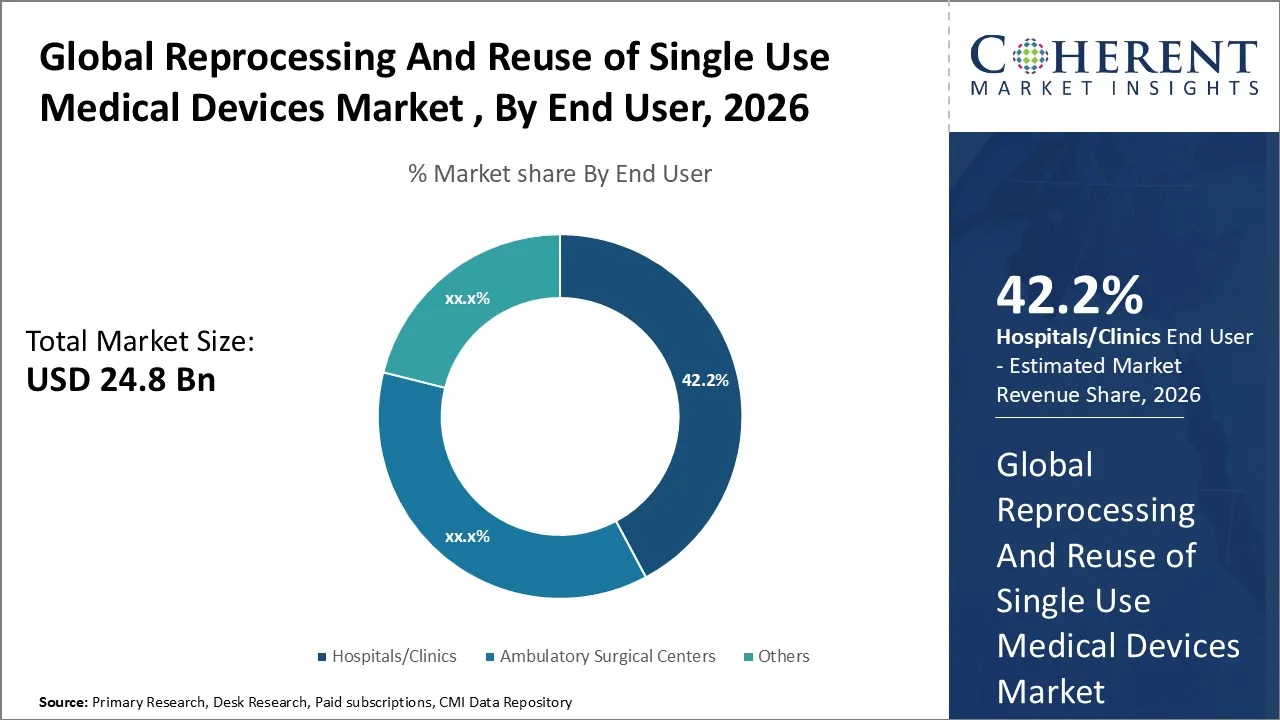
- By End User, Hospitals/Clinics acquired the prominent market share of 42.2% in 2026 owing to the cost reduction and budget optimization.
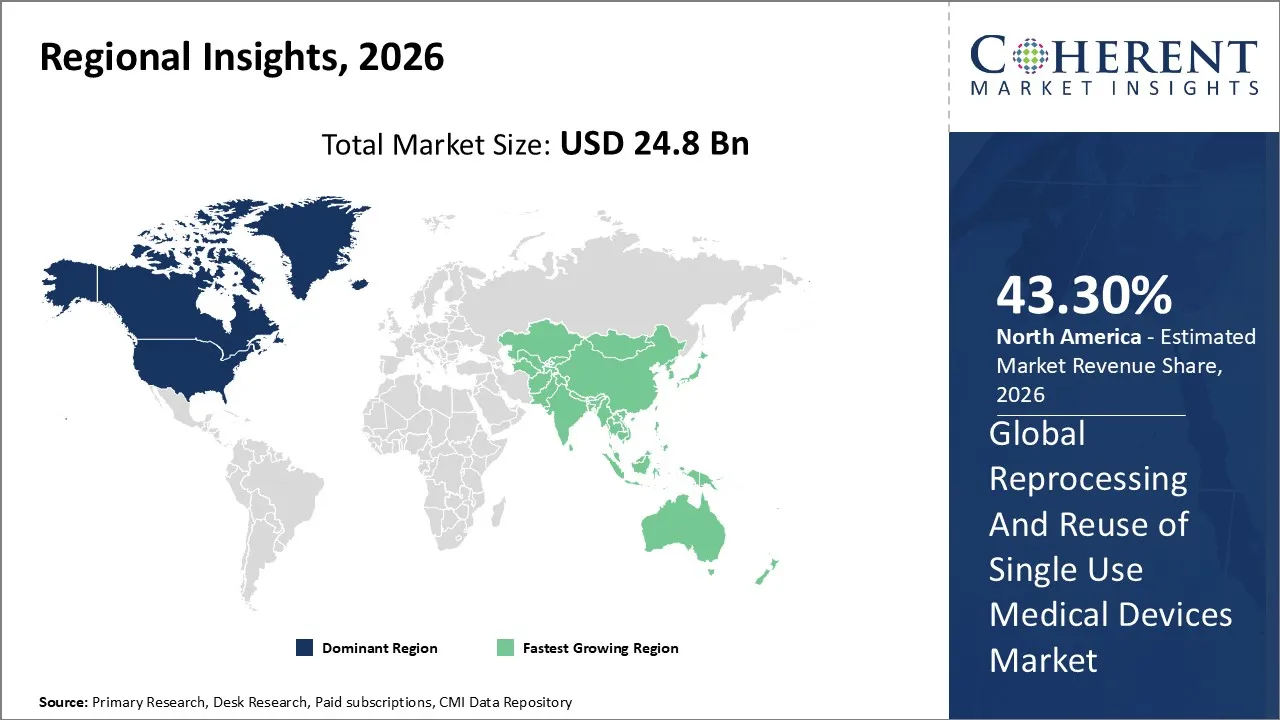
- By Region, North America dominates the overall market with an estimated share of 43.3% in 2026 owing to the strong cost-containment pressure in healthcare.
Market Overview
The Reprocessing and Reuse of Single-Use Medical Devices Market involves organizations collecting, cleaning, sterilizing, testing, and re-certifying devices originally labeled for single use to enable their safe reuse. Rising healthcare costs, increasing surgical procedures, and stronger sustainability goals drive market growth. Hospitals and ambulatory surgical centers actively adopt reprocessed devices, supported by stringent regulatory frameworks and advanced sterilization technologies. North America drives adoption, while Europe and Asia-Pacific expand their presence by prioritizing cost efficiency and environmental sustainability initiatives.
Current Events and their Impact on the Reprocessing and Reuse of Single Use Medical Devices Market
Current Events | Description and its impact |
Regulatory Changes in Key Regions |
|
Technological Advancements in Sterilization and Tracking |
|
Public Health Trends and Infection Control Priorities |
|
Segmental Insights
- Current Industry Events of 2026
- Market Size Estimation
- Regional Breakdown
- Competitive Landscape
- Customer Intelligence
- Segmental Analysis
- Pricing Analysis
- Key Market Drivers, Challenges & Future Trends
- Customized Insights Section
Reprocessing And Reuse of Single Use Medical Devices Market Insights, By End User - Hospital/clinics contribute the highest share of the market owing to its cost reduction and budget optimization
Hospitals/Clinics acquired the prominent market share of 42.2% in 2026. Hospitals and clinics actively fuel the growth of the Reprocessing and Reuse of Single-Use Medical Devices Market by adopting reprocessed instruments to control healthcare costs and enhance operational efficiency. High patient volumes and frequent surgeries generate steady demand for reusable devices. Established sterile processing departments and partnerships with certified third-party reprocessors allow healthcare facilities to reuse devices safely and reliably. Furthermore, sustainability initiatives and strict regulatory compliance motivate hospitals and clinics to implement reprocessing programs, cut medical waste, and deliver cost-effective, high-quality patient care.
Reprocessing And Reuse of Single Use Medical Devices Market Insights, By Product Type - Class II contribute the highest share of the market owing to its technological & sterilization advances
Class II hold the largest market share of 52.3% in 2026. Class II devices significantly propel the Reprocessing and Reuse of Single-Use Medical Devices Market because healthcare providers widely use them in complex procedures and purchase them at relatively high costs. Hospitals actively reprocess these moderate-risk devices to lower procurement spending while maintaining strong clinical performance. Advanced cleaning validation and functional testing technologies enable safe and reliable reuse. Clear regulatory guidelines and structured approval pathways further motivate healthcare facilities to incorporate Class II device reprocessing into their standard operational practices. For instance, in June 2025, Cardinal Health launched a U.S. multi-parameter monitoring system that continuously tracks cardiac activity, blood oxygen, and temperature through a single patient-use cable and lead wire.
Reprocessing And Reuse of Single Use Medical Devices Market Insights, By Application - Cardiology contributes the highest share of the market owing to its established clinical safety evidence
Cardiology expected to hold largest market share of 35.6% in 2026. Cardiology strongly propels the Reprocessing and Reuse of Single-Use Medical Devices Market as healthcare providers perform a high number of interventional procedures and rely heavily on advanced disposable devices such as electrophysiology catheters and diagnostic mapping tools. The rising prevalence of cardiovascular diseases pushes hospitals to seek cost-effective treatment options, leading them to adopt reprocessed devices. Robust quality assurance measures and demonstrated clinical effectiveness build physician trust. Efforts to control catheterization lab costs and minimize procedural waste further drive reprocessing adoption in cardiology units.
Regional Insights
North America Reprocessing And Reuse of Single Use Medical Devices Market Trends
North America dominates the overall market with an estimated share of 43.3% in 2026. In North America, hospitals and surgical centers actively drive the Reprocessing and Reuse of Single-Use Medical Devices Market by adopting cost-saving strategies and reprocessing high-value devices to control budgets and minimize waste. Providers leverage advanced sterilization technologies, regulatory guidance, and established third-party reprocessing services to ensure safe and efficient operations. Sustainability efforts and environmental regulations further motivate healthcare facilities to implement reuse programs, while growing procedural volumes and ongoing technological innovations continue to expand the market throughout the United States and Canada. For instance, in May 2024, Cook Medical launched its Ascend Single-Use Flexible Ureteroscope in the U.S. and Canada, expanding its stone management offerings for urology customers.
Asia Pacific Reprocessing And Reuse of Single Use Medical Devices Market Trends
Hospitals and clinics in the Asia Pacific region actively drive the growth of the Reprocessing and Reuse of Single-Use Medical Devices Market by adopting cost-effective solutions to address increasing healthcare demands. Providers respond to rising medical waste and growing sustainability awareness by implementing reprocessing programs. They invest in advanced sterilization technologies and collaborate with certified reprocessing partners to ensure device safety and reliability. Expanding surgical volumes, higher chronic disease rates, and strengthening regulatory frameworks further propel market growth across countries including China, India, Japan, and Australia.
United States Reprocessing And Reuse of Single Use Medical Devices Market Trends
Hospitals and surgical centers in the United States actively drive the growth of the Reprocessing and Reuse of Single-Use Medical Devices Market by adopting cost-saving strategies to manage high healthcare expenditures. Providers reprocess high-value devices to lower procurement costs while maintaining safety and performance standards. They rely on advanced sterilization technologies, strict FDA regulations, and extensive third-party reprocessing services to ensure reliable reuse. A stronger focus on sustainability and waste reduction, along with increasing procedural volumes and technological advancements, further propels market expansion across healthcare facilities nationwide. For instance, in December 2025, Edgewell Personal Care launched the Schick and Skintimate Free Recycling Program with TerraCycle, letting U.S. consumers recycle all disposable razors.
China Reprocessing And Reuse of Single Use Medical Devices Market Trends
Hospitals and clinics across China actively drive the growth of the Reprocessing and Reuse of Single-Use Medical Devices Market by adopting cost-effective strategies to manage increasing patient volumes and rising healthcare needs. Providers implement reprocessing programs to lower procurement costs while maintaining device safety and performance. They invest in advanced sterilization technologies and work closely with certified reprocessing partners to ensure reliability. Government initiatives promoting environmental sustainability, tighter regulatory oversight, and expanding surgical procedures further accelerate the adoption of reprocessed devices in both urban and regional healthcare facilities.
End-user Feedback and Unmet Needs in the Reprocessing And Reuse of Single Use Medical Devices Market
- Device Performance and Reliability: End users emphasize consistent device functionality after reprocessing, noting occasional concerns with durability or material integrity. Hospitals and clinics seek validated processes that ensure reprocessed devices perform identically to new ones, particularly for high-risk procedures, where failure could compromise patient safety and clinical outcomes.
- Sterilization and Infection Control Confidence: Healthcare providers require robust sterilization protocols and verification systems. Some end users remain cautious about microbial safety, highlighting the need for advanced cleaning technologies, real-time validation, and regulatory-compliant procedures to build trust and broaden adoption across departments.
- Operational Integration and Workflow Efficiency: Clinicians and sterile processing teams report challenges in integrating reprocessing into existing workflows. End users need streamlined processes, clear device tracking, and training programs that minimize additional labor and prevent delays, ensuring reprocessed devices are ready when and where needed.
Reprocessing And Reuse of Single Use Medical Devices Market Trend
Rising Adoption Across Hospitals and Surgical Centers
Healthcare facilities increasingly integrate reprocessing programs to manage costs and optimize device utilization. High-value single-use devices, such as catheters and endoscopes, are prioritized for reuse. Hospitals leverage both in-house sterile processing departments and third-party certified reprocessors to maintain safety and efficiency. The trend reflects a shift toward operational cost management, improved workflow efficiency, and sustainable practices, making reprocessing a routine part of hospital procurement strategies while ensuring consistent clinical performance and reliability.
Technological Advancements in Sterilization and Validation
Innovations in sterilization technologies, including automated cleaning systems, advanced sterilizers, and functional testing, enhance the safety and reliability of reprocessed devices. Real-time validation, device tracking, and analytics tools allow healthcare providers to monitor performance and compliance. These technological improvements reduce infection risks and support regulatory requirements, enabling broader adoption of reprocessing programs across clinical departments. Providers increasingly rely on these tools to ensure device functionality and patient safety while minimizing operational bottlenecks.
Reprocessing And Reuse of Single Use Medical Devices Market Opportunity
Cost Optimization for Healthcare Providers
Reprocessing high-value single-use devices offers hospitals and clinics a strategic opportunity to reduce procurement costs while maintaining clinical outcomes. Facilities can reinvest the savings into expanding services or upgrading infrastructure. End users can implement standardized reprocessing programs and leverage third-party certified providers, ensuring safety and reliability. This opportunity is particularly significant for departments with high procedural volumes, such as cardiology and gastroenterology, where device reuse directly impacts operational efficiency and budget management.
Market Report Scope
Reprocessing And Reuse of Single Use Medical Devices Market Report Coverage
| Report Coverage | Details | ||
|---|---|---|---|
| Base Year: | 2025 | Market Size in 2026: | USD 24.8 Bn |
| Historical Data for: | 2020 To 2024 | Forecast Period: | 2026 To 2033 |
| Forecast Period 2026 to 2033 CAGR: | 11.3% | 2033 Value Projection: | USD 36.7 Bn |
| Geographies covered: |
| ||
| Segments covered: |
| ||
| Companies covered: | Stryker Corporation, Medline Industries, Inc., Suretek Medical, Renu Medical Inc., Johnson & Johnson, Northeast Scientific Inc., Medtronic Plc, Steripro Canada, Vanguard AG, Innovative Health, Verathon Inc., and Hogy Medical Co., Ltd. | ||
| Growth Drivers: |
| ||
| Restraints & Challenges: |
| ||
Reprocessing And Reuse of Single Use Medical Devices Market News
- In July 2025, Daewoong Pharmaceutical launched MobiCARE Refresh, a reusable version of its wearable ECG device developed with Sheerst Technology, promoting sustainable healthcare through a circular model that integrates digital health and ESG principles.
- In September 2025, PENTAX Medical, with Advanced Sterilization Products, launched the Sterilizable DEC Duodenoscope in the U.S., offering predictable handling and full sterilization in 68 minutes using the STERRAD System.
Analyst Opinion (Expert Opinion)
- The Reprocessing and Reuse of Single‑Use Medical Devices Market reflects a mature but still evolving paradigm in healthcare operations, where cost pressures, sustainability imperatives, and regulatory oversight intersect in complex ways. Reprocessed devices are not a theoretical construct — regulated reprocessors in the United States alone have handled tens of millions of device cycles with safety records comparable to original manufacturers’ products, demonstrating that rigorous cleaning and functional testing can uphold clinical standards without compromising patient safety.
- Economic rationale remains compelling: reprocessed SUDs typically cost a fraction of new units, and industry data indicate that hospitals adopting comprehensive programs can save hundreds of millions annually in device costs and waste disposal, illustrating the tangible financial leverage these practices can deliver to strained healthcare budgets.
- By design, many SUDs are labeled “single use” because original manufacturers have not conducted reuse validation, and significant portions of devices — particularly those with narrow lumens, delicate coatings or complex mechanisms — remain unsuitable for safe reprocessing without advanced validation. Thus, while technological advances and FDA‑aligned regulatory frameworks provide a structured pathway for expanded reuse, they also underline that reprocessing must be evidence‑based, device‑ specific, and integrated with robust quality systems.
Speak to the analyst
Want personalized insights?
Take the findings above to one of our principal consultants, or have the report rebuilt around the segments, geographies and competitors you actually track.
Market Segmentation
- By Product Type
- Class I
- Tourniquet Cuffs
- Pulse Oximeters Sensors
- Sequential Compression Sleeves
- Others
- Class II
- Endoscope
- Diagnostic Ultrasound Catheter
- Laparoscope
- Trocar
- Others
- Class I
- By Application
- Cardiology
- Gastroenterology
- Orthopedic
- General Surgery
- Others
- By End User
- Hospitals/Clinics
- Ambulatory Surgical Centers
- Others
- By Regional Insights
- North America
- U.S.
- Canada
- Latin America
- Brazil
- Argentina
- Mexico
- Rest of Latin America
- Europe
- Germany
- U.K.
- Spain
- France
- Italy
- Russia
- Rest of Europe
- Asia Pacific
- China
- India
- Japan
- Australia
- South Korea
- ASEAN
- Rest of Asia Pacific
- Middle East
- GCC Countries
- Israel
- Rest of Middle East
- Africa
- South Africa
- North Africa
- Central Africa
- North America
- Key Players Insights
- Stryker Corporation
- Medline Industries, Inc.
- Suretek Medical
- Renu Medical Inc.
- Johnson & Johnson
- Northeast Scientific Inc.
- Medtronic Plc
- Steripro Canada
- Vanguard AG
- Innovative Health
- Verathon Inc.
- Hogy Medical Co., Ltd.
Sources
Primary Research interviews
- Hospital procurement managers
- Sterilization and infection control specialists
- Biomedical engineers in healthcare facilities
- Clinical staff and surgeons using single-use devices
- Regulatory and compliance officers
Databases
- PubMed
- ClinicalTrials.gov
- FDA Device Database
- WHO Global Health Observatory
- National Health Service (NHS) data repositories
Magazines
- Medical Device and Diagnostic Industry (MD+DI)
- Healthcare Purchasing News
- Infection Control Today
- Biomedical Instrumentation & Technology
Journals
- Journal of Hospital Infection
- American Journal of Infection Control
- Medical Device Technology Journal
- International Journal of Medical Engineering and Informatics
- BMJ Open
Newspapers
- The New York Times – Health Section
- The Guardian – Health
- The Wall Street Journal – Health & Technology
Associations
- Association for the Advancement of Medical Instrumentation (AAMI)
- International Federation of Infection Control (IFIC)
- Healthcare Sterile Processing Association (HSPA)
- World Health Organization (WHO)
Public Domain sources
- FDA guidance documents
- CDC guidelines on infection prevention
- WHO reports on medical device safety
- Government healthcare portals (e.g., NHS, HHS)
Proprietary Elements
- CMI Data Analytics Tool
- Proprietary CMI Existing Repository of information for last 8 years
Get access to 250+ pages report
Every segment, forecast, competitor profile and data table behind the analysis above — available for instant download.
- ESOMAR Member
- ISO 9001:2015 Certified
- D-U-N-S Registered
- GDPR & CCPA Compliant
Missing comfort of reading report in your local language? Find your preferred language:
Transform your Strategy with Exclusive Trending Reports
Frequently Asked Questions
The Reprocessing and Reuse of Single Use Medical Devices Market is estimated to be valued at USD 24.8 Bn in 2026 and is expected to reach USD 36.7 Bn by 2033.
The market is expected to exhibit a CAGR of 11.3% during the forecast period.
The market is estimated to be valued at USD 24.8 Bn in 2026.
Stryker Corporation, Medline Industries, Inc., Suretek Medical, Renu Medical Inc., Johnson & Johnson, Northeast Scientific Inc., Medtronic Plc, Steripro Canada, Vanguard AG, Innovative Health, Verathon Inc., and Hogy Medical Co., Ltd. are some of the prominent players operating in the market.
The market is expected to be valued at USD 36.7 Bn in 2033.
North America is the prominent region in the market.
Increasing focus on reducing medical waste and cost savings associated with reprocessing single use medical devices, are expected to drive growth of the market.